India-Japan Strategic Partnership: Indo-Pacific Timeline
Explore the India-Japan strategic partnership timeline, from 1952 diplomatic ties to 2026 defence cooperation, Quad and Indo-Pacific security.
Latest Story
The India-Japan strategic partnership has grown from a 1952 peace treaty and yen loans into cooperation on defence technology, maritime security, high-speed rail, critical minerals and the Quad. The latest step came on 19 November 2026, when the fourth 2+2 meeting in Tokyo moved towards Japanese forces using an Indian firing range. This timeline traces how the two countries got here, and what it does and does not mean.
The firing-range plan is intent, not a completed exercise. Japan’s defence minister said both sides are accelerating adjustments for Japanese forces to use an Indian range within the next year. We could not open the joint statement and did not find a Letter of Intent in the reports we could read. This is a partnership, not an alliance. India and Japan have no mutual-defence treaty and keep independent foreign policies.
💡 Short Answer
The India-Japan Special Strategic and Global Partnership is a deep but non-treaty relationship. Diplomatic ties date from 28 April 1952, and the partnership was upgraded in 2000, 2006 and 2014. It now spans a 2020 logistics agreement, the UNICORN naval mast pact of 2024, a 2025 security declaration, a July 2026 economic security declaration and the November 2026 Tokyo 2+2. Both back a free and open Indo-Pacific.
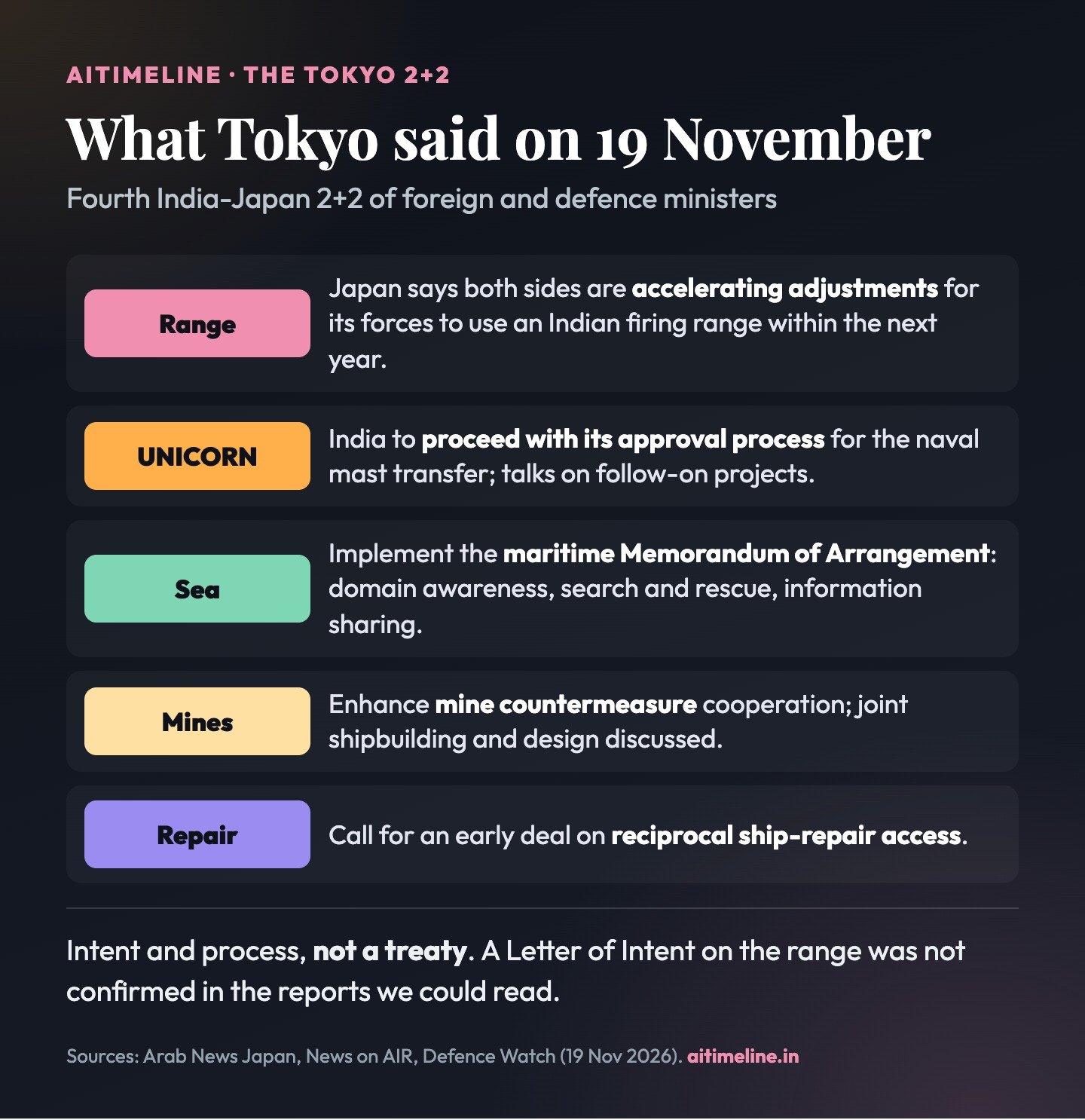
What Tokyo Agreed on 19 November 2026
The fourth 2+2 of foreign and defence ministers.
India-Japan Strategic Partnership: Key Questions
From Economic Friendship to Strategic Convergence
- Ties began in 1952: India signed a separate peace treaty rather than join the San Francisco conference.
- Three upgrades: Global Partnership in 2000, Strategic and Global in 2006, Special Strategic and Global in 2014.
- Defence is now practical: ACSA in 2020, UNICORN in 2024, first Japanese fighters in India in 2026.
- Economic security is central: the July 2026 declaration covers chips, minerals, clean energy and pharmaceuticals.
- The firing-range plan is still intent: Japan says adjustments are being accelerated for use within the next year.
- Not an alliance: no mutual-defence treaty, and different approaches to China.
Timeline: India-Japan Strategic Partnership, 1952 to 2026
Newest first. Labels mark foundations, security, agreements, economy and summits.
Fourth 2+2 in Tokyo: ranges, ships and UNICORN Security
What was said: Japan’s Defence Minister Shinjiro Koizumi said the two sides are accelerating adjustments for Japan’s Self-Defense Forces to use an Indian firing range within the next year, after the success of the Veer Guardian air exercise. This is an intention under discussion, not a completed exercise. We could not open the joint statement and did not find a Letter of Intent in the reports we could read.
Maritime and industry: The ministers agreed to implement the Memorandum of Arrangement on maritime security through maritime and air domain awareness, search and rescue and information sharing. They agreed to enhance cooperation on mine countermeasures, called for an early agreement on reciprocal access to ship-repair facilities, and discussed joint naval shipbuilding and design.
UNICORN: Reports say India will proceed with its domestic approval process for the transfer of UNICORN equipment and the two sides will begin discussing follow-on projects. We found no confirmed date for that approval.
Third India-Japan Defence Industry Forum Agreement
What happened: Defence industry representatives met in Tokyo for the third forum. Reports differ on the exact date, giving 13 October and 30 October, so this article says only October 2026.
Why it matters: The forum is where equipment and technology projects such as UNICORN find industrial partners. India describes its aim as Design with Japan, Make in India.
Veer Guardian 26: Japanese fighters in India Security
The exercise: Japan’s Air Self-Defense Force deployed fighters to India for the first time for Veer Guardian 26 at Jodhpur. Sources give the end date as 21 or 22 September. The first edition was held at Hyakuri Air Base in Japan in January 2023.
The follow-up: At the November 2+2, Koizumi tied the plan for an Indian firing range to the success of this exercise.
16th Annual Summit: Takaichi in New Delhi Summit
Outcomes: Modi and Takaichi adopted the Joint Declaration on Economic Security Cooperation, covering semiconductors, critical minerals, ICT, clean energy and pharmaceuticals. Separate statements covered artificial intelligence and energy resilience, and reports count 16 formal outcomes.
Investment: Reports say the leaders will work towards the 10 trillion yen investment target set in 2025. Figures for new company pledges vary between sources, so we do not quote one.
First India-Japan-Indonesia naval PASSEX Security
What happened: Japan’s Maritime Staff Office announced a trilateral passing exercise with the Indian and Indonesian navies on 16 February 2026. The defence ministers later described it as the first such trilateral exercise.
Why it matters: It extends bilateral naval cooperation to a third Indo-Pacific partner without creating a new alliance.
15th Annual Summit: Joint Vision and a new security declaration Summit
What they adopted: The leaders adopted the India-Japan Joint Vision for the Next Decade and a new Joint Declaration on Security Cooperation, updating the 2008 text.
Investment: They set a target of 10 trillion yen of Japanese private investment and financing for India over the following decade, building on the 5 trillion yen goal of 2022.
UNICORN: the first defence technology pact Agreement
The deal: India and Japan signed a Memorandum of Implementation for the Unified Complex Radio Antenna, or UNICORN, a mast that integrates antennas to reduce a ship’s radar signature. It is fitted on Japan’s Mogami-class frigates.
Different readings: India describes the deal as co-development for Indian Navy ships, while Japanese accounts describe an export of the system. It provides for a certain level of design cooperation on mast-ship integration, not a full warship redesign.
Third 2+2 in New Delhi Security
What happened: The foreign and defence ministers met in New Delhi to coordinate security priorities, in the year the two countries marked a decade of the Special Strategic and Global Partnership.
Kishida’s Indo-Pacific plan and the Hiroshima meeting Summit
March 2023: Kishida visited India and set out Japan’s updated Free and Open Indo-Pacific plan, calling India an indispensable partner.
May 2023: Modi visited Hiroshima for the G7 summit and held talks with Kishida. A bust of Mahatma Gandhi was unveiled near the Peace Memorial Park.
14th Summit: a 5 trillion yen ambition Economy
The target: The leaders aimed to realise 5 trillion yen of public and private Japanese investment and financing in India over five years.
Beyond money: They also advanced cooperation on clean energy, industrial competitiveness and infrastructure.
ACSA: reciprocal logistics for the armed forces Security
What it does: The agreement lets the two armed forces provide each other with supplies and services during exercises, training, humanitarian assistance and other agreed activities.
Timeline: It was signed on 9 September 2020 and entered into force on 11 July 2021.
Civil nuclear cooperation agreement Agreement
Why it was significant: Japan is the only country to have suffered atomic bomb attacks in wartime. The agreement allows cooperation in peaceful nuclear energy subject to safeguards and other conditions.
Vision 2025 and the bullet train Economy
The vision: The leaders adopted Japan-India Vision 2025 and advanced the Mumbai-Ahmedabad high-speed rail project, using Japanese Shinkansen technology and financial assistance.
The delay: Reports in 2026 differ on timing. One source says only the Surat-Bilimora section is aimed for August 2027 and full service has slipped to 2029 or later. We could not confirm this with an official statement.
Special Strategic and Global Partnership Summit
The upgrade: Narendra Modi visited Japan and the two leaders upgraded ties to a Special Strategic and Global Partnership.
CEPA enters into force Economy
What it covers: The agreement covers trade in goods and services, investment, movement of professionals and intellectual property, and aims to reduce tariffs on a large share of bilateral trade.
Joint Declaration on Security Cooperation Security
What it set up: The declaration created a framework for defence dialogue, maritime security, counterterrorism and regional stability.
Abe’s Confluence of Two Seas speech Foundation
The idea: Abe told Parliament that the Pacific and Indian Oceans were joining as seas of freedom and prosperity, an idea that fed the later Indo-Pacific concept.
From Global Partnership to Strategic and Global Partnership Foundation
Steps: In August 2000 Prime Ministers Mori and Vajpayee agreed a Global Partnership. In April 2005 the two countries began regular annual summits after Koizumi’s visit. In December 2006, during Manmohan Singh’s visit, ties became a Strategic and Global Partnership.
A separate peace and the first yen loan Foundation
The treaty: India did not join the 1951 San Francisco Peace Conference and signed a separate peace treaty with Japan on 28 April 1952, establishing diplomatic relations.
First ties: Prime Minister Nobusuke Kishi visited India in 1957. In 1958 Japan extended its first yen loan to India, starting a long development-cooperation relationship.
Older roots: Buddhism links the societies. The Indian monk Bodhisena took part in the consecration of the Great Buddha at Todaiji in Nara in 752.
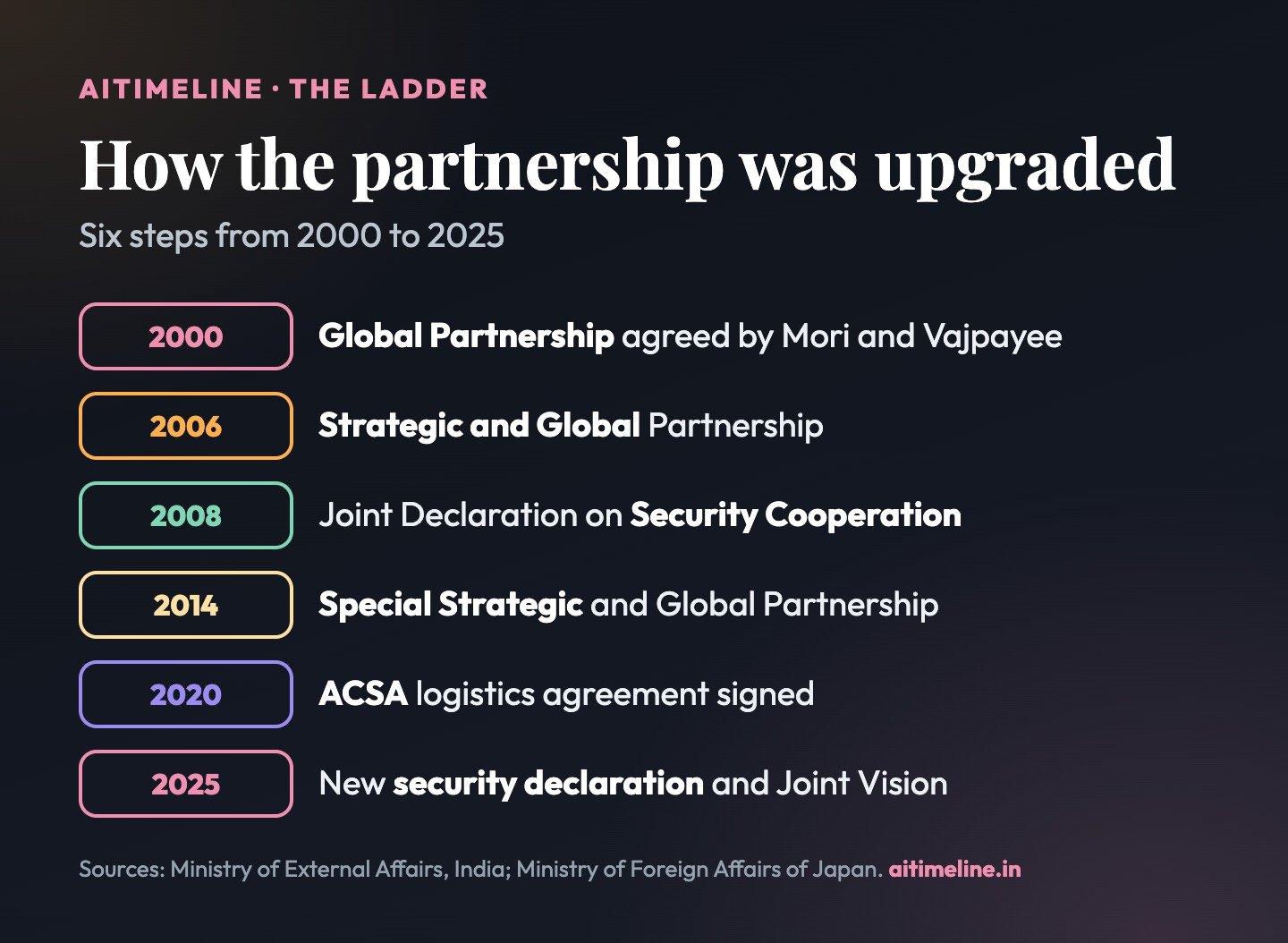
How the Partnership Was Upgraded
Each step raised the level of political contact.
The Five Pillars of Cooperation
Where the relationship is concentrated.
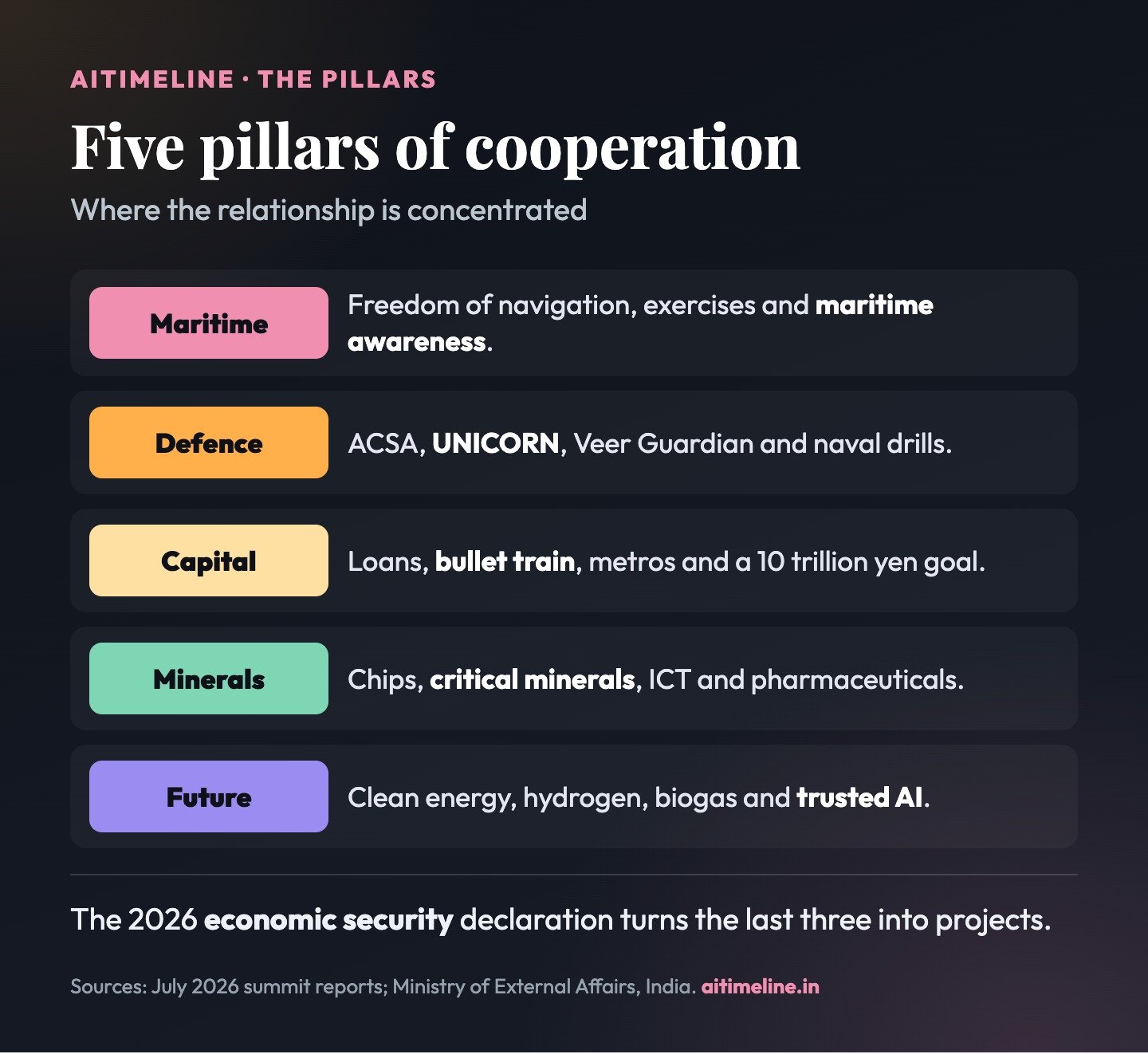
Maritime security. Japan depends on sea routes across the Indian and Pacific Oceans, and India is a major Indian Ocean power. Both support freedom of navigation and international law. Defence and technology. The relationship has moved from declarations to exercises, logistics and the UNICORN project. Infrastructure and investment. Japanese loans and technology have supported metros, industrial corridors and the bullet train. Economic security. Semiconductors, critical minerals, ICT, clean energy and pharmaceuticals are the focus of the 2026 declaration. Energy and AI. Hydrogen, ammonia, biogas and trusted AI have become priorities.
The Defence Track
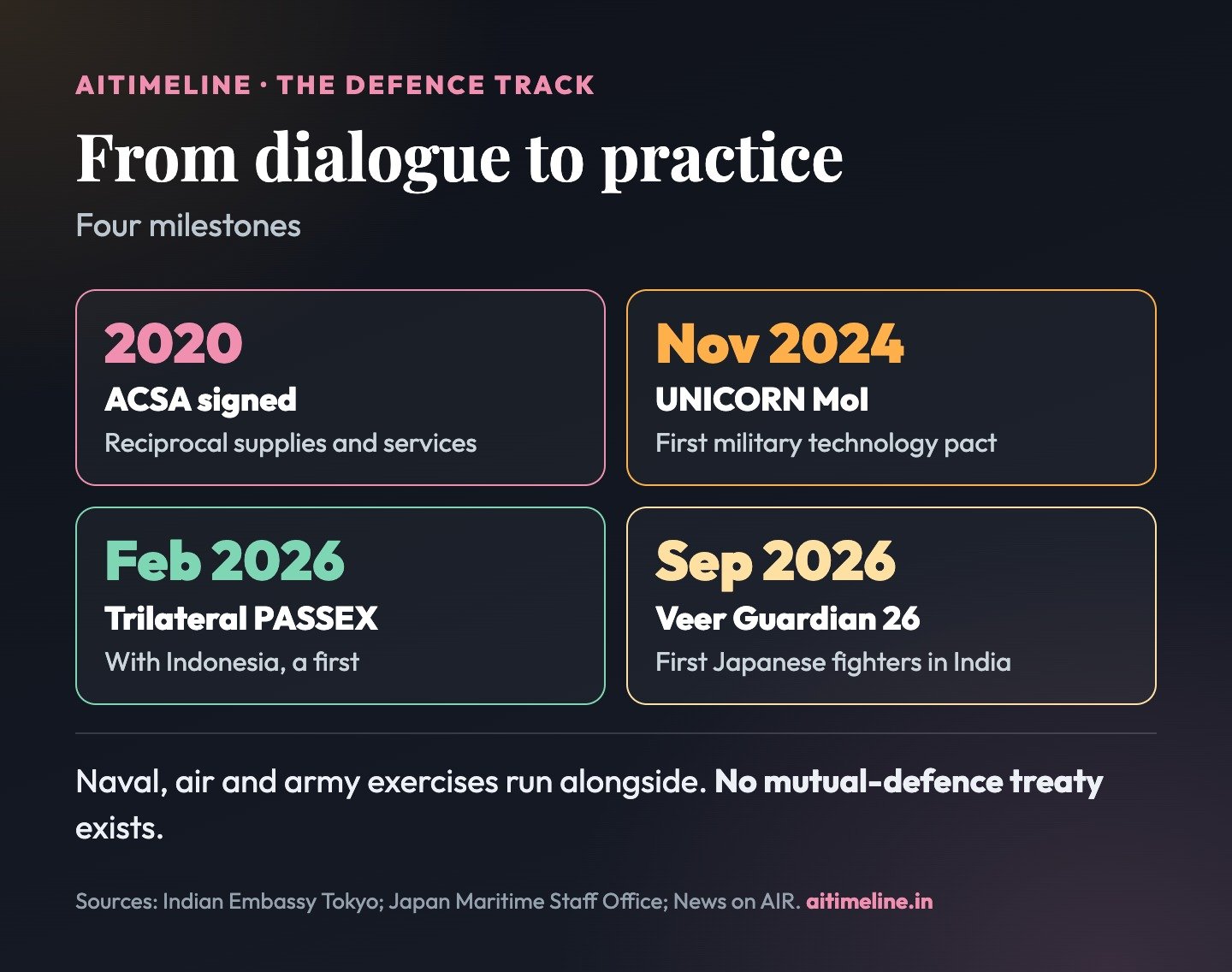
Exercises include the naval JIMEX and Malabar series and the air-force Veer Guardian. These developments do not amount to a mutual-defence treaty. Reports say India and Japan are also discussing naval shipbuilding and design, mine countermeasures and reciprocal access to ship-repair facilities. No agreement on these has been announced.
Investment Ambitions
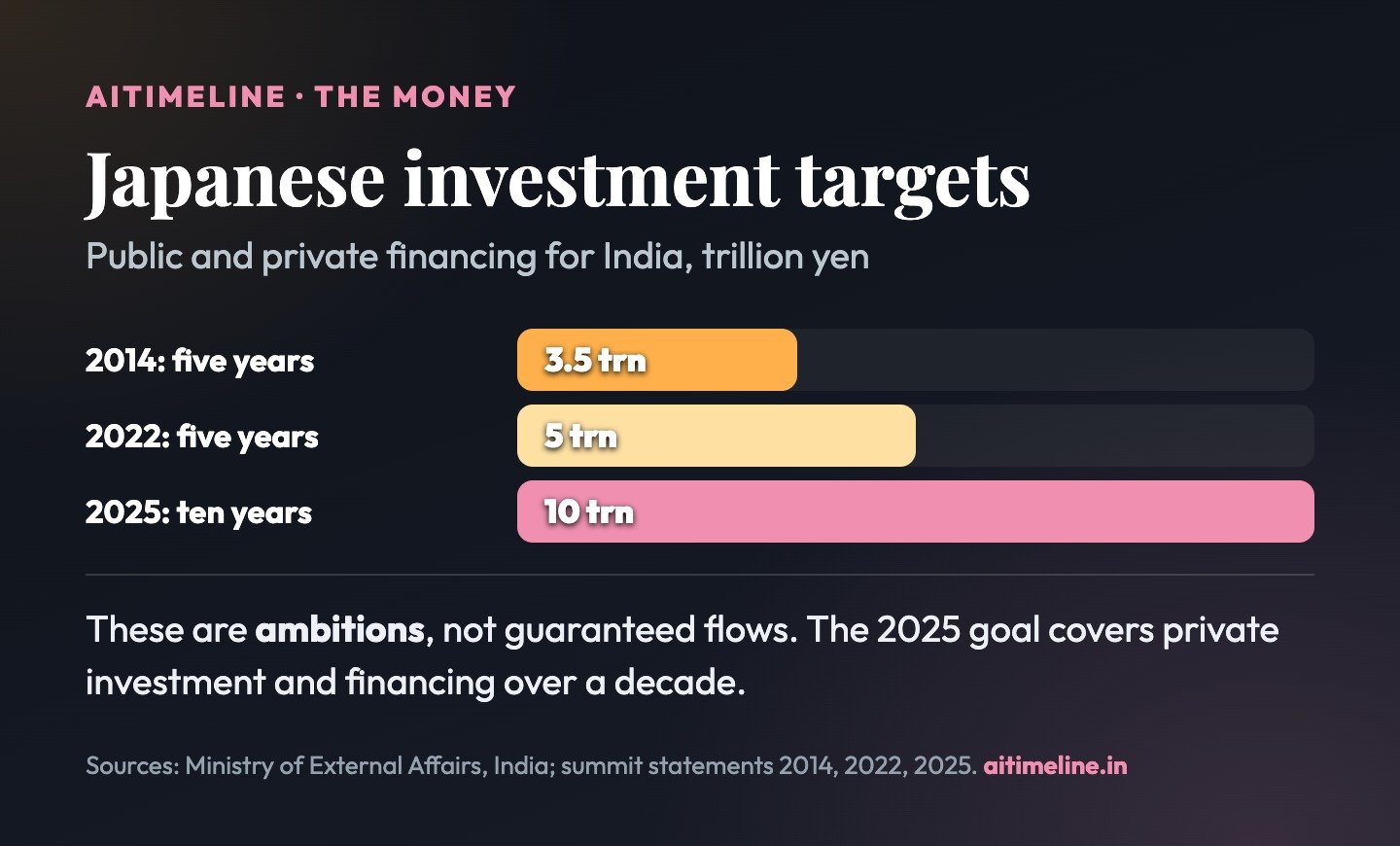
The targets are ambitions for public and private financing, not guaranteed flows. Japan also supports the Mumbai-Ahmedabad high-speed rail line, which has faced land-acquisition and delivery delays.
The Quad and the Limits of “Alliance”
India, Japan, Australia and the United States.
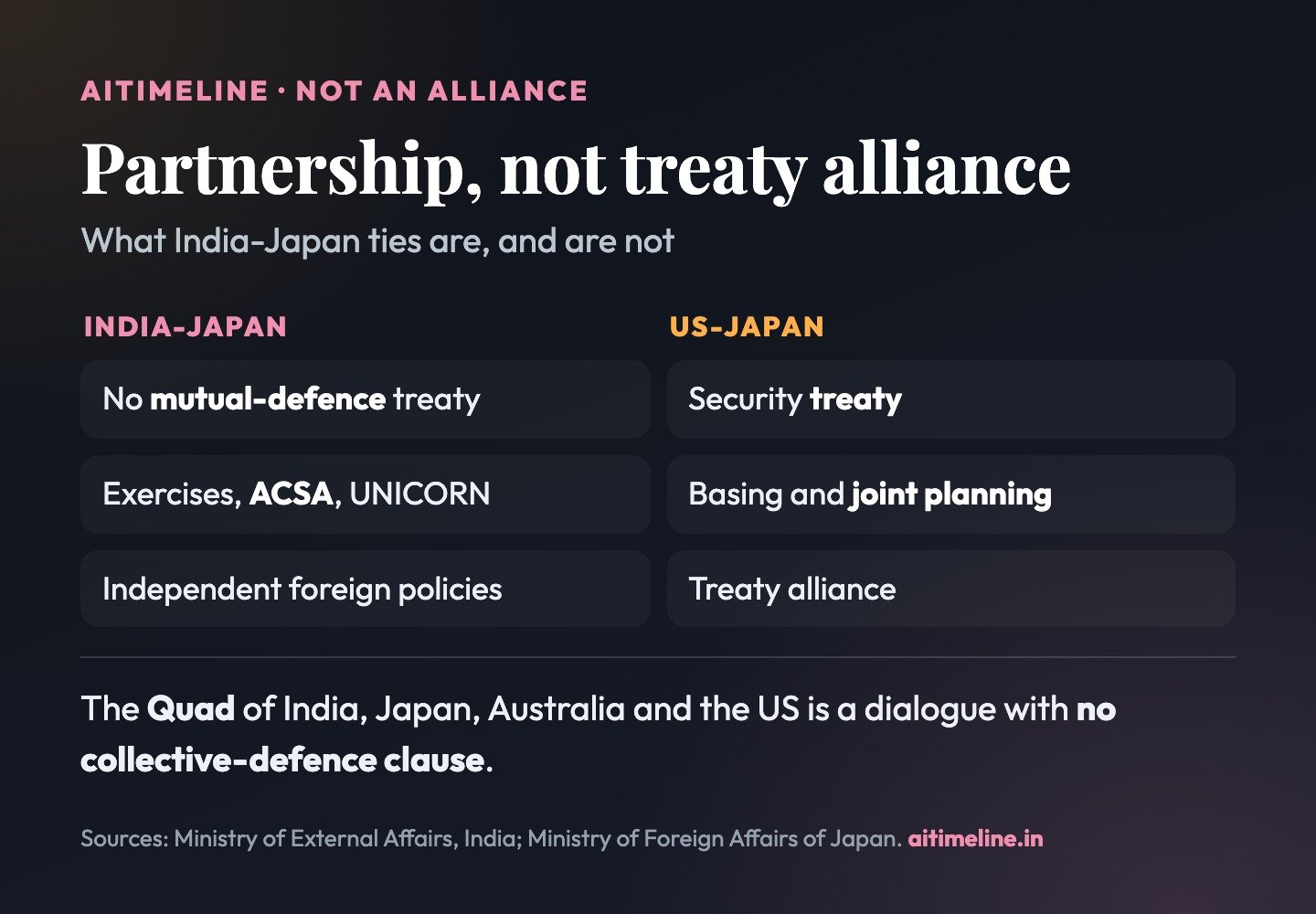
The Quad works on maritime awareness, critical technologies, supply chains, infrastructure, health security and disaster response. For India and Japan it complements the bilateral track and links them to ASEAN and other partners.
China and the Strategic Context
Japan has maritime and territorial disputes with China in the East China Sea, while India has unresolved border tensions along the Line of Actual Control. Both worry about military pressure and economic dependence. Their approaches differ: India keeps wide economic and diplomatic engagement with China, while Japan’s policy is shaped by its proximity and its alliance with the United States.
| Year | Milestone |
|---|---|
| 1952 | Diplomatic relations established |
| 2000 | Global Partnership |
| 2006 | Strategic and Global Partnership |
| 2008 | Joint Declaration on Security Cooperation |
| 2011 | CEPA enters into force |
| 2014 | Special Strategic and Global Partnership |
| 2016-17 | Civil nuclear agreement signed and in force |
| 2020-21 | ACSA signed and in force |
| 2024 | UNICORN Memorandum of Implementation |
| 2025 | Joint Vision and new security declaration |
| 2026 | Economic security declaration; fourth 2+2 |
What Limits the Partnership?
Five constraints.
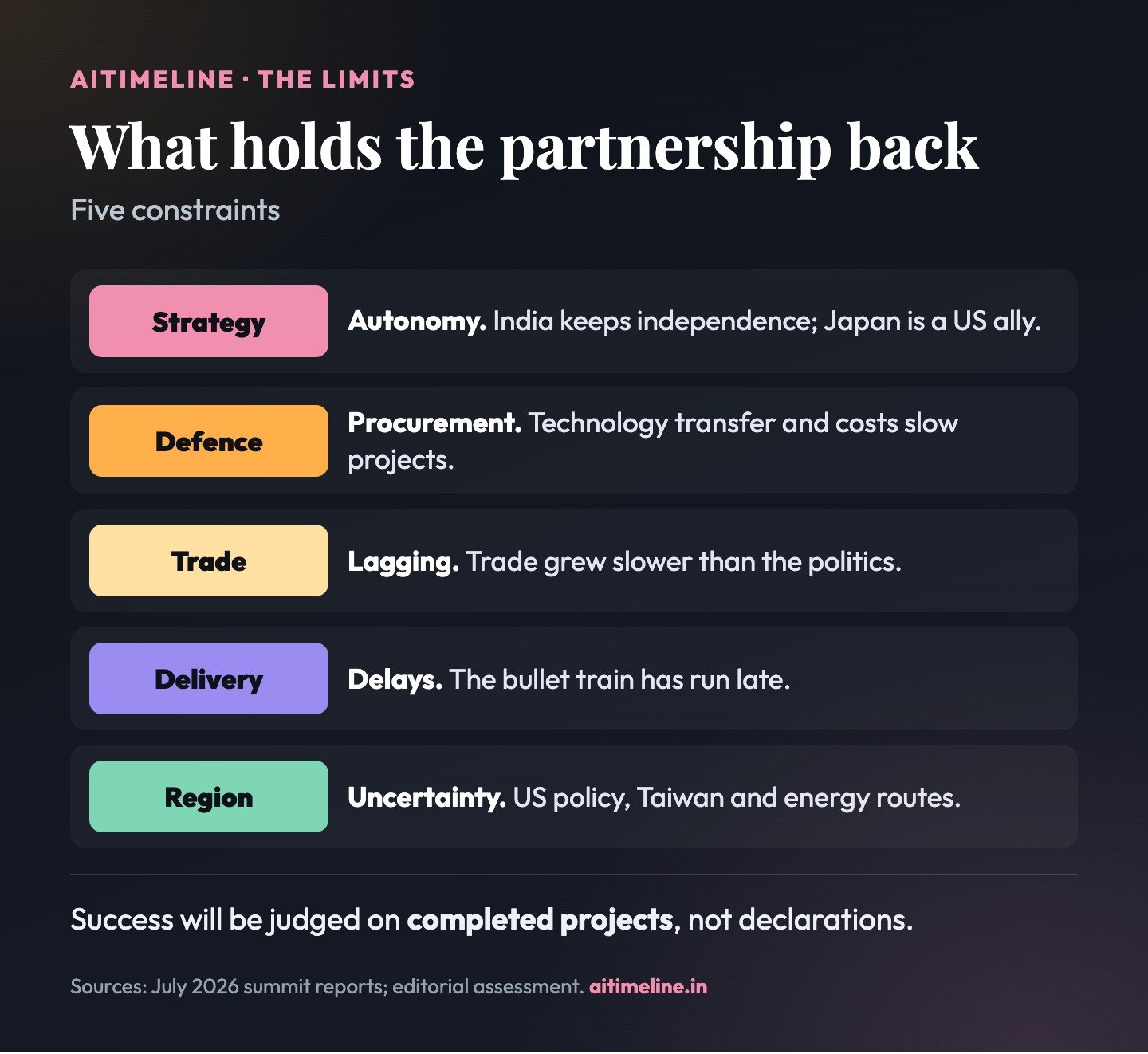
India stresses strategic autonomy while Japan sits inside a US alliance. Technology transfer, costs and export controls slow defence projects. Trade has not kept pace with the politics. Large projects such as the bullet train have run late. And changes in US policy, Taiwan tensions or energy-route instability can complicate coordination. The partnership will be judged by completed projects, not declarations.
What to Watch in 2027
Watch whether Japanese forces gain access to an Indian firing range, India’s approval of UNICORN equipment transfer, progress on the bullet train, concrete projects under the economic security declaration, the 10 trillion yen target, and the 75th anniversary of diplomatic ties.
Conclusion: From Economic Friendship to Strategic Convergence
India and Japan have moved from post-war economic assistance to a broad strategic partnership. The 1952 treaty, the 2000, 2006 and 2014 upgrades and the 2008 and 2025 security declarations built the frame. Recent steps such as ACSA, UNICORN and Veer Guardian have made it practical.
Its value will depend on outcomes: reliable infrastructure, resilient supply chains and defence cooperation that moves from statements to practice, without becoming a formal alliance.
Explore More Timelines
People Also Ask
Frequently Asked Questions
⚠️ Editorial Note
Details of the 19 November 2026 meeting come from news reports because the official joint press statement could not be opened by our checker. We did not find confirmation of a Letter of Intent on firing-range training, of a February 2027 approval date for UNICORN, or of the exact signing date of the maritime Memorandum of Arrangement, so none is stated as fact. Sources differ on the date of the third Defence Industry Forum, so only the month is given. This article is editorial information, not official policy.
Related Stories
Sources & further reading
Every dated entry above was checked against these references. Last reviewed 25 November 2026.
- Ministry of External Affairs, India: India-Japan Bilateral Relations (August 2025)
- Ministry of Foreign Affairs of Japan: Japan-India Relations, basic data
- PIB: India-Japan Joint Vision for the Next Decade, August 2025
- News on AIR: India and Japan to expand maritime security cooperation and joint defence manufacturing (19 Nov 2026)
- Arab News Japan: The 4th Japan-India 2+2 Ministerial Meeting commits to strengthening strategic ties
- Defence Watch: India and Japan hold 4th 2+2 ministerial dialogue in Tokyo
- Deccan Herald: India, Japan ink first military technology transfer pact for UNICORN mast
- News on AIR: India-Japan air forces conclude Veer Guardian 2026 at Jodhpur
- Japan Ministry of Defense: Japan-India Joint Press Statement (20 Aug 2026)
- Drishti IAS: 16th India-Japan Annual Summit 2026
- Prime Minister of India: Joint Declaration on Security Cooperation between India and Japan