Bhanwari Devi Case: Timeline of Justice & Legal Reform in India
Explore the Bhanwari Devi case timeline, the 1997 Vishaka Guidelines, the POSH Act 2013 and the long, unfinished pursuit of justice in India since 1992.
Latest Story
In September 1992 Bhanwari Devi, a government village worker in Rajasthan, reported that she had been gang-raped in her field for trying to stop a child marriage. The men she named were acquitted in 1995, and the appeal is still undecided. But her case reached the Supreme Court by another route. The Bhanwari Devi case led to the 1997 Vishaka judgment, which made sexual harassment at work a violation of women’s fundamental rights, and to the POSH Act of 2013. This page follows both tracks, the criminal case and the law it changed, from 1985 to November 2026.
Two legal processes run through this story and they should not be confused. The criminal case against the five men she accused ended in acquittal at trial and has been on appeal since 1996. The constitutional case, Vishaka v. State of Rajasthan, was a separate petition by women’s groups that produced the workplace guidelines; it did not decide whether the men were guilty. An acquittal is not a finding that the assault did not happen. Where common accounts get a fact wrong, we say so in the entry and in the editorial note.
💡 Short Answer
Bhanwari Devi, a saathin in Rajasthan’s Women’s Development Programme, reported being gang-raped on 22 September 1992 after opposing a child marriage. A Jaipur court acquitted the five accused in 1995, and the state’s 1996 appeal is still unresolved. Her case led to the Supreme Court’s Vishaka judgment of 13 August 1997, whose guidelines became the POSH Act, 2013.
Bhanwari Devi Case: Key Questions
The Bhanwari Devi Case in Ten Points
- Her work: from 1985 Bhanwari Devi was a saathin, a village worker in a Rajasthan government programme for women.
- The trigger: in May 1992 she tried to stop the marriage of a nine-month-old girl in Bhateri.
- The assault: on 22 September 1992 she said five men attacked her and her husband, and two of them raped her.
- The delays: her medical examination came about 52 hours later; the case went to the CBI in January 1993.
- The verdict: a Jaipur court acquitted all five on 15 November 1995, in reasoning widely condemned as prejudiced.
- The appeal: filed in 1996, it has no reported verdict; four of the five accused had died by 2018.
- The petition: Vishaka and other women’s groups went to the Supreme Court in 1992.
- The judgment: on 13 August 1997 the Court laid down binding workplace guidelines under Article 141.
- The law: the POSH Act, passed in 2013 and in force from 9 December 2013, replaced them.
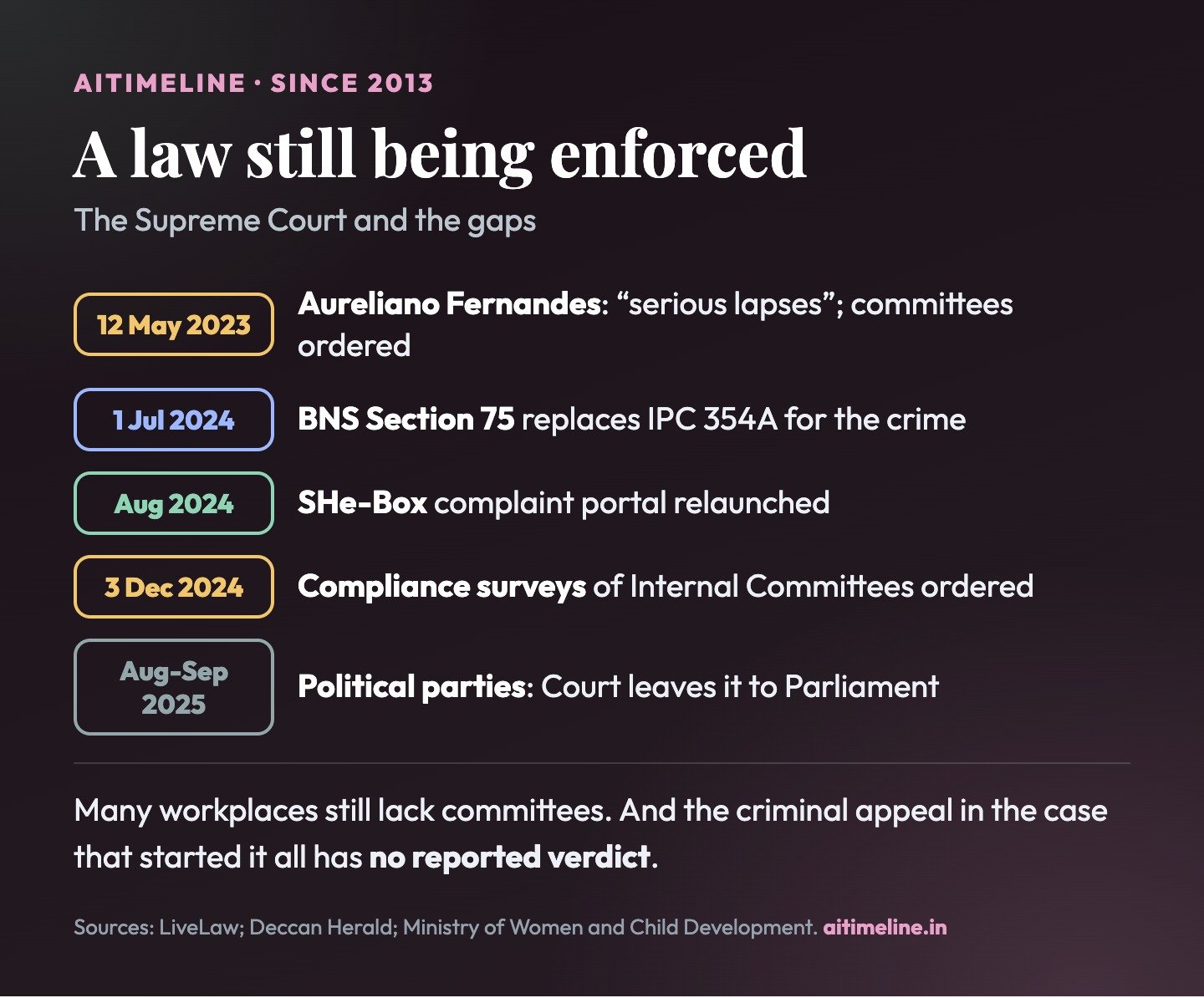
- Since: the Supreme Court found “serious lapses” in compliance in 2023 and has been monitoring it since.
From a Field in Bhateri to a National Law
The whole story on one page, 1985 to 2026.

Bhanwari Devi’s story is usually told as the origin of India’s workplace sexual-harassment law, and it is. But the law came from a petition filed by others, about women in general. Her own case, the prosecution of the men she accused, went the other way: a trial marked by delays, an acquittal in 1995 that women’s groups called a judgment on her caste and gender, and an appeal that has outlived most of the accused.
The reason her case could become a workplace case at all is the job she was doing. As a saathin she was the government’s representative in the village, sent to campaign against child marriage. When she said she was attacked for doing exactly that, it raised a question Indian law had never answered: what does an employer, including the State, owe a woman who is harassed or assaulted because of her work?
Two Tracks: The Criminal Case and the Constitutional Case
Often run together. They were separate cases with separate outcomes.
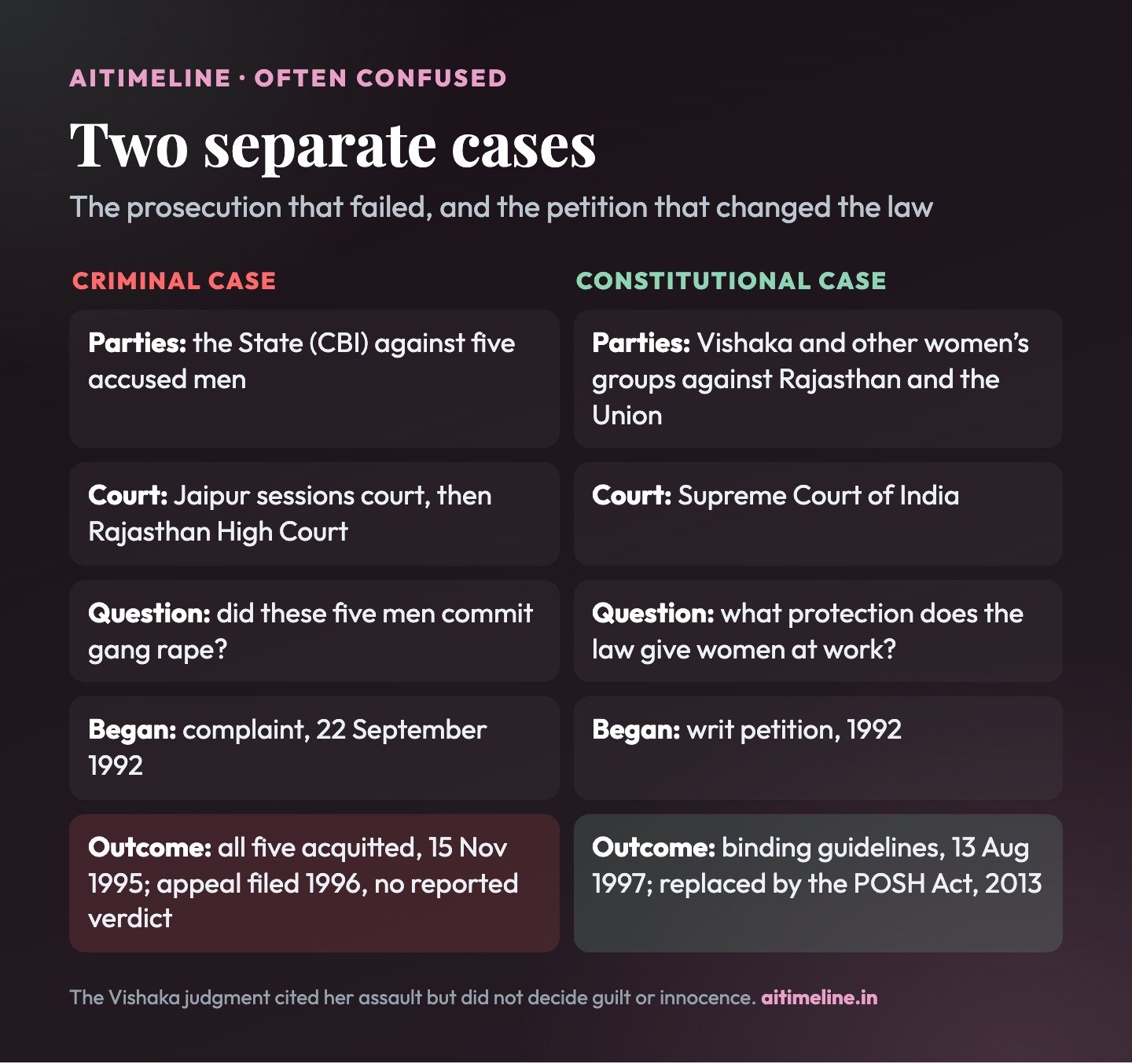
The Criminal Case: Assault, Investigation, Acquittal
From the complaint at Bassi police station to the 1995 verdict.
She reported the assault the same night. What followed became, for women’s groups, a case study in how the system treats a poor rural woman: a police station without a woman doctor, a hospital that would not examine her without a magistrate’s order, a medical examination about 52 hours after the assault, and an investigation that had to be moved first to the state CID and then to the CBI before it reached court.
The trial ran through six judges. On 15 November 1995 the last of them acquitted all five men. The judgment’s reasoning, as reported, included that a husband could not have passively watched his wife being raped and that a middle-aged village man would not have joined a rape in front of his nephew. The verdict meant the prosecution had failed. It did not establish that she had not been attacked, and the state government, under pressure from women’s groups, appealed.

The Vishaka Judgment, 13 August 1997
What the Supreme Court decided, and on what basis.
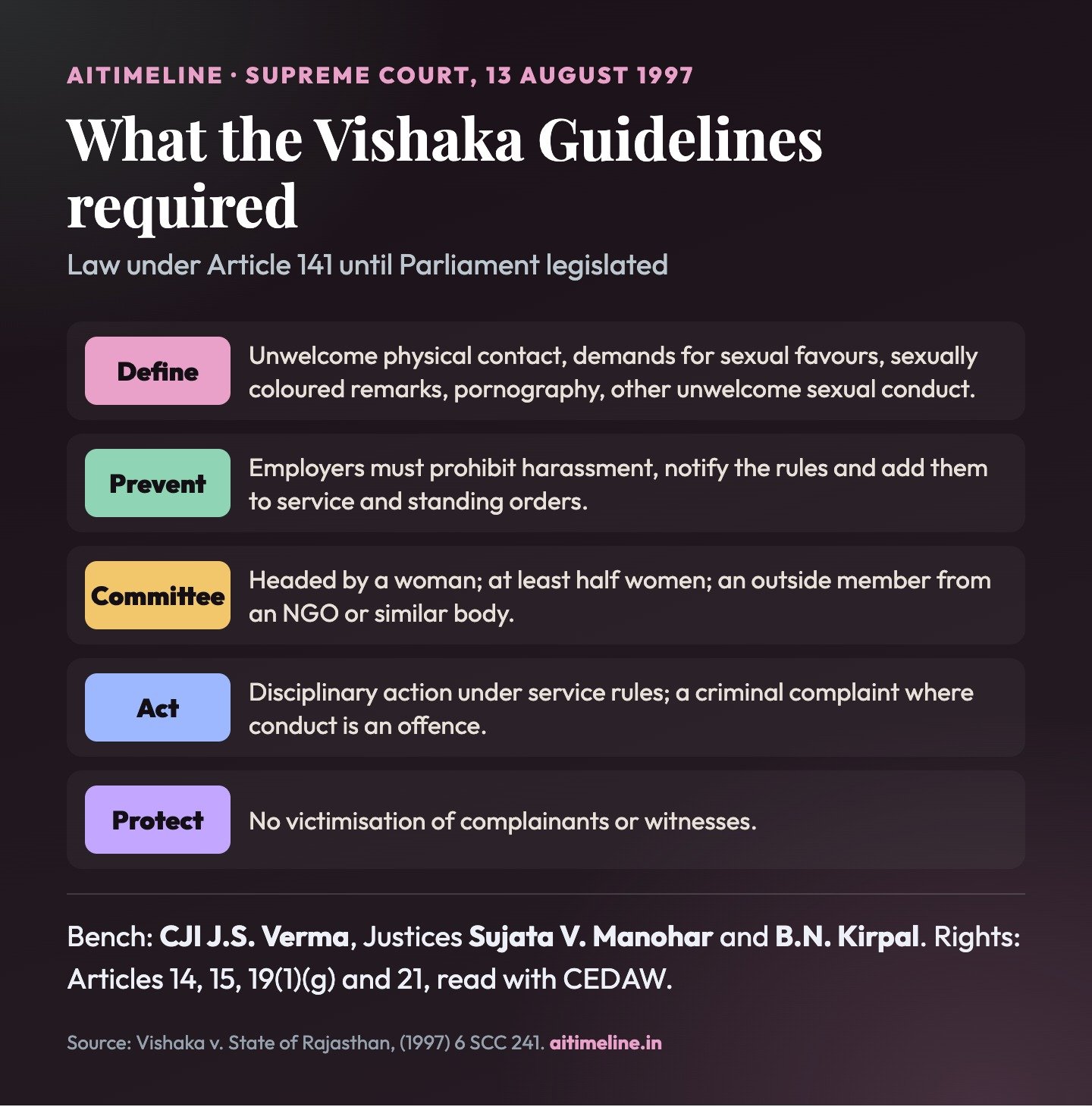
The petition was filed in 1992 by Vishaka, a Jaipur women’s group, with other organisations including the Women’s Rehabilitation Group, Jagori and Kali for Women. It asked the Court to enforce working women’s rights under Articles 14, 19 and 21. A bench of Chief Justice J.S. Verma and Justices Sujata V. Manohar and B.N. Kirpal agreed that sexual harassment at work violated those rights and Article 15, and noted that India had ratified the UN Convention on the Elimination of All Forms of Discrimination against Women.
The novel part was the remedy. With no law in place, the Court laid down guidelines itself and declared them binding under Article 141 until Parliament acted. They applied to employers in the public and private sectors, and they lasted sixteen years.
Timeline: The Bhanwari Devi Case and the Law, 1985-2026
Newest first. Colour shows the strand: her life and work, the criminal case, the Supreme Court, legislation, or developments since the Act.
Where things stand Since the Act
Settled: The legal framework her case helped create is in force. The Vishaka Guidelines governed workplaces from 1997 to 2013, and the Sexual Harassment of Women at Workplace Act, 2013, has applied since 9 December 2013. The Supreme Court is still pressing governments and employers to comply with it.
Not settled: The appeal against the 1995 acquittal of the five men she accused was filed in 1996 and was still described as pending in 2018 and 2023. We found no reported High Court judgment in it. By 2023, ThePrint reported, only one of the five accused, Badri Gujjar, was still alive.
Political parties stay outside the Act Supreme Court
What happened: On 1 August 2025 a bench led by Chief Justice B.R. Gavai declined to hear a public-interest petition seeking to bring political parties under the POSH Act, calling it a matter of legislative policy; the petitioner withdrew it. On 15 September the Court dismissed a follow-up plea challenging the Kerala High Court’s 2022 ruling that parties need not set up Internal Committees.
Why it matters: The 2013 Act is built around an employer and a workplace. Bodies without a conventional employer-employee relationship, such as political parties, fall outside it unless Parliament changes the law.
Supreme Court orders a compliance survey Supreme Court
What happened: Returning to its 2023 POSH judgment, the Supreme Court directed the States and Union Territories to survey whether public and private workplaces had constituted Internal Committees, and to make sure district officers and Local Committees were in place. Further compliance orders followed in 2025.
Why it matters: More than a decade after the Act came into force, the Court found that the committees it requires were still missing in many institutions. The Vishaka principle of employer responsibility depends on them existing.
A relaunched SHe-Box portal Legislation
What happened: The Union government relaunched SHe-Box, its online portal for workplace sexual-harassment complaints, as a central register meant to link complaints to the Internal and Local Committees responsible for them.
Why it matters: It is a reporting channel, not a new remedy: complaints are still inquired into by the committees the 2013 Act sets up.
New criminal code Legislation
What happened: The Bharatiya Nyaya Sanhita replaced the Indian Penal Code. The offence of sexual harassment that had been Section 354A of the IPC since 2013 continues as Section 75 of the new code.
Why it matters: The POSH Act’s civil, workplace process and the criminal law run side by side. A woman can use either or both, as the Vishaka Guidelines had first recognised in 1997.
Thirty-one years on, in Bhateri Since the Act
What happened: A ThePrint ground report found Bhanwari Devi, by then about 70 by its account, still living in Bhateri, caught up in a family dispute over land. The child bride whose 1992 wedding she had tried to stop, now 32, told the reporter she blamed Bhanwari for her father and uncles being jailed.
Why it matters: The report showed how the case still divided the village, and noted that of the five accused only Badri Gujjar was alive.
Supreme Court finds “serious lapses” Supreme Court
What happened: Hearing a case from Goa University, the Supreme Court said there were serious lapses in enforcing the POSH Act a decade after it was passed. It directed the Union, States, statutory bodies, universities and professional bodies to check that Internal Committees were properly constituted and their details published.
Why it matters: The judgment restated the Vishaka idea that a safe workplace is part of women’s fundamental rights, and treated non-compliance as a failure of the State, not only of individual employers.
#MeToo, and a pending appeal Since the Act
What happened: As the #MeToo movement led to a wave of workplace-harassment complaints in India, Scroll.in revisited Bhanwari Devi. It reported that four of the five men she accused had died and that the appeal filed 22 years earlier was still pending.
Why it matters: Her own words framed the contradiction: “The court of law and the government has failed me but I got justice in the people’s court.”
BBC revisits the case Since the Act
What happened: BBC News published “Bhanwari Devi: The rape that led to India’s sexual harassment law”, revisiting the 1995 acquittal and the appeal that had not been decided.
Why it matters: International coverage renewed attention to the gap between the national reform associated with her name and the stalled resolution of her own case.
The POSH Act comes into force Legislation
What happened: The Sexual Harassment of Women at Workplace (Prevention, Prohibition and Redressal) Act, 2013, came into force together with its Rules. From this date the Act, not the Vishaka Guidelines, governed workplace complaints.
What it requires: Every workplace with ten or more employees must constitute an Internal Committee; a district-level Local Committee hears complaints from smaller workplaces and complaints against the employer. Employers must display information, run awareness programmes and act on the committee’s findings, and face fines for non-compliance.
Presidential assent Legislation
What happened: The President gave assent to the Bill on 22 April 2013, and the Act was published in the Gazette the next day. It still needed notification before it could take effect.
Why it matters: The law now explicitly cited the Vishaka judgment’s reasoning: that sexual harassment violates women’s rights to equality, life with dignity and to practise any profession.
Rajya Sabha passes the Bill Legislation
What happened: The Rajya Sabha passed the Bill that the Lok Sabha had approved in September 2012, completing its passage through Parliament.
The context: It passed weeks after the Justice J.S. Verma Committee, set up after the December 2012 Delhi gang rape, reported on 23 January 2013. The criminal law was amended the same year, adding Section 354A on sexual harassment to the IPC.
Lok Sabha passes a revised Bill Legislation
What happened: The Lok Sabha passed the revised Bill, renamed the Sexual Harassment of Women at Workplace (Prevention, Prohibition and Redressal) Bill. Its most important change was to bring domestic workers within its scope, as the Standing Committee had urged.
Why it matters: The 2010 draft had excluded domestic workers, among the most exposed women workers in India. Women’s groups had made that exclusion their main objection.
Medha Kotwal Lele: guidelines cannot stay symbolic Supreme Court
What happened: A bench of Justices R.M. Lodha, Anil R. Dave and Ranjan Gogoi found that many States had not implemented the Vishaka Guidelines fifteen years on. It directed States and Union Territories to amend their service rules, and told employers and professional bodies such as Bar Councils and medical councils to set up complaint mechanisms.
Why it matters: It made clear that the guidelines were binding obligations, and kept them enforceable while the Bill was still in Parliament.
Standing Committee reports Legislation
What happened: The Parliamentary Standing Committee on Human Resource Development presented its 239th report on the 2010 Bill. It recommended including domestic workers and tightening the provisions on committees and complaints.
Why it matters: Most of its central recommendations shaped the revised Bill passed in 2012.
A Bill is introduced Legislation
What happened: The Union government introduced the Protection of Women Against Sexual Harassment at Workplace Bill, 2010, in the Lok Sabha, thirteen years after the Vishaka judgment. It was referred to the Standing Committee.
Why it matters: It was the first attempt to turn the Supreme Court’s guidelines into statute, with Internal and Local Complaints Committees and penalties for employers.
Committees made inquiry authorities Supreme Court
What happened: In an interim order, the Supreme Court directed that the complaints committee envisaged by Vishaka would be treated as the inquiry authority under the Central Civil Services (Conduct) Rules, and its report as the inquiry report on which disciplinary action is taken.
Why it matters: Before this, a committee’s finding could be followed by a fresh departmental inquiry, delaying any outcome. The order gave its findings direct effect in government service.
Help from the state government Her life & work
What happened: According to Wikipedia’s account, Chief Minister Ashok Gehlot’s government allotted Bhanwari Devi a plot of land, with ₹40,000 to build a house and ₹10,000 for her son’s education.
Why it matters: Official support came a decade after the assault, while the criminal appeal remained undecided.
Bawandar Her life & work
What happened: Jag Mundhra’s film Bawandar, starring Nandita Das, dramatised Bhanwari Devi’s story, bringing it to a wide audience in India and abroad.
Why it matters: The film made her one of the best-known survivors in India, though it was a dramatisation, not a record of the case.
The Vishaka judgment Supreme Court
What happened: A bench of Chief Justice J.S. Verma and Justices Sujata V. Manohar and B.N. Kirpal held that sexual harassment at the workplace violates women’s fundamental rights under Articles 14, 15, 19(1)(g) and 21. With no law in place, it laid down guidelines that were to be treated as law under Article 141 until Parliament legislated.
What the guidelines required: A definition of sexual harassment; a duty on employers to prevent it; complaint committees headed by a woman, at least half women, with a third-party member from an NGO or similar body; disciplinary action under service rules; and criminal complaints where conduct was also an offence. The Court drew on India’s obligations under CEDAW.
An appeal is filed Criminal case
What happened: Under pressure from women’s groups, the Rajasthan government decided to appeal against the acquittal. The appeal was filed in 1996; Scroll.in in 2018 described it as having been pending for 22 years.
Why it matters: An appeal against acquittal is the only route to reversing the trial verdict. Its delay is the most criticised part of the case.
The trial court acquits all five Criminal case
What happened: After five judges had been changed, the sixth acquitted all five accused of the gang rape. The judgment’s reasoning, as widely reported, included that her husband could not have watched passively while his wife was raped, and that a middle-aged village man could not have taken part in a rape in the presence of his own nephew.
Why it matters: Women’s groups said the reasoning rested on caste and social prejudice, not evidence. The acquittal meant the prosecution had not secured a conviction; it did not establish that the assault did not happen.
Recognition before the verdict Her life & work
What happened: Bhanwari Devi received the Neerja Bhanot Memorial Award in 1994, worth ₹1 lakh, for courage and commitment. Prime Minister P.V. Narasimha Rao’s office gave her ₹25,000. She was invited to the UN Fourth World Conference on Women in Beijing in 1995.
Why it matters: By the time the trial court ruled, her case was already a national and international symbol of the women’s movement.
Arrests and trial Criminal case
What happened: The CBI investigation led to the arrest of the five accused, who were charged with gang rape, assault and conspiracy. Their bail pleas were refused at first, and the trial began in the Jaipur sessions court, where Bhanwari Devi gave evidence in 1994.
Why it matters: The trial would test the evidence she had fought to have recorded, including a medical examination conducted days late.
The CBI takes over Criminal case
What happened: After protests by women’s groups over the local police’s handling, the case went first to the state CID and then, in January 1993, to the CBI.
Why it matters: Transfer to a central agency was a response to allegations that the local investigation had been compromised.
A complaint, and the delays Criminal case
What happened: She and her husband reported the assault at Bassi police station. Bassi had no woman doctor, and SMS Hospital in Jaipur would not examine her without a magistrate’s order; the medical examination took place about 52 hours after the assault, past the 24 hours within which a swab should be taken. Rajasthan Patrika reported the complaint on 25 September.
Why it matters: The delays weakened the forensic evidence and became a central complaint of the protests that followed.
The assault in the field Her life & work
What happened: At dusk, as she and her husband Mohan Lal worked in their field, five men attacked them, she said: Ram Sukh, Gyarsa and Ram Karan Gujjar, their uncle Badri Gujjar, and Shravan Sharma. Her husband was beaten unconscious. In her account, Ram Sukh held her while Badri and Gyarsa raped her.
Why it matters: She said it was revenge for her work against the May 1992 child marriage. Because she was a government worker assaulted for doing her job, her case became the basis for asking who protects women at work.
Women’s groups go to the Supreme Court Supreme Court
What happened: Vishaka, a Jaipur women’s group, together with the Women’s Rehabilitation Group, Jagori and Kali for Women among others, filed a writ petition in the Supreme Court. It asked the Court to enforce working women’s fundamental rights under Articles 14, 19 and 21.
Why it matters: The petition turned a single crime into a constitutional question: what does the State owe women who are harassed or attacked because of their work?
The child marriage on Akha Teej Her life & work
What happened: During the state’s campaign against child marriage before the festival of Akha Teej, Bhanwari Devi tried to stop Ram Karan Gujjar from marrying off his nine-month-old daughter. Police came on 5 May and stopped the ceremony, but the marriage took place in the early hours of the next day.
Why it matters: The village blamed her for the police visit. She and her family faced a social and economic boycott in the months before the assault.
A saathin in Bhateri Her life & work
What happened: Bhanwari Devi, from a family of potters in Bhateri village near Jaipur, became a saathin, or “friend”, a grassroots worker in the Rajasthan government’s Women’s Development Programme, launched in the early 1980s.
What the work involved: Saathins campaigned on sanitation, family planning, girls’ education and land rights, and against dowry, female infanticide and child marriage.
From Guidelines to Statute, 1997-2013
Why it took sixteen years, and what changed on the way.
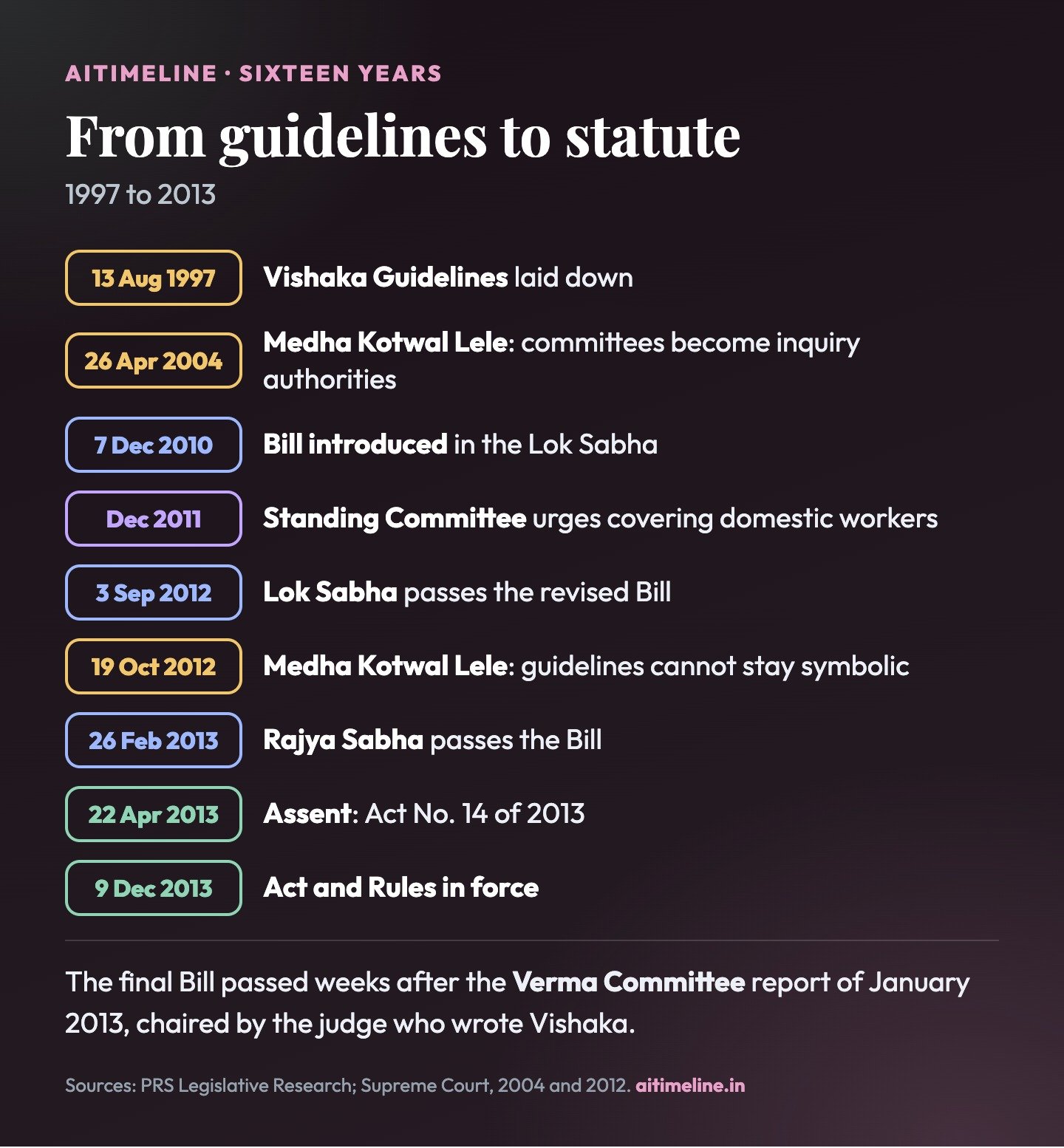
For most of those years the guidelines were law on paper and patchy in practice. Many institutions never set up committees, and when they did, a committee’s finding could be followed by a second, departmental inquiry. The Supreme Court tried to close those gaps through the Medha Kotwal Lele case, first in 2004 by making committee reports the inquiry report in central government service, then in 2012 by ordering States and professional bodies to comply.
The Bill introduced in 2010 was criticised mainly for leaving out domestic workers. The Standing Committee agreed, and the revised Bill passed in 2012 and 2013 included them. Its final passage came weeks after the Justice J.S. Verma Committee, set up after the December 2012 Delhi gang rape, reported on the criminal law. The judge who wrote Vishaka in 1997 thus also shaped the 2013 criminal-law reforms.
How the POSH Act Works
The Vishaka framework, as Parliament enacted it.
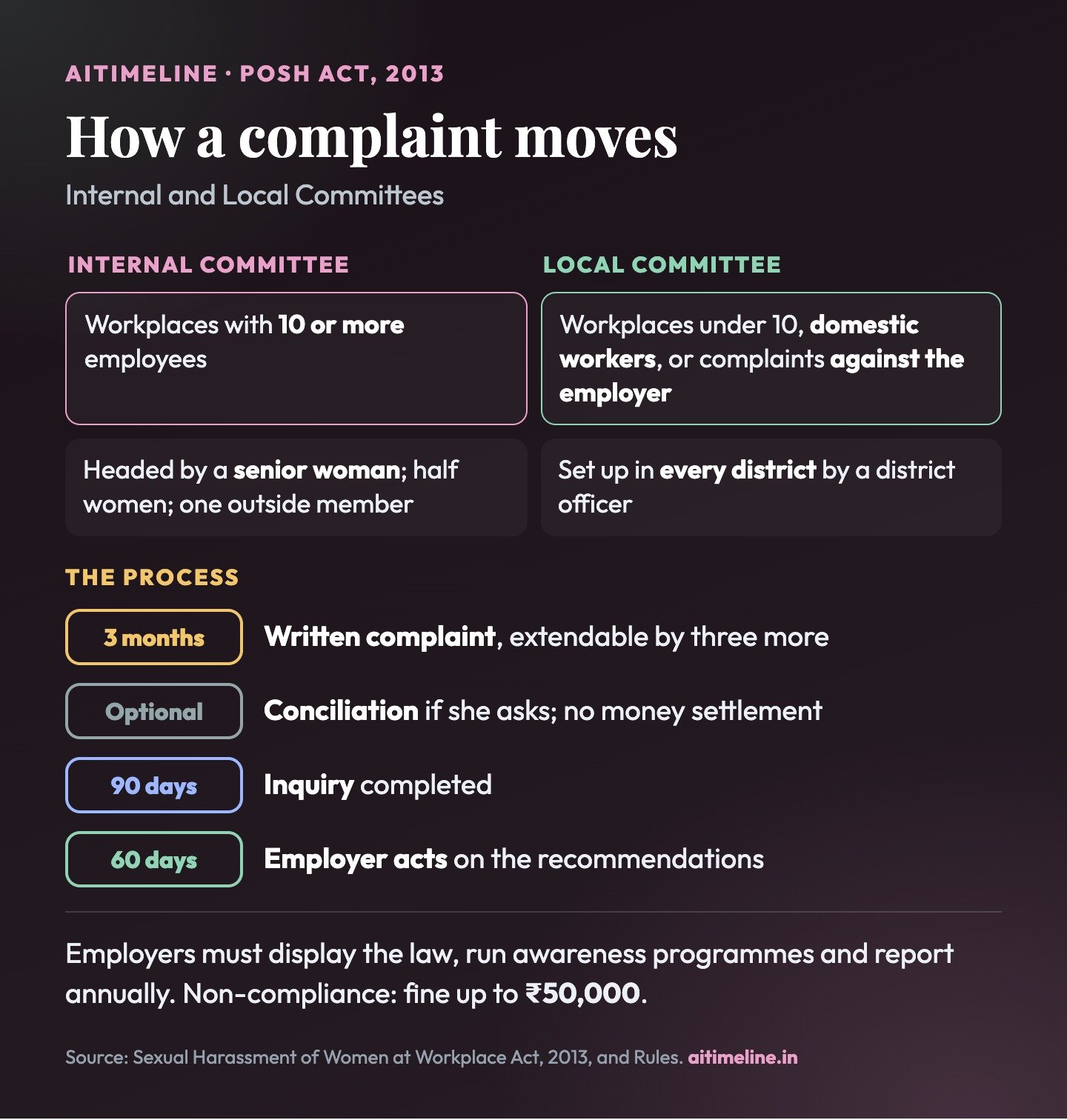
The Act kept Vishaka’s core ideas, employer responsibility, a committee led by women with an outside member, and protection against retaliation, and added deadlines, penalties and a district-level body for women outside formal workplaces. It also covers women who are not employees, such as visitors, clients and domestic workers. A criminal complaint remains available alongside it; the offence of sexual harassment is now Section 75 of the Bharatiya Nyaya Sanhita.
What Changed Because of the Bhanwari Devi Case
| Area | Before Vishaka (to 1997) | After Vishaka and POSH |
|---|---|---|
| Legal framework | No law on workplace sexual harassment | Binding guidelines (1997), then the POSH Act (2013) |
| Status of harassment | Treated as a private or disciplinary matter | A violation of fundamental rights |
| Employer duty | None defined | Duty to prevent, publicise and redress |
| Complaints | No uniform process | Internal Committees; district Local Committees |
| Informal and domestic workers | Outside any mechanism | Covered through Local Committees |
| Criminal law | Only “outraging modesty” (IPC 354, 509) | Specific offence: IPC 354A (2013), BNS Section 75 (2024) |
Why the Case Still Matters
Workplace safety became a constitutional issue. Vishaka linked harassment at work to equality, dignity and the right to practise a profession, and made employers, including the State, responsible.
The Court filled a legislative gap. It used international law and Article 141 to make rules binding until Parliament acted, a method later relied on in other rights cases and also debated as judicial overreach.
Caste and gender shaped access to justice. The criticism of the 1995 judgment became part of a wider argument about how social power affects a rural, lower-caste woman’s ability to be believed.
Reform did not deliver individual justice. The most persistent contradiction is that a case that changed the law for every working woman in India has not produced a timely, final verdict for the woman at its centre.
Key People and Organisations
| Person or organisation | Role |
|---|---|
| Bhanwari Devi | Saathin from Bhateri who reported the 1992 assault |
| Mohan Lal Prajapat | Her husband, beaten in the attack; died in 2020 |
| Ram Sukh, Gyarsa, Ram Karan and Badri Gujjar; Shravan Sharma | The five men she accused; acquitted in 1995 |
| Vishaka | Jaipur women’s group that led the 1992 Supreme Court petition |
| Women’s Rehabilitation Group, Jagori, Kali for Women | Co-petitioners in the Vishaka case |
| Chief Justice J.S. Verma | Wrote the 1997 judgment; chaired the 2013 criminal-law committee |
| Justices Sujata V. Manohar and B.N. Kirpal | The other members of the Vishaka bench |
| Medha Kotwal Lele | Activist whose 1999 petition pressed enforcement of Vishaka |
| Jag Mundhra and Nandita Das | Director and lead of Bawandar (2000) |
Key Dates at a Glance
| Milestone | Date |
|---|---|
| Becomes a saathin | 1985 |
| Child marriage on Akha Teej | 5-6 May 1992 |
| Reported assault | 22 September 1992 |
| Vishaka petition filed | 1992 |
| CBI takes over | January 1993 |
| Trial court acquits all five | 15 November 1995 |
| State appeal filed | 1996 |
| Vishaka judgment | 13 August 1997 |
| Medha Kotwal Lele interim order / judgment | 26 April 2004 / 19 October 2012 |
| POSH Bill introduced | 7 December 2010 |
| Lok Sabha / Rajya Sabha pass | 3 September 2012 / 26 February 2013 |
| Presidential assent | 22 April 2013 |
| POSH Act in force | 9 December 2013 |
| Aureliano Fernandes judgment | 12 May 2023 |
Explore More Timelines
People Also Ask
Frequently Asked Questions
Based on the Vishaka and later Supreme Court judgments, the 2013 Act, parliamentary records and reporting to 15 November 2026.
⚠️ Editorial Note: What We Corrected and What We Could Not Confirm
This page separates the criminal case from the Vishaka petition: the 1997 judgment did not rule on the men Bhanwari Devi accused, and the POSH Act is legislation, not a judgment in her case. The 1995 acquittal is described as an acquittal, not as proof that the assault did not occur. Several details in common accounts are wrong. She named two men, Badri and Gyarsa Gujjar, as having raped her, not three. The Vishaka petition was filed in 1992 (Writ Petition (Crl) 666-670 of 1992), not 1996. All five accused were acquitted at trial; reports that some were convicted of lesser offences could not be confirmed. Exact dates for the chargesheet, arrests and bail orders differ between accounts, so we give years. We could not verify a January 2026 Rajasthan High Court order sometimes cited as the latest in her appeal; the case number and description we were given do not match the state’s 1996 appeal against five acquitted men, and the name Bhanwari Devi is common in Rajasthan court records, so we have not relied on it. As of 15 November 2026 we found no reported final judgment in the appeal.
Related Reading on AiTimeline
Sources & further reading
Every dated entry above was checked against these references. Last reviewed 15 November 2026.
- Indian Kanoon: Vishaka & Ors v. State of Rajasthan & Ors (Supreme Court, 13 August 1997)
- PRS Legislative Research: The Protection of Women Against Sexual Harassment at Work Place Bill, 2010
- Rajya Sabha Standing Committee on HRD: 239th Report on the 2010 Bill (via PRS)
- Ministry of Women and Child Development: SHe-Box complaint portal
- BBC News: Bhanwari Devi, the rape that led to India's sexual harassment law (17 March 2017)
- Scroll.in: Dalit woman's rape in '92 led to India's first sexual harassment law but justice still eludes her (22 October 2018)
- ThePrint: 2 men raped Bhanwari Devi for trying to stop 1992 child marriage (18 September 2023)
- ThePrint: India's answer to sexual harassment at work was passed this day in 2013
- LiveLaw: Supreme Court directions on POSH Act Internal Committees, Aureliano Fernandes (May 2023)
- Deccan Herald: Supreme Court dismisses plea for bringing political parties under POSH Act (September 2025)