How the PNB Fraud Unfolded: Nirav Modi, Fake Bank Guarantees and the ₹6,498-Crore Trail
Follow the PNB-Nirav Modi fraud timeline, how unauthorised LoUs allegedly worked, the evidence, asset recovery, extradition and banking reforms.
Latest Story
How did one branch of a public-sector bank guarantee thousands of crores without the bank knowing? The PNB–Nirav Modi fraud came down to a gap between two systems. Guarantees called Letters of Undertaking were sent abroad on SWIFT, but never entered in Punjab National Bank’s own books. Overseas branches lent against them, and new guarantees paid off old ones. When the scheme surfaced in January 2018, Nirav Modi had already left India. The CBI later put the amount linked to his firms at ₹6,498.20 crore. This timeline follows the scheme, the investigation, the money and the extradition fight, and keeps allegations, findings and court rulings apart.
💡 Short Answer
Between 2011 and 2018, officials at PNB’s Brady House branch in Mumbai allegedly issued Letters of Undertaking to Nirav Modi’s firms through SWIFT without limits, margin or entries in the bank’s core system. PNB disclosed the fraud on 14 February 2018. Modi, arrested in London in March 2019, remains in UK custody and has not been tried in India.
PNB Nirav Modi Fraud: Key Questions
The Fraud in Ten Points
- March 2011: PNB’s own investigation dates the first fake guarantees, about US$15.5 million, to this month.
- February to May 2017: the CBI alleges 150 LoUs worth ₹6,498.20 crore went to Modi’s three firms.
- 1 January 2018: Nirav Modi left India, weeks before the first complaint.
- 16 January 2018: a request for fresh credit without cash margin exposed missing records.
- 14 February 2018: PNB disclosed fraudulent transactions of about US$1.77 billion.
- 13 March 2018: the RBI abolished LoUs and Letters of Comfort for import trade credit.
- 14 May 2018: the CBI chargesheeted Modi, his associates and PNB officials, including a former managing director.
- 19 March 2019: Modi was arrested in London; he has been in custody since.
- 2021 to 2026: UK courts and the Home Secretary approved extradition, and the High Court refused to reopen it in March 2026.
- Recovery: the ED said ₹1,052.42 crore had been restored to banks by May 2025, a fraction of the amount alleged.
How the Alleged Fraud Worked
A guarantee sent on one system and missing from the other.
A Letter of Undertaking is a bank guarantee used in import finance. An importer’s bank promises an overseas lender, usually a foreign branch of another Indian bank, that it will repay short-term buyer’s credit. Normally the bank checks the customer’s approved limit, takes cash margin or collateral, records the liability in its books and only then sends the undertaking.
Investigators allege that at Brady House none of those steps happened. LoUs were sent by SWIFT, but no limit was sanctioned, no margin was taken and nothing was entered in the Core Banking Solution (CBS). When the credit fell due, new LoUs raised more credit to repay it, so the hidden exposure kept rolling over and growing.
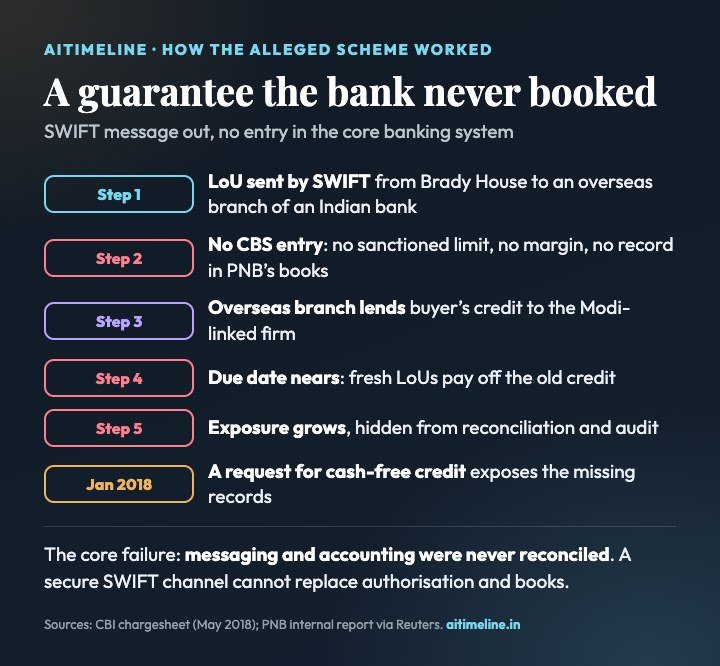
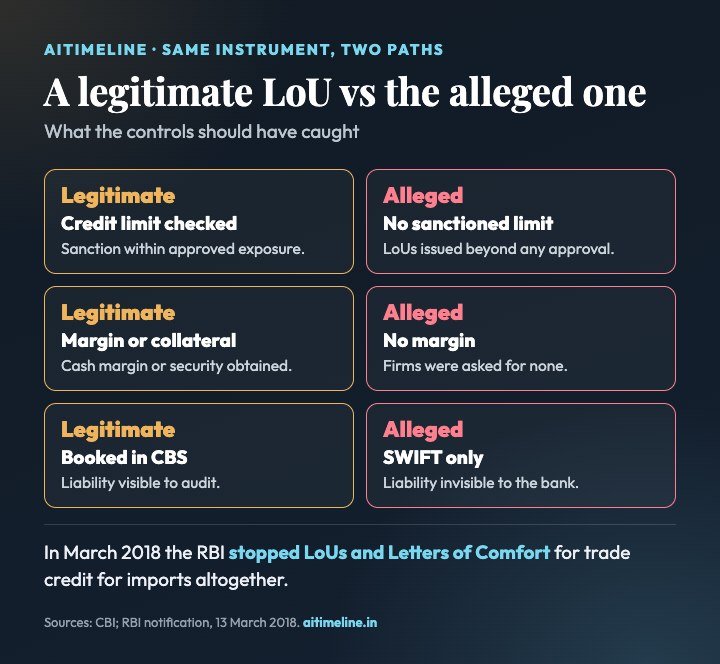
The central weakness was not SWIFT itself. It was that PNB’s SWIFT terminal and its accounting system did not talk to each other, and nobody reconciled the two. A secure messaging channel is only as good as the authorisation and bookkeeping behind it.
Timeline: From the First Guarantee to the Extradition Fight
Newest first. Colour shows which strand each event belongs to.
Strasbourg, and a wait for surrender UK extradition
What was reported: Modi took his case to the European Court of Human Rights in April 2026. In early July several Indian outlets, citing unnamed sources, reported that the Strasbourg court had given him no relief and that only administrative steps remained before his transfer.
The official line: On 28 July 2026 the Ministry of External Affairs said he would be extradited once the legal proceedings still under way in the UK were completed. It did not describe those proceedings. As of 8 November 2026, no report reviewed showed that he had been handed over to India.
A London civil judgment for Bank of India Asset recovery
What happened: In a separate civil claim, the High Court in London ruled for Bank of India against Firestar Diamond FZE and others in a dispute over unpaid credit, reported at about US$10.7 million (roughly ₹100 crore).
Why it matters: It showed creditors pursuing Modi-linked companies through civil courts abroad, alongside the criminal and extradition tracks.
A separate ₹321.88-crore case goes to a magistrate Indian courts
The order: The special court allowed the CBI’s request to transfer a separate ₹321.88-crore case, arising from a complaint by PNB’s Mumbai zonal office about misused credit facilities, to a magistrate’s court.
The reason: The CBI told the court it had not found material to sustain Prevention of Corruption Act charges against PNB officials in that case. A chargesheet would be filed against private individuals only, which took the case out of the special court’s jurisdiction.
What it is not: It is not an acquittal of Nirav Modi and has nothing to do with the main ₹6,498.20-crore case.
UK High Court refuses to reopen the extradition appeal UK extradition
The application: Modi asked the Divisional Court to reopen his 2022 appeal, relying on a 2025 ruling in another Indian extradition case (Bhandari) about the risk of interrogation after surrender.
The ruling: Lord Justice Stuart-Smith and Mr Justice Jay refused. They held that reopening needs exceptional circumstances and a real injustice, and found the Indian government’s assurances, including a note verbale of 12 February 2026 that he would not be questioned by named agencies, comprehensive and reliable.
What it did not do: It did not itself send him to India. Physical surrender is handled by the Home Office.
₹66.33 crore of attached property goes to PNB Asset recovery
The order: The court allowed PNB to take over property of Nirav Modi and his sister Purvi Modi worth ₹66.33 crore, attached by the ED. It included jewellery, watches, coins and cash valued at ₹40.83 crore from his Samudra Mahal residence and a ₹19.50-crore flat in his sister’s name.
The condition: PNB had to give an undertaking that the sale proceeds would be returned if a court later required it.
Fourth High Court bail application rejected UK extradition
The ruling: The High Court in London refused bail on an application filed on 21 March 2025 on grounds of delay and health. The ED said the court cited the sheer quantum of the fraud.
The ED’s figures: The ED said assets worth ₹1,052.42 crore had been restored to PNB and consortium banks, about ₹2,596 crore had been attached in India and abroad, and ₹692.90 crore had been confiscated under the Fugitive Economic Offenders Act.
Bombay High Court bails Gokulnath Shetty Indian courts
The order: The court granted bail to the retired PNB deputy manager on the sole ground of long incarceration. He had been in custody since March 2018, nearly six years, and the trial had not begun.
Which case: This was the CBI case concerning the Mehul Choksi group’s companies, reported as involving more than ₹7,000 crore. The CBI called Shetty a mastermind of the fraud.
What it means: Bail is not acquittal. The court said its observations were preliminary.
High Court dismisses the extradition appeal UK extradition
The appeal: Modi argued that extradition would be oppressive because of his mental health and suicide risk. The High Court rejected the appeal. On 15 December 2022 it refused to certify a point of law for the UK Supreme Court.
The effect: His ordinary appeal routes in the UK were then exhausted, though the case would come back to the court in 2026.
First restoration of attached assets to PNB Asset recovery
What happened: The special court allowed attached assets of Modi’s group, reported at about ₹1,000 crore, to be restored to PNB and other lenders. Further orders followed in later years.
UK Home Secretary orders extradition UK extradition
What happened: Home Secretary Priti Patel signed the extradition order after the magistrates’ court ruling. Modi then appealed to the High Court.
Westminster court rules he can be extradited UK extradition
The ruling: The judge found a prima facie case on the fraud, money-laundering and witness-interference allegations and no bar to extradition, rejecting claims about his mental health and Indian prison conditions.
Standard: A prima facie finding is not a verdict of guilt. It means the evidence is enough for a trial.
Declared a fugitive economic offender Indian courts
The declaration: On the ED’s application, the court declared Modi a fugitive economic offender, allowing his property to be confiscated by the Centre.
What it is not: It is a statutory finding that he left India to avoid prosecution and has not returned. It is not a conviction for fraud.
Arrested in London UK extradition
The arrest: Modi was arrested on an extradition warrant at a bank branch in Holborn and remanded in custody the next day. He has been held at HMP Wandsworth since.
Before it: The Home Office had certified India’s request and sent it to Westminster Magistrates’ Court in early March 2019.
India asks the UK to extradite him UK extradition
The requests: The ED sent its extradition request in early August 2018 and the CBI followed later that month, after both agencies had filed charges. UK authorities confirmed in August that Modi was in the country.
Fugitive Economic Offenders Act becomes law Asset recovery
The law: The Act, which replaced an ordinance in force since 21 April, lets a special court declare a person accused of an economic offence of ₹100 crore or more a fugitive and the government confiscate their property.
Interpol Red Notice Investigation
What happened: Interpol issued a Red Notice for Nirav Modi on the ED’s money-laundering case, also covering his brother Nishal Modi and company executive Subhash Parab.
What it is: A Red Notice asks police worldwide to locate and provisionally arrest a person pending extradition. It is not an international arrest warrant.
PNB’s internal report is revealed Bank and regulator
The report: Reuters reported on a 162-page internal investigation, placed before PNB’s fraud risk management committee on 5 April 2018, which blamed 54 officials, from clerks and foreign-exchange managers to auditors and regional heads.
Its findings: It traced the first fraudulent guarantees to March 2011, about US$15.5 million issued by SWIFT without entries in the core banking system, and found repeated lapses in risk control, reconciliation and follow-up of audit observations.
CBI files its chargesheet Investigation
The charges: The CBI chargesheeted Nirav Modi, his brother Nishal, executives of his firms and PNB officials, alleging that 150 LoUs worth ₹6,498.20 crore were issued to his three firms between February and May 2017 without sanctioned limits or margin.
Senior bankers: It also named Usha Ananthasubramanian, former PNB managing director and then head of Allahabad Bank, and other senior PNB executives for alleged lapses.
The Choksi case: A separate chargesheet against Mehul Choksi’s companies alleged ₹7,080.86 crore through 142 LoUs and 58 foreign letters of credit, later revised to ₹6,344.96 crore.
RBI ends LoUs for import trade credit Bank and regulator
The rule: The RBI told authorised dealer banks to stop issuing Letters of Undertaking and Letters of Comfort for trade credits for imports with immediate effect. Letters of Credit and bank guarantees remained allowed.
Passports revoked Investigation
What happened: The passports of Nirav Modi and Mehul Choksi, suspended on 16 February, were revoked after they did not respond to a show-cause notice.
First arrests Investigation
Who: The CBI arrested Gokulnath Shetty, the retired PNB deputy manager; Manoj Kharat, a single-window operator; and Hemant Bhatt, an authorised signatory of Modi’s firms. Vipul Ambani, a senior Firestar Diamond executive, was arrested on 20 February.
Status: Arrest and remand are investigative steps, not findings of guilt.
ED searches and a second FIR Investigation
What happened: The ED registered a money-laundering case and searched premises of Modi’s and Choksi’s businesses, seizing diamonds, gold and jewellery. The CBI registered a separate FIR on the Gitanjali group of Mehul Choksi.
PNB discloses about $1.77 billion Bank and regulator
The disclosure: PNB told the stock exchanges it had detected fraudulent and unauthorised transactions of about US$1.77 billion (around ₹11,400 crore) at one Mumbai branch, for the benefit of certain account holders.
The reaction: PNB shares fell sharply, and the case became the largest bank fraud India had then seen.
CBI registers the first FIR Investigation
The FIR: The CBI registered a case of cheating and criminal conspiracy against Nirav Modi, Nishal Modi, Ami Modi, Mehul Choksi and PNB officials over eight LoUs worth ₹280.70 crore issued in February 2017.
PNB complains to the CBI Bank and regulator
What happened: PNB’s officials filed a complaint with the CBI about eight allegedly fraudulent LoUs.
A request for credit exposes the scheme Bank and regulator
What happened: Representatives of Modi-linked firms asked the branch for fresh buyer’s credit. Officials asked for cash margin; the firms said they had obtained such credit before without it. The branch found no sanctioned limits on record for the earlier guarantees.
Nirav Modi leaves India Investigation
What happened: Nirav Modi left India on 1 January 2018, weeks before the complaint. His brother Nishal also left that day, and Mehul Choksi on 4 January.
150 LoUs in four months Bank and regulator
The allegation: The CBI alleged that 150 LoUs were issued in this period to Diamonds R US, Solar Exports and Stellar Diamonds, the three partnership firms of Nirav Modi, without sanctioned limits or cash margin.
The pattern: New LoUs were used to repay buyer’s credit raised on earlier ones, so the exposure kept growing.
The first fraudulent guarantees Bank and regulator
What happened: According to PNB’s internal investigation, the Brady House branch issued the first fake credit guarantees to Modi’s firms in March 2011 through SWIFT messages that bypassed the core banking system.
Why it went unseen: SWIFT was not linked to the core banking system, and reconciliation and audits failed to flag the messages for nearly seven years.
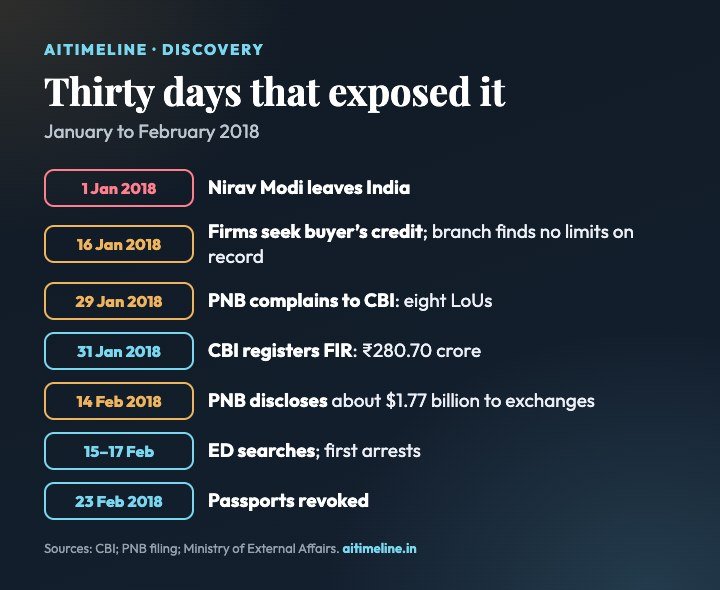
Thirty Days in 2018
From a routine credit request to revoked passports.
What Evidence Supports the Case?
Different kinds of material, with different legal weight.
SWIFT messages without CBS entries
The core of the prosecution: guarantees the bank sent but never booked.
150 LoUs in 2017
The CBI’s May 2018 allegation of LoUs issued without limits or margin to three firms.
PNB’s 162-page report
Evidence of control failures across levels. It is not a criminal finding against the 54 officials named.
Overseas entities
The ED alleges funds moved through companies in places including Hong Kong and Dubai.
Prima facie, not guilt
The UK courts found a case to answer. No court has yet tried the charges.
Attachment and restoration
Securing assets for banks does not decide the criminal charges.
The Money: Why the Figures Differ
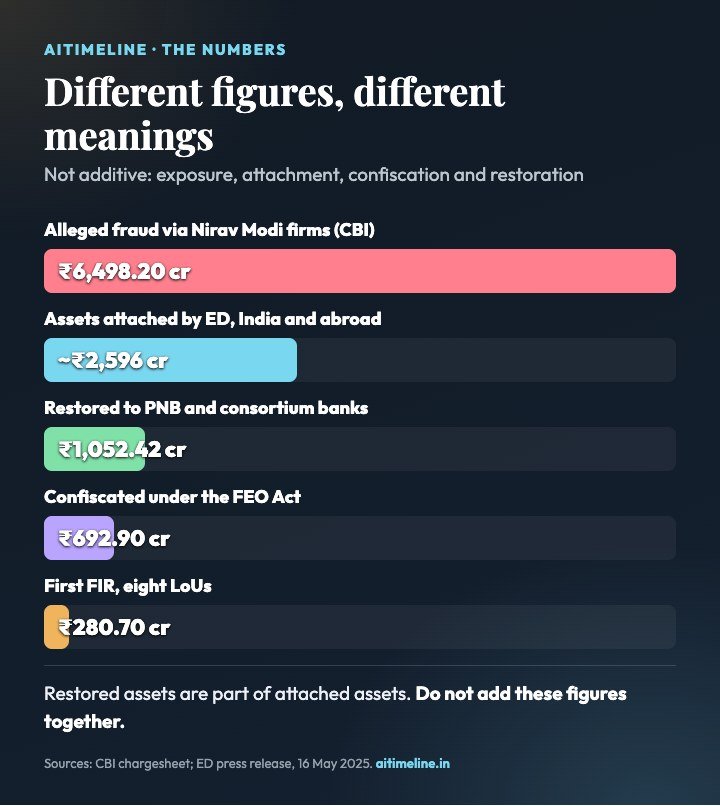
Exposure, charges, attachment, confiscation and restoration are different things.
| Figure | What it refers to |
|---|---|
| ₹280.70 crore | Eight LoUs in the first CBI FIR, 31 January 2018 |
| ₹6,498.20 crore | Alleged fraud through Nirav Modi’s three firms, CBI chargesheet, May 2018; the base of the ED’s case |
| ~US$1.77 billion (~₹11,400 crore) | PNB’s first public estimate, 14 February 2018, covering both groups |
| ₹7,080.86 crore | Alleged fraud through Mehul Choksi’s companies (separate case), later revised to ₹6,344.96 crore |
| ~₹13,000 crore | Commonly cited combined figure for the two groups |
| ~₹2,596 crore | Assets attached by the ED in India and abroad, May 2025 |
| ₹692.90 crore | Confiscated under the Fugitive Economic Offenders Act, May 2025 |
| ₹1,052.42 crore | Restored to PNB and consortium banks by May 2025 |
| ₹66.33 crore | Further attached property released to PNB, June 2025 |
| ₹321.88 crore | A separate PNB complaint sent to a magistrate in June 2026 |
The table is the honest answer to “how big was the PNB scam?”. The amount alleged, the amount secured and the amount handed back are three different numbers, and the last is far smaller than the first.
The Extradition Fight
Eight years from request to, so far, no handover.
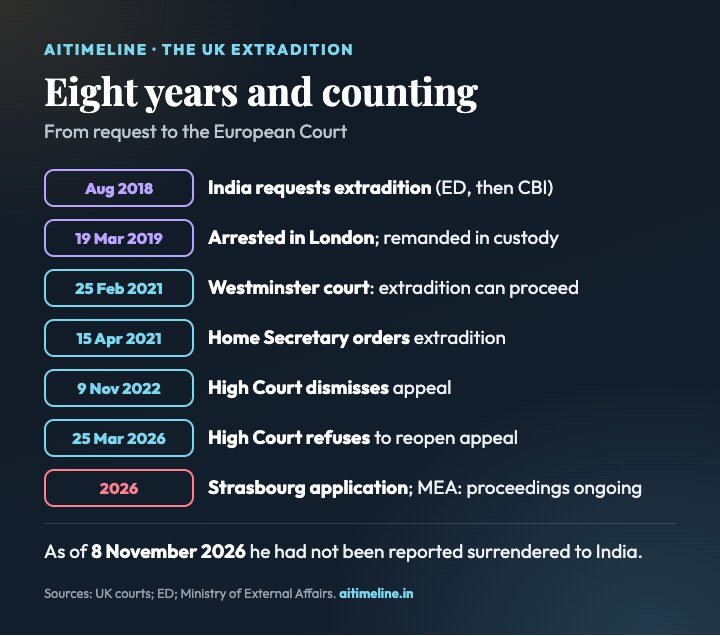
Modi has used almost every route British law offers: the magistrates’ court, the Home Secretary, a High Court appeal, an attempt to reach the Supreme Court, repeated bail applications, a bid to reopen the appeal and, reportedly, an application in Strasbourg. Each was decided against him. What has kept him in London is the length of the process, not any finding in his favour.
What Is the Legal Position?
Several cases, each with its own evidence and outcome.
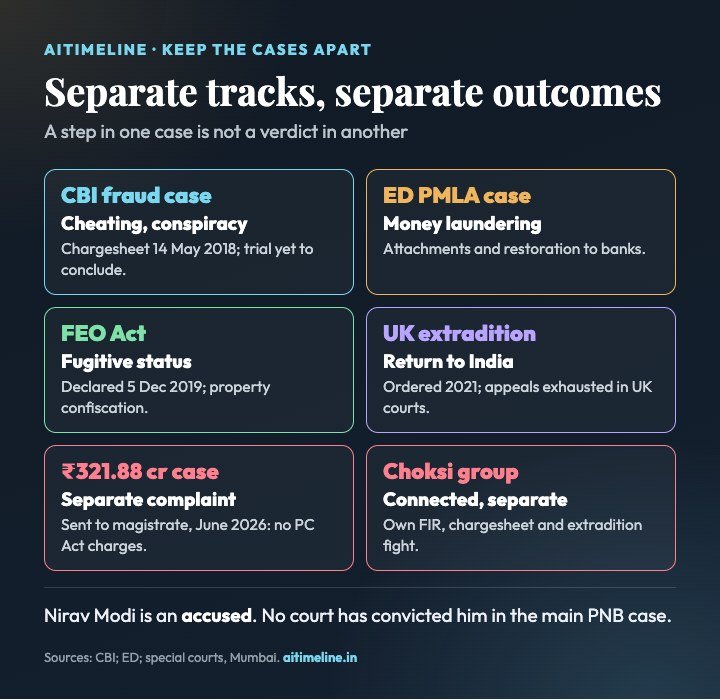
| Track | What it decides | Status, November 2026 |
|---|---|---|
| CBI fraud case | Cheating, conspiracy and corruption charges | Pending before the special court, Mumbai |
| ED PMLA case | Money laundering; attachment of proceeds | Pending; assets attached and partly restored |
| FEO Act | Fugitive status; confiscation | Declared 5 December 2019 |
| UK extradition | Whether he is returned to India | Ordered; no surrender reported |
| ₹321.88-crore case | Separate complaint | With a magistrate; no corruption charges |
| Choksi group case | Connected fraud by Gitanjali companies | Separate; Choksi faces extradition in Belgium |
Impact on India’s Banking System
LoUs abolished
The RBI ended LoUs and Letters of Comfort for import trade credit on 13 March 2018.
SWIFT linked to CBS
Banks were pushed to integrate SWIFT with core banking and reconcile every message.
Beyond one branch
The internal report blamed 54 officials, from clerks to regional heads.
Fugitive economic offenders
The 2018 Act gave the state a way to confiscate property of accused who stay abroad.
Confidence and capital
The loss hit PNB’s results and renewed questions about governance in state-owned banks.
Assets abroad
Recovery depended on foreign courts, Interpol and treaty requests, all slow.
Lessons for Bank Controls
- Segregation of duties: the person who creates a SWIFT message should not be the one who authorises it.
- Daily reconciliation: every outgoing SWIFT commitment should match a CBS entry.
- Staff rotation: officials in sensitive posts should not stay for years at one desk.
- Audit follow-up: observations carried forward without action are a warning, not paperwork.
- Exception monitoring: repeated rollovers for one customer should trigger review.
- Star-branch scepticism: unusually high business from a few accounts deserves more scrutiny, not less.
Key People and Institutions
Nirav Modi
Diamond merchant whose three firms received the LoUs; in UK custody since 2019.
Mehul Choksi
Modi’s uncle and head of the Gitanjali group, charged in a connected case.
Gokulnath Shetty
Accused of issuing the LoUs; on bail since February 2024.
Manoj Kharat
Arrested with Shetty on 17 February 2018.
CBI and ED
The CBI handles the fraud case; the ED the money-laundering and confiscation cases.
Reserve Bank of India
Abolished the LoU route for import trade credit in March 2018.
Explore More Timelines
People Also Ask
Frequently Asked Questions
Checked against court records, agency statements and contemporary reporting.
⚠️ Editorial Note
Nirav Modi is described here as an accused. As of 8 November 2026 he had not been tried or convicted in the main PNB case, and the CBI and ED cases remained pending. Arrests, chargesheets, internal reports, fugitive declarations and asset orders are separate from a verdict, and this page keeps them apart. The Nirav Modi case is also kept separate from the connected Mehul Choksi case. Checking the brief this page began from: the Interpol Red Notice was dated 29 June 2018, not 2 June; India’s extradition requests went in August 2018, not 27 July; the Fugitive Economic Offenders Act became law on 31 July 2018 after an April ordinance; the 150-LoU allegation comes from the CBI’s May 2018 chargesheet, not a 2023 Delhi High Court judgment; the June 2025 release to PNB was ₹66.33 crore, not ₹60.33 crore; the ₹321.88-crore case was transferred on 11 June 2026; and figures attributed to an ED annual report for 2025–26 could not be found, so the ED’s May 2025 figures are used instead. Reports in July 2026 of a final European Court of Human Rights rejection rely on unnamed sources and are treated as unconfirmed.
Related Reading on AiTimeline
Sources & further reading
Every dated entry above was checked against these references. Last reviewed 8 November 2026.
- Enforcement Directorate press release: UK High Court rejects Nirav Modi's bail application; assets restored to victim banks (16 May 2025)
- BAILII: Modi v Government of India [2026] EWHC 716 (Admin), 25 March 2026 (application to reopen extradition appeal refused)
- Judiciary of England and Wales: Modi v Government of India
- SCC Online Blog: Why the UK High Court refused to reopen Nirav Modi's extradition case (27 March 2026)
- Scroll / Reuters: PNB fraud went undetected due to widespread systemic lapses for years (internal report, June 2018)
- Reserve Bank of India notification: Discontinuance of Letters of Undertaking (LoUs) and Letters of Comfort (LoCs) for Trade Credits (13 March 2018)
- Millennium Post: CBI files charge sheet in Nirav Modi case, names PNB ex-chief and senior officials (May 2018)
- LiveLaw: Bombay High Court grants bail to Gokulnath Shetty, prime accused in PNB fraud case, citing long incarceration (February 2024)
- ETV Bharat / PTI: CBI finds no evidence of corruption in case involving Nirav Modi; transferred to magistrate (June 2026)
- Free Press Journal: Special PMLA court allows release of Nirav Modi and sister's Rs 66.33 crore attached properties to PNB (June 2025)
- Deccan Herald: Interpol issues Red Corner Notice against Nirav Modi (July 2018)
- Business Standard / PTI: Passports of Nirav Modi, Mehul Choksi revoked (February 2018)
- The Tribune: Nirav Modi's extradition to happen after ongoing legal proceedings end, says MEA (July 2026)