Coalgate: How India’s Coal Allocation Controversy Changed the Rules
Explore the Coalgate timeline, CAG's ₹1.86 lakh crore estimate, Supreme Court's 2014 coal-block cancellations, CBI investigations, trials and impact.
Latest Story
Between 1993 and 2011 the Union government handed out more than 200 coal blocks to companies without auctions. In 2012 the Comptroller and Auditor General estimated that private allottees stood to gain about ₹1.86 lakh crore. In 2014 the Supreme Court declared the allocations arbitrary and illegal and cancelled 214 of them. This timeline of the coal allocation scam, popularly called Coalgate, follows the audit, the court rulings, the move to auctions and the criminal trials that are still running in 2026, including the closure of the case against former Prime Minister Manmohan Singh in July 2026.
29 July 2026: the Supreme Court accepted the CBI’s closure reports in the Talabira II case and set aside the 2015 order summoning Manmohan Singh. July 2026: it allowed appeals against coal-case convictions and acquittals in the Delhi High Court. 19 August 2026: it told the High Court not to stay trials and to decide appeals within about four weeks. Jump to the latest entries.
💡 Short Answer
Coalgate is the controversy over coal blocks allotted without auctions from 1993 to 2011. The CAG estimated ₹1.86 lakh crore in potential gains to private allottees in 2012, an audit estimate rather than a proven loss. On 25 August 2014 the Supreme Court held the allocations arbitrary and illegal and later cancelled 214 of 218. Criminal cases are decided block by block: some ended in convictions, others in acquittals.
Coal Allocation Scam: Key Questions
Coalgate in Ten Points
- The system: captive coal blocks were allotted from 1993 without auctions.
- The delay: competitive bidding was proposed in June 2004 but never introduced before 2014.
- The audit: the CAG’s August 2012 report estimated ₹1.86 lakh crore in gains to private allottees.
- Not a theft figure: the estimate measured potential gain, not money proved stolen.
- The CBI row: the agency admitted sharing its draft report with the Law Minister, who resigned in May 2013.
- The ruling: on 25 August 2014 the Supreme Court declared the allocations arbitrary and illegal.
- The cancellation: 214 of 218 allocations went on 24 September 2014, with a ₹295-a-tonne levy.
- The new law: auctions under the Coal Mines (Special Provisions) Act, 2015.
- The trials: Madhu Koda, H.C. Gupta, Dilip Ray and Vijay Darda were convicted in specific cases; others were acquitted.
- 2026: the case against Manmohan Singh was closed, and appeals were opened to the Delhi High Court.
The ₹1.86 Lakh Crore Figure: An Estimate, Not a Proven Loss
The single most misquoted number in the story.
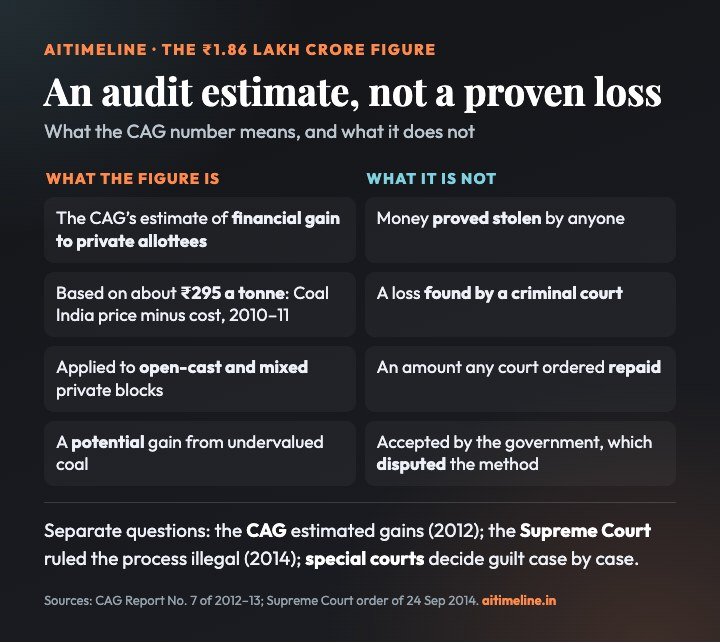
The CAG’s Report No. 7 of 2012–13, tabled on 17 August 2012, worked out a per-tonne gain: Coal India’s average sale price in 2010–11 minus the average cost of production, which came to about ₹295 a tonne. Applied to the extractable reserves of open-cast and mixed blocks held by private companies, that gave roughly ₹1.86 lakh crore. The report said only part of that gain could have reached the exchequer even if blocks had been auctioned.
A draft version leaked in March 2012 had put the figure at about ₹10.67 lakh crore on a far wider basis, which is one reason the final number was attacked from both sides. The government contested the method; the CAG stood by it. What matters for readers is that three questions were answered by three different bodies: the CAG estimated the cost of the policy, the Supreme Court judged whether the process was lawful, and the special courts decide, one block at a time, whether anyone committed a crime.
The 2026 Rulings: Where Coalgate Stands Now
Three Supreme Court orders in five weeks changed the shape of the remaining cases.
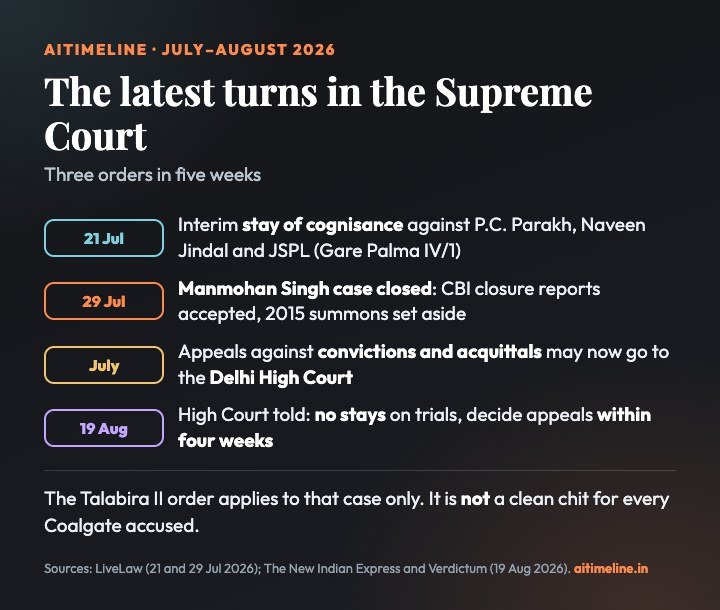
On 29 July 2026 a bench of Chief Justice Surya Kant and Justices Joymalya Bagchi and V. Mohana set aside the special court’s March 2015 order that had taken cognisance against Manmohan Singh, Kumar Mangalam Birla, P.C. Parakh and three others in the Talabira II case. The bench said it had examined both CBI closure reports and found no compelling reason for the trial court to reject them. Singh had died on 26 December 2024; his appeal was decided on its merits.
The same month, the court relaxed the arrangement it had imposed in 2014, under which challenges to the special court’s orders could only be brought to the Supreme Court. Appeals against convictions and acquittals can now be heard by the Delhi High Court. On 19 August 2026 the bench added that the High Court must not stay coal-case trials and should decide pending appeals preferably within four weeks, noting it had expressed no view on the merits of any case.
Timeline: The Coal Allocation Scam, 1992 to 2026
Newest first. Colour shows the type of event.
Where things stand Supreme Court
The allocations: Settled. The Supreme Court’s 2014 finding that the Screening Committee and government-dispensation routes were arbitrary and illegal stands, and coal mines are now allotted under the Coal Mines (Special Provisions) Act, 2015.
The criminal cases: Still open. The CBI filed 57 coal-block cases, and the Enforcement Directorate brought money-laundering cases on top. Some ended in convictions, others in acquittals or discharges, and several are at trial or on appeal before the Delhi High Court.
Supreme Court: no stays on trials, decide appeals in four weeks Supreme Court
What happened: Told that some accused had gone to the Delhi High Court and others to the Supreme Court, the bench directed that the High Court grant no interim stay of coal-scam trials and decide pending appeals and petitions preferably within four weeks.
Why it matters: It keeps the trials moving after the court opened the High Court route a month earlier, while giving the accused a quick hearing.
Supreme Court closes the case against Manmohan Singh Supreme Court
What happened: The court accepted the CBI’s closure reports in the Talabira II case and set aside the special court’s March 2015 order that had summoned former Prime Minister Manmohan Singh and five others. It found no compelling reason for the trial court to have rejected the closure reports and taken cognisance.
The context: Singh had challenged the summons in 2015 and the Supreme Court stayed it on 1 April 2015. He died on 26 December 2024; the court decided the appeal he had filed in his lifetime.
Appeals against verdicts can go to the Delhi High Court Supreme Court
What changed: Since 2014 the Supreme Court had routed challenges to the special coal court’s orders only to itself, to stop the trials being stalled. In July 2026 it allowed both the prosecution and the accused to appeal convictions and acquittals in the Delhi High Court.
What did not: Challenges to orders on framing of charges, quashing and bail still have to be filed in the Supreme Court, according to reports of the modified order.
Supreme Court stays cognisance against P.C. Parakh, Naveen Jindal Supreme Court
What happened: The court granted an ad-interim stay of a special judge’s 1 June 2026 order taking cognisance against former Coal Secretary P.C. Parakh, Jindal Steel & Power, its chairman Naveen Jindal and others.
Status: Interim only. The stay continues until further orders; no finding of guilt or innocence has been made.
SKS Ispat and four others acquitted Trial verdicts
The verdict: The court acquitted SKS Ispat & Power Ltd and four individuals of cheating and criminal conspiracy, holding that suspicion could not take the place of proof beyond reasonable doubt.
Who was cleared: They included the company’s managing director Anil Gupta and designated director Sudhir Kumar Sahay. Sahay is the brother of former Union minister Subodh Kant Sahay, who was not an accused.
Bander case: all accused acquitted Trial verdicts
The verdict: The court acquitted former Rajya Sabha MP Vijay Darda, his son Devendra Darda, Manoj Kumar Jayaswal, AMR Iron & Steel and former Coal Secretary H.C. Gupta, finding “no iota of evidence” of criminality or undue influence in the allocation.
Why it matters: It was the oldest pending coal-block case, registered in 2012. Gupta, whom the court had summoned despite a CBI closure report, was described as honourably acquitted.
New special judge for the coal cases Supreme Court
What happened: On the Delhi High Court’s request, the Supreme Court appointed Delhi Higher Judicial Service officer Sunena Sharma as special judge for the coal-block cases, replacing Sanjay Bansal, who had heard them for about four and a half years.
The set-up: She shares the remaining trials with Special Judge Dheeraj Mor. The court’s order spells her name “Sunaina”.
Former Coal Secretary H.C. Gupta discharged in Fatehpur East case Trial verdicts
The order: The court discharged H.C. Gupta, former Joint Secretary K.S. Kropha, RKM Powergen and two of its directors, holding there was not “an iota of material” that the officials acted against the public interest when the Screening Committee recommended the company.
The pattern: It was the fourth recent case in which Gupta and Kropha secured relief. Gupta also has convictions in other blocks, under appeal.
A second special judge for the coal trials Supreme Court
What happened: The Supreme Court designated Dheeraj Mor as a special judge for the coal-block cases, alongside Sanjay Bansal, whose tenure it extended, to speed up the remaining trials.
Manmohan Singh dies Investigation & politics
What happened: The former Prime Minister died with his 2015 challenge to the special court’s summons still before the Supreme Court, which had stayed the summons since April 2015.
Odisha blocks case: officials and company acquitted Trial verdicts
The verdict: The court acquitted H.C. Gupta, K.S. Kropha, K.C. Samria, Navabharat Power and its promoters, holding that the CBI had not proved any misrepresentation about the company’s net worth or land holdings.
A distinction: The court said the officials might be administratively liable, but were not criminally liable.
Vijay Darda and son sentenced to four years Trial verdicts
The verdict: Former Rajya Sabha MP Vijay Darda, his son Devendra Darda and Manoj Kumar Jayaswal of JLD Yavatmal Energy were sentenced to four years for cheating and conspiracy. H.C. Gupta, K.S. Kropha and K.C. Samria received three years.
The finding: The court held that the company had misrepresented facts to secure the block. JLD Yavatmal was fined Rs 50 lakh.
Dilip Ray sentenced to three years Trial verdicts
The verdict: Special Judge Bharat Parashar sentenced former Minister of State for Coal Dilip Ray, who served in the Vajpayee government, and two former Coal Ministry officials to three years for conspiracy and other offences over the 1999 allocation to Castron Technologies.
Next day: On 27 October 2020 the Delhi High Court suspended the sentence and granted bail pending appeal. It did not stay the conviction.
Former Coal Secretary H.C. Gupta jailed for three years Trial verdicts
The verdict: Gupta, K.S. Kropha and K.C. Samria were sentenced to three years in the case involving Vikash Metals and Power. The company’s managing director received four years.
Madhu Koda sentenced to three years Trial verdicts
The verdict: Former Jharkhand Chief Minister Madhu Koda, his aide Vijay Joshi, former Coal Secretary H.C. Gupta and former Jharkhand Chief Secretary A.K. Basu were sentenced to three years over the allocation to Vini Iron and Steel Udyog. Koda was fined Rs 25 lakh.
Afterwards: The Delhi High Court refused to stay Koda’s conviction, and the Supreme Court declined to interfere, which kept him out of elections.
First conviction of public servants Trial verdicts
The verdict: H.C. Gupta and two other former Coal Ministry officials became the first public servants convicted in a coal-block case, and were sentenced to two years. Gupta appealed.
First conviction in the coal-block cases Trial verdicts
The verdict: Jharkhand Ispat Pvt Ltd and its directors R.S. Rungta and R.C. Rungta were convicted of cheating and conspiracy. The Rungtas were later sentenced to four years.
The first coal-mine auctions Policy & auctions
What happened: The Coal Ministry e-auctioned cancelled blocks in two tranches. By the end of March 2015, 29 mines had been auctioned and the government projected large revenues for the coal-bearing states over the life of the mines.
The audit: The CAG later reviewed these auctions in its Report No. 20 of 2016.
Coal Mines (Special Provisions) Act becomes law Policy & auctions
What happened: Parliament replaced the two ordinances with an Act, which received the President’s assent on 30 March 2015. It provides for allocating the cancelled mines by auction or by allotment to government companies.
The schedule: Schedule I lists the 204 coal mines covered by the Supreme Court’s cancellation, in the government’s block-wise count.
Supreme Court stays the summons to Manmohan Singh Supreme Court
What happened: On petitions by Singh and the other accused, the Supreme Court stayed the trial court’s summons and the proceedings against them. The stay lasted more than 11 years.
Special court summons a former Prime Minister Investigation & politics
What happened: Rejecting the CBI’s closure report, the court summoned Manmohan Singh, who held the Coal portfolio in 2005, Kumar Mangalam Birla, P.C. Parakh, Hindalco and two of its officials as accused over the allocation of Talabira II.
Status: A summons is a decision that there is enough to proceed, not a finding of guilt.
Ordinance to re-allot the cancelled blocks Policy & auctions
What happened: The government issued an ordinance to take over the cancelled blocks and allocate them afresh by auction and allotment, and re-promulgated it on 26 December after the Bill did not pass in the winter session.
Supreme Court cancels 214 of 218 allocations Supreme Court
The order: The court cancelled all allocations examined except four: two Ultra Mega Power Project blocks of Sasan Power, NTPC’s Pakri Barwadih and SAIL’s Tasra. In the government’s block-wise count, 204 of 218 blocks were cancelled.
The levy: For 42 producing or nearly producing blocks, cancellation took effect from 31 March 2015. All allottees that had mined coal had to pay an additional levy of Rs 295 per tonne, a figure taken from the CAG report.
Supreme Court: allocations arbitrary and illegal Supreme Court
The holding: Every allocation since 1993 through the Screening Committee and the government-dispensation route was declared arbitrary and illegal. The Screening Committee had not followed any consistent, objective or transparent method and had not compared applicants.
What it did not decide: The court did not hold any allottee or official criminally guilty. Criminality was left to the CBI investigations and the special court.
A special court for the coal cases Supreme Court
What happened: The Supreme Court designated a special judge in Delhi to try all coal-block cases and barred other courts from staying the investigations or trials.
FIR names Kumar Mangalam Birla and P.C. Parakh Investigation & politics
The allegation: The CBI alleged that Parakh, then Coal Secretary, changed an earlier decision to give Talabira II to Neyveli Lignite and allowed Hindalco to share the block in 2005. Reports date the FIR to 14 or 15 October 2013.
The response: Parakh said that if there was a conspiracy, the Prime Minister, who approved the decision, would also be part of it. The Prime Minister’s Office defended the decision as made on merits.
FIR against Naveen Jindal and Dasari Narayana Rao Investigation & politics
The allegation: The CBI registered a case alleging irregularities in an allocation to Jindal Steel & Power and Gagan Sponge. Congress MP Naveen Jindal and former Minister of State for Coal Dasari Narayana Rao were named.
Law Minister Ashwani Kumar resigns Investigation & politics
What happened: A second CBI affidavit on 6 May said changes had been made to the draft status report after meetings with the Law Minister and officials of the PMO and the Coal Ministry. Kumar resigned on the night of 10 May.
CBI admits sharing its report with the government Investigation & politics
What happened: Sinha told the Supreme Court that the draft of the 8 March status report had been shared with Law Minister Ashwani Kumar, as he wished, and with officials of the PMO and the Coal Ministry.
Why it matters: The court had been told the report was not shared. The disclosure became a debate about the CBI’s independence.
Parliamentary committee calls allocations illegal Audit & Parliament
The finding: The committee said coal blocks had been allocated in an “unauthorised” and illegal manner between 1993 and 2010 and recommended cancelling blocks that had not started production.
Supreme Court issues notice on the coal PIL Supreme Court
What happened: The court issued notice to the Union on a petition seeking to quash allocations since 1993 and asked the Coal Secretary to answer questions on how blocks were allotted. A Common Cause petition followed in November 2012.
Monitoring: From 2013 the court received CBI status reports and monitored the investigation.
CBI registers its first coal FIRs Investigation & politics
What happened: After a preliminary enquiry on the CVC’s reference, the CBI registered its first FIRs against companies alleged to have misrepresented facts to obtain blocks, including AMR Iron & Steel over the Bander block.
CAG report tabled: Rs 1.86 lakh crore estimate Audit & Parliament
What it said: The CAG estimated the financial gain to private allottees from 57 blocks at about Rs 1.86 lakh crore and criticised the delay in introducing competitive bidding, first proposed in 2004.
What it did not say: It did not say that the money had been stolen or that it was a proven loss to the exchequer. The government disputed the method.
CVC refers the allegations to the CBI Investigation & politics
What happened: The CVC asked the CBI to examine allegations that companies had obtained blocks by misrepresenting their eligibility.
Draft CAG figure of Rs 10.67 lakh crore leaks Audit & Parliament
What happened: A newspaper reported a draft CAG estimate of about Rs 10.67 lakh crore in windfall gains. The CAG said the figure was preliminary, and the final report of August 2012 used a much narrower basis.
Advertisements and peak allocations Policy & auctions
What happened: With demand for coal rising, the Coal Ministry advertised blocks in September 2005 and again in 2006, when 38 blocks were put up and 15 reserved for power. The Screening Committee recommended large numbers of allottees in these years.
The flaw: The Supreme Court later found the committee had not recorded comparative evaluation of applicants or applied consistent criteria.
Competitive bidding first proposed Policy & auctions
What happened: The Coal Ministry proposed allocating blocks by competitive bidding. States raised objections, and departments debated whether the law had to be amended first.
What followed: Bidding was not introduced. Parliament amended the mining law in 2010, but no auction was held before the Supreme Court’s 2014 ruling.
Captive allocations to private companies begin Policy & auctions
What happened: After the law was opened up to captive mining for specified end uses, the government began allotting blocks to private and public companies through the Screening Committee, without auctions.
Screening Committee set up Policy & auctions
What happened: The Coal Ministry constituted the Screening Committee to consider applications for captive coal blocks.
How Coal Blocks Were Handed Out
Twenty-two years from a screening committee to the first auction.
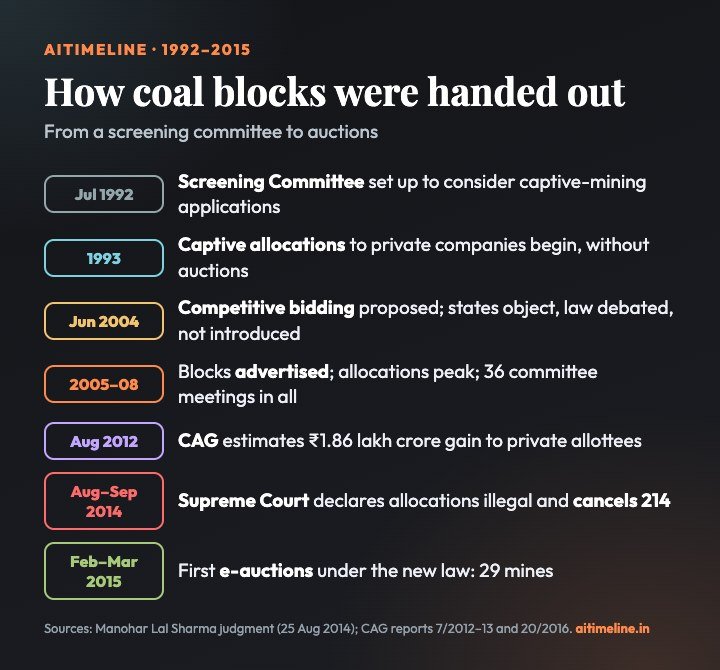
India nationalised coal mining in the early 1970s. In 1993 the law was amended to let companies mine coal for their own power, steel and cement plants, and the Screening Committee the Coal Ministry had set up on 14 July 1992 began recommending allottees. As demand rose, the ministry advertised blocks in September 2005 and again in 2006, when 38 blocks were put up. The Supreme Court later divided the committee’s 36 meetings to 2008 into four periods and found the same defects throughout: no recorded comparison of applicants and no consistent criteria.
The proposal to auction blocks, first mooted in June 2004 when P.C. Parakh was Coal Secretary, ran into objections from coal-bearing states and a debate over whether the law needed changing. Parliament amended the mining law in 2010, but no auction had taken place when the Supreme Court ruled in 2014. Manmohan Singh held the Coal portfolio for much of 2004–2009, which is why the controversy fell heavily on his government. The topic links to India’s wider coal and power story.
Why the Supreme Court Cancelled the Allocations
A judgment on process in August, an order on consequences in September.

| Issue | What the court found |
|---|---|
| Transparency | No open, recorded process for choosing among applicants |
| Objectivity | No consistent criteria applied across the 36 Screening Committee meetings |
| Comparison | Applicants were not evaluated against one another |
| Government dispensation | Allocations to state companies for commercial use with private partners were not legally permissible |
| Natural resources | Public resources must be distributed fairly and in the public interest |
| Consequence | 214 of 218 allocations cancelled; ₹295 a tonne levy; 42 blocks given until 31 March 2015 |
Why do some sources say 204 blocks and others 214? The court’s order and most reporting counted 214 cancelled allocations out of 218. The government’s statement to Parliament of 1 December 2014 counted blocks, set aside 12 Ultra Mega Power Project blocks and said 204 of 218 blocks were cancelled; the 2015 Act lists 204 mines. Both describe the same order. Neither is a criminal finding: the court left criminality to the CBI and the special court.
Three Tracks: Audit, Constitution, Crime
Why an illegal process did not make every allottee a criminal.
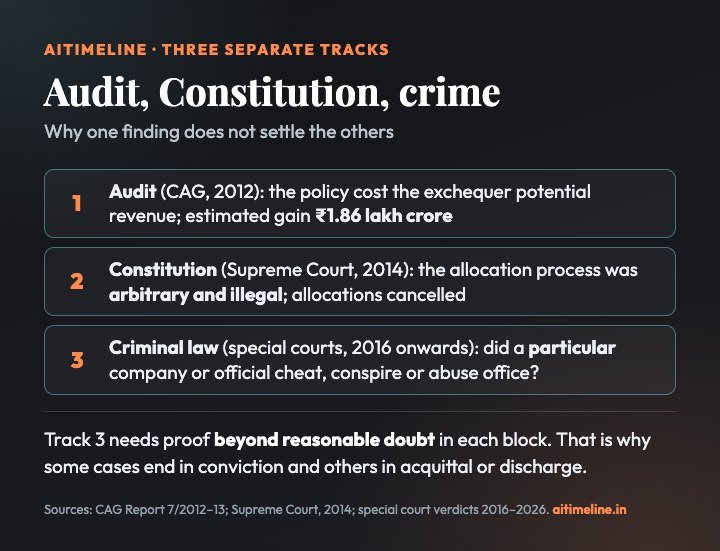
Readers often treat the CAG figure, the 2014 judgment and the criminal verdicts as one story with one ending. They are not. An allocation can be unlawful as a matter of public law, because the process was arbitrary, without anyone having committed a crime in obtaining it. To convict, a special court needs evidence of something more specific: false statements about net worth or land, a quid pro quo, or an official dishonestly favouring an applicant. That explains why the same former Coal Secretary, H.C. Gupta, has been convicted in some blocks and acquitted or discharged in others.
Trial Outcomes: Convictions, Acquittals and Discharges
A selection of verdicts from the CBI’s 57 coal-block cases.
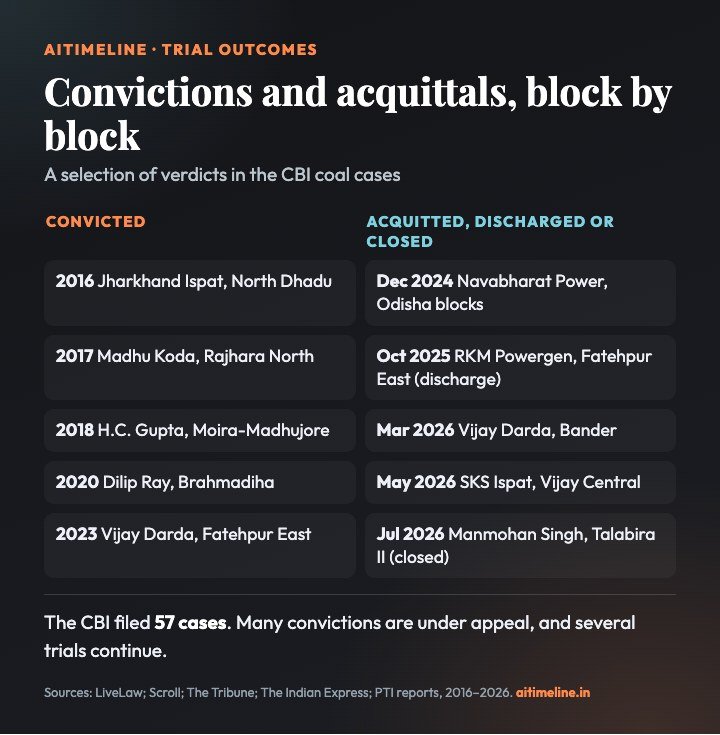
| Date | Block | Main accused | Outcome |
|---|---|---|---|
| 28 Mar 2016 | North Dhadu, Jharkhand | Jharkhand Ispat; R.S. and R.C. Rungta | Convicted (first coal-case verdict) |
| 13–16 Dec 2017 | Rajhara North, Jharkhand | Madhu Koda, H.C. Gupta, A.K. Basu | Convicted; 3 years |
| 30 Nov – 5 Dec 2018 | Moira and Madhujore, West Bengal | H.C. Gupta, K.S. Kropha, K.C. Samria | Convicted; 3 years |
| 6–26 Oct 2020 | Brahmadiha, Jharkhand | Dilip Ray | Convicted; 3 years, suspended on appeal |
| 13–26 Jul 2023 | Fatehpur East, Chhattisgarh | Vijay Darda, Devendra Darda, H.C. Gupta | Convicted; 4 and 3 years |
| 11 Dec 2024 | Rampia and Mandakini, Odisha | Navabharat Power, H.C. Gupta | Acquitted |
| 31 Oct 2025 | Fatehpur East, Chhattisgarh | RKM Powergen, H.C. Gupta, K.S. Kropha | Discharged |
| 27 Mar 2026 | Bander, Maharashtra | Vijay Darda, AMR Iron & Steel, H.C. Gupta | Acquitted |
| 27 May 2026 | Vijay Central, Chhattisgarh | SKS Ispat & Power | Acquitted |
| 29 Jul 2026 | Talabira II, Odisha | Manmohan Singh, K.M. Birla, P.C. Parakh | Summons set aside; closure accepted |
Fatehpur East appears twice because several companies shared the block: JLD Yavatmal Energy’s case ended in convictions in 2023, while RKM Powergen’s ended in a discharge in 2025. Convictions are not final while appeals are pending, and acquittals can be challenged by the CBI. For other long-running cases built on allegations of corruption, see our timelines of the Bofors case and the spectrum auctions that followed the 2G controversy.
The CBI Status-Report Row
How the investigation itself became a scandal in 2013.
From March 2013 the Supreme Court was reading CBI status reports on the coal investigation. On 26 April 2013 CBI Director Ranjit Sinha filed an affidavit admitting that the draft of the 8 March report had been shared with Law Minister Ashwani Kumar and officials of the Prime Minister’s Office and the Coal Ministry. A second affidavit on 6 May said changes had been made after those meetings. On 8 May the court called the CBI a “caged parrot”, and on 10 May Kumar resigned, on the same day as Railway Minister Pawan Bansal, who quit over an unrelated bribery case. The episode became a lasting reference point in debates over the agency’s independence.
Impact: What Coalgate Changed
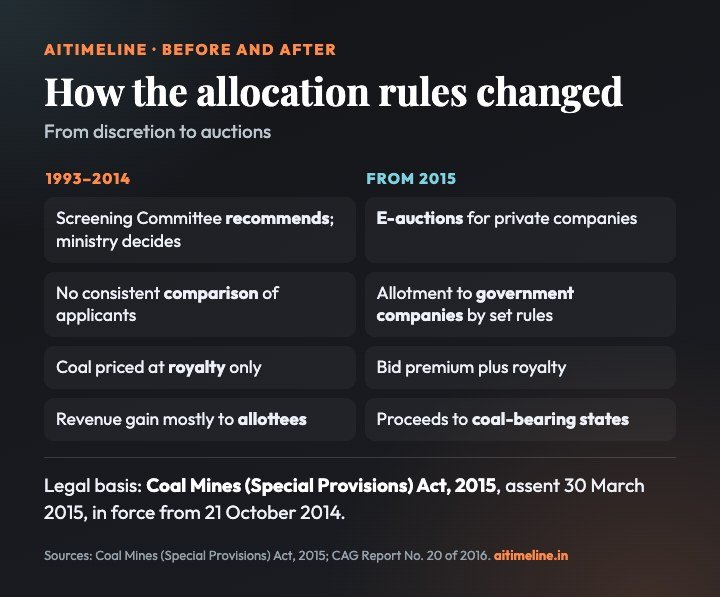
- Auctions became the rule: the 2015 Act replaced discretion with e-auctions and set allotment rules for government companies.
- States gained revenue: auction proceeds flow to coal-bearing states such as Jharkhand, Odisha and Chhattisgarh.
- A natural-resources precedent: the 2014 judgment, with the 2G ruling of 2012, shaped how courts view the distribution of scarce public resources.
- Disruption for industry: power, steel and cement makers lost captive supply and had to bid again; some blocks took years to restart.
- Investigative independence: the status-report affair intensified scrutiny of the CBI’s relationship with the government.
- Political cost: Coalgate became, with 2G, a core part of the 2014 election campaign against the UPA government.
- Slow justice: fourteen years after the CAG report, trials and appeals are still running.
Key People and Institutions
| Person or body | Role |
|---|---|
| Manmohan Singh | Prime Minister; held the Coal portfolio for much of 2004–2009; summoned in 2015, case closed by the Supreme Court on 29 July 2026 |
| P.C. Parakh | Coal Secretary 2004–2005; proposed competitive bidding; named in the Talabira II and Gare Palma IV/1 cases |
| H.C. Gupta | Coal Secretary 2005–2008 and Screening Committee chair; convicted in several cases, acquitted or discharged in others |
| Kumar Mangalam Birla | Aditya Birla Group chairman; named in the Talabira II FIR; proceedings set aside in 2026 |
| Naveen Jindal | JSPL chairman; named in CBI cases; cognisance in one case stayed in July 2026 |
| Madhu Koda | Former Jharkhand Chief Minister; convicted in the Rajhara North case, 2017 |
| Dilip Ray | Minister of State for Coal in 1999; convicted in the Brahmadiha case, 2020 |
| Vijay Darda | Former Rajya Sabha MP; convicted in Fatehpur East (2023), acquitted in Bander (2026) |
| Ashwani Kumar | Law Minister; resigned 10 May 2013 over the CBI status report |
| Ranjit Sinha | CBI Director; his April 2013 affidavit disclosed the report-sharing |
| CAG (Vinod Rai) | Audited allocations; estimated ₹1.86 lakh crore in gains (2012) |
| Supreme Court | Declared allocations illegal (2014), cancelled them, set up and supervised the special court |
Explore More Timelines
People Also Ask
Frequently Asked Questions
Based on the CAG report, Supreme Court records and reporting to 12 November 2026.
⚠️ Editorial Note
This timeline separates audit observations, political allegations, investigative steps and judicial findings. The CAG’s ₹1.86 lakh crore is described as an estimate of potential gains, not proven theft. The Supreme Court’s finding on the allocation process is kept apart from criminal verdicts in individual cases; being named in an FIR or summoned is not a finding of guilt. We corrected several points found in earlier summaries: the court cancelled 214 of 218 allocations (204 blocks in the government’s count); the Coal Mines (Special Provisions) Act received assent on 30 March 2015, replacing ordinances of October and December 2014; Dilip Ray’s case concerned the Brahmadiha block and he was sentenced on 26 October 2020; and the Fatehpur East discharge of H.C. Gupta and K.S. Kropha was ordered on 31 October 2025 and reported in early November, not in April 2025. Reports date the Birla FIR to 14 or 15 October 2013. The date of the July 2026 order opening appeals to the Delhi High Court was not reported.
Related Reading on AiTimeline
Sources & further reading
Every dated entry above was checked against these references. Last reviewed 12 November 2026.
- CAG Report No. 7 of 2012-13: Performance Audit of Allocation of Coal Blocks and Augmentation of Coal Production
- Manohar Lal Sharma v. Principal Secretary: Supreme Court judgment of 25 August 2014
- Manohar Lal Sharma v. Principal Secretary: Supreme Court order of 24 September 2014 on cancellation
- Allocation of Coal Blocks: government statement, 1 December 2014
- The Coal Mines (Special Provisions) Act, 2015
- CAG compliance audit on e-auction of coal mines (Report No. 20 of 2016), Chapter 1
- Supreme Court accepts CBI's clean chit to ex-PM Manmohan Singh in coal block case, sets aside summoning order (29 July 2026)
- Coal scam cases: SC asks Delhi HC to avoid trial stays, decide appeals in four weeks (19 August 2026)
- Coal scam cases: SC asks Delhi HC not to stay trials, dispose of appeals in four weeks
- Supreme Court stays cognizance against former Coal Secretary, Naveen Jindal, JSPL in coal block allocation case (21 July 2026)
- Supreme Court appoints new judge for trial of coal blocks allocation scam cases (12 January 2026)
- Delhi court discharges ex-Secretary in Fatehpur East coal block allocation case (4 November 2025)
- 'No iota of evidence': Delhi court acquits all in Bander coal block case (27 March 2026)
- Coal scam: Delhi court awards 4-year jail to ex-MP Vijay Darda, son (26 July 2023)
- Former NDA minister Dilip Ray, others convicted in Jharkhand coal scam (6 October 2020)
- Coal scam: CBI court sentences former Jharkhand CM Madhu Koda, 3 others to three years in jail (16 December 2017)
- Delhi court acquits ex-coal secretary, two other bureaucrats in Odisha coal scam case (December 2024)
- Special CBI court delivers first conviction in coal block allocation scam, convicts JIPL and directors (28 March 2016)
- Coalgate scam: ex-Coal Secretary H.C. Gupta sentenced to three years in jail (December 2018)
- Coal block allocations illegal: House panel (23 April 2013)
- Coal scam: Delhi court acquits SKS Ispat Ltd and others (27 May 2026)