Nithari Killings: How a 2006 Discovery Led to a 19-Year Legal Battle
Explore the Nithari killings timeline: the 2006 discovery, accused Surendra Koli and Moninder Singh Pandher, the CBI probe and final Supreme Court rulings.
Latest Story
In December 2006, skulls and bones were pulled from a drain behind a house in Noida’s Sector 31, next to the village of Nithari, where children and young women had been going missing for two years. The house belonged to businessman Moninder Singh Pandher; his domestic help, Surendra Koli, became the main accused. The Nithari killings case then ran for 19 years: more than a dozen death sentences, a stay of execution granted in the middle of the night, and finally acquittals in every case, after the courts found the confession and recoveries at the heart of the prosecution unreliable. In September 2026 Koli was found dead in Haridwar. This timeline separates what investigators alleged from what the courts decided.
💡 Short Answer
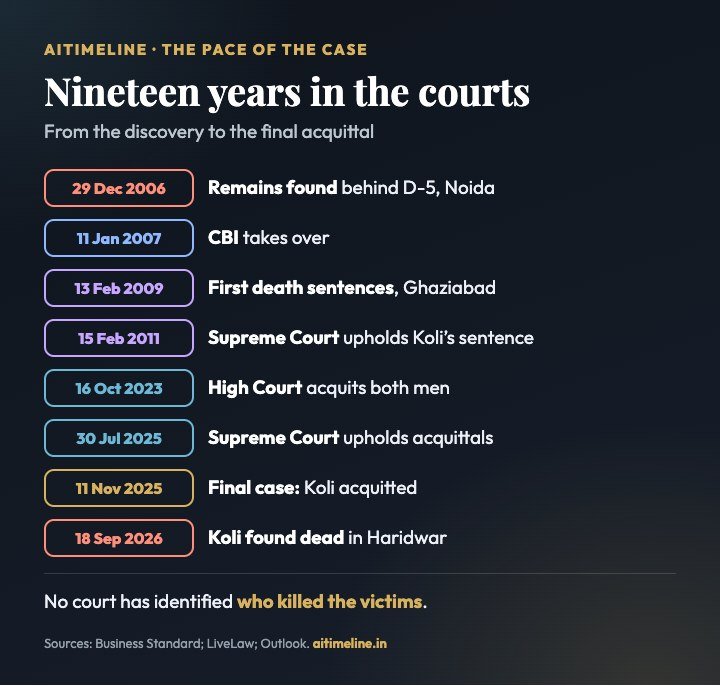
Human remains were found behind Moninder Singh Pandher’s house in Noida on 29 December 2006, and the CBI took over in January 2007. Pandher and his domestic help Surendra Koli were sentenced to death in several trials. The Allahabad High Court acquitted both in October 2023, the Supreme Court upheld that in July 2025 and acquitted Koli in the last case on 11 November 2025. Koli was found dead in Haridwar on 18 September 2026.
Nithari Killings Case: Key Questions
The Case in Ten Points
- The discovery: remains found behind D-5, Sector 31, Noida, on 29 December 2006.
- The victims: mostly children and young women from poor families in Nithari village.
- The ignored warnings: families said missing-person complaints from 2005 went nowhere.
- The handover: the CBI took over on 11 January 2007 and chargesheeted 16 cases.
- The core evidence: Koli’s confession and the recoveries said to follow from it.
- The sentences: Koli was sentenced to death in more than a dozen trials; Pandher in three.
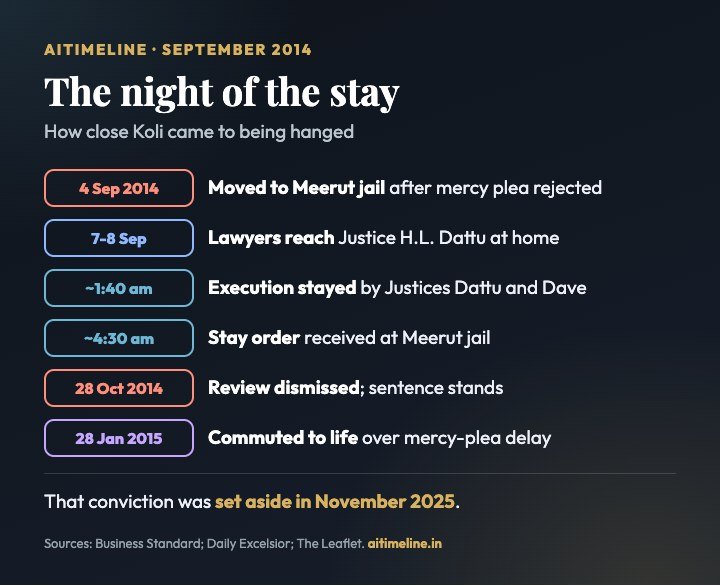
- The near-execution: stayed at about 1:40 am on 8 September 2014.
- The reversal: High Court acquittals on 16 October 2023, upheld on 30 July 2025.
- The final case: Supreme Court recalled its own 2011 judgment on 11 November 2025.
- The open question: no court has established who committed the killings.
Timeline: From the Disappearances to the Final Acquittal
Newest first. Colour shows which phase each event belongs to.
Post-mortem attributes Koli’s death to hanging After release 2025-2026
The finding: Police said the post-mortem examination gave the cause of death as asphyxia due to ante-mortem hanging, and that forensic evidence, CCTV footage and their inquiries had so far shown nothing to suggest another person was involved.
The dispute: Koli’s family sought a high-level inquiry into the death, and the father of one Nithari victim publicly rejected the suicide account. Koli was cremated in Haridwar by his brothers and son.
Surendra Koli found dead in Haridwar After release 2025-2026
What police found: Koli was found hanging inside a small tea stall he had begun running only days earlier. The shutter was down and there was no response to knocking. Circle Officer Shishupal Singh Negi said the death appeared prima facie to be a suicide. No suicide note was found.
His last weeks: Police said he had come to Haridwar about six weeks earlier, introduced himself as “Sada Ram” from Almora, worked briefly as a security guard and then took over the stall, which was rented in an acquaintance’s name.
Koli walks out of Luksar jail After release 2025-2026
The release: Jail superintendent Brijesh Kumar said Koli was released on the Supreme Court’s order the evening after the judgment. No family members were at the gate, and he left with his lawyers without speaking to reporters.
Time inside: He had been in custody since his arrest on 29 December 2006, close to 19 years, much of it under sentence of death.
Supreme Court sets aside Koli’s last conviction Appeals and acquittals 2009-2025
The order: The court recalled its own 15 February 2011 judgment and its 28 October 2014 review order, set aside the 2009 trial and High Court judgments in the case of the 14-year-old girl, acquitted Koli and ordered his release if not wanted in any other case.
The reason: The conviction rested on the same two pieces of evidence the courts had rejected in twelve companion cases: a confession recorded under Section 164 of the CrPC and recoveries claimed under Section 27 of the Evidence Act. The bench said the same statement could not be voluntary and reliable in one case when it had been “judicially discredited in all others”.
The findings: It said the confession came after nearly 60 days of police custody without effective legal aid, that the scene was not secured before digging began, that the disclosure was not recorded at the time, and that there was no credible chain of custody or expert evidence for the dismemberment the prosecution described.
Judgment reserved on the curative petition Appeals and acquittals 2009-2025
The argument: Koli’s lawyers argued that his one remaining conviction rested on the same confession and recoveries that had already failed in every other case.
The bench’s view: While reserving its verdict, the bench remarked that keeping the conviction would create an anomaly, since he stood acquitted in the other cases on the same evidence.
Supreme Court rejects 14 appeals against the acquittals Appeals and acquittals 2009-2025
The ruling: The bench dismissed all 14 appeals against the Allahabad High Court’s 2023 acquittals of Koli and Pandher, saying the appellants had not pointed to any perversity in the High Court judgment.
The recoveries: The court observed that the area behind the house where remains were found was not accessible only to the accused. The law, the Chief Justice said, requires a recovery from a place “exclusively known to the accused alone”.
What remained: Pandher now stood acquitted in all cases. Koli stayed in prison only because his 2011 conviction in the case of the 14-year-old girl still stood.
Allahabad High Court acquits Koli in 12 cases, Pandher in two Appeals and acquittals 2009-2025
The verdict: The court overturned the trial court’s death sentences and acquitted Koli in 12 cases and Pandher in the two in which he had been convicted, holding that the prosecution had not proved guilt beyond reasonable doubt.
The criticism: It said basic norms of collecting evidence had been “brazenly violated”, called the investigation botched and described the outcome as nothing short of a betrayal of public trust by the responsible agencies. It also faulted investigators for not seriously pursuing the possibility of organ trade.
The caveat: The acquittals did not identify who else committed the crimes. They meant the evidence against these two men did not meet the legal standard.
Koli’s death sentence commuted to life Appeals and acquittals 2009-2025
The order: The High Court commuted the death sentence in the case of the 14-year-old girl to life imprisonment, citing the inordinate delay in deciding his mercy petition.
What it did not do: The conviction itself stood. It was only set aside by the Supreme Court in November 2025.
Hours from the gallows, a midnight stay Appeals and acquittals 2009-2025
The warrant: After the President rejected his mercy petition, a death warrant was issued and Koli was moved on 4 September 2014 to Meerut jail, which had hanging facilities that Ghaziabad’s Dasna jail lacked.
The stay: His lawyers approached Justice Dattu at his residence on the night of 7-8 September. Justices Dattu and Dave stayed the execution for a week in an order passed at about 1:40 am on 8 September; the stay was later extended until the review was heard.
The review: On 28 October 2014 the Supreme Court dismissed his review petition, leaving the conviction and sentence in place.
Supreme Court upholds Koli’s first death sentence Appeals and acquittals 2009-2025
The judgment: The court dismissed Koli’s appeal and confirmed his conviction and death sentence in the first Nithari case to reach it.
Why it mattered later: This judgment remained the only Nithari conviction still standing after 2025, until the court recalled it on a curative petition.
High Court acquits Pandher, upholds Koli’s sentence Appeals and acquittals 2009-2025
The ruling: The High Court found no substantial evidence linking Pandher to the rape and murder and acquitted him in that case, while confirming Koli’s conviction and death sentence.
The challenge: The victim’s father challenged Pandher’s acquittal, and the case continued in higher courts alongside Koli’s appeal.
Last death sentence in the series Trials 2009-2021
The verdict: Koli was convicted and sentenced to death again. Pandher, tried in the same case, was acquitted.
What followed: In March 2021 a Ghaziabad court acquitted Koli in a separate case involving a 10-year-old girl, the first trial in the series that ended in his acquittal.
One trial after another Trials 2009-2021
The pattern: Each victim’s case was tried separately. Koli was sentenced to death in further cases in 2010 (three), 2012, 2016 (two) and 2019 (two), among others.
Pandher’s cases: Pandher had been charged by the CBI only under the Immoral Traffic (Prevention) Act, but the trial court summoned him as a co-accused in five more cases.
Both men sentenced to death in a second case Trials 2009-2021
The verdict: Convicted on 22 July, Koli and Pandher were sentenced to death two days later for the rape and murder of a 20-year-old woman. The judge called it a rarest-of-rare case.
Later: In December 2017 both were sentenced to death in another case, involving a 25-year-old domestic help. These were the two convictions of Pandher that the High Court set aside in 2023.
First convictions and death sentences Trials 2009-2021
The verdict: Convicted a day earlier, Koli and Pandher were sentenced to death for the rape and murder of a 14-year-old girl who had gone missing in February 2005. The court classed it as rarest of rare.
On appeal: The High Court acquitted Pandher in September 2009 but upheld Koli’s conviction and sentence.
The confession that shaped every trial CBI investigation 2007
The statement: Koli’s recorded statement, in which he allegedly admitted to several killings and made claims of cannibalism and necrophilia, became the core of the prosecution case in trial after trial.
The later view: The Allahabad High Court in 2023 and the Supreme Court in 2025 held it unreliable: recorded after prolonged police custody, without effective legal aid, amid allegations of torture, and without the clear satisfaction of voluntariness the law requires from the recording magistrate.
The CBI takes over CBI investigation 2007
The cases: The CBI registered 19 cases. Three were closed for lack of evidence and chargesheets were filed in 16, all against Koli for murder and related offences. Pandher was chargesheeted in only one, under the Immoral Traffic (Prevention) Act.
The approach: The investigation relied heavily on Koli’s confession and on recoveries attributed to his disclosures, the two strands that later failed in court.
More remains, and suspended policemen Disappearances and discovery 2005-2006
What happened: More skeletal remains were found as searches spread around the property and nearby drains. Several policemen were suspended over the handling of earlier complaints.
The anger: Parents said they had reported children missing as early as 2005 and had been ignored. Most of the missing came from poor labouring families in Nithari village.
Human remains found behind D-5 Disappearances and discovery 2005-2006
The discovery: Police searching the drain behind Moninder Singh Pandher’s bungalow, next to Nithari village, recovered skulls, skeletal remains and clothing fragments stuffed in bags.
The arrests: Noida police arrested Pandher, the owner, and Surendra Koli, his domestic help, in connection with the disappearances.
Children and young women go missing Disappearances and discovery 2005-2006
The disappearances: Children and young women from labouring families in and around Nithari went missing over about two years. Among them was a 14-year-old girl who vanished in February 2005, whose case later became the first to be tried.
The response: Families said their complaints were brushed aside. The failure to act on missing-person reports later became one of the case’s lasting lessons.
Who Were the Accused?
Two men, very different legal paths, the same final outcome.
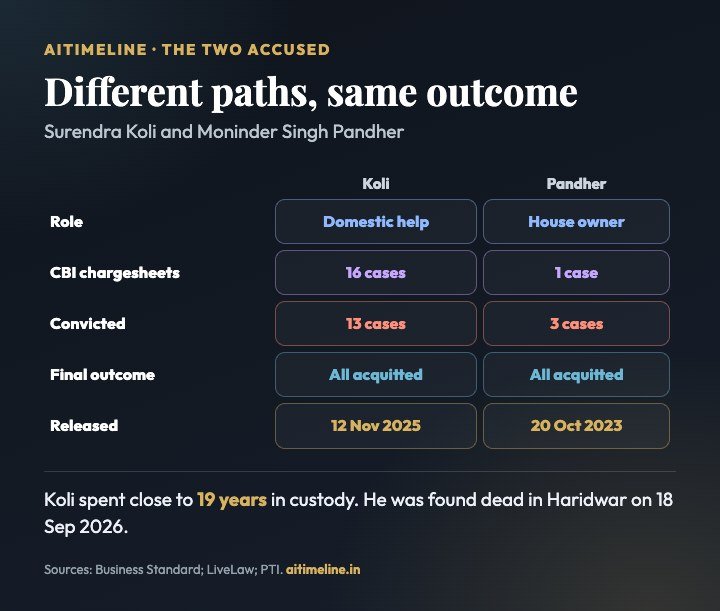
Surendra Koli
From Mangrukhal village in Almora district, Uttarakhand, he began working at Pandher’s house in 2004. The CBI made him the main accused in all 16 chargesheets. Convicted in 13 cases and acquitted in all of them by November 2025, he spent close to 19 years in custody and was found dead in Haridwar on 18 September 2026.
Moninder Singh Pandher
The businessman who owned the house was chargesheeted by the CBI in one case, under the Immoral Traffic (Prevention) Act, and summoned by the trial court as a co-accused in others. Sentenced to death in 2009 and twice in 2017, he was acquitted every time on appeal and released on 20 October 2023.
| Stage | Surendra Koli | Moninder Singh Pandher |
|---|---|---|
| Arrest | 29 Dec 2006 | 29 Dec 2006 |
| CBI chargesheets | 16 cases | 1 case (later summoned in others) |
| Trial-court convictions | 13 cases, death sentence in most | 3 cases, death sentence |
| Acquitted by High Court | 12 cases, 16 Oct 2023 | 1 case in Sep 2009; 2 cases, 16 Oct 2023 |
| Supreme Court | Acquittals upheld Jul 2025; last case acquitted 11 Nov 2025 | Acquittals upheld 30 Jul 2025 |
| Released | 12 Nov 2025, Luksar jail | 20 Oct 2023, Luksar jail |
How the Investigation Unfolded
Noida police, then the CBI, and a set of cases built on one statement.
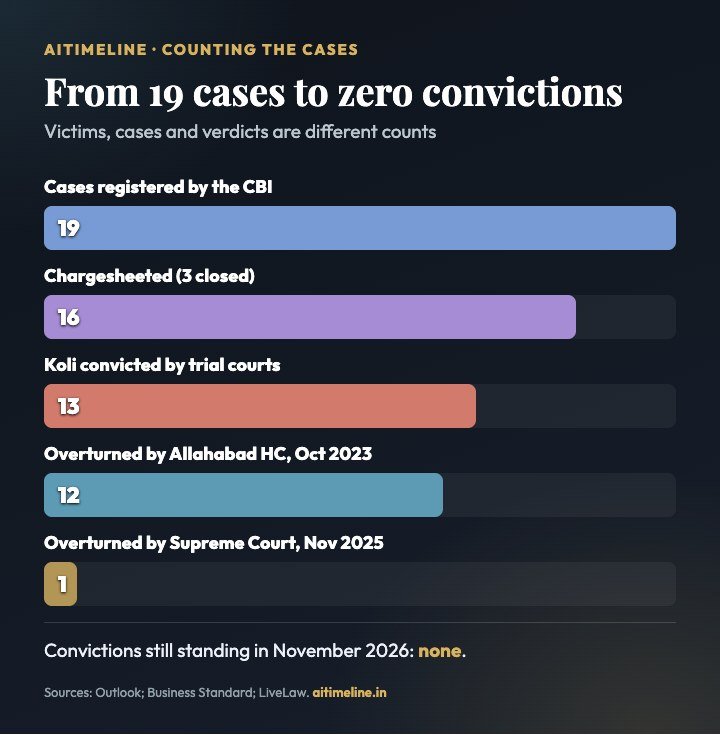
The case began with families who said their missing-person complaints had been ignored for months. When residents found remains near D-5 and called the police, the investigation moved fast, and so did the public outrage: policemen were suspended within a day. The Uttar Pradesh government handed the case to the CBI on 10 January 2007. The agency registered 19 cases, closed three and chargesheeted 16, almost all against Koli. Pandher was chargesheeted only under the Immoral Traffic (Prevention) Act, though trial courts later summoned him as a co-accused in other cases. Each victim’s case was tried separately, but nearly all leaned on the same two pillars: the statement Koli gave a magistrate in early 2007, and the remains and belongings said to have been recovered on his information.
Why the Evidence Failed
What the Allahabad High Court (2023) and the Supreme Court (2025) found.
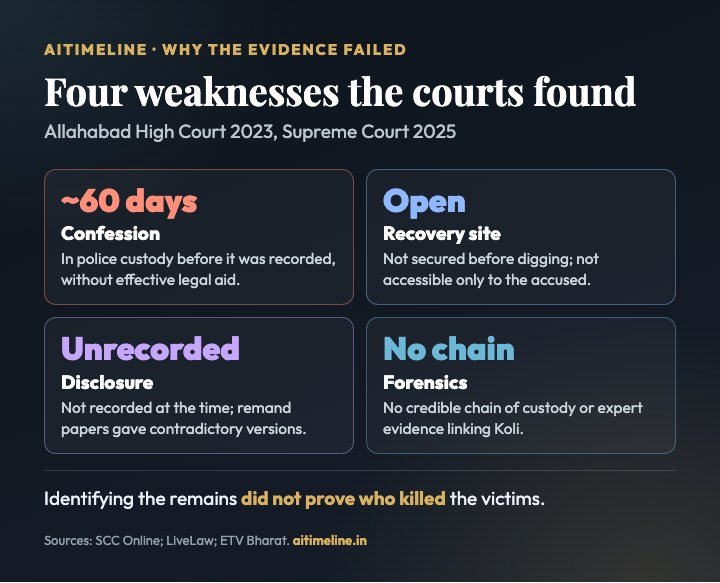
Five weaknesses the courts identified
- The confession: recorded after nearly 60 days of police custody, without effective legal aid, amid allegations of torture; the magistrate did not record the clear satisfaction of voluntariness the law demands.
- The recoveries: the drain and open ground behind the house were not under Koli’s exclusive control, so finds there could not be pinned to his disclosure.
- The paperwork: the disclosure was not recorded at the time, and remand papers carried contradictory versions.
- The forensics: examination identified remains, but no credible chain of custody or expert evidence connected Koli to the crimes.
- The lines not followed: the High Court faulted investigators for not seriously pursuing other possibilities, including organ trade.
Often claimed
- The courts found the killings never happened.
- The courts proved cannibalism and organ trafficking.
- Koli was freed on a technicality.
- Someone else has been identified as the killer.
What the record shows
- Victims disappeared and remains were found; that was never in doubt.
- Neither was established; both came from allegations or criticism of the probe.
- The core evidence was found unreliable and inadmissible as proof of guilt.
- No court has identified any other perpetrator.
Same Evidence, Opposite Outcomes
The contrast that ended the last case.
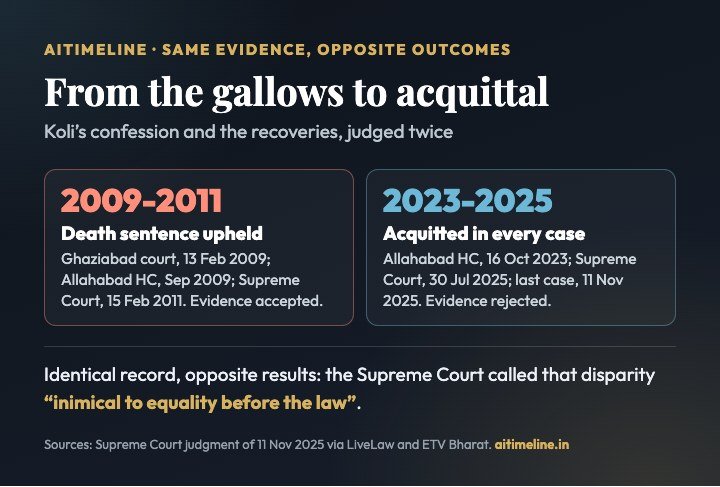
By mid-2025 the Nithari cases had reached an odd position. In twelve cases the courts had found Koli’s confession and the recoveries unreliable. In one, decided earlier, the Supreme Court itself had treated the same material as enough to send him to the gallows. Koli’s curative petition argued that both could not be right. The bench of Chief Justice B.R. Gavai and Justices Surya Kant and Vikram Nath agreed, saying arbitrary disparity in outcomes on an identical record is “inimical to equality before the law”. It also noted the cost of that error: the commutation to life in 2015 had changed the sentence, but the conviction still carried the gravest consequences.
What Happened to the Victims’ Families
The families of Nithari were mostly labourers and domestic workers who had moved to Noida for work. Several said they had reported children missing long before December 2006 and been turned away, which is why the discovery set off immediate anger against the police. They waited through two decades of separate trials. Some joined the CBI in challenging the 2023 acquittals; the Supreme Court dismissed those appeals in July 2025. After Koli’s death, the father of one victim rejected the police account of suicide. The legal outcome answered a narrow question, whether these two men were proved guilty on lawful evidence, and left the larger one, who killed their children, without an answer from any court.
The Legacy of the Nithari Case
Complaints ignored
- Reports from 2005 went nowhere.
- Poorer families were not heard.
- Police were suspended after the fact.
A case built on one statement
- Long custody before the confession.
- Unsecured recovery site.
- No chain of custody.
Fair trial over pressure
- Death sentences reversed.
- A final judgment recalled.
- No one held responsible.
The case shows why a conviction, an acquittal and an unsolved crime are three different things. A court can find that the prosecution failed without saying who else, if anyone, was responsible. In Nithari, that gap is permanent unless new evidence emerges: the two men the State accused have been acquitted, one of them is dead, and the investigation that might have found the truth was, in the High Court’s words, botched.
Explore More Timelines
People Also Ask
Frequently Asked Questions
Dated facts from court rulings and contemporary reports, 2005 to 2026.
⚠️ Editorial Note
This account draws on reports of the Supreme Court’s 11 November 2025 judgment by LiveLaw, ETV Bharat and All India Radio; LiveLaw on the 30 July 2025 order; SCC Online and Scroll on the 16 October 2023 High Court judgment; Business Standard and Outlook timelines of the trials; PTI, The Leaflet and Business Standard on the 2014 stay; and LawBeat, The Pioneer, Outlook and The Free Press Journal on Koli’s release and death. The full judgments were not read. Checking the brief this page began from against those records: Koli was released from Luksar district jail in Greater Noida on 12 November 2025, not “Kasna Jail”; the post-mortem has since been reported as asphyxia due to ante-mortem hanging, and his family disputes the suicide finding; the 19 skulls and 19 registered cases do not mean 19 girls, since victims included young women and counts of victims, FIRs and chargesheets differ; the July 2025 bench was Chief Justice Gavai with Justices Satish Chandra Sharma and K. Vinod Chandran; and Pandher’s first acquittal came on 11 September 2009. Reports give Koli’s age variously, so we omit it. Victims are not named. This is not legal advice.
Related Reading on AiTimeline
Sources & further reading
Every dated entry above was checked against these references. Last reviewed 7 November 2026.
- Nithari Killings: Surendra Koli To Walk Free As Supreme Court Sets Aside His Only Remaining Conviction
- Nithari Killings: Supreme Court Rejects CBI Appeals Against Acquittals of Surender Koli, Moninder Singh Pandher
- Nithari killings: Allahabad High Court acquits Surendra Koli, Moninder Pandher, sets aside death sentence
- 'Rapes, murders & cannibalism': A timeline of Nithari serial killings
- Nithari Case Timeline: From Mass Killings To 12 Death Sentences And 13 Acquittals
- Nithari killings case: Surendra Koli to be released, SC acquits him in last pending case
- Nithari killings: Surendra Koli walks out of jail after SC acquittal
- Surendra Koli, Acquitted In Nithari Serial Killings Case In 2025, Dies By Suicide At Haridwar Tea Stall
- Surendra Koli Died By Suicide, Post-Mortem Report Confirms: Uttarakhand Police
- SC stays death sentence of Nithari killer Koli