Social Security Trust Fund: Projections, Shortfall and Proposed Fixes
The 2026 Trustees Report says Social Security's retirement fund runs dry in late 2032, leaving 78% of benefits payable. Full timeline, causes and fixes.
Latest Story
For more than 71 million Americans, Social Security is the foundation of retirement, survivor or disability income. But the money flowing into its retirement trust fund is no longer enough to pay every promised benefit. The Social Security trust fund for retirement and survivors is now projected to exhaust its reserves in late 2032, and the 2026 Trustees Report put the long-term gap at its widest in about half a century. That does not mean the program disappears. It means that, unless Congress acts, benefits would be cut automatically. This timeline traces how the program got here, what the latest projections say and which fixes are on the table.
💡 Short Answer
The 2026 Social Security Trustees Report, released on 9 June 2026, projects that the retirement and survivors (OASI) trust fund will run out of reserves in the fourth quarter of 2032, after which about 78% of scheduled benefits would be payable. The combined retirement and disability funds would last until 2034, with 83% payable. The 75-year deficit grew to 4.42% of taxable payroll. Congress can close it with more revenue, lower benefit growth or both.
Social Security Trust Fund: Key Questions
The Social Security Shortfall in Ten Points
- The date: the retirement and survivors fund is projected to run out of reserves in the fourth quarter of 2032.
- Not zero: incoming taxes would still pay about 78% of scheduled benefits.
- Combined view: pooling with the disability fund would stretch the date to 2034, with 83% payable, but needs legislation.
- Widest gap in decades: the 75-year deficit rose from 3.82% to 4.42% of taxable payroll in one year.
- Three causes: lower fertility assumptions, lower immigration assumptions and the 2025 tax law.
- Reserves shrinking: down $160 billion in 2025 to $2.56 trillion, as costs have exceeded total income since 2021.
- CBO agrees, roughly: exhaustion in fiscal 2032 and a 26% cut, with a 4.6% of payroll gap.
- Precedent: the 1983 amendments mixed tax increases and benefit changes, including a higher retirement age.
- On the table in 2026: the bipartisan PROMISE Act process and the Democrats’ Social Security 2100 Act.
- Time matters: the later Congress acts, the larger and more abrupt the changes have to be.
Social Security Trust Fund at a Glance
Projections under the 2026 Trustees Report’s intermediate assumptions. These are projections, not guarantees. Scroll sideways on a phone.
| Key measure | 2026 Trustees Report |
|---|---|
| Released | 9 June 2026 |
| Retirement and survivors fund (OASI) depletion | Fourth quarter of 2032 |
| Payable after OASI depletion | About 78% of scheduled benefits |
| Combined OASI and DI depletion | 2034 |
| Payable after combined depletion | About 83% of scheduled benefits |
| Disability fund (DI) alone | Solvent through the 75-year period |
| 75-year actuarial deficit | 4.42% of taxable payroll (3.82% in 2025) |
| Combined reserves, end of 2025 | $2.56 trillion, down $160 billion |
| 2025 income vs cost | $1.45 trillion vs $1.61 trillion |
| Beneficiaries | More than 71 million |
| Medicare HI fund depletion | 2033, 89% payable |
| Payroll tax | 12.4% (6.2% worker + 6.2% employer) up to $184,500 in 2026 |
The Social Security Trust Fund Timeline, 1935–2034
Newest first, from the projected depletion dates back to the 1935 Act. Tags mark laws, Trustees and CBO projections, benefit changes, reform proposals and the growing shortfall.
2032
Projected: retirement fund reserves run out Shortfall
Under the 2026 Trustees Report’s intermediate assumptions, the OASI trust fund, which pays retirement and survivors benefits, would exhaust its reserves in the fourth quarter of 2032. From then, incoming payroll taxes and benefit taxes would cover about 78% of scheduled benefits. Current law does not allow the program to borrow or to pay more than it has, so the shortfall would mean an automatic, across-the-board reduction.
Projected: combined funds run out Shortfall
If the retirement and disability funds were pooled, which would take legislation, the combined reserves would last until 2034, with about 83% of benefits payable after that. The DI fund on its own is projected to stay solvent for the full 75-year window, because disability claims have fallen since the mid-2010s.
2026
A 3.6% COLA for 2027 Benefits
The Social Security Administration announced a 3.6% cost-of-living adjustment for 2027, after 2.8% for 2026, driven by higher inflation and fuel prices earlier in the year. The cap on earnings subject to Social Security tax will rise from $184,500 to $192,300. The increase protects beneficiaries’ purchasing power, but it also raises the program’s costs, and CRFB warned that the scheduled 2032 cut would erase years of such increases.
2026
CBO: exhausted in fiscal 2032, a 26% cut CBO
The Congressional Budget Office published its own long-term projections. It too found the OASI fund exhausted in fiscal year 2032, but with a slightly larger 75-year shortfall than the Trustees, 4.6% of taxable payroll, and a deeper cut at exhaustion, about 26%. CBO had first moved its exhaustion date a year earlier, to 2032, in its February 2026 baseline, citing the 2025 reconciliation act, higher tariffs and lower immigration.
The two sets of numbers use different economic and demographic assumptions and should not be treated as identical, but they agree on the core point: the retirement fund has about six years left.
The House’s leading expansion advocate loses his seat Proposal
John Larson, the ranking Democrat on the Ways and Means Social Security subcommittee and author of the Social Security 2100 Act, lost his primary. The bill, which he had reintroduced as H.R. 9519 on 29 June 2026 with a Senate companion from Richard Blumenthal on 21 July, would raise benefits and impose payroll tax on earnings above $400,000. It will need a new House champion in the next Congress.
2026
Bipartisan senators propose the PROMISE Act Proposal
Six senators from both parties introduced a bill that would not itself fix Social Security, but would force Congress to vote on a fix. The Social Security Advisory Board would submit a draft ‘base bill’; congressional leaders or any bipartisan pair could offer alternatives; and the process would end in an up-or-down vote on a plan restoring solvency for at least 50 years, with a new review every decade. Bill Cassidy separately continued to promote a proposed investment fund to help close the gap.
2026
2026 Trustees Report: OASI date moves to late 2032 Trustees
The Trustees moved the projected OASI depletion date one quarter earlier, to the fourth quarter of 2032, and kept the combined date at 2034. The long-range actuarial deficit jumped from 3.82% to 4.42% of taxable payroll, the widest in about half a century. The biggest drivers were a lower long-run fertility assumption (lowered to 1.75 children per woman, from 1.9), lower assumed immigration and the 2025 tax law.
In 2025 the combined funds took in $1.45 trillion and paid out $1.61 trillion, so reserves fell by $160 billion to $2.56 trillion. More than 71 million people were receiving benefits.

CBO brings its exhaustion date forward a year CBO
In its ten-year baseline, the CBO projected the OASI trust fund would be exhausted in fiscal year 2032, one year sooner than it had projected a year earlier. CBO Director Phillip Swagel said benefits would then be cut automatically unless Congress intervened.
2025
The 2025 tax law adds a senior deduction Law
The reconciliation law did not change Social Security directly, but its temporary extra deduction for older taxpayers reduces the income tax collected on Social Security benefits, part of which is credited to the trust funds. The Trustees later counted it among the three main reasons the outlook worsened.
2025
2025 Trustees Report: OASI in 2033, deficit 3.82% Trustees
The 2025 report brought the OASI date to the first quarter of 2033 and the combined date forward a year, to 2034, partly to account for the cost of the Social Security Fairness Act. The 75-year deficit rose from 3.50% to 3.82% of taxable payroll.
2025
Social Security Fairness Act signed Law
Joe Biden signed a bill ending two rules that had reduced Social Security for people who also received pensions from jobs not covered by Social Security, including many teachers, police officers and firefighters, and their spouses. It was a long-sought fix for those workers, but with no new revenue attached it increased the program’s long-term costs.
2024 Trustees Report: combined date 2035 Trustees
A stronger economy and labour market nudged the combined depletion date a year later, to 2035, while the OASI date held at 2033. It was the last report in which the outlook improved.
Costs exceed total income Shortfall
From 2021, Social Security’s annual costs exceeded all its income, including interest on the trust funds, so the program began drawing down the reserves built up after 1983. The pandemic also disrupted employment and mortality, and so the assumptions behind the projections.
2015
Congress patches the disability fund Law
Faced with a projected DI shortfall that would have cut disability benefits by about a fifth, Congress temporarily reallocated part of the 12.4% payroll tax rate from the retirement fund to the disability fund. It solved the near-term problem without changing total revenue, which is why it is often cited as a model for, and a warning about, last-minute fixes.
Costs pass non-interest income Shortfall
For the first time since the 1983 rescue, Social Security’s costs exceeded its income from payroll taxes and taxes on benefits, with interest on the trust funds’ Treasury securities covering the difference. The first baby boomers, born in 1946, had become eligible for early retirement benefits in 2008.
Personal accounts proposal stalls Proposal
After his re-election, George W. Bush toured the country promoting voluntary personal retirement accounts funded by part of the payroll tax. Opposition from Democrats and wavering Republicans meant the plan never reached a vote. It was the last major attempt at structural reform.
More benefits become taxable Law
A second tier of benefit taxation was added on top of the 1983 rules. The thresholds for both tiers were never indexed to inflation, so a growing share of retirees pays tax on benefits each year, which slowly adds income to the funds.
1983
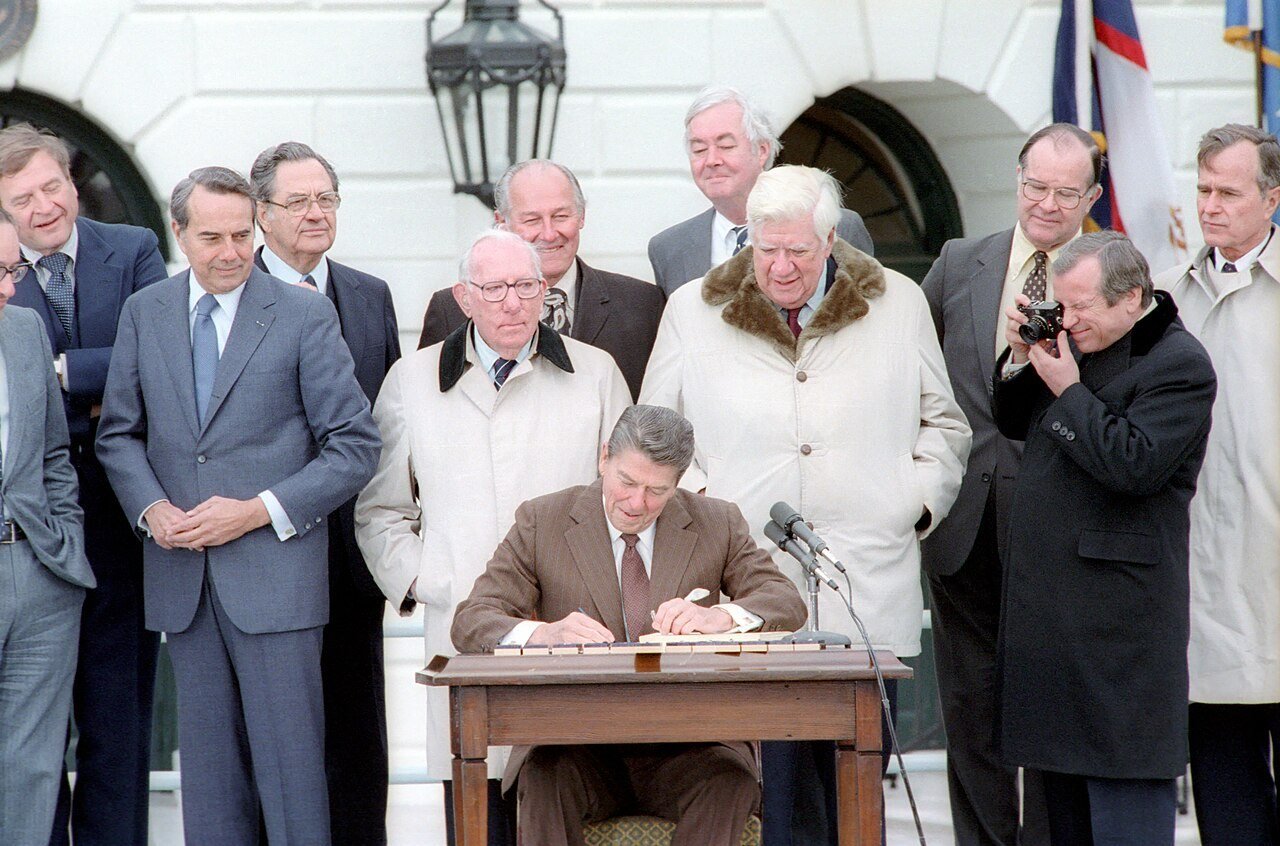
Reagan signs the bipartisan rescue Law
With the retirement fund months from being unable to pay benefits on time, the National Commission on Social Security Reform, chaired by Alan Greenspan, produced a compromise that Congress passed and Reagan signed. It accelerated payroll tax increases, made up to half of benefits taxable for higher earners, covered new federal employees, delayed a cost-of-living adjustment by six months and phased in a higher full retirement age. The package built up the reserves now being drawn down.
Carter-era amendments fix the formula Law
A flaw in how the 1972 automatic adjustments worked meant some new benefits were effectively indexed twice. The 1977 amendments fixed the formula and raised taxes, but high inflation and a weak economy left the fund in trouble again within a few years.
Automatic cost-of-living adjustments Benefits
Before 1972, Congress raised benefits by legislation from time to time. The 1972 amendments made increases automatic, tied to the Consumer Price Index, and the first automatic COLA took effect in 1975.
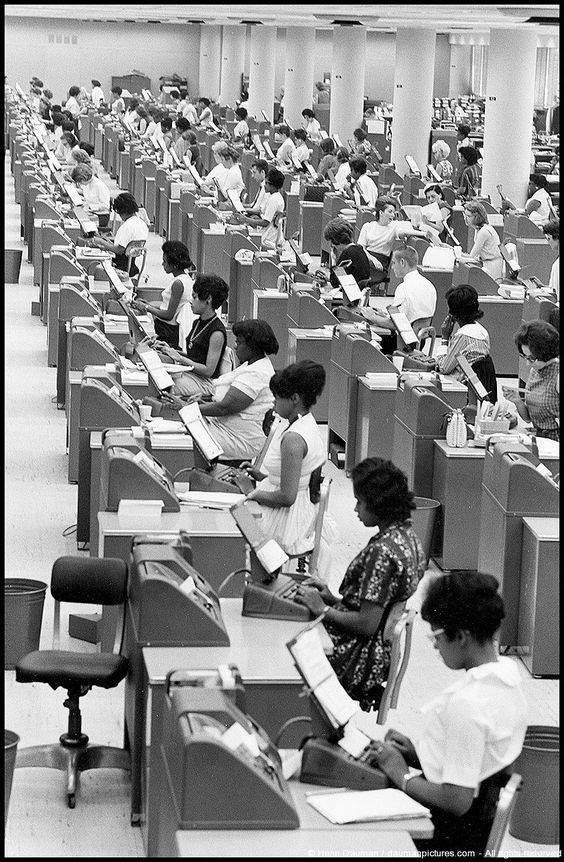
Disability insurance added Law
Disability benefits were introduced for insured workers aged 50 to 64, financed through a separate Disability Insurance trust fund. The age limit was later removed. The OASI and DI funds remain legally separate today, which is why there are two depletion dates.
Monthly benefits begin Benefits
Payroll tax collection began in 1937. The 1939 amendments added benefits for dependants and survivors and brought monthly payments forward to 1940. The first monthly retirement cheque went to Ida May Fuller of Vermont, who went on to collect benefits for 35 years.
1935
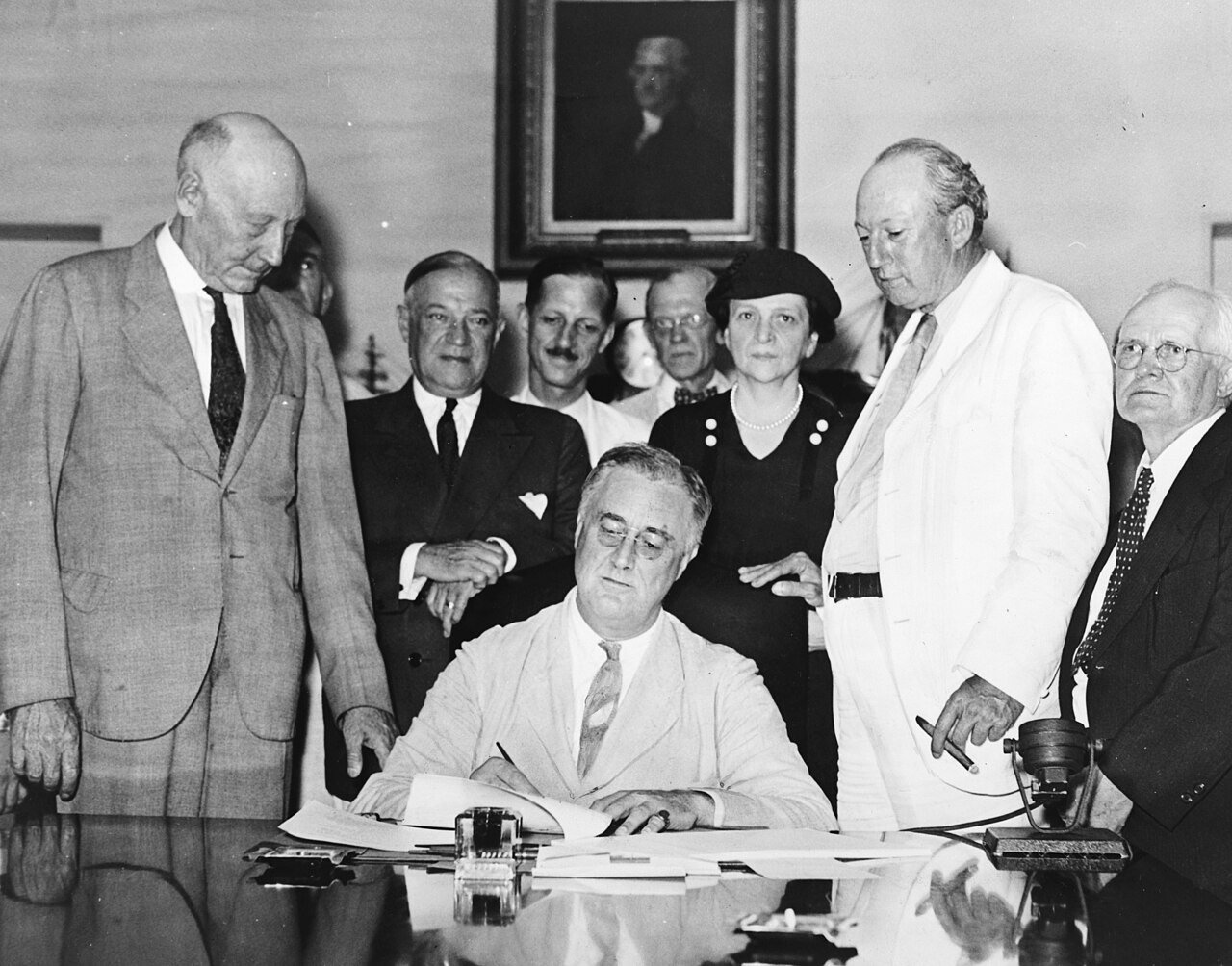
Roosevelt signs the Social Security Act Law
Franklin D. Roosevelt signed the Act in the depth of the Depression. It created a national old-age insurance program financed by contributions from workers and employers, which became the basis of today’s Social Security.
How the Projections Have Shifted
The depletion date moves a little each year with new data on births, immigration, wages and law. The direction since 2016 has been mostly worse.
| Trustees Report | OASI depletion | Combined OASDI | Actuarial deficit |
|---|---|---|---|
| 2026 | 2032 | 2034 | 4.42% |
| 2025 | 2033 | 2034 | 3.82% |
| 2024 | 2033 | 2035 | 3.50% |
| 2023 | 2033 | 2034 | 3.61% |
| 2022 | 2034 | 2035 | 3.42% |
| 2021 | 2033 | 2034 | 3.54% |
| 2020 | 2034 | 2035 | 3.21% |
| 2019 | 2034 | 2035 | 2.78% |
| 2018 | 2034 | 2034 | 2.84% |
| 2017 | 2035 | 2034 | 2.83% |
| 2016 | 2035 | 2034 | 2.66% |
Pick a monthly benefit. What would be payable after depletion?
If Congress does nothing, the 2026 Trustees Report projects 78% of scheduled retirement and survivors benefits would be payable after late 2032, or 83% on a combined OASI and DI basis from 2034. Amounts are in today’s dollars and illustrate a uniform cut; actual rules would depend on legislation.
The payable share is also projected to drift lower later in the century as the gap widens. The Congressional Budget Office’s September 2026 projections imply a deeper first-year cut, about 26%.
Why Is Social Security Facing a Shortfall?
Social Security is largely pay-as-you-go: today’s workers fund today’s beneficiaries, with the reserves covering the difference while they last.
An ageing population
The baby-boom generation is retiring, so the number of workers paying in for each beneficiary keeps falling.
Lower fertility
The 2026 report cut its long-run fertility assumption to 1.75 children per woman, from 1.9, meaning fewer future workers.
Lower immigration
Lower assumed numbers of immigrants also mean fewer payroll-tax payers in the decades ahead.
Longer retirements
People who reach 65 are living longer than when the 1983 reforms were designed, so benefits are paid for more years.
Recent legislation
The 2025 Fairness Act raised benefits for some public-sector retirees; the 2025 tax law cut income tax on benefits flowing to the funds.
A fixed tax rate
The 12.4% combined rate has not changed since 1990, and a larger share of wages now sits above the taxable cap than in 1983.
Pick your birth year. Where will you be when the fund runs short?
Full retirement ages follow the schedule set in 1983. Ages are at the end of 2032, when the OASI reserves are projected to be exhausted.
Proposed Fixes: How Could Congress Strengthen Social Security?
No package has been enacted. These are the main options analysts and lawmakers discuss; their effect depends entirely on design.
Raise or remove the tax cap
Apply payroll tax to more of high earners’ pay, as the Social Security 2100 Act would above $400,000.
Raise the payroll tax rate
A gradual increase on workers and employers from today’s 6.2% each.
Raise the retirement age
Lift the full retirement age beyond 67, or index it to life expectancy, for younger workers.
Change the benefit formula
Slow benefit growth for higher earners while protecting low-income retirees.
Change the COLA
Switch to chained CPI, which grows more slowly, or to an elderly index (CPI-E), which grows faster and costs more.
Force a vote
The PROMISE Act would set up a commission-style process ending in an up-or-down vote on a 50-year solvency plan.
| Option | Main effect | Who bears it | Key concern |
|---|---|---|---|
| Raise or remove the tax cap | More revenue from earnings above $184,500 | Higher earners and their employers | Whether new taxes earn new benefits |
| Raise the 12.4% rate | Broad, predictable revenue | All workers and employers | Lower take-home pay, hiring costs |
| Raise the retirement age | Lower lifetime benefits | Future retirees | Hardest on manual workers and shorter lives |
| Change the benefit formula | Slower benefit growth | Future middle and higher earners | Smaller benefits than promised |
| Change the COLA index | Slower or faster benefit growth | Current and future retirees | Purchasing power over long retirements |
| New revenue sources | Taxes on investment income or other pay | Mainly high-income households | Breaks the payroll-tax link |
| Investment fund (Cassidy idea) | Returns from a new invested fund | Taxpayers, via borrowing to seed it | Market risk and upfront cost |
| Mixed package | Shares the adjustment | Spread across groups | Hardest to negotiate |
Every option moves the cost of the gap onto someone: higher earners, all workers, future retirees or taxpayers in general. That is why most analysts expect any final deal to look like 1983, a negotiated package with several parts phased in over years, rather than one big change. The size of the required changes grows the longer action is delayed, because fewer years remain to spread them over and more of the baby-boom generation will already be retired.
What Happens If Congress Does Nothing?
Scheduled benefits vs payable benefits
Full scheduled benefits, including annual COLAs, are paid. Reserves fall each year as costs exceed income.
Benefits are limited to what comes in: about 78% for retirement and survivors, with the payable share drifting lower over time.
Current law does not let Social Security borrow or pay more than its trust fund holds, so the cut would be automatic. How it would be applied is not spelled out: it could take the form of delayed payments or uniform reductions, and no Congress has ever let a trust fund actually reach that point. In 1983, Congress acted months before the retirement fund would have been unable to pay benefits on time.
Explore More Timelines
People Also Ask
Frequently Asked Questions
The Deadline Is a Warning, Not an Ending
Social Security’s projected depletion is a serious financing problem, but not a forecast that the program will disappear. The real question is whether lawmakers will act before reserves run out to bring scheduled benefits and dedicated revenue back into line, or provide other funding.
The 1983 amendments showed that Social Security’s finances can be repaired with a bipartisan mix of revenue and benefit changes. The difference in 2026 is the size of the gap, 4.42% of taxable payroll, and the time left, about six years for the retirement fund.
Related AiTimeline Stories
⚠️ Editorial Note
This article draws on the 2016–2026 Social Security Trustees Reports (intermediate assumptions), the Social Security Administration’s 2027 COLA announcement, the Congressional Budget Office’s February 2026 baseline and September 2026 long-term Social Security projections, the text and sponsors’ descriptions of the PROMISE Act and the Social Security 2100 Act, and contemporaneous reporting. Depletion dates and payable percentages are projections that change every year and are not guarantees of a particular cut for any individual. The calculator figures are simple illustrations. This is not financial, tax or retirement-planning advice; check your own record at ssa.gov. Last checked 15 October 2026.
Sources & further reading
Every dated entry above was checked against these references. Last reviewed 15 October 2026.
- The 2026 Annual Report of the Board of Trustees of the Federal OASI and DI Trust Funds
- 2026 Trustees Report: Highlights
- Social Security Announces 3.6 Percent Benefit Increase for 2027
- CBO's 2026 Long-Term Projections for Social Security
- Analysis of the 2026 Social Security Trustees' Report
- CBO Projects Social Security Nearing Insolvency
- PROMISE Act Jumpstarts Path Toward Saving Social Security
- H.R.9519 - Social Security 2100 Act (119th Congress)
- Social Security Trust Fund Report 2026
- High Inflation Drives 3.6% Social Security COLA