Doordarshan History: From Monopoly to Modern Broadcasting
Doordarshan history from the 1959 Delhi experiment to colour TV, Ramayan, the 1991-95 satellite shock that ended its monopoly, DD Free Dish and AI anchors.
Latest Story
For about three decades, Doordarshan was Indian television. It began as a one-studio experiment in Delhi on 15 September 1959, spent its first years as a teaching and farm-advice service, turned colour for the 1982 Asian Games, and emptied streets on Sunday mornings with Ramayan. Then cable operators started pulling in foreign satellite channels during the 1991 Gulf War, Zee TV launched in 1992, and in 1995 the Supreme Court ruled that the airwaves belong to the public, not the government. The monopoly was over. This timeline explains why Doordarshan lost it, and why it did not disappear: free-to-air DTH, regional channels, a legal right to share big sports feeds, and a public-service mandate that commercial channels do not have. In September 2026 it turned 67.
🧠 AI Overview Summary
Doordarshan began as an experimental television service of All India Radio in Delhi on 15 September 1959. It added school programmes in 1961, a daily service in 1965 and the farm show Krishi Darshan in 1967. It became a separate department on 1 April 1976, went national and colour in 1982 around the Asian Games, and dominated Indian viewing through the 1980s. Its monopoly ended in the early 1990s, when cable networks brought in STAR TV and Zee TV and the Supreme Court ruled in 1995 that the airwaves are public property. Doordarshan joined Prasar Bharati in 1997. It now runs 35 satellite channels and the free DTH platform DD Free Dish, which carries 381 channels.
Doordarshan: Key Questions
67 Years of Doordarshan in Ten Lines
- It started as a teacher, not an entertainer: school television in 1961 and Krishi Darshan for farmers in 1967 came before any serials.
- Satellites were tested early: the 1975–76 SITE experiment beamed programmes to about 2,400 villages in six states.
- 1 April 1976: television split from All India Radio. Advertising had begun on 1 January that year.
- 1982 made it national: colour and the National Programme began on 15 August 1982, just before the Delhi Asian Games.
- The 1980s were the one-screen years: Hum Log, Buniyaad, Ramayan and Mahabharat drew audiences no Indian channel has matched since, relative to TV ownership.
- It was never independent of government: during the Emergency it was a ministry department, and its news was criticised for decades as pro-government.
- The monopoly broke in 1991–95: cable and the Gulf War, STAR TV, Zee TV, and a 1995 Supreme Court ruling on the airwaves.
- Prasar Bharati, 1997: a statutory public broadcaster took over Doordarshan and AIR, though the government still funds it.
- DD Free Dish is its quiet success: from 33 channels in 2004 to 381 today, with about ₹1,061 crore in revenue in 2024–25.
- Now it is multi-platform: DD Kisan’s AI anchors (2024), the WAVES OTT app, YouTube and apps, alongside 35 satellite channels.
1959–1976: A Classroom Before an Entertainment Channel
Television arrived in India as a development tool, run by the radio service.
India’s first television broadcast went out from a makeshift studio at Akashvani Bhavan in Delhi on 15 September 1959. President Dr Rajendra Prasad inaugurated the service. It was run by All India Radio, reached only a small area around Delhi and went on air a couple of days a week for about an hour. The audience was a few hundred sets, many of them in community centres.
What the service broadcast shows what it was for. The School Television project started on 24 October 1961, bringing lessons to Delhi students. A regular daily service with a Hindi news bulletin began on 15 August 1965. On 26 January 1967, Doordarshan launched Krishi Darshan, a programme for farmers that ran for decades. Commercial entertainment was not the point. The government saw television as a way to teach, inform and spread farming know-how in a mostly rural, mostly non-reading country.
The network spread slowly. Bombay (now Mumbai) got India’s second television station on 2 October 1972. Srinagar and Amritsar followed in 1973, and Calcutta, Madras and Lucknow by 1975.
Then came the boldest experiment. From 1 August 1975 to 31 July 1976, the Satellite Instructional Television Experiment (SITE) used a NASA satellite, ATS-6, to beam educational programmes to community TV sets in about 2,400 villages in six states. It proved that satellites could reach villages that ground transmitters never would, a lesson India applied with its own INSAT satellites a few years later. Commercials came to Doordarshan on 1 January 1976, and on 1 April 1976 television was separated from All India Radio as a department of the Information and Broadcasting Ministry, under the name Doordarshan.
1982–1984: Colour, INSAT and the Asian Games
A sporting event forced a technology upgrade, and a satellite made it national.
India won the right to host the IX Asian Games in New Delhi in November 1982, and the government wanted them seen in colour. On 15 August 1982, Doordarshan began colour transmission and the National Programme, relayed across the network by satellite. The first colour broadcast was Prime Minister Indira Gandhi’s Independence Day speech from the Red Fort. Import rules for colour TV sets were eased that year, and the Games, which opened on 19 November 1982, made the colour set a status object in middle-class homes.
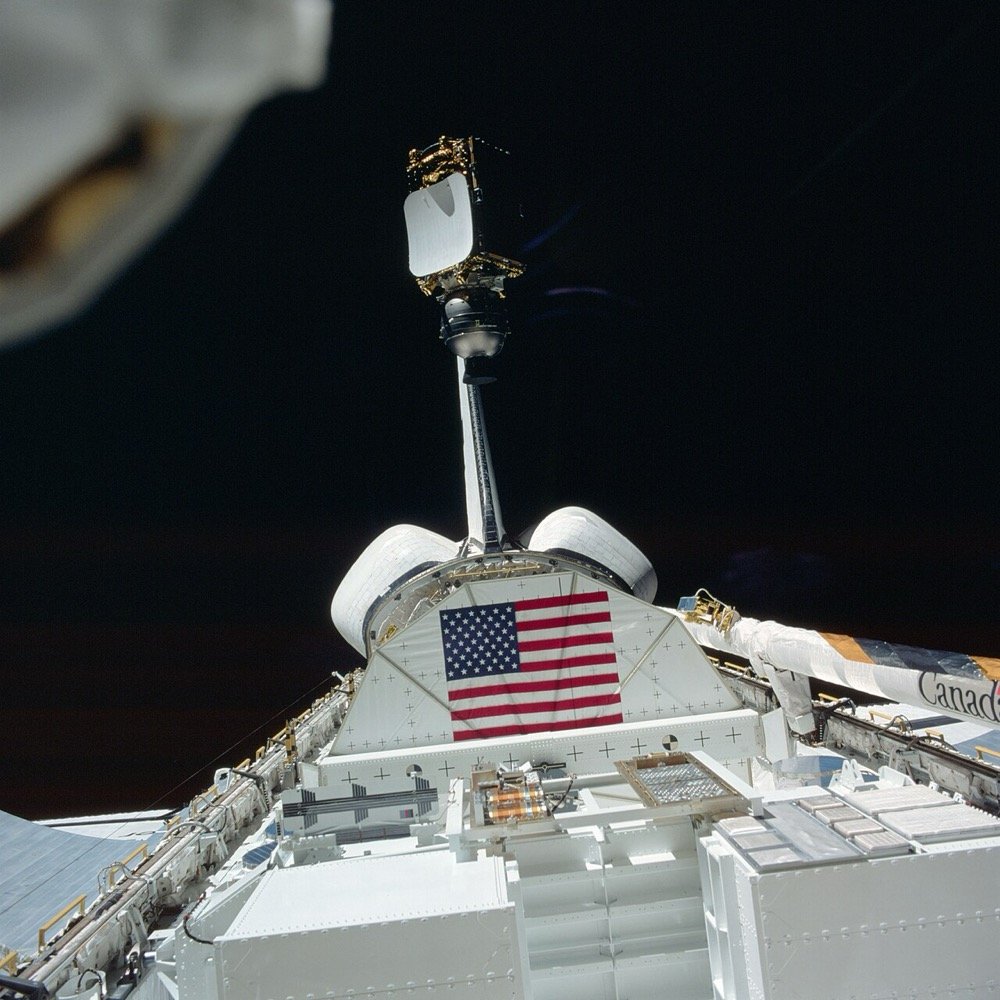
At the same time, Doordarshan began a rapid build-out of low-power transmitters, so that towns far from the big cities could pick up a signal. The satellite backbone came with INSAT-1B, released from the US Space Shuttle Challenger on 30 August 1983. It let Doordarshan send one national feed to transmitters across the country. By the mid-1980s, a programme made in Delhi could be watched in hundreds of towns at the same moment.
A second channel started in Delhi in 1984 (9 August per Doordarshan’s milestone list; some official sources give 17 September) and in Bombay on 1 May 1985. The same year, in July 1984, Doordarshan aired Hum Log, India’s first long-running soap opera. It was designed to carry family-planning and social messages, but viewers mostly watched it as a family drama, which showed Doordarshan what a mass audience wanted.
1984–1991: The One-Screen Years
When a whole country watched the same programme at the same time.
With only one or two channels, Doordarshan’s schedule became the country’s schedule. Chitrahaar (film songs) and the Sunday film were weekly events. Buniyaad (1986), a family saga set around Partition, and the Hindi adaptation of R.K. Narayan’s Malgudi Days (1986) became landmarks. Fauji (1989) introduced a young Shah Rukh Khan. Udaan, Circus, Nukkad and Wagle Ki Duniya filled the rest of the week.
The biggest were the mythological serials. Ramanand Sagar’s Ramayan began on 25 January 1987 in a Sunday morning slot, and accounts from the time describe empty streets and TV sets garlanded like shrines. B.R. Chopra’s Mahabharat followed on 2 October 1988. Scholars such as Arvind Rajagopal later argued that Ramayan helped bring Hindu religious imagery into national politics in the years before the Ayodhya movement peaked. That debate is part of Doordarshan’s history too.
The reason this era cannot happen again is structural, not nostalgic. There was one channel, a fixed schedule and no way to record or skip. Every Indian with a TV had to watch the same programme at the same time. After 1991, that stopped being true.
Who Controlled the Screen?
A government department with a national monopoly, and the arguments that followed.
For its first 38 years, Doordarshan was part of the Information and Broadcasting Ministry, and it showed. During the Emergency (1975–77), it carried the government’s line with no independent editors. According to the Shah Commission, which investigated Emergency excesses, Kishore Kumar’s songs were kept off both AIR and Doordarshan from May 1976 after he declined to perform at a government event.
After the Emergency, the Janata government set up a working group under journalist B.G. Verghese, which in 1978 recommended an autonomous national broadcasting trust it called Akash Bharati. The idea went nowhere for more than a decade. Through the 1980s, opposition parties regularly accused Doordarshan’s news of favouring the ruling party. The law that finally created an autonomous body, the Prasar Bharati Act, was passed in 1990 but only came into force in 1997.
1991–1995: How the Monopoly Ended
Technology got there first. The law caught up in 1995.
The monopoly did not end by a government decision. It was bypassed. In January 1991, during the Gulf War, hotels and then neighbourhood cable operators in Indian cities put up dishes to catch CNN’s live coverage and ran cables to nearby homes. Later that year, Hong Kong-based STAR TV began beaming channels across Asia from the AsiaSat 1 satellite, and cable operators relayed them too. Doordarshan’s legal monopoly covered transmitting from Indian soil. Signals from a satellite over Asia were outside it.
Zee TV, the first private Hindi channel, launched on 2 October 1992, uplinked from Hong Kong. Sun TV followed in Tamil in 1993, and Sony Entertainment Television in 1995. Doordarshan responded with the DD Metro entertainment channel on 1 April 1993 and regional-language satellite channels from 1 October 1993, and later leased time slots to private producers.
The legal turning point came on 9 February 1995. In Secretary, Ministry of Information and Broadcasting v. Cricket Association of Bengal, the Supreme Court ruled against the government’s claim that only Doordarshan could create and telecast signals of cricket matches. The Court held that the airwaves are public property, to be used in the public interest, and that broadcasting is part of the freedom of speech under Article 19(1)(a). It asked the government to set up an independent authority to regulate broadcasting. The same year, Parliament passed the Cable Television Networks (Regulation) Act, which brought the cable industry into the law, and Doordarshan launched its international channel, DD World (later DD India), on 14 March 1995.
Doordarshan vs the Satellite Channels, Mid-1990s
Which event most directly ended “only Doordarshan”?
1997–2007: Prasar Bharati, DD News and the Sports Feed Law
A new legal structure, and a new role in a crowded market.
Prasar Bharati (Broadcasting Corporation of India) came into existence on 23 November 1997, with Doordarshan and All India Radio as its two constituents. The Act tells it to inform, educate and entertain, to uphold national unity, to give special attention to agriculture, rural development, health, science, women, children and minorities, and to provide “a fair and balanced flow of information”. It is funded mostly by the government, which also appoints its board, so critics describe its autonomy as partial.
News became round-the-clock. Doordarshan launched DD Sports on 18 March 1999, started hourly news in July 1999 and began test transmission of a news and current-affairs channel on 15 August 1999. The full 24-hour DD News channel launched on 3 November 2003, replacing DD Metro. By then India had several private 24-hour news channels, and DD News was one of many rather than the only one.
One advantage came through Parliament. The Sports Broadcasting Signals (Mandatory Sharing with Prasar Bharati) Act, 2007 requires private broadcasters that hold rights to sporting events of national importance, such as major India cricket matches, to share the live feed with Prasar Bharati for its free terrestrial and DTH channels. It is a big reason many Indians in homes without paid TV can still watch a World Cup match on DD.
2004–2025: DD Free Dish, the Quiet Comeback
The broadcaster that once meant scarcity now runs India’s largest free TV platform.
On 16 December 2004, Prime Minister Manmohan Singh launched DD Direct+, Doordarshan’s free-to-air DTH service. Viewers paid once for a dish and receiver, about ₹3,000–3,500 at launch, and then nothing every month. The first bouquet carried 33 TV channels, including private ones such as Aaj Tak, plus AIR radio channels. It was renamed DD Free Dish.
The model works because private channels pay to be on it. Prasar Bharati auctions slots on the platform, and broadcasters bid for them to reach homes, mostly rural and low-income, that do not pay for cable or DTH. According to Prasar Bharati’s 2024–25 annual report, DD Free Dish carried 381 TV channels and 48 radio channels, reached nearly 49 million households, and earned ₹1,060.71 crore in 2024–25, slightly down from ₹1,077.27 crore the year before. The count includes educational channels carried with Doordarshan co-branding since 2021.
2015–2026: Kisan, COVID, AI Anchors and OTT
An old broadcaster adding platforms rather than replacing them.
Doordarshan kept launching channels that commercial television would not. DD Kisan, a 24-hour agriculture channel, started on 26 May 2015. DD Arunprabha, for Arunachal Pradesh and the North East, followed on 9 February 2019. On 19 January 2024, DD Podhigai was relaunched as DD Tamil.
The COVID-19 lockdown of 2020 gave the old network an unexpected moment. From 28 March 2020, Doordarshan re-telecast Ramayan and then Mahabharat. Doordarshan said the Ramayan episode of 16 April 2020 drew 7.7 crore viewers, which it called a world record for an entertainment programme. With schools shut and broadband patchy, DD and its regional channels also carried lessons, and Prasar Bharati’s annual report describes the network’s role in 2020–21 as pivotal.
National events kept returning to DD: the launch of Chandrayaan-3 on 14 July 2023 and its landing that August, Aditya-L1 on 2 September 2023, and the G20 summit in New Delhi on 9–10 September 2023. On 26 May 2024, DD Kisan’s ninth anniversary, the channel introduced two AI news anchors, AI Krish and AI Bhoomi, which the government said could present in 50 languages. In November 2024 Prasar Bharati launched its own OTT app, WAVES. On 15 September 2026, Doordarshan marked its 67th foundation day at Doordarshan Bhawan in New Delhi with the theme “Kal Bhi Apna, Aaj Bhi Apna”.
35
6 national, 28 state and regional, 1 international, as stated for the 67th foundation day.
65–66
65 per the September 2026 foundation-day figures; 66 Doordarshan Kendras in the 2024–25 annual report.
381 channels
Nearly 49 million households and ₹1,060.71 crore revenue in 2024–25.
| Era | Technology | Audience | Doordarshan’s role |
|---|---|---|---|
| 1959–1975 | Experimental terrestrial TV | A few cities | Education and development experiment |
| 1975–1982 | SITE satellite test, city stations | Villages via community sets, city homes | Development communication |
| 1982–1991 | Colour, INSAT, low-power transmitters | A mass national audience | Monopoly national broadcaster |
| 1991–1997 | Cable and foreign satellites | Urban viewers leave for private channels | Monopoly lost |
| 1997–2004 | Multi-channel satellite | A competitive market | Statutory public broadcaster |
| 2004–2019 | Free-to-air DTH | Rural and low-income homes | Free alternative to paid TV |
| 2020–2026 | DTH, streaming, apps, AI | Hybrid TV and online audiences | Multi-platform public broadcaster |
The Complete Doordarshan Timeline
Newest first.
Doordarshan Turns 67
The 67th foundation day is marked with the theme “Kal Bhi Apna, Aaj Bhi Apna”. The network runs 35 channels from 65 studio centres.
DD Tamil, AI Anchors and WAVES
DD Podhigai becomes DD Tamil. DD Kisan introduces AI anchors Krish and Bhoomi on its ninth anniversary. Prasar Bharati launches the WAVES streaming app.
Chandrayaan-3, Aditya-L1 and the G20
Doordarshan covers India’s third Moon mission launch, the Aditya-L1 solar mission and the G20 summit in New Delhi.
Ramayan Returns in the Lockdown
Doordarshan re-telecasts Ramayan and Mahabharat during the COVID-19 lockdown. It says the 16 April Ramayan episode drew 7.7 crore viewers. Its channels also carry school lessons.
DD Kisan and DD Arunprabha
A 24-hour farm channel launches in 2015. DD Arunprabha, for Arunachal Pradesh and the North East, follows in 2019.
The Sports Feed Law
Private rights-holders must share live feeds of sporting events of national importance with Prasar Bharati for free-to-air viewers.
DD Direct+ Launches
Doordarshan’s free-to-air DTH service starts with 33 TV channels and no monthly fee. It is later renamed DD Free Dish.
24-Hour DD News
DD News launches as a round-the-clock news channel, replacing DD Metro. A news channel had been on test transmission since 15 August 1999.
DD Sports and Hourly News
DD Sports is inaugurated, news on the hour begins, and a news and current-affairs channel starts test transmission.
Prasar Bharati Takes Over
The Prasar Bharati Act, passed in 1990, comes into force. Doordarshan and AIR stop being ministry departments and become parts of a statutory corporation.
The Airwaves Judgment
The Supreme Court rules that the airwaves are public property and the government cannot monopolise broadcasting. Doordarshan launches its international channel, later DD India. Sony Entertainment Television also launches.
DD Metro and Regional Satellite Channels
Doordarshan answers the private channels with the DD Metro entertainment channel and regional-language satellite channels.
Cable, STAR TV and Zee
Cable operators relay CNN’s Gulf War coverage, then STAR TV’s channels. Zee TV, the first private Hindi channel, launches from Hong Kong.
Ramayan, Mahabharat and Fauji
Ramanand Sagar’s Ramayan and B.R. Chopra’s Mahabharat become national Sunday rituals. Fauji introduces Shah Rukh Khan.
Hum Log and a Second Channel
India’s first long-running soap opera begins. A second Doordarshan channel starts in Delhi, and in Bombay in May 1985.
INSAT-1B Goes Up
Deployed from Space Shuttle Challenger, INSAT-1B gives Doordarshan a satellite relay to feed transmitters across India.
Colour and the Asian Games
Colour transmission and the National Programme begin with the Independence Day speech. Doordarshan covers the IX Asian Games in Delhi and starts expanding low-power transmitters.
Ads, Then Independence From AIR
Commercials are introduced. Television is separated from All India Radio as Doordarshan, a department of the I&B Ministry.
SITE Reaches 2,400 Villages
The Satellite Instructional Television Experiment uses NASA’s ATS-6 satellite to beam educational programmes to villages in six states.
Bombay Gets Television
India’s second TV station opens in Bombay. Srinagar, Amritsar, Calcutta, Madras and Lucknow follow by 1975.
Daily Service and Krishi Darshan
A regular daily service with a Hindi news bulletin begins. Krishi Darshan, for farmers, follows in 1967.
Experimental TV and School Television
President Rajendra Prasad inaugurates an experimental television service run by AIR in Delhi. School television for Delhi students follows in 1961.
Quiz: How Well Do You Know Doordarshan?
Tap a question to reveal the answer.
1. When did India’s experimental television service begin?
2. What was Doordarshan’s first major rural programme?
3. Which event pushed Doordarshan into colour?
4. When did Doordarshan separate from All India Radio?
5. What did the Supreme Court decide in February 1995?
6. When did Prasar Bharati begin functioning?
7. How many TV channels did DD Free Dish carry in 2024–25?
8. Which DD channel introduced the AI anchors Krish and Bhoomi?
Explore More Timelines
People Also Ask
Frequently Asked Questions
Related AiTimeline Stories
⚠️ Editorial Note
Dates come from Doordarshan’s official milestone list, Prasar Bharati’s pages and 2024–25 annual report, the Supreme Court’s 1995 judgment, NASA’s record of the INSAT-1B deployment, and reporting on the 2024 AI anchors and the 2026 foundation day. Where sources differ, both are given: the second Delhi channel is dated 9 August or 17 September 1984, and the studio-centre count is 65 or 66. Viewership claims, such as the 2020 Ramayan figure, are Doordarshan’s own. This is editorial, AI-assisted content, not an official Prasar Bharati publication.
Sources & further reading
Every dated entry above was checked against these references. Last reviewed 26 September 2026.
- Doordarshan milestones list (History of Doordarshan, DAV University study material)
- Prasar Bharati: Doordarshan channels
- Supreme Court: Secretary, Ministry of I&B v. Cricket Association of Bengal (9 February 1995)
- Indian Broadcasting World: DD Free Dish clocks Rs 1,060 crore revenue, reaches 49 mn homes
- MediaNama: DD Kisan launches two AI anchors (May 2024)
- Channel I'M: 67 years of Doordarshan
- Rising Kashmir: Doordarshan celebrates 67th Foundation Day
- Doordarshan (Wikipedia)