Samsung Galaxy Note 7: The Unfolding Battery Crisis Timeline
How the Samsung Galaxy Note 7 went from 2016 flagship to two recalls, a flight ban and discontinuation, what caused its battery fires, and 2026 lessons.
Latest Story
Samsung launched the Galaxy Note 7 in August 2016 as the best phone it had ever made. Within weeks its batteries were catching fire. Samsung stopped sales and replaced about 2.5 million phones, but the replacements caught fire too, and on 11 October 2016 it ended production for good. The US banned the phone from every flight. In January 2017 Samsung revealed that batteries from two suppliers had two different defects. This Galaxy Note 7 battery crisis timeline traces each step from launch to withdrawal, explains what went wrong inside the cells, and follows how the lessons shape battery safety in 2026, from Samsung’s charging speeds to new rules for power banks on planes.
💡 Short Answer
The Samsung Galaxy Note 7 was withdrawn in October 2016 because its batteries could short-circuit internally and catch fire. Samsung first replaced the phones, but the replacements, with batteries from a second supplier, had a different defect. Samsung’s investigation found a too-small pouch in one battery and welding burrs in the other. The crisis cost Samsung about $5.3 billion.
Galaxy Note 7 Battery Crisis: Key Questions
The Note 7 Crisis in Ten Points
- Fast launch: unveiled on 2 August 2016 and on sale from 19 August, with a 3,500 mAh battery in a 7.9 mm body.
- Early fires: 35 cases by 1 September led Samsung to halt sales and offer replacements the next day.
- Formal recall: the US recalled about 1 million phones on 15 September after 92 reports of overheating.
- Failed fix: a replacement Note7 filled a Southwest jet with smoke on 5 October.
- The end: sales and exchanges stopped on 10 October and production on 11 October 2016.
- Flight ban: the US banned the phone from all flights from 15 October.
- Two causes: Samsung found different defects in batteries from two suppliers.
- New checks: the 8-Point Battery Safety Check added X-ray, disassembly and accelerated-use testing.
- Second life: refurbished phones returned as the Galaxy Note FE in July 2017.
- Legacy in 2026: lithium battery fires on planes keep rising, and ICAO now limits power banks.
The Timeline: From Flagship to Flight Ban, and After
Newest first. Tags mark the launch, incidents, recall steps, regulator action, the findings, the aftermath and battery safety today.
2026
A power bank recall turns fatal Battery safety today
The US Consumer Product Safety Commission re-announced the recall of Casely’s 5,000 mAh wireless power banks, first recalled in April 2025, after 28 more reports of overheating or fire. A 75-year-old woman in New Jersey died of burns after a unit caught fire on her lap while charging her phone, and a passenger suffered burns on a flight in February 2026. A decade after the Note7, the same lithium-ion failure keeps appearing in smaller, cheaper devices.
2026
New global power bank rules for flights Battery safety today
Rules agreed by the International Civil Aviation Organization took effect for international flights: power banks must travel in the cabin, never in checked bags, may not be recharged on board or used to charge other devices, and are limited to two per passenger. Up to 100 Wh is allowed, 100 to 160 Wh needs airline approval, and anything larger is banned. Several airlines, including Emirates, Qantas and Southwest, had already restricted their use.
Samsung finally speeds up charging Battery safety today
For years after the Note7, Samsung kept battery capacities and charging speeds below those of Chinese rivals, some of which ship 100W charging and silicon-carbon cells of 7,000 mAh or more. The Galaxy S26 Ultra kept a 5,000 mAh battery, the same size as the S20 Ultra in 2020, but raised wired charging to 60W. Tech reviewers widely link Samsung’s caution to the Note7, though the company has never said so directly.
2025
Google throttles the Pixel 6a over overheating Battery safety today
Google said some Pixel 6a batteries could overheat and pushed a mandatory update that reduced capacity and charging speed on affected phones after 400 charge cycles, offering a free battery replacement, $100 or a $150 store credit. It echoed Samsung’s 2016 decision to limit charging by software, this time as a precaution rather than after fires on a mass scale.
2025
Air Busan fire leads Korea to tighten power bank rules Battery safety today
A fire broke out in the overhead bin of an Air Busan jet before take-off, and the aircraft was destroyed. Investigators focused on a power bank. South Korea banned power banks from overhead bins from March 2025, and other Asian carriers followed with their own limits, part of the chain of decisions that led to the 2026 ICAO rules.
2017
The Galaxy Note8 restores the line Aftermath
Samsung chose a smaller battery than the Note7’s 3,500 mAh and said it had been through the 8-point check. It sold strongly, and the Note series continued until the Galaxy Note20 in 2020, after which its S Pen features moved into the Galaxy S Ultra phones.
2017
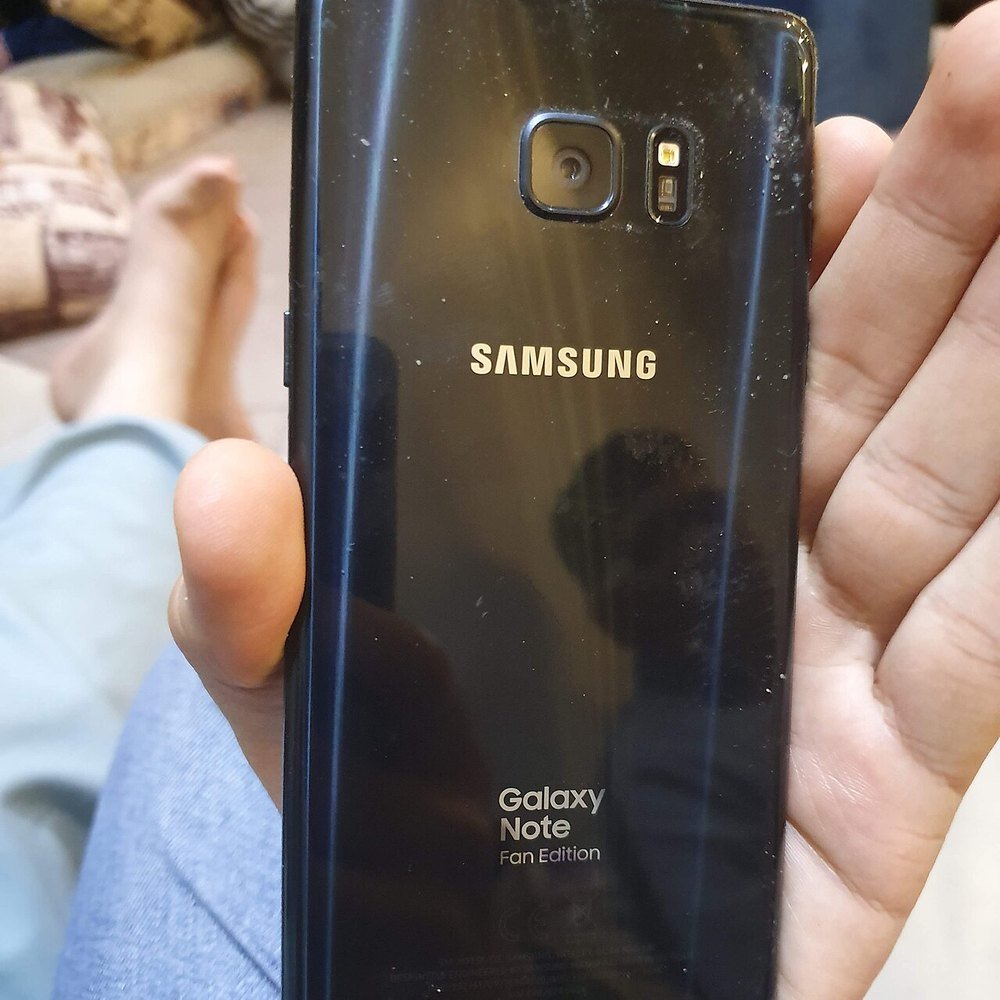
The Note7 returns as the Galaxy Note FE Aftermath
Samsung reused unopened parts and refurbished phones to make the Fan Edition, with a smaller battery than the original. Its release, and the July 2017 announcement that 157 tonnes of metals including gold, silver, cobalt and copper would be recovered from returned phones, followed Samsung’s recycling principles of 27 March 2017 and pressure from Greenpeace not to scrap millions of devices.
2017
Samsung explains the fires Findings
Mobile chief DJ Koh apologised and presented the results. Battery A had a pouch too small for its electrode assembly, so the negative electrode bent in the upper-right corner and could touch the positive electrode. Battery B had abnormally high welding burrs on the positive tab that could pierce the separator, and some cells lacked insulation tape. Samsung found no fault in the phone’s hardware or software. It introduced the 8-Point Battery Safety Check, multi-layer safety measures and an external Battery Advisory Group including Cambridge chemist Clare Grey and Stanford’s Yi Cui.
5 Jan 2017
Remaining US phones are switched off Recall
With some phones still in use months after the recall, Samsung pushed an update that prevented US Note7s from charging at all. Verizon at first refused to send it, saying customers who were travelling needed working phones over the holidays, then gave way. By January Samsung said more than 96% of the 3.06 million Note7s sold had been returned.
2016
The US bans the Note7 from all flights Regulator
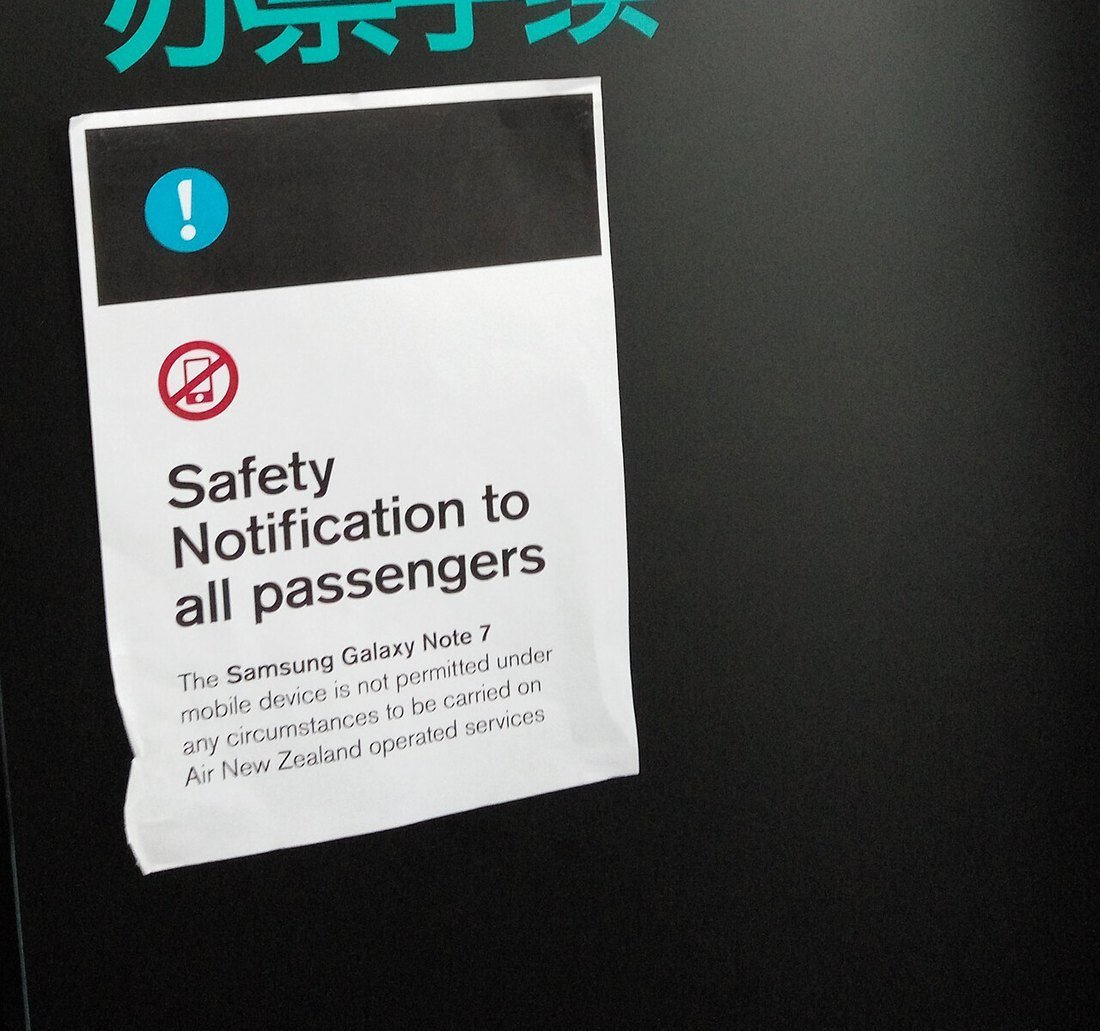
The order, announced the day before, made it illegal to carry a Note7 on a flight to, from or within the United States, even switched off. Passengers found with one could have it confiscated and face fines. Airlines and regulators worldwide imposed similar bans, and the Note7 was named in pre-flight announcements for months.
2016
Samsung counts the cost Aftermath
Samsung cut its estimate of third-quarter operating profit from 7.8 trillion to 5.2 trillion won and warned of a further hit of about 3 trillion won over the next two quarters. The direct cost was manageable for a company of Samsung’s size; the damage to its brand, just as Apple launched the iPhone 7, was harder to measure.
2016
The US recall expands to every Note7 Recall
The CPSC and Samsung recalled all Galaxy Note7 phones, original and replacement. Samsung had received 96 US reports of batteries overheating, 23 of them since the first recall, including 13 reports of burns and 47 of property damage. Owners were told to power down and return their phones for a refund or a different phone.
2016
Production stops for good Recall
Samsung told South Korea’s stock exchange it would permanently stop production and sales of the Galaxy Note7. It was one of the most expensive product withdrawals in consumer electronics, and the first time a major smartphone had been killed by safety problems after launch.
2016
Samsung halts sales and exchanges Recall
After more reports of replacement phones overheating in the US, South Korea, China and Taiwan, Samsung asked partners to stop selling and exchanging the Note7 while it investigated. US carriers had already stopped exchanges on 9 October.
2016
A replacement phone smokes on a Southwest flight Incident
The owner had switched off his replacement Note7 when it began smoking in his pocket. He dropped it on the floor, and smoke filled the cabin. Because the phone was a replacement, marked as safe with a black square on its box, the incident showed that Samsung’s fix had not worked.
2016
Replacement phones reach US customers Recall
Samsung said replacements had batteries from a different supplier and showed a green battery icon on screen to tell them apart. Exchanges began in the US on 21 September, and sales resumed in South Korea on 1 October. Within days, replacements were also catching fire.
2016
A software update caps charging at 60% Recall
To reduce the risk from phones not yet exchanged, Samsung limited charging to 60% of capacity. It was the first time a phone maker had remotely restricted a device on this scale for safety reasons.
2016
The official US recall Regulator
The CPSC’s formal recall made selling a Note7 illegal in the US and set out the remedy. Fires had damaged cars and a garage. Critics said Samsung’s own exchange programme, launched two weeks earlier without the regulator, had confused consumers about whether their phones were dangerous.
2016
Aviation and safety regulators step in Regulator
The Federal Aviation Administration strongly advised passengers not to turn on or charge Note7s in flight or put them in checked bags. A day later, the CPSC told consumers to power down and stop using their phones. Airlines in Australia, Europe and Asia issued similar warnings.
2016
Samsung stops sales and promises replacements Recall
Samsung said a battery cell problem had caused 35 incidents and that it would replace every Note7 sold, whatever the date of purchase. Mobile chief DJ Koh said the problem affected about 24 in every million phones. The decision was fast by industry standards, but it was taken before the cause was fully understood.
2016
First fires, then shipments are delayed Incident
Photos of burnt Note7s began to spread online in South Korea. On 31 August Samsung delayed shipments to carriers there for ‘additional inspections for quality control’. It was the first sign that the problem was more than a few isolated cases.
2016
The Note7 goes on sale Launch
Early reviews were among the best Samsung had received, praising the curved screen, water resistance and iris scanner. Demand outstripped supply in several markets, putting pressure on Samsung and its suppliers to produce phones and batteries quickly.
2016
Samsung unveils the Galaxy Note7 Launch
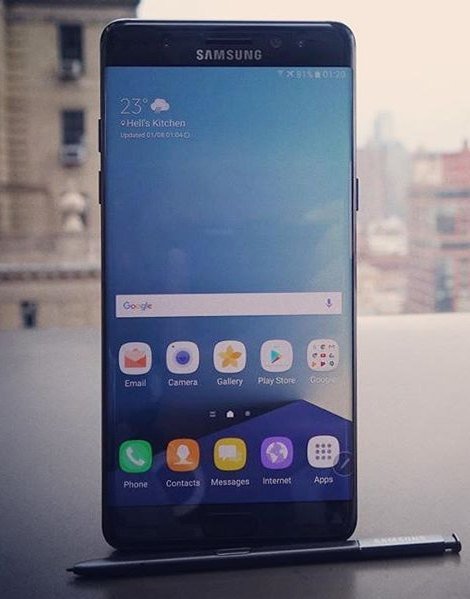
The Note7 skipped the number 6 so the Note line would match the Galaxy S7. Its 3,500 mAh battery was the largest yet in a Note phone, fitted into a body only 7.9 mm thick. That combination of a large battery in a tight space became central to the later investigation.
Pick a part of the story to see who made it, what the investigators found and what happened as a result.
Based on Samsung’s 23 January 2017 findings and the reports of UL, Exponent and TÜV Rheinland. Samsung did not name its suppliers; the names are from contemporary news reports.
The Galaxy Note 7 Crisis by the Numbers
| Measure | Figure | Source |
|---|---|---|
| Days on sale | About 53 (19 Aug–10 Oct 2016) | Samsung announcements |
| Worldwide cases at first halt | 35 (to 1 September 2016) | Samsung, 2 Sep 2016 |
| Phones covered by first exchange | About 2.5 million | Samsung, 2 Sep 2016 |
| US reports of overheating | 92 by 15 Sep; 96 by 13 Oct 2016 | CPSC |
| Phones recalled in the US | About 1.9 million | CPSC, 13 Oct 2016 |
| Phones sold worldwide | 3.06 million | Samsung, Jan 2017 |
| Returned by January 2017 | More than 96% | Samsung, Jan 2017 |
| Hit to operating profit | About $5.3 billion | Samsung, 14 Oct 2016 |
| Phones and batteries tested | 200,000+ phones, 30,000+ batteries | Samsung, 23 Jan 2017 |
| Metals to be recovered | About 157 tonnes | Samsung, Jul 2017 |
What Caused the Galaxy Note 7 Batteries to Fail?
A lithium-ion battery is a sandwich of a positive electrode, a negative electrode and a thin plastic separator, rolled or stacked inside a pouch and soaked in a flammable electrolyte. The separator keeps the electrodes apart while letting lithium ions pass. If anything breaks through it, the electrodes touch, current flows inside the cell and it heats up rapidly. Above a certain temperature the materials start to break down and release more heat and gas, a chain reaction known as thermal runaway.
Samsung’s investigation found two different routes to the same short circuit. In Battery A, used in most original phones, the corner of the pouch did not leave enough room for the electrodes, so the negative electrode was bent and, over time, could meet the positive electrode. In Battery B, used in the replacements, welding at the positive tab left burrs high enough to push through the separator, and some cells were missing the insulation tape meant to protect that spot. Samsung, UL, Exponent and TÜV Rheinland each found no fault in the phone’s own hardware or software.
The design made both failures more likely. Samsung had fitted its biggest Note battery yet into a thin body with tight tolerances, leaving little room for normal swelling or for manufacturing variation. That is why one of the multi-layer measures Samsung announced afterwards was simply more space around the battery.
Too little room
The pouch’s upper-right corner squeezed the electrode assembly. The bent negative electrode could reach the positive electrode and short the cell.
Welding burrs
Sharp burrs at the positive tab could pierce the separator. Some cells lacked insulation tape, and some had thin separators.
Internal short circuit
Current flowing inside the cell heated it from within, which could trigger thermal runaway, venting and fire.
Phone hardware or software
Investigators found no fault in the charging circuits, software or other components of the phone itself.
Why Did the Replacement Programme Fail?
Samsung acted quickly. Within two weeks of the first public reports it had stopped sales and promised to replace every phone, at a time when it believed it understood the problem: a defect in one supplier’s batteries. Replacements would use cells from the other supplier. But that supplier had to increase production sharply to cover millions of phones, and its cells had a different, unrelated flaw. The replacements went out before anyone had shown that they could not fail in some other way.
The programme also started outside the formal recall process. Samsung announced its exchange on 2 September, but the US recall, which made sales illegal and set out the remedy, did not come until 15 September. In the meantime, consumers heard mixed messages about whether their phones were safe. When the replacements began to fail in early October, the company had already used up much of the trust the quick response had earned.
- Single-cause thinking: the first fix assumed one faulty battery, not a design with little margin for error.
- Supplier ramp-up: doubling one supplier’s output quickly raised the risk of new manufacturing defects.
- Validation gap: replacements were not proven safe against every plausible failure before they shipped.
- Time pressure: Apple unveiled the iPhone 7 on 7 September 2016, raising the stakes of a long gap in sales.
- Mixed messaging: a company exchange before a formal recall confused owners about what to do.
Samsung’s 8-Point Battery Safety Check
Introduced on 23 January 2017, alongside multi-layer safety measures and an external advisory group.
| Test | Status in 2017 | What it looks for |
|---|---|---|
| Durability test | Enhanced | Batteries survive overcharging, nail puncture and extreme temperatures |
| Visual inspection | Enhanced | Visible defects, checked against standardised criteria |
| X-ray test | Enhanced | Hidden faults inside the cell, such as bent electrodes |
| Disassembling test | Enhanced | Batteries taken apart to check tab welding and insulation tape |
| ΔOCV test | Enhanced | Changes in open-circuit voltage through manufacturing |
| Charge and discharge test | New | Large-scale charging and discharging before shipment |
| TVOC test | New | Leaks of volatile organic compounds from the cell |
| Accelerated usage test | New | Simulates months of real-world use in a short time |
The point of the check was to test batteries at several stages, from cell production to the finished phone, rather than relying on a single inspection. X-ray and disassembly tests target exactly the kinds of hidden defects that caused the Note7 fires. Samsung’s multi-layer measures also covered phone design: more space around the battery, brackets to protect it from impact, and charging software that limits temperature, current and charging time.
The Financial and Business Impact
Samsung put the cost at about $5.3 billion in lost operating profit over three quarters, for refunds, replacements, logistics, write-offs and lost sales. It was large, but Samsung’s memory chip business was booming and the company reported strong profits again within months. The Galaxy S8, launched in April 2017, and the Note8 in August sold well.
The harder damage was to trust. Airline announcements naming the Note7 were repeated at gates around the world for months, a constant reminder of the failure. Samsung responded by making battery safety part of its marketing and, for years, by keeping battery sizes and charging speeds conservative. Carriers and retailers, who had handled millions of returns, also became more demanding about the testing they expect before a launch.
Lithium-Ion Battery Crises Before and Since
The Note7 was the most visible battery failure in consumer electronics, but not the only one.
| Year | Device or event | Problem | Response |
|---|---|---|---|
| 2006 | Dell and Apple laptops (Sony cells) | Contaminated cells overheating | Recall of about 4.1 million Dell batteries, then others |
| 2013 | Boeing 787 Dreamliner | Lithium-ion main battery fires | Worldwide grounding for about three months |
| 2016 | Galaxy Note7 | Two separate battery cell defects | Two recalls, flight ban, phone discontinued |
| 2016 | Hoverboards | Battery packs catching fire | US recall of about 500,000 units |
| 2025 | Pixel 6a | Risk of battery overheating | Mandatory update limiting capacity and charging |
| 2025–26 | Power banks on aircraft | Cabin fires, including Air Busan | Airline limits, then ICAO rules from March 2026 |
Battery Safety in 2026: What the Note 7 Still Teaches
Ten years after the Note7’s launch, the risks it exposed have not gone away; they have moved. Phones are now among the safer lithium-ion products, with better testing and more conservative designs. The bigger concerns are cheap power banks, vapes and e-bikes, which are made by thousands of suppliers with uneven quality control and carried everywhere, including on planes.
Regulators have responded. The FAA verified 93 lithium battery incidents on aircraft in 2025. Since 27 March 2026, ICAO rules limit international passengers to two power banks and ban charging them on board, after a series of cabin fires including the Air Busan fire in January 2025. In Europe, the Batteries Regulation will require portable batteries in new devices to be replaceable by users from 18 February 2027, although phones meeting separate durability standards can be exempted.
Type the capacity printed on a power bank to convert it to watt-hours and see which ICAO rule applies on international flights.
Uses the nominal 3.7 volts of a typical lithium-ion cell. If the label gives watt-hours, use that figure instead. Airlines can set stricter rules, so always check yours.
For comparison, the Galaxy Note7’s 3,500 mAh battery held about 13.5 Wh. It is still banned on flights however small, because it is a recalled, defective battery.
How the Crisis Changed Battery Safety Practices
- Validate under real conditions: battery tests must cover mechanical stress, manufacturing variation and long-term swelling, not just new cells.
- Supplier quality is engineering: a part made by another company still decides whether the finished product is safe.
- Test the fix independently: a replacement is not safe just because it is different from the original.
- Safety before schedule: a rival’s launch is never a reason to ship an unproven fix.
- Make recalls clear: owners need one simple instruction, a formal recall and an easy refund.
- Build in traceability: records of cell batches and test results let companies narrow a recall quickly.
Explore More Timelines
People Also Ask
Frequently Asked Questions
Conclusion: A Flagship That Became a Safety Case Study
The Galaxy Note7 went from launch to withdrawal in less than ten weeks. What began as a few photos of burnt phones in South Korea became two recalls, a worldwide flight ban and a $5.3 billion loss, because a fix was shipped before it was proven. Samsung’s January 2017 investigation found that two suppliers’ batteries had failed for different reasons inside a design with little margin for error.
The lasting lesson is that battery safety depends on the whole system, from cell design and supplier quality to independent testing and clear recalls. A decade later, as power banks and vapes cause more fires on planes than phones do, regulators are applying the same lesson to products far cheaper than a flagship phone.
Related AiTimeline Stories
⚠️ Editorial Note
This timeline draws on Samsung Newsroom statements from September 2016 and January 2017, the US Consumer Product Safety Commission recall notices of 15 September and 13 October 2016, the US Department of Transportation’s emergency order, the FAA’s lithium battery incident data, ICAO’s 2026 power bank rules and reporting by the Associated Press, Bloomberg and other outlets. Samsung did not publicly name its battery suppliers; the names given are from contemporary reports. Flight rules vary by airline and country, so check with your airline before travelling. This article is for information and is not safety or legal advice.
Sources & further reading
Every dated entry above was checked against these references. Last reviewed 18 October 2026.
- Samsung Electronics Announces Cause of Galaxy Note7 Incidents in Press Conference
- Samsung Announces New and Enhanced Quality Assurance Measures to Improve Product Safety
- Samsung Recalls Galaxy Note7 Smartphones Due to Serious Fire and Burn Hazards
- Samsung Expands Recall of Galaxy Note7 Smartphones Based on Additional Incidents with Replacement Phones
- Samsung sees $5.3 billion profit impact from Note 7 crisis
- Samsung blames Galaxy Note 7 smartphone fires on battery design, manufacturing
- Lithium Battery Incidents
- Casely Reannounces Recall of Wireless Portable Power Banks
- New airline power bank rules: what passengers need to know