← AiTimeline Home

Business · Europe · 1970–2026

Euro Launch Anniversary: Survival, Crisis and the Future of Europe’s Currency

📅 Updated 19 October 2026💶 20 turning points🌍 21 member countries
Advertisement

View as Web Story

In short

Euro timeline from the 1999 launch and 2002 cash to the Greek debt crisis, Draghi's pledge, Bulgaria joining in 2026, ECB rate rises and the digital euro.

Advertisement

Latest Story

The euro was launched on 1 January 1999 and became everyday cash on 1 January 2002. Since then it has survived a global financial crisis, a sovereign debt crisis that nearly pushed Greece out, a pandemic and an inflation shock, and it is still growing: Bulgaria became the 21st member on 1 January 2026. This euro launch anniversary timeline runs newest first, from the October 2026 debt worries, the ECB’s 2026 rate rises and the digital euro back through Draghi’s ‘whatever it takes’ and the 2002 cash changeover to the Maastricht Treaty.

Advertisement
Advertisement

💡 Short Answer

The euro was launched as an electronic currency in 11 countries on 1 January 1999, and euro banknotes and coins entered circulation in 12 countries on 1 January 2002. It survived the 2008 financial crisis, the 2010–15 debt crisis, COVID-19 and the 2022 inflation surge. Bulgaria made it 21 members in January 2026. The ECB raised rates twice in 2026, and a digital euro could be issued from 2029 if EU law is passed.

⚡ The Euro: Quick Facts
Launched1 Jan 1999 (cash 1 Jan 2002)
Members21 countries, about 358m people
Newest memberBulgaria, 1 Jan 2026
ECB deposit rate2.50% (since 16 Sep 2026)
Inflation, Sep 20263.8% (target 2%)
Digital euroPilot H2 2027, issue 2029 at earliest
⚡ Quick Answers — AI Overview Ready

Euro Anniversary: Key Questions

When did the euro start?
On 1 January 1999, as a currency for banks, markets and electronic payments in 11 EU countries. Notes and coins arrived on 1 January 2002, so the 25th anniversary of euro cash falls on 1 January 2027.
How did the euro survive the debt crisis?
Through rescue loans to Greece, Ireland, Portugal, Spain and Cyprus, new institutions such as the European Stability Mechanism and banking union, and the ECB’s 2012 pledge to do ‘whatever it takes’, which calmed markets without being used.
Is the euro in trouble in 2026?
Not in crisis, but under pressure. Inflation rose to 3.8% in September 2026 after an energy shock, the ECB raised rates in June and September, and French borrowing costs are near their highest spread over Germany since 2012. The EU says there are no signs of a new debt crisis.
What comes next for the euro?
EU law on a digital euro, with a pilot from late 2027 and possible issue in 2029; new banknote designs due to be chosen around the end of 2026; a new ECB president by late 2027; and continuing debates on debt, defence spending and growth.
📚 Key Takeaways

The Euro’s Story in Ten Points

  • Two birthdays: the euro launched on 1 January 1999 and became cash on 1 January 2002.
  • From 11 to 21: ten countries have joined since 1999, most recently Croatia (2023) and Bulgaria (2026).
  • No exits: no country has ever left the euro, though Greece came close in 2015.
  • Design flaw exposed: the debt crisis showed a shared currency without a shared budget or bank backstop was fragile.
  • Seven rescues: Greece (three times), Ireland, Portugal, Spain’s banks and Cyprus received help from 2010 to 2015.
  • Three words: Draghi’s 2012 ‘whatever it takes’ ended the acute crisis without the ECB spending a euro.
  • From minus to plus: the deposit rate went from −0.50% (2019) to a record 4.00% (2023).
  • 2026 hikes: an energy shock pushed inflation to 3.8% and the ECB raised rates in June and September.
  • Digital euro: Parliament backed the law in July 2026; first issue could come in 2029.
  • Fiscal risk: France’s budget fight is the main debt worry of autumn 2026, but officials see no new crisis.

Euro Timeline: Latest Developments First

Newest first. Each entry is tagged by theme and ends with why it matters. Use the filter to follow one thread.

🎯 Interactive: Filter the Timeline

Follow one thread of the euro’s story: crises, ECB decisions, new members, cash and digital money, or the treaties behind it.

–

Advertisement

Debt worries return, with France in the spotlight Crisis

14 Oct: Commissioner Valdis Dombrovskis sees ‘no signs’ of a new sovereign debt crisisFrench 10-year spread over Germany near 140 basis points, the widest since 2012France’s 2027 budget: €54 billion of savings, deficit 5.4% to 5% of GDPNational Assembly vote on the budget’s first part due 20 Oct

Speaking to Reuters at the IMF meetings in Bangkok, Dombrovskis said governments must stay prudent as sovereign and corporate borrowing costs and inflation expectations rise, and urged France to adopt its budget on time to signal stability. He noted that Europe’s long average debt maturity gives governments time before higher yields feed into interest bills. Higher yields are not a repeat of 2010–12: the ECB now has crisis tools such as its Transmission Protection Instrument, and no country has lost market access.

Why it matters: A single currency with 21 national budgets still depends on each government keeping markets’ trust.
Jun–Sep
2026

The ECB raises rates again as an energy shock hits ECB policy

11 Jun: deposit rate up from 2.00% to 2.25%, the first rise since September 202310 Sep: second hike, to 2.50% (main refinancing rate 2.65%)Inflation: 2.8% in June, 3.2% in August, 3.8% in September (Eurostat)Next decision: 29 Oct 2026

Renewed US–Iran hostilities and the wider Middle East conflict pushed oil and gas prices up, and staff projections showed inflation staying well above target for an extended period. All Governing Council members backed the September hike, according to its published account, though they stressed the response should stay proportionate. Staff see growth of only 0.9% in 2026. After cutting rates eight times from June 2024 to June 2025, the ECB has turned again to defending its 2% target.

Why it matters: Price stability is the ECB’s only primary mandate, and its credibility is what gives the euro its value.
Jul–Sep
2026

Europeans vote on new euro banknotes Cash & digital money

Two themes shortlisted: ‘European culture’ and ‘Rivers and birds’Public survey 23 Jul–21 Sep 2026Final design decision expected around the end of 2026New notes will take several years to reach circulation

The ‘European culture’ shortlist features figures such as Marie Curie, Beethoven and Leonardo da Vinci; ‘Rivers and birds’ features motifs such as a kingfisher and a white stork. The current notes, with their bridges, windows and gateways, will stay legal tender. The ECB also says cash remains essential even as it prepares a digital euro.

Why it matters: The redesign is the first since euro notes were created, and a sign the ECB plans for cash to survive alongside digital payments.
Dec 2025–
Jul 2026

The digital euro law moves forward Cash & digital money

Dec 2025: EU governments agree their position23 Jun 2026: European Parliament economic committee backs the regulation 43–149 Jul 2026: plenary confirms the negotiating mandate 416–169Trilogue talks under way; leaders want a deal by end-2026

The Parliament’s version provides for online and offline digital euros, cash-like privacy for offline payments and holding limits to protect bank deposits. On 6 October 2026 ECB Executive Board member Piero Cipollone said that, if the law is concluded by the end of 2026, the ECB aims to be ready for a first issuance in 2029, with a 12-month pilot involving 36 payment service providers starting in the second half of 2027.

Why it matters: Two-thirds of euro-area card payments rely on international card schemes, the ECB says; the digital euro is Europe’s attempt at a public, pan-European alternative.
1 Jan
2026

Bulgaria becomes the 21st euro member New members

Conversion rate fixed at 1.95583 lev per euroBulgarian National Bank joins the Eurosystem; Governor Dimitar Radev joins the ECB Governing CouncilFull member of the Single Supervisory Mechanism (close cooperation since October 2020)About 358 million people now use the euro

The lev had been tied to the Deutsche Mark under a currency board since 1997 and then to the euro, so the rate did not change. Bulgaria entered the ERM II waiting room in July 2020. Supporters pointed to lower transaction costs and deeper ties with European markets; critics, including protesters in Sofia, feared price rises and the loss of the last trace of national monetary policy, which the currency board had already given up.
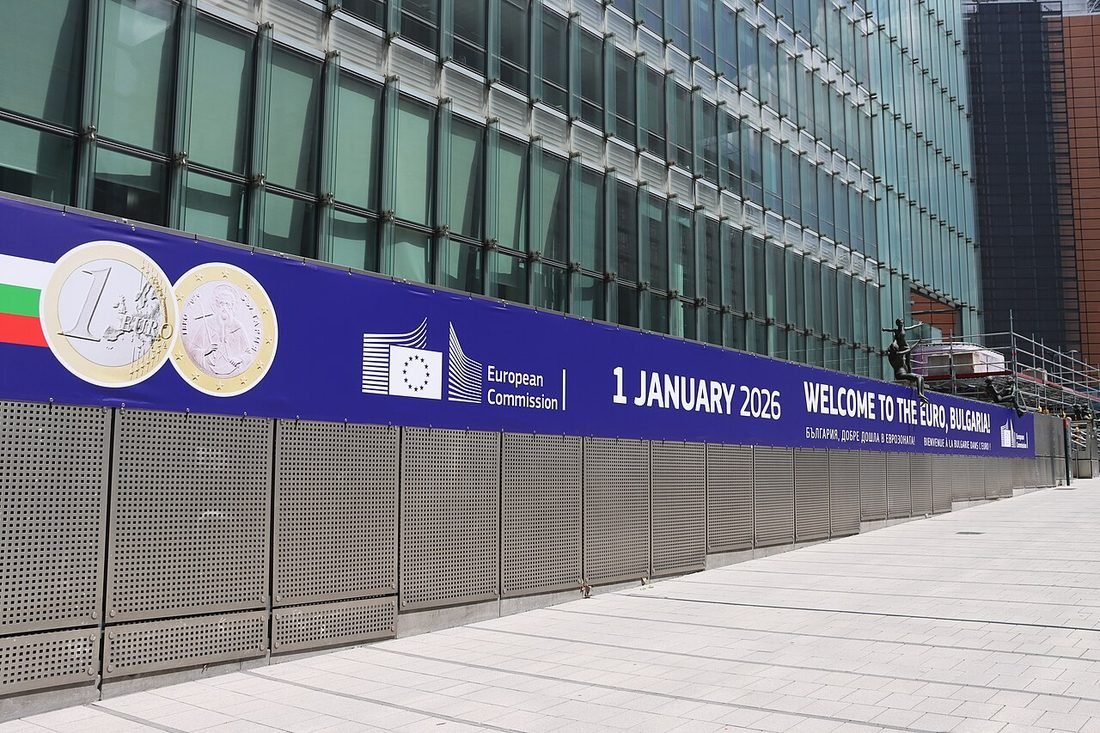
Why it matters: Enlargement in the middle of a turbulent decade shows the euro still attracts new members.
A Welcome to the euro, Bulgaria banner dated 1 January 2026
A European Commission banner welcoming Bulgaria to the euro on 1 January 2026, photographed in July 2025. Photo: FrDr, CC BY-SA 4.0, via Wikimedia Commons.

The digital euro moves to its next phase Cash & digital money

30 Oct 2025: the ECB Governing Council ends the two-year preparation phaseTechnical work on a rulebook, platform and providers continuesFirst issuance targeted for 2029, subject to legislation

The ECB stressed that it would decide whether to issue a digital euro only after EU law is adopted. It also confirmed basic use would be free for individuals and that the design would let people pay offline, without the ECB seeing who paid whom.

Why it matters: This decision turned the digital euro from a study into a project with a target date.
2022–
2023

Inflation, war and ten straight rate rises ECB policy

24 Feb 2022: Russia’s full-scale invasion of Ukraine sends gas prices soaring21 Jul 2022: first ECB hike in 11 years (+0.50 points)Oct 2022: euro-area inflation peaks at 10.6%28 Sep 2022: euro at $0.9565, its lowest since 2002Sep 2023: deposit rate reaches a record 4.00%

The ECB had kept its deposit rate below zero from 2014 to 2022. It raised rates by 4.5 points in 14 months, its fastest tightening ever, and created the Transmission Protection Instrument in July 2022 so that spreads for countries such as Italy did not spiral. Households with variable-rate mortgages in countries such as Spain and Ireland felt the hikes much faster than those on fixed rates in Germany and France.

Why it matters: The same interest rate hits 20 economies differently, the euro’s oldest structural tension.
1 Jan
2023

Croatia joins as the 20th member New members

Conversion rate 7.53450 kuna per euroJoins the Schengen area on the same dayFirst new member since Lithuania in 2015

Croatia’s entry ended an eight-year pause in enlargement. Shops had to show prices in both kuna and euros for a year, and the government blamed some retailers for unjustified price rises around the changeover, a familiar complaint in many euro adoptions.

Why it matters: It proved that the euro could still expand after the debt crisis.
2020–
2021

COVID-19 and the first big joint EU borrowing Crisis

18 Mar 2020: ECB launches the €750 billion Pandemic Emergency Purchase Programme, later raised to €1,850 billionMar 2020: EU budget rules suspended21 Jul 2020: leaders agree the €750 billion NextGenerationEU recovery fund

Lockdowns caused the deepest recession in the euro’s history. This time the response came fast: the ECB bought government and corporate bonds on a huge scale, and the EU agreed for the first time to borrow large sums jointly on markets to fund grants and loans for member states, with Italy and Spain the biggest recipients. NextGenerationEU was presented as a one-off, not a permanent fiscal union.

Why it matters: It broke a taboo on common EU debt that had blocked solutions during the debt crisis.
2014–
2019

Negative rates and quantitative easing ECB policy

Jun 2014: deposit rate cut to −0.10%, making the ECB the first major central bank to go negativeNov 2014: ECB takes over supervision of the biggest banks22 Jan 2015: €60 billion-a-month bond buying announcedSep 2019: deposit rate cut to −0.50%

With inflation stuck close to zero and fears of deflation, Draghi’s ECB used tools previously seen as off limits. Critics, especially in Germany, argued that negative rates hurt savers and banks and that bond buying amounted to financing governments; the German Constitutional Court challenged the programme in 2020.

Why it matters: These tools kept the euro area out of deflation but left a legacy of cheap borrowing that ended abruptly in 2022.
Jan–Aug
2015

Greece’s ‘Grexit’ summer Crisis

25 Jan: Syriza wins the election; Alexis Tsipras becomes prime minister29 Jun: banks closed and capital controls imposed5 Jul: 61.3% vote ‘No’ to creditors’ terms13 Jul: Tsipras accepts a deal after an all-night summitAug: third rescue of up to €86 billion from the ESM

Greece missed an IMF repayment on 30 June, and euro leaders openly discussed a temporary exit. Tsipras ultimately accepted tougher conditions than those voters had rejected, splitting his party. Lithuania joined the euro on 1 January of the same year, showing that the club was growing even as it struggled to hold on to Greece. Greece left its last rescue programme in August 2018.

Why it matters: It tested whether euro membership was truly irreversible, and the answer, for now, was yes.
Jul–Oct
2012

‘Whatever it takes’ ECB policy

26 Jul: Draghi’s London pledge6 Sep: Outright Monetary Transactions announced8 Oct: the €500 billion European Stability Mechanism is inauguratedJun–Jul: Spain requests up to €100 billion to recapitalise its banks

Spanish and Italian borrowing costs had climbed above 6–7%, levels that had forced Greece, Ireland and Portugal into rescue programmes. Draghi’s words, backed by the OMT promise of unlimited bond purchases for countries in an ESM programme, broke the panic. OMT was never used. Leaders also agreed in June 2012 to build a banking union, with the ECB supervising the largest banks from November 2014.
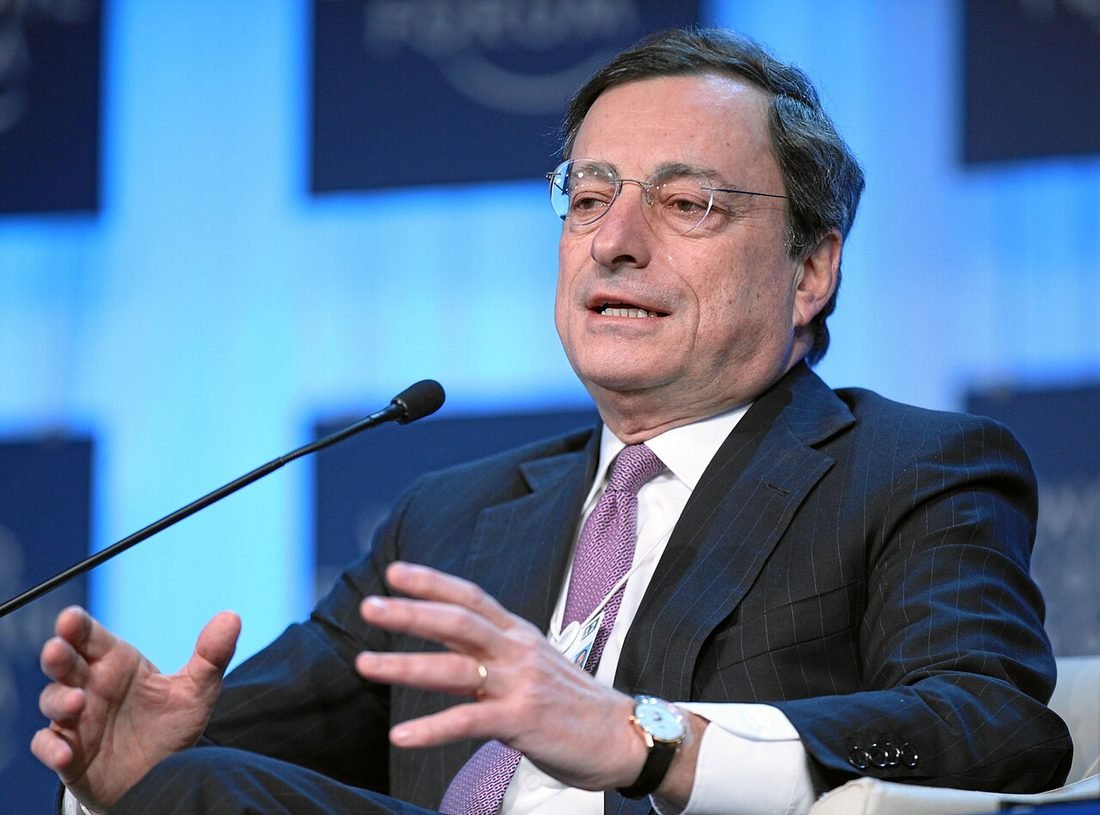
Why it matters: Probably the most effective sentence in central banking history: confidence returned without a euro being spent.
ECB President Mario Draghi speaking in Davos in January 2012
ECB President Mario Draghi at the World Economic Forum in Davos in January 2012, six months before his ‘whatever it takes’ pledge. Photo: World Economic Forum, CC BY-SA 2.0, via Wikimedia Commons.
2009–
2013

The sovereign debt crisis Crisis

Oct 2009: Greece’s new government reveals a far larger deficit than reported2 May 2010: first Greek rescue, €110 billionNov 2010: Ireland, €85 billionMay 2011: Portugal, €78 billionMar 2012: Greek private debt write-down and second rescueMar 2013: Cyprus, €10 billion with a bank bail-in

The crisis exposed a design flaw: countries shared a currency and a central bank but not a budget, a banking safety net or a way to handle a government that could not pay. Rescue loans came with harsh austerity. Unemployment rose above 27% in Greece and above 26% in Spain, and mass protests filled squares such as Syntagma in Athens. Europe built new institutions in response, first the temporary EFSF in 2010, then the permanent ESM.
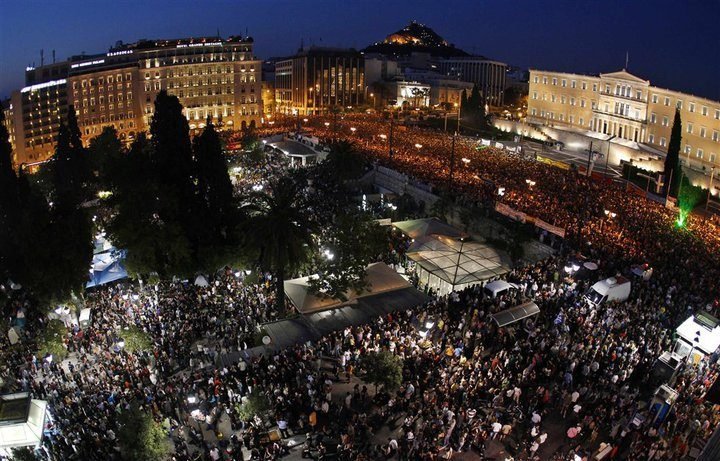
Why it matters: The euro survived, but the social and political scars still shape debates about shared debt and rules.
Crowds fill Syntagma Square in Athens during an anti-austerity protest in May 2011
Crowds fill Syntagma Square in front of the Greek parliament during an anti-austerity protest on 29 May 2011. Photo: Kotsolis, CC BY-SA 3.0, via Wikimedia Commons.
2008–
2009

The global financial crisis reaches Europe Crisis

15 Jul 2008: euro hits its record high of $1.59915 Sep 2008: Lehman Brothers collapsesOct 2008: ECB starts cutting rates and lends banks unlimited funds at a fixed rate1 Jan 2009: Slovakia joins as the 16th memberMay 2009: main rate at a then-record low of 1%

European banks had loaded up on US mortgage securities and lent heavily into property booms in Ireland and Spain. Governments rescued banks, and the cost moved onto their own balance sheets. The euro itself held up, but the recession set the stage for the sovereign debt crisis.

Why it matters: It showed that a strong currency cannot protect countries with weak banks and big imbalances.
1 Jan
2002

Euro banknotes and coins arrive Cash & digital money

12 countries, about 308 million people14.89 billion banknotes worth €633 billion and about 52 billion coins produced3 Jan: 96% of cash machines dispensing euros1 Mar 2002: euro the sole legal tender everywhere

It was the biggest cash changeover in history. Banks and shops were ‘front-loaded’ with euros in late 2001, and citizens could buy starter kits of coins in December. Within a week more than half of all cash payments were made in euros, and by 1 March more than 6 billion national banknotes and nearly 30 billion coins had been withdrawn. Many people felt prices rose; official statistics put the changeover effect at about 0.1–0.3 percentage points of inflation, mostly in cafés, restaurants and services.
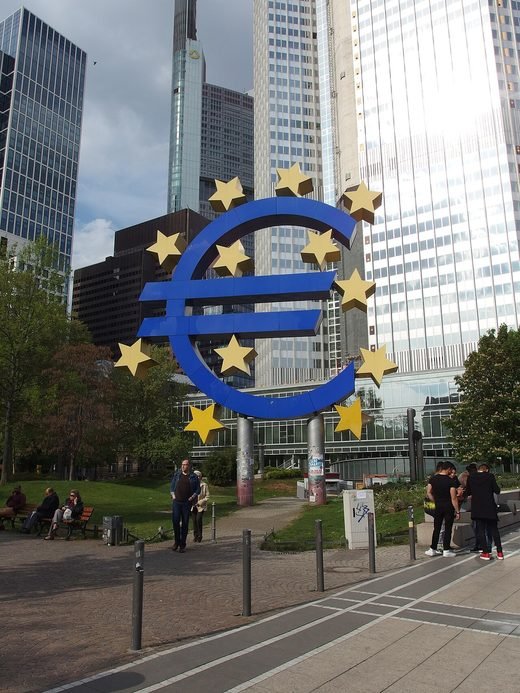
Why it matters: Cash made the euro real for people, and turned a financial project into a daily symbol of Europe.
The euro sign sculpture outside the Eurotower in Frankfurt
The euro sign sculpture outside the Eurotower in Frankfurt, the ECB’s first headquarters. Photo: Guilhem Vellut, CC BY 2.0, via Wikimedia Commons.
Sep–Oct
2000

A weak start for the new currency New members

22 Sep 2000: ECB, US Federal Reserve, Bank of Japan and others intervene to support the euro28 Sep 2000: Danish voters reject the euro, 53.2% to 46.8%26 Oct 2000: record low of $0.82521 Jan 2001: Greece joins as the 12th member

The euro lost nearly 30% against the dollar in its first two years as money flowed into the booming US economy. The coordinated intervention, and later ECB purchases, signalled that the big central banks would not let the slide continue. Sweden would also vote no, in 2003.

Why it matters: Early weakness fed scepticism that the euro would ever be a serious rival to the dollar.
1 Jan
1999

The euro is born Treaties & politics

31 Dec 1998: conversion rates irrevocably fixed11 countries: Austria, Belgium, Finland, France, Germany, Ireland, Italy, Luxembourg, the Netherlands, Portugal and SpainFirst ECB reference rate: $1.1789ECB, founded on 1 June 1998, takes over monetary policy

The euro first existed only in bank accounts, financial markets and electronic payments, while national notes and coins remained in use as fixed subdivisions of the euro. Wim Duisenberg was the ECB’s first president. The UK, Denmark and Sweden stayed out; Greece did not yet meet the criteria.

Why it matters: It moved control of interest rates from national capitals to Frankfurt, the biggest transfer of economic power in the EU’s history.

Leaders name the currency ‘euro’ Treaties & politics

15–16 Dec 1995: Madrid European Council chooses the name and confirms a 1 January 1999 start1996: the € symbol is presented1997: Stability and Growth Pact agreed to police budgets after launch

The name replaced the ‘ecu’, the basket unit used since 1979. The Stability and Growth Pact, pushed by Germany, kept the 3% of GDP deficit limit binding after countries joined, though France and Germany themselves breached it in 2003.

Why it matters: The rules set in the mid-1990s were the ones tested to breaking point a decade later.
1992–
1993

The Maastricht Treaty sets the course Treaties & politics

7 Feb 1992: Treaty on European Union signed2 Jun 1992: Danish voters reject it (later accepted with opt-outs)20 Sep 1992: France approves it with 51%Sep 1992: currency crisis forces the pound and lira out of the Exchange Rate Mechanism1 Nov 1993: treaty enters into force

The treaty laid down the convergence criteria: low inflation, a budget deficit below 3% of GDP, public debt below 60% of GDP or falling, a stable exchange rate and low long-term interest rates. The 1992–93 currency turmoil, when speculators broke several currency pegs, convinced many leaders that only a single currency could end such attacks.
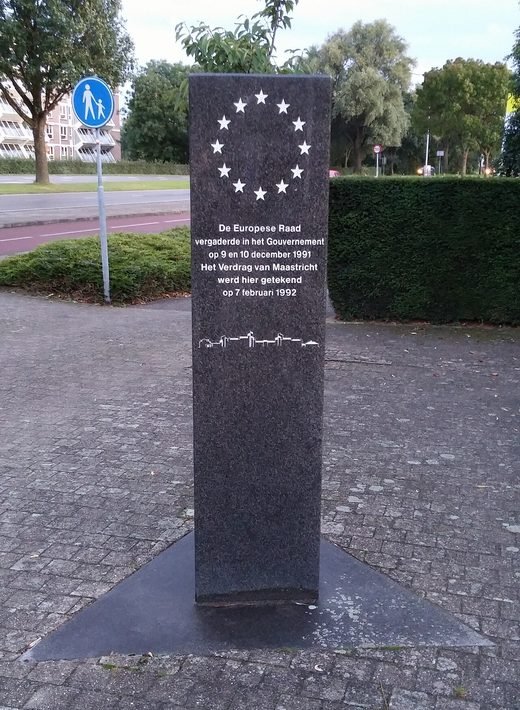
Why it matters: Maastricht’s rules defined who could join, and the fiscal limits it set are still debated today.
Stone memorial in Maastricht marking the signing of the Maastricht Treaty in 1992
A stone memorial outside the Limburg provincial government building in Maastricht marks the signing of the Treaty on European Union on 7 February 1992. Photo: Dozura, CC BY-SA 4.0, via Wikimedia Commons.
1970–
1989

The long road to monetary union Treaties & politics

1970: Werner Report proposes monetary union by 19801972: the ‘snake’ limits currency swings13 Mar 1979: European Monetary System and the ecu launchedApr 1989: Delors Report sets out three stages to a single currency

The first plan foundered on the collapse of the Bretton Woods system and the oil shocks of the 1970s. The EMS kept European currencies within bands around one another, and the fall of the Berlin Wall in November 1989 gave new political urgency to tying a reunified Germany into a common European currency.

Why it matters: The euro was 30 years in the making, a political project as much as an economic one.
Advertisement
Advertisement

The Euro Against the Dollar Since 1999

Euro vs US dollar: yearly average of the ECB reference rate, 1999–2026US dollars per euro. 2026 = January to 16 October. Dashed line = parity ($1).$0.8$1.0$1.2$1.4$1.61.070.9220010.95200420071.471.3320101.2820131.11201620191.05202220251.162026Source: ECB euro foreign exchange reference rates (daily), averaged by AiTimeline. Orange bars = average below parity.
The euro started at $1.18, sank to $0.83 by October 2000, peaked at $1.60 in July 2008 and fell below parity in 2022. Its 2026 average so far is about $1.16, though the rate slipped to around $1.12–1.13 in October.

Who Uses the Euro: 21 Members and Their Old Currencies

Fixed conversion rates set on entry, which can never change.

JoinedCountryOld currencyUnits per €1
1999GermanyDeutsche Mark (DEM)1.95583
1999FranceFrench franc (FRF)6.55957
1999ItalyItalian lira (ITL)1936.27
1999SpainSpanish peseta (ESP)166.386
1999NetherlandsDutch guilder (NLG)2.20371
1999BelgiumBelgian franc (BEF)40.3399
1999LuxembourgLuxembourg franc (LUF)40.3399
1999AustriaAustrian schilling (ATS)13.7603
1999PortugalPortuguese escudo (PTE)200.482
1999FinlandFinnish markka (FIM)5.94573
1999IrelandIrish pound (IEP)0.787564
2001GreeceGreek drachma (GRD)340.75
2007SloveniaSlovenian tolar (SIT)239.64
2008CyprusCypriot pound (CYP)0.585274
2008MaltaMaltese lira (MTL)0.429300
2009SlovakiaSlovak koruna (SKK)30.126
2011EstoniaEstonian kroon (EEK)15.6466
2014LatviaLatvian lats (LVL)0.702804
2015LithuaniaLithuanian litas (LTL)3.4528
2023CroatiaCroatian kuna (HRK)7.5345
2026BulgariaBulgarian lev (BGN)1.95583
💱 Interactive: Old Currency to Euro Converter

Found old Marks, francs or lira in a drawer? Convert any of the 21 currencies the euro replaced at its official, irrevocably fixed rate.

–

The Debt Crisis Rescues

Headline programme sizes; not every euro committed was drawn.

DateCountryRescueLenders
May 2010Greece (1st)€110 billionEuro countries + IMF
Nov 2010Ireland€85 billionEFSF/EFSM, bilateral, IMF, Irish funds
May 2011Portugal€78 billionEFSF/EFSM + IMF
Mar 2012Greece (2nd)~€130 billion + private write-downEFSF + IMF
Jul 2012Spain (banks)Up to €100 billion (about €41 billion used)EFSF/ESM
Mar 2013Cyprus€10 billion + bank bail-inESM + IMF
Aug 2015Greece (3rd)Up to €86 billionESM

ECB Interest Rates: Key Turning Points

DateECB deposit rateWhy
Jan 19992.00%Euro launched
Oct 20003.75%Weak euro, rising oil prices
Jul 20083.25%Last pre-crisis hike
May 20090.25%Global financial crisis
Jun 2014−0.10%First negative rate, deflation fears
Sep 2019−0.50%Record low
Sep 20234.00%Record high after 10.6% inflation
Jun 20252.00%End of eight cuts
Sep 20262.50%Second hike of 2026 on energy shock

How the Euro Survived: Four Lessons

Design

A central bank is not enough

One interest rate cannot fix 21 different budgets, banking systems and labour markets. National policies still matter.

Confidence

Credible promises work

The ECB’s 2012 pledge changed market expectations before a single bond was bought. Words backed by tools can stop a panic.

Institutions

Crises rebuild the club

The ESM, banking union, the Transmission Protection Instrument and NextGenerationEU were all born in emergencies.

Politics

Growth is not proof

New members show the euro still attracts, but debt, low productivity and public distrust remain unsolved.

The Future of the Euro: What Comes Next?

Digital money: EU institutions aim to finish the digital euro law by the end of 2026. If they do, a pilot starts in the second half of 2027 and a first issue could follow in 2029, but the ECB will decide only after the law is passed. Privacy, holding limits and costs for banks remain the hard questions.

Rates and inflation: the ECB meets on 28–29 October 2026 with inflation at 3.8%. Markets in early October expected a hold, but the path depends on energy prices and the Middle East conflict.

Debt and budgets: France’s 2027 budget votes begin on 20 October. Rising defence spending and higher yields will test the EU’s reformed fiscal rules, in force since 2024, across the euro area.

Leadership: Christine Lagarde’s term as ECB president ends in October 2027. Reports throughout 2026 suggested she could leave early; the ECB says she has made no decision. Her successor will shape the digital euro and the response to the energy shock.

Cash and symbols: new banknote designs are due to be chosen around the end of 2026, just before euro cash turns 25 on 1 January 2027.

Advertisement

Explore More Timelines

People Also Ask

How old is the euro in 2026?
The euro is 27 years old as a currency (launched 1 January 1999) and nearly 25 as cash; banknotes and coins turn 25 on 1 January 2027.
Who controls the euro?
The European Central Bank in Frankfurt sets interest rates for all euro countries together with their national central banks, which form the Eurosystem. Governments still control their own taxes and spending.
What was the first year of euro coins?
Euro coins and banknotes entered circulation on 1 January 2002, although coins were minted from 1999 and many carry 1999, 2000 or 2001 dates.
Which country left the euro?
None. No country has ever left the euro, and the EU treaties contain no procedure for doing so. Greece came closest in 2015.
Is the digital euro a cryptocurrency?
No. It would be central bank money issued and guaranteed by the ECB, worth exactly one euro, unlike cryptocurrencies or private stablecoins.

Frequently Asked Questions

When was the euro launched?
The euro was launched on 1 January 1999 as an accounting and electronic currency in 11 EU countries, with exchange rates irrevocably fixed the day before. Euro banknotes and coins followed on 1 January 2002, when 12 countries, including Greece, swapped their national cash for the euro.
When is the euro’s launch anniversary?
Both anniversaries fall on 1 January: the financial launch in 1999 and the cash launch in 2002. The euro turned 25 as a currency on 1 January 2024. The 25th anniversary of euro banknotes and coins falls on 1 January 2027.
How many countries use the euro in 2026?
Twenty-one EU countries use the euro after Bulgaria joined on 1 January 2026: Austria, Belgium, Bulgaria, Croatia, Cyprus, Estonia, Finland, France, Germany, Greece, Ireland, Italy, Latvia, Lithuania, Luxembourg, Malta, the Netherlands, Portugal, Slovakia, Slovenia and Spain. The ECB says about 358 million people use it.
Which was the last country to adopt the euro?
Bulgaria, on 1 January 2026, at a fixed rate of 1.95583 lev per euro, the same rate at which the lev had been pegged to the euro, and before that to the Deutsche Mark, since 1997. It became the 21st member. Croatia had joined three years earlier, on 1 January 2023.
Which EU countries do not use the euro?
Six EU members still use their own currencies: Czechia, Denmark, Hungary, Poland, Romania and Sweden. Denmark has a legal opt-out and keeps its krone tied to the euro. The others are legally committed to join once they meet the convergence criteria, but have no fixed date.
What was the eurozone debt crisis?
It was a period from late 2009 to about 2015 when several euro countries lost the confidence of bond markets. It began when Greece revealed a much bigger deficit in October 2009. Greece, Ireland, Portugal and Cyprus needed full rescue programmes, Spain borrowed to rescue its banks, and borrowing costs in Italy also soared.
How much did the Greek bailouts cost?
Greece received three programmes: €110 billion in May 2010, a second of about €130 billion in 2012 alongside a private debt write-down, and up to €86 billion from the European Stability Mechanism in August 2015. The Greek economy shrank by about a quarter. Greece exited its last programme in August 2018.
Did Greece nearly leave the euro?
Yes, in 2012 and again in 2015. In July 2015 banks were shut, capital controls imposed and Greeks voted 61% against creditors’ terms in a referendum on 5 July. Days later Prime Minister Alexis Tsipras accepted a tougher deal to stay in, after euro leaders discussed a temporary ‘Grexit’.
What did Mario Draghi mean by ‘whatever it takes’?
Speaking in London on 26 July 2012, the ECB president said that ‘within our mandate, the ECB is ready to do whatever it takes to preserve the euro. And believe me, it will be enough.’ Six weeks later the ECB announced Outright Monetary Transactions, a bond-buying backstop that calmed markets without ever being used.
Has the euro ever been worth less than the dollar?
Yes. In its early years the euro fell to a record low of $0.8252 on the ECB’s reference rate on 26 October 2000. It also dropped below parity in 2022, reaching $0.9565 on 28 September 2022. Its highest ECB reference rate was $1.599 on 15 July 2008.
What is the euro worth against the dollar in October 2026?
The ECB reference rate was $1.1253 on 16 October 2026. The euro has weakened from $1.1974 at the end of January 2026 as an energy shock from the Middle East conflict hit Europe, but it remains well above its 2022 lows.
Why did the ECB raise interest rates in 2026?
Higher energy prices after the conflict in the Middle East pushed euro-area inflation back up. The ECB raised its deposit rate from 2.00% to 2.25% on 11 June 2026, its first increase since 2023, and to 2.50% on 10 September 2026. Inflation was 3.8% in September. The next decision is due on 29 October.
What is the ECB’s inflation target?
The ECB aims for inflation of 2% over the medium term, a symmetric target adopted in its 2021 strategy review. Before that it aimed for ‘below, but close to, 2%’. Euro-area inflation peaked at 10.6% in October 2022 and stood at 3.8% in September 2026.
Is there a new euro debt crisis in 2026?
No. On 14 October 2026 EU Economic Commissioner Valdis Dombrovskis said there were no signs of a new euro-area sovereign debt crisis, but urged prudent budgets as borrowing costs rise. France is the main worry: its 10-year spread over Germany has hovered near 140 basis points, the widest since 2012.
What is the digital euro?
It is a proposed digital form of cash issued by the ECB, usable online and offline for free basic payments anywhere in the euro area. It would sit alongside banknotes and private payment apps, not replace them. Holdings would be capped to protect bank deposits, and offline payments would offer cash-like privacy.
When will the digital euro launch?
Not before 2029, and only if the law is passed. The ECB aims to be ready for a first issuance in 2029, assuming the legislation is agreed by the end of 2026. A 12-month pilot with 36 payment providers is planned from the second half of 2027. The ECB Governing Council will decide on issuance only after the law is adopted.
Has the digital euro law been approved?
Not yet. EU governments agreed their position in December 2025. The European Parliament’s economic committee backed the regulation by 43 votes to 14 on 23 June 2026, and the full Parliament confirmed its negotiating mandate on 9 July 2026 by 416 to 169. Talks between the institutions are under way.
Will euro banknotes change?
Yes, eventually. The ECB has shortlisted designs on two themes, ‘European culture’ and ‘Rivers and birds’, and ran a public survey from 23 July to 21 September 2026. It expects to choose the final designs around the end of 2026, but it will take several years before new notes circulate. Current notes remain legal tender.
What was the Maastricht Treaty?
The Treaty on European Union, signed in Maastricht on 7 February 1992 and in force from 1 November 1993, created the EU and set out the path to a single currency. It set convergence criteria on inflation, budget deficits (3% of GDP), public debt (60% of GDP), exchange rates and long-term interest rates.
Why was it called the euro?
European leaders chose the name at the Madrid summit in December 1995. It replaced the ‘ecu’, the European Currency Unit used as a basket currency since 1979, which some countries, notably Germany, opposed because it sounded like an old French coin. The € symbol was unveiled in 1996.
What happened to old currencies like the Deutsche Mark and franc?
Their values were fixed against the euro, for example 1.95583 Deutsche Marks or 6.55957 French francs per euro, and they stopped being legal tender by early 2002. Several central banks, including Germany’s, Austria’s and Ireland’s, still exchange old notes for euros indefinitely; others have closed their exchange windows.
Is India affected by the euro?
Yes. The euro area is one of India’s biggest trading partners and sources of investment, and the euro is the second most-used reserve currency after the dollar. Changes in ECB interest rates and the euro’s value affect Indian exporters, rupee-euro conversion costs for students and travellers, and India’s trade talks with the EU.

Conclusion: From a Cash Revolution to a Digital Future

The euro began as a bold political bet and has been written off more than once: in 2000, when it sank below 83 US cents, and in 2012 and 2015, when markets bet on a break-up. Each time, governments and the ECB built new tools and compromises to keep it together, and new members kept joining.

As euro cash approaches its 25th birthday, the question is no longer whether the currency survives, but whether it can deliver faster growth, sustainable public finances and a modern way to pay, while keeping the trust of 358 million people with very different needs.

Related AiTimeline Stories

⚠️ Editorial Note

This timeline separates the euro’s 1999 financial launch from the 2002 cash changeover. The digital euro is a proposal, not an issued currency, and its timetable depends on EU legislation. Autumn 2026 fiscal pressures are described as risks, not as a new sovereign debt crisis, in line with official statements on 14 October 2026. Exchange rates are ECB reference rates; inflation figures are from Eurostat. Figures are as of 19 October 2026 and may change. This is not investment advice.

Advertisement
France Protests Timeline: From the 2026 Unrest to the French Revolution UN Food Aid Cuts in Gaza: A Timeline of the Funding Crisis
→
Next Article