Unnao Case: The Survivor’s Fight for Justice and the Court Battles That Followed
Follow the Unnao rape case from the 2017 complaint and survivor's father's death to Sengar's conviction, Supreme Court intervention and 2026 appeal.
Latest Story
In 2017 a 17-year-old girl from Unnao, Uttar Pradesh, accused her local MLA, Kuldeep Singh Sengar of the BJP, of raping her. It took ten months, a self-immolation attempt and her father’s death in custody before he was arrested. A truck crash in 2019 killed two of her relatives, and the Supreme Court moved the cases to Delhi. Sengar was convicted and jailed for life in December 2019, and for ten years in 2020 over her father’s death. This Unnao rape case timeline follows each legal track, through the 2025 bail controversy, to appeals still pending in November 2026.
The Unnao case is several cases. We keep apart the rape prosecution, the death of the survivor’s father, and the 2019 crash, and we distinguish court findings from allegations and from lawyers’ arguments. Bail and suspension orders are procedural; they are not rulings on guilt. The survivor is not named, as the law requires.
💡 Short Answer
The Unnao rape case concerns the rape of a 17-year-old girl by BJP MLA Kuldeep Singh Sengar on 4 June 2017. A Delhi court convicted him on 16 December 2019 and sentenced him to life. In March 2020 he and six others got 10 years for the custodial death of her father. The Delhi High Court suspended his life sentence in December 2025, but the Supreme Court stayed that order and set it aside in May 2026. His appeals were pending as of November 2026.
Unnao Rape Case: Key Questions
The Unnao Case in Nine Points
- The allegation: rape of a 17-year-old at the MLA’s house on 4 June 2017.
- The delay: no FIR against Sengar until April 2018, ten months later.
- The father: beaten, falsely jailed and dead in custody within six days in April 2018.
- The crash: two aunts killed on 28 July 2019; a court later found no evidence of conspiracy.
- The Supreme Court: five cases moved to Delhi, a 45-day trial, CRPF protection.
- The verdicts: life for rape (2019); 10 years for culpable homicide (2020).
- The bail row: sentence suspended in December 2025, stayed in six days, set aside in May 2026.
- The legal question: is an MLA a “public servant” under the POCSO Act?
- Still open: both main appeals were pending in the Delhi High Court in November 2026.
One Case, Three Legal Tracks
Why the Unnao case produced several trials and several outcomes.
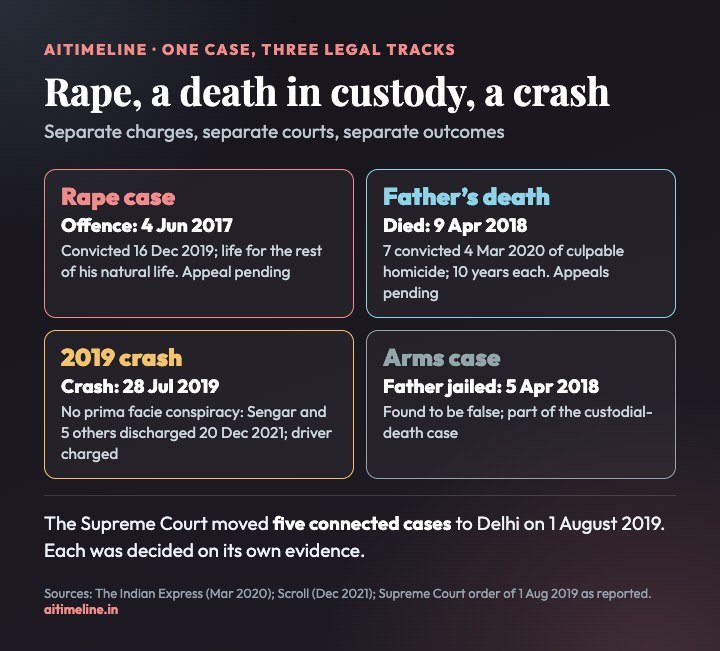
Most confusion about Unnao comes from treating it as one verdict. The rape prosecution ended in a conviction and life sentence. The father’s death, which grew out of a false arms case against him, ended in a separate conviction for culpable homicide. The 2019 crash produced a third outcome: the court charged the truck driver with negligence but found no evidence that Sengar or others had conspired to cause it. Each was decided on its own evidence, and each has its own appeal history.
Timeline: The Unnao Case, 2017 to November 2026
Newest first. Colour shows the type of event.
Where the Unnao case stands High Court appeals
The rape case: The December 2019 conviction and life sentence stand. Sengar’s appeal against them was being argued before a division bench led by Justice Prathiba M. Singh in July 2026. We found no report of a judgment, or of the judgment being reserved, by 12 November 2026.
The custodial-death case: The 2020 conviction and 10-year sentence also stand. The appeals by Sengar and his co-convicts were moved to Justice Saurabh Banerjee’s bench on 23 July 2026. No verdict has been reported.
Custody: Sengar has remained in custody throughout: the December 2025 suspension was stayed within six days and later set aside, and his 10-year sentence was never suspended.
Custodial-death appeals move to a new bench High Court appeals
What happened: The High Court transferred the appeals of Sengar and the other convicts in the death of the survivor’s father to Justice Saurabh Banerjee. The earlier bench had heard arguments on 15, 19 and 26 May 2026.
Why it matters: A change of bench can mean arguments are heard again, which adds time to an appeal the Supreme Court had asked to be fast-tracked.
Defence argues the rape appeal High Court appeals
The arguments: Senior Advocate N. Hariharan, for Sengar, argued that Sengar was not present at the place of the incident, challenged the documents and medical evidence used to fix the survivor’s age, and said the conspiracy conviction could not stand when co-accused Shashi Singh had been acquitted.
The record: The court’s 6 July order notes only that he argued for about an hour and that the hearing would continue on 7 July.
How to read it: These are defence submissions, not findings of the court. The CBI and the survivor had not yet replied in the coverage we found.
Final hearing of the rape appeal begins High Court appeals
What was argued: Sengar’s counsel argued that he was not a “public servant” for the area where the offence took place, which matters because the aggravated POCSO charge depends on it.
Next step: The bench fixed further dates in July for the defence to finish.
Supreme Court sets aside the suspension of Sengar’s sentence Supreme Court
The ruling: The Supreme Court set aside the Delhi High Court order that had suspended Sengar’s life sentence and sent the bail question back to the High Court. It said the High Court “may make an endeavour to decide the main appeal finally as early as possible”.
On the law: Justice Bagchi said the court did not endorse the High Court’s “hypertechnical view” that a legislator is not a public servant for the purposes of the POCSO Act, describing the Act as one that protects children as well as punishing offenders.
What it did not do: It did not decide whether the conviction is right. That is for the High Court in the main appeal.
Survivor’s plea to add evidence rejected High Court appeals
The plea: The survivor asked to place school records on file as additional evidence of her age in Sengar’s appeal.
The decision: The court dismissed the application and said the appeal would be decided on the existing trial record. It listed the appeal for final hearing from 25 May.
Survivor’s appeal for a harsher sentence dismissed for delay High Court appeals
The appeal: The survivor had sought to have the custodial-death conviction converted to murder and the sentence enhanced, including to death.
The decision: The court refused to condone a delay of 1,945 days in filing the appeal, called it unexplained, and dismissed the appeal as barred by limitation. It said hearing so late an appeal for enhancement would prejudice the accused.
What it did not do: It did not touch the 2020 convictions or sentences, which remain under the convicts’ own appeals.
Survivor allowed to join the CBI’s appeal Supreme Court
The order: The court allowed the survivor to become a party to the CBI’s appeal against Sengar’s bail, relying on its 2022 Lakhimpur Kheri ruling that a victim has a right to be heard at every stage of a criminal case.
Refused: It declined a separate intervention application by the survivor’s cousin.
Supreme Court asks for the custodial-death appeal to be heard out of turn Supreme Court
The order: The court declined to disturb the High Court’s refusal to suspend Sengar’s 10-year sentence and asked the High Court to decide his appeal in the custodial-death case within three months, and to take up the survivor’s own appeal within a week.
Context: The High Court had already, on 3 February, listed the custodial-death appeal for day-to-day hearing from 11 February.
No suspension of the 10-year sentence High Court appeals
The decision: The court rejected Sengar’s plea to suspend his sentence in the custodial-death case, despite the long period he had spent in jail, and said the better course was to hear the appeal on merits quickly.
Why it mattered: Even if the rape sentence had stayed suspended, this sentence would have kept him in prison.
Supreme Court stays the bail order Supreme Court
The order: The Supreme Court stayed the High Court’s 23 December order, so Sengar could not be released on it.
The reasoning: The bench said that if the High Court’s reading were right, a police constable would be a public servant but an MLA would not.
The CBI’s case: The CBI called the High Court order “contrary to law” and “perverse”.
High Court suspends the life sentence High Court appeals
The order: The court suspended Sengar’s life sentence and granted bail pending his appeal, on a Rs 15 lakh personal bond with three sureties, with conditions: stay in Delhi, report to police weekly, deposit his passport, keep 5 km from the survivor’s Delhi home, and not threaten her or her mother.
The legal question: The order turned on whether a sitting MLA is a “public servant” for the aggravated offence under the POCSO Act. The court took the view that he was not, as reported.
What it did not do: It did not acquit him. He also stayed in jail on the separate 10-year sentence.
First bid to suspend the 10-year sentence fails High Court appeals
The decision: The court refused to suspend Sengar’s sentence in the custodial-death case, noting he had served about six years of ten, the gravity of the offence, his record and the need for continued CRPF protection of the survivor’s family.
Correction: This order concerned the custodial-death case, not the rape case. It was reported on 8 June 2024.
Crash case: no conspiracy charge against Sengar Trial & verdicts
The decision: The court found no prima facie case of conspiracy against Sengar and five others in the 2019 truck crash, noting that the only evidence was the oral statements of the complainant and her family. It discharged them.
The driver: The truck driver was charged with causing death by negligence (Section 304A IPC), causing grievous hurt and rash driving.
How to read it: The ruling was about the evidence of a conspiracy, not about the crash itself. Two women died and the survivor and her lawyer were badly hurt. The CBI had earlier concluded it found no evidence of conspiracy.
Ten years for the father’s death Trial & verdicts
The sentence: Sengar and six others, including his brother and two police officers, were each sentenced to 10 years. Sengar and his brother were each told to pay Rs 10 lakh to the family.
The court’s view: The judge refused leniency and noted that the dead man had been the family’s sole earner.
Convicted of culpable homicide in the father’s death Trial & verdicts
The verdict: The court convicted Sengar, his brother Atul (Jaideep) Singh Sengar, two police officers and three others of culpable homicide not amounting to murder and related offences.
The findings: The judge said Sengar had no intention to kill, but the father “was beaten in a brutal manner that led to his death”, and that he had been falsely implicated in an arms case. The judge called the doctors who treated him “butchers”.
Not murder: Charges framed on 13 August 2019 included murder; the verdict was under Section 304 IPC, not Section 302.
Life for the remainder of his natural life Trial & verdicts
The sentence: Sengar was sentenced to imprisonment for the rest of his natural life and fined Rs 25 lakh.
The money: Reports agree Rs 10 lakh was to go as compensation to the survivor’s side, but differ on whether to the survivor or her mother; the rest was largely for prosecution costs.
The court’s view: As a public servant, the court said, he had betrayed people’s trust.
Sengar convicted of rape Trial & verdicts
The verdict: The court convicted Sengar of rape of a minor under the IPC and of aggravated sexual assault under the POCSO Act, finding that the survivor was under 18 in June 2017.
The co-accused: Shashi Singh, accused of taking the survivor to Sengar’s house, was acquitted.
Testimony recorded in a hospital court Trial & verdicts
What happened: On the Delhi High Court’s order of 6 September, Judge Dharmesh Sharma held court inside AIIMS so the survivor could testify while recovering from the crash. Her testimony was completed on 13 September.
After: She was discharged from AIIMS on 25 September and stayed in Delhi with her family.
Charges framed in the rape case Trial & verdicts
What happened: The trial court framed charges against Sengar and Shashi Singh. Charges in the father’s death case followed on 13 August.
Same month: The BJP, which had suspended Sengar, expelled him in August 2019.
Supreme Court moves five cases to Delhi Supreme Court
The orders: The court transferred five connected cases to the District and Sessions Judge, West, at Tis Hazari; ordered the rape trial held day to day and finished within 45 days; gave the CBI seven days to complete the crash probe; and ordered Uttar Pradesh to pay Rs 25 lakh in interim compensation.
Protection: It ordered CRPF protection for the survivor, her family, her lawyer and his family. A day later it ordered her jailed uncle moved from Rae Bareli to Tihar.
A letter to the Chief Justice surfaces Supreme Court
What happened: It emerged that the family had written to the Chief Justice of India about threats before the crash. On 31 July the court took up the matter and asked for a report.
Politics: Opposition parties raised the case in Parliament on 30 July.
Truck hits the survivor’s car near Rae Bareli Violence & safety
What happened: A truck with a blackened number plate hit the car carrying the survivor, two aunts and her lawyer as they travelled to meet her jailed uncle. Both aunts died; one was a witness in the rape case. The survivor and her lawyer were critically injured.
Security gap: Police assigned to protect her were not in the car; the explanation given was that there was no room.
The allegation: The family said the crash was an attempt to kill her. A murder case was filed against Sengar and nine others and handed to the CBI.
The survivor’s uncle is jailed Violence & safety
What happened: The uncle, who had campaigned against Sengar after his brother’s death, was arrested on 21 November 2018 in an 18-year-old gun-firing case. By December 2019 he was reported to be serving a 10-year sentence in that separate case.
The dispute: The family questioned the timing of the case. We could not verify the date he was sentenced.
CBI files chargesheets Complaint & police
The rape case: On 11 July the CBI chargesheeted Sengar for rape.
The father’s case: Two days later it chargesheeted Sengar, his brother, three police officers and five others for framing the survivor’s father in the arms case.
Sengar arrested Complaint & police
What happened: The CBI took Sengar in for questioning on 13 April and arrested him later that day after the Allahabad High Court, which had taken up the case on its own, ordered action. Shashi Singh was arrested on 14 April.
Brother arrested, case handed to the CBI Complaint & police
What happened: Atul Sengar was arrested and six police officers were suspended over the assault on the father. An FIR was finally registered against Sengar, and the state handed the cases to the CBI.
The survivor’s father dies in custody Violence & safety
What happened: The father died of his injuries the day after his daughter’s protest in Lucknow. The trial court later held that the beating had led to his death.
Self-immolation attempt outside the Chief Minister’s house Complaint & police
What happened: Saying police had taken no action, the survivor tried to set herself on fire outside the Chief Minister’s residence. The case became national news.
Father beaten, then jailed Violence & safety
What happened: The survivor’s father was beaten, allegedly by Sengar’s supporters, and then booked in an illegal-arms case and sent to judicial custody on 5 April.
The finding: The trial court later found the arms case was false.
Survivor names Sengar in a letter to the CM Complaint & police
What she said: The survivor wrote that she had been raped on 4 June 2017 at Sengar’s house, where she had gone for help finding a job, and that police had not let her name him.
Response: No FIR was registered against Sengar for months.
First FIR, naming other men Complaint & police
What happened: After she went missing on 11 June, an FIR was registered on 20 June against Shubham Singh and Awdhesh Tiwari for abduction. She was found in Auraiya the next day and, on 22 June, gave a statement to a magistrate about abduction and gang rape by them and others.
Context: That case was separate from the allegation against Sengar.
The alleged assault Complaint & police
The allegation: The prosecution said the survivor, then a minor, was taken to Sengar’s house on the promise of a job and raped there. The trial court accepted this in 2019.
April 2018: Ten Days That Changed the Case
From a beating to an arrest.
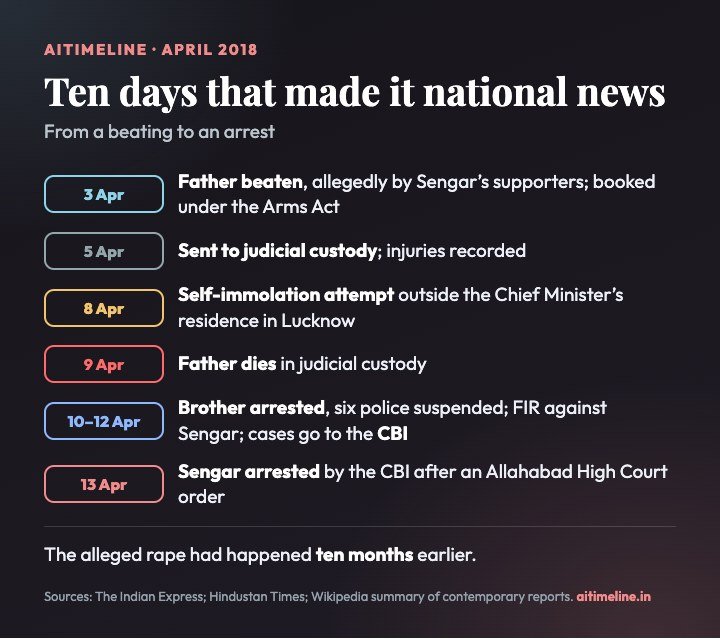
For ten months the survivor’s complaint against a sitting MLA went nowhere. What changed it was a sequence the trial court later examined in detail: her father was beaten, then arrested in an arms case that the court found had been fabricated, then died in custody. Her protest outside the Chief Minister’s house came the day before he died. Within a week the state had handed the case to the CBI, and the Allahabad High Court, acting on its own, had pressed for Sengar’s arrest.
Why the Supreme Court Moved the Cases to Delhi
1 August 2019, four days after the crash.
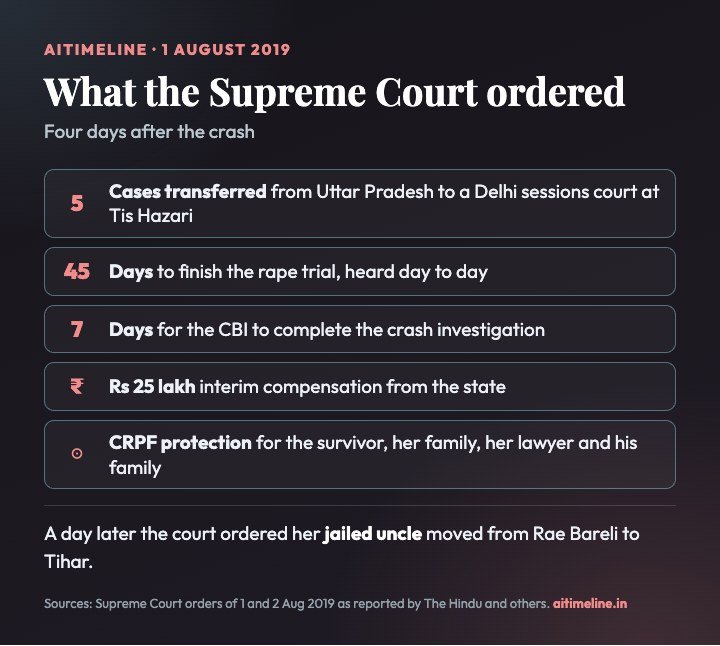
The family had written to the Chief Justice about threats on 12 July 2019. Sixteen days later a truck hit their car. When the letter became public, the Supreme Court took up the matter and, within two days, moved every connected case out of Uttar Pradesh. The transfer did not change the law or the charges. It changed the conditions: a court in Delhi, a near-daily hearing schedule, a central armed police escort and, when the survivor could not leave hospital, a courtroom set up inside AIIMS.
The 45-day deadline was not met; the verdict came about four months after the transfer. But a trial that might otherwise have taken years in Uttar Pradesh ended in under five months.
What the Trial Courts Decided
Two convictions by the same judge, District Judge Dharmesh Sharma.
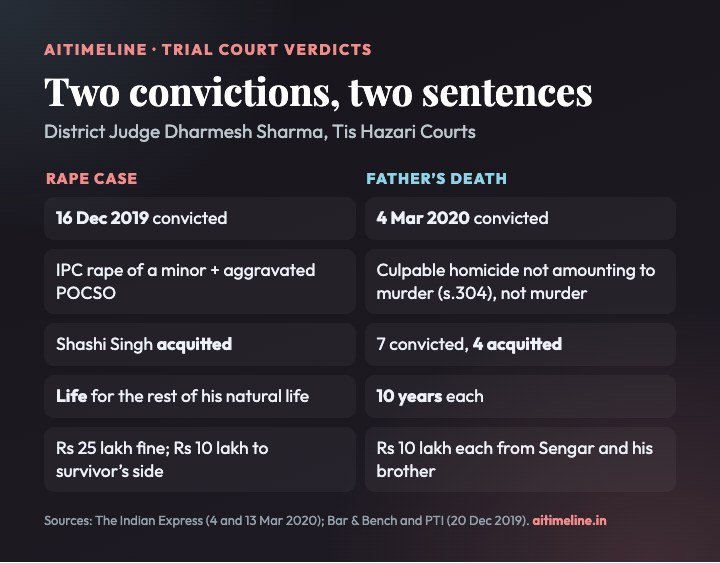
| Case | Court’s finding | Sentence | Status |
|---|---|---|---|
| Rape of a minor | Guilty under IPC and POCSO; survivor under 18 in June 2017 | Life for the rest of his natural life; Rs 25 lakh fine | Appeal pending (Crl.A. 53/2020) |
| Father’s death | Culpable homicide not amounting to murder; arms case false | 10 years each for 7 convicts | Appeals pending |
| 2019 crash | No prima facie conspiracy against Sengar and five others | Driver charged with negligence | Driver’s case separate |
The distinction between culpable homicide and murder matters. Charges framed in August 2019 included murder, but the judge found that Sengar did not intend to kill, while holding that the beating led to the death. The survivor’s later attempt to have the conviction converted to murder failed in April 2026, on the ground of delay rather than on the merits.
The 2025 Bail Row and the Public Servant Question
How a suspended life sentence became a constitutional argument.
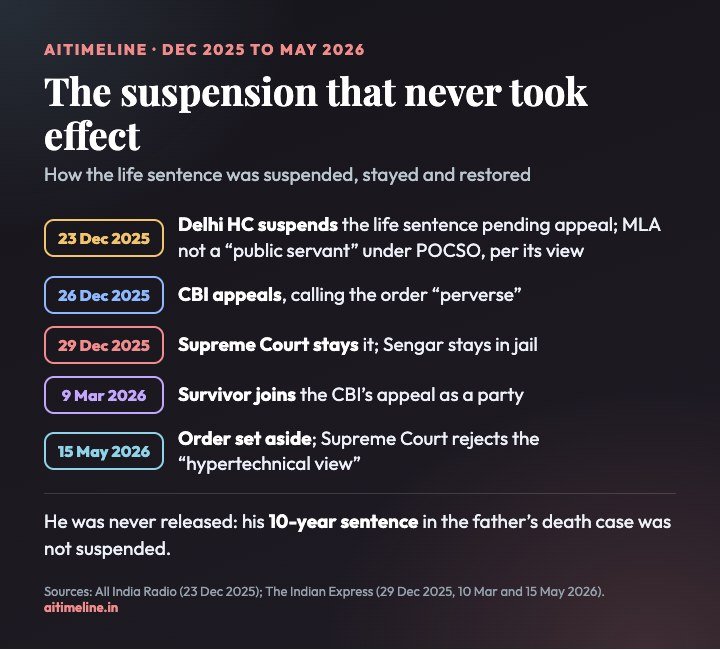
The POCSO Act punishes sexual assault more severely when it is committed by a public servant. The trial court treated Sengar, a sitting MLA, as one. On 23 December 2025 a High Court bench took the view that he was not, which weakened the aggravated charge and, with the time he had already served, supported suspending his sentence while the appeal was heard.
The reaction was immediate: the survivor protested at India Gate, and the CBI went to the Supreme Court. A bench led by Chief Justice Surya Kant stayed the order within a week, observing that on the High Court’s reading a police constable would be a public servant but an MLA would not. In May 2026 it set the order aside, rejecting what it called a “hypertechnical view”, but left the final answer to the High Court in the main appeal. That answer could matter well beyond Unnao, for any case involving an elected representative accused of abusing a child.
Where the Appeals Stand in November 2026
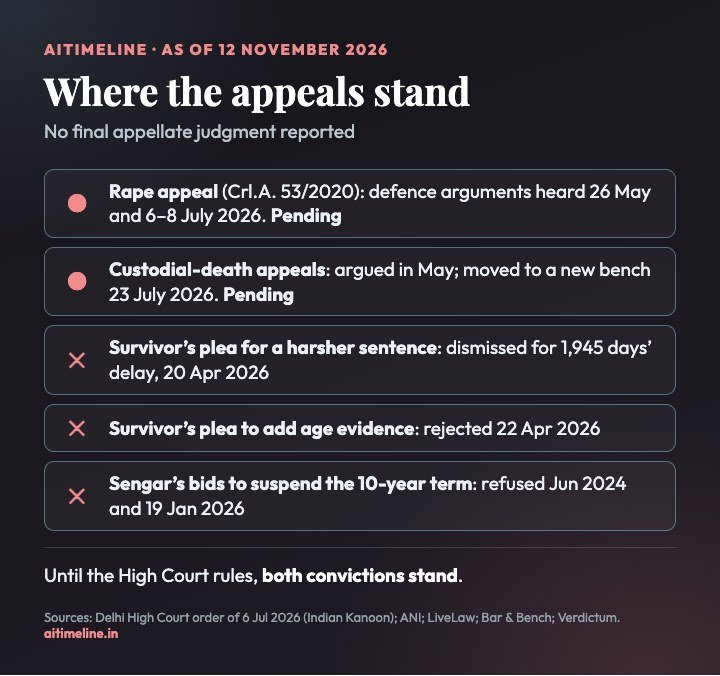
The last hearing record we could locate in the rape appeal is the High Court’s order of 6 July 2026, which notes an hour of argument by Sengar’s senior counsel and continuation the next day. Reports of 6 and 7 July describe defence arguments that Sengar was not at the scene, that the survivor’s age was not properly proved, and that the conspiracy charge fell with Shashi Singh’s acquittal. Those are arguments, not findings. We found no report of the CBI’s reply, a reserved judgment or a verdict by 12 November 2026.
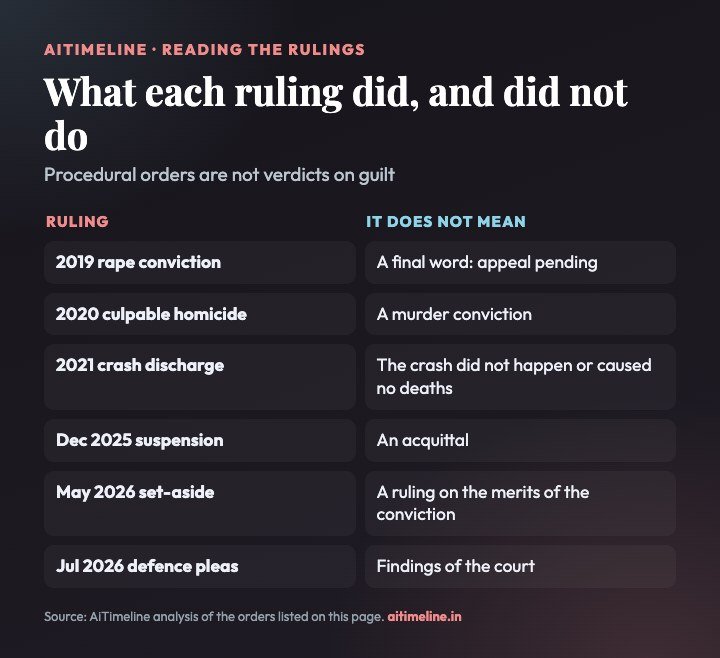
What Each Ruling Did, and Did Not Do
| Person or body | Role |
|---|---|
| Kuldeep Singh Sengar | Former BJP MLA for Bangermau; convicted of rape (2019) and culpable homicide (2020); denies the charges and is appealing |
| The survivor | Complainant; identity protected; party to the CBI’s Supreme Court appeal since March 2026 |
| Atul (Jaideep) Singh Sengar | Sengar’s brother; convicted in the father’s death case |
| Shashi Singh | Co-accused in the rape trial; acquitted |
| CBI | Investigated all connected cases from April 2018; prosecuting the appeals |
| Dharmesh Sharma | District judge who tried both cases and recorded the survivor’s testimony at AIIMS |
| Supreme Court | Transferred the cases in 2019; stayed and set aside the 2025 suspension |
| Delhi High Court | Hearing the appeals; suspended the sentence in 2025 |
What the Unnao Case Changed
No new law, but lasting lessons in how the system works.
- Police accountability: a complaint against a powerful local politician went unregistered for ten months, and a false case was used against the complainant’s father.
- Protecting survivors: the Supreme Court treated safety as a condition of a fair trial, with CRPF protection and a transfer out of the state.
- Speed: day-to-day hearings delivered a verdict in under five months, against years for comparable cases.
- Courts that come to the witness: a hospital courtroom let a critically injured survivor testify.
- Victims in appeals: in 2026 the survivor was made a party to the bail appeal, applying the Lakhimpur Kheri principle.
- Law on legislators: whether an MLA is a public servant under POCSO is still to be settled.
Unnao is often discussed with other cases that tested the system in the same years, including Kathua and Hathras, and with the 2013 criminal-law changes that followed the Nirbhaya case.
Explore More Timelines
People Also Ask
Frequently Asked Questions
Based on court orders and reporting to 12 November 2026.
⚠️ Editorial Note
The survivor and her relatives are not named, in line with Section 72 of the Bharatiya Nyaya Sanhita (formerly Section 228A IPC). Allegations about the 2019 crash are kept separate from the court’s finding in the conspiracy case, and the 2025 suspension and the Supreme Court’s 2026 orders are described as procedural, not as rulings on the conviction. We corrected some details found in earlier summaries: the Delhi High Court’s June 2024 refusal to suspend a sentence concerned the custodial-death case, not the rape case; the Supreme Court made the survivor a party on 9 March 2026 (reported on 10 March); and Sengar and five others were discharged, not acquitted after trial, in the crash case. We could not verify the date of the survivor’s uncle’s sentence or a court application by the survivor in February 2018, and do not state them. Reports differ on whether the Rs 10 lakh from the rape fine went to the survivor or her mother. Sengar has denied the allegations and his appeals are pending.
Related Reading on AiTimeline
Sources & further reading
Every dated entry above was checked against these references. Last reviewed 12 November 2026.
- Unnao rape case: Supreme Court sets aside Delhi High Court order suspending Kuldeep Sengar's sentence (15 May 2026)
- Kuldeep Sengar v. CBI, Crl.A. 53/2020: Delhi High Court order of 6 July 2026
- Unnao rape case: Supreme Court allows survivor to be heard in CBI's plea against Sengar's bail (10 March 2026)
- Kuldeep Sengar's brief relief ends as SC stays Delhi HC's bail order (29 December 2025)
- Delhi High Court suspends jail term of expelled BJP leader Kuldeep Singh Sengar (23 December 2025)
- Delhi HC rejects Unnao rape survivor's appeal for harsher punishment in father's custodial death case (20 April 2026)
- Delhi High Court rejects Unnao rape victim's plea to lead further evidence against Sengar (22 April 2026)
- Supreme Court asks Delhi High Court to hear Kuldeep Sengar's appeal out of turn (9 February 2026)
- Delhi HC rejects Sengar's plea seeking suspension of sentence in Unnao custodial death case (June 2024)
- Unnao custodial death case: Delhi HC transfers appeals of Sengar, others to another bench (23 July 2026)
- Kuldeep Sengar, 6 others get 10 years in prison for death of Unnao rape victim's father (13 March 2020)
- Unnao rape case: Kuldeep Sengar convicted of culpable homicide of victim's father (4 March 2020)
- Delhi court sentences Kuldeep Singh Sengar to imprisonment for the remainder of his life (20 December 2019)
- Unnao rape convict Kuldeep Sengar acquitted in 2019 car crash case (20 December 2021)
- Unnao survivor discharged from AIIMS, to stay in Delhi with family (25 September 2019)
- Custodial murder to conditional bail: a timeline of the Unnao rape case (24 December 2025)