RG Kar Case: From Nationwide Protests to the 2026 CBI Investigation
RG Kar Hospital case timeline: the August 2024 crime, doctors' protests, Sanjay Roy's conviction, pending appeals and the 2026 CBI cover-up probe.
Latest Story
On 9 August 2024, a 31-year-old postgraduate trainee doctor was found raped and murdered inside Kolkata’s RG Kar Medical College and Hospital. The crime brought doctors out on strike across India, moved the Supreme Court to act on its own and ended, in the trial court, with a civic volunteer, Sanjay Roy, sentenced to prison for the rest of his life. It did not end there. Roy’s appeal and the CBI’s appeal for the death penalty are pending, and since May 2026 a CBI team ordered by the Calcutta High Court has been examining the victim’s parents’ allegation that evidence was destroyed and others were involved. This timeline keeps those tracks apart, because the courts do.
💡 Short Answer
Sanjay Roy, a civic volunteer, was convicted on 18 January 2025 of the rape and murder of a trainee doctor at RG Kar Medical College, Kolkata, and sentenced to life imprisonment for the rest of his natural life. His appeal and the CBI’s death-penalty appeal are pending. A separate CBI inquiry into an alleged cover-up, ordered on 21 May 2026, filed a sealed report; the next hearing is on 20 November 2026.
RG Kar Case: Key Questions
The Case in Ten Points
- 9 August 2024: a trainee doctor was found raped and murdered inside RG Kar Medical College and Hospital.
- 10 August: Kolkata Police arrested civic volunteer Sanjay Roy, tracked through CCTV footage and a Bluetooth headset.
- 13 August: the Calcutta High Court moved the case to the CBI, citing the risk of evidence being destroyed.
- 20 August: the Supreme Court formed a National Task Force on doctors’ safety and sent the CISF to guard the hospital.
- September 2024: ex-principal Sandip Ghosh was arrested in a financial case, then with a police officer over alleged evidence tampering.
- 7 October: the CBI’s chargesheet named Roy as the sole accused.
- 18 and 20 January 2025: Roy was convicted and sentenced to imprisonment for the rest of his life; the court ruled out the death penalty.
- 7 February 2025: the High Court admitted the CBI’s appeal for the death penalty and dismissed the state’s.
- 21 May 2026: the High Court ordered a CBI SIT to probe the parents’ allegations of a cover-up.
- Now: a sealed CBI report is before the High Court, with arguments on 20 November 2026; no court has found that anyone else took part.
Five Proceedings, Kept Apart
Coverage often blurs these together. The courts treat each one separately.
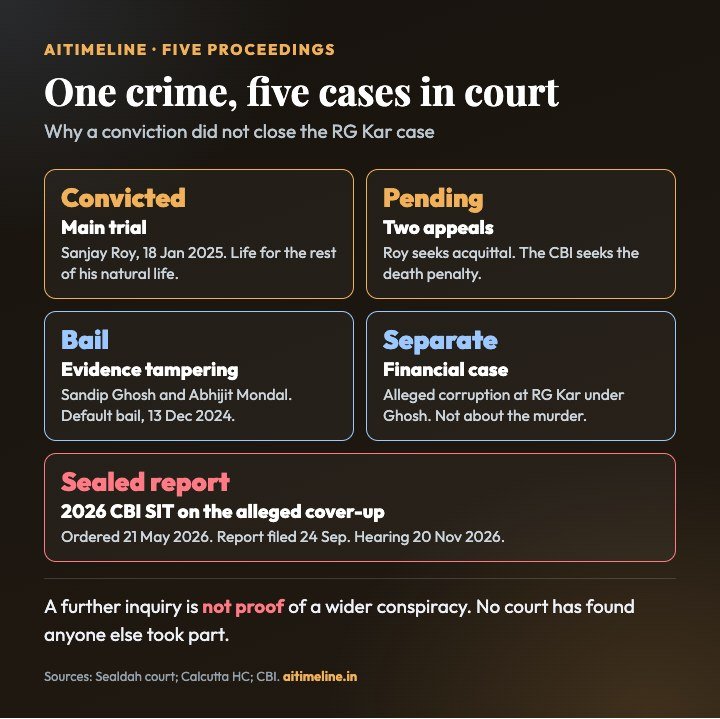
| Proceeding | What it is about | Status, November 2026 |
|---|---|---|
| Main rape-and-murder trial | Whether Sanjay Roy committed the crime | Convicted 18 Jan 2025; life for the rest of his life |
| Appeals | Roy seeks acquittal; CBI seeks the death penalty | Pending in the Calcutta High Court |
| Evidence tampering | Handling of the scene and delay in the FIR; Ghosh and Mondal | Both on default bail since 13 Dec 2024 |
| Financial irregularities | Alleged corruption at RG Kar under Ghosh | Separate CBI case, chargesheet filed |
| 2026 CBI SIT | Alleged larger conspiracy and cover-up | Sealed report filed; hearing 20 Nov 2026 |
Timeline: From the Seminar Room to the High Court
Newest first. Colour shows which strand each event belongs to.
Conviction stands; the wider probe is unresolved Cover-up probe
Main case: Sanjay Roy remains convicted and serving imprisonment for the rest of his natural life. His appeal against conviction and the CBI’s appeal for the death penalty are pending in the Calcutta High Court.
Cover-up probe: The CBI’s court-ordered inquiry into alleged evidence destruction and a possible larger conspiracy has produced a sealed report. Arguments on it are listed before Justices Shampa Sarkar and Tirthankar Ghosh on 20 November 2026.
CBI files a sealed report on the alleged conspiracy Cover-up probe
The filing: The CBI handed the division bench of Justices Shampa Sarkar and Tirthankar Ghosh a report, in a sealed cover, on its inquiry into the alleged larger conspiracy, as the court had directed at the previous hearing.
What the court wants: The bench has asked for a detailed account of how investigators arrived at the suspected involvement of specific individuals. It listed the matter for arguments on 20 November 2026.
A 13th status report before the Sealdah court Cover-up probe
What it covered: The CBI told the court the issues raised by the victim’s family had been examined, that its case diary had been submitted and that some aspects remained under investigation. Reports said investigators had visited the crematorium.
The family: The parents said they were not satisfied and continued to press for the role of others to be examined.
High Court gives the CBI three weeks Cover-up probe
The progress: The CBI said it had identified and questioned 16 people the victim’s family wanted examined, and asked for four more weeks.
The order: The bench gave it three weeks to complete the inquiry and fixed the next hearing for 24 September.
“We are not satisfied with the report” Cover-up probe
The criticism: Reviewing the SIT’s first status report, the bench said it was not satisfied, noted the probe had been running since October 2024 and said it expected a “final shape” to be given to it forthwith.
The direction: It ordered the CBI to place all material it had collected before the court in a sealed cover, with the case diary, at the next hearing on 6 August.
High Court orders a CBI Special Investigation Team Cover-up probe
The order: The bench constituted a three-member SIT headed by the CBI’s Joint Director, Eastern Zone, to examine allegations of a larger conspiracy, destruction of evidence and attempts to hush up the crime.
The scope: The SIT was told to reconstruct events from the victim’s dinner on the night of 8 August 2024 to her cremation on the evening of 9 August, and was free to question anyone it considered necessary.
A second bench steps aside In court
What happened: The bench recused from the parents’ plea and the connected matters, saying it could not give the case the time it needed, and sent it back to the Chief Justice.
Next: The case went to a special division bench of Justices Shampa Sarkar and Tirthankar Ghosh, which first heard it on 19 May and said it would examine whether any scope for further investigation remained.
Appeals bench recuses; a new bench is named In court
The recusal: The division bench that had admitted the CBI’s appeal said it was no longer a regular bench for criminal appeals and could not hold daily hearings, and referred the matters to the Chief Justice. The case had not been heard in the High Court for about five months.
The reassignment: On 19 March the case was allotted to a new bench of Justices Rajasekhar Mantha and Rai Chattopadhyay.
Roy appeals against his conviction In court
The appeal: Sanjay Roy asked the High Court to set aside his conviction and acquit him, challenging the trial court’s reading of the evidence.
The listing: On 16 July 2025 the bench of Justices Debangshu Basak and Md Shabbar Rashidi directed that his appeal and the CBI’s appeal for a harsher sentence be heard together, from September 2025.
Supreme Court sends the parents to the High Court In court
The order: The Supreme Court allowed the victim’s parents to pursue their pending petition for further investigation before the Calcutta High Court.
The background: In December 2024 a single judge, Justice Tirthankar Ghosh, had said the parents needed clarity from the Supreme Court or the High Court’s Chief Justice bench before he could hear a plea for a fresh probe.
High Court admits the CBI’s appeal In court
The ruling: The bench admitted the CBI’s appeal seeking the death penalty, holding that the agency that prosecuted the case could challenge the sentence.
The state: It dismissed the West Bengal government’s separate appeal for the death penalty as not maintainable.
Life imprisonment for the rest of his life In court
The sentence: Roy was sentenced to imprisonment for the remainder of his natural life and fined Rs 50,000. The court said the case did not fall in the “rarest of rare” category needed for a death sentence.
Compensation: The court directed the state to pay Rs 17 lakh to the family. The parents said they did not want compensation.
Sanjay Roy convicted In court
The verdict: The trial court found Roy guilty of rape, of causing death in the course of rape and of murder, holding that the prosecution had proved its case beyond reasonable doubt.
In court: Roy maintained that he had been framed.
The trial ends In court
What happened: After about two months of in-camera hearings, arguments closed and the judge fixed 18 January 2025 for the verdict.
The evidence: The court examined around 50 witnesses, as well as forensic and CCTV evidence.
Default bail for Sandip Ghosh and Abhijit Mondal Cover-up probe
The order: The court granted statutory bail to the former principal and the former Tala police station officer-in-charge because the CBI had not filed a chargesheet against them within 90 days in the evidence-tampering case.
What it means: Default bail follows from an investigating agency missing a deadline. It is not an acquittal or a finding that the allegations were false.
Trial begins in camera In court
The trial: Day-to-day hearings against Roy began before the Additional District and Sessions Court at Sealdah, closed to the public.
The charge: The court had framed charges of rape and murder a week earlier. Roy pleaded not guilty.
Task force says no separate central law needed Safety and policy
The finding: The National Task Force set up by the Supreme Court said a separate central law against violence on healthcare workers was not needed, because state laws and the Bharatiya Nyaya Sanhita already covered such offences.
The recommendations: It proposed security, infrastructure and working-condition measures in hospitals, including duty-room and rest facilities and better working hours for resident doctors in line with National Medical Commission guidelines.
Junior doctors’ hunger strike Protests
The demands: Junior doctors began a fast-unto-death demanding justice for the victim and safety and administrative reforms in state medical colleges.
The end: They called off the fast on 21 October after a meeting with Chief Minister Mamata Banerjee.
CBI chargesheet names Roy as sole accused Investigation
The chargesheet: The CBI charged Sanjay Roy with the rape and murder and named him as the only accused. It cited forensic evidence and CCTV footage that placed him at the scene.
What it left open: The agency said its inquiry into whether others had a role, and into the handling of the case, was continuing.
Supreme Court reviews both investigations In court
The hearing: The Court examined CBI status reports on the rape-and-murder inquiry and on the financial-irregularities investigation, and asked to be kept informed.
Other directions: It also took up the slow progress on CCTV, rest rooms and toilets at West Bengal’s government hospitals.
Kolkata Police Commissioner removed Protests
The decision: After talks with protesting junior doctors, the state agreed to remove Police Commissioner Vineet Goyal and senior health officials, two of the protesters’ demands.
The aftermath: The doctors partially resumed work from 21 September, having stopped work since 10 August.
Ghosh and the Tala police station chief arrested Cover-up probe
The arrests: The CBI arrested former principal Sandip Ghosh in the rape-and-murder case, and Abhijit Mondal, then officer-in-charge of Tala police station, alleging destruction of evidence and delay in registering the FIR.
The distinction: These allegations concern the handling of the case. They are separate from the charge against Roy of committing the crime.
Bengal passes the Aparajita Bill Safety and policy
The bill: The Aparajita Woman and Child (West Bengal Criminal Laws Amendment) Bill, 2024 proposed the death penalty for rape that causes death or leaves the victim in a vegetative state, and time-bound investigation and trial.
Its status: Because it amends central criminal laws, it needs the President’s assent. The Governor referred it to the President.
CBI arrests Sandip Ghosh in the financial case Investigation
The arrest: After two weeks of questioning, the CBI arrested the former principal over alleged financial irregularities during his tenure, along with three others.
The case: The Calcutta High Court had transferred that inquiry from a state SIT to the CBI on 23 August. The CBI later filed a chargesheet in the case.
Supreme Court questions the police response In court
The hearing: The CBI told the Court the crime scene had been altered before it took over. The bench called the time at which Kolkata Police recorded the unnatural-death entry, after the post-mortem, extremely disturbing.
Doctors: The Court asked protesting doctors to resume duty and said no action would be taken against them.
Supreme Court sets up the National Task Force Safety and policy
The order: The Court formed a National Task Force, chaired by Surgeon Vice Admiral Arti Sarin, to recommend a national protocol for the safety and working conditions of medical professionals, and sought a CBI status report.
Security and privacy: It ordered the Central Industrial Security Force to secure the hospital, which it did from 21 August, and directed that the victim’s name, photographs and videos be removed from social media.
Supreme Court takes suo motu cognisance In court
The step: The Supreme Court took up the case on its own motion, treating it as a question of doctors’ safety nationwide as well as a criminal investigation.
Why it mattered: It brought the investigation, the hospital vandalism and working conditions under the Court’s supervision.
Doctors’ nationwide withdrawal of services Protests
The strike: The IMA called a 24-hour withdrawal of non-emergency services across India, demanding a central law on violence against healthcare workers and safer workplaces.
The scale: Outpatient departments and elective procedures were hit in many states.
Reclaim the Night, and a mob at the hospital Protests
The protest: Thousands of women joined midnight marches in Kolkata and other cities under the banner of Reclaim the Night.
The vandalism: Around midnight a mob entered RG Kar and vandalised the emergency department and other areas, injuring police personnel. The High Court called it a complete failure of the state machinery.
High Court transfers the case to the CBI In court
The order: The Calcutta High Court moved the investigation from Kolkata Police to the CBI, citing the lack of meaningful progress and the risk of evidence being destroyed.
Ghosh: It directed Sandip Ghosh, who had been given a new posting, to go on long leave.
The principal resigns, and is reposted Investigation
The resignation: Ghosh resigned as principal amid protests by students and doctors.
The reposting: Within hours he was named principal of Calcutta National Medical College, a move later criticised in court.
Civic volunteer Sanjay Roy arrested Investigation
The arrest: Kolkata Police arrested Sanjay Roy, a civic volunteer attached to the police, after CCTV footage showed him entering the building where the body was found.
The evidence: Investigators said a Bluetooth headset found near the body was linked to his phone.
Trainee doctor found dead in the seminar room Investigation
What happened: The body of a 31-year-old postgraduate trainee doctor was found in a seminar room of the hospital’s emergency building, where she had gone to rest during a long night shift.
The post-mortem: It found she had been sexually assaulted and killed by strangulation.
The First Week
Most of the later disputes trace back to these days.
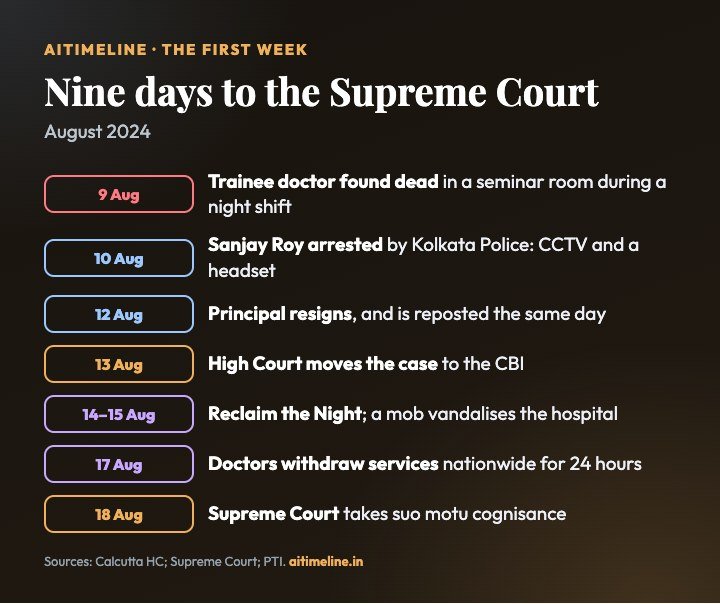
The speed of the early decisions is what turned a crime into a national controversy. The unnatural-death entry was recorded only after the post-mortem, the body was cremated the same evening, and the principal who resigned was reposted the same day. When a mob broke into the hospital two nights later, protesters and the courts alike asked whether the scene had been protected. Those questions are what the victim’s parents are still pressing in 2026.
The Trial and the Appeals
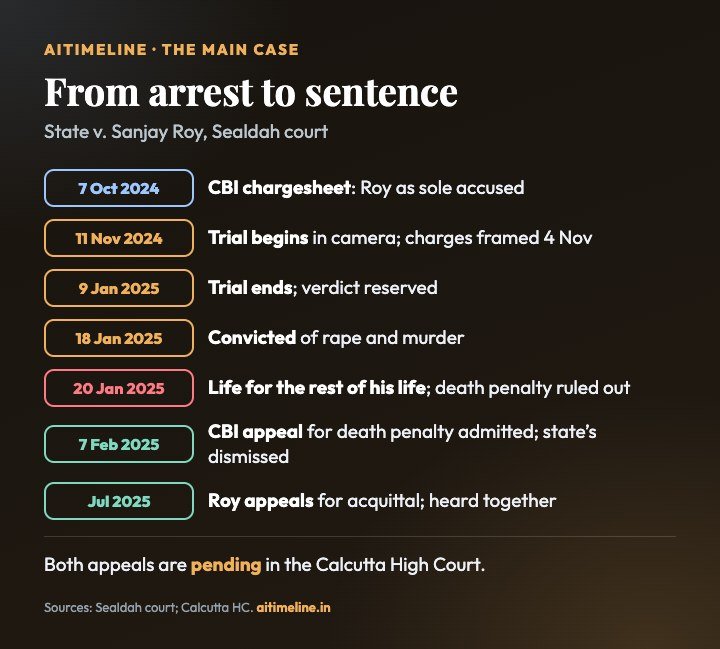
The trial was quick by Indian standards: just over two months of in-camera hearings and a verdict five months after the arrest. The judge accepted the CBI’s forensic and CCTV evidence and convicted Roy, but declined the death penalty, finding the case short of the “rarest of rare” standard. Both sides have appealed. The appeals have not been heard on their merits, largely because the High Court bench handling them changed twice in 2026.
The 2026 Cover-up Probe
A further inquiry is not proof of a wider conspiracy.
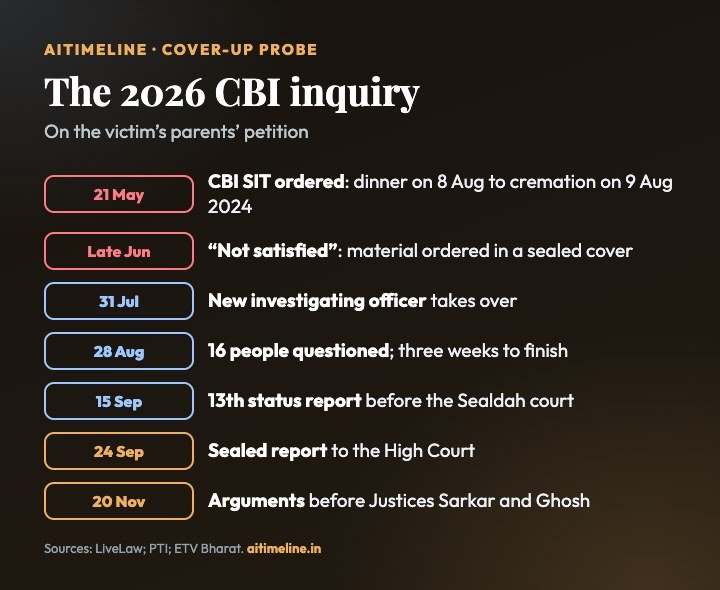
The parents’ case is that the first hours after the crime were handled in ways that suppressed evidence, and that Roy may not have acted alone. The CBI’s chargesheet says he did. The High Court has not resolved that conflict; it has ordered the CBI to investigate it properly and has been openly critical of the pace. What the sealed report says, and whether it leads to any new charge, is the question for the hearing on 20 November 2026.
Why the High Court Case Kept Stalling
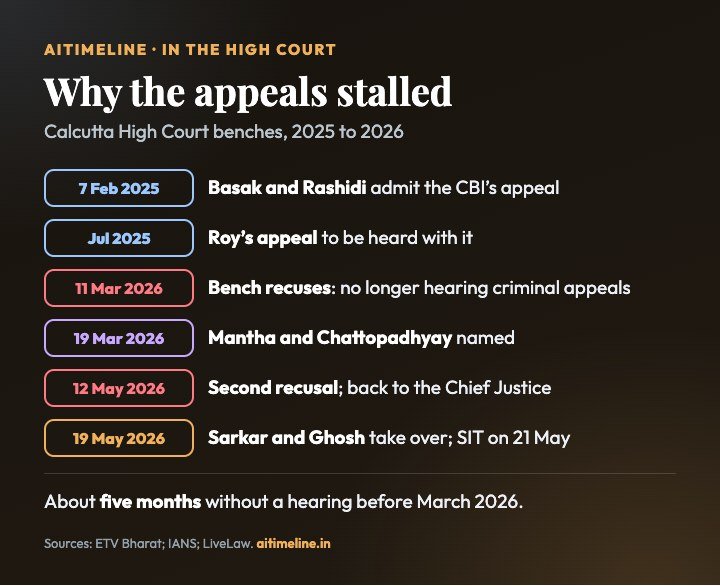
By March 2026 the case had not been heard in the High Court for about five months. The bench that had admitted the CBI’s appeal said it no longer sat on criminal appeals, and its successor stepped aside in May. Each change sent the matters back to the Chief Justice for reassignment. The current bench has concentrated on the parents’ plea for further investigation; the appeals on conviction and sentence are still to be argued.
Why the Supreme Court Stepped In
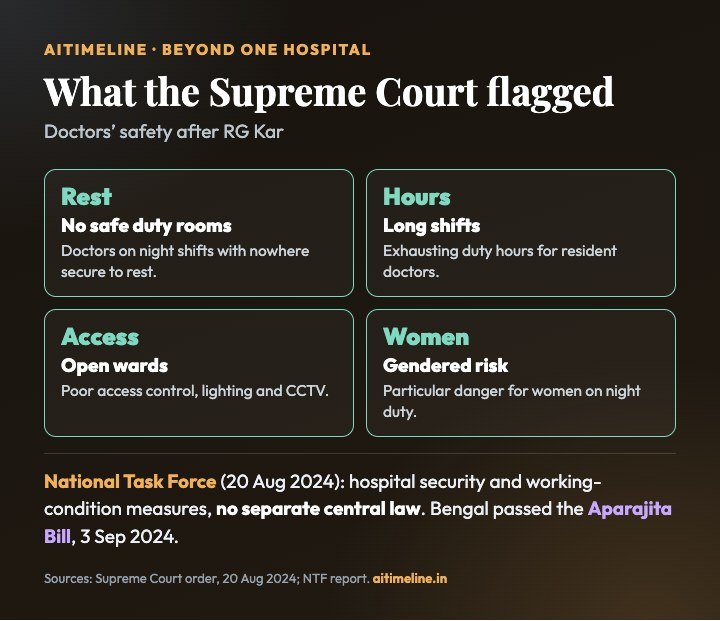
On 20 August 2024 the Supreme Court said the case raised systemic questions about the safety of doctors everywhere: rest rooms that did not exist, long shifts, unlit corridors, open access to wards and the particular risks faced by women on night duty. It set up a National Task Force, chaired by Surgeon Vice Admiral Arti Sarin, to draw up a national protocol. By November 2024 the Task Force had reported that a separate central law was not needed, favouring enforcement of existing laws and practical measures inside hospitals instead. The Court also directed that the victim’s identity and images be taken off social media.
Legal and Institutional Impact
A national framework
The National Task Force set out security, rest-room and working-hour measures for hospitals, under Supreme Court supervision.
CISF at a state hospital
Central forces guarding a state medical college was unprecedented, and pushed states to review CCTV, lighting and access control.
The Aparajita Bill
West Bengal sought the death penalty for rape causing death and fixed deadlines for investigation and trial, subject to the President’s assent.
The first hours matter
Questions over the scene, the late FIR and a same-day cremation made evidence preservation the case’s longest-running dispute.
Administrators in the dock
A principal and a police station chief were arrested over the handling of a crime they were not accused of committing.
The victim’s identity
The Supreme Court ordered her name and images removed online, a reminder that the law bars identifying rape victims.
Key People and Institutions
Sanjay Roy
Civic volunteer attached to Kolkata Police; convicted of rape and murder, appealing for acquittal.
Sandip Ghosh
Arrested in the financial case and over alleged evidence tampering; on default bail in the latter.
Abhijit Mondal
Tala police station officer-in-charge in August 2024; arrested over the handling of the case, on default bail.
CBI
Prosecuted Roy, investigates the financial case, and runs the 2026 SIT on the alleged cover-up.
Calcutta High Court
Moved the case to the CBI in 2024; hears the appeals and the parents’ plea, now before Justices Sarkar and Ghosh.
Supreme Court of India
Took suo motu cognisance and set up the National Task Force on doctors’ safety.
Key Facts at a Glance
| Detail | Information |
|---|---|
| Incident | Rape and murder of a postgraduate trainee doctor |
| Date and place | 9 August 2024, RG Kar Medical College and Hospital, Kolkata |
| Arrest | Sanjay Roy, 10 August 2024 |
| Transfer to CBI | Calcutta High Court, 13 August 2024 |
| Supreme Court | Suo motu 18 August; National Task Force 20 August 2024 |
| Chargesheet | 7 October 2024, Roy as sole accused |
| Trial | In camera at Sealdah, 11 November 2024 to 9 January 2025 |
| Verdict | Convicted 18 January 2025; sentenced 20 January 2025 |
| Sentence | Imprisonment for the rest of his natural life, Rs 50,000 fine |
| Appeals | CBI for death penalty (admitted 7 Feb 2025); Roy for acquittal |
| Further probe | CBI SIT ordered 21 May 2026; sealed report 24 Sep 2026 |
| Next hearing | 20 November 2026 |
Explore More Timelines
People Also Ask
Frequently Asked Questions
Checked against Supreme Court orders, court reporting and contemporary coverage.
⚠️ Editorial Note
This account draws on the Supreme Court’s order of 20 August 2024, Calcutta High Court proceedings as reported by LiveLaw, Bar & Bench, PTI and IANS, and contemporary reporting. The victim is not named, as Indian law requires. Sanjay Roy’s conviction, the allegations against hospital and police officials, the financial-irregularities case and the 2026 cover-up inquiry are separate proceedings and are kept separate here; a court-ordered further investigation is not proof of a wider conspiracy. Checking the brief this page began from: the CBI’s arrest on 2 September 2024 was of Sandip Ghosh in the financial case, not of Roy, who had been in custody since 10 August; the 2026 SIT’s remit begins with the victim’s dinner on the night of 8 August, not 9 August; and the appeals bench recused on 11 March 2026, with a new bench named on 19 March and the present bench taking over after a second recusal in May. This is not legal advice.
Related Reading on AiTimeline
Sources & further reading
Every dated entry above was checked against these references. Last reviewed 8 November 2026.
- Supreme Court of India: In Re Alleged Rape and Murder Incident of a Trainee Doctor in R.G. Kar Medical College, SMW (Crl) No. 2 of 2024, order of 20 August 2024
- LiveLaw: Calcutta High Court constitutes three-member SIT to probe cover-up allegations (21 May 2026)
- LiveLaw: Calcutta High Court to examine scope for further probe on victim's family's plea (19 May 2026)
- The Pioneer: Calcutta HC expresses displeasure at CBI probe (June 2026)
- ETV Bharat: Calcutta High Court directs CBI to complete RG Kar probe in three weeks (28 Aug 2026)
- Deccan Herald / PTI: RG Kar conspiracy probe, CBI submits report to Calcutta High Court (Sep 2026)
- ETV Bharat: Calcutta High Court bench recuses from RG Kar case, matter referred to Chief Justice (Mar 2026)
- Bar & Bench: Calcutta High Court to hear appeal by convict Sanjay Roy in September (Jul 2025)
- News On AIR: Calcutta HC dismisses Bengal government's plea, admits CBI appeal (7 Feb 2025)
- The Tribune: No separate central law needed to deal with violence against medical professionals, NTF tells SC
- Deccan Herald: CBI arrests ex-RG Kar principal Sandip Ghosh over financial irregularities (Sep 2024)
- LiveLaw: Supreme Court allows victim's parents to pursue plea in Calcutta HC for probe into alleged cover-up (Mar 2025)