IC 814 Hijack: Seven Days That Forced India Into a Historic Decision
IC 814 hijack timeline: the 1999 seizure, the Amritsar stop, Kandahar hostage talks, India's release of three militants and the security aftermath.
Latest Story
On 24 December 1999, five armed men seized Indian Airlines Flight IC 814 soon after it entered Indian airspace on its way from Kathmandu to Delhi. Over the next 16 hours the aircraft touched down at Amritsar, Lahore and Dubai before landing at Kandahar, in Taliban-held Afghanistan, where about 155 passengers and crew were held for six more days. The IC 814 hijack timeline turns on two decisions: the 46 minutes the aircraft spent on the ground at Amritsar, and the government’s choice on 31 December to release three militants, among them Masood Azhar. This page sets out every stage, the trials that followed and the security legacy, to 17 November 2026.
The documented events of the hijacking, the exchange and the trials are on the court and government record. Judgements about responsibility, such as who failed at Amritsar, or whether the release caused later attacks, are disputed by the officials involved and by historians. We attribute those views rather than present them as findings. The men tried in India were alleged helpers, not the five hijackers, who have never faced a court.
💡 Short Answer
IC 814 was hijacked on 24 December 1999 on a Kathmandu-Delhi flight. It landed at Amritsar, where it left after 46 minutes without being stopped, then Lahore, Dubai and Kandahar. Passenger Rupin Katyal was killed and 27 people were freed at Dubai. On 31 December India released Masood Azhar, Omar Sheikh and Mushtaq Zargar, and the hostages were freed. Azhar went on to found Jaish-e-Mohammed.
IC 814 Hijack: Key Questions
The IC 814 Hijack in Ten Points
- The seizure: five Harkat-ul-Mujahideen men hijacked IC 814 at about 16:53 on 24 December 1999.
- Amritsar: the aircraft sat on Indian soil for about 46 minutes and left without fuel; it was not stopped.
- The killing: passenger Rupin Katyal, 25, was stabbed and died; his body was taken off at Dubai.
- Dubai: 27 passengers were freed at the Al Minhad air base in exchange for fuel.
- Kandahar: the aircraft landed at 08:33 on 25 December in Taliban-held territory, beyond India’s reach.
- The demands: 36 prisoners, a ransom and a militant’s body. The money and body were dropped.
- The exchange: on 31 December India freed Masood Azhar, Omar Sheikh and Mushtaq Zargar.
- The trials: three alleged helpers got life in 2008; in 2014 the High Court upheld one and cleared two of hijacking.
- The hijackers: all five were declared proclaimed offenders and never tried.
- The legacy: Jaish-e-Mohammed, a tougher Anti-Hijacking Act in 2016 and a debate that has not ended.
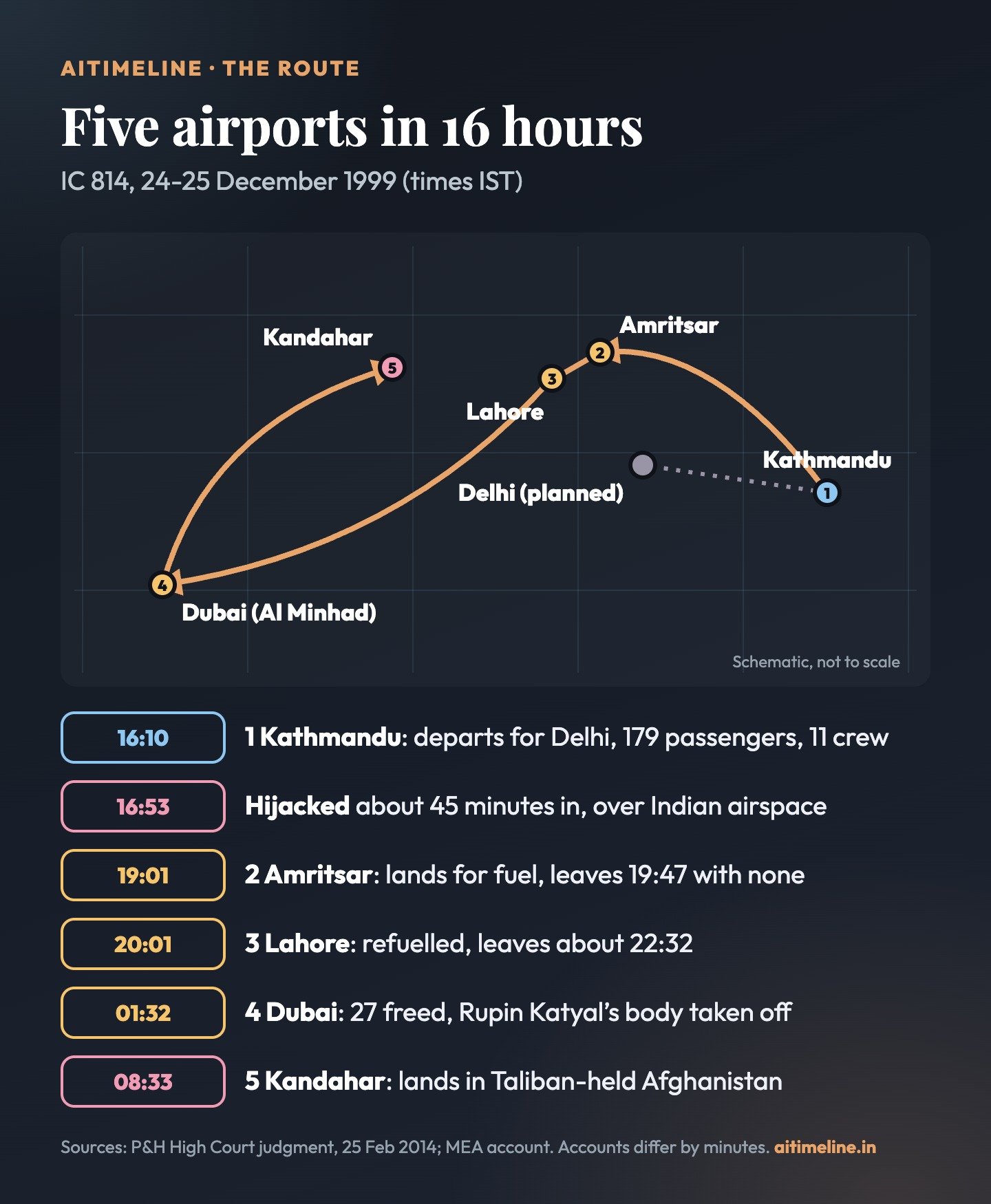
The Hijacked Flight Route
Kathmandu to Kandahar in about 16 hours, with three stops on the way.
IC 814 Hijack Timeline: Newest First
Tagged by thread: the hijack, the Kandahar talks, the courts, the militant aftermath, and law and policy.
Where the IC 814 case stands Law & policy
The trial record: Only three men, all accused of helping the hijackers, have faced an Indian court. Abdul Latif Adam Momin is serving life. Yusuf Nepali and Dilip Kumar Bhujel had their hijacking and murder convictions set aside in 2014 and stayed convicted only under the Arms Act. The Supreme Court admitted Momin’s appeal in April 2017; we found no reported final decision.
The hijackers: None of the five men who seized the aircraft has been tried. All were declared proclaimed offenders. One, Zahoor Mistry, was reported shot dead in Karachi in March 2022.
The released men: Masood Azhar is on the UN sanctions list and Mushtaq Zargar is a designated terrorist under Indian law. Omar Sheikh was acquitted of Daniel Pearl’s murder by Pakistan’s Supreme Court in 2021.
Operation Sindoor: India says Yusuf Azhar was killed Militant aftermath
What India said: After the Pahalgam attack, India struck targets in Pakistan, including Jaish-e-Mohammed’s base in Bahawalpur. At a briefing, the Director General of Military Operations, Lt Gen Rajiv Ghai, named Yusuf Azhar among the “high-value targets” killed.
Why it matters for IC 814: Yusuf Azhar, Masood Azhar’s brother-in-law, was named by the CBI as one of the planners of the hijacking and declared a proclaimed offender.
The caveat: Masood Azhar acknowledged that ten family members and four associates died in the Bahawalpur strike. We found no independent confirmation of Yusuf Azhar’s death beyond Indian official statements.
A Netflix series reopens the debate Law & policy
The series: IC 814: The Kandahar Hijack, a six-part Netflix drama directed by Anubhav Sinha, is based on Captain Devi Sharan’s account of the hijacking.
The row: Critics objected that the hijackers were shown mainly by their code names, two of which were Hindu names, Bhola and Shankar. The ministry summoned Netflix’s India content head in early September 2024, and Netflix agreed to add the hijackers’ real names to the opening disclaimer.
The record: The code names are genuine. The 2014 High Court judgment lists them: Chief, Burger, Doctor, Bhola and Shankar, matched to five Pakistani nationals.
Mushtaq Zargar declared a terrorist Law & policy
The order: The Home Ministry declared Mushtaq Ahmed Zargar, alias Latram, a terrorist under the Unlawful Activities (Prevention) Act, adding him to the Fourth Schedule.
The grounds: The notification said he was involved in murder, kidnapping, terror attacks and terror funding, and ran militant activity in Jammu and Kashmir from Pakistan. His group, Al-Umar Mujahideen, was already a banned organisation.
The link to 1999: Zargar was one of the three men India freed at Kandahar. He was the third of the three to face formal Indian or UN designation.
Hijacker Zahoor Mistry shot dead in Karachi Militant aftermath
The killing: Zahoor Mistry, the hijacker the High Court identified as “Bhola”, was shot by two gunmen on a motorcycle at a furniture business in Karachi, according to reports.
The cover: He had reportedly been living as Zahid Akhund. Pakistani media described the victim as a businessman.
The record: Mistry was one of the five hijackers declared proclaimed offenders in India and was never tried.
Pakistan’s Supreme Court frees Omar Sheikh Militant aftermath
The ruling: A three-judge bench upheld, by 2-1, the Sindh High Court’s April 2020 decision overturning Omar Sheikh’s conviction for the 2002 murder of US journalist Daniel Pearl, and ordered his release.
The reaction: Pearl’s family called it a travesty of justice. The White House said it was outraged. Pakistan’s government sought a review.
After the ruling: He was later moved from death row to a government rest house inside a jail. We found no confirmed account of his status in 2026.
The UN lists Masood Azhar as a terrorist Militant aftermath
The listing: The Security Council committee on ISIL and Al-Qaida sanctions added Masood Azhar to its list, subjecting him to an asset freeze, travel ban and arms embargo.
The delay: Earlier attempts had been blocked by China’s technical holds. The hold was lifted after the Pulwama attack.
The link to 1999: The listing named him as the founder and leader of Jaish-e-Mohammed, the group he set up after his release at Kandahar.
Pulwama: Jaish claims a suicide bombing Militant aftermath
The attack: A suicide bomber rammed a CRPF convoy on the Jammu-Srinagar highway, killing 40 personnel. Jaish-e-Mohammed claimed responsibility.
The response: India carried out an air strike on a target near Balakot, Pakistan, on 26 February 2019.
The Kandahar debate: The attack was the most widely cited example in the argument that releasing Masood Azhar had long-term costs.
Supreme Court admits Momin’s appeal Courts
The order: A bench of Justices Pinaki Chandra Ghose and Rohinton Nariman granted leave to Abdul Latif Adam Momin to appeal against his life sentence.
Bail refused: The court later refused his bail plea, in November 2017.
Outcome: We found no reported final judgment on the appeal as of November 2026.
Anti-Hijacking Act, 2016 comes into force Law & policy
The law: The Anti-Hijacking Act, 2016 repealed and replaced the Anti-Hijacking Act, 1982. It came into force by a gazette notification of 5 July 2017.
The penalty: It provides for the death penalty where a hijacking results in the death of any person, including security personnel or ground staff, and life imprisonment otherwise.
The wider reach: The law covers threats and attempts, including hoax threats, and expands jurisdiction over offences committed outside India in defined cases.
Attack on the Pathankot air base Militant aftermath
The attack: Gunmen attacked the Indian Air Force station at Pathankot. Seven security personnel were killed in the operation that followed.
Attribution: India blamed Jaish-e-Mohammed. The NIA later charged Masood Azhar and others.
The pattern: Pathankot is one of the attacks most often listed when critics weigh the cost of the 1999 release.
Yusuf Nepali walks free Courts
The release: Yusuf Nepali, also named Bhupal Man Damai, was released after about 14 years in custody, following the High Court verdict.
Why: With his hijacking and murder convictions set aside, only the Arms Act conviction remained, and he had already served more than its term.
The appeal: The CBI challenged his acquittal in the Supreme Court.
High Court upholds one life term, clears two Courts
The bench: Justices Hemant Gupta and Fateh Deep Singh decided three connected appeals arising from the Patiala trial.
Momin: The court upheld Abdul Latif Adam Momin’s conviction and life sentence, finding his confession voluntary and his role in the conspiracy corroborated. It rejected the CBI’s plea for the death penalty.
Nepali and Bhujel: It set aside their convictions for murder, hijacking and conspiracy, holding that supplying weapons was not proof they knew of the plan. Their Arms Act conviction stood.
Mumbai court acquits 19 in linked passport case Courts
The case: A separate prosecution in Mumbai concerned forged passports and documents allegedly arranged for people linked to the hijacking.
The verdict: The court acquitted all 19 accused. The defence argued, among other things, that Momin had already been tried at Patiala for related acts.
Not the main case: This acquittal did not affect the Patiala convictions, which were then under appeal.
Patiala special court: three sentenced to life Courts
The verdict: Judge Inderjit Singh Walia convicted Abdul Latif Adam Momin, Dilip Kumar Bhujel and Yusuf Nepali and sentenced them to life imprisonment.
The charges: Murder, attempted murder, kidnapping, forgery and criminal conspiracy under the Indian Penal Code, Section 25 of the Arms Act and Section 4 of the Anti-Hijacking Act, 1982.
The allegation: The prosecution said they arranged stays, passports, tickets and weapons for the hijackers. The CBI had sought the death penalty.
Omar Sheikh sentenced to death in Pakistan Militant aftermath
The case: Omar Sheikh was convicted for the kidnapping and murder of Wall Street Journal reporter Daniel Pearl, abducted in Karachi in January 2002.
The link: He was one of the three men India had freed at Kandahar 30 months earlier.
What followed: The murder conviction was overturned in 2020 and the acquittal upheld in 2021.
The Parliament attack Militant aftermath
The attack: Five gunmen attacked the Parliament complex. Nine people were killed, mostly security personnel, along with all five attackers.
Attribution: India blamed Jaish-e-Mohammed and Lashkar-e-Taiba, and the crisis led to a months-long military stand-off with Pakistan.
The Kandahar link: In his statement to Parliament after the attack, External Affairs Minister Jaswant Singh listed the IC 814 hijacking among earlier Pakistan-linked terror incidents.
CBI takes over and files its chargesheet Courts
The FIRs: A zero FIR was lodged at Delhi airport on 26 December 1999 and another at Amritsar on 29 December.
The CBI case: The CBI registered its case on 11 January 2000 and filed its report on 21 June 2000 against ten accused: the five hijackers, two alleged planners and three alleged helpers.
The charges: The Patiala court framed charges on 28 April 2001 against the three accused in custody. The other seven were proclaimed offenders.
Masood Azhar founds Jaish-e-Mohammed Militant aftermath
The return: Within weeks of his release Masood Azhar appeared in Pakistan and addressed public rallies.
The group: He launched Jaish-e-Mohammed in 2000, drawing members from Harkat-ul-Mujahideen, the group the hijackers belonged to.
The bans: India, the US, the UK and the UN later designated Jaish a terrorist organisation; Pakistan banned it in January 2002.
India releases three men; the hostages go home Kandahar talks
The decision: The Vajpayee government agreed to free Masood Azhar, Ahmed Omar Saeed Sheikh and Mushtaq Ahmed Zargar, instead of the 36 prisoners first demanded.
Jaswant Singh: External Affairs Minister Jaswant Singh flew to Kandahar with the three men. His presence became the most criticised image of the crisis; he later defended the trip as a way to make sure the exchange went through and the hostages were actually freed.
The release: The exchange took place in the late afternoon, around 17:30 according to the High Court. 145 passengers and 11 crew were flown back to Delhi by special flight that night.
The exit: The Taliban let the hijackers and the released men leave. They were reported to have been taken towards the Pakistan border.
The window narrows Kandahar talks
Pressure: Accounts describe deteriorating conditions on board and growing Taliban pressure for the aircraft to leave. The government feared a mass-casualty end.
Srinagar: Two of the men to be released, Azhar and Zargar, were held in Jammu and Kashmir. Former RAW chief A.S. Dulat later wrote that Chief Minister Farooq Abdullah strongly objected before agreeing.
The choice: Ministers weighed holding out against a limited exchange. The Cabinet Committee on Security settled on three names.
Money and the body are dropped Kandahar talks
Taliban stance: Taliban officials told the hijackers that the ransom and the demand for Sajjad Afghani’s body were un-Islamic, according to contemporary accounts.
Indian position: India refused both. Negotiators pressed for a single, final list rather than piecemeal exchanges for groups of hostages.
Remaining demand: The talks narrowed to the number of prisoners to be released.
Negotiators arrive; the demands are set out Kandahar talks
The team: India sent a team led by Vivek Katju, a Joint Secretary in the External Affairs Ministry, with Intelligence Bureau officer Ajit Doval and RAW officer C.D. Sahay among its members.
The first demand: The hijackers first sought the release of Masood Azhar.
The full list: They then demanded Azhar and 35 other militants, the body of Harkat commander Sajjad Afghani, killed in a 1999 jail-break attempt in Jammu, and a ransom widely reported as US$200 million.
India looks for a channel Kandahar talks
Contact: India did not recognise the Taliban government, so it sought contact through the UN and through Taliban officials at the airport.
The case: A zero FIR was registered at Delhi’s airport the same day.
On board: Food, water and medical help reached the aircraft only through the Taliban, who controlled the airport and surrounded the plane.
Dubai, then Kandahar The hijack
Dubai: Unable to land at Kabul at night, the aircraft went to Dubai and landed at about 01:32 at the Al Minhad air base.
Release: After negotiations with UAE authorities, 27 passengers, women, children and the injured among them, were released in exchange for fuel. Rupin Katyal’s body was taken off.
Kandahar: The aircraft left at about 06:20 and landed at Kandahar, in Taliban-controlled Afghanistan, at 08:33.
Lahore: refuelled and gone The hijack
Landing: Pakistan first refused permission and switched off runway lights. With fuel critically low, the aircraft landed at about 20:01.
Refuelled: It was refuelled. Indian requests to keep it on the ground were not acted on, and it took off at about 22:32.
Hostages: Jaswant Singh asked Pakistan to allow women and children off; that did not happen at Lahore.
Amritsar: the 46 minutes that mattered The hijack
Why Amritsar: Pakistan had refused landing at Lahore, and the captain warned that fuel was low. The aircraft landed at Amritsar at about 19:01.
The stand-off: The captain asked for immediate refuelling. A fuel bowser was sent and parked near the aircraft. The National Security Guard team was still waiting in Delhi for officials to join it.
The stabbings: Hijackers stabbed passengers including Rupin Katyal and Satnam Singh, and threatened to kill more.
Take-off: At about 19:47 the aircraft took off without fuel or clearance. The NSG reached Amritsar around 20:15.
The dispute: Officials have given conflicting accounts of who was meant to immobilise the aircraft, and whether the bowser was meant to block it. No inquiry report has been made public.
IC 814 is hijacked over India The hijack
Departure: Indian Airlines Flight IC 814, an Airbus A300 commanded by Captain Devi Sharan, left Kathmandu at 16:10 with 179 passengers and 11 crew, according to the High Court.
The hijack: At about 16:53, some 45 minutes into the flight and over Indian airspace, five armed men took control and ordered the aircraft towards Lahore.
The alarm: Delhi air traffic control learned of the hijacking at 16:56. The hijackers used code names: Chief, Doctor, Burger, Bhola and Shankar.
Decision Point One: Amritsar
The only time the aircraft was on Indian soil after the hijacking.
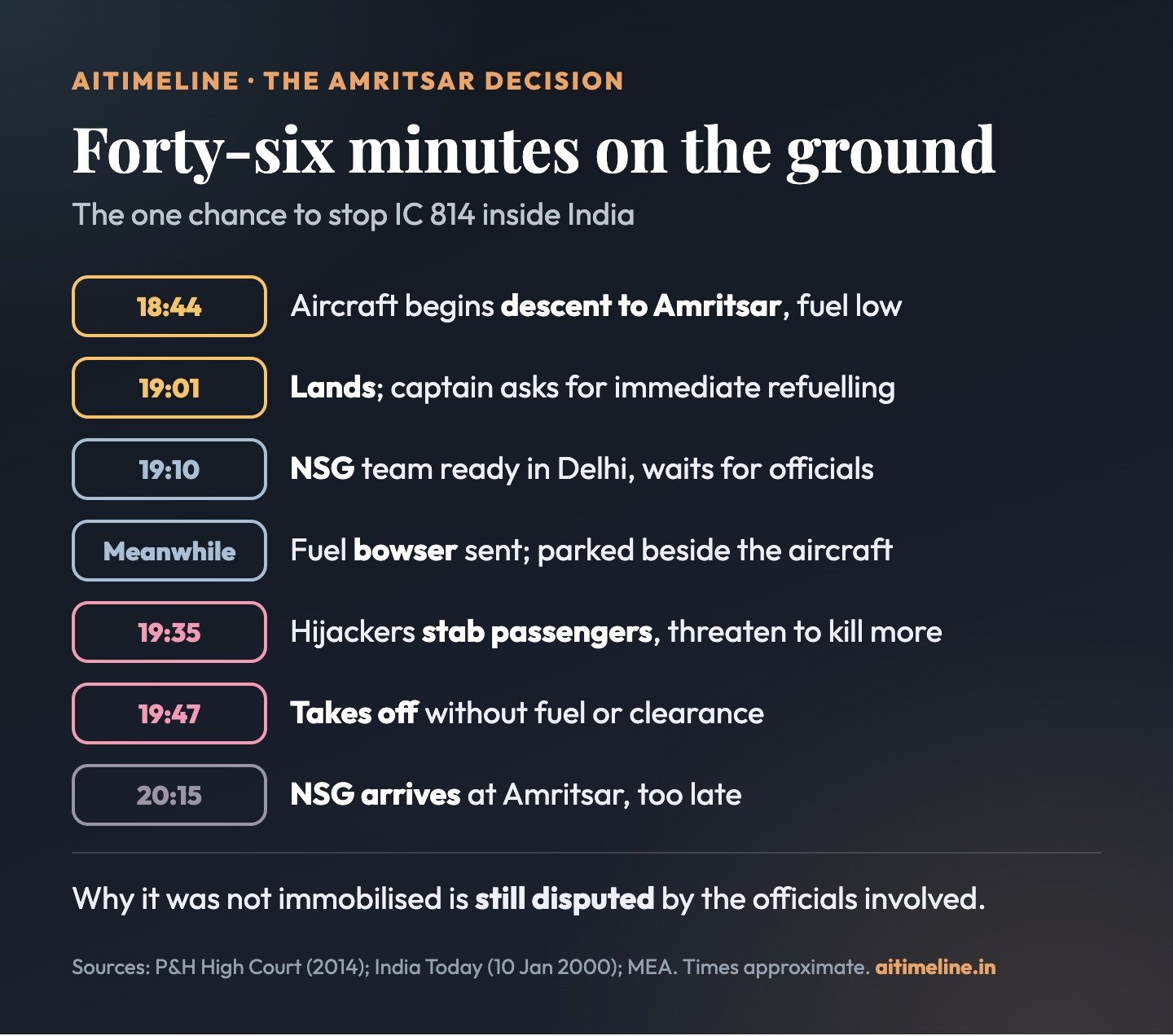
What is documented. The aircraft landed at about 19:01 and the captain asked for immediate refuelling. The High Court records cries heard at about 19:35 as passengers were stabbed, and a take-off at about 19:47 to 19:49. The NSG commandos, according to reporting at the time, were ready in Delhi by about 19:10 but waited for officials and arrived after the aircraft had left.
What is disputed. The plan for the fuel bowser is the core of the dispute. National Security Adviser Brajesh Mishra later said the government had wanted to use it to stop the aircraft; Punjab officials and others have given different accounts of what they were told and when. No official inquiry report has been published, so these accounts cannot be checked against a single record.
Why it matters. Once the aircraft left Indian airspace, every later option depended on another government: Pakistan at Lahore, the UAE at Dubai and the Taliban at Kandahar. Most later criticism of the crisis management starts here.
Seven Days in Captivity
From the hijacking on 24 December to the release on 31 December.
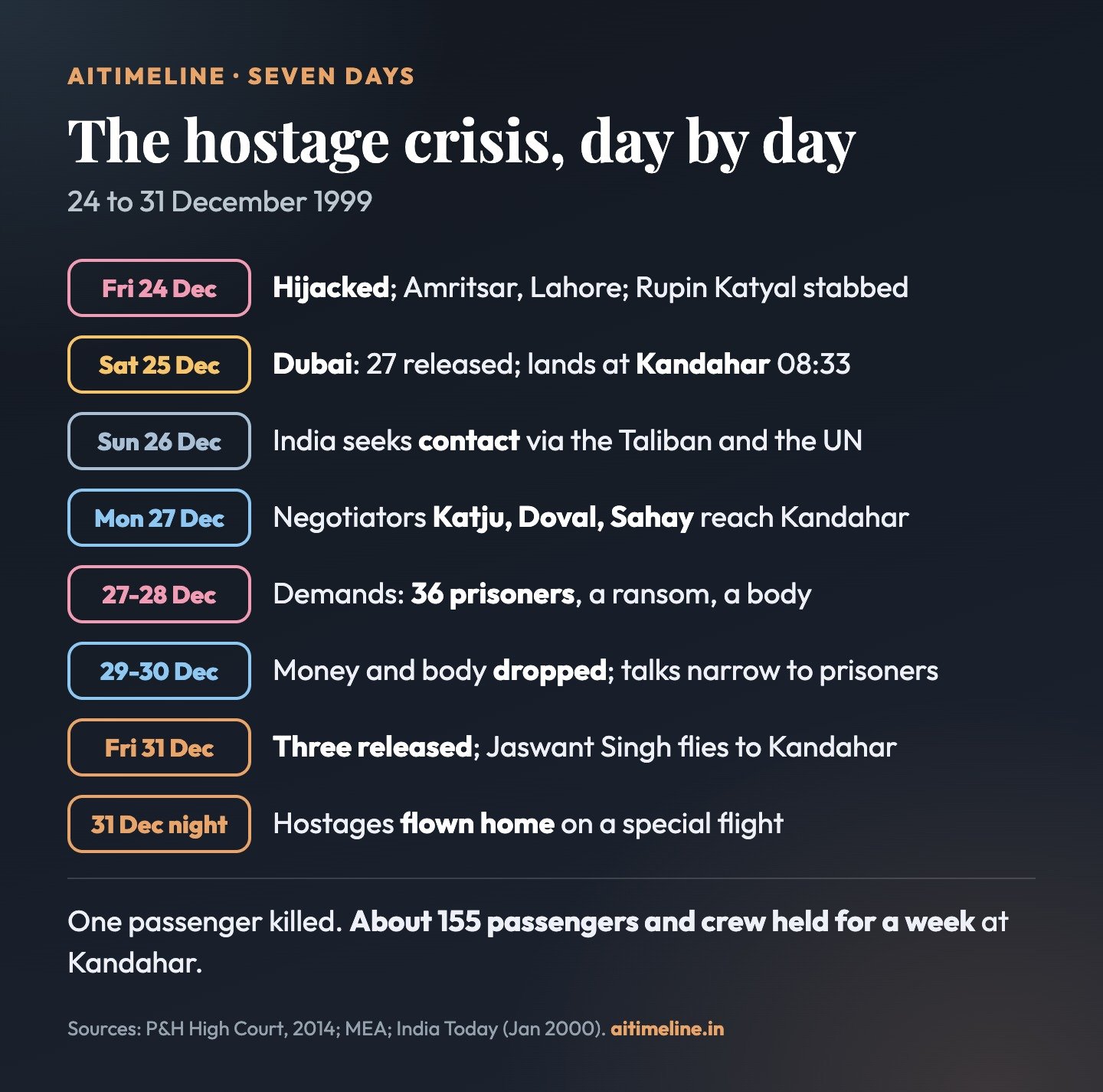
The ground. At Kandahar the aircraft sat on an airport run by a government India did not recognise. Taliban fighters surrounded it, food and water arrived only through them, and an Indian rescue was not a realistic option.
The talks. The Indian team, led by Vivek Katju with Ajit Doval and C.D. Sahay, reached Kandahar on 27 December. The negotiators pressed for a single final list of demands rather than hostage-by-hostage bargaining.
The pressure. Families of the hostages protested in Delhi, including outside the Prime Minister’s residence. The government’s later accounts describe the public pressure, and the deteriorating conditions on board, as part of the context for the final decision.
Decision Point Two: The Prisoner Exchange
31 December 1999: from 36 names to three.
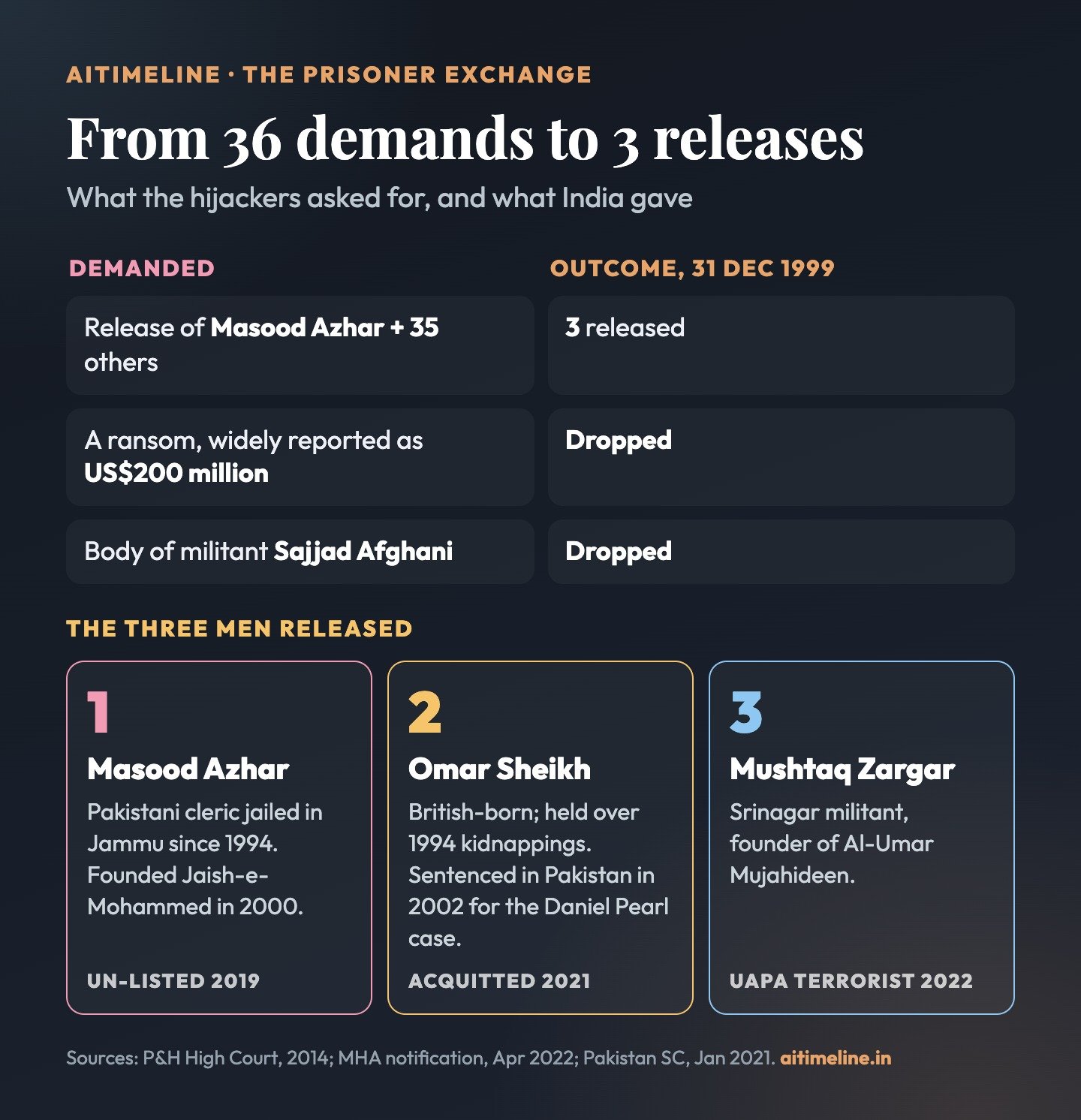
| Released man | Held in India since | Later |
|---|---|---|
| Masood Azhar | Arrested in Kashmir, February 1994 | Founded Jaish-e-Mohammed 2000; UN-listed 1 May 2019 |
| Ahmed Omar Saeed Sheikh | 1994, over kidnappings of foreigners in Delhi | Death sentence in Pakistan 2002 (Pearl); acquittal upheld 2021 |
| Mushtaq Ahmed Zargar | 1992, Srinagar militant leader | Militant activity from Pakistan; UAPA terrorist April 2022 |
The government’s case. Ministers argued that about 155 lives were at stake on hostile ground, that the hijackers had already killed one passenger, and that the price had been cut from 36 prisoners, a ransom and a body to three prisoners.
The criticism. Critics argued that the release rewarded hijacking, that Masood Azhar was the one prisoner the militants most wanted, and that the External Affairs Minister’s presence at Kandahar handed them a propaganda image.
What the record cannot settle. Whether a refusal would have ended with the hostages killed, or with the hijackers giving in, is unknowable. That is why both positions are still argued.
The Investigation and the Trials
Only the alleged helpers faced an Indian court.
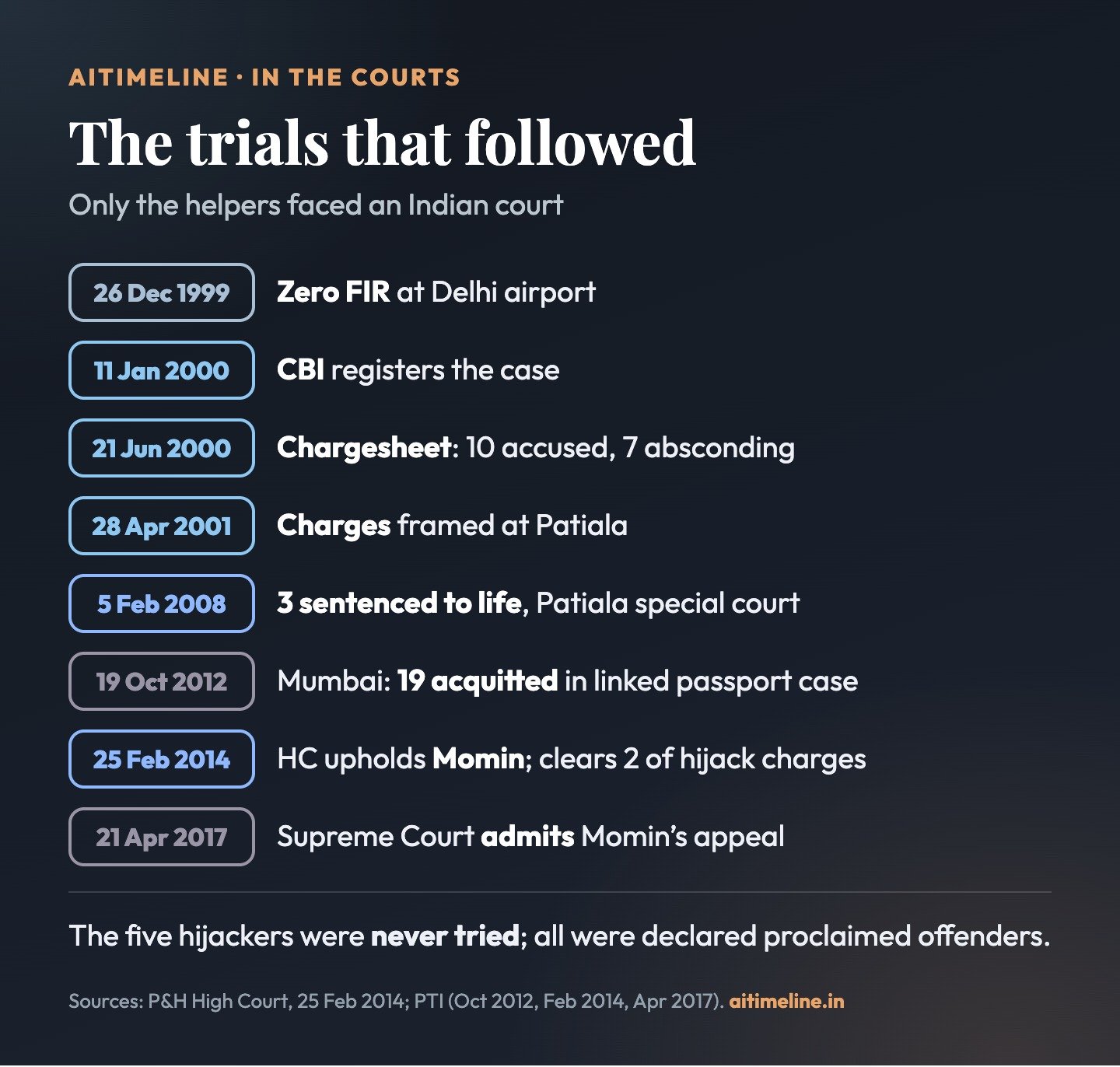
| Date | Court or agency | What happened |
|---|---|---|
| 11 Jan 2000 | CBI | Case registered after zero FIRs at Delhi and Amritsar |
| 21 Jun 2000 | CBI | Chargesheet against 10 accused |
| 28 Apr 2001 | Special court, Patiala | Charges framed against three in custody |
| 5 Feb 2008 | Special court, Patiala | Momin, Bhujel and Nepali sentenced to life |
| 19 Oct 2012 | Sessions court, Mumbai | 19 acquitted in the separate passport case |
| 25 Feb 2014 | Punjab and Haryana High Court | Momin’s life term upheld; Bhujel and Nepali cleared of hijack and murder |
| 21 Apr 2017 | Supreme Court | Momin’s appeal admitted; no reported decision since |
The Ten Accused, and What Became of Them
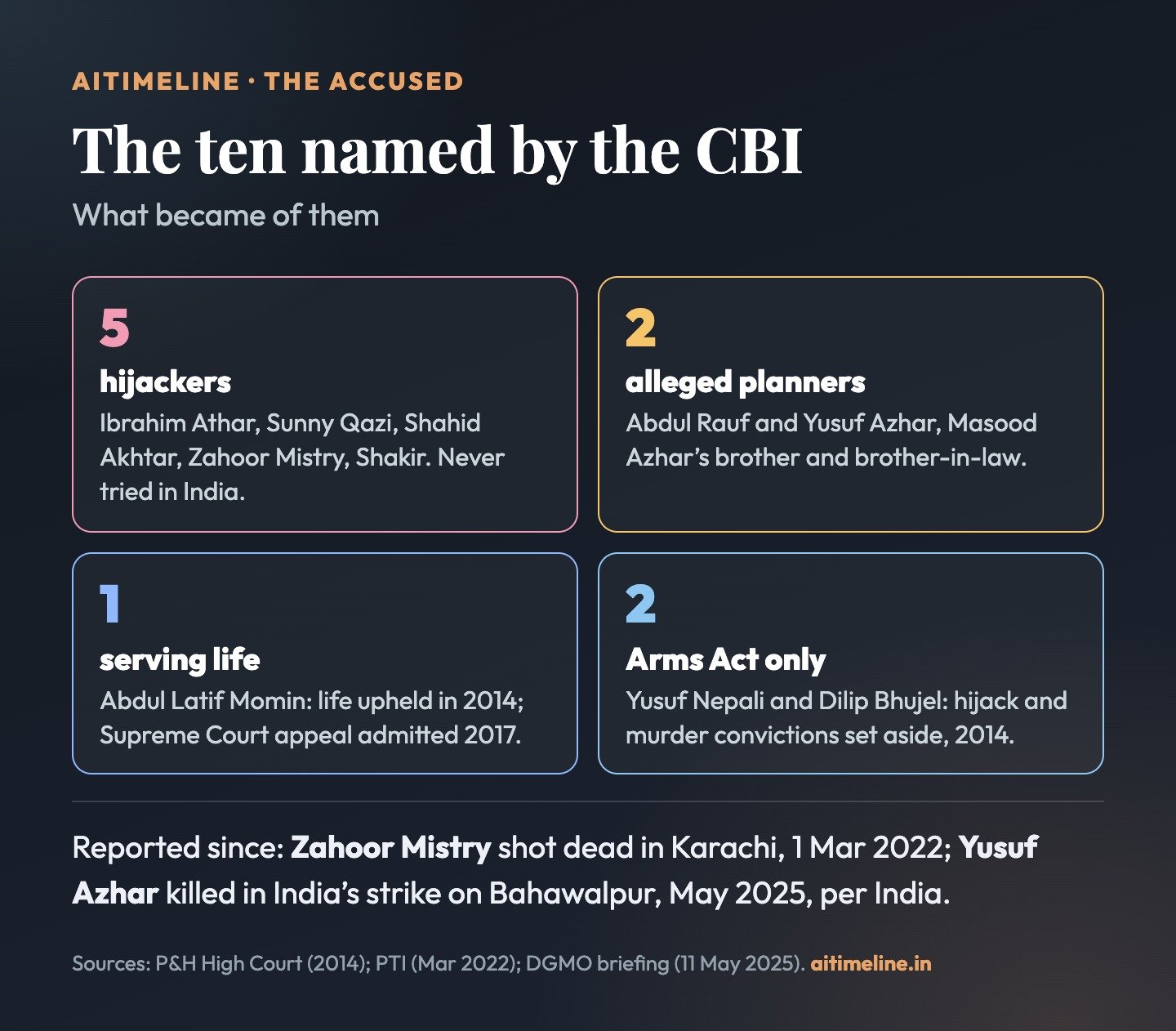
| Accused | Code name or role | Status |
|---|---|---|
| Ibrahim Athar | “Chief”; Masood Azhar’s brother | Proclaimed offender |
| Sunny Ahmed Qazi | “Burger” | Proclaimed offender |
| Shahid Akhtar Sayeed | “Doctor” | Proclaimed offender |
| Zahoor Mistry | “Bhola” | Reported killed in Karachi, 1 March 2022 |
| Shakir | “Shankar” | Proclaimed offender |
| Abdul Rauf | Alleged planner; Azhar’s brother | Proclaimed offender |
| Yusuf Azhar | Alleged planner; Azhar’s brother-in-law | India says killed, 7 May 2025 |
| Abdul Latif Adam Momin | Alleged helper | Life term upheld 2014; appeal pending |
| Yusuf Nepali (Bhupal Man Damai) | Alleged helper | Arms Act only; released 2014 |
| Dilip Kumar Bhujel | Alleged helper | Arms Act only |
The Security Legacy
Later attacks, sanctions and a new hijacking law.

Jaish-e-Mohammed. Masood Azhar founded Jaish in 2000. India has blamed it for the December 2001 Parliament attack (with Lashkar-e-Taiba), the January 2016 Pathankot attack, and the February 2019 Pulwama bombing, which Jaish claimed. These attacks are why the Kandahar release is still discussed. A release does not prove any single attack was foreseeable, but it is the centre of the long-term criticism.
Aviation security. The hijacking exposed weak screening at Kathmandu and poor coordination between air traffic control, the crisis management group and the NSG. India tightened screening, clarified who commands a hijack response, and deployed armed sky marshals on some flights.
The 2016 Act. The Anti-Hijacking Act, 2016 replaced the 1982 law and came into force on 5 July 2017. It allows the death penalty when a hijacking causes the death of any person, covers threats and hoaxes, and extends jurisdiction to some offences outside India.
| Issue | Anti-Hijacking Act, 1982 | Anti-Hijacking Act, 2016 |
|---|---|---|
| Death penalty | Only if a hostage was killed | If the hijacking causes the death of any person |
| Otherwise | Life imprisonment | Life imprisonment, fine, confiscation of property |
| Threats and hoaxes | Limited | Expressly covered |
| In force | 1982 | 5 July 2017 |
What Is Established, and What Is Still Debated
- The aircraft left Amritsar after about 46 minutes without being stopped.
- One passenger was killed and 27 people were freed at Dubai.
- India released three men on 31 December 1999.
- Who was responsible for not immobilising the aircraft at Amritsar.
- Whether India had a viable alternative to the release.
- How far Pakistan’s state was involved: India alleges it; Pakistan denies it.
- The Supreme Court appeals filed in 2017.
- The fate of the hijackers other than Zahoor Mistry.
- Any public inquiry report on the crisis management.
Key People and Organisations
Atal Bihari Vajpayee
Led the government that approved the release of three militants on 31 December 1999.
Jaswant Singh
Flew to Kandahar with the three released men; the most criticised image of the crisis.
Devi Sharan
Flew the aircraft through four forced landings; signalled the hijacking to Delhi ATC.
Vivek Katju
External Affairs Joint Secretary who led the Indian team at Kandahar from 27 December.
Ajit Doval
Member of the Kandahar team; later National Security Adviser from 2014.
Rupin Katyal
Aged 25, returning from his honeymoon; stabbed at Amritsar and died.
| Person or body | Role in the episode |
|---|---|
| Brajesh Mishra | National Security Adviser; later described the Amritsar fuel-bowser plan |
| C.D. Sahay | RAW officer on the Kandahar negotiating team |
| Taliban authorities | Controlled Kandahar airport and acted as intermediaries |
| Harkat-ul-Mujahideen | The Pakistan-based group the hijackers belonged to |
| CBI | Investigated the hijacking from 11 January 2000 |
| Punjab and Haryana High Court | Decided the appeals on 25 February 2014 |
Did You Know?
- Christmas Eve: the hijacking began on 24 December and ended on New Year’s Eve, 31 December 1999.
- Code names: the hijackers called themselves Chief, Doctor, Burger, Bhola and Shankar on board.
- Kabul refused: the hijackers first wanted Kabul, but it lacked night-landing facilities.
- Custody date: Abdul Latif Adam Momin was arrested on 30 December 1999, before the crisis ended.
- Zero FIR: the first case was a zero FIR at Delhi airport on 26 December 1999.
- Bullets kept: Jaswant Singh was reported to have kept bullets from IC 814 in his office with a sign reading “Lest we forget”.
Explore More Timelines
People Also Ask
Frequently Asked Questions
Based on the 2014 High Court judgment, government statements and reporting to 17 November 2026.
⚠️ Editorial Note: What We Corrected and What We Could Not Confirm
The hijacking, the exchange and the court decisions are on the record. Judgements about responsibility for Amritsar, the necessity of the release, and Pakistan’s role are attributed, not presented as findings. Times differ between the High Court judgment and the External Affairs Ministry’s account by up to 45 minutes at Lahore and longer at Kandahar; we use the ministry’s times where they are more specific and note the difference. The brief we started from had several errors. The Mumbai acquittal of 19 accused in the linked passport case was on 19 October 2012, as recorded in the 2014 High Court judgment, not 11 July 2020, and it was an acquittal at trial, not an appeal upholding one. The High Court did not simply decide “appeals”: it upheld Momin’s life term and set aside the hijacking and murder convictions of Nepali and Bhujel. The hostages were flown home on the night of 31 December, not 1 January 2000. We could not find the Indian Express article of 29 March 2026 cited in the brief, or confirm the date of a parliamentary statement of 28 February 2000, and have not relied on them. The ransom is widely reported as US$200 million; reports of the amount vary.
Related Reading on AiTimeline
Sources & further reading
Every dated entry above was checked against these references. Last reviewed 17 November 2026.
- Punjab and Haryana High Court: Abdul Latif Adam Momin v Union of India through CBI (25 February 2014), via Indian Kanoon
- Lok Sabha Debates: External Affairs Ministry account of the IC 814 hijacking (eparlib)
- India Today: Pakistan Foreign Office called India to say they were outraged the plane had landed in Lahore (10 January 2000)
- BBC News: Indian hijack drama over (31 December 1999)
- The Tribune: Kandahar hijack, life term for 3 (6 February 2008)
- PTI via Business Standard: Case related to Kandahar hijack collapses, 19 acquitted (19 October 2012)
- PTI via Business Standard: Kandahar hijack case, CBI petition dismissed (26 February 2014)
- PTI via Business Standard: 1999 hijack case, Yusuf Nepali released from jail (April 2014)
- ANI via Business Standard: Kandahar hijacking, SC admits appeal by convict Momin (21 April 2017)
- Legislative Department: The Anti-Hijacking Act, 2016 (Act No. 30 of 2016)
- PTI via Business Standard: India's tough anti-hijacking law comes into force (6 July 2017)
- Al Jazeera: Pakistan frees man convicted of US journalist Daniel Pearl murder (28 January 2021)
- ThePrint: Indian Airlines plane hijacker who was running business in Pakistan killed (March 2022)
- ThePrint: India designates Al-Umar Mujahideen founder Mushtaq Ahmed Zargar as terrorist (April 2022)
- Deccan Herald: JeM's Yusuf Azhar, wanted in Kandahar hijacking case, killed in Operation Sindoor (May 2025)