From Pahalgam to Operation Sindoor: How India and Pakistan Reached the Brink of War
The Pahalgam attack of 22 April 2025, Operation Sindoor, four days of India-Pakistan fighting and the legal and security aftermath to November 2026.
Latest Story
On 22 April 2025, gunmen killed 26 people at a meadow above Pahalgam in Kashmir. Within two weeks, India had suspended a 65-year-old water treaty, expelled diplomats and launched Operation Sindoor, striking nine sites in Pakistan and Pakistan-occupied Jammu and Kashmir. Four days of drones, missiles, artillery and air strikes followed before the two armies agreed to stop at 5 pm on 10 May. This timeline follows the Pahalgam attack and Operation Sindoor decision by decision, separates what each government claimed from what can be verified, and tracks the aftermath through the NIA’s chargesheets and the Indus Waters dispute in The Hague, up to November 2026.
💡 Short Answer
After 26 people were killed at Baisaran near Pahalgam on 22 April 2025, India held the Indus Waters Treaty in abeyance and cut diplomatic ties. On 7 May it launched Operation Sindoor, striking nine sites it called terrorist infrastructure. Four days of fighting ended with a DGMO-level halt from 5 pm on 10 May. The halt has held, but there is no settlement: the treaty dispute and the NIA case continue.
Pahalgam and Operation Sindoor: Key Questions
The Crisis in Ten Points
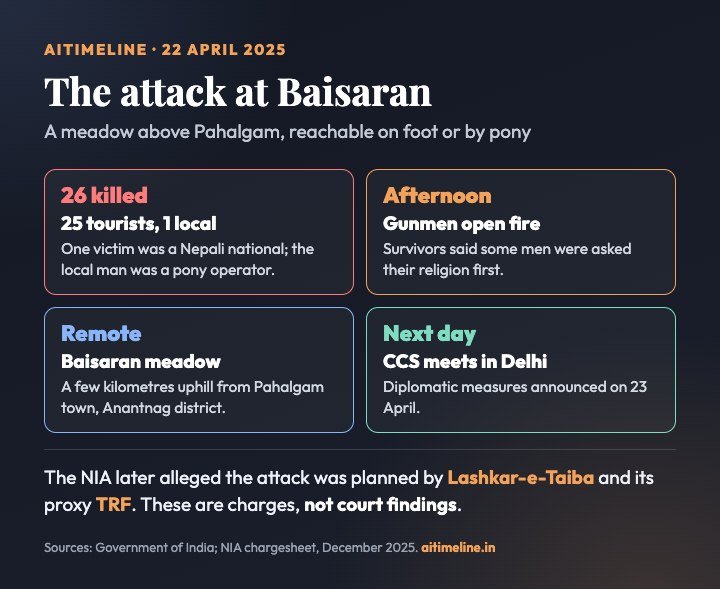
- 22 April 2025: 26 people killed at Baisaran, one of the deadliest attacks on civilians in Kashmir in decades.
- 23 April: India held the Indus Waters Treaty in abeyance for the first time since 1960.
- 24 April: Pakistan closed its airspace, suspended trade and threatened to suspend the Simla Agreement.
- 7 May: Operation Sindoor struck nine sites; India said no military facility was targeted.
- 7 to 10 May: drones, missiles and artillery widened the conflict to air bases on both sides.
- 10 May: a DGMO-level understanding stopped firing from 5 pm IST.
- Disputed: aircraft losses, casualty totals and the US role are still contested.
- 28 July: three men the government called the attackers were killed in Operation Mahadev.
- 15 December 2025 and 6 July 2026: NIA chargesheets named LeT, TRF and, later, Hafiz Saeed.
- 31 August 2026: a Hague tribunal said the treaty is still in force; India rejected it.
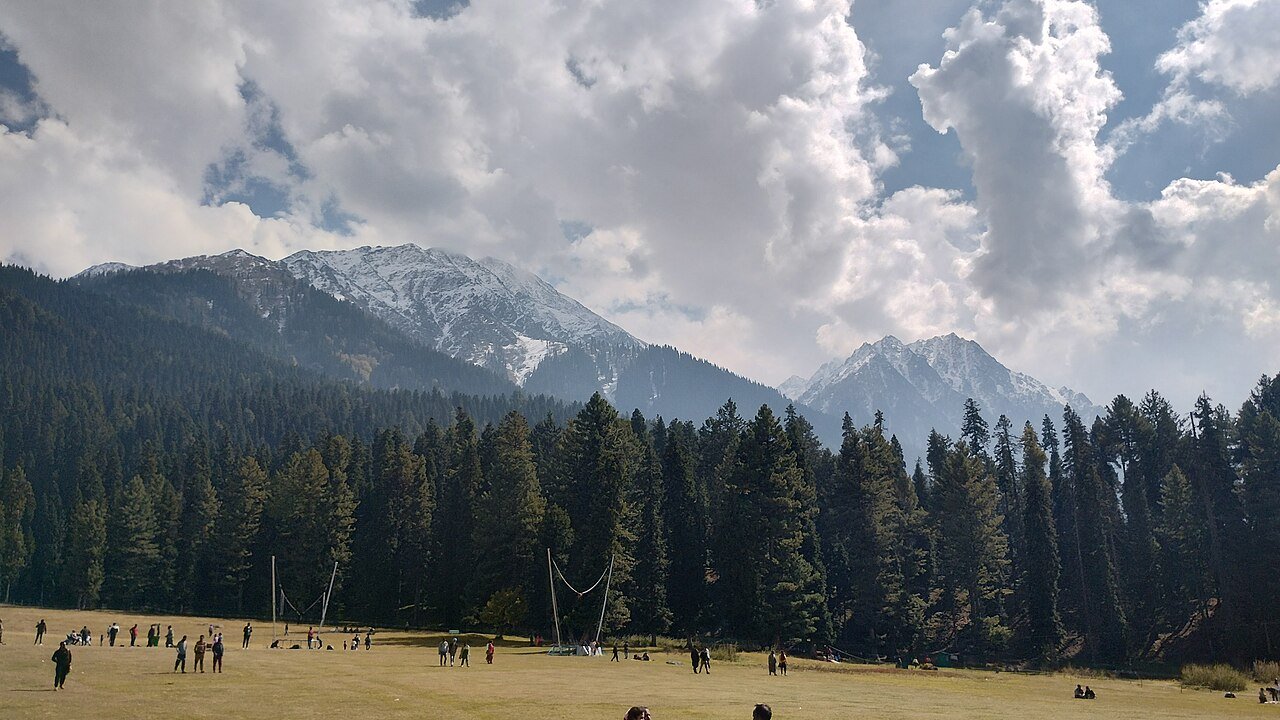
Baisaran meadow above Pahalgam, photographed in October 2023. Photo: Hellohappy, Wikimedia Commons, CC BY-SA 4.0.
Timeline: From the Pahalgam Attack to the Aftermath
Newest first. Colour shows which strand each event belongs to.
A halt that holds, with no settlement Diplomacy
Where it stands: The halt in fighting agreed on 10 May 2025 has held: there has been no return to the strikes and counter-strikes of that week. But no peace agreement or wider political settlement has followed, and there is no structured dialogue between the two governments.
What remains in place: India still holds the Indus Waters Treaty in abeyance. Pakistan has repeatedly extended its ban on Indian aircraft using its airspace, most recently to 24 November 2026. The Attari–Wagah crossing, trade and visa measures announced in April 2025 have not been reversed.
Tribunal rules the treaty is still in force; India rejects it Water & law
The award: The Court of Arbitration, with the Permanent Court of Arbitration as its secretariat, unanimously held that none of the grounds India had cited could justify suspending or terminating the Indus Waters Treaty. It said the treaty “remains fully in force” and that India must observe its obligations.
Interim order: In a separate order the same day, the court barred India from concreting the Ratle hydro-electric project’s dam wall and power intake above certain levels until 90 days after a Neutral Expert rules on the project’s design, expected around July 2027.
India’s response: The Ministry of External Affairs rejected the award on the same day, calling the court “illegally constituted” and saying it had no jurisdiction over India’s sovereign decisions. It said the abeyance remained in force.
Hafiz Saeed named in supplementary chargesheet Investigation
The filing: The NIA filed a supplementary chargesheet naming Lashkar-e-Taiba founder Hafiz Saeed as an accused, both personally and as head of the LeT and its proxy, The Resistance Front.
The charges: He was charged under the Bharatiya Nyaya Sanhita and the Unlawful Activities (Prevention) Act, including for conspiracy and waging war against India, according to reports of the filing. Saeed is in Pakistan and has not appeared before any Indian court.
Second award on India’s hydro projects Water & law
What it decided: The court issued a supplemental award on “maximum pondage”, the amount of water India’s run-of-river projects on the western rivers may hold back. Pakistan welcomed it as limiting India’s ability to control flows.
India’s position: India again said it did not recognise the court and that its awards had no effect.
NIA files a 1,597-page chargesheet Investigation
Who is named: The chargesheet named Lashkar-e-Taiba and The Resistance Front as organisations, Pakistan-based handler Sajid Jatt, the three men killed in Operation Mahadev, and two local men accused of sheltering the attackers.
The NIA’s case: The agency alleged the attack was planned and directed from Pakistan and carried out by LeT through its TRF front. It said its investigation was continuing.
Court of Arbitration rules on how to read the treaty Water & law
What it decided: The court issued its award on issues of general interpretation of the Indus Waters Treaty, setting out how the treaty’s design rules for Indian hydro projects on the western rivers should be read.
India’s position: India rejected the award, maintaining that it had never recognised the court.
Operation Mahadev: three gunmen killed near Dachigam Investigation
The operation: Security forces killed three men in the Mahadev ridge area near Dachigam National Park, on the outskirts of Srinagar. Weapons recovered included an M4 carbine and two AK-47 rifles.
The identification: Home Minister Amit Shah told the Lok Sabha on 29 July that the three, named as Suleiman, Afghan and Jibran, were the men who carried out the Pahalgam attack. The NIA later named them in its chargesheet.
Parliament debates Operation Sindoor Diplomacy
The debate: Both Houses held a special discussion on the attack and the operation. The government defended the strikes as a calibrated response; the opposition questioned intelligence failures, aircraft losses and repeated US claims of having brokered the halt.
The government’s line: Ministers said no foreign leader had asked India to stop the operation and that the halt was agreed directly between the two militaries.
US designates TRF a terrorist organisation Diplomacy
The decision: The State Department designated The Resistance Front as a Foreign Terrorist Organization and Specially Designated Global Terrorist, describing it as a front and proxy for Lashkar-e-Taiba and linking it to the Pahalgam attack.
The reaction: India welcomed the designation as a sign of international cooperation against terrorism.
Tribunal says abeyance cannot limit its powers Water & law
What it decided: The court held that a party cannot reduce its competence by unilateral action taken after proceedings have begun, so India’s abeyance decision did not stop the arbitration. It did not yet decide whether the treaty itself remained in force.
India’s response: India rejected the award, saying it had never recognised the court and that, with the treaty in abeyance, it was not bound to perform any of its obligations.
Two men arrested for sheltering the attackers Investigation
The arrests: The NIA arrested two residents of the Pahalgam area, Parvaiz Ahmad Jothar and Bashir Ahmad Jothar, on charges of knowingly harbouring the three gunmen at a seasonal hut before the attack.
What the NIA said: The agency said the men had revealed the identities of the attackers and confirmed they were Pakistani nationals linked to Lashkar-e-Taiba.
Indian military acknowledges aircraft losses Military
What was said: Chief of Defence Staff Gen. Anil Chauhan acknowledged in interviews that India had lost aircraft in the opening phase, without giving a number, and said tactics were corrected afterwards. He rejected Pakistan’s claim of six Indian jets as incorrect.
Later claims: In August 2025, Air Chief Marshal A.P. Singh claimed that Indian air defences had shot down several Pakistani aircraft. Pakistan denied losing any.
All-party delegations tour world capitals Diplomacy
The outreach: India sent seven delegations of MPs from across parties, including the opposition, to brief governments on the Pahalgam attack and India’s position on cross-border terrorism.
The message: The delegations argued that the strikes were a response to terrorism, not aggression against Pakistan, and that India would not accept outside mediation on Kashmir.
DGMOs speak again; Modi addresses the nation Diplomacy
The talks: The two Directors General of Military Operations spoke as agreed on 10 May and discussed keeping the halt in place, including reducing troop deployments on the border.
The address: Prime Minister Modi said India had only paused its action, and that terror and talks, and terror and trade, could not go together. “Water and blood cannot flow together,” he said, referring to the treaty.
Military chiefs give India’s account Military
The claims: India’s DGMO said more than 100 terrorists had been killed in the strikes on the nine sites, and described air-defence engagements over the following nights.
How to read them: These are official claims. Pakistan disputed them, and they have not been independently verified.
Firing to stop from 5 pm: the DGMO understanding Diplomacy
What was agreed: Pakistan’s DGMO called his Indian counterpart at 3:35 pm. They agreed that all firing and military action on land, in the air and at sea would stop from 5 pm, and to speak again on 12 May.
The US role: US President Donald Trump announced the ceasefire on social media before either government did and later claimed repeatedly to have brokered it. India said the halt was agreed directly between the two militaries; Pakistan thanked the US for its role.
Violations: Late that night, Misri said there had been repeated violations of the understanding and asked Pakistan to address them. The firing died down by the next morning.
Strikes on Pakistani air bases Military
Pakistan’s attack: Pakistan launched what it called Operation Bunyan-um-Marsoos, targeting Indian military sites with drones and missiles. India said most were intercepted.
India’s response: India said it struck military targets at air bases including Rafiqui, Murid, Chaklala, Rahim Yar Khan, Sukkur and Chunian, and radar sites at Pasrur and Sialkot.
Waves of drones along the border Military
India’s account: India said Pakistan sent 300 to 400 drones towards 36 locations from Leh to Sir Creek on the night of 8 May, to probe air defences and gather intelligence, and that most were shot down.
On the ground: Blackouts were enforced in border towns, airports across north and west India were closed, and shelling along the Line of Control continued.
Counter-attacks and air-defence strikes Military
India’s account: India said Pakistan tried to strike military targets at 15 locations, including Awantipura, Srinagar, Jammu, Pathankot, Amritsar, Jalandhar, Ludhiana, Bhuj and others, and that the attacks were neutralised.
India’s response: India said it hit air-defence radars and systems at several locations in Pakistan, including one at Lahore.
Operation Sindoor: nine sites struck Military
The strikes: The Indian Armed Forces struck nine sites: Bahawalpur, Muridke and two near Sialkot in Pakistan, and two near Muzaffarabad, two near Kotli and one at Bhimber in Pakistan-occupied Jammu and Kashmir. India linked Bahawalpur to Jaish-e-Mohammed and Muridke to Lashkar-e-Taiba.
India’s framing: The Ministry of Defence called the action “focused, measured and non-escalatory” and said no Pakistani military facility had been targeted.
Pakistan’s account: Pakistan said the strikes hit civilian areas and mosques and killed civilians, and called them an act of war.
The joint briefing Diplomacy
Who briefed: Foreign Secretary Vikram Misri set out the diplomatic case, while Colonel Sofiya Qureshi of the Army and Wing Commander Vyomika Singh of the Air Force described the strikes with video of the targets.
The message: India said it had acted because Pakistan had taken no action against the groups behind the attack, and that it had intelligence of further attacks being planned.
Armed forces given “operational freedom” Military
The decision: Prime Minister Modi told the defence leadership that the armed forces had complete operational freedom to decide the mode, targets and timing of India’s response.
Other steps: On 30 April India closed its airspace to Pakistani airlines. Firing along the Line of Control was reported on several nights in late April.
NIA takes over the investigation Investigation
The handover: The NIA formally took over the case from the Jammu and Kashmir Police and began questioning survivors, ponywalas, shopkeepers and other witnesses at Baisaran.
The method: Investigators relied on eyewitness accounts, video and photos taken by tourists, and phone data.
Pakistan responds; Modi promises pursuit Diplomacy
Pakistan’s measures: Pakistan closed its airspace to Indian airlines, suspended trade, closed the Wagah border, expelled Indian defence advisers and said it could hold the Simla Agreement and other bilateral agreements in abeyance. It said any attempt to stop or divert its water would be treated as an act of war.
India’s message: Speaking in Bihar, Prime Minister Modi said India would identify, track and punish every terrorist and their backers “to the ends of the earth”. India also formally wrote to Pakistan about the treaty decision.
Cabinet Committee on Security announces measures Diplomacy
The decisions: The Indus Waters Treaty of 1960 would be held in abeyance “until Pakistan credibly and irrevocably abjures its support for cross-border terrorism”. The Attari Integrated Check Post was closed, Pakistani nationals could no longer travel under the SAARC visa exemption scheme, and Pakistan’s defence, naval and air advisers were declared persona non grata.
Diplomatic cut: The strength of both High Commissions was to be cut from 55 to 30 by 1 May.
Attack at Baisaran meadow Attack
The attack: In the early afternoon, gunmen emerged from the pine forest around Baisaran, a meadow reached only on foot or by pony, and opened fire on tourists. Twenty-six people were killed: 25 tourists, one of them a Nepali national, and Syed Adil Hussain Shah, a local pony operator who survivors said tried to stop the gunmen.
Religion: Survivors said the attackers asked some men their religion, or to recite Islamic verses, before shooting them.
Reaction: Prime Minister Modi cut short a visit to Saudi Arabia. The attack was condemned across Indian politics and by governments around the world, and Kashmiris held protests against it.
The Indus Waters Treaty is signed Water & law
The treaty: Signed by Jawaharlal Nehru and Ayub Khan on 19 September 1960, it gave India the eastern rivers (Ravi, Beas, Sutlej) and Pakistan the western rivers (Indus, Jhelum, Chenab), with limited Indian use of the western rivers for hydropower.
Why it matters here: The treaty has no clause allowing either side to suspend it unilaterally, which is at the heart of the legal dispute after April 2025.
The Four Decisions That Shaped the Crisis
From pressure, to force, to escalation, to a halt.
Pressure before force
India’s first response was diplomatic and economic. Suspending the water treaty, closing Attari and expelling military advisers signalled that the cost of a major attack would go beyond protest notes.
Use military force
Operation Sindoor moved from pressure to strikes. India framed it as narrow: nine sites linked to terrorist groups, no Pakistani military targets. Pakistan treated it as aggression and retaliated.
Widen the response
After Pakistani drones and missiles, India hit air-defence systems and then air bases. The problem was to respond strongly enough to deter further attacks without starting a prolonged war.
Stop
The halt was agreed through the DGMO hotline. It ended the fighting but settled nothing about responsibility for the attack, the treaty or future relations.
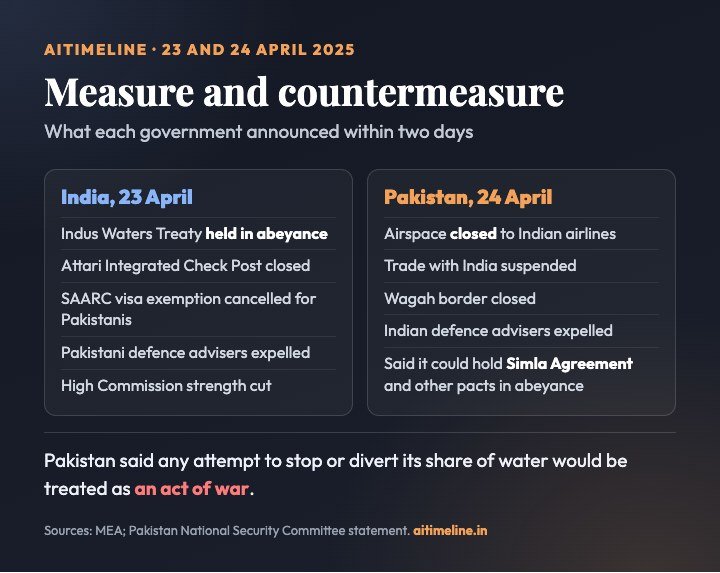
The order of these decisions matters. In 2016 and 2019, India’s cross-border responses came after attacks on soldiers. In 2025 the victims were civilians on holiday, and the government’s first moves targeted long-standing arrangements that had survived earlier wars, starting with the Indus Waters Treaty. That made the crisis broader than a military exchange from the outset.
Four Days in May: How the Fighting Unfolded
The most serious India–Pakistan military confrontation in decades.
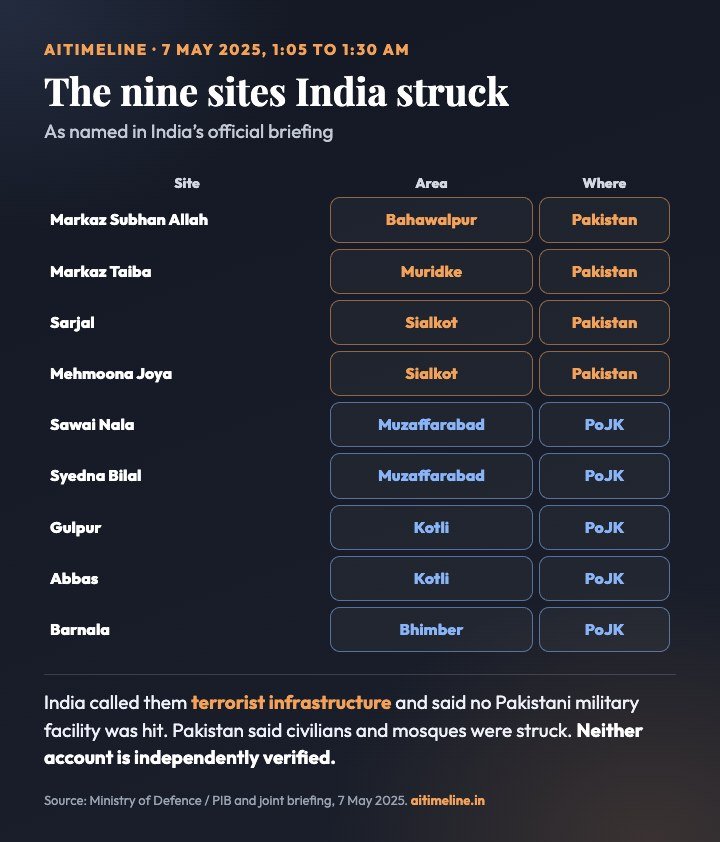
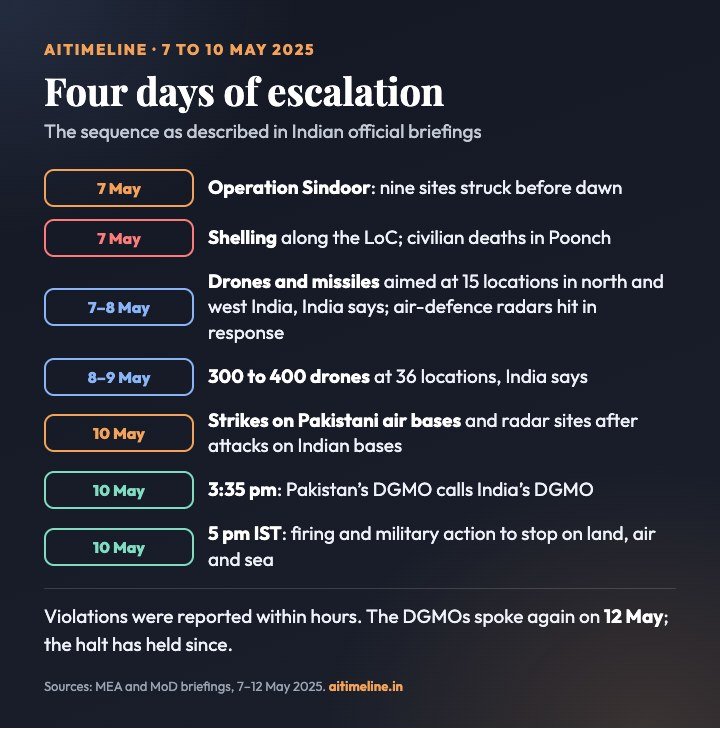
India’s initial strikes lasted about 25 minutes. The Ministry of Defence said it had chosen targets linked to Jaish-e-Mohammed, Lashkar-e-Taiba and Hizbul Mujahideen, and had avoided Pakistani military facilities to keep the action “non-escalatory”. Pakistan said the strikes killed civilians, including children, and damaged mosques.
What followed was a contest of drones, missiles and air defences, not a ground war. India reported Pakistani attempts to hit military sites from Kashmir to Gujarat; Pakistan reported Indian drones over its cities. Both sides shelled along the Line of Control, where civilians suffered most, particularly in Poonch on the Indian side. On 10 May both struck the other’s air bases, and by that afternoon the militaries had agreed to stop.
Operation Sindoor: What Is Established and What Remains Disputed
Claims are attributed. Neither government’s figures are treated as settled.
| Issue | What can be stated responsibly |
|---|---|
| Initial targets | India announced strikes on nine sites it described as terrorist infrastructure |
| Military facilities | India said none were targeted on 7 May; it later confirmed strikes on air-defence systems (8 May) and air bases (10 May) |
| Subsequent fighting | Both countries reported drone, missile, air-defence and artillery activity |
| Aircraft losses | India acknowledged losses without a number; each side claims to have downed the other’s aircraft. Unverified |
| Casualties | Both sides reported civilian and military deaths; totals are not independently verified |
| Ceasefire mechanism | India announced a direct DGMO-level understanding on 10 May |
| International role | The US claimed to have brokered the halt; Pakistan thanked it; India denied any mediation |
| Long-term outcome | The fighting stopped; political, water and security disputes continue |
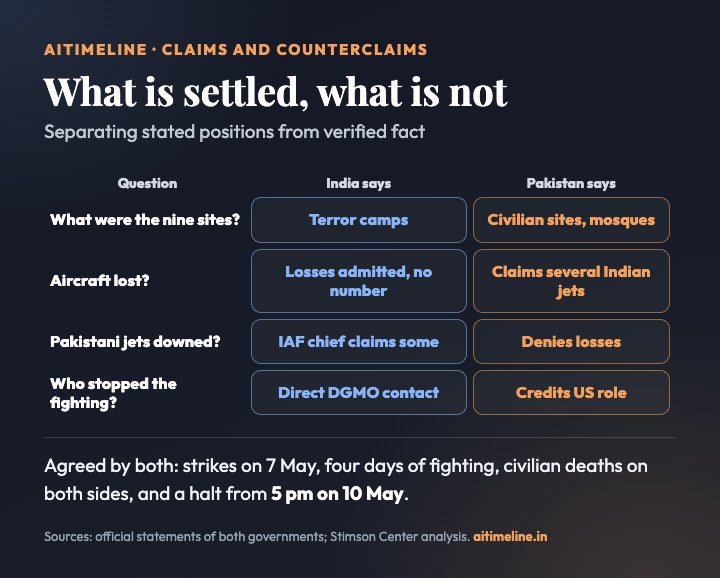
Independent analysts, including the Stimson Center’s early assessment of the crisis, have used satellite imagery to confirm damage at several of the sites both sides named. But the precise numbers that dominated television coverage in both countries, of aircraft downed, militants killed and soldiers lost, rest largely on official statements that cannot be checked.
The Indus Waters Treaty: Why It Became a Major Issue
A water-sharing pact that survived three wars, now in legal limbo.
Signed in 1960 with the World Bank as a party, the treaty gives India the three eastern rivers and Pakistan the three western rivers, which carry most of the system’s water. India may build run-of-river hydro projects on the western rivers within design limits. It has no exit or suspension clause.
India’s decision of 23 April 2025 to hold the treaty in abeyance made water part of the confrontation. In practice, India stopped routine data-sharing under the treaty (it passed on some flood warnings through diplomatic channels on humanitarian grounds), skipped meetings of the Permanent Indus Commission and moved to speed up its projects. It cannot, in the short term, cut the rivers’ flow in any meaningful way, because it lacks the storage to do so.
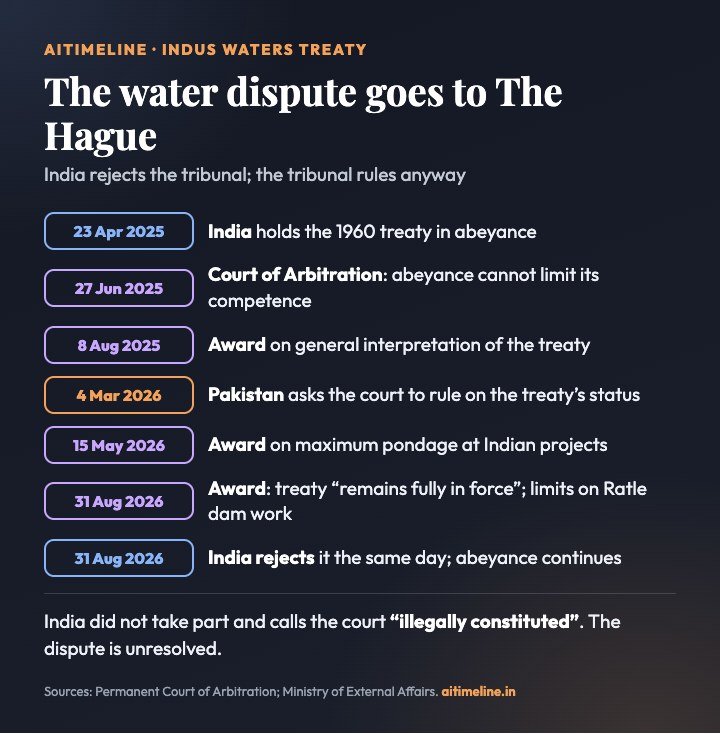
The legal fight runs through an arbitration that began in 2016 over two Indian projects. India boycotts it, arguing that the World Bank wrongly allowed a Court of Arbitration and a Neutral Expert to proceed at the same time. The court has nonetheless kept ruling, and on 31 August 2026 held that the treaty remains in force. The award states the tribunal’s position; India’s rejection states the Indian government’s. Neither ends the dispute.
Investigation and Accountability
Allegations, arrests and an encounter, but no trial verdict.
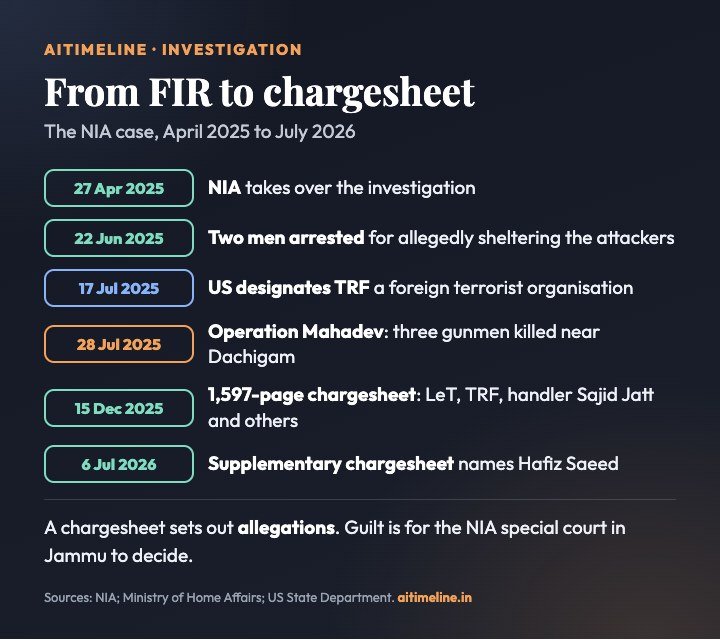
The investigation has moved further than in many earlier attacks: the men the government identifies as the gunmen are dead, two alleged harbourers are in custody, and the chargesheets name the organisations and the Pakistan-based figures the NIA holds responsible. But the three alleged attackers were killed rather than tried, and the most senior accused are outside India’s reach. Whatever the special court decides about the two local accused, the case against the alleged planners is unlikely to be tested in a courtroom.
Impact and Aftermath
A new threshold
India showed it would use cross-border force, deeper into Pakistan than in 2019, after a major attack. Air defence, counter-drone systems and precision weapons became defence priorities.
Nuclear shadow
Two nuclear-armed states struck each other’s air bases. The crisis ended in four days, but it lowered the bar for military action in future crises.
Mediation dispute
Repeated US claims of brokering the halt strained India–US ties; Pakistan used them to argue for outside involvement on Kashmir, which India rejects.
Tourism and livelihoods
Bookings collapsed after the attack, hitting hotel workers, guides, pony operators and drivers, and many tourist spots were closed for months.
A treaty in limbo
India says the treaty is in abeyance; the tribunal says it is in force. Data-sharing and commission meetings have stopped.
Closed links
Airspace bans, the closed Attari–Wagah crossing and suspended trade and visas remain from April 2025.
Key Institutions and Actors
| Actor | Role in the crisis |
|---|---|
| PM Narendra Modi | Chaired the CCS; gave forces operational freedom; addressed the nation on 12 May |
| Cabinet Committee on Security | Approved the 23 April measures, including treaty abeyance |
| Indian Armed Forces | Conducted Operation Sindoor and the responses that followed |
| Foreign Secretary Vikram Misri | Set out India’s official position; announced the 10 May understanding |
| DGMOs of India and Pakistan | Agreed the halt by hotline on 10 May; spoke again on 12 May |
| National Investigation Agency | Investigated the attack; filed chargesheets in Dec 2025 and Jul 2026 |
| Pakistan’s government and military | Denied involvement; retaliated; claimed major successes in the fighting |
| United States | Claimed a role in the halt; designated TRF in July 2025 |
| Court of Arbitration / PCA | Issued awards on the treaty, including on 31 August 2026 |
Explore More Timelines
People Also Ask
Frequently Asked Questions
Checked against official statements, NIA filings, the Permanent Court of Arbitration and contemporary reporting.
⚠️ Editorial Note
This timeline separates India’s official account, Pakistan’s competing position, independently reported developments and legal proceedings. Military claims about targets, casualties, aircraft and damage are attributed to the government that made them and are not treated as verified. The NIA’s allegations are not judicial findings, and the Court of Arbitration’s award is rejected by India. Checking the brief this page began from: Operation Mahadev took place on 28 July 2025, not 29 July (the Home Minister confirmed the identities in Parliament on 29 July); the vague 14 May 2025 entry was replaced with the dated briefings of 11 and 12 May; and the Court of Arbitration’s earlier rulings of June and August 2025 and May 2026, Pakistan’s countermeasures of 24 April and the CDS’s acknowledgement of aircraft losses were added.
Related Reading on AiTimeline
Sources & further reading
Every dated entry above was checked against these references. Last reviewed 8 November 2026.
- Ministry of Defence / PIB: Operation Sindoor, Indian Armed Forces carried out precision strike at terrorist camps (7 May 2025)
- Ministry of External Affairs: Foreign Secretary's statement on the cessation of firing and military action (10 May 2025), via GlobalSecurity
- Permanent Court of Arbitration: Award on the Status of the Indus Waters Treaty and Order on Interim Measures, press release (31 August 2026)
- Permanent Court of Arbitration: Indus Waters Western Rivers Arbitration (Pakistan v. India), case page
- The Week: India rejects Court of Arbitration award, says treaty remains in abeyance (31 August 2026)
- All India Radio News: NIA files chargesheet in Pahalgam terror attack case (December 2025)
- Kashmir Observer: NIA names Hafiz Saeed in supplementary chargesheet (6 July 2026)
- India Today NE: Amit Shah says Pahalgam attackers killed in Operation Mahadev (29 July 2025)
- US Department of State: Terrorist Designation of The Resistance Front (17 July 2025), via GlobalSecurity
- Stimson Center: Four Days in May, the India-Pakistan Crisis of 2025
- Gulf News: Pakistan extends airspace ban on Indian aircraft until 24 November 2026