Lily Thomas Case: Why Convicted Lawmakers Can Lose Their Seats Immediately
Understand the 2013 Lily Thomas judgment, how it changed disqualification of convicted MPs and MLAs, Section 8 of the RPA and the Rahul Gandhi case.
Latest Story
Until July 2013, an MP or MLA convicted of a crime and sentenced to prison could usually keep the seat for years, simply by appealing. The Lily Thomas case ended that. On 10 July 2013 the Supreme Court struck down Section 8(4) of the Representation of the People Act, 1951, the clause that had deferred disqualification for sitting legislators for three months and then for as long as any appeal took. Since then, a member convicted of an offence covered by Section 8 is disqualified from the day of conviction, like any other candidate. The judgment unseated a Rajya Sabha MP within three months, survived a government attempt to override it, and in 2023 cost Rahul Gandhi his Lok Sabha seat until the Supreme Court stayed his conviction. This page sets out what the court decided, how the law works now, and the cases that have tested it.
Conviction, sentence, suspension of sentence, stay of conviction and acquittal are different legal steps, and only some of them affect a seat. We say which court made each order and quote the judgment where it matters. The timeline is colour-coded by strand: the law, government action, disqualifications, court rulings and context. Where the brief we worked from had a detail that the record contradicts, we say so in the entry and in the editorial note.
💡 Short Answer
In Lily Thomas v. Union of India, decided on 10 July 2013, the Supreme Court struck down Section 8(4) of the Representation of the People Act, which let convicted MPs and MLAs keep their seats while appealing. Now a sitting legislator convicted of an offence under Section 8, usually with a sentence of two years or more, is disqualified from the date of conviction. Only a court order staying the conviction restores the seat.
Lily Thomas Case: Key Questions
The Judgment in Ten Points
- The clause: Section 8(4) deferred a sitting member’s disqualification for three months after conviction, and then until any appeal was decided.
- The ruling: on 10 July 2013 the Supreme Court held Parliament had no power to enact it and declared it ultra vires.
- The reasoning: Articles 102 and 191 apply the same disqualifications to being chosen and being a member; Articles 101(3)(a) and 190(3)(a) make the seat fall vacant automatically.
- Prospective: members already convicted, with appeals pending, kept the old protection; members convicted later did not.
- The safety valve: an appellate court can stay a conviction, and the disqualification then stops operating.
- The backlash: the government’s review failed, and its ordinance to override the judgment was withdrawn on 2 October 2013.
- The first casualties: Rasheed Masood in the Rajya Sabha, then Lalu Prasad and Jagdish Sharma in the Lok Sabha.
- The clarification: Lok Prahari (2018) confirmed a stay of conviction revives the seat; Saritha Nair (2020) confirmed a suspended sentence does not.
- The test case: Rahul Gandhi lost his seat for 137 days in 2023, regaining it only when his conviction was stayed.
- The limit: charges and FIRs do not disqualify; only convictions do, and a lifetime ban is still being argued.
What Does Section 8 of the Representation of the People Act Say?
Four subsections, one struck down.
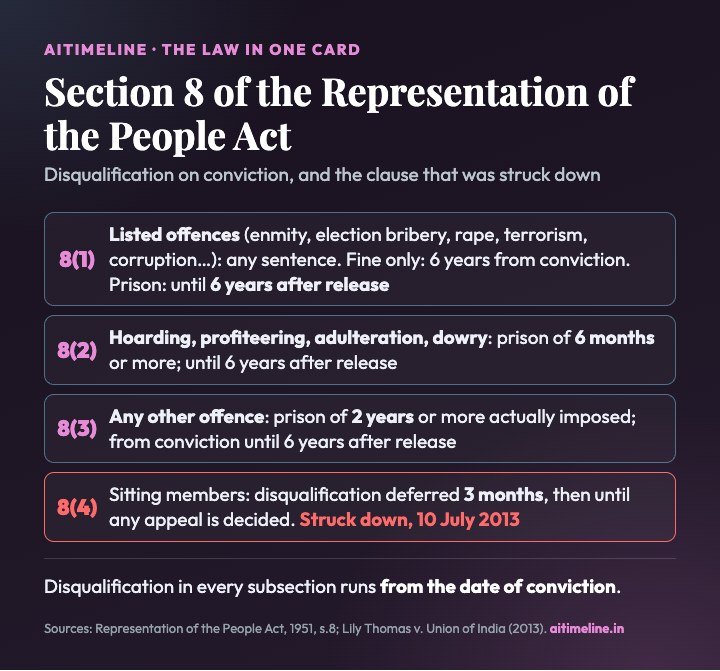
Section 8 is the part of the 1951 Act that turns a criminal conviction into a bar on sitting in Parliament or a state legislature. Article 102(1)(e) and Article 191(1)(e) of the Constitution let Parliament add disqualifications by law, and Section 8 is the main one it added. It works in tiers. Section 8(1) lists offences serious enough that any conviction counts. Section 8(2) covers economic and social offences such as hoarding and adulteration, where six months in prison is enough. Section 8(3) is the catch-all: any other offence where the court actually imposes two years or more.
Section 8(4) sat on top of the other three. It did not create a disqualification; it delayed one. For a person who was already an MP or MLA on the date of conviction, it said the disqualification would not take effect for three months, and if an appeal or revision was filed within that time, not until the court disposed of it. Appeals in India routinely take years. In practice, a convicted legislator could serve out a full term.
What Changed on 10 July 2013?
The same conviction, before and after.
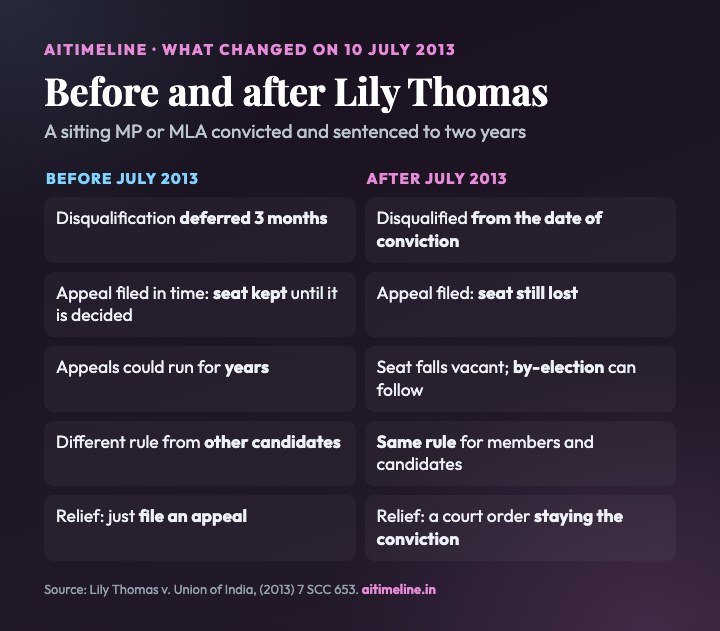
The bench of Justices A.K. Patnaik and S.J. Mukhopadhaya did not need to decide whether Section 8(4) was unfair. It decided the case on power. Articles 102(1) and 191(1) say a person is disqualified “for being chosen as, and for being,” a member on the same grounds. Articles 101(3)(a) and 190(3)(a) then say that if a member becomes subject to a disqualification, the seat “shall thereupon become vacant”. Parliament could prescribe the grounds. It could not, the court held, prescribe a different moment at which those grounds take effect for people who happened to be in the House.
The government argued that the provision protected the House from losing members to frivolous convictions that might later be overturned. The court’s answer was that the remedy already existed: an appellate court can stay a conviction. It also limited the ruling to the future. Members already convicted, whose appeals were pending on 10 July 2013, kept their seats; anyone convicted after that date would not. For other judgments in which the Supreme Court drew the line between Parliament’s power and the Constitution’s structure, see our explainers on the Kesavananda Bharati case and the Second Judges Case.
Appeal, Bail, Suspension of Sentence or Stay of Conviction?
The distinction the whole ruling turns on.
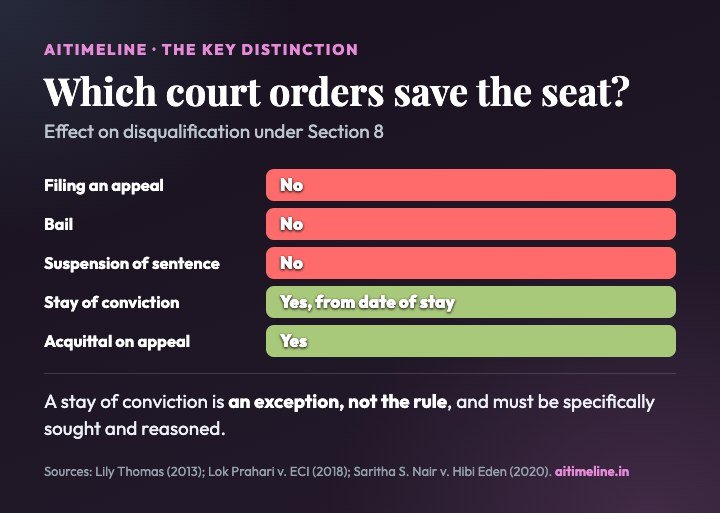
Most confusion about Lily Thomas comes from treating every form of appellate relief as the same thing. They are not. Bail is about custody. A suspended sentence means the punishment is paused while the appeal is heard; the conviction still stands, and Section 8 is triggered by the conviction. A stay of conviction is different in kind: it suspends the conviction itself, so for as long as the stay lasts there is nothing for Section 8 to act on.
The Lily Thomas bench relied on two earlier rulings for this. In Rama Narang (1995), a three-judge bench held that an appellate court can stay a conviction, not only a sentence. In Ravikant Patil (2007), another three-judge bench said a stayed conviction is not erased but becomes “non-operative”, and warned that such a stay “is not the rule but is an exception to be resorted to in rare cases”. Lok Prahari tested that in 2018, arguing that a stay should not revive a seat; the Supreme Court disagreed. Two years later, in Saritha S. Nair v. Hibi Eden, it confirmed the other side: a suspended sentence, without a stay of conviction, does not lift the bar.
| Order | What it does | Effect on disqualification |
|---|---|---|
| Appeal filed | Challenges conviction or sentence | None by itself |
| Bail | Releases the convict from custody | None |
| Suspension of sentence | Pauses the punishment | None; conviction still operates |
| Stay of conviction | Suspends the conviction itself | Does not operate while the stay lasts |
| Acquittal | Sets the conviction aside | Removed |
How a Seat Is Lost, and Won Back
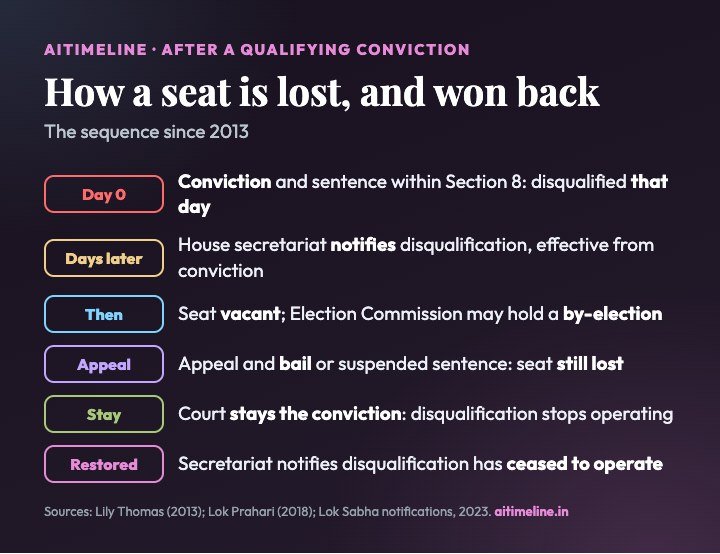
The notification that follows a conviction is often reported as the moment a member is “disqualified”, but it is a record, not a decision. When the Karnataka Assembly notified Vinay Kulkarni’s disqualification on 2 May 2026, it said he had stood disqualified since 15 April, the day of his conviction. The reverse is also true: when a conviction is stayed, the secretariat notifies that the disqualification has “ceased to operate”, as it did for Mohammed Faizal and Rahul Gandhi in 2023.
Timeline: The Lily Thomas Case and the Disqualification of Convicted Lawmakers
Newest first. Colour shows the strand: the law, government, disqualifications, court rulings, or context.
Where the law stands Courts
Settled: A sitting MP or MLA who is convicted of an offence covered by Section 8 and, where the subsection requires it, sentenced to the qualifying term, is disqualified from the date of conviction. Filing an appeal does not change that. Only an order staying the conviction itself, from an appellate court or a High Court, stops the disqualification operating, and only from the date of that order.
Not settled: Whether a convicted politician should be barred for life, rather than for six years after release, is still before the Supreme Court in Ashwini Upadhyay’s 2016 petition. The Centre opposed a lifetime ban in February 2025. We found no ruling on it by November 2026.
Karnataka: Vinay Kulkarni disqualified from the date of conviction Disqualification
What happened: A Bengaluru sessions court convicted Congress MLA Vinay Kulkarni and 15 others on 15 April 2026 for the 2016 murder of BJP zilla panchayat member Yogeshgouda Goudar, and sentenced them to life imprisonment on 17 April. The Assembly’s notification of 2 May said he stood disqualified from 15 April under Article 191(1)(e) read with Section 8, and the Dharwad seat was declared vacant.
Why it matters: The notification came more than two weeks after the verdict, but the disqualification ran from the conviction date, exactly as Lily Thomas requires. The House secretariat records a vacancy; it does not decide whether one exists.
Kerala: Antony Raju loses his seat Disqualification
What happened: Former Kerala minister Antony Raju was convicted of tampering with evidence in a 1990 drug-seizure case in which he had been the accused’s lawyer, and sentenced to three years. He was disqualified under the Representation of the People Act with effect from 3 January 2026, and his Thiruvananthapuram seat fell vacant.
Why it matters: Legal experts quoted at the time made the Lily Thomas point plainly: staying the sentence would not save the seat. Only a stay or reversal of the conviction would.
UP: Abbas Ansari sentenced to exactly two years Disqualification
What happened: A special MP/MLA court sentenced Abbas Ansari, MLA from Mau Sadar, to two years under IPC sections 189 and 153-A, with shorter concurrent terms on other counts, in a hate-speech case from the 2022 election campaign. Officials said on 1 June that he had been disqualified and the seat declared vacant, PTI reported.
Why it matters: It shows how fine the Section 8(3) line is: two years is enough. His party said it would go to the High Court; this page has not tracked the later appellate orders.
Centre opposes a lifetime ban Government
What happened: In an affidavit in Ashwini Upadhyay’s 2016 petition, which challenges Sections 8 and 9 of the Act, the Union government said a lifetime bar on convicted politicians would be unduly harsh and that the existing six-year period after release was a sufficient deterrent. Whether a life ban is appropriate, it argued, is solely for Parliament to decide.
Why it matters: It is the live frontier of the debate Lily Thomas opened. The 2013 judgment changed when disqualification starts; the Upadhyay case asks how long it should last. Upadhyay later widened his plea, and we found no ruling on it by November 2026.
Lakshadweep: disqualified, restored, disqualified, restored Disqualification
What happened: Lakshadweep MP Mohammed Faizal was sentenced to ten years for attempted murder on 11 January 2023 and disqualified. The Kerala High Court suspended his conviction on 25 January, and the Lok Sabha Secretariat restored him on 29 March. The Supreme Court set that order aside on 22 August and sent it back; the High Court refused a stay on 3 October, disqualifying him again; on 9 October the Supreme Court stayed that refusal.
Why it matters: No case shows more clearly that, after Lily Thomas, a legislator’s seat depends almost entirely on whether the conviction itself is stayed.
Rahul Gandhi’s membership restored Disqualification
What happened: Three days after the Supreme Court stayed his conviction, the Lok Sabha Secretariat issued a notification that his disqualification had ceased to operate, and he returned to the House.
Why it matters: It completed the sequence the Lily Thomas and Lok Prahari judgments describe: disqualification on conviction, no relief from an appeal or a suspended sentence, and restoration only once the conviction was stayed.
Supreme Court stays the conviction Courts
What happened: The Supreme Court stayed Rahul Gandhi’s conviction pending his appeal. It noted that the trial judge had given no reason for imposing the maximum two-year sentence, and that one day less would not have triggered disqualification.
Why it matters: The stay of conviction, not a suspension of sentence, was what removed the basis for disqualification under Section 8(3). The court also said the remarks were “not in good taste”.
Gujarat High Court refuses a stay Courts
What happened: The High Court dismissed Rahul Gandhi’s criminal revision application against the sessions court’s refusal to stay his conviction, saying there were no reasonable grounds for relief. It asked the Surat court to decide his appeal quickly.
Why it matters: His sentence stayed suspended, so he was not jailed, but the conviction stood and so did his disqualification. That is the distinction this whole page turns on.
Sessions court refuses to stay the conviction Courts
What happened: The Surat sessions court, hearing Rahul Gandhi’s appeal, rejected his application to stay the conviction. It had already granted him bail and kept his sentence suspended when he filed the appeal on 3 April.
Why it matters: Bail and a suspended sentence kept him out of prison. Neither restored his seat.
Lok Sabha notifies Rahul Gandhi’s disqualification Disqualification
What happened: A day after the conviction, the Secretariat notified that Rahul Gandhi stood disqualified from membership of the Lok Sabha from 23 March 2023, under Article 102(1)(e) of the Constitution read with Section 8 of the Representation of the People Act.
Why it matters: Before 2013 he would have had three months to appeal and could have kept his seat until the appeal was decided. After Lily Thomas, there was no such window.
Surat court convicts Rahul Gandhi of defamation Courts
What happened: A Surat magistrate convicted Rahul Gandhi of criminal defamation over his 2019 campaign remark about the “Modi” surname and sentenced him to two years. The sentence was suspended for 30 days to let him appeal.
Why it matters: Two years is exactly the Section 8(3) threshold, so the conviction disqualified him that day.
Saritha Nair: a suspended sentence is not enough Courts
What happened: A bench of Chief Justice S.A. Bobde and Justices A.S. Bopanna and V. Ramasubramanian dismissed Saritha Nair’s challenge to the 2019 election of Hibi Eden. Her nomination had been rejected because of two convictions, and the court held that suspension of her sentence did not remove the Section 8(3) disqualification.
Why it matters: It applied the Lily Thomas reasoning to candidates: the conviction is the trigger, so only a stay of conviction helps.
Lok Prahari: a stay of conviction restores the seat Courts
What happened: Lok Prahari, one of the original petitioners, asked the court to hold that an appellate court cannot stay a conviction at all, or at least that a stay cannot revive a lost seat. The court, in a judgment by Justice Chandrachud, rejected this: once a conviction is stayed, the disqualification that flows from it does not operate.
Why it matters: It settled the escape route Lily Thomas had left open. A legislator can keep or regain a seat, but only through a specific, reasoned order staying the conviction, which the courts have called an exception.
Public Interest Foundation: charges are not convictions Courts
What happened: Five judges declined to bar candidates merely because criminal charges had been framed against them, saying only Parliament could add such a disqualification. Instead, they directed candidates to declare pending criminal cases and parties to publicise them.
Why it matters: It marks the limit of Lily Thomas. Section 8 turns on conviction; an FIR, a chargesheet or framed charges do not disqualify anyone.
Jayalalithaa becomes the first sitting chief minister unseated Disqualification
What happened: A special court convicted Tamil Nadu Chief Minister J. Jayalalithaa in the disproportionate assets case and sentenced her to four years. She was disqualified as MLA and had to step down as chief minister.
Why it matters: It showed that the ruling reached the most powerful office-holders. The Karnataka High Court acquitted her in May 2015, and she returned as chief minister.
Lalu Prasad and Jagdish Sharma lose their Lok Sabha seats Disqualification
What happened: After their convictions in the fodder scam by a Ranchi court, RJD chief Lalu Prasad (Saran) and Jagdish Sharma (Jahanabad) were disqualified from the Lok Sabha.
Why it matters: They were the first Lok Sabha members unseated under the new rule. Lalu Prasad, sentenced to five years, was barred from contesting for the length of his term plus six years.
Government withdraws the ordinance and the bill Government
What happened: Five days after Rahul Gandhi’s outburst, the Cabinet unanimously decided to withdraw both the ordinance and the Representation of the People (Second Amendment and Validation) Bill, 2013, which would have restored protection for convicted legislators.
Why it matters: It ended the only serious attempt to legislate around the judgment. Lily Thomas has stood unaltered by Parliament since.
Rasheed Masood becomes the first MP disqualified Disqualification
What happened: Congress Rajya Sabha member Rasheed Masood was sentenced to four years for cheating, forgery and corruption over fraudulent nominations to central-pool MBBS seats while he was a Union minister. He lost his seat, the first MP to do so under the new rule.
Why it matters: It was the first test of the judgment, and the protection had already gone: the ordinance meant to restore it was never promulgated.
Rahul Gandhi calls the ordinance “complete nonsense” Government
What happened: Walking into a press conference held by Congress spokesperson Ajay Maken, Rahul Gandhi said of his own government’s ordinance: “It’s complete nonsense. It should be torn up and thrown away.”
Why it matters: It sank the ordinance. Ten years later it became one of the most quoted ironies of his own disqualification.
Cabinet clears an ordinance to blunt the judgment Government
What happened: With a bill to override the judgment pending in Parliament, the UPA Cabinet approved an ordinance to the same effect. It would, as reported, have let a convicted legislator keep the seat while an appeal was pending, though without a vote or salary.
Why it matters: The timing, days before the fodder scam verdict, drew criticism from opposition parties and from within the Congress.
Supreme Court refuses to review the judgment Courts
What happened: The Union government asked the court to review Lily Thomas, arguing among other things that a two-judge bench should not have decided a question of this weight. The court dismissed the review, noting that Parliament was free to change the law if it disagreed.
Why it matters: With the courts closed to it, the government turned to legislation and then to an ordinance.
Parliament reverses the companion ruling on jailed candidates The law
What happened: Parliament amended the Act so that a person whose right to vote is suspended because of custody does not cease to be an elector and can still contest. This undid the Supreme Court’s other ruling of 10 July 2013, which had held that people in jail or police custody could not stand for election.
Why it matters: Parliament reversed one of the two July 2013 rulings within weeks. It tried, and failed, to reverse the other.
Same day: people in custody cannot contest Courts
What happened: The same bench upheld a Patna High Court ruling that a person barred from voting under Section 62(5) because of imprisonment or police custody is not an elector, and so cannot be elected.
Why it matters: Coming on the same day, the two rulings were read together as a judicial push against the criminalisation of politics, which sharpened Parliament’s response.
Lily Thomas: Section 8(4) struck down Courts
What happened: In a judgment written by Justice Patnaik, the court held that Parliament had no power to enact Section 8(4). Articles 102(1) and 191(1) lay down the same disqualifications for being chosen as and for being a member, and Articles 101(3)(a) and 190(3)(a) make a seat fall vacant automatically when a member becomes disqualified. Parliament could not defer that for sitting members. The provision was declared ultra vires.
Prospective effect: Members already convicted, whose appeals had been filed within three months and were pending, were not affected. But any member convicted after 10 July 2013 would not be saved by filing an appeal. The court left the Article 14 challenge undecided because it did not need to reach it.
The safety valve: Answering the government’s argument that a member could be unseated by a frivolous conviction, the court pointed to Rama Narang (1995) and Ravikant Patil (2007): an appellate court can stay the conviction, and the disqualification will not operate from the date of the stay.
Three petitions challenge Section 8(4) Context
What happened: Lawyer Lily Thomas (WP 490 of 2005) and the organisation Lok Prahari, through its general secretary S.N. Shukla (WP 231 of 2005), asked the Supreme Court to declare Section 8(4) unconstitutional. A third petition, by Patna High Court advocate Basant Kumar Chaudhary (WP 694 of 2004), was heard with them.
The argument: Articles 102 and 191 apply the same disqualifications to a person “being chosen as, and for being” a member. Nothing in them lets Parliament treat sitting members more leniently. Shukla also cited the Constituent Assembly’s rejection of an amendment that would have protected sitting members.
K. Prabhakaran: a Constitution Bench explains the saving Courts
What happened: Deciding a case about when the two-year threshold is counted, a five-judge bench described why Parliament had treated sitting members differently: to protect the composition of the House, and the government’s majority, from sudden conviction-driven vacancies.
Why it matters: The petitioners later argued that these reasons explained the provision but did not give Parliament the power to make it. The Lily Thomas bench agreed.
B.R. Kapur: Jayalalithaa’s appointment as chief minister quashed Courts
What happened: The court held that a person convicted and sentenced to two years or more, whose conviction had not been stayed, could not be appointed chief minister, even with a majority behind her. Jayalalithaa’s appointment in May 2001 was declared invalid.
Why it matters: It established that disqualifications cannot be side-stepped through high office, and drew the line between suspending a sentence and staying a conviction that later cases relied on.
Section 8 reorganised; the saving becomes 8(4) The law
What happened: The Representation of the People (Amendment) Act, 1988, numbered Act 1 of 1989 and in force from 15 March 1989, reorganised Section 8’s categories of disqualifying offences. In the process, the existing protection for sitting members was renumbered from sub-section (3) to sub-section (4).
Why it matters: Many accounts, including the brief we worked from, say Section 8(4) was introduced in 1989. The sitting-member saving was older; 1989 is when it took the number that the Supreme Court struck down.
Constitution and the Representation of the People Act Context
What happened: The Constitution, in force from 26 January 1950, set out the disqualifications for membership of Parliament (Article 102) and of state legislatures (Article 191), and allowed Parliament to add more by law. The Representation of the People Act, 1951 did so, including disqualification on conviction.
Why it matters: The 2013 judgment turned on this structure: Parliament could add disqualifications, but not postpone the effect of a disqualification for members already in the House.
The 2013 Ordinance That Never Was
Parliament’s attempt to undo the judgment, and why it collapsed.

The political class’s first response was to look for a way around the judgment. The Union sought a review, arguing in part that so weighty a question should not have been decided by two judges; the court refused in early September. A bill to restore a version of the protection was already pending, and on 24 September, days before the fodder scam verdict against Lalu Prasad, the Cabinet approved an ordinance to the same effect.
It lasted three days. On 27 September Rahul Gandhi, then the Congress vice-president, walked into a party press conference and said the ordinance was “complete nonsense” that “should be torn up and thrown away”. On 2 October the Cabinet withdrew both the ordinance and the bill. By then the first disqualification had already happened: Rasheed Masood lost his Rajya Sabha seat on 1 October. Lalu Prasad and Jagdish Sharma followed in the Lok Sabha later that month. Parliament did, however, reverse the court’s other ruling of 10 July, on candidates in custody, by amending Section 62 of the Act.
Rahul Gandhi, 2023: The Ruling in Practice
A two-year sentence, a lost seat, and a stay.
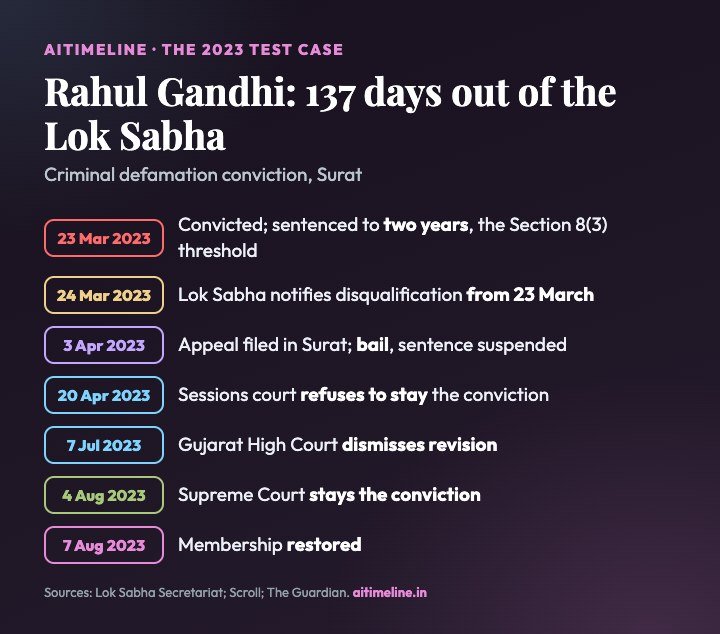
Rahul Gandhi’s case is the clearest public demonstration of how the law works after 2013. On 23 March 2023 a Surat magistrate convicted him of criminal defamation over a 2019 campaign remark and imposed two years, the maximum for the offence and exactly the Section 8(3) threshold. The next day the Lok Sabha Secretariat notified that he stood disqualified from 23 March. His sentence was suspended and he was on bail, but the sessions court and then the Gujarat High Court refused to stay the conviction, so the disqualification held.
On 4 August a Supreme Court bench of Justices B.R. Gavai, P.S. Narasimha and Sanjay Kumar stayed the conviction, observing that the trial judge had given no reason for the maximum sentence and that a day less would not have disqualified him. Three days later he was back in the House. The stay did not decide his guilt; his appeal remained pending in Surat. Our Rahul Gandhi defamation case timeline follows that case in detail.
Why the Two-Year Sentence Matters
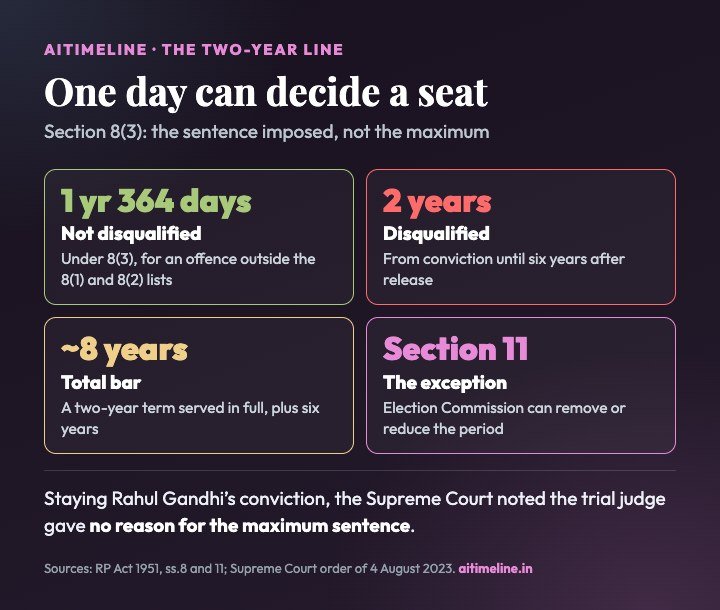
Section 8(3) looks at the sentence the trial court actually imposes, not the maximum the law allows. A legislator convicted of a serious offence but sentenced to eighteen months is not disqualified under 8(3); one sentenced to exactly two years is. That gives trial judges a decisive role, which is why the Supreme Court in 2023 dwelt on the absence of reasons for the maximum term. Once triggered, the bar lasts from conviction until six years after release, so a two-year sentence served in full keeps a person out of elected office for around eight years.
There is one administrative exit. Section 11 lets the Election Commission remove a disqualification or reduce its period, recording reasons. It used the power in 2019 to shorten the bar on Sikkim Chief Minister Prem Singh Tamang, who then won a by-election.
What the Lily Thomas Judgment Did Not Do
- It did not disqualify people facing charges. An FIR, chargesheet or framed charges have no effect under Section 8. In Public Interest Foundation (2018), a Constitution Bench refused to create such a disqualification and left it to Parliament.
- It did not make every conviction disqualifying. The offence and sentence must fit Section 8(1), (2) or (3).
- It did not remove the right of appeal. It removed the automatic protection that came with appealing.
- It did not reach back. Members convicted before 10 July 2013 with appeals already pending kept their seats.
- It did not impose a lifetime ban. Disqualification still ends six years after release, a period Ashwini Upadhyay’s pending petition seeks to make permanent.
- It did not decide the equality argument. The court left the Article 14 challenge open because it struck the provision down on other grounds.
Key Related Cases
| Case | Date | What it decided |
|---|---|---|
| B.R. Kapur v. State of Tamil Nadu | 21 Sep 2001 | A disqualified convict cannot be appointed chief minister |
| K. Prabhakaran v. P. Jayarajan | 11 Jan 2005 | Explained why Parliament had treated sitting members differently |
| Lily Thomas v. Union of India | 10 Jul 2013 | Section 8(4) struck down |
| CEC v. Jan Chaukidar | 10 Jul 2013 | People in custody cannot contest; reversed by Parliament |
| Public Interest Foundation v. Union of India | 25 Sep 2018 | Framed charges do not disqualify; disclosure required |
| Lok Prahari v. Election Commission | 26 Sep 2018 | A stay of conviction lifts the disqualification |
| Saritha S. Nair v. Hibi Eden | 9 Dec 2020 | A suspended sentence does not |
| Rahul Gandhi v. Purnesh Modi | 4 Aug 2023 | Conviction stayed; Lok Sabha seat restored |
Facts at a Glance
| Question | Answer |
|---|---|
| Who filed the case? | Lily Thomas; Lok Prahari through S.N. Shukla |
| Judgment date | 10 July 2013 |
| Provision struck down | Section 8(4), RP Act 1951 |
| Review dismissed | September 2013 |
| Ordinance withdrawn | 2 October 2013 |
| First MP disqualified | Rasheed Masood, 1 October 2013 |
| Does an appeal stop disqualification? | No |
| Does a stay of conviction? | Yes, from the date of the stay |
| Most prominent test | Rahul Gandhi, March to August 2023 |
Explore More Timelines
People Also Ask
Frequently Asked Questions
Based on the judgments and reporting to 15 November 2026.
⚠️ Editorial Note
This page explains the law as it stood on 15 November 2026. It is not legal advice. A conviction, a sentence, a suspension of sentence, a stay of conviction and an acquittal are distinct legal steps, and nothing here suggests that a person facing criminal charges is disqualified. We read the Lily Thomas judgment itself and quote it directly. Checking the record, we corrected the brief we worked from in four places: the protection for sitting members was not introduced in 1989, when it was only renumbered as Section 8(4); Section 8(3) turns on the sentence actually imposed, not on an offence “carrying” two years; the Gujarat High Court order of 7 July 2023 dismissed a criminal revision, not an appeal; and the brief omitted the 2013 review, ordinance and first disqualifications. We added the cases since 2023, including Mohammed Faizal, Abbas Ansari, Antony Raju and Vinay Kulkarni, and the Centre’s 2025 affidavit on a lifetime ban. We have not tracked later appellate orders in every individual case listed.
Related Reading on AiTimeline
Sources & further reading
Every dated entry above was checked against these references. Last reviewed 15 November 2026.
- Supreme Court of India: Lily Thomas v. Union of India, judgment of 10 July 2013 (text)
- Bar & Bench: Supreme Court strikes down Section 8(4) of the Representation of the People Act
- Supreme Court of India: Lok Prahari v. Election Commission of India, judgment of 26 September 2018
- Supreme Court of India: Saritha S. Nair v. Hibi Eden, judgment of 9 December 2020
- LiveLaw: Supreme Court rejects review petition on convicted MPs and MLAs
- Business Standard (IANS): Cabinet unanimously withdraws ordinance and bill, 2 October 2013
- LiveLaw: Rasheed Masood becomes the first MP to be disqualified
- Scroll: Gujarat High Court refuses to stay Rahul Gandhi's conviction, 7 July 2023
- The Guardian: Rahul Gandhi wins Supreme Court appeal against defamation conviction, 4 August 2023
- The Week: Lok Sabha Secretariat revokes disqualification of Lakshadweep MP, 29 March 2023
- Bar & Bench: Centre opposes plea in Supreme Court for life ban on convicts from contesting polls
- The News Minute: Antony Raju disqualified as MLA after conviction in evidence tampering case
- The News Minute: Karnataka Assembly disqualifies Vinay Kulkarni after murder conviction
- The Tribune (PTI): Abbas Ansari disqualified from UP Assembly, 1 June 2025