Golaknath Case 1967: Parliament’s Power to Amend the Constitution
Explore the 1967 Golaknath case, its 6-5 Supreme Court verdict, the 24th Amendment and how Kesavananda Bharati established the Basic Structure doctrine.
Latest Story
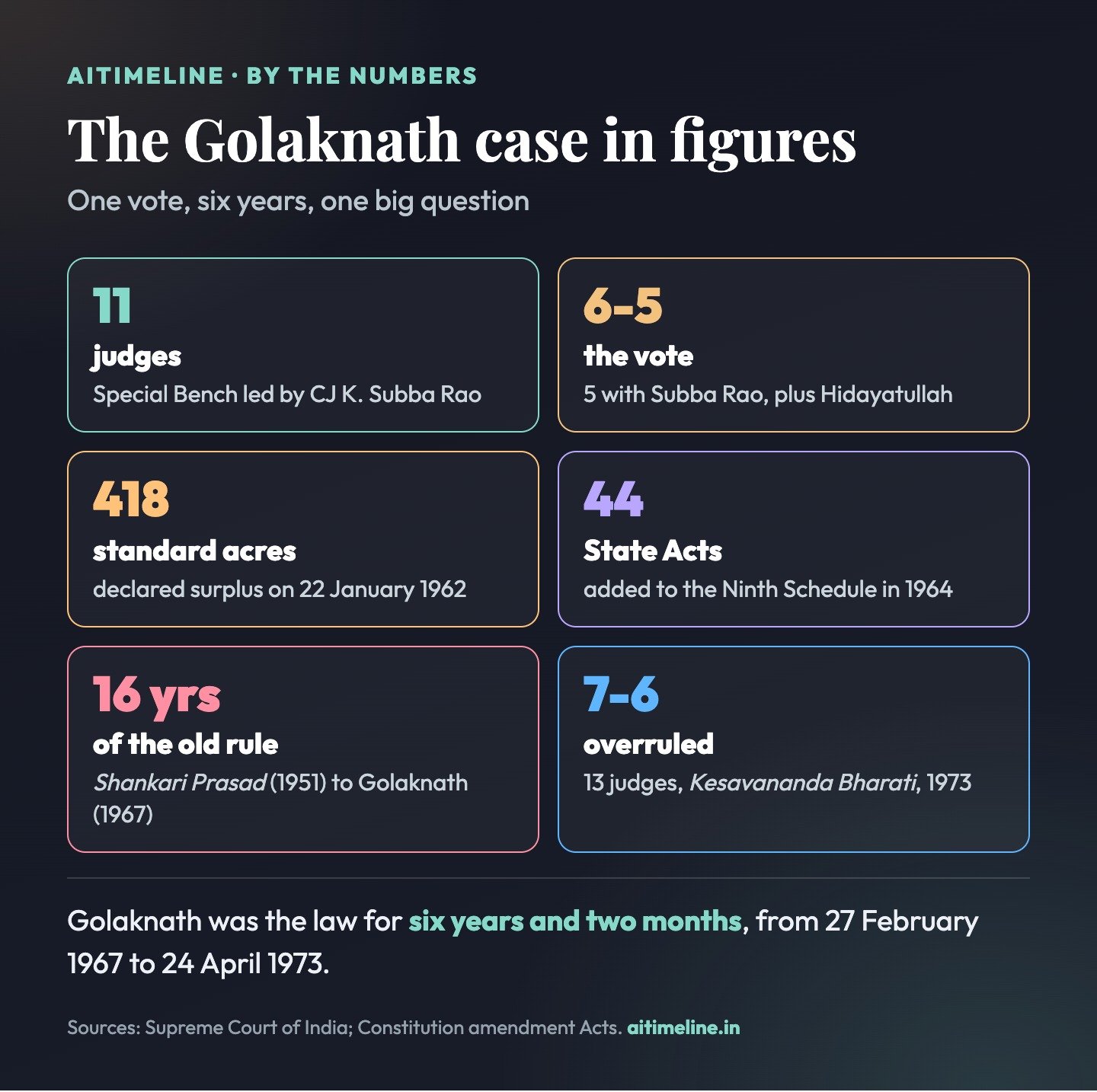
Can Parliament amend the Constitution to take away a Fundamental Right? For 16 years the Supreme Court said yes. Then, on 27 February 1967, in I.C. Golaknath v. State of Punjab, an 11-judge Bench said no, by a single vote. The Golaknath case began as a Punjab family’s fight over 418 standard acres of surplus land and ended as the first ruling that Parliament’s amending power had limits. It held that a constitutional amendment is ‘law’ under Article 13(2) and so cannot abridge Part III, yet used prospective overruling to leave every earlier amendment standing. Parliament reversed it with the Twenty-fourth Amendment in 1971, and in 1973 Kesavananda Bharati replaced it with the basic structure doctrine. This timeline follows that argument from the drafting of Articles 13 and 368 to today, checked against the judgments and the amendment Acts.
The petitioners lost. The petitions were dismissed and the Punjab and Mysore land laws stayed in force. Prospective overruling was the view of five judges, led by Chief Justice Subba Rao; Justice Hidayatullah, the sixth vote, reached the same result through long acquiescence and Article 31A. The Twenty-fourth Amendment Bill was introduced on 28 July 1971, not 22 July. The Twenty-fifth Amendment received assent on 20 April 1972, five and a half months after the Twenty-fourth, not on the same day. Golaknath did not create the basic structure doctrine; its majority expressly left that question open.
💡 Short Answer
In I.C. Golaknath v. State of Punjab (27 February 1967), the Supreme Court held 6-5 that Parliament cannot use its amending power under Article 368 to take away or abridge Fundamental Rights, because an amendment is ‘law’ under Article 13(2). Applying prospective overruling, it left earlier amendments valid and dismissed the petitions. Parliament reversed the ruling with the Twenty-fourth Amendment (1971). In Kesavananda Bharati (1973) a 13-judge Bench overruled Golaknath: Parliament may amend Fundamental Rights, but not the Constitution’s basic structure. That remains the law as of November 2026.
The Golaknath Case: Key Questions
The Golaknath Case in Ten Lines
- The silence: Articles 13(2) and 368 never said whether an amendment counts as ‘law’.
- Round one: Shankari Prasad (1951) said it does not, so Fundamental Rights could be amended.
- Round two: Sajjan Singh (1964) agreed, but two judges voiced doubts.
- The dispute: a Punjab family lost 418 standard acres as surplus under a 1953 land law.
- The shield: the Seventeenth Amendment (1964) had put that law in the Ninth Schedule.
- The verdict: on 27 February 1967, 6-5, amendments became ‘law’ that could not abridge rights.
- The twist: prospective overruling kept every earlier amendment, and the family lost.
- The reply: the Twenty-fourth Amendment (1971) restored Parliament’s power in so many words.
- The settlement: Kesavananda Bharati (1973) overruled Golaknath but created the basic structure limit.
- Today: Parliament can amend rights, but not the Constitution’s essential features.
The Case: A Punjab Family, a Land Law and the Ninth Schedule
How a surplus-land order became a question about the Constitution itself.
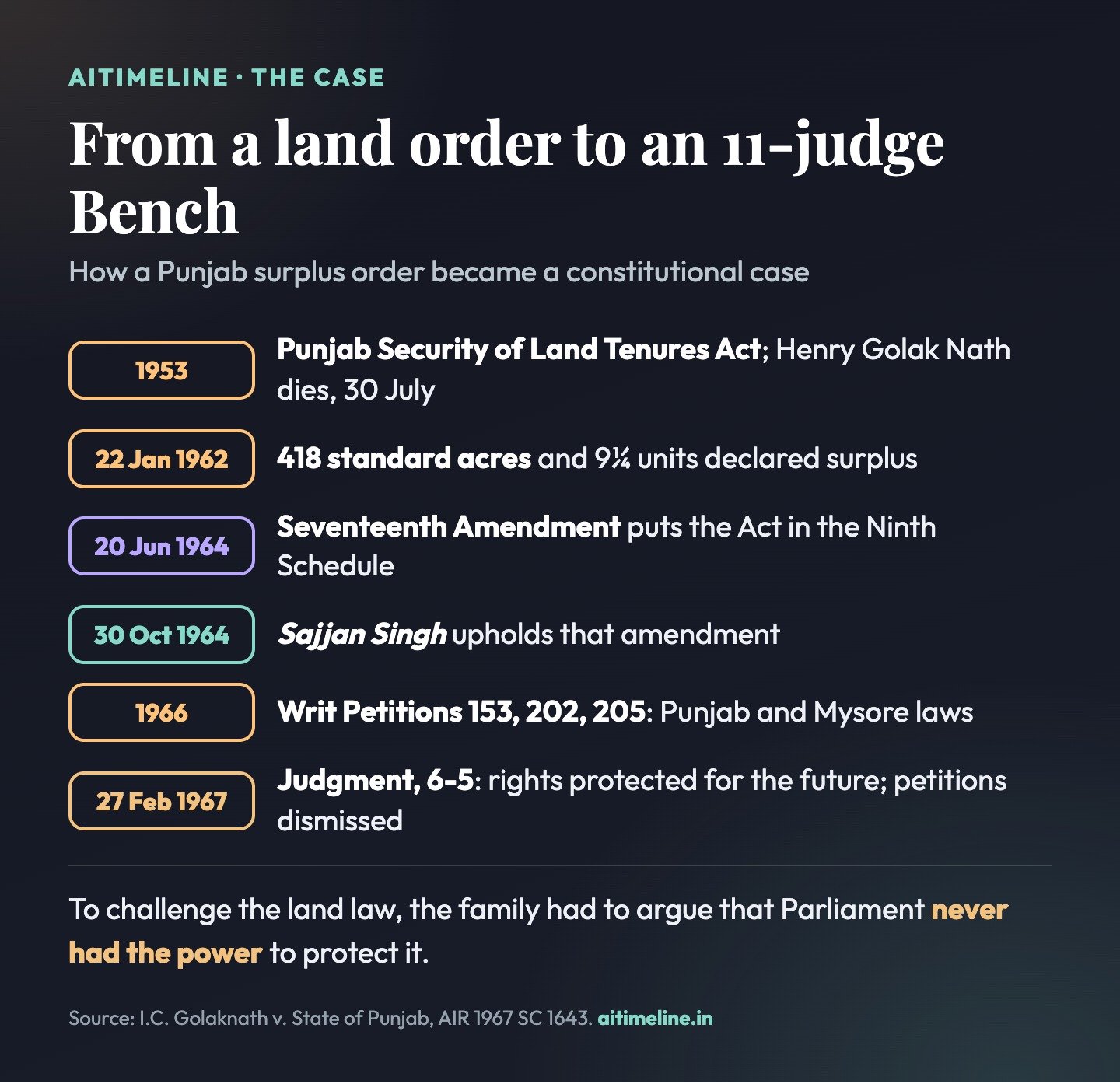
The Golak Nath family held more than 500 acres of farmland in the Jullundur area of Punjab. The Punjab Security of Land Tenures Act, 1953 capped the land an owner could keep for personal cultivation and let the State declare the rest surplus for resettling tenants. Henry Golak Nath died on 30 July 1953. On 22 January 1962, in revision proceedings, the Financial Commissioner held that 418 standard acres and 9¼ units in the hands of his son, daughter and granddaughters were surplus.
An ordinary challenge would have argued that the Act violated the rights to equality, property and occupation under Articles 14, 19(1)(f) and 19(1)(g). But in 1964 the Seventeenth Amendment had added the Punjab Act, along with 43 other State land laws, to the Ninth Schedule, which made it immune to such challenges. The only way through was to argue that Parliament never had the power to make the Seventeenth Amendment. That meant asking the Court to overrule Shankari Prasad and Sajjan Singh, both of which said Parliament could amend Fundamental Rights.
The family filed Writ Petition 153 of 1966 under Article 32. Two further petitions challenged the Mysore Land Reforms Act, 1962. The Court constituted a Special Bench of 11 judges, heard the State governments and more than 20 interveners, and delivered judgment on 27 February 1967.
What the Golaknath Judgment Actually Decided
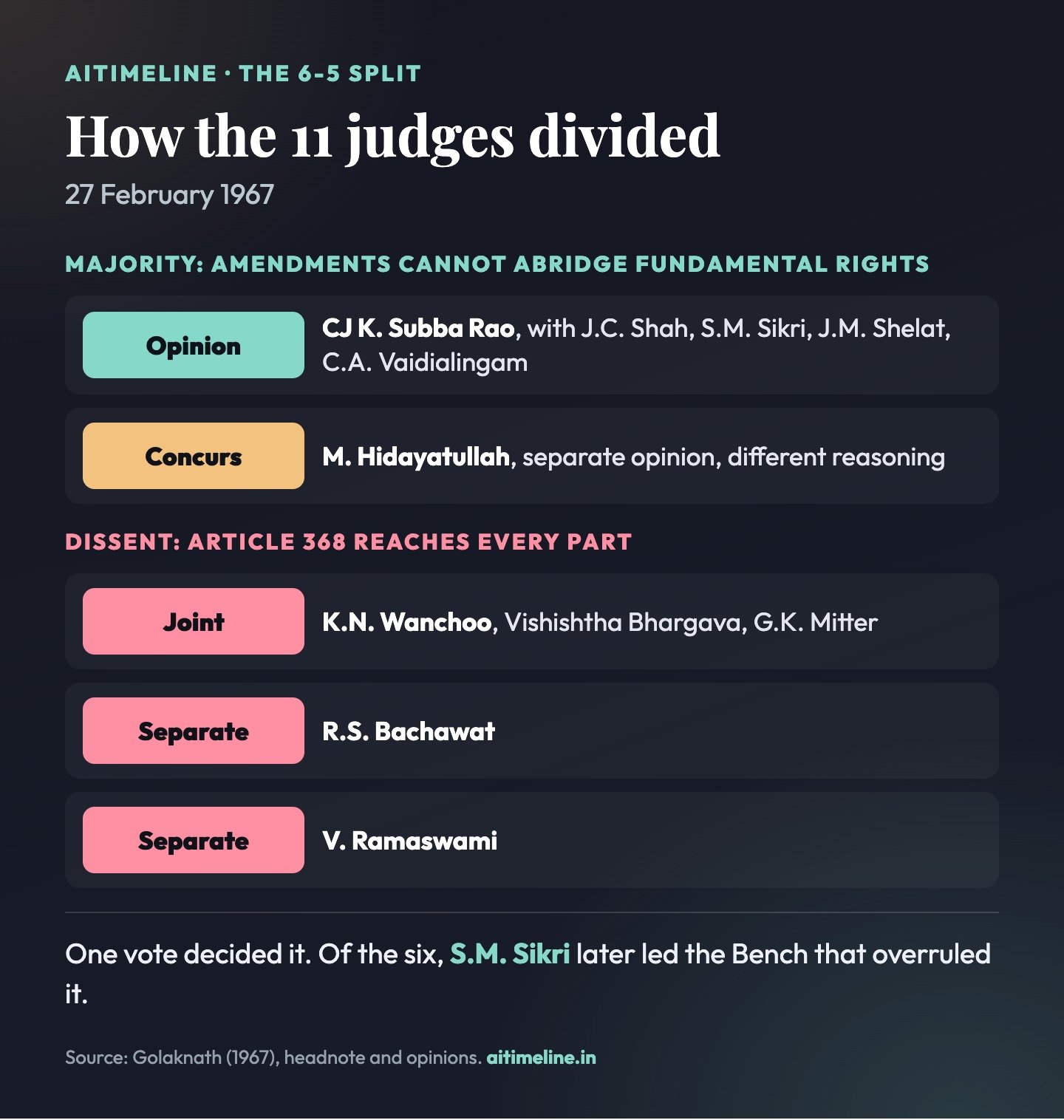
Six votes for the restriction, five against, and two different routes within the six.
| Constitutional question | Golaknath ruling |
|---|---|
| Can Parliament amend Fundamental Rights? | Not so as to take away or abridge them |
| Is an amendment ‘law’ under Article 13(2)? | Yes (all six in the majority) |
| Does Article 368 give the power or only the procedure? | Only the procedure (Subba Rao’s five); Hidayatullah held the power sui generis |
| Were Shankari Prasad and Sajjan Singh right? | No; overruled on whether an amendment is ‘law’ |
| Were earlier amendments invalidated? | No; prospective overruling (five) or long acquiescence (Hidayatullah) |
| Were the Punjab and Mysore laws struck down? | No; the petitions were dismissed |
| Can the basic structure be changed? | Left open expressly; the majority found it unnecessary to decide |
Chief Justice Subba Rao described Fundamental Rights as ‘primordial rights necessary for the development of human personality’, given ‘a transcendental position’ and kept beyond the reach of Parliament. He read the heading of Article 368, ‘Procedure for amendment of the Constitution’, literally: the Article set out how to amend, not the power to do so, which he traced to Parliament’s residuary legislative power. An amendment was therefore a law like any other, and Article 13(2) applied to it. In an obiter remark, his opinion suggested that if Fundamental Rights ever had to be abridged, Parliament could use its residuary power to convene a constituent assembly.
Justice Hidayatullah got to the same holding by a different path. He rejected the idea that Article 368 was a self-contained code, held that ‘the State’ in Article 13(2) bound Parliament even when amending, and warned that the protection of Fundamental Rights was needed ‘so that we may not walk in fear of democracy itself’. The five dissenters held that Article 368 carried both power and procedure, and that an amendment is a constituent act, not ‘law’.
Prospective Overruling: How the Court Changed the Rule Without Undoing the Past
A device from American case law, used in India for the first time.
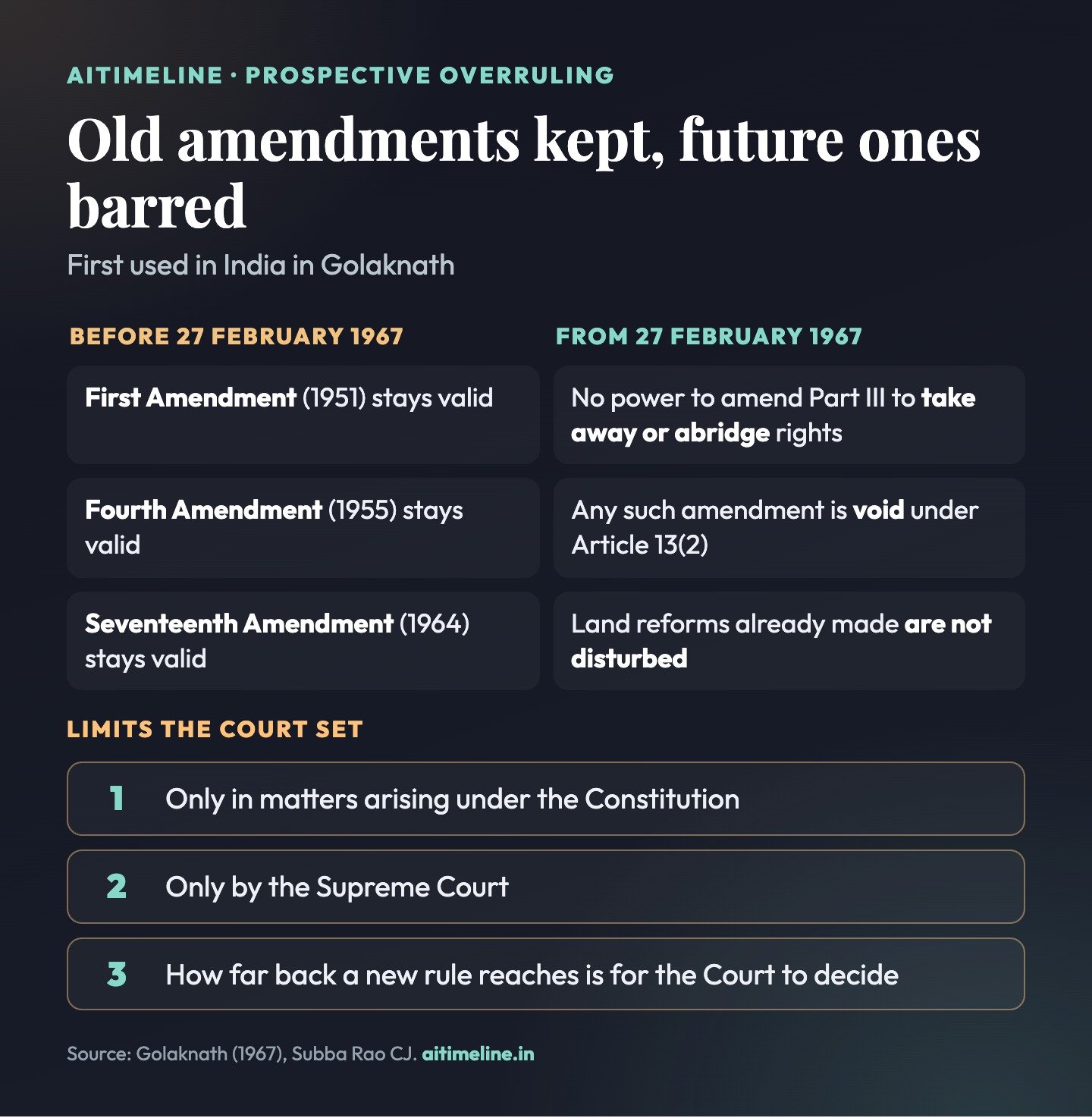
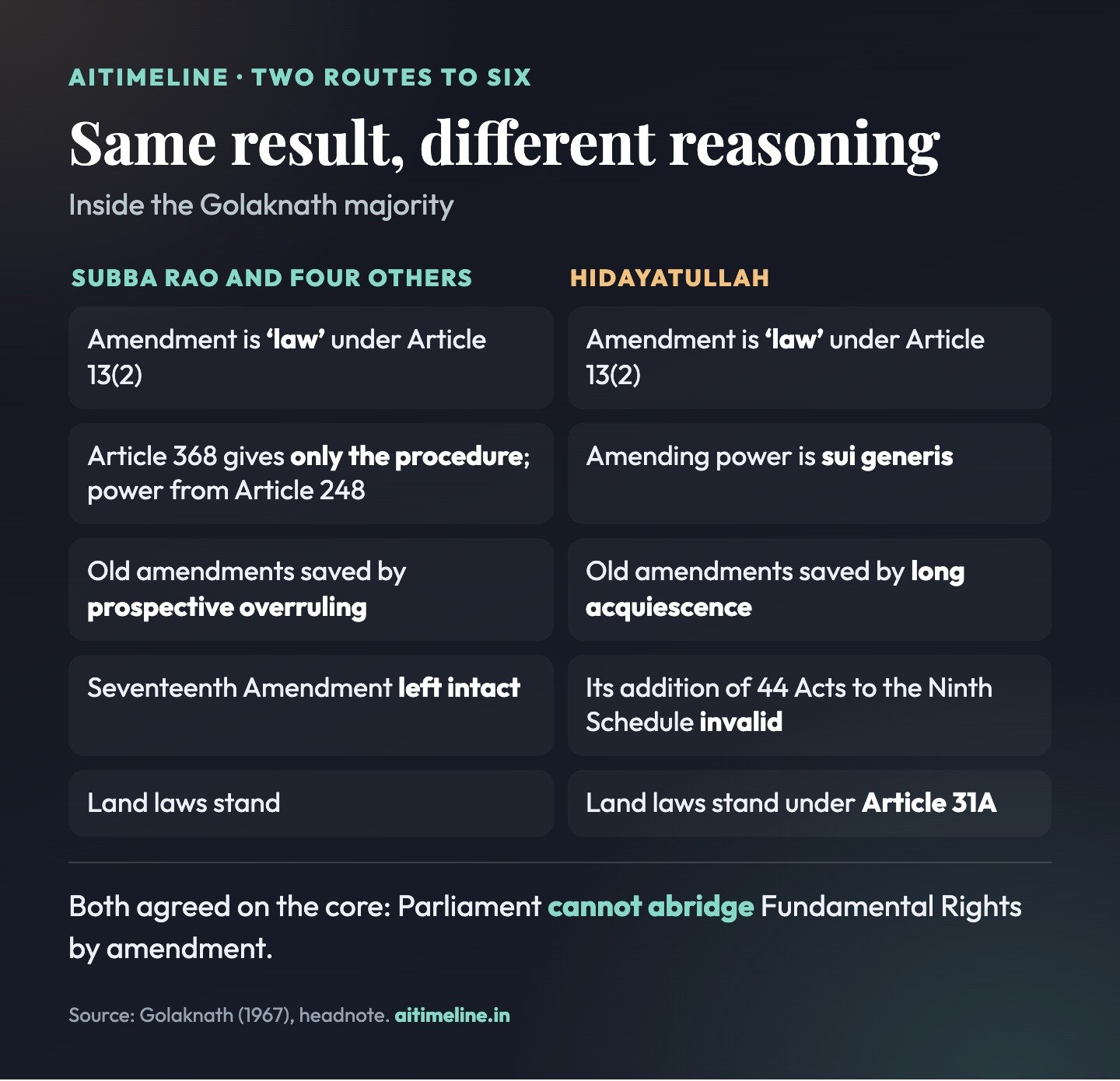
Subba Rao’s opinion accepted that the First, Fourth and Seventeenth Amendments had abridged Fundamental Rights. Striking them down would have unravelled 16 years of zamindari abolition and land reform. Citing the ‘chaotic situation that may be brought about by the sudden withdrawal at this stage of the amendments’, he applied the doctrine of prospective overruling, which he drew from decisions such as Great Northern Railway v. Sunburst Oil (1932). The Court declared that its decision would not affect the validity of the Seventeenth Amendment or other amendments already made, and that ‘in future Parliament will have no power to amend Part III’ so as to take away or abridge Fundamental Rights.
Two limits were attached: the doctrine could be used only in constitutional matters, and only by the Supreme Court. The dissenters rejected it altogether, holding to the traditional view that a court declares what the law has always been. Hidayatullah did not adopt it either; he held the old amendments safe because they had been accepted for so long. Kesavananda later made the point moot by overruling Golaknath, but the Supreme Court has used prospective overruling in other cases since.
Golaknath Case Timeline, 1949 to 2026
Newest first. Each entry is tagged by type.
Where the law stands now Basic structure era
The rule today: Parliament can amend any part of the Constitution under Article 368, Fundamental Rights included. An amendment is not ‘law’ under Article 13, so it is not void merely because it takes away or abridges a right. But it cannot damage or destroy the basic structure of the Constitution, and courts decide what that structure contains.
What survives of Golaknath: Its central holding does not. Its concerns do: that Fundamental Rights need protection from the ordinary politics of a two-thirds majority, and that a court can change a constitutional rule without unsettling the past. Prospective overruling, first used in India in this case, is still part of the Supreme Court’s toolkit.
NJAC ruling: an amendment ratified by the States still falls Basic structure era
What happened: The Court struck down the Constitution (Ninety-ninth Amendment) Act, 2014 and the National Judicial Appointments Commission Act, 2014, holding that the new commission undermined the independence of the judiciary, a basic feature.
Why it matters here: It shows how far the argument has moved since 1967. Golaknath asked whether a right in Part III could be touched at all. The NJAC case did not involve Part III; it tested an amendment to the judges’ appointment process against an unwritten structural principle.
I.R. Coelho: no blanket shield for the Ninth Schedule Basic structure era
What happened: The Court held that laws added to the Ninth Schedule on or after 24 April 1973 can be tested against Fundamental Rights, and struck down if their effect damages the basic structure.
The Golaknath link: The Ninth Schedule, created in 1951 and enlarged in 1964, was the device at the centre of the Golaknath dispute. Coelho settled what protection it still gives: full for laws added before Kesavananda, conditional after.
Minerva Mills: limited amending power is itself basic Supreme Court
What fell: Section 55 of the Forty-second Amendment, which had added clauses (4) and (5) to Article 368 to bar courts from questioning amendments and to declare Parliament’s amending power unlimited.
Why it matters: Parliament’s last attempt to restore the pre-1967 position, with no limits at all, failed. The Court held that a limited amending power and judicial review are themselves part of the basic structure.
Forty-second Amendment tries to end the argument Amendment
What it did: Among many other changes, it inserted clause (4) into Article 368, saying no amendment ‘shall be called in question in any court on any ground’, and clause (5), declaring that there is ‘no limitation whatever’ on Parliament’s constituent power.
Why it mattered: It was a direct answer to both Golaknath and Kesavananda. Had it survived, the question of limits on the amending power would have been closed by the amending power itself.
Kesavananda Bharati overrules Golaknath Supreme Court
What happened: The largest Bench in the Court’s history held that Parliament can amend any provision of the Constitution, including Fundamental Rights, but cannot alter its basic structure. It upheld the Twenty-fourth Amendment and so overruled Golaknath’s holding that an amendment is ‘law’ under Article 13(2).
Why it matters: The Court rejected both extremes: Golaknath’s absolute bar on touching Part III and the government’s claim of unlimited power. It also upheld the Twenty-ninth Amendment and struck down the part of Article 31C that barred courts from asking whether a law actually gave effect to the Directive Principles.
Twenty-ninth Amendment protects Kerala’s land laws Amendment
What it did: It placed the Kerala Land Reforms (Amendment) Acts of 1969 and 1971 in the Ninth Schedule, shielding them from challenge on the ground that they violated Fundamental Rights.
Why it mattered: It used exactly the device Golaknath had restricted. With the Twenty-fourth Amendment in place, the government could argue that Golaknath no longer stood in the way, and Kesavananda Bharati’s petition became the vehicle for testing that claim.
Twenty-fifth Amendment adds Article 31C Amendment
What it did: It replaced ‘compensation’ in Article 31(2) with ‘amount’, and inserted Article 31C, protecting laws giving effect to Article 39(b) and (c) from challenge under Articles 14, 19 and 31. A declaration in such a law that it gave effect to those principles could not be questioned in court.
Why it mattered: Together with the Twenty-fourth, it was Parliament’s attempt to put property-related economic policy beyond the reach of the Golaknath approach. Kesavananda later struck down the declaration clause.
Twenty-fourth Amendment reverses Golaknath Amendment
What it did: It added clause (4) to Article 13, saying nothing in that Article applies to an amendment made under Article 368. It retitled Article 368 ‘Power of Parliament to amend the Constitution and procedure therefor’, declared that Parliament may amend any provision ‘by way of addition, variation or repeal’ in exercise of its constituent power, and made the President’s assent to an amendment Bill compulsory.
Why it mattered: It answered each part of Golaknath in turn: the majority view that Article 368 gave only a procedure, that an amendment is ‘law’, and that Part III was beyond reach. It was ratified by more than half the State Legislatures.
Law Minister H.R. Gokhale introduces the Twenty-fourth Amendment Bill Amendment
What happened: Months after winning a two-thirds majority in the March 1971 general election, the government introduced the Bill to restore Parliament’s power to amend Fundamental Rights. The Twenty-fifth Amendment Bill was introduced the same day.
The background: By 1971 the Court had also struck down bank nationalisation (R.C. Cooper, 1970) and the derecognition of the princes (Madhav Rao Scindia, 1970). Golaknath was now part of a wider conflict between the government and the Court over property and economic reform.
Kesavananda Bharati files the petition that will reopen Golaknath The Golaknath case
What happened: The head of the Edneer Mutt challenged Kerala’s land reform legislation under Article 32. As Parliament passed the Twenty-fourth, Twenty-fifth and Twenty-ninth Amendments, the petition grew into a challenge to all three.
Why a 13-judge Bench: Testing those amendments meant reconsidering Golaknath, an 11-judge ruling. Only a larger Bench could overrule it, so the Court assembled 13 judges.
Chief Justice Subba Rao resigns to run for President The Golaknath case
What happened: Koka Subba Rao, who had led the majority, left office on 11 April 1967 to contest the presidential election as the opposition parties’ consensus candidate. On 6 May he lost to Zakir Husain, who received 471,244 electoral votes to his 363,971.
Why it mattered: His departure fed the political reading of the judgment. To the government’s supporters, Golaknath looked less like legal interpretation and more like a stand against Parliament; to its defenders, it was an act of judicial courage. K.N. Wanchoo, who had led the dissent, succeeded him as Chief Justice.
Golaknath decided: Fundamental Rights beyond the amending power The Golaknath case
The majority: Chief Justice Subba Rao, writing for himself and Justices J.C. Shah, S.M. Sikri, J.M. Shelat and C.A. Vaidialingam, held that Parliament cannot amend Part III so as to take away or abridge Fundamental Rights. An amendment is ‘law’ under Article 13(2), so an amendment that abridges a right is void. Justice M. Hidayatullah agreed on both points in a separate opinion, making six.
Where the power comes from: Subba Rao’s five held that Article 368 set out only the procedure for amendment; the power itself came from Parliament’s residuary legislative power under Article 248 and Entry 97 of List I. Hidayatullah disagreed, calling the amending power sui generis.
The result: The petitions were dismissed. The Punjab and Mysore land laws stayed in force, and so did the Seventeenth Amendment that protected them.
Prospective overruling: the past preserved, the future barred Supreme Court
What the Court did: Having found that earlier amendments abridged Fundamental Rights, Subba Rao’s opinion declined to strike them down. It declared that the decision would not affect the validity of the Seventeenth Amendment or other amendments already made, and that ‘in future Parliament will have no power to amend Part III’ so as to take away or abridge Fundamental Rights.
Hidayatullah’s different route: Hidayatullah did not rest on prospective overruling. He held that the First and Fourth Amendments, among others, could not now be challenged because of long acquiescence, and that the two land laws were valid under Article 31A and the President’s assent. He would have held invalid the part of the Seventeenth Amendment that added 44 State Acts to the Ninth Schedule.
Five judges dissent: Article 368 can reach any part Supreme Court
The dissent: Article 368 contains both the power and the procedure to amend every part of the Constitution, including Part III. An amendment is a constituent act, not ‘law’ for the purposes of Article 13(2). Shankari Prasad and Sajjan Singh were correctly decided and should stand.
Why it matters: The dissent became the law four years later, when Parliament wrote its central points into the Twenty-fourth Amendment, and Kesavananda upheld that amendment in 1973.
Three writ petitions reach an 11-judge Special Bench The Golaknath case
Who came to court: Writ Petition 153 was filed by the son, daughter and granddaughters of Henry Golak Nath against the State of Punjab and its Financial Commissioner. The other two challenged the Mysore Land Reforms Act, 1962, as amended in 1965. Because both laws were in the Ninth Schedule, the petitioners had to attack the Seventeenth Amendment, and with it the rulings in Shankari Prasad and Sajjan Singh.
The questions: Whether a constitutional amendment is ‘law’ under Article 13(2); whether Article 368 confers the power to amend or only lays down the procedure; and whether Fundamental Rights can be taken away or abridged at all. The Court formed a Special Bench of 11 judges because only a larger Bench could reconsider the earlier five-judge decisions.
Sajjan Singh upholds the Seventeenth Amendment, with two doubters Supreme Court
The holding: The majority followed Shankari Prasad: Article 368 allows Parliament to amend Fundamental Rights, and an amendment is not ‘law’ under Article 13(2). The Seventeenth Amendment was valid.
The doubts: Justices M. Hidayatullah and J.R. Mudholkar agreed with the result but questioned whether Fundamental Rights could be the plaything of a special majority. Mudholkar asked whether changing a ‘basic feature’ of the Constitution would be an amendment at all, the idea that Kesavananda later took up.
Seventeenth Amendment shields the Punjab and Mysore laws Amendment
What it did: It widened the meaning of ‘estate’ in Article 31A to cover ryotwari and other agricultural land, and added 44 State land laws to the Ninth Schedule, including the Punjab Security of Land Tenures Act, 1953 and the Mysore Land Reforms Act, 1962.
Why it mattered: It is the amendment the Golaknath petitioners attacked. If it was valid, their challenge to the Punjab Act on Fundamental Rights grounds could not succeed. To win, they had to persuade the Court that Parliament had no power to make it.
418 standard acres declared surplus The Golaknath case
What happened: In revision against an order of the Additional Commissioner, Jullundur Division, the Financial Commissioner held that 418 standard acres and 9¼ units in the hands of the Golak Nath family were surplus under the Punjab Security of Land Tenures Act, 1953, read with Section 10-B.
Why it mattered: Surplus land could be used to resettle tenants. The family argued that the Act violated Articles 14, 19(1)(f) and 19(1)(g), which protected equality, property and occupation at the time.
Fourth Amendment widens Article 31A Amendment
What it did: It made the adequacy of compensation for acquired property non-justiciable, extended Article 31A to further categories of law and added more Acts to the Ninth Schedule.
Why it mattered: Each round of land and property litigation drew a constitutional amendment in reply. Hidayatullah’s opinion in Golaknath counted it among the amendments that could no longer be challenged because of long acquiescence.
Punjab Security of Land Tenures Act The Golaknath case
What it did: The Act limited how much land an owner could reserve for personal cultivation, protected tenants from eviction and allowed land above the permissible limit to be declared surplus for resettling tenants.
The family: The Golak Nath family held more than 500 acres of farmland in the Jullundur area. The law left them a fraction for personal cultivation and the rest could be declared surplus, which set the long dispute in motion.
Shankari Prasad: an amendment is not ‘law’ Supreme Court
The holding: The First Amendment was valid. ‘Law’ in Article 13(2) means ordinary legislation, not an amendment made in exercise of constituent power under Article 368. Parliament could therefore amend Fundamental Rights.
Why it matters: This was the interpretation Golaknath overturned 16 years later, and which the Twenty-fourth Amendment then wrote into the text.
First Amendment creates the Ninth Schedule Amendment
What it did: It inserted Article 31A, protecting laws for the acquisition of estates, and Article 31B with the Ninth Schedule, protecting the Acts listed in it from challenge on the ground of inconsistency with Fundamental Rights. It also rewrote Article 19(2) on restrictions on speech.
Why it mattered: The Ninth Schedule began with 13 Acts, mostly zamindari abolition laws. It became the instrument at the heart of Golaknath, Kesavananda and I.R. Coelho.
Constitution in force: Fundamental Rights, Directive Principles and property Constitution-making
What it set up: Part III guaranteed enforceable Fundamental Rights, including the right to acquire, hold and dispose of property under Article 19(1)(f) and protection against deprivation of property without authority of law under Article 31. Part IV listed Directive Principles, including fair distribution of material resources, which courts could not enforce.
The tension: Land reform depended on taking land from large owners; property rights protected those owners. Every amendment and judgment in this timeline is part of the argument over which should prevail.
Articles 13 and 368 adopted Constitution-making
The two provisions: Article 13(2) says the State shall not make any law that takes away or abridges the rights conferred by Part III, and that any law in contravention is void. Article 368, headed ‘Procedure for amendment of the Constitution’, required a Bill passed by a majority of each House’s total membership and two-thirds of members present and voting.
The unanswered question: Neither Article said whether an amendment under Article 368 was a ‘law’ under Article 13(2). For 18 years that silence decided whether Fundamental Rights could be amended.
Parliament Responds: The 1971 Amendments
Each ruling drew an amendment; each amendment drew a ruling.
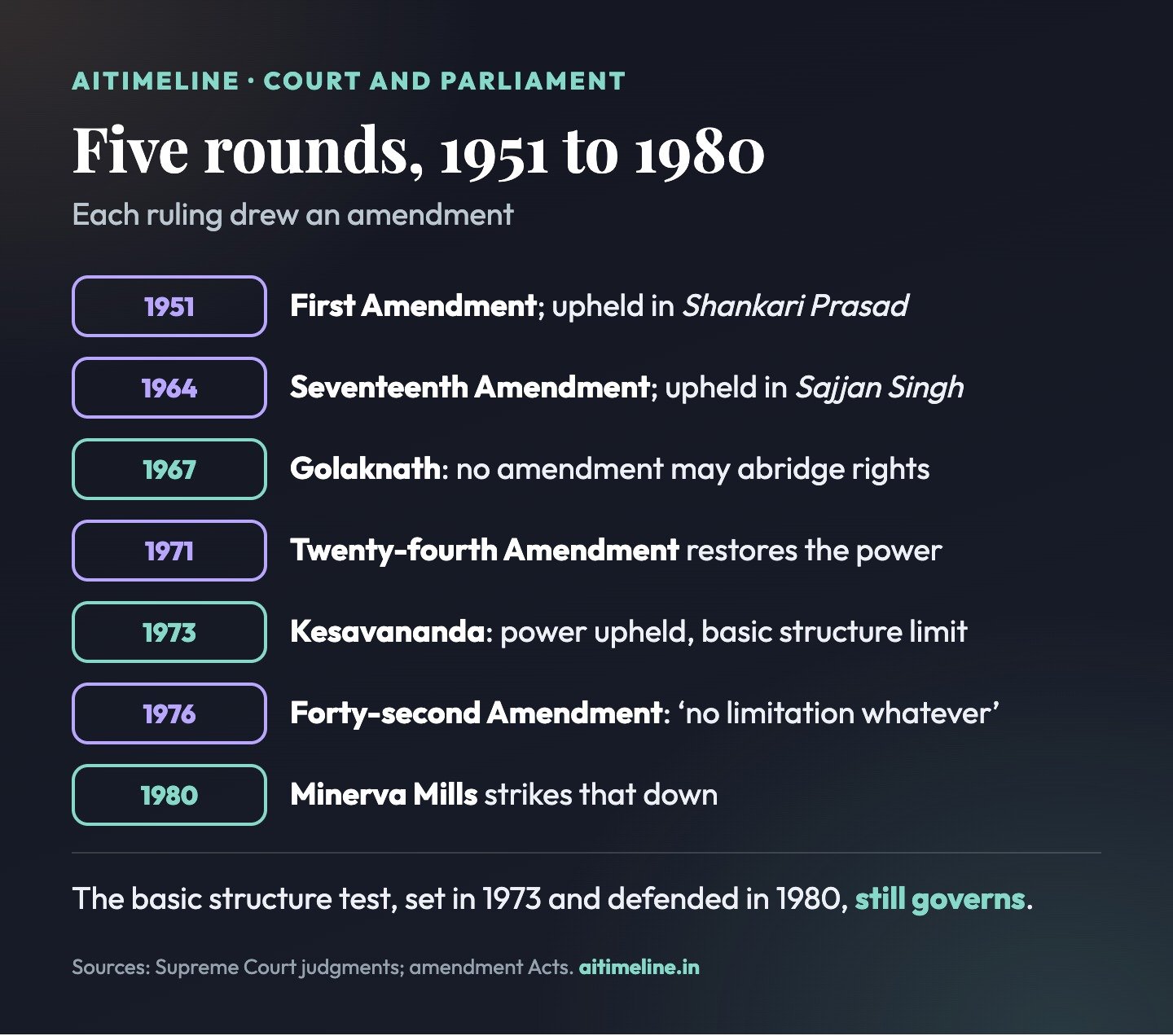
Golaknath did not stop land reform; it stopped Parliament from removing the next obstacle by amendment. That mattered more after 1969, when the Court struck down bank nationalisation in R.C. Cooper and the derecognition of the princes in Madhav Rao Scindia, both in 1970. After winning a two-thirds majority in March 1971, the government moved quickly. Law Minister H.R. Gokhale introduced the Twenty-fourth Amendment Bill on 28 July 1971; its Statement of Objects and Reasons said Golaknath had reversed the earlier rulings ‘by a narrow majority’ and that Parliament had to be able to amend Fundamental Rights.
The Act, which received assent on 5 November 1971, answered each element of the judgment. A new Article 13(4) said nothing in Article 13 applies to an amendment under Article 368. Article 368 was retitled to speak of Parliament’s ‘power’, not just procedure, and its new clause (1) confirmed that Parliament could amend any provision ‘by way of addition, variation or repeal’. The President was required to assent to amendment Bills. The Twenty-fifth Amendment (assent 20 April 1972) added Article 31C, and the Twenty-ninth (9 June 1972) put Kerala’s land laws in the Ninth Schedule. All three came before the 13-judge Bench in Kesavananda Bharati.
Golaknath vs Kesavananda Bharati: What Changed?
From protecting a list of rights to protecting the Constitution’s identity.
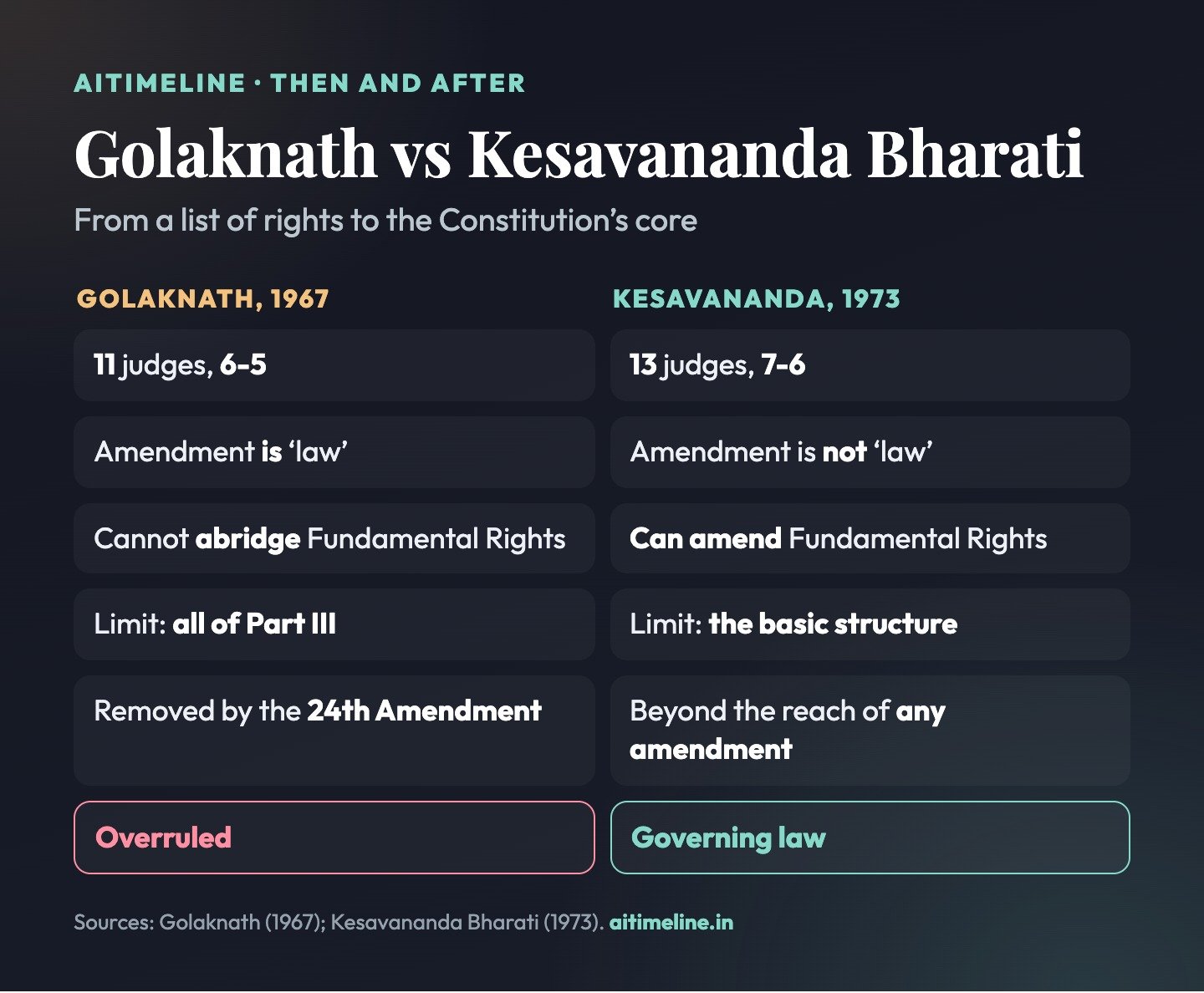
| Issue | Golaknath (1967) | Kesavananda Bharati (1973) |
|---|---|---|
| Bench | 11 judges, CJ K. Subba Rao | 13 judges, CJ S.M. Sikri |
| Majority | 6-5 | 7-6 |
| Is an amendment ‘law’ under Article 13(2)? | Yes | No (24th Amendment upheld) |
| Power over Fundamental Rights | Cannot take away or abridge them | Can amend them |
| The limit | Part III as a whole | The basic structure |
| Earlier amendments | Saved by prospective overruling | 24th and 29th upheld; part of 31C struck down |
| Status in 2026 | Overruled | Governing law |
The two judgments are often presented as opposites, but they share more than it seems. Both held that the amending power has limits that courts enforce. Golaknath located the limit in the text, Article 13(2), and drew it around the whole of Part III; that was simple but rigid, and Parliament removed it with a single amendment. Kesavananda located the limit in the Constitution’s structure, where no amendment could reach it, but left judges to decide case by case what that structure contains. Some Fundamental Rights, such as equality and the core of personal liberty, have since been treated as part of it; the right to property, the subject of Golaknath itself, was removed from Part III in 1978.
Key People and Institutions
| Name | Role |
|---|---|
| Henry Golak Nath | Punjab landowner (died 30 July 1953) whose son, daughter and granddaughters filed Writ Petition 153 of 1966 |
| Chief Justice K. Subba Rao | Led the 11-judge Bench and wrote the majority opinion; resigned on 11 April 1967 to run for President |
| Justice M. Hidayatullah | Sixth majority vote, in a separate opinion; had voiced doubts in Sajjan Singh |
| Justice K.N. Wanchoo | Led the dissent; succeeded Subba Rao as Chief Justice |
| Justice J.R. Mudholkar | In Sajjan Singh (1964), asked whether changing a ‘basic feature’ was amendment at all |
| Justice S.M. Sikri | In the Golaknath majority; as Chief Justice, led the Kesavananda Bench that overruled it |
| H.R. Gokhale | Law Minister who introduced the Twenty-fourth and Twenty-fifth Amendment Bills on 28 July 1971 |
| Nani A. Palkhivala | Lead counsel for the petitioners in Kesavananda Bharati |
| Parliament of India | Passed the First, Fourth, Seventeenth, Twenty-fourth, Twenty-fifth, Twenty-ninth and Forty-second Amendments |
Conclusion: From Golaknath to Basic Structure
Golaknath was a narrow judgment in two senses: it was decided by one vote, and it gave the petitioners nothing. Yet it changed the terms of Indian constitutional law. It was the first time the Supreme Court said that a two-thirds majority in Parliament was not enough to remove a Fundamental Right, and it found a way to say so without undoing the land reforms of the previous 16 years.
Its specific rule lasted six years. Parliament wrote the dissent into the Constitution in 1971, and Kesavananda Bharati accepted that amendment in 1973 while setting a different and more durable limit. The result is neither the unlimited power Parliament claimed nor the absolute protection Golaknath offered, but a system in which the Constitution can change without ceasing to be itself.
Explore More Timelines
People Also Ask
Frequently Asked Questions
Based on the 1967 judgment, the amendment Acts and later Supreme Court rulings.
⚠️ Editorial Note: What We Checked
We checked the brief we started from against the full text of the 1967 judgment and its headnote, the Twenty-fourth Amendment Act and its Statement of Objects and Reasons, and the judgments in Shankari Prasad, Sajjan Singh, Kesavananda Bharati and Minerva Mills. The Twenty-fourth Amendment Bill was introduced on 28 July 1971, not 22 July. The Twenty-fifth Amendment received assent on 20 April 1972, not 5 November 1971. Prospective overruling was applied by Chief Justice Subba Rao’s five-judge opinion; Justice Hidayatullah relied on long acquiescence and Article 31A, and would have held invalid the Seventeenth Amendment’s addition of 44 Acts to the Ninth Schedule. The petitioners were Henry Golak Nath’s son, daughter and granddaughters; he had died in 1953. The precise surplus area in the 1962 order was 418 standard acres and 9¼ units. This article explains constitutional history; it is not legal advice.
Related Reading on AiTimeline
Sources & further reading
Every dated entry above was checked against these references. Last reviewed 20 November 2026.
- Supreme Court of India: I.C. Golaknath v. State of Punjab, judgment of 27 February 1967, AIR 1967 SC 1643, (1967) 2 SCR 762 (Indian Kanoon)
- Supreme Court of India: Sri Sankari Prasad Singh Deo v. Union of India, 5 October 1951, AIR 1951 SC 458 (Indian Kanoon)
- Supreme Court of India: Sajjan Singh v. State of Rajasthan, 30 October 1964, AIR 1965 SC 845 (Indian Kanoon)
- Legislative Department, Government of India: The Constitution (Twenty-fourth Amendment) Act, 1971, with Statement of Objects and Reasons
- Supreme Court of India: Kesavananda Bharati v. State of Kerala, 24 April 1973 (Indian Kanoon)
- Supreme Court of India: Minerva Mills Ltd. v. Union of India, 31 July 1980 (Indian Kanoon)
- PRS Legislative Research: Parliament and the Judiciary, discussion paper
- Legislative Department, Government of India: The Constitution of India (Article 13 and Article 368)