Dandi March History: Why the Salt Satyagraha Succeeded
Explore the 1930 Dandi March timeline, why Gandhi chose salt, how the Salt Satyagraha spread across India and what it won and what it did not.
Latest Story
On 6 April 1930, Mahatma Gandhi bent down on the seashore at Dandi in Gujarat and picked up a handful of salt. Under colonial law the act was an offence. The Dandi March, a walk of about 241 miles from Sabarmati Ashram, became the opening action of the Civil Disobedience Movement. It did not win independence or abolish the salt monopoly. It succeeded in a different way: it turned an abstract demand for freedom into something ordinary people could do, and it brought the Viceroy to the negotiating table.
The campaign did not win immediately. The 1931 Gandhi-Irwin Pact allowed only limited local salt-making and left the monopoly in place. The starting numbers vary by source. The Rajghat chronology says 78 Ashramites and others; PIB says 79 followers. Sources also differ on whether Dandi was reached on the night of 4 April or on 5 April.
💡 Short Answer
The Salt Satyagraha succeeded because salt was a tax every household understood and breaking the salt law was an act anyone could repeat. A walk led by Gandhi from 12 March 1930 became a national campaign of non-violent defiance, drew international attention, and led to the Gandhi-Irwin Pact of 5 March 1931. It did not abolish the salt monopoly or end British rule.
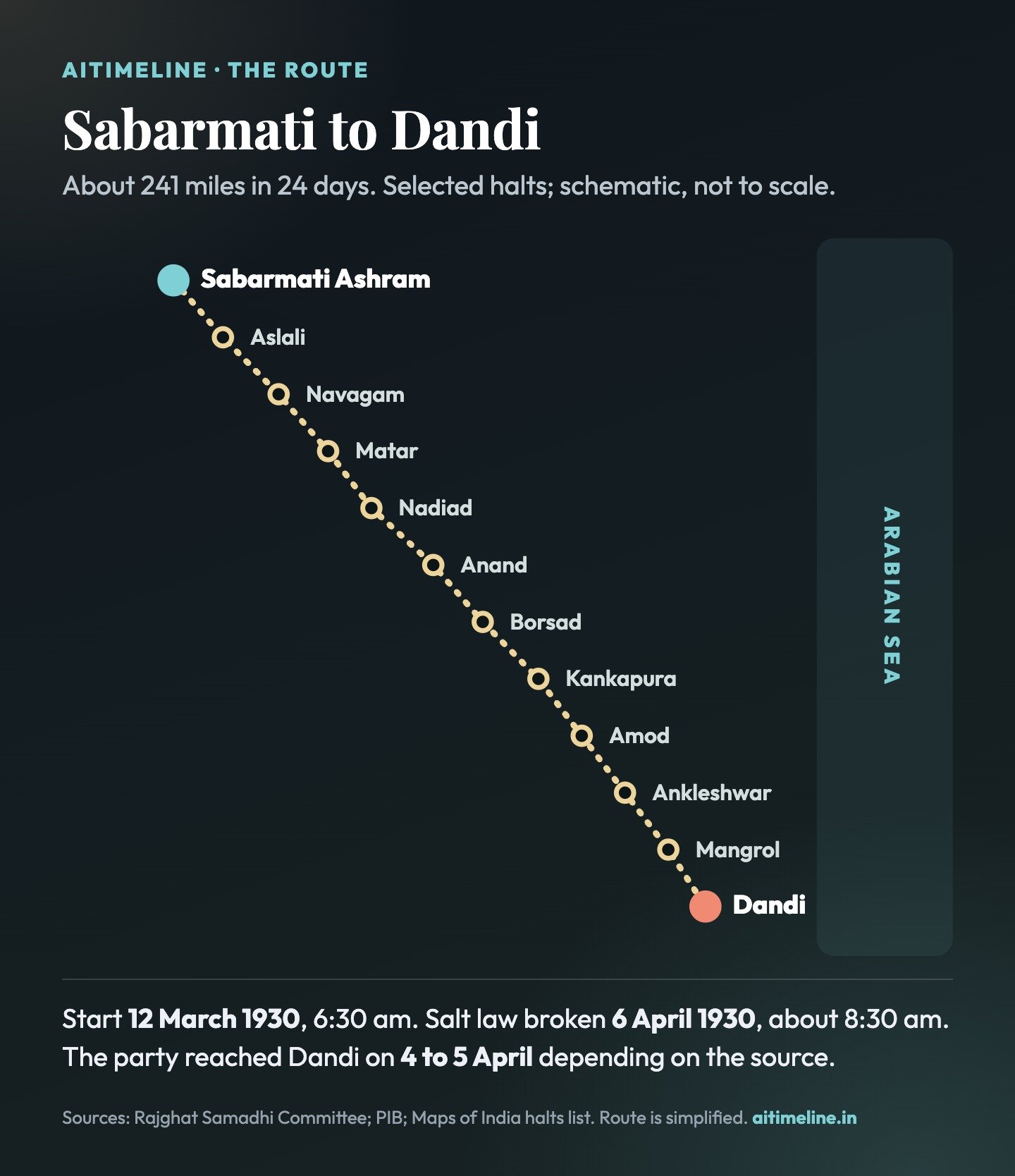
The Route: Sabarmati to Dandi
A schematic of selected halts. It is not a surveyed map and is not to scale.
Dandi March: Key Questions
From a Handful of Salt to a National Movement
- December 1929: Congress declared complete independence its goal at Lahore.
- 2 March 1930: Gandhi wrote to Lord Irwin saying he would break the salt law.
- 12 March: The march left Sabarmati at 6:30 am.
- 6 April: Gandhi picked up natural salt at Dandi at about 8:30 am.
- 5 May: Gandhi was arrested at 12:45 am; others carried on.
- 21 May: The Dharasana raid drew international reporting.
- 5 March 1931: The Gandhi-Irwin Pact suspended the movement.
- January 1932: Civil disobedience resumed and Gandhi was arrested again.
Timeline: The Dandi March and the Salt Satyagraha
Newest first. Labels mark the build-up, the march, defiance, repression and talks.
Civil Disobedience resumes and Gandhi is arrested again Talks
What happened: After the Second Round Table Conference failed to settle India’s constitutional future, Gandhi decided on 31 December 1931 to restart satyagraha. He was arrested in Bombay at 3 am on 4 January 1932 and taken to Yeravda jail.
Why it matters: The 1931 settlement had been a pause, not a peace. The campaign resumed, but under heavier repression and with greater organisational strain than in 1930.
Gandhi attends the Second Round Table Conference Talks
What happened: Gandhi left for London on 29 August 1931 and returned on 28 December. The talks did not produce agreement on India’s constitutional future.
Why it matters: The pact had committed Congress to take part, so the conference showed what the 1931 settlement could and could not deliver.
The Gandhi-Irwin Pact is signed Talks
The terms: The Civil Disobedience Movement would be discontinued. Ordinances issued for it would be withdrawn, and prisoners held for offences not involving violence would be released. Seized property not illegally held would be returned.
Salt: Government said it could not condone breaches of the salt law or make substantial changes to the Salt Acts. It would extend its administrative provisions so residents of villages adjoining salt-collecting areas could collect or make salt for domestic consumption or sale within those villages, not for sale to people outside them.
The limit: Gandhi asked for a public inquiry into police conduct but agreed not to press it. The pact did not end the monopoly or the salt tax.
Gandhi is released from prison Talks
What happened: Gandhi had been held without trial since his arrest on 5 May 1930. He was released unconditionally on 26 January 1931, which opened the way to talks with Lord Irwin.
Repression and raids continue Repression
What happened: Police raided the satyagrahis’ camp at Untadi on 23 May and destroyed it on 25 May. Mass raids on the Wadala salt works near Bombay began on 18 May and recurred on 25 May and 1 June. A Prevention of Intimidation Ordinance was promulgated on 30 May.
The end of this phase: The Gandhi Heritage Portal records a final raid on the Dharasana salt works on 6 June 1930, after which further activity there was suspended.
The Dharasana salt works raid Repression
What happened: Volunteers advanced on the Dharasana salt works and police used force against them. Sarojini Naidu was arrested during the mass raids that day.
Why it mattered: United Press correspondent Webb Miller’s eyewitness dispatch described the violence against the volunteers and circulated internationally, drawing attention to how the colonial authorities were responding to a non-violent campaign.
Abbas Tyabji, then Sarojini Naidu, lead the volunteers Repression
12 May: Several of the original marchers, led by Abbas Tyabji, set out towards Dharasana and were arrested.
15 May: Volunteers under Sarojini Naidu marched on the Dharasana salt works. The campaign continued under new leadership.
Gandhi is arrested at Karadi Repression
What happened: Gandhi was arrested at 12:45 am at Karadi, near Dandi, for violating the salt law. He was imprisoned without trial.
What followed: His arrest did not stop the campaign. Other leaders and volunteers carried on organising demonstrations and salt-law violations.
Gandhi tells Irwin he will go to Dharasana Repression
The letter: Gandhi wrote that he intended to reach Dharasana with his companions and demand possession of the salt works. He had announced the plan in a speech at Chharwada village on 26 April.
The choices he offered: He said the government could stop him by removing the salt tax or by arresting him and his party.
Peshawar demonstrations; Garhwali Rifles refuse to fire Defiance
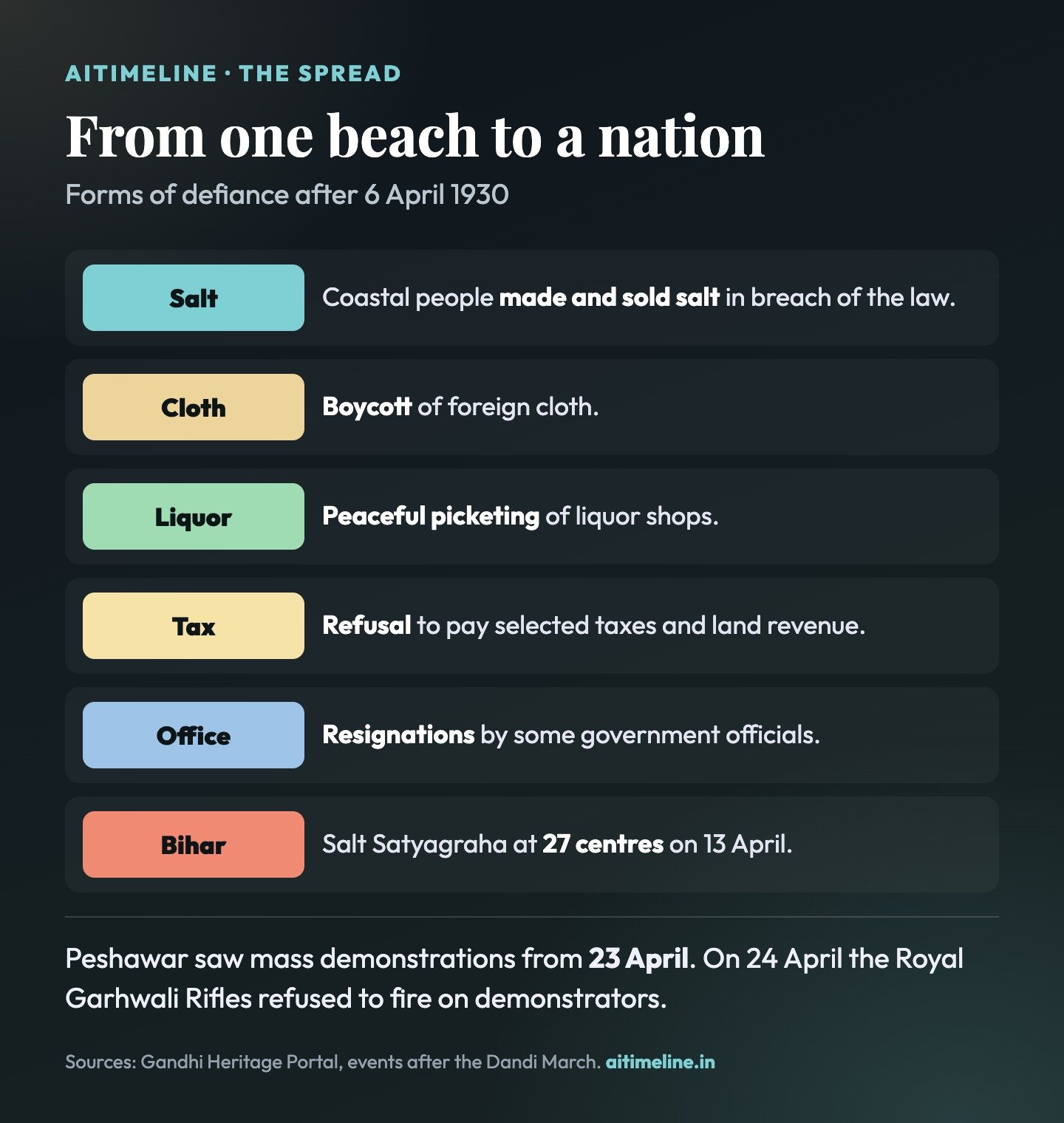
What happened: Mass demonstrations began in Peshawar on 23 April. On 24 April the Royal Garhwali Rifles refused to fire on demonstrators, and the Gandhi Heritage Portal records that police and military were withdrawn on 25 April, leaving the town in the hands of its citizens until 4 May.
Why it matters: It showed the challenge to colonial authority reaching well beyond the salt-producing coast.
Jawaharlal Nehru is arrested Repression
What happened: Jawaharlal Nehru was arrested on 14 April 1930 and sent to Naini Central Prison near Allahabad, with a sentence of six months.
Why it matters: Senior Congress leaders were being jailed as the campaign widened.
Civil disobedience spreads Defiance
Spread: People on the coast began making and selling salt. Gandhi began touring villages by car on 8 April. On 13 April the portal records that Salt Satyagraha started at 27 different centres in Bihar.
Women: At the Gujarati Women’s Conference at Dandi on 13 April, Gandhi told women their time to take a full share in the struggle had come.
Gandhi breaks the salt law at Dandi Defiance
What happened: At 8:30 am Gandhi picked up natural salt from the seashore at Dandi, openly breaking the law that reserved salt manufacture to the government.
The signal: The act was the signal for wider salt-law violations across India. It did not abolish the monopoly. It showed that the law could be defied in public, cheaply and by anyone.
The marchers reach Dandi March
Arrival: Gandhi reached Dandi after about three and a half weeks. PIB records the padyatra entering Dandi on the night of 4 April, with hundreds of satyagrahis gathering on the coast on the morning of 5 April.
Next morning: Sarojini Naidu, Abbas Tyabji and Mithuben Petit joined at Dandi. Gandhi announced that he would break the salt law the following morning.
Villages become political meeting places March
What happened: The march passed through villages and towns in Gujarat. Large crowds gathered to listen to Gandhi, who explained the injustice of the salt law and urged people to prepare for non-violent resistance.
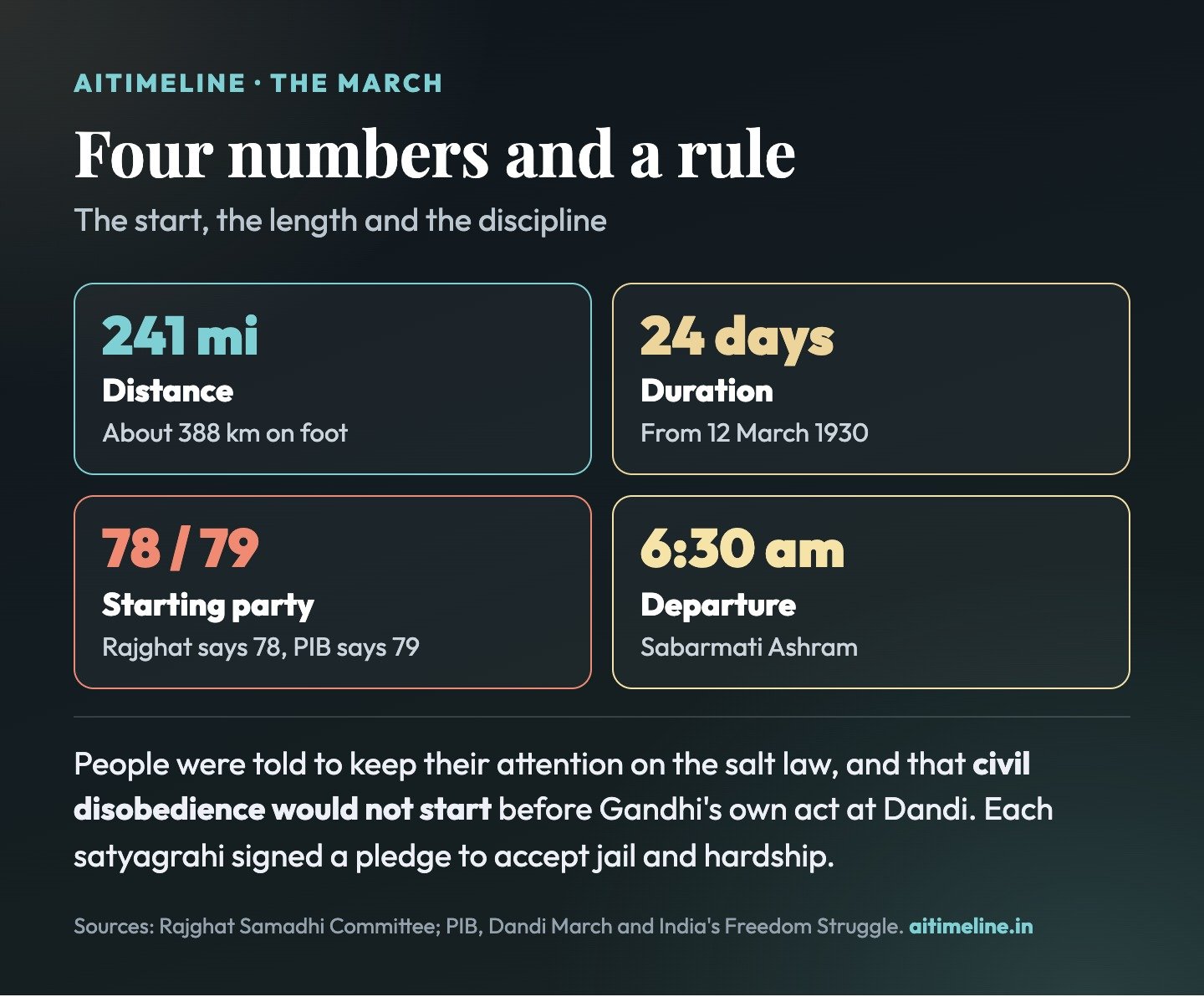
The discipline: PIB records that people were told to keep their attention on the salt law, and that civil disobedience would not begin before Gandhi’s own act at Dandi.
The Dandi March begins March
The start: Gandhi left Sabarmati Ashram at 6:30 am with 78 Ashramites and others, according to the Rajghat chronology, on a walk of about 241 miles to Dandi.
The count: PIB gives 79 followers, which is why the starting party is described as 78 or 79 depending on whether Gandhi is counted.
Vallabhbhai Patel is arrested at Ras Build-up
What happened: Patel was arrested at Ras while preparing support for the campaign, five days before Gandhi set out.
Gandhi announces the march to Dandi Build-up
What happened: After evening prayers at the ashram, Gandhi announced his intention to march to Dandi.
Gandhi writes to Viceroy Lord Irwin Build-up
The letter: Gandhi set out India’s grievances and explained why he would break the salt law. The Gandhi Heritage Portal calls it an ultimatum that was nonetheless addressed ‘Dear Friend’. PIB records that it was carried by Reginald Reynolds, an Englishman living at the ashram.
The reply: The Viceroy’s private secretary replied that the Viceroy regretted Gandhi contemplated a course involving violation of the law and danger to the public peace. Gandhi’s answer was: ‘On bended knees, I asked for bread but received a stone instead.’
Congress authorises civil disobedience Build-up
What happened: The Congress Working Committee met at the ashram and decided to launch civil disobedience. Gandhi was given full powers to start it as and when he thought fit.
Gandhi publishes eleven demands in Young India Build-up
The demands: They ranged across land revenue, military and civil service costs, a protective tariff on foreign cloth, prohibition, the release of political prisoners and the abolition of the salt tax.
Why salt: Of the eleven, the salt tax was the one every household paid.
Independence Day is first observed Build-up
What happened: Congress supporters took the Pledge of Independence across India, following the Lahore session’s call for Purna Swaraj.
From Rowlatt to Lahore: the road to a new campaign Build-up
1919-1922: The Rowlatt Act and the Jallianwala Bagh massacre deepened opposition to British rule. After violence at Chauri Chaura in February 1922, Gandhi suspended the Non-Cooperation Movement.
1927-1929: Congress resolved to boycott the Simon Commission, which had no Indian members. The Calcutta session of December 1928 set a deadline of 31 December 1929 for the British to accept a dominion-status constitution. At Lahore, Congress declared ‘Swaraj’ to mean Complete Independence.
The gap: The movement had a goal but no agreed method. Salt supplied one.
Why Gandhi Chose Salt
An essential commodity, a tax and a ban on making it.
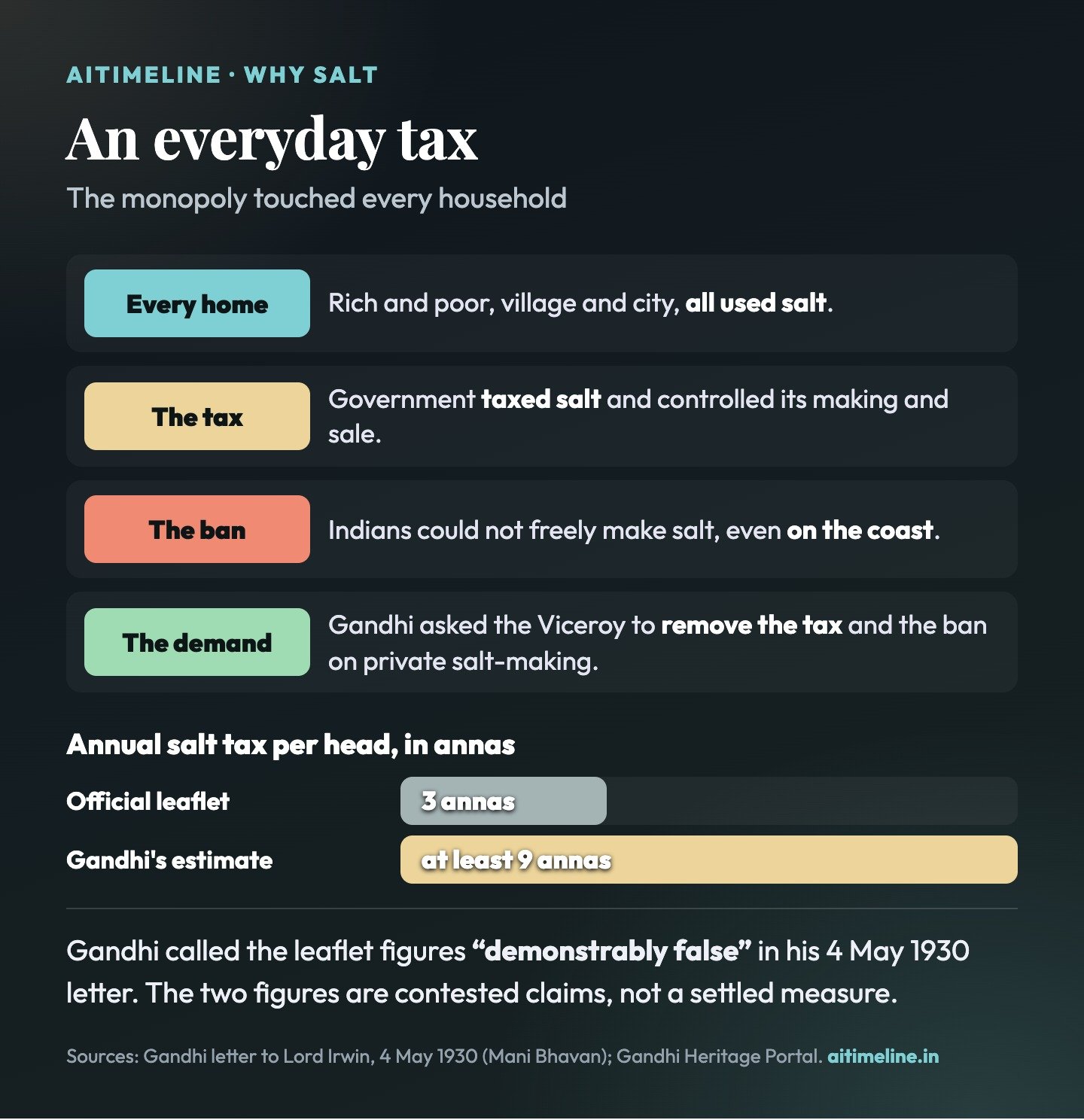
The NCERT account explains that Gandhi chose salt because it could unite different sections of society around one grievance. The advantages were practical: universal relevance, easy participation, visible defiance, and a cause coastal and inland communities could both support. The tax figures are contested. Gandhi disputed the official leaflet’s estimate in his 4 May 1930 letter to the Viceroy, so treat the annas comparison as two claims, not a settled measure.
The March in Numbers
How the Campaign Spread
From one beach to a national movement of many forms of defiance.

Was It an Immediate Victory?
No. Separate what it achieved from what it did not.
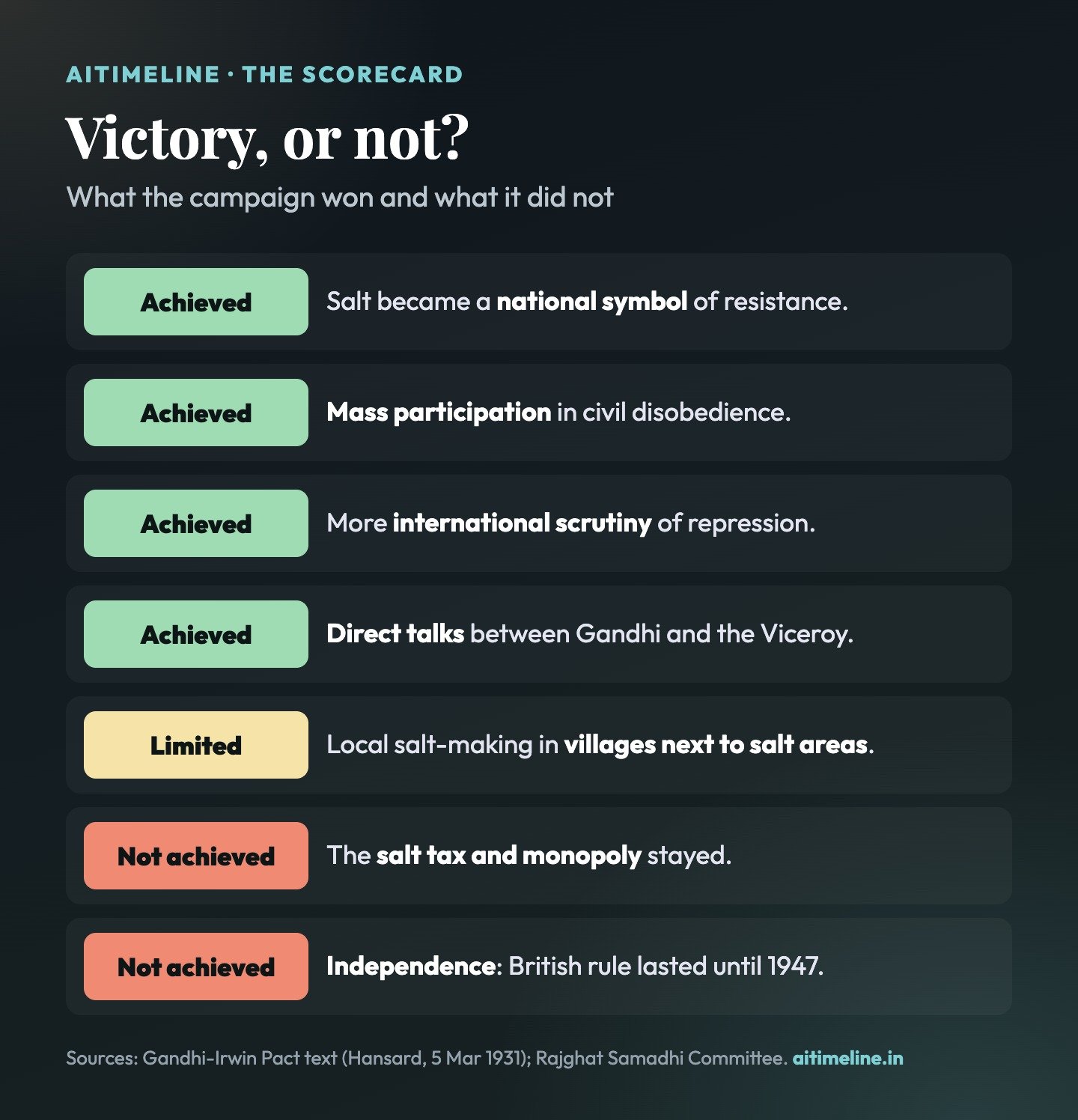
| What it achieved | What it did not achieve |
|---|---|
| Made salt a national symbol of resistance | Did not abolish the salt tax |
| Widened participation in civil disobedience | Did not secure complete independence |
| Raised international scrutiny of repression | Did not end British political control |
| Brought Gandhi into talks with the Viceroy | Did not settle India’s constitutional future |
| Won limited local salt-making in some villages | Did not remove the wider salt monopoly |
The pact text is specific. Government said it could not condone breaches of the salt law or make substantial modifications to the Salt Acts, but would let residents of villages immediately adjoining salt-collecting areas make salt for domestic consumption or sale within those villages, not for sale to people outside them. Research on the political economy of salt notes that the monopoly remained, although some coercive features were relaxed.
Why the Salt Satyagraha Worked
Seven reasons, from the scale of participation to the pressure to negotiate.
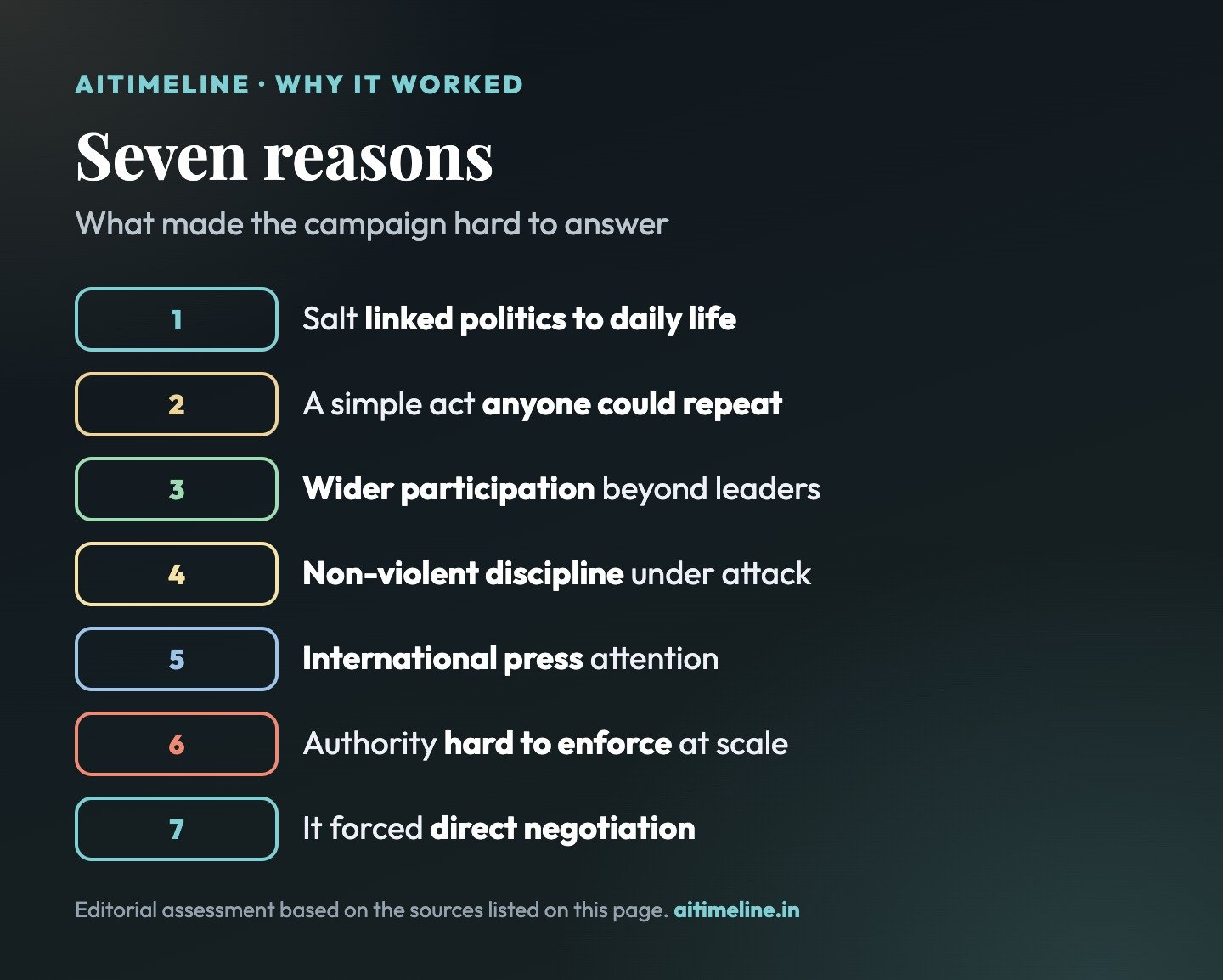
The march itself was led by Gandhi and a small party. The act of making salt was what could be repeated by people in different places. The government could arrest Gandhi and other leaders, but it could not easily stop people across a large country from making salt, boycotting cloth or joining demonstrations. The Dharasana events mattered because eyewitness accounts, including Webb Miller’s, documented the treatment of unarmed volunteers.
The campaign also changed the character of the freedom struggle. It moved the movement towards mass civil disobedience in which people outside established political organisations could take part, made Gandhi an internationally recognised symbol of non-violent resistance, and strengthened Congress’s position by forcing the government to negotiate. It later became a standard example for movements using organised non-violent resistance.
Conclusion: A Small Act With National Consequences
Gandhi did not choose salt because breaking one law would end British rule. He chose it because salt joined economic hardship, colonial control and the demand for freedom in a single, understandable act.
The march did not immediately achieve independence. It widened participation, attracted international attention and forced the government to deal with the Congress leadership. Its lasting importance lies in the way a handful of salt became a symbol of collective resistance.
Explore More Timelines
People Also Ask
Frequently Asked Questions
⚠️ Editorial Note
The Salt Satyagraha was a campaign within the wider Civil Disobedience Movement. Its negotiated gains were limited. The route graphic is schematic and shows selected halts, not a surveyed map. Starting-party numbers and the Dandi arrival date vary between sources and are shown as such. Salt-tax figures are contested claims from 1930, not a settled measure. The research article on the political economy of salt is cited from the brief and could not be opened by our checker.
Related Stories
Sources & further reading
Every dated entry above was checked against these references. Last reviewed 25 November 2026.
- Gandhi Heritage Portal: Background to the Salt Satyagraha
- Gandhi Heritage Portal: Events After the Dandi March
- Government of India (PIB): Dandi March and India's Freedom Struggle
- Rajghat Samadhi Committee: Mahatma Gandhi Chronology
- UK Parliament Hansard: Conversations between the Governor-General of India and Mr. Gandhi, 5 March 1931
- Mani Bhavan Gandhi Sangrahalaya: Letter to Lord Irwin
- Maps of India: Dandi March route
- South Asia: Journal of South Asian Studies: The Political Economy of Salt in India, c. 1878-1947