UK Retail Sector: Adapting to Economic & Consumer Shifts
Explore the UK retail sector's evolution, from high-street shopping to e-commerce, inflation pressures, changing consumer habits and future trends.
Latest Story
The UK retail sector has moved from supermarkets and high streets to a mix of shops, websites, discount chains and resale apps. Official figures for October 2026 show sales volumes rising 0.7% and online spending up 9.7% on a year earlier. This guide explains what each number measures, what drove it, and what the longer record says about where British retail goes next.
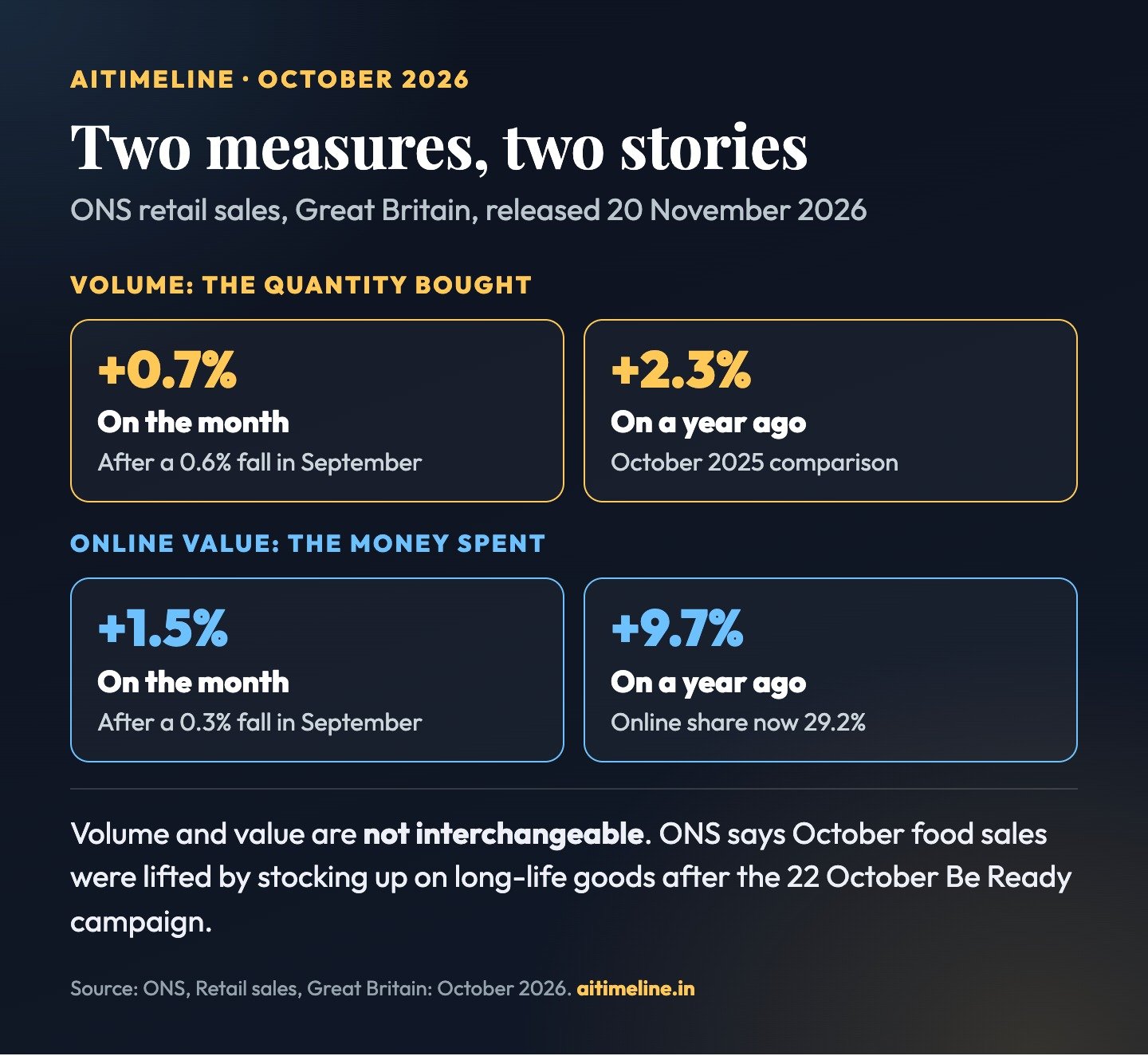
+0.7% and +9.7% are different measures. The first is retail sales volume, the quantity bought, month on month. The second is online sales value, money spent, year on year. ONS also links part of October’s food-store rise to stockpiling after a government campaign, so one good month is not yet a recovery.
💡 Short Answer
UK retail sales volumes rose 0.7% in October 2026 after a 0.6% fall in September, and online sales value was 9.7% higher than a year earlier, with 29.2% of sales made online (ONS, Great Britain). Part of the rise came from stocking up on long-life food. Behind it lies a decade of online growth, an inflation shock in 2022 and a shopper who now puts value ahead of brand.
October 2026 in Two Measures
ONS retail sales for Great Britain, released 20 November 2026.
UK Retail Sector: Key Questions
UK Retail in Eight Points
- Latest data: volumes +0.7% in October 2026, following a revised 0.6% fall in September.
- Two measures: volume (quantity) and online value (money spent) answer different questions.
- Caveat: ONS links part of the food rise to stocking up after the 22 October Be Ready campaign.
- Online: 3.4% of sales in 2007, 27.9% in 2020 (annual), 29.2% in October 2026 (monthly).
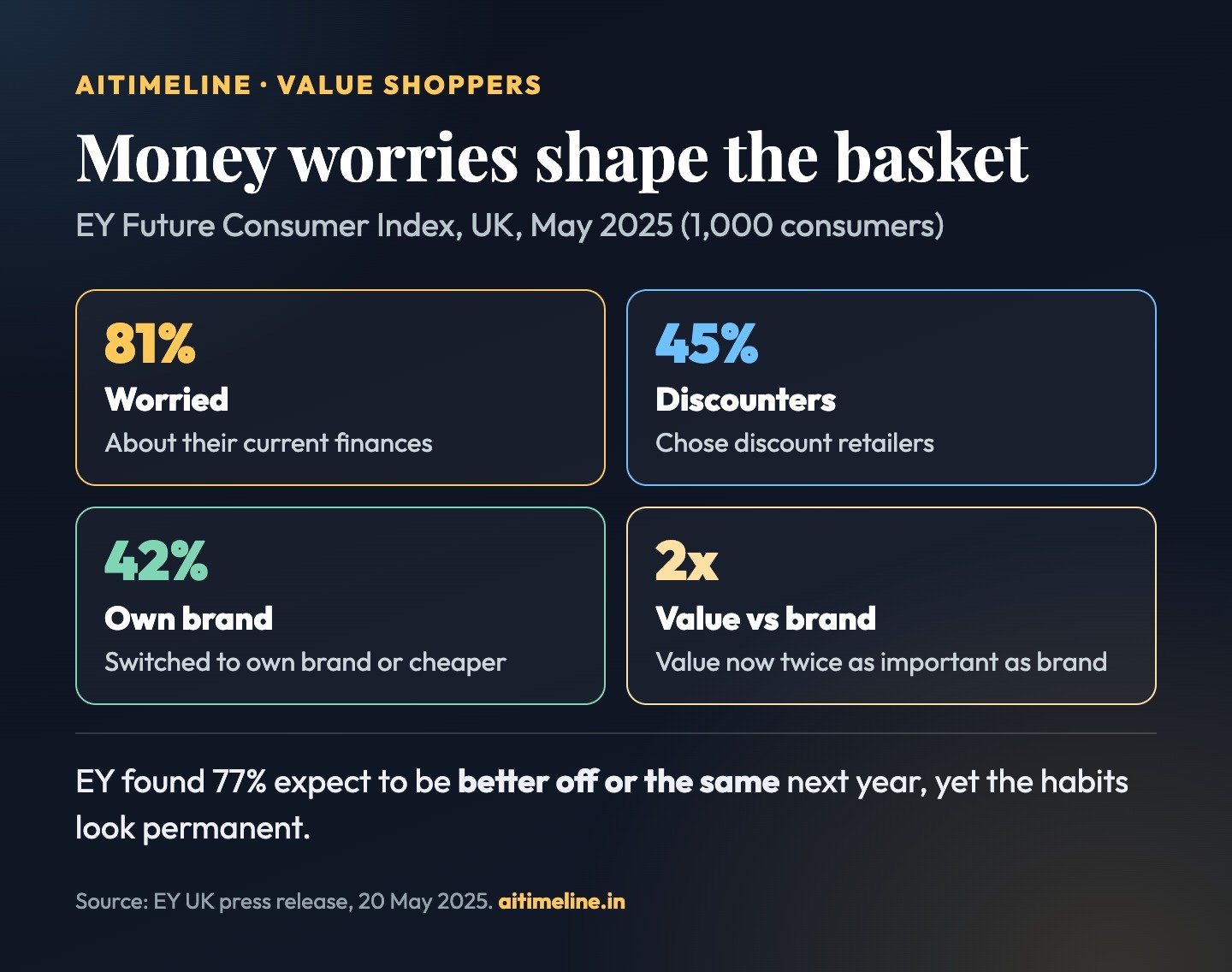
- Value first: EY found 81% worried about finances and 45% choosing discounters.
- Closures: 34 multi-store chains ceased trading in 2024, as cited by the Commons Library.
- Resale: 60% of UK consumers buy second-hand, per BearingPoint.
- Outlook: pricing, digital service and well-chosen shops matter together; no one lever is enough.
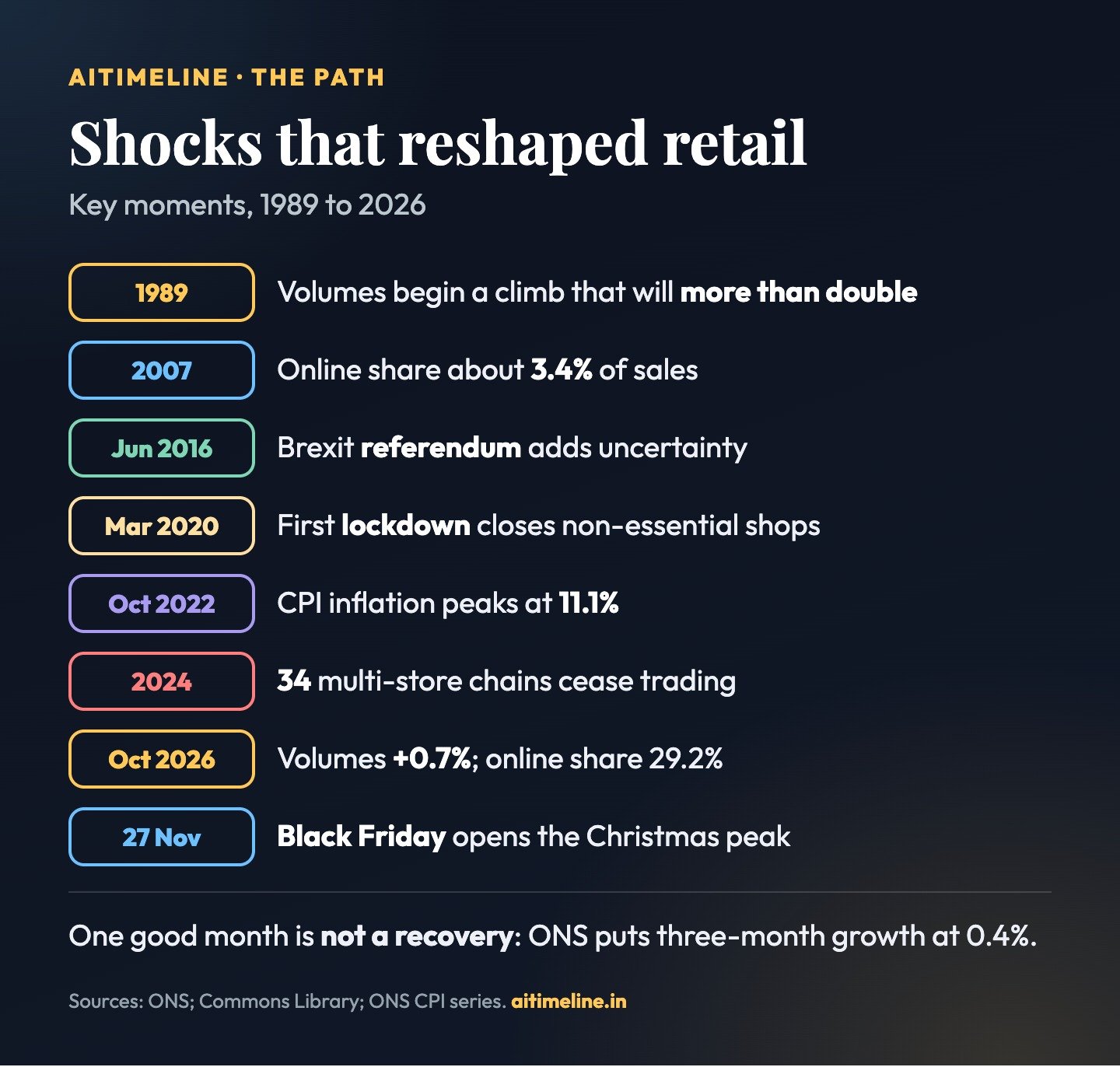
Timeline: UK Retail from 1989 to Christmas 2026
Newest first. Labels mark background, shocks, data releases, policy and outlook.
Black Friday opens the Christmas trading peak Outlook
What to watch: Retailers go into the Christmas period with better headline numbers than a month ago. Promotions, delivery, stock availability and price are the likely deciders, but there is no hard data yet: the first official read of November trading is the ONS release due on 18 December.
The test: The task is to turn one improving month into sustained growth while protecting margins. Heavy discounting can lift volumes and still weaken profit.
CBI survey reports the best sales month since December 2022 Data
The reading: As reported, the Confederation of British Industry’s retailer survey showed its sales-volume balance rising to +9 in November from -10 in October, the strongest year-on-year sales month since December 2022.
The caution: The CBI said the improvement did not yet establish a sustained recovery, and retailers stayed cautious about investment and demand. The Reuters page returned an access error when we tried to open it, so these figures are as reported to us, not re-checked at source.
ONS: retail volumes rise 0.7% in October Data
Volumes: The quantity bought rose 0.7% in October after a revised 0.6% fall in September, and was 2.3% above October 2025. Over the three months to October volumes rose 0.4% on the three months to July and 1.7% on a year earlier.
What drove it: Non-food stores rose 1.1% on the month, helped by art galleries, sports, games and toy shops and clothing, where retailers pointed to people buying more per visit, new launches and restocking after September inventory problems. Food stores rose as shoppers bought long-life goods.
Online: Online sales value rose 1.5% in the month and 9.7% on a year earlier. The online share of all retail sales edged up from 29.1% in September to 29.2% in October.
Government’s Be Ready campaign sends shoppers to long-life food Shock
The effect: ONS reports that supermarkets saw an October uplift in emergency items such as UHT milk and tinned goods after the UK government launched its Be Ready campaign on 22 October 2026.
Why it matters: Part of the headline rise in food-store volumes therefore reflects a one-off stock-up, not a lasting change in spending. The size of that effect is not published.
September falls 0.6% as warm weather delays autumn ranges Shock
What happened: Retail volumes fell 0.6% in September, a sharper drop than the 0.4% first reported, and online sales value fell 0.3%.
The weather: ONS says online clothing retailers reported that the release of autumn and winter ranges suffered in unseasonably warm weather, while clothing stores also had inventory problems.
Fuel spike after conflict in the Middle East Shock
The spike: ONS says fuel sales jumped in March 2026 following the outbreak of conflict in the Middle East, then fell in May and June and have recovered gradually since.
Still pricey: Automotive fuel volumes fell back to August levels in October as pump prices rose for the third month in a row, a reminder that energy costs reach shoppers through more than the shop till.
BearingPoint: six in ten UK shoppers buy second-hand Background
The findings: BearingPoint found that 60% of UK consumers buy second-hand goods, 60% buy from individuals and 63% sell to individuals through consumer-to-consumer channels such as Vinted.
The gap: The UK still lags other European countries in both business-to-consumer and consumer-to-consumer resale; BearingPoint cites Italy at 70% buying second-hand. It warns retailers risk losing secondary margin and should consider their own resale strategy or partnerships.
EY: value is now the top purchasing factor Background
The numbers: EY reports that 81% of UK consumers are worried about their current finances, 45% opted for discount retailers and 42% switched to own brand or cheaper alternatives. Value is now twice as important as brand in purchasing decisions.
A mixed mood: Despite the worry, 77% believe they will be better off or the same next year. EY says the changes in shopping habits appear to be permanent.
Employer National Insurance rises Policy
The change: The employer National Insurance rate rose from 13.8% to 15% and the threshold at which it starts fell from £9,100 to £5,000 a year. Retail, one of Britain’s largest employers, is exposed to payroll costs.
Our caveat: We did not find a published estimate of the cost to retailers in the sources used for this page, so none is given.
34 multi-store retailers cease trading Shock
The count: The House of Commons Library, citing Centre for Retail Research data, reports that 34 multi-store retail companies ceased trading in 2024, affecting 7,537 stores and 55,914 employees.
Reading it: The figure is for multi-store chains, not all shops. We could not open the Library briefing, so this is quoted as cited to us.
Inflation peaks and value becomes a weapon Shock
The squeeze: UK consumer price inflation peaked at 11.1% in October 2022, a 41-year high, as energy and food costs surged. Households compared prices, traded down and waited for promotions.
The response: Discounters, own-label ranges and loyalty prices became competitive tools. Retailers meanwhile faced higher wage, energy, transport and property costs of their own.
Online sales reach about 37% of all retail Shock
The peak: The Commons Library, analysing ONS data, puts the online share of retail sales at about 37% in February 2021, a record at that point.
Annual picture: ONS’s annual series is lower: 27.9% for 2020 as a whole, up from 3.4% in 2007. Monthly and annual shares are different measures.
First COVID-19 lockdown closes non-essential shops Shock
The closure: From late March 2020 non-essential stores were ordered to close. Supermarkets, pharmacies and other essential retailers kept trading, while clothing, department-store and leisure-linked businesses were hit hardest.
The digital jump: Consumers moved to online ordering, home delivery and contactless payment, and retailers brought forward digital investment they had planned for later.
Brexit referendum adds uncertainty Shock
The vote: The UK voted to leave the European Union, raising questions about future trading arrangements, labour supply and the cost of imported goods.
For retailers: Sterling’s fall after the vote raised the cost of many imports. Retailers had to plan for changes to sourcing and borders over several years.
Phones, click-and-collect and omnichannel shopping Background
What changed: Smartphones let shoppers compare prices and read reviews in the aisle. Retailers added mobile sites and apps, click-and-collect, loyalty schemes and joined-up stock systems so online and in-store worked together.
Shop mix: ONS notes that between 2013 and 2019 the share of predominantly food stores declined, with changing consumer habits a possible reason, before the pandemic reversed it.
Financial crisis squeezes household budgets Background
The effect: The crisis hit employment, confidence and household spending, and retailers faced weaker demand and pressure to offer keener prices.
Digital response: Many invested in websites, online catalogues, digital payments and delivery, narrowing the line between shops and internet retailers.
ONS benchmark: online is 3.4% of retail Background
The baseline: ONS records online sales at 3.4% of all retail sales in 2007, rising to 27.9% in 2020. It adds that the rise in online spending was larger in the Netherlands and the UK than in other European counterparts.
The platforms: Amazon and eBay had by then taught shoppers to compare products, prices and sellers without visiting several shops.
From supermarkets and retail parks to the web Background
Growth: ONS finds total retail sales volumes more than doubled between 1989 and 2021. Food stores were the largest sector for the last 25 years, and sports equipment, games and toys sales volumes rose 451% from 1989 to 2020 while alcohol, other drinks and tobacco fell 76%.
Non-store retail: The share of spending on non-store retailing, mostly online, was 8% in 1989, fell to 4.4% in 2003 and reached 16.5% in 2020.
The setting: Supermarkets, shopping centres and out-of-town retail parks reshaped habits through the 1990s, and early online shops arrived in the late 1990s, though physical stores stayed dominant.
How Much of Retail Is Online?
Four figures, three bases. Do not line them up as one series.
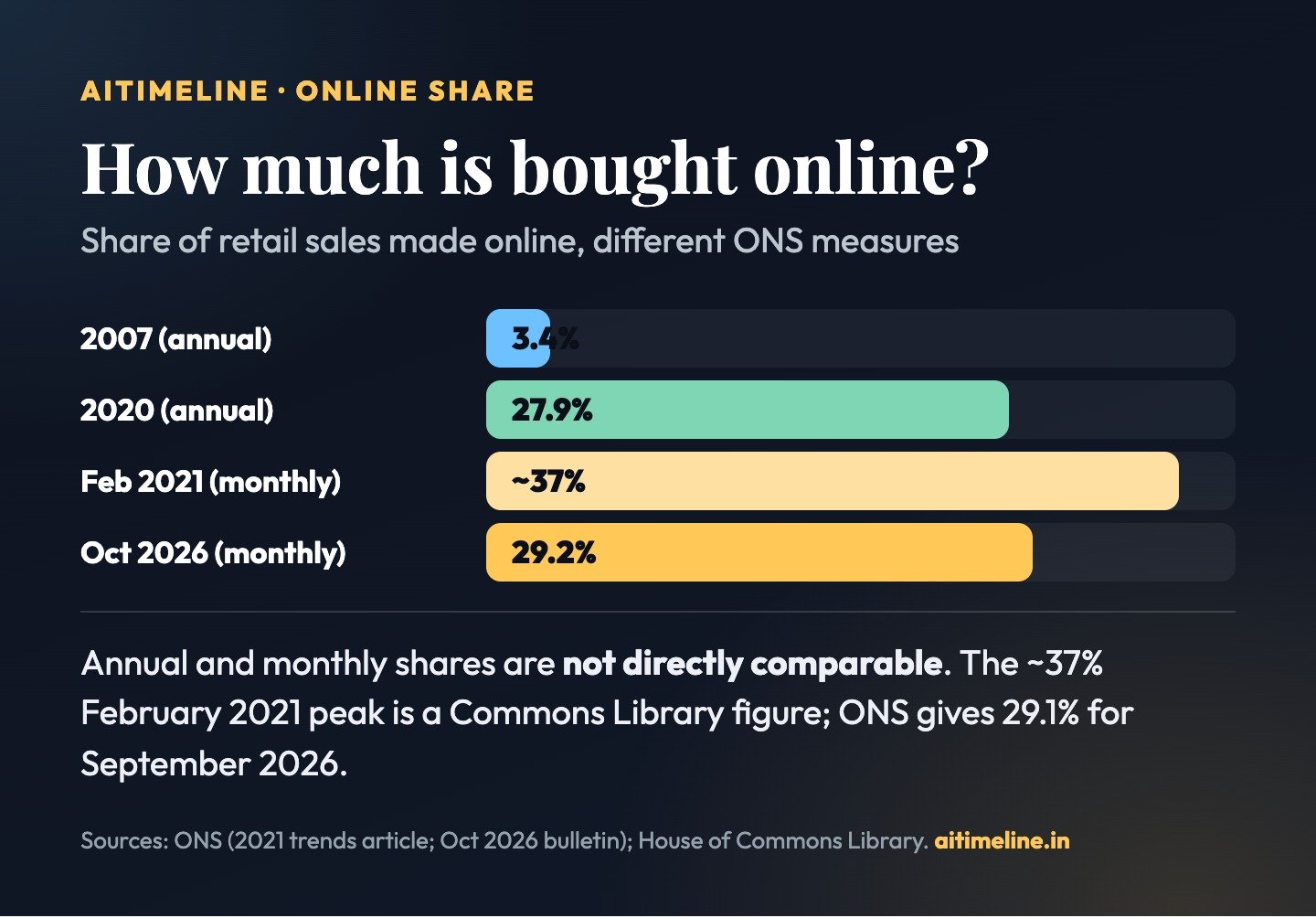
| Period | Online share | Basis and source |
|---|---|---|
| 2007 | 3.4% | Annual, ONS |
| 2020 | 27.9% | Annual, ONS |
| Feb 2021 | About 37% | Monthly, Commons Library citing ONS |
| Sep 2026 | 29.1% | Monthly, ONS |
| Oct 2026 | 29.2% | Monthly, ONS |
The pandemic did not create online shopping, but it pushed the share up faster than anyone planned. Since then the share has settled below the lockdown peak and above any pre-2020 level. The important change is behavioural: browsing, price checking and ordering now sit alongside, not instead of, a shop visit.
The Sector in Numbers
Size, jobs and 2024 closures, as cited from the Commons Library.
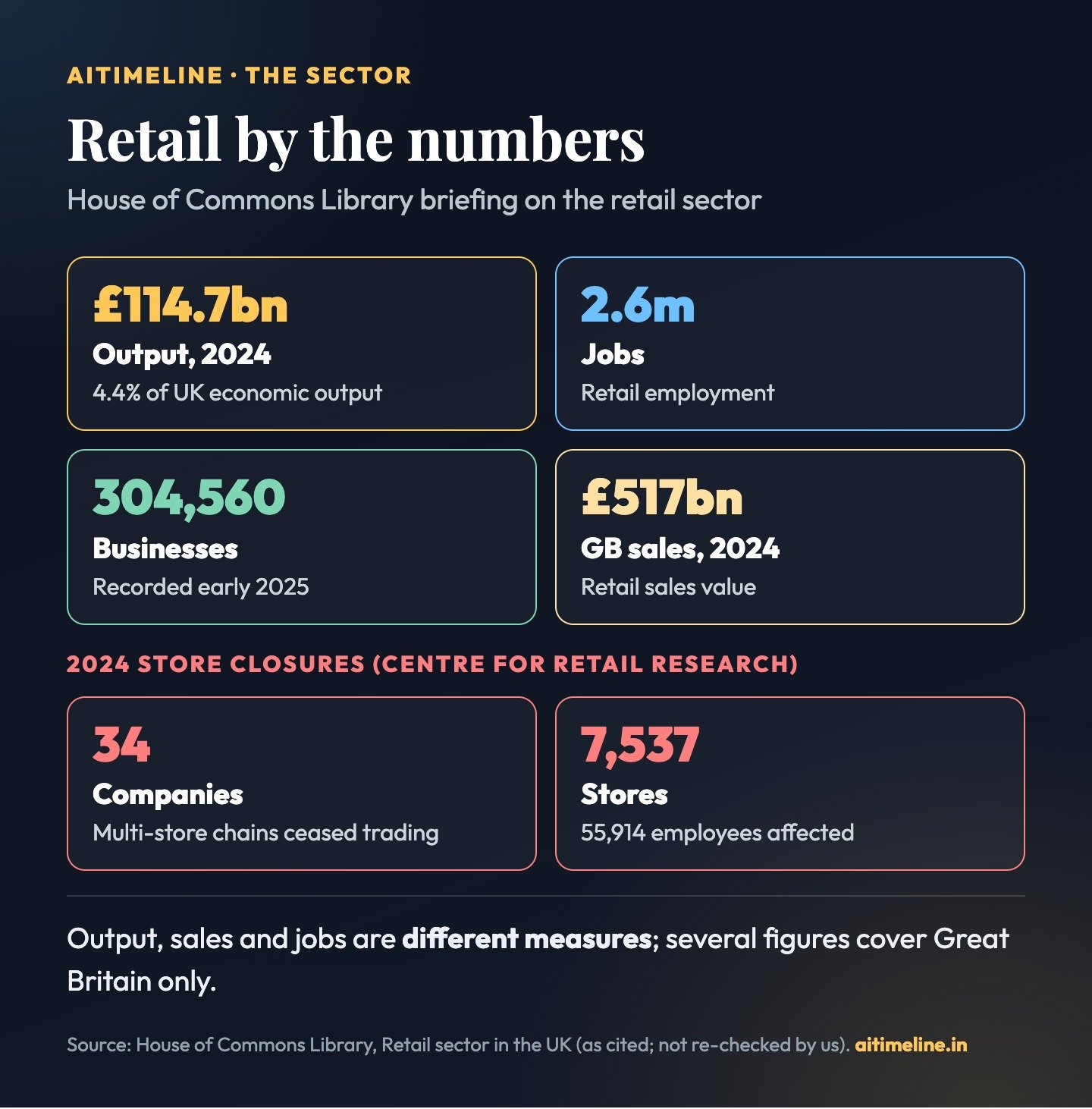
Retail matters beyond the till. It supports employment in every town, anchors commercial property and feeds logistics and delivery networks. The figures above come from the House of Commons Library, which we could not open directly; they are quoted as cited. They mix years, measures and geographies, so treat them as a sketch of scale rather than a single dataset.
The Value-Conscious Shopper
What the 2025 EY survey found.
| Force | What it does to retailers |
|---|---|
| E-commerce and omnichannel | Shoppers expect to browse, compare, order and return across channels |
| Inflation and budgets | Price comparison, brand switching, own label and promotion hunting |
| The high street | Stores must earn their rent; space shifts toward service, food and leisure |
| Technology and AI | Recommendations, forecasting, pricing analytics, automation and fraud detection |
| Sustainability | Resale, repair, recycling and reusable packaging become part of the offer |
Excessive discounting can win customers and still damage margins and brand position. That is the trade-off behind most current retail strategy: be cheap enough to keep the shopper, but not so cheap that the business cannot pay for stores, staff and delivery.
How UK Retailers Are Adapting
Challenge on the left, typical response on the right.
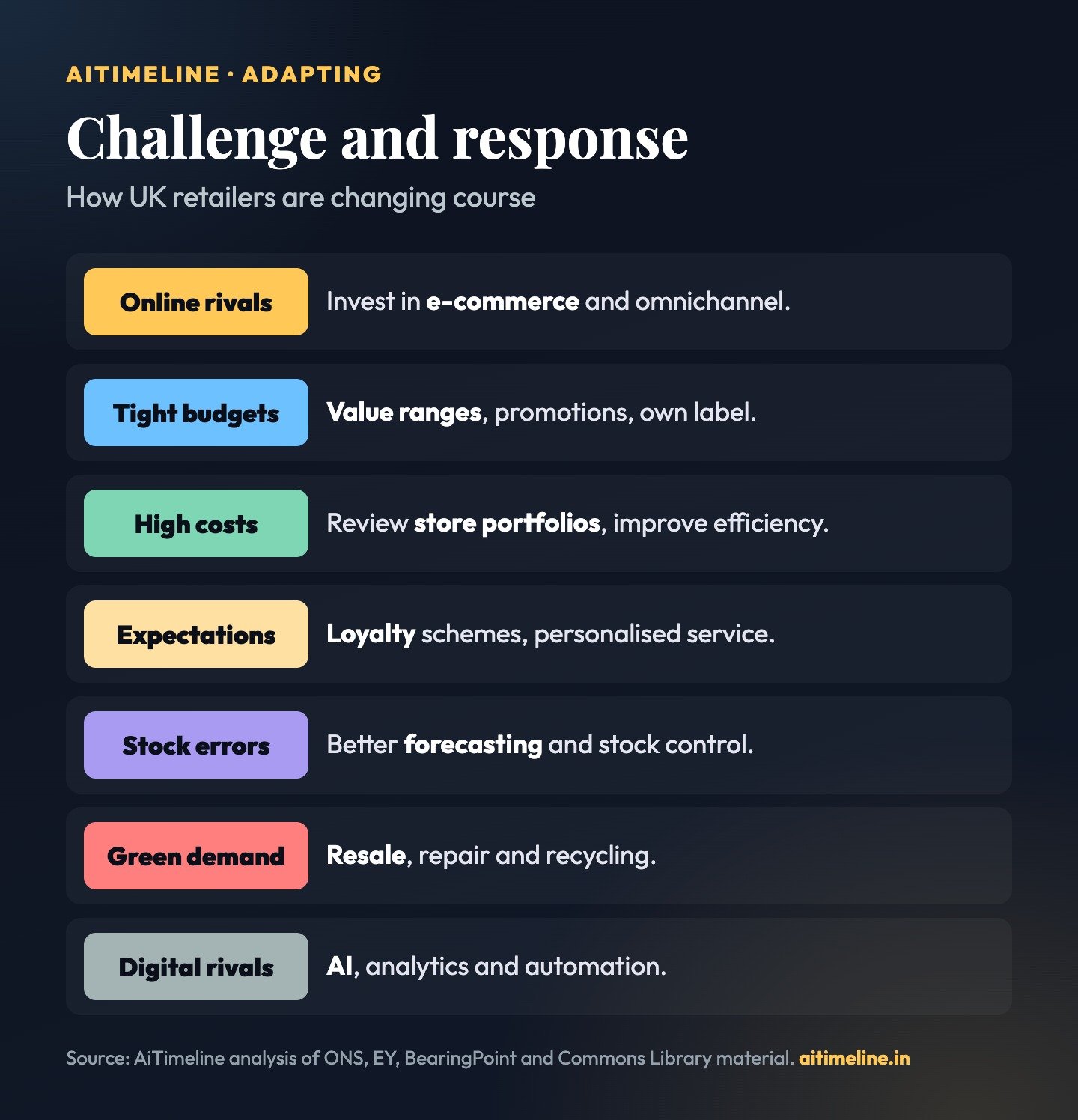
| Challenge | Retailer response |
|---|---|
| Online competition | Invest in e-commerce and omnichannel services |
| Household budget pressure | Value ranges, promotions and own-label products |
| High operating costs | Improve efficiency and review store portfolios |
| Changing expectations | Loyalty schemes and personalised services |
| Inventory problems | Better demand forecasting and stock management |
| Environmental concerns | Resale, repair and recycling services |
| Digital competition | AI, analytics and automation |
The AI uses are practical rather than glamorous: recommending products, answering customer queries, forecasting stock, spotting fraud and running warehouses. The costs and risks are equally practical, including implementation spending, data protection and cybersecurity. We found no national figure for how widely they are used.
Resale and the Circular Shift
BearingPoint’s March 2026 survey.
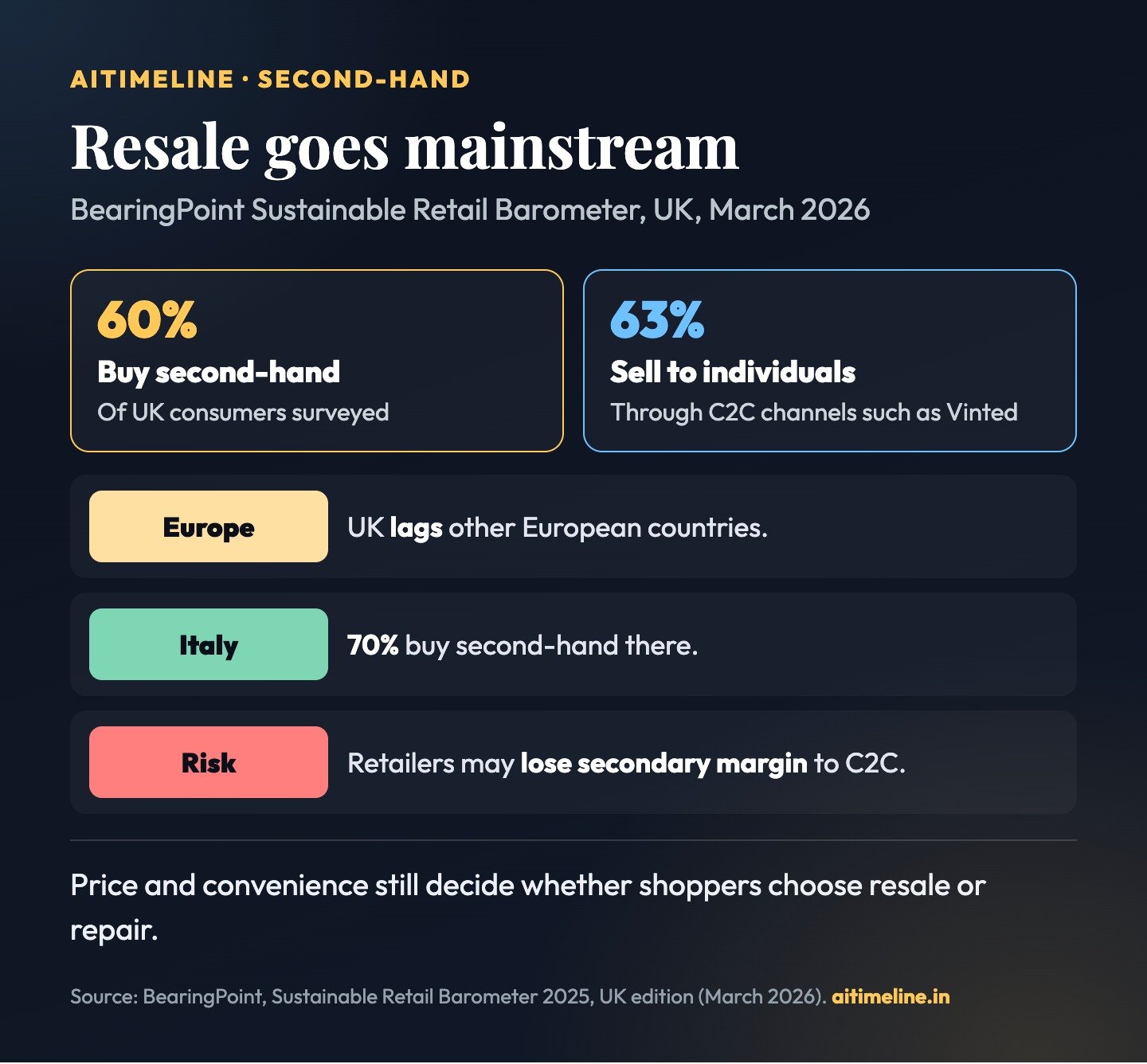
Second-hand is both a competitor and an opportunity. Retailers that stay out leave resale margin to consumer-to-consumer platforms; those that join through their own platforms or partnerships keep customers in the brand. BearingPoint’s own caution applies: price and convenience still decide what mainstream shoppers choose.
Key Figures, With Their Limits
Different periods and measures; not interchangeable.
| Indicator | Figure | Source and basis |
|---|---|---|
| Retail output, 2024 | £114.7 billion | Commons Library, UK, as cited |
| Share of UK output, 2024 | 4.4% | Commons Library, as cited |
| Retail jobs | 2.6 million | Commons Library, as cited |
| Retail businesses, early 2025 | 304,560 | Commons Library, as cited |
| Great Britain retail sales, 2024 | £517 billion | Commons Library, as cited |
| Sales volume, Oct 2026 | +0.7% month on month | ONS, Great Britain |
| Online sales value, Oct 2026 | +9.7% year on year | ONS, Great Britain |
| Online share, Oct 2026 | 29.2% | ONS, Great Britain |
What Lies Ahead
An outlook, not a forecast.
Integrated shopping. Customers will expect online and physical shopping to work together, with flexible delivery, returns and collection.
Affordability. Value is likely to stay central while household budgets face pressure, and discounters and own-label ranges keep their place.
Smarter data. Retailers will keep using AI and analytics for recommendations, pricing, forecasting and service, subject to cost and data-protection duties.
A changing high street. Successful shops are likely to offer experience, convenience and services rather than relying on walk-in sales alone.
Resale and repair. Second-hand shopping could become a normal part of retail business models, if it is affordable and easy.
Conclusion: A Good Month Is Not a Trend
British retail has moved from a mostly store-based industry to a market shaped by digital platforms, price-sensitive shoppers and rising costs. The pandemic accelerated online buying, the inflation shock of 2022 strengthened demand for value, and technology offers new ways to serve customers.
October’s numbers are encouraging, but they sit beside three cautions: a revised September fall, a stockpiling boost to food stores and a three-month rise of only 0.4%. The next test is Christmas trading and the 18 December ONS release. Retailers that combine competitive prices, dependable digital operations and well-chosen shops are best placed to benefit.
Explore More Timelines
People Also Ask
Frequently Asked Questions
⚠️ Editorial Note
This page relies on the ONS retail sales bulletin for October 2026 (released 20 November 2026), the ONS 1989 to 2021 retail trends article, the EY UK press release of 20 May 2025 and the BearingPoint Sustainable Retail Barometer (March 2026), all read directly. The House of Commons Library briefing and the Reuters report on the CBI survey could not be opened, so their figures are quoted as cited and flagged. Where the draft we received differed, we changed it: ONS attributes part of October’s food rise to stockpiling after the Be Ready campaign; the 2019 “one-fifth online” claim was dropped as unverified in favour of ONS’s 3.4% (2007) and 27.9% (2020); the ~37% February 2021 share is labelled as a monthly Commons Library figure; ONS covers Great Britain, not the whole UK; and the December 2025 parliamentary review was dropped for lack of a dated source. The employer National Insurance change and inflation peak are well-documented public facts given without a linked source. This is information, not investment or business advice.
Related Stories
Sources & further reading
Every dated entry above was checked against these references. Last reviewed 26 November 2026.
- ONS: Retail sales, Great Britain: October 2026 (released 20 November 2026)
- ONS: Economic trends in the retail sector, Great Britain: 1989 to 2021
- House of Commons Library: Retail sector in the UK (SN06186)
- Reuters: UK retailers report best month for sales since late 2022, CBI (24 Nov 2026)
- EY UK: Brand loyalty declines as financial concerns persist (20 May 2025)
- BearingPoint: Sustainable Retail Barometer 2025, UK edition (March 2026)