Ramadan Economics: How the Holy Month Reshapes Gulf Markets
Explore how Ramadan reshapes Gulf economies: Visa late-night data, shorter working hours, food delivery, retail, advertising and Eid shopping surges.
Latest Story
Ramadan economics in the Gulf is less about how much people spend than about when. In Ramadan 2024 the share of Kuwait’s card transactions made between 10 pm and 4 am rose from 17.1% to 38.2%, according to Visa. Working hours shrink, grocery and delivery demand moves to the night, and the last ten days belong to Eid shopping. This page traces the verified data, from the 2024 payment record to the 2026 rules, and says where the numbers measure timing, expectations or self-reported behaviour rather than total spending.
Visa’s headline figure is a share of transactions by hour, not a rise in spending. It shows the Gulf’s commercial clock moving to after dark. Surveys from YouGov and Ipsos describe expectations and self-reported behaviour, and Google and Visa’s Eid figures compare against non-peak weeks. This page keeps the four kinds of evidence apart.
💡 Short Answer
Ramadan reshapes Gulf markets by moving activity to the night. Visa found the share of transactions between 10 pm and 4 am rose to 38.2% in Kuwait, 35.0% in Saudi Arabia and 26.9% in the UAE in 2024. Working hours fall by two a day in the UAE and to six hours a day in several states, groceries lead spending plans, and the last ten days bring an Eid surge: Saudi fashion-retailer spending rose 136% in the week before Eid.
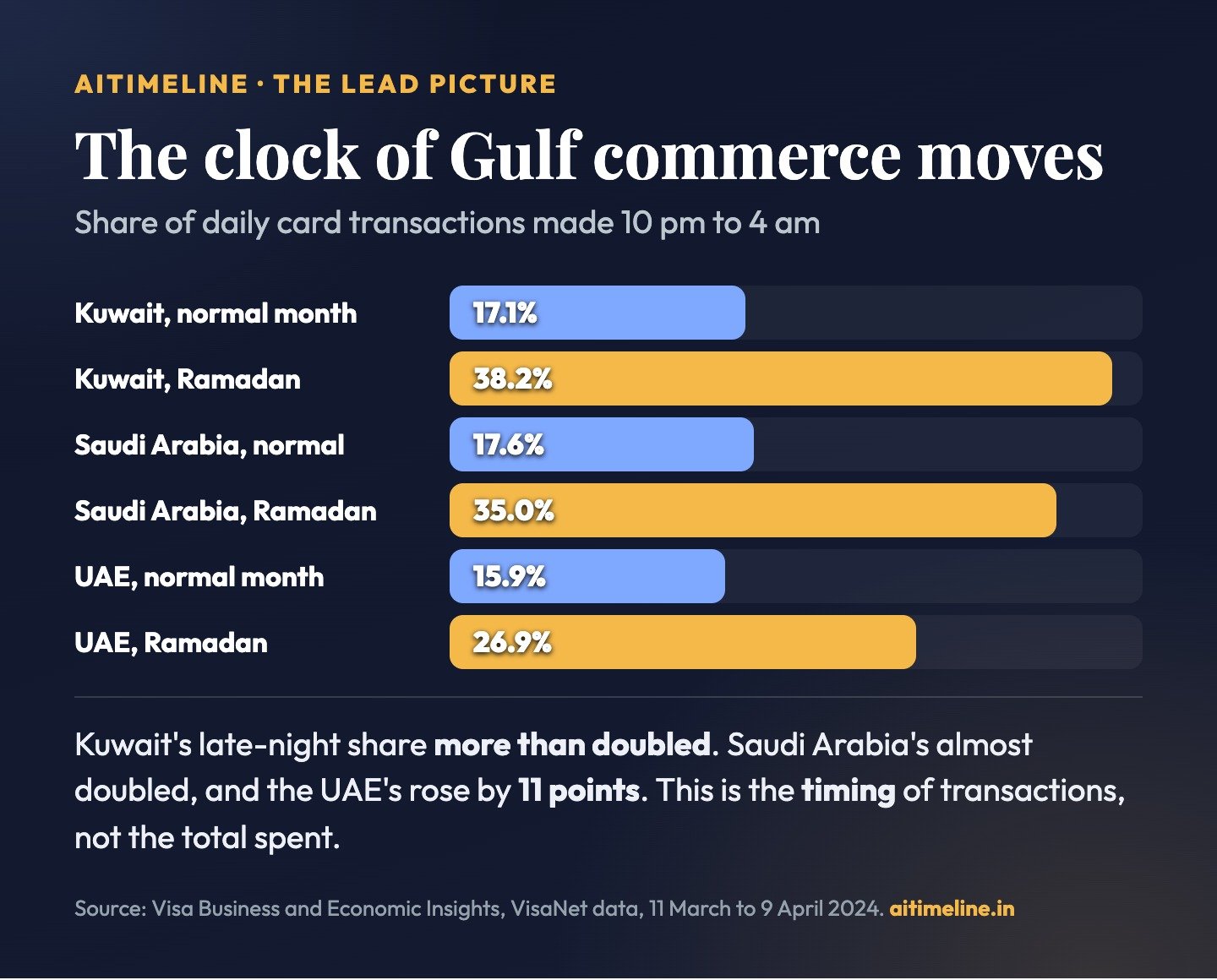
The Lead Picture: The Clock of Gulf Commerce Moves
Share of daily card transactions made between 10 pm and 4 am.
Ramadan Economics: Key Questions
What the Evidence Shows
- The night shift is real: the 10 pm to 4 am share of transactions rose in all three markets Visa measured, most in Kuwait.
- It is timing, not total spending: Visa measures the share of payments by hour, so it cannot show a rise in the amount spent.
- Suhoor drives the late hours: restaurants, cafes, delivery apps and groceries shift most, with much of the activity from 11 pm to 3 am.
- Groceries lead intentions: 57% of surveyed Saudi and UAE residents expected to spend more on them.
- Shopping shifts through the month: groceries early, clothing, department stores and luxury in the last ten days.
- Eid week is the spike: Saudi fashion-retailer spending was up 136% in the week before Eid, against non-peak weeks.
- Hours fall across the Gulf: the UAE by two hours a day, others to six hours a day or 36 a week.
- Shoppers plan: a 2026 survey says planned lists, not impulse, dominate Ramadan shopping.
- Dates matter: Visa’s data is from Ramadan 2024 and was published in March 2025; we found no newer release.
Timeline: How the Gulf Measured Ramadan, 2024 to 2026
Newest first. Labels mark data, surveys, rules and context.
Ramadan 2026 is over; the next one is due in February 2027 Context
The position: Ramadan 2026 was expected to begin around 19 February and end around 20 March, with the Eid al-Fitr holidays following, according to Morgan Lewis’s employer guide of 11 February 2026. Because the Islamic calendar is lunar, the month moves about ten days earlier each year, so on our arithmetic the next Ramadan starts around 8 February 2027, subject to moon sighting.
What we could not confirm: We found no official announcement of 2027 dates or working-hour rules. Visa’s published night-time figures cover Ramadan 2024; we did not find an equivalent Visa transaction-share release for Ramadan 2025 or 2026, so the numbers below are the latest we could verify.
UAE cuts private-sector hours by two a day for Ramadan 2026 Rules
Private sector: On 12 February 2026 the UAE’s Ministry of Human Resources and Emiratisation announced that normal working hours would be cut by two hours a day for private-sector employees during Ramadan. Companies could use flexible or remote work within the reduced daily limits.
Federal government: FAHR’s Circular No. 01 of 2026, issued on 11 February 2026, set federal hours at 9:00 am to 2:30 pm from Monday to Thursday and 9:00 am to 12:00 noon on Friday, except where a job’s nature requires otherwise. Its news release also let entities allow up to 70% of employees to work remotely on Fridays.
How six Gulf states limit working time in Ramadan Rules
The map: Saudi Arabia and Bahrain cap Muslim employees at six hours a day or 36 a week. Kuwait and Qatar cap everyone at 36 hours a week whatever their religion. Oman caps Muslim employees at six hours a day or 30 a week. The UAE cuts onshore hours by two a day for all employees.
UAE free zones: Abu Dhabi Global Market gives Muslim employees a 25% cut in daily hours without a pay cut, and the Dubai International Financial Centre limits them to six hours a day without a pay cut. The firm’s guide also notes that Eid al-Fitr holidays are paid public holidays across the region.
Ipsos and ArabyAds: the Ramadan shopper plans, and does not impulse-buy Survey
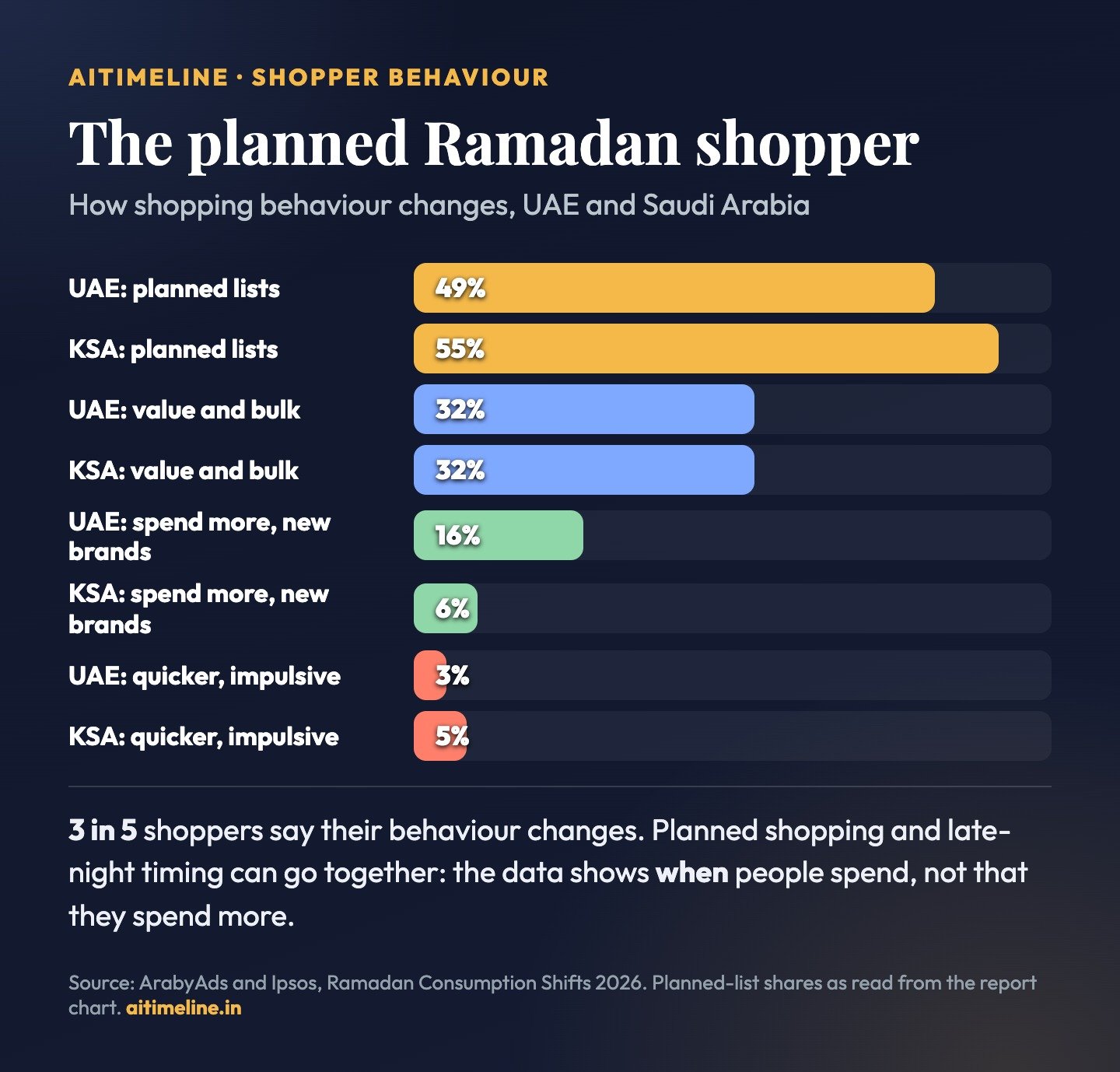
The finding: The report says three in five shoppers across the UAE and Saudi Arabia change how they shop in Ramadan. In the UAE, 49% say they stick to planned lists and traditional items, and 55% in Saudi Arabia. A further 32% in both countries focus on value, discounts and bulk buying.
Impulse is rare: Only 3% of UAE and 5% of Saudi respondents say they make quicker or more impulsive purchases, and 16% and 6% say they spend more and try new brands. The planned-list shares are read from the report’s chart; we did not find the sample size in the pages we read.
Google and Visa: Ramadan is the Gulf’s second-biggest retail search peak Survey
The peaks: The Google and Visa report says Ramadan retail searches come second only to Black Friday in the UAE, and that Ramadan and Eid al-Fitr are the biggest search peaks in Saudi Arabia. Retail search in Saudi Arabia rose about 13% during Ramadan against non-peak times.
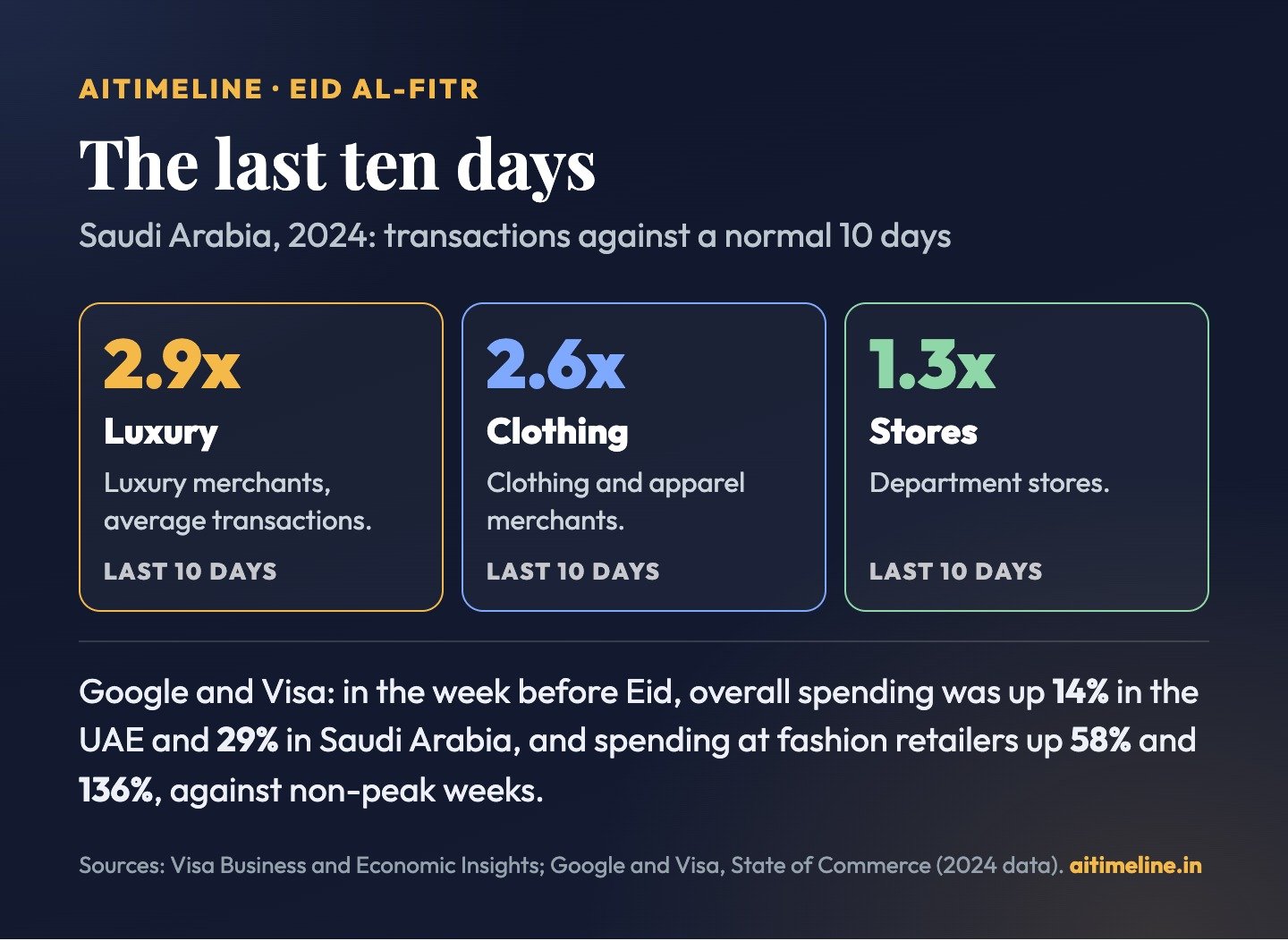
Before Eid: In the week before Eid al-Fitr, overall spending was up 14% in the UAE and 29% in Saudi Arabia against non-peak moments. Spending at fashion retailers rose 58% in the UAE and 136% in Saudi Arabia. Apparel searches in Saudi Arabia rose 23% between weeks three and four of Ramadan, and beauty searches 43%.
A correction: The 136% is the fashion-retailer figure, not overall spending; a widely repeated summary mixes the two.
Visa: groceries early, clothing and luxury at the end Data
Two phases: Visa found grocery and supermarket spending rises in the days before Ramadan and the first couple of weeks, as households stock up. In the final ten days, spending shifts towards clothing, department stores and luxury items.
The multiples: In Saudi Arabia during the last ten days of Ramadan 2024, luxury merchants saw 2.9 times their average number of transactions, clothing and apparel merchants 2.6 times and department stores 1.3 times, against a normal ten days. Visa says Kuwait and the UAE showed similar trends.
Visa: Kuwait’s late-night share jumps from 17% to 38% Data
The shares: The share of daily transactions made between 10 pm and 4 am rose in Ramadan 2024 from 17.1% to 38.2% in Kuwait, from 17.6% to 35.0% in Saudi Arabia and from 15.9% to 26.9% in the UAE. Visa describes the rise as more than doubling in Saudi Arabia and Kuwait; on the rounded figures Saudi Arabia is 1.99 times, so we say almost doubled.
Where it happened: Dine-in restaurants and cafes, food delivery apps, groceries and quick-service restaurants shifted most, with much of the spending between 11 pm and 3 am. In Kuwait, delivery apps peaked from midnight to 3 am, and spending dipped from about 5 to 7 pm as families prayed and broke the fast.
Why: Visa links the shift to suhoor, the pre-dawn meal, which is more often eaten at a restaurant or ordered in than iftar, the home-cooked evening meal.
Ipsos Ramadan Handbook: Saudi and UAE shoppers remember Ramadan ads Survey
The finding: In Saudi Arabia, 53% of respondents were more likely to remember brands that advertise in Ramadan, and 55% had bought a product after seeing a Ramadan ad. In the UAE the shares were 51% and 54%. In Kuwait they were 38% and 33%.
The caveat: These are self-reported answers from a panel survey across Egypt, Jordan, Kuwait, Lebanon, Saudi Arabia and the UAE, so they show perceived advertising influence, not measured sales.
YouGov: groceries lead, dining out and delivery follow Survey
The finding: Across the two samples, 57% expected to spend more on groceries and daily essentials in Ramadan than in the rest of the year, 48% on gifts and charitable giving and 37% on dining out and food delivery. In the chart by country, groceries were 55% in the UAE and 58% in Saudi Arabia.
The difference: UAE residents were more likely to expect higher dining-out and delivery spending (41% against 33% in Saudi Arabia). Saudi residents were more likely to expect higher home-decor spending (37% against 30%).
UAE announces a two-hour daily cut for Ramadan 2024 Rules
The rule: On 4 March 2024 the ministry said private-sector working hours would fall by two hours a day during Ramadan, for fasting and non-fasting staff alike, from Monday 11 March. Employers could offer flexible or remote work within the daily limits, and hours beyond the reduced schedule could count as overtime.
Ramadan 2024 starts: the month Visa measured Context
The window: Visa’s analysis of anonymised VisaNet transactions covers 11 March to 9 April 2024. That is the Ramadan month behind every Visa figure on this page, even though Visa published the results in March 2025.
Date check: Some summaries date the Visa night-time finding to March 2024. The data is from 2024, but the release is from 2025.
Peak Hours: A Day in Kuwait
The busiest hours move for groceries, delivery and dining.
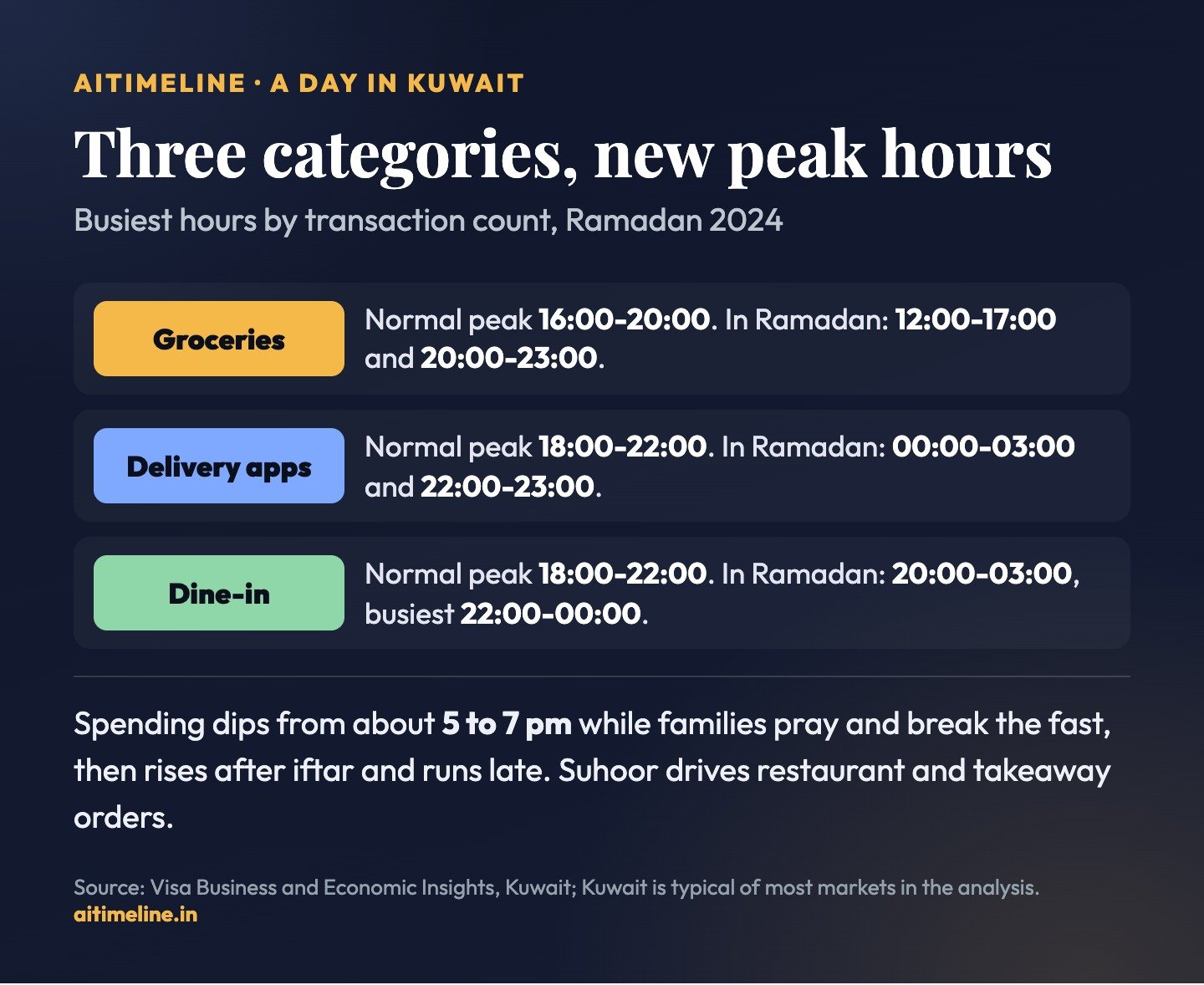
Visa says Kuwait typifies a trend seen in most of the Muslim-majority markets it analysed, but the hour-by-hour charts are Kuwait’s alone. We do not assume the same hours for Saudi Arabia or the UAE.
Spending Plans: What People Expect to Buy
A survey of expectations, not a record of spending.

YouGov asked 1,023 Saudi and 1,031 UAE residents how they expected spending to change against the rest of the year. Dining and delivery was a split category: 37% expected an increase, 38% no change and 25% a decrease. Even groceries, the clearest winner, was an increase for 57%, not for everyone.
The Eid Surge: The Last Ten Days
From groceries to clothing, department stores and luxury.
| Measure | UAE | Saudi Arabia | Source |
|---|---|---|---|
| Overall spend, week before Eid | +14% | +29% | Google and Visa |
| Fashion-retailer spend, week before Eid | +58% | +136% | Google and Visa |
| Luxury transactions, last 10 days | Similar trend | 2.9x normal | Visa |
| Clothing transactions, last 10 days | Similar trend | 2.6x normal | Visa |
| Retail search during Ramadan | Second to Black Friday | About +13% | Google and Visa |
Comparisons are against non-peak weeks or a normal ten days; the two sources use different measures and should not be added together.
Working Hours: Shorter Days Across the Gulf
General rules, with exceptions for free zones and sectors.
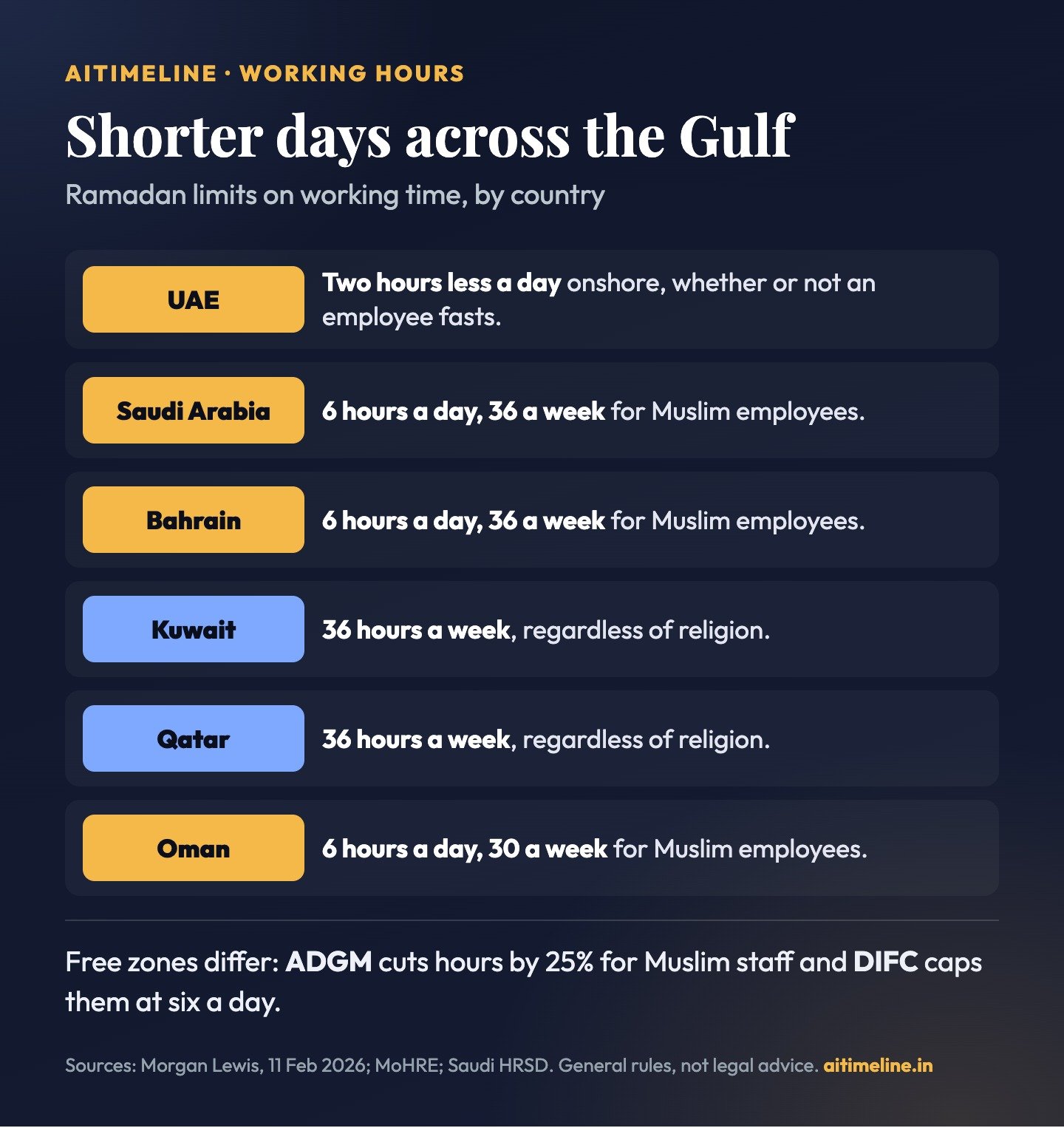
Shorter hours matter for retail and delivery because daytime staffing shrinks just as evening demand grows. Employer guidance suggests shift systems so that opening hours stay covered. The rules differ by country, religion and free zone, and the table above is a general summary, not legal advice.
The Planned Shopper
A 2026 survey finds intention, not impulse.
Advertising: Do Ramadan Ads Stick?
Self-reported answers from a six-country survey.

The Ipsos handbook surveyed 3,000 respondents across six countries, representative of the Muslim population. The Saudi and UAE numbers are the highest of the Gulf markets in the survey, but they record what people say, not what they bought.
Who Is Affected: Six Business Areas
What the evidence supports for each, and what it does not.
Groceries and supermarkets
Grocery spending rises before and early in Ramadan, according to Visa, and shifts later in the evening. Higher demand is not proof of higher profit; we found no margin data.
Restaurants and cafes
Dine-in activity in Kuwait peaked from 22:00 to 00:00 in Ramadan, and suhoor drives late trade. Daytime trade is a different story.
Food delivery apps
In Kuwait, delivery apps peaked from midnight to 3 am. We did not find a verified Gulf-wide growth figure for delivery or e-commerce.
Fashion, beauty and luxury
The Eid surge sits here: Saudi luxury transactions were 2.9 times normal in the last ten days of Ramadan 2024, and fashion-retailer spending was up 136% in the week before Eid.
Advertising
Ipsos finds Saudi and UAE respondents say they remember and act on Ramadan ads. The survey is self-reported.
Staffing and logistics
Shorter hours and late-night demand mean split shifts and night cover. Employer guidance also warns productivity may fall.
Risks and Limits of the Evidence
Timing is not total. Visa’s figure is a share of transactions in each hour. It does not say Ramadan spending rose by that proportion.
One Ramadan, three markets. The payment data covers Ramadan 2024 in Kuwait, Saudi Arabia and the UAE. It does not cover Bahrain, Oman or Qatar, and we found no newer release.
Surveys are not receipts. YouGov measures expectations, Ipsos measures self-reported behaviour, and Google and Visa compare against non-peak weeks.
Net economic effect is unproven. Night-time commerce rises while daytime activity and working hours fall. We found no verified Gulf-wide measure of the net effect on output or growth.
Key Terms
| Term | Meaning | Why it matters |
|---|---|---|
| Iftar | The evening meal that breaks the fast | Marks the start of the evening economy |
| Suhoor | The pre-dawn meal | Drives late-night dining and delivery |
| Eid al-Fitr | The holiday ending Ramadan | Peak for clothing, gifts and travel |
| VisaNet | Visa’s payment network | Source of the anonymised transaction data |
| GCC | Gulf Cooperation Council | Six states: Bahrain, Kuwait, Oman, Qatar, Saudi Arabia, UAE |
| Non-peak | A week outside a seasonal peak | The baseline for Google and Visa’s Eid figures |
Conclusion: A Change of Clock, Not Just a Bigger Bill
The best-evidenced change in Gulf commerce during Ramadan is the clock. Visa’s payment data shows a third or more of Kuwaiti and Saudi transactions falling after 10 pm, shorter working hours press against longer evenings, and the Eid week lifts fashion spending sharply.
What the evidence does not yet show is the size of the net economic effect. The best data is from Ramadan 2024, the surveys measure intentions and memories, and we found no newer payment release. The next Ramadan, due around February 2027, will test whether the pattern holds.
Explore More Timelines
People Also Ask
Frequently Asked Questions
⚠️ Editorial Note
Figures come from Visa, YouGov, Google and Visa, Ipsos, ArabyAds, the UAE’s Ministry of Human Resources and Emiratisation and FAHR, Morgan Lewis and Saudi Arabia’s Human Resources ministry. We corrected details found in earlier summaries: the Visa data was collected in March and April 2024 and published in March 2025; the 136% Saudi figure is fashion-retailer spending, not overall spending, which rose 29% in the same week; Saudi Arabia’s late-night share almost doubled rather than more than doubled; and we dropped uncited background entries and a vague 2026 reporting entry. This page is editorial information, not financial or legal advice.
Related Stories
Sources & further reading
Every dated entry above was checked against these references. Last reviewed 27 November 2026.
- Visa Business and Economic Insights: The bustling Ramadan night-time economy (March 2025)
- YouGov: Ramadan 2025 consumer insights (UAE and KSA)
- Google and Visa: State of Commerce, Search and Spend Decoded (UAE and Saudi Arabia, 2024-2025)
- Ipsos: The 2025 Ramadan Handbook, MENA edition
- ArabyAds and Ipsos: 2026 Ramadan Consumption Shifts report (UAE and KSA)
- WAM: Two working hours reduction during Ramadan for private sector employees, MoHRE (March 2024)
- WAM: MoHRE reduces working hours for private sector during Ramadan 2026
- UAE FAHR: Circular No. 01 of 2026 on official working hours during Ramadan 1447 AH
- Morgan Lewis: Ramadan in the Arab Gulf Cooperation Countries, what employers need to know (11 February 2026)
- Saudi Ministry of Human Resources and Social Development: Working conditions and hours