Cerebras Systems: The Wafer-Scale AI Chip Timeline
Explore Cerebras Systems' journey from its 2015 founding to wafer-scale AI chips, WSE generations, CS-4, major partnerships and future roadmap.
Latest Story
Cerebras Systems set out in 2015 to do what chip makers had avoided for decades: use almost an entire silicon wafer as one processor instead of cutting it into many small chips. Its first Wafer Scale Engine appeared in August 2019, the third generation in March 2024, and the rack-scale CS-4 in August 2026. The company listed on Nasdaq as CBRS in May 2026. We follow each step and mark which figures are company claims, which come from filings and where our sources disagree.
Chip size and system speed are different claims. The wafer-scale chip is a fact of design: about 46,225 square millimetres in every generation. The headline speed-ups, such as 30 times faster than GPUs, are company-reported results for named models and settings. Revenue also comes in two forms: GAAP, and a company-defined core measure that in the third quarter of 2026 ran higher.
💡 Short Answer
Cerebras is a US AI-computing company, founded in 2015, that builds processors from nearly a whole silicon wafer. WSE-1 (2019) had 1.2 trillion transistors, WSE-3 (2024) has 4 trillion, and CS-4 (August 2026) combines three wafers in a rack. It signed OpenAI and AWS, listed on Nasdaq as CBRS on 14 May 2026, and reported $210.8 million of GAAP revenue in the third quarter.
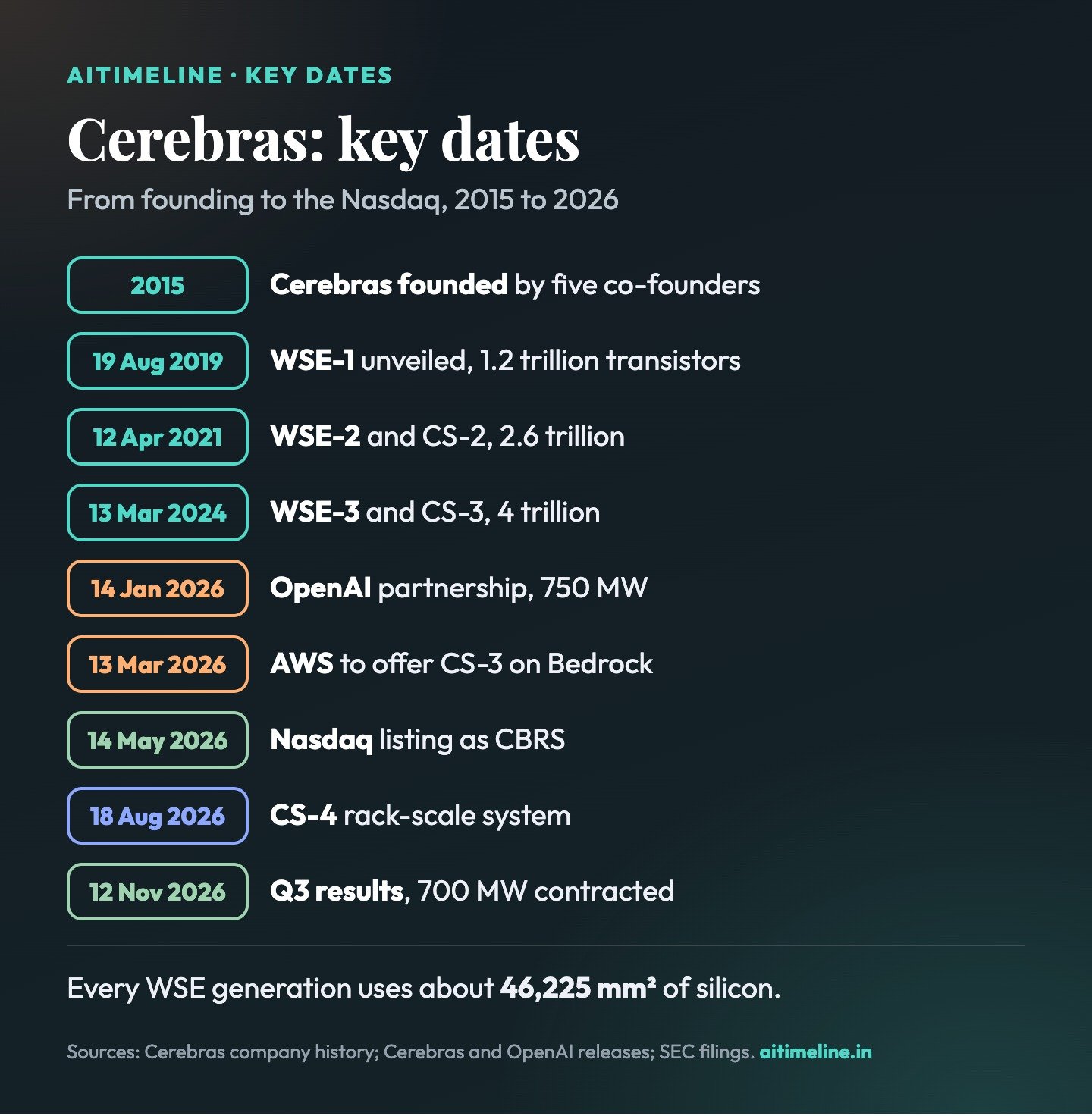
The Lead Picture: Key Dates, 2015 to 2026
Nine dates in order.
Cerebras Systems: Key Questions
What the Record Shows
- One wafer, one chip: every WSE generation uses about 46,225 square millimetres of silicon.
- Founded 2015: by five co-founders, including CEO Andrew Feldman.
- Three generations in five years: 1.2 trillion transistors in 2019, 2.6 trillion in 2021, 4 trillion in 2024.
- The pivot to inference: cloud and partner demand drove growth after 2025, and GAAP cloud revenue rose 265% in Q3 2026.
- OpenAI and AWS: 750 MW announced on 14 January 2026 and a Bedrock collaboration on 13 March 2026.
- Public since May 2026: $185 a share and about $6.38 billion gross.
- CS-4 shifts the unit to the rack: three wafers, 750 petaflops, and a claimed 30 times GPU speed on one model.
- Revenue is growing but losses persist: $210.8 million GAAP in Q3 2026 with a $161.2 million GAAP net loss.
- The roadmap is targets: CS-5 for early summer 2027 and CS-6 with 3D-stacked DRAM have no guaranteed performance.
Timeline: Cerebras Systems, 2015 to 2026
Newest first. Labels mark origins, wafer generations, inference and cloud, the public company and the next generation.
Third-quarter results: 700 MW under contract Public company
The numbers: Cerebras reported GAAP revenue of $210.8 million, up 55% year on year, and core (non-GAAP) revenue of $230.9 million, up 70%. GAAP cloud and other services revenue rose 265% to $141.9 million, while GAAP hardware revenue fell to $68.9 million from $96.8 million a year earlier. The GAAP net loss was $161.2 million, against core net income of $29.8 million.
Capacity and customers: The company said it had secured 700 gross megawatts of data-centre capacity for delivery by the end of 2027, announced commercial wins with two new hyperscalers and described a cloud deal with a top-three hyperscaler, with more to be shared next year. It also named Flex and Sanmina as manufacturing partners and said it expected to exit 2026 with more than ten times its manufacturing capacity at the start of the year. Full-year core revenue guidance was raised to $940 to $960 million, and its next-generation WSE-5 was reported back from the fab and in system testing.
Oracle plans Cerebras inference on OCI Inference and cloud
What was announced: Cerebras and Oracle announced plans to make Cerebras inference available on Oracle Cloud Infrastructure for AI labs, enterprises and developers. The release says availability is planned in calendar year 2027.
What was not said: No contract value, system count or region list was given. Oracle’s cloud adds another route to market beside the AWS arrangement announced in March.
Hot Chips: CS-5 and CS-6 roadmap Next generation
CS-5: Cerebras said CS-5, built on its next-generation WSE and targeted for 2027, is designed to produce up to 10,000 output tokens per second per user on leading open-source models. For multi-trillion-parameter models it targets up to 5,000 tokens per second per user and 3 million tokens per second per megawatt.
CS-6: CS-6 is described as a 3D design that pairs wafer-scale SRAM and compute with 3D-stacked DRAM through ultra-high-bandwidth connections, to add memory capacity while keeping data local. Cerebras said work on it began in 2024.
CS-4 and the Nexus rack-scale platform Next generation
The system: CS-4 is built from three new Wafer Scale Engine 3 Turbo (WSE-3T) processors in the first system of the Nexus platform. Cerebras lists 750 petaflops of AI compute, 7.2 terabits per second of I/O, 129.6 petabytes per second of memory bandwidth and 160.5 petabytes per second of total compute-fabric bandwidth, with wafer-to-wafer latency as low as two microseconds.
The claim: The company says CS-4 is up to twice as fast as CS-3, with up to 10 times the throughput per watt, and up to 30 times faster than GPU solutions per user: more than 4,400 tokens per second per user on GPT-OSS-120B in a head-to-head test. The WSE-3T keeps the WSE-3’s 4 trillion transistors, 900,000 cores, 46,225 square millimetres and 44 GB of SRAM, but doubles compute to 250 petaflops per wafer.
First-quarter results as a public company Public company
Results: GAAP revenue was $193.4 million, up 94% year on year, and core revenue was $191.3 million, up 92%. The GAAP net loss was $14.0 million. The company set full-year 2026 core revenue guidance at $855 to $865 million, since raised.
Commitments: The release describes the OpenAI agreement as a multi-year deal for 750 MW valued at more than $20 billion, notes a $1 billion working-capital loan from OpenAI in January, and lists the AWS partnership.
Cerebras lists on Nasdaq as CBRS Public company
The offering: Class A shares began trading on 14 May 2026 under the ticker CBRS. The company announced the closing of its IPO on 15 May: 34.5 million shares at $185 each, including the underwriters’ full option of 4.5 million shares, for about $6.38 billion in gross proceeds before fees and expenses.
The banks: Morgan Stanley, Citigroup, Barclays and UBS Investment Bank were lead book-running managers.
AWS to deploy CS-3 systems and offer them on Bedrock Inference and cloud
The plan: Amazon Web Services said it would deploy Cerebras CS-3 systems in its data centres and offer them through Amazon Bedrock, running open-source models and Amazon’s Nova models.
Disaggregated inference: The companies are also building an architecture that splits inference in two: AWS Trainium handles prefill, which processes the prompt, and sends the result over Amazon’s Elastic Fabric Adapter to the Cerebras WSE, which handles decode, generating the answer. Cerebras claims this gives five times more high-speed token capacity in the same hardware footprint.
OpenAI partners with Cerebras for 750 MW Inference and cloud
The announcement: OpenAI said it was partnering with Cerebras to add 750 megawatts of ultra low-latency AI compute to its platform. The capacity comes online in multiple tranches through 2028 and is integrated into OpenAI’s inference stack in phases.
Why: OpenAI said the aim was faster responses for hard questions, code generation, image creation and AI agents, citing Cerebras’s approach of putting compute, memory and bandwidth together on one giant chip.
From chip maker to inference provider Inference and cloud
Adoption: Cerebras says its technology was powering Meta’s Llama API, Perplexity and Mistral, with integrations through Hugging Face and OpenRouter. It also announced rapid data-centre expansion across North America and Europe.
The shift: The business moved from selling on-premises systems towards pay-as-you-go cloud inference, which is the revenue line that later grew 265% in the third quarter of 2026.
WSE-3 and CS-3: four trillion transistors Wafer generations
The chip: The third-generation Wafer Scale Engine has 4 trillion transistors, 900,000 AI cores, 44 GB of on-chip SRAM and 125 petaflops of peak AI performance on TSMC’s 5 nm process. Cerebras said it doubles WSE-2 performance at the same power draw and price.
The system: The CS-3 was offered with 1.5 TB, 12 TB or 1.2 PB of external memory, to train models of up to 24 trillion parameters, in clusters of up to 2,048 systems. Cerebras said such a cluster could train Llama 70B from scratch in a day.
Condor Galaxy 1 with G42 Wafer generations
The system: With the UAE-based G42, Cerebras unveiled the Condor Galaxy network of AI supercomputers. The first, CG-1, was announced with 4 exaFLOPs of FP16 performance and 54 million cores, built from 64 CS-2 systems.
Why it mattered: It showed wafer-scale processors being combined into very large installations, rather than sold one system at a time.
Gordon Bell Special Prize Wafer generations
The prize: Researchers at Argonne National Laboratory won the Gordon Bell Special Prize for work on COVID-19 variants, powered by a Cerebras CS-2 cluster.
Recognition: In the same year Cerebras says the WSE-2 was honoured by the Museum of Computing as an epochal achievement in chip-making.
NETL reports a large speed-up on field equations Wafer generations
The result: Teams at the US National Energy Technology Laboratory found that a CS-2 system was nearly 500 times faster than NETL’s Joule supercomputer in field-equation modelling, according to Cerebras.
The significance: It pointed to uses beyond neural-network training, in scientific simulation. It is one workload on one comparison machine, so it does not generalise to all simulations.
WSE-2 and CS-2 Wafer generations
The chip: The second-generation Wafer Scale Engine had 2.6 trillion transistors and 850,000 AI cores, made by TSMC on its 7 nm process. Cerebras compared it with the largest GPU of the time, which had 54 billion transistors, and said the CS-2 more than doubled the CS-1’s performance.
Memory: Later in 2021 Cerebras added MemoryX, an external memory system that stores model weights outside the processor, to support very large models.
WSE-1: the largest chip ever built Origins
The chip: The first Wafer Scale Engine contained more than 1.2 trillion transistors across 46,225 square millimetres, with 400,000 AI-optimised cores and 18 GB of on-chip SRAM, made by TSMC on a 16 nm process. Cerebras said it was 56.7 times larger than the largest GPU of the day, which measured 815 square millimetres.
The system: The CS-1 system, which made the technology available in data centres, followed the same year.
Solving yield, power, cooling and packaging Origins
The problems: Cerebras later named the decades-old challenges that had limited chip size: cross-reticle connectivity, yield, power delivery and packaging. A defect anywhere on a wafer-sized chip could otherwise ruin it, so the design needs spare cores and routing to work around flaws.
The partner: The company said it worked for years with TSMC, whose wafer process had to meet very strict defect-density requirements for such a large die.
Cerebras Systems is founded Origins
The founders: Andrew Feldman, Gary Lauterbach, Michael James, Sean Lie and Jean-Philippe Fricker launched Cerebras in 2015 with the aim of bringing wafer-scale computing to market.
The bet: The company says that at the time it was unclear whether such a feat was technically possible.
The WSE Generations: What Changed
Transistors, cores and memory, 2019 to 2026.
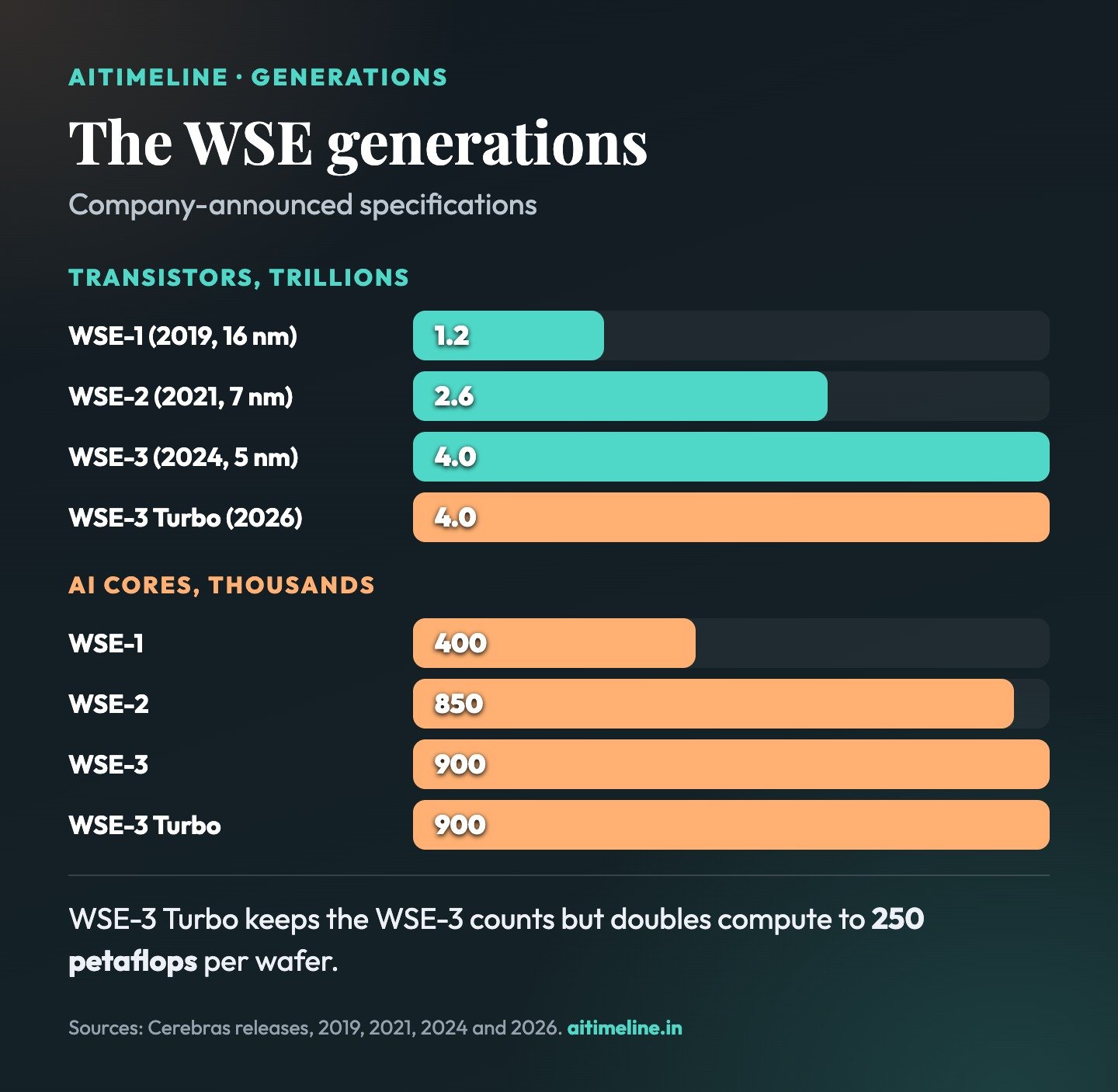
Transistor count and core count rose steeply across the first three generations, then flattened. The WSE-3 Turbo in CS-4 keeps the WSE-3’s 4 trillion transistors, 900,000 cores, 46,225 square millimetres and 44 GB of SRAM, and doubles compute to 250 petaflops per wafer and memory bandwidth to 43.2 petabytes per second. Cerebras’s later gains therefore come from system design as much as from the chip.
Wafer-Scale Versus GPUs
Different answers to the same data-movement problem.
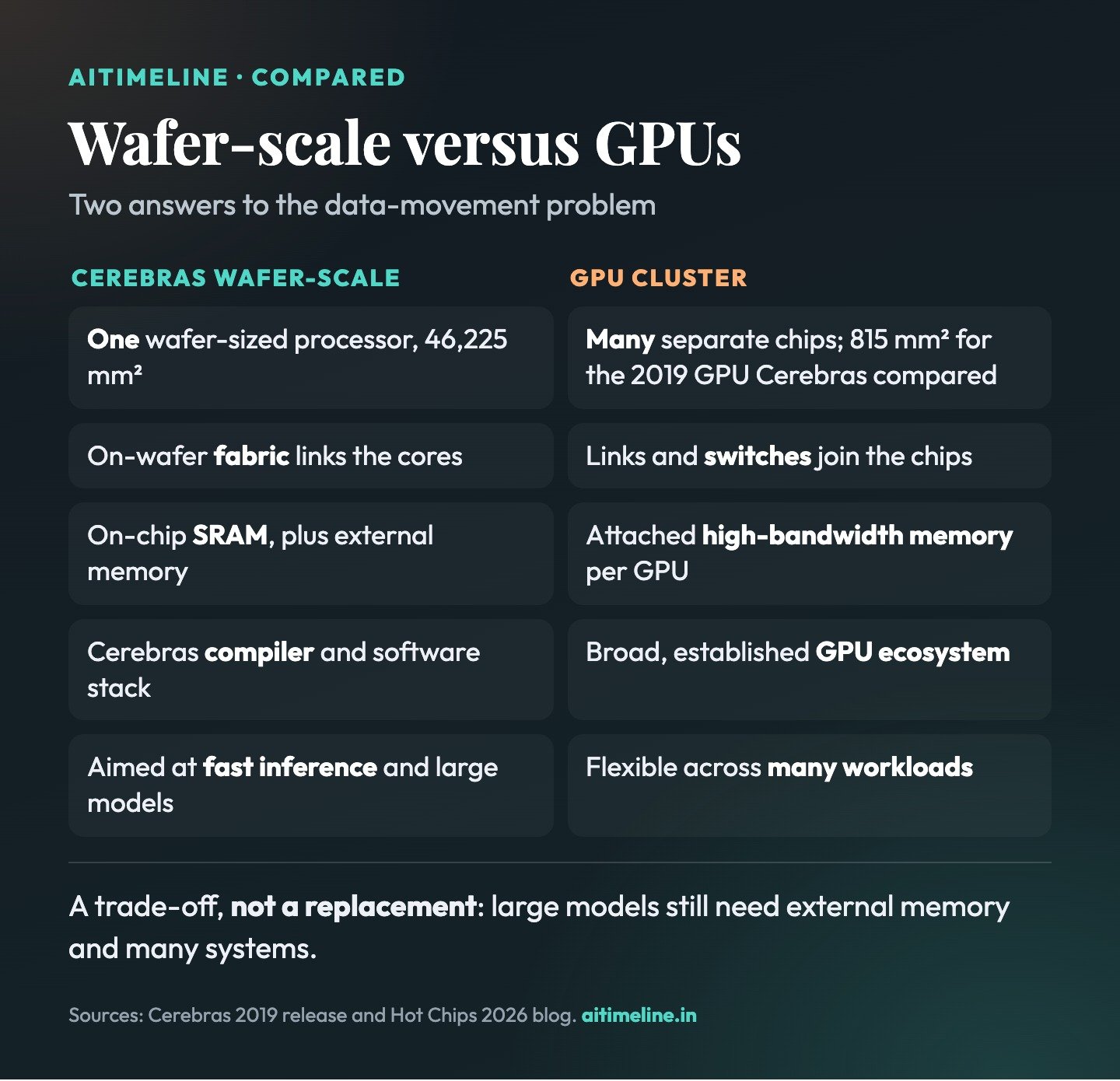
Cerebras argues that conventional systems scale by joining many GPUs through external links and switches, so data must leave one chip and cross the system for each step, and that this overhead can take as long as the computation at small batch sizes. Its answer is to keep more of that traffic on one wafer. GPUs counter with a broad software ecosystem, a large installed base and flexibility across many workloads. This is a trade-off, not a replacement: very large models still need external memory and many systems.
CS-4: The Rack Becomes the Product
What Cerebras announced in August 2026.
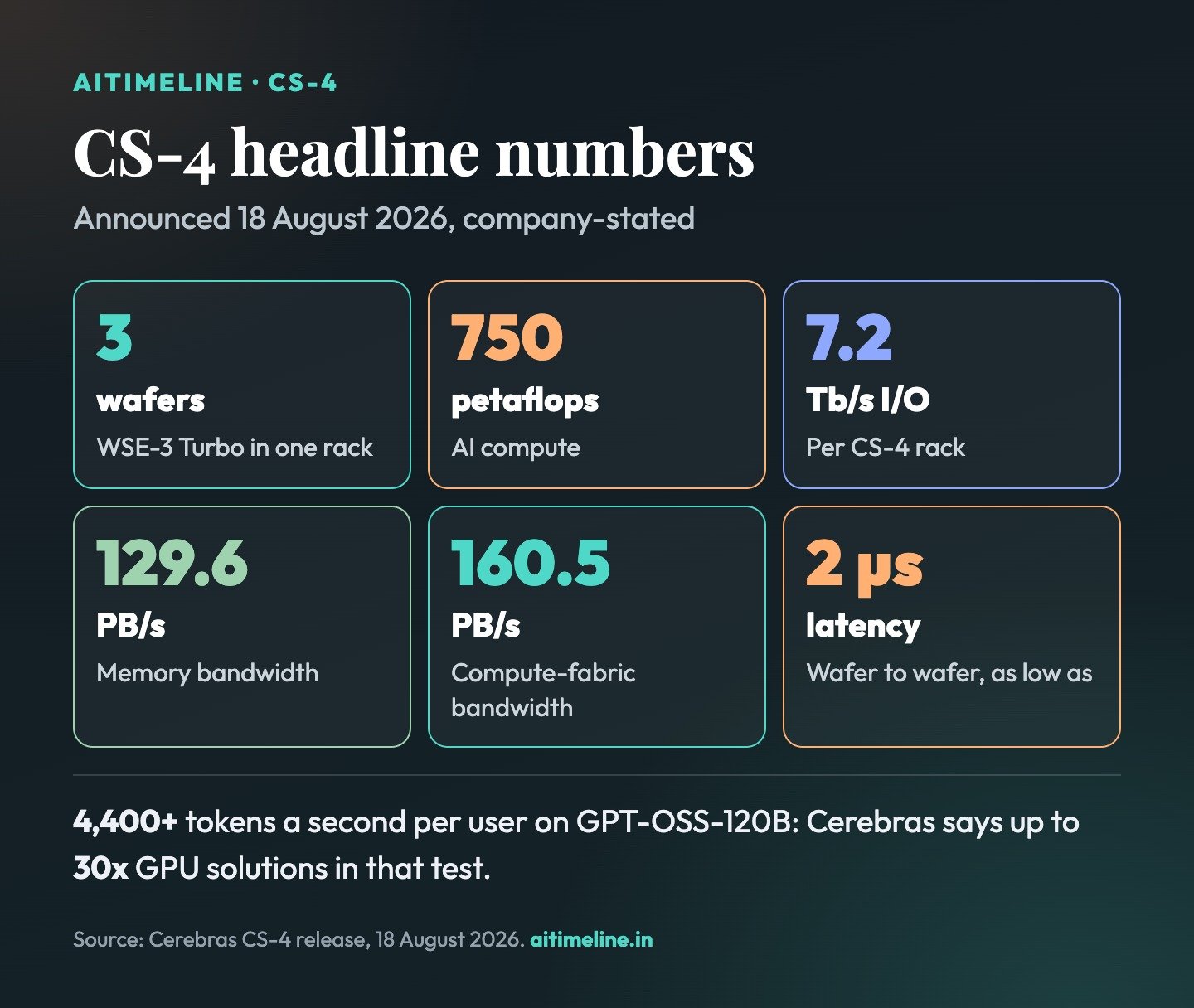
CS-4 is the first system of the Nexus platform: three wafers, each in a pluggable backpack that folds power conversion, liquid cooling and I/O around the wafer. Cerebras says power conversion sits about 0.5 millimetres from the wafer, against roughly 50 millimetres on GPU boards. It says first shipments began in the quarter of the announcement.
The Deals: OpenAI, AWS, Oracle and the IPO
Four routes to market in ten months.
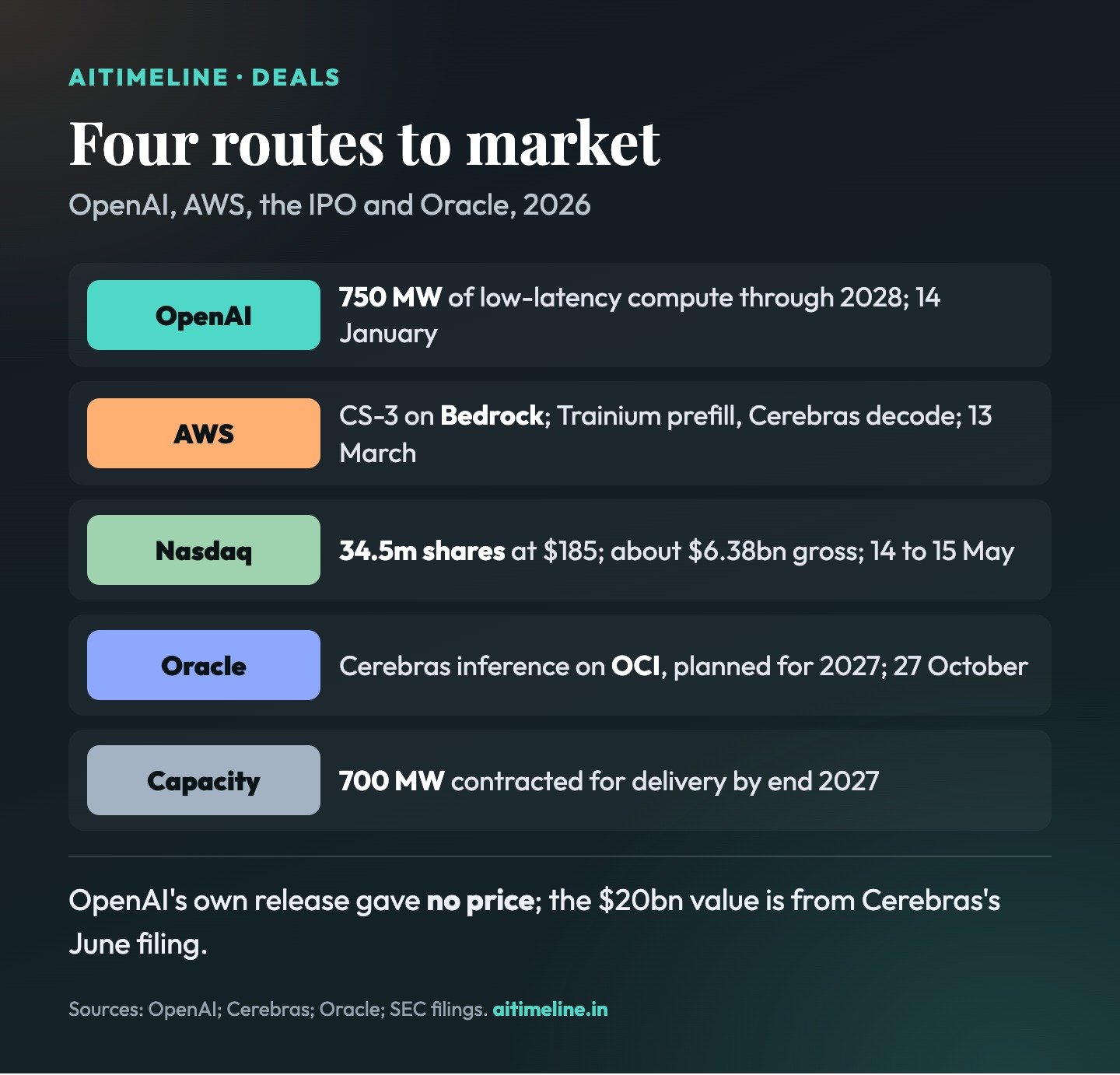
OpenAI’s announcement gave capacity in megawatts and no price. Cerebras’s own June filing put the deal at more than $20 billion and recorded a $1 billion working-capital loan from OpenAI. AWS and Oracle are distribution deals, with Oracle’s planned for 2027. Together they reduce reliance on selling single systems, but they also commit Cerebras to deliver large amounts of capacity on schedule.
The Money: Revenue, Losses and Capacity
First and third quarter of 2026.
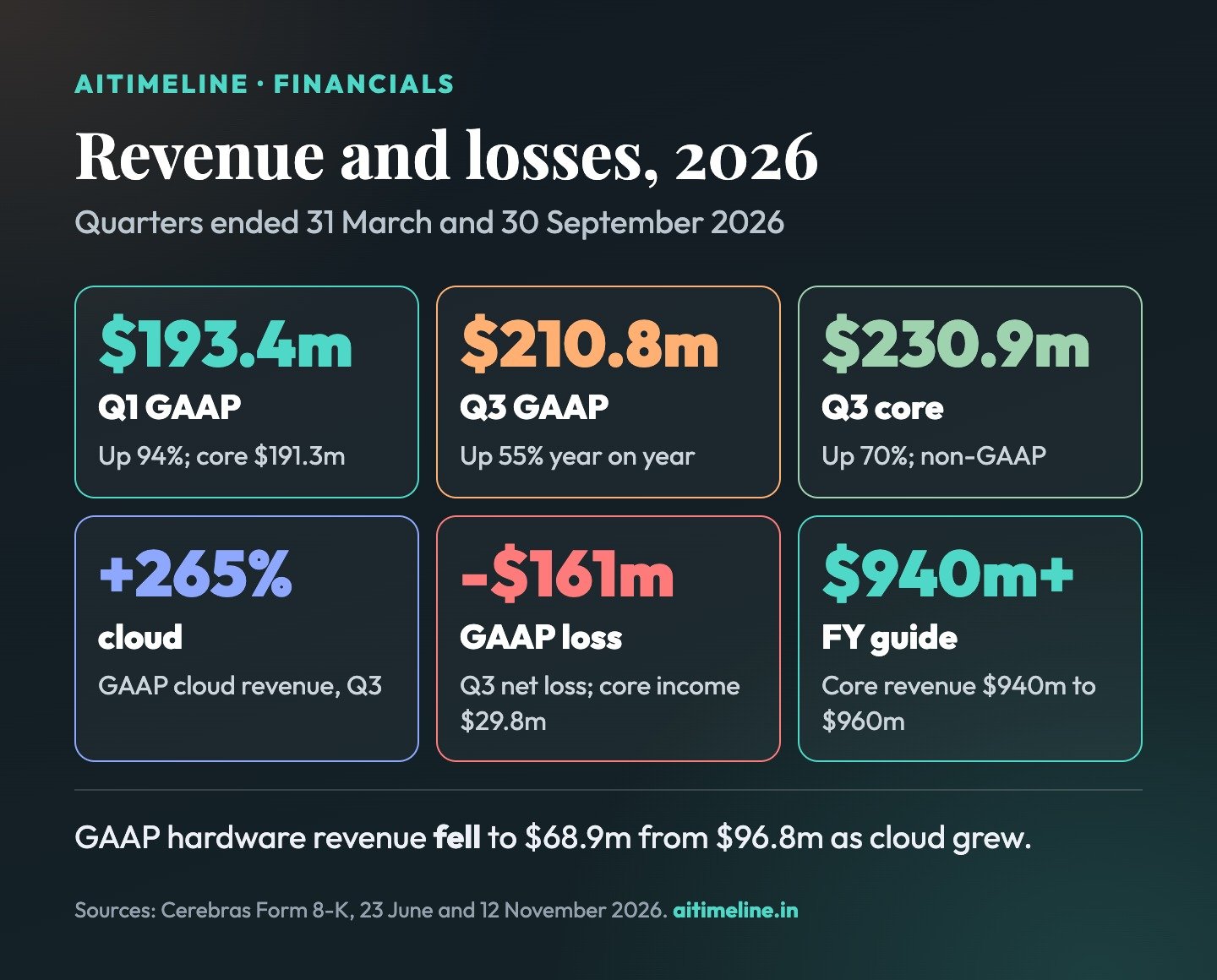
GAAP and core figures differ, and the third quarter shows the gap clearly: $210.8 million GAAP against $230.9 million core, a GAAP net loss of $161.2 million and core net income of $29.8 million. GAAP hardware revenue fell while cloud revenue surged, which fits the shift from selling systems to selling tokens. Figures come from Cerebras’s filings and are not independently audited by us.
The Roadmap: CS-5, CS-6 and What Could Slip
Targets, not deliveries.
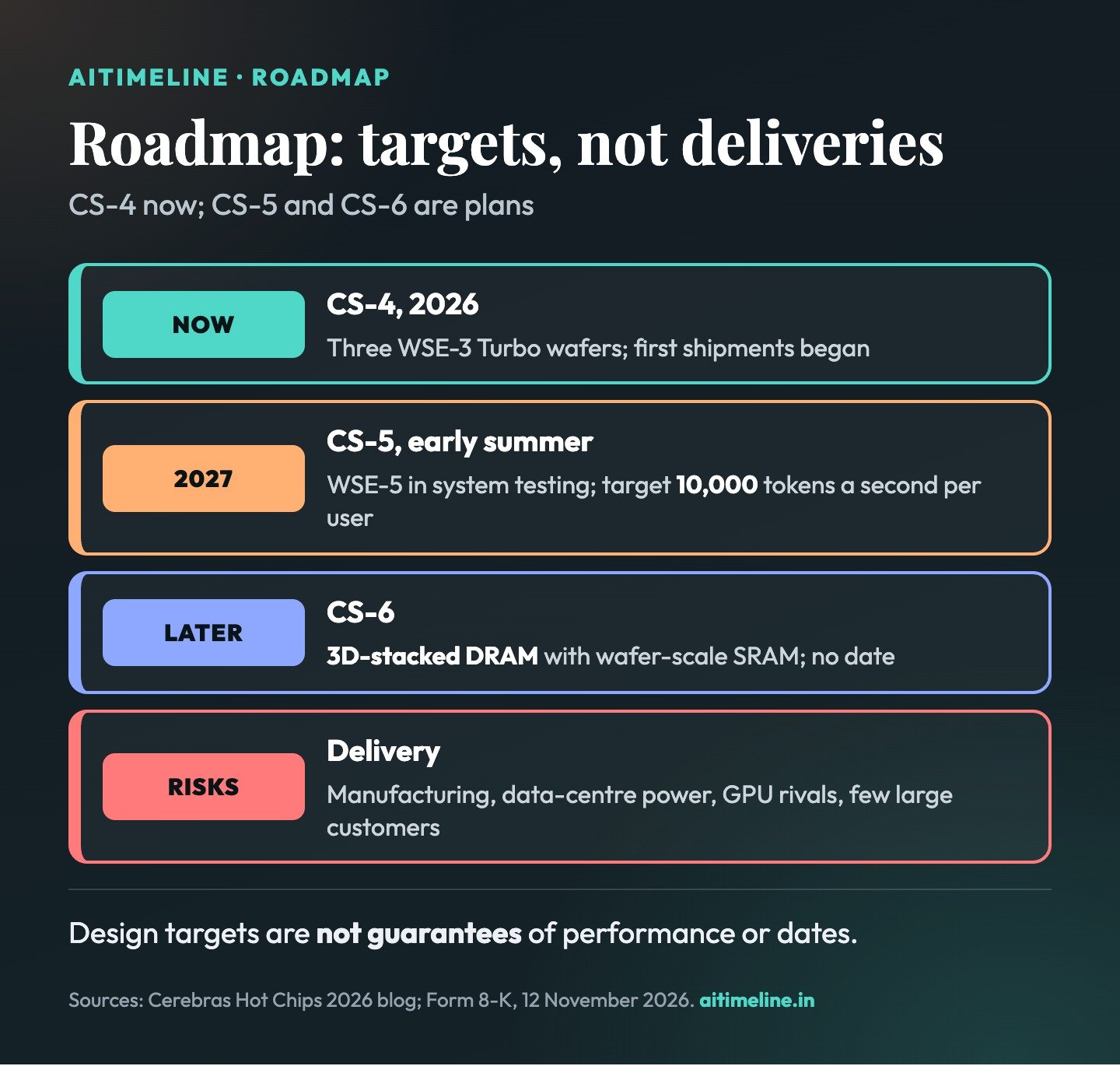
The roadmap depends on execution: manufacturing capacity, data-centre power and cooling delivered on time, and a continued speed lead as GPU platforms improve. Cerebras also depends on a small number of very large customers. The WSE-5 was reported in system testing in November 2026, but a chip in testing is not a product in production.
Source Gaps and Corrections
| Claim in the brief or earlier draft | What we found | Status |
|---|---|---|
| Founded in 2016 (earlier draft) | Cerebras’s company history says 2015 | Corrected |
| WSE-3 Turbo specs “not stated” | The CS-4 release gives them: 4 trillion transistors, 900,000 cores, 44 GB SRAM, 250 petaflops per wafer | Added |
| NETL 2021: “major performance gains” | Cerebras says nearly 500 times faster than Joule; we could not find the NETL study | As reported |
| WSE-3 announced March 2024 | The release page is dated 11 March, the dateline says 13 March | 13 March used |
| OpenAI deal: 750 MW only | The $20 billion value and $1 billion loan come from Cerebras’s June filing, not OpenAI | Attributed |
| Oracle partnership, October 2026 | Announced 27 October; availability planned for 2027, no contract value | Hedged |
| 30 times faster inference than GPUs | One comparison on GPT-OSS-120B with identical prompts; Cerebras says results vary | Hedged |
| Q3 results page on the company site | Returned an access error; we used the SEC-filed press release | Verified |
| Core revenue above GAAP in Q3 | Confirmed: $230.9 million core against $210.8 million GAAP | Explained |
Conclusion: From One Giant Chip to a Rack-Scale Business
Cerebras began as an engineering bet that a whole wafer could be one working processor. WSE-1 showed it could be built, WSE-2 and WSE-3 made it larger, and the company then found its market in fast inference rather than training alone. OpenAI, AWS and Oracle, followed by a $6.38 billion IPO, turned that bet into a public company.
What the record does not show is that wafer-scale will replace GPUs. The largest speed claims are company-reported, losses remain on a GAAP basis, and the 2027 roadmap is a set of targets. The test is delivery: capacity on time, at reliable cost, as competitors improve.
Explore More Timelines
People Also Ask
Frequently Asked Questions
⚠️ Editorial Note
This page draws on Cerebras’s own press releases, blog posts and SEC filings, and on OpenAI’s announcement. Product specifications, benchmark comparisons and roadmap dates are company-announced and have not been independently verified across workloads. It is editorial journalism, not investment advice, and it does not forecast the CBRS share price.
Related Stories
Sources & further reading
Every dated entry above was checked against these references. Last reviewed 28 November 2026.
- Cerebras: Company history and milestones
- Cerebras: Unveils the Industry's First Trillion Transistor Chip (19 August 2019)
- Cerebras: Second Generation Wafer Scale Engine, WSE-2 (12 April 2021)
- Cerebras: Third Generation WSE-3 and CS-3 (13 March 2024)
- OpenAI: OpenAI partners with Cerebras (14 January 2026)
- Cerebras: Cerebras is coming to AWS (13 March 2026)
- Cerebras: Closing of Initial Public Offering (15 May 2026)
- Cerebras: CS-4 announcement (18 August 2026)
- Cerebras: Deep Dive at Hot Chips 2026 (25 August 2026)
- Cerebras and Oracle bring Cerebras AI inference to Oracle Cloud Infrastructure (27 October 2026)
- Cerebras Systems Form 8-K: third quarter 2026 results (12 November 2026)