Is a Red Sea Defence Alliance Really Forming? Inside the Pacts, Patrols and Politics
No single Red Sea Defence Alliance exists. See what CTF-153, EU Aspides, Prosperity Guardian and the new Saudi-Turkey-Pakistan pact actually cover.
Latest Story
Somewhere south of Jeddah, a container ship’s third officer is not thinking about grand strategy. He is thinking about the next watch schedule, whether the insurer’s war-risk premium got paid before the policy lapsed, and whether the automatic identification system transponder should stay on or off through the Bab el-Mandeb strait tonight – on, and a hostile radar operator can see exactly who you are; off, and a passing warship from one of three different naval missions might treat you as unidentified. That is the granular, unglamorous reality behind a headline phrase that gets thrown around a lot right now: “Red Sea defence alliance.” There is no single organization by that name. What exists instead is a stack of separate, overlapping arrangements – some of them warships, some of them paper agreements, one of them signed as recently as August 7, 2026, in Mecca – built up over four years of crisis, war and partial recovery in one of the world’s most important and most fought-over stretches of water. This piece tries to sort out exactly what is real, what is signed, what is reported, and what is still just analysts talking, because on a subject this consequential, that distinction is the whole story. Red Sea security is not one thing. It is at least six things happening at once, and they do not all point the same direction.
🧠 AI Overview Summary
There is no single, formally named “Red Sea Defence Alliance.” What exists is a set of overlapping arrangements: the US-led Operation Prosperity Guardian, the EU’s defensive EUNAVFOR Aspides mission, the multinational Combined Maritime Forces’ CTF-153, and – since August 7, 2026 – the trilateral Mecca Joint Defence Agreement between Saudi Arabia, Turkey and Pakistan, a mutual-defence pact that officials describe as regional deterrence, not a Red Sea-specific or NATO-style bloc. Houthi attacks on Red Sea shipping, which began in November 2023, paused after an October 2025 Gaza ceasefire, and resumed threats in August 2026 amid the wider Iran war, remain the central driver of why this patchwork keeps expanding.
The Core Question: Is a New Red Sea Security Order Emerging?
What’s Actually True Right Now
- No single alliance exists. “Red Sea Defence Alliance” describes a phenomenon – overlapping security activity – not a registered organization with members, a headquarters or a budget.
- Three naval missions currently operate in or near the Red Sea corridor: CTF-153 (Combined Maritime Forces), EUNAVFOR Aspides (EU), and Operation Prosperity Guardian (US-led coalition). They report to different chains of command and were not designed to merge.
- The Mecca Joint Defence Agreement (Aug 7, 2026) between Saudi Arabia, Turkey and Pakistan is a mutual-defence pact, not a maritime-security mission – it says nothing publicly about Red Sea patrols.
- It builds on an existing bilateral pact: the September 2025 Saudi-Pakistan Strategic Mutual Defence Agreement, which Riyadh had already invoked once during the 2026 Iran war.
- Houthi attacks paused, then flickered back on. A near-total pause followed the October 2025 Gaza ceasefire; threats against tankers resumed in early August 2026, tied to the wider US-Israel-Iran conflict and Saudi Arabia’s rerouting of its own tankers.
- Suez Canal traffic is recovering but still well below its pre-crisis baseline, even as revenue climbs – carriers are cautious, not convinced.
- Iran has publicly dismissed the new pact as unable to buy Gulf states real security, while stopping short of declaring it a target.
- Egypt, not any single Gulf state, has the most direct financial stake in Red Sea stability – canal transit fees are one of its largest hard-currency earners.
- India, though not a treaty party to anything discussed here, is arguably the country with the most exposed trade route through this corridor.
- Nothing here has an Article 5-style enforcement history. Every mutual-defence clause in this region remains, in the words of one Gulf analyst, more a political signal than a proven war guarantee.
What’s Real Right Now, in Three Cards
The three arrangements below are documented, operating structures. A single unified “Red Sea Defence Alliance” combining them is not one of the three – it does not exist.
Official Agreement
Multilateral Task Force
Military Operation
Not shown here because it is not a maritime mission: the Mecca Joint Defence Agreement (Aug 7, 2026) is a mutual-defence pact between Saudi Arabia, Turkey and Pakistan – covered in full further down.
Master Timeline: From Suez to Mecca
Newest first. Labels mark source type – [Official Agreement], [Military Operation], [Diplomatic Development], [Shipping], [Historical], [Reported] or [Analysis] – so you can see at a glance what’s confirmed versus interpreted.
Houthis threaten Saudi oil tankers in the northern Red Sea
What happened: Houthi spokesperson Yahya Saree said the group would target Saudi oil tankers in the northern Red Sea, framing it as retaliation for Riyadh directing its own tankers away from the Bab el-Mandeb chokepoint toward a longer, safer southern routing.
Why it mattered: It was the clearest signal that the relative maritime calm since the October 2025 Gaza ceasefire was fraying, and that Houthi targeting logic had shifted from “ships linked to Israel” toward a broader set of tankers tied to Saudi Arabia.
Red Sea impact: Underwriters immediately began repricing war-risk premiums for northern Red Sea transits; several carriers held vessels at anchor pending clarity.
Saudi Arabia, Turkey and Pakistan sign the Mecca Joint Defence Agreement
What happened: Crown Prince Mohammed bin Salman, Turkish President Recep Tayyip Erdogan and Pakistani Prime Minister Shehbaz Sharif signed a trilateral pact stating that “any armed attack against any one of the three states shall be regarded as an attack against them all.” It followed roughly a year of negotiation.
Why it mattered: It is the first trilateral collective-defence pact among these three states, combining Turkey’s NATO-linked military capability, Saudi financial weight and Pakistan’s nuclear-armed military. It arrived amid the ongoing Iran war and Iranian-linked strikes on Saudi territory.
Red Sea impact: None stated. The published text and official statements from all three governments describe collective deterrence against aggression on member territory – not a Red Sea patrol mandate, naval commitment or Bab el-Mandeb mission.
Strait of Hormuz reopening collapses
What happened: The brief reopening of Hormuz negotiated under the June 14 US-Iran interim deal broke down after attacks on commercial vessels resumed, pushing the strait back toward effective closure to routine traffic.
Why it mattered: It confirmed that the Iran war’s maritime fallout was not confined to Hormuz alone – shippers were now weighing risk in two chokepoints simultaneously, a combination without a recent precedent.
Red Sea impact: Indirect but significant – some tonnage that might otherwise have used Hormuz-adjacent Gulf ports shifted further scrutiny onto Red Sea/Bab el-Mandeb routing decisions, compounding underwriting complexity for the whole region.
US-Iran interim deal, mediated by Pakistan
What happened: Washington and Tehran agreed an interim deal that included reopening the Strait of Hormuz, ending Hezbollah-Israel hostilities in Lebanon, and a 60-day cessation of hostilities.
Why it mattered: It was the first sign the wider Iran war might be winding down through diplomacy rather than further strikes, and it put Pakistan in an unusual mediator role between Washington and Tehran even as it deepened security ties with Riyadh.
Red Sea impact: Contributed to a temporary lull in Houthi threats against shipping through much of June and into early July.
First ceasefire in the 2026 Iran war
What happened: After roughly 40 days of sustained combat following the February 28 strikes, a ceasefire took hold between Israel, the US and Iran.
Why it mattered: It offered the first real pause in a conflict that had already reshaped Gulf threat perceptions, accelerating the diplomatic track that eventually produced both the June Hormuz deal and the August Mecca pact.
Red Sea impact: Eased some tanker-routing risk temporarily, though underlying Houthi capability and intent were untouched by the ceasefire.
Iran declares the Strait of Hormuz closed; Saudi-Pakistan pact invoked
What happened: Iranian forces declared Hormuz “closed” and attacked transiting ships. Around the same period, Saudi Arabia invoked its September 2025 Strategic Mutual Defence Agreement with Pakistan; Pakistan reportedly deployed troops, JF-17 aircraft, drone squadrons and air-defence systems to Saudi territory.
Why it mattered: It was the first real-world test of a modern Gulf mutual-defence clause under wartime conditions – a data point directly relevant to how much weight the August Mecca pact’s similar language should carry.
Red Sea impact: Shipping lines including Maersk, MSC, CMA CGM and Hapag-Lloyd suspended Hormuz transits; some rerouting pressure spilled into Red Sea and Gulf of Aden risk calculations as insurers repriced the whole region.
US and Israel strike Iran; Supreme Leader Khamenei killed
What happened: The US and Israel launched coordinated strikes on Iranian nuclear, military and leadership targets. Supreme Leader Ali Khamenei was killed, along with several senior Iranian military officials; Iran’s government confirmed his death on March 1, and Mojtaba Khamenei was named the new Supreme Leader on March 8-9.
Why it mattered: This is the single event that most directly reshaped Gulf security calculations in 2026 – it triggered the Hormuz crisis, hardened Saudi threat perceptions, and forms the direct backdrop against which the Mecca pact was negotiated and signed five months later.
Red Sea impact: Iran’s retaliatory missile and drone barrage, and the broader war footing across the region, elevated risk perceptions along the entire Red Sea-Gulf-Hormuz corridor simultaneously.
EU extends Aspides mandate to February 2027
What happened: The Council of the EU extended EUNAVFOR Aspides’ mandate by a further year, with a financial reference amount of roughly €15 million for the March 2026-February 2027 period, following a strategic review.
Why it mattered: It confirmed the EU still viewed the mission as necessary two years after launch, even amid signs of partial de-escalation – a hedge against exactly the kind of renewed threats seen months later.
Red Sea impact: Kept a defensive European naval presence in the corridor without expanding its mandate beyond escort and defensive engagement.
Red Sea shipping stays deeply depressed even as some carriers test transits
What happened: Red Sea traffic remained roughly 60% below pre-crisis levels even as isolated carriers, including CMA CGM, began testing eastbound Suez transits with larger vessels.
Why it mattered: It showed the industry’s caution outlasted the initial Houthi pause – trust, once lost, does not return on the same timeline as the ceasefire that triggered the lull.
Red Sea impact: Suez Canal Authority still posted a revenue uptick (~$449 million in early 2026) as some traffic returned, but nowhere near 2023 volumes.
Houthis pull back from Red Sea shipping attacks
What happened: Following the October 2025 Gaza ceasefire, Houthi forces effectively paused large-scale maritime attacks; no sustained, confirmed missile or drone strikes on merchant vessels were recorded from roughly November 11, 2025 until late February 2026.
Why it mattered: It was the longest sustained lull since the campaign began in November 2023, and it directly tied Red Sea shipping safety to the separate Israel-Hamas track – a linkage that would later break when the wider Iran war began.
Red Sea impact: Enabled the first meaningful uptick in carrier confidence and Suez transit numbers since 2023.
US-brokered Gaza ceasefire
What happened: A US-brokered ceasefire took hold in the Israel-Hamas war in Gaza.
Why it mattered: The Houthis had explicitly tied their maritime campaign to the Gaza war, so a ceasefire there removed the group’s stated justification for continuing to target shipping – even though analysts cautioned the freight fleet would not snap back to the Red Sea quickly regardless.
Red Sea impact: Set up the November pause in attacks, though CNBC and others warned recovery would be gradual, not immediate.
Saudi Arabia and Pakistan sign the Strategic Mutual Defence Agreement
What happened: Saudi Arabia and Pakistan signed a bilateral mutual-defence pact at Al-Yamamah Palace, stating any aggression against either country would be treated as aggression against both. It followed Israel’s September 9 strike on Hamas targets inside Qatar, which alarmed Gulf capitals.
Why it mattered: It became the template and legal precedent for the trilateral Mecca pact eleven months later, and it was the agreement Riyadh actually invoked during the March 2026 Iran war escalation.
Red Sea impact: None directly – the SMDA is a bilateral land/air mutual-defence pact, not a maritime-security arrangement.
Egypt’s navy takes command of CTF-153
What happened: The Egyptian Navy assumed command of Combined Maritime Forces’ CTF-153 from the Royal Australian Navy at a ceremony at Naval Support Activity Bahrain.
Why it mattered: It put a Red Sea littoral state with the single largest direct stake in the corridor – the Suez Canal itself – in command of the region’s dedicated multinational maritime-security task force.
Red Sea impact: Signalled growing regional-state leadership within existing multilateral structures, rather than replacement of them with something new.
US Destroyer Squadron 50 takes over Prosperity Guardian’s day-to-day lead
What happened: Destroyer Squadron 50 of US Naval Forces Central Command assumed responsibility for leading Operation Prosperity Guardian from CTF-153, formalizing a clearer separation between the US-led shipping-protection coalition and the multinational CMF task force it had originally worked alongside.
Why it mattered: It clarified, on paper, exactly how many distinct chains of command actually exist in the Red Sea at once – useful context for anyone assuming “the coalition” is a single thing.
Red Sea impact: Administrative rather than operational – continuity of the US-led escort and information-sharing mission.
EUNAVFOR Aspides launches
What happened: The EU launched Operation Aspides (Greek for “shields”), a defensive naval mission under the Common Security and Defence Policy, explicitly separate from the US-led Prosperity Guardian coalition.
Why it mattered: It gave Europe an independent instrument to protect its own shipping interests without folding into a US-commanded operation – a distinction European officials have been careful to maintain ever since.
Red Sea impact: Established a standing, defensively-mandated European naval presence escorting merchant vessels through the Red Sea and Gulf of Aden.
Operation Prosperity Guardian announced
What happened: The US announced a multinational coalition, initially including states such as the UK, Bahrain, Canada, France, Italy, Netherlands, Norway, Seychelles and Spain, to protect shipping in the Red Sea and Gulf of Aden following the surge in Houthi attacks.
Why it mattered: It was the first large coalition response specifically built around the post-October-2023 attack wave, distinct from the pre-existing CTF-153 framework.
Red Sea impact: Established continuous escort presence and an information-sharing mechanism (initially under Operation Prosperity Guardian’s “IMSC” construct) for commercial traffic transiting the corridor.
Houthi forces hijack the Galaxy Leader
What happened: Houthi forces seized the Bahamas-flagged, Japanese-leased car carrier Galaxy Leader in the southern Red Sea, holding its 25 crew members – the majority Filipino – for more than a year before their release.
Why it mattered: It is the conventional starting point of the modern Red Sea shipping crisis and the direct trigger for every naval-coalition response that followed, from CTF-153’s expanded activity to Prosperity Guardian and Aspides.
Red Sea impact: Opened a sustained campaign of missile, drone and small-boat attacks on commercial shipping that would depress Suez Canal traffic for years.
Combined Maritime Forces establishes CTF-153
What happened: CMF, a 34-nation multinational naval partnership headquartered in Bahrain, created a new task force – CTF-153 – dedicated specifically to Red Sea, Bab el-Mandeb and Gulf of Aden maritime security, complementing existing CMF task forces covering piracy and Gulf security elsewhere.
Why it mattered: It pre-dated the Houthi shipping crisis by more than a year, meaning the Red Sea already had a dedicated multinational security structure before the 2023 attacks began – a structure the later crisis response built on top of, rather than started from scratch.
Red Sea impact: Established the standing framework for capacity-building and information-sharing that CTF-153 still runs today.
China opens its first overseas military base, in Djibouti
What happened: The People’s Liberation Army Navy opened its first-ever overseas military base in Djibouti, adjacent to the Chinese-invested Doraleh Multipurpose Port, at the mouth of Bab el-Mandeb.
Why it mattered: It gave Beijing a permanent military foothold at one of the world’s most consequential chokepoints, alongside existing US, French, Italian and Japanese bases in the same small country.
Red Sea impact: Added a great-power military dimension to a corridor already crowded with competing regional and global interests, well before the current shipping crisis began.
Egypt-Israel peace treaty reshapes Red Sea access
What happened: The Camp David-brokered treaty guaranteed Israeli shipping free passage through the Suez Canal and the Straits of Tiran, formally ending the blockade dynamics that had driven earlier wars.
Why it mattered: It removed one of the primary historical triggers for Red Sea military confrontation between Egypt and Israel, stabilizing the northern end of the corridor for decades.
Red Sea impact: Enabled the multi-decade period of relatively unimpeded commercial transit that the current crisis represents such a sharp break from.
Egypt closes the Bab el-Mandeb during the Yom Kippur War
What happened: Egypt blockaded the Bab el-Mandeb strait to Israeli shipping and Israel-bound cargo during the October 1973 war, using the chokepoint as a strategic lever alongside the wider conflict.
Why it mattered: It was the clearest historical demonstration that whoever can influence Bab el-Mandeb can affect a state’s economy without firing a shot at its territory – a logic that echoes directly in how Houthi forces have used the same geography fifty years later.
Red Sea impact: Reinforced the strait’s status as a strategic asset independent of the Suez Canal itself.
Straits of Tiran closure helps trigger the Six-Day War
What happened: Egypt’s closure of the Straits of Tiran to Israeli shipping was among the immediate triggers of the 1967 Arab-Israeli War, after which the Suez Canal itself closed for eight years.
Why it mattered: It is the starkest historical case of a Red Sea-adjacent chokepoint closure leading directly to war, and it shaped Israeli strategic doctrine on freedom-of-navigation red lines for decades afterward.
Red Sea impact: The Suez Canal’s 1967-1975 closure remains the longest disruption in the canal’s modern history, longer even than the 2023-onward Red Sea crisis to date.
Suez Crisis: Egypt nationalizes the canal
What happened: President Gamal Abdel Nasser nationalized the Suez Canal Company; Britain, France and Israel launched a joint military response, which US and Soviet pressure forced them to abandon.
Why it mattered: It ended direct European colonial control over the canal and confirmed Egypt’s sovereign leverage over the world’s most important artificial shipping chokepoint – a leverage every subsequent Egyptian government has guarded closely.
Red Sea impact: Established the modern template: Suez Canal control equals major-power attention, regardless of who is actually fighting over Red Sea access itself.
The Suez Canal opens
What happened: The Suez Canal opened, connecting the Mediterranean directly to the Red Sea and eliminating the need for European-Asian shipping to sail around Africa.
Why it mattered: It is the single event that converted the Red Sea from a regional waterway into an artery of global trade, permanently linking Egyptian sovereignty, European commercial interests and Indian Ocean trade in one geography – the same triangle still driving events in 2026.
Red Sea impact: Created the economic stakes that every subsequent Red Sea conflict, from 1956 to the present Houthi campaign, has ultimately revolved around.
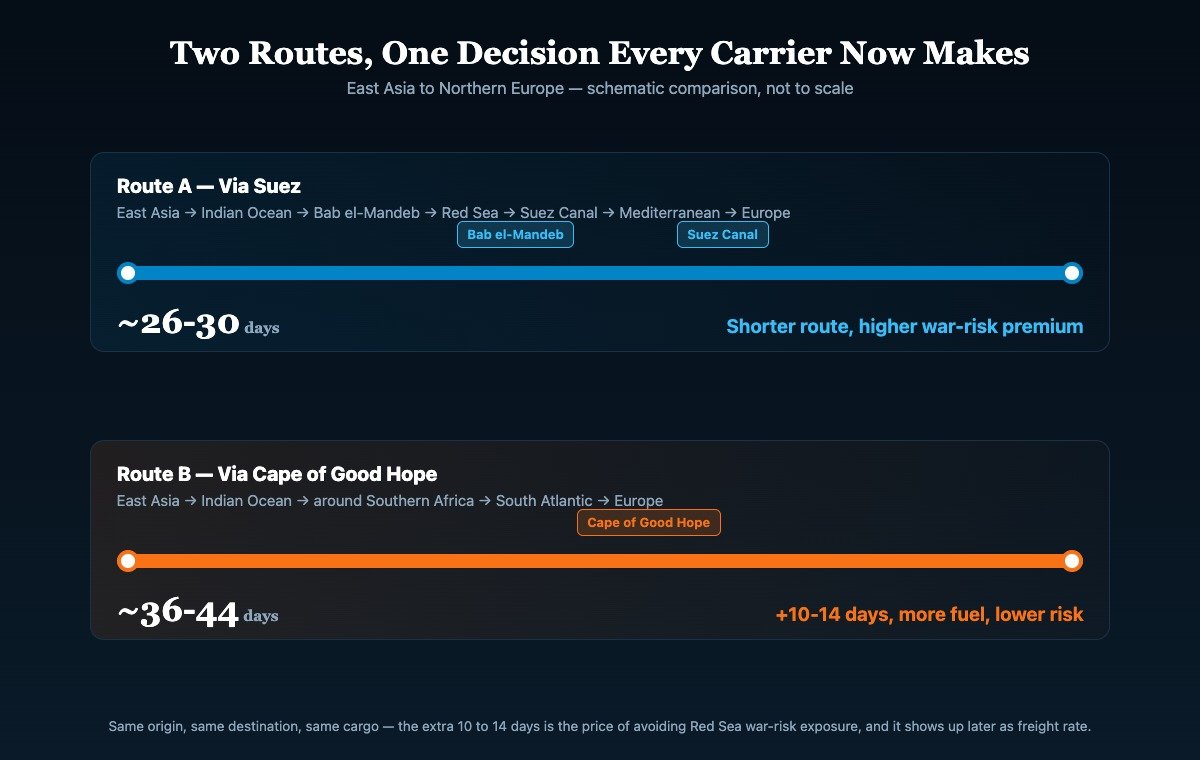
Two routes, one decision every carrier now has to make on every voyage.
Why Bab el-Mandeb Matters
A 26-30 kilometer strait most people who depend on it will never see
Bab el-Mandeb – Arabic for “Gate of Tears” – is the strait separating Yemen from Djibouti and Eritrea, connecting the southern Red Sea to the Gulf of Aden and, from there, the Indian Ocean. At its narrowest, the navigable shipping channel is a few kilometers wide, funneling essentially all northbound Indian Ocean-to-Mediterranean traffic through a space a warship’s radar can watch in its entirety. That geography is precisely what makes it valuable to defend and valuable to threaten: a single actor with shore-based missiles, drones or small fast boats can put a meaningful fraction of world trade at risk without needing a navy at all.
The commercial logic runs in a straight line from there to Suez. Roughly 12-15% of global trade and close to 30% of global container traffic, by widely cited industry estimates, ordinarily transits the Red Sea-Suez corridor – container ships and tankers moving between East Asia, South Asia, the Gulf and Europe use it because the alternative, sailing around Africa’s Cape of Good Hope, adds roughly 3,500-4,000 nautical miles and 10-14 days to a voyage. That is not a rounding error. It is extra fuel, extra crew time, extra insurance exposure and, ultimately, extra cost passed somewhere down the chain – to a shipping line, a retailer, or a consumer.
What makes disruption here different from a purely regional problem is that almost none of the ships transiting Bab el-Mandeb are going to or from a Red Sea country. A container ship carrying Bangladeshi garments to Rotterdam, Indian pharmaceuticals to Marseille, or Gulf crude to a European refinery has no direct stake in Yemen’s civil war – it is simply forced through this specific 26-30 kilometer gap by the physical map of the planet. That is why a conflict most people could not place on a map moves freight rates from Shanghai to Southampton.
The Houthis and the Red Sea
What is documented, what is claimed, and what is contested
The Houthi movement, formally Ansar Allah, is an armed Zaidi Shia political and military group that has controlled Yemen’s capital Sanaa and much of the country’s northern and western territory since seizing it from the internationally recognized government in 2014-2015, triggering Yemen’s ongoing civil war and a Saudi-led military intervention that began in 2015. Iran has provided the Houthis with weapons, training and financial support, according to Western governments and independent researchers; Tehran has generally acknowledged political support for the group while being more circumspect about direct military backing – a distinction worth holding onto, because it is one of the more contested factual points in this entire story.
The Houthis themselves say their maritime campaign, which began in November 2023, targets vessels linked to Israel, the US and the UK in solidarity with Palestinians in Gaza – a stated motivation, not an independently verified targeting logic in every case, since multiple ships with no discernible Israeli, US or UK connection were also struck or seized during the campaign. That gap between the Houthis’ stated rationale and their actual targeting pattern is itself one of the more consequential open questions for insurers and shipping lines trying to assess risk.
Their capability is real and has grown over the campaign: anti-ship ballistic and cruise missiles, one-way attack drones, and remote-controlled or crewed small boats, some supplied or adapted with Iranian-origin components according to Western military assessments. International responses have included direct strikes on Houthi military infrastructure by the US and UK at various points, defensive interceptions by CTF-153, Aspides and Prosperity Guardian vessels, and the broader diplomatic track connecting the group’s behavior to the state of the Gaza war and, more recently, the Iran war. None of that has produced a durable end to the group’s capability or intent – only periods, sometimes lasting months, where both happened to align with restraint.
Operation Prosperity Guardian
US-led multinational coalition announced December 18, 2023, escorting commercial shipping and sharing threat information across the Red Sea and Gulf of Aden. As of 2026, day-to-day leadership sits with US Naval Forces Central Command’s Destroyer Squadron 50. Distinct from CTF-153, though the two have worked alongside each other.
EUNAVFOR Aspides
Launched February 2024 under the EU’s Common Security and Defence Policy with a strictly defensive mandate – protecting merchant shipping, not conducting offensive operations. Mandate extended to February 2027 by the Council of the EU, with a roughly €15 million reference budget for 2026-27.
CTF-153 (Combined Maritime Forces)
Established April 2022 by the 34-nation Combined Maritime Forces partnership, headquartered in Bahrain, for capacity-building and cooperation across the Red Sea, Bab el-Mandeb and Gulf of Aden. Command rotates among member navies; Egypt’s navy led the task force from April 2025.
Mecca Joint Defence Agreement
Signed August 7, 2026 by Saudi Arabia, Turkey and Pakistan – a collective-defence pact treating an attack on one as an attack on all three. No maritime mandate, no Red Sea mission, no announced command structure or troop numbers.
Maritime Security Arrangements, Side by Side
| Arrangement | Purpose | Members | Mandate | Legal Basis | 2026 Status |
|---|---|---|---|---|---|
| CTF-153 | Capacity-building & maritime cooperation | Combined Maritime Forces (34 nations) | Cooperative, non-offensive | CMF charter | Active; Egypt-led command since Apr 2025 |
| EUNAVFOR Aspides | Defensive escort of merchant shipping | EU member states | Defensive only | EU CSDP, UNSCR 2722 | Active; mandate to Feb 2027 |
| Prosperity Guardian | Shipping protection & information-sharing | US-led, 20+ states (many undisclosed) | Escort + limited strikes on threats | US-led coalition, national mandates | Active; led by DESRON 50 |
| Mecca Joint Defence Agreement | Mutual defence of member territory | Saudi Arabia, Turkey, Pakistan | Collective deterrence, not maritime | Trilateral treaty | Signed Aug 7, 2026; untested |
| Saudi-Pakistan SMDA | Bilateral mutual defence | Saudi Arabia, Pakistan | Collective deterrence, not maritime | Bilateral treaty | Active since Sep 2025; invoked Mar 2026 |
Why Egypt Is Central to Red Sea Security
No other country’s economy is as directly wired into Red Sea stability as Egypt’s. Suez Canal transit fees are one of Egypt’s largest sources of foreign currency, alongside tourism, remittances and foreign direct investment – and canal revenue losses over the worst of the 2023-2025 disruption ran to an estimated $9-10 billion, even though that figure represents only around 1% of overall Egyptian GDP, a reminder that “large in absolute terms” and “structurally decisive” are not always the same thing. By early 2026, canal revenues were climbing again – reported quarter-on-quarter growth of 13% in Q2 2026 to roughly $1.26 billion – but Egyptian officials themselves describe the recovery as gradual, tied to shipping-line confidence rather than any single policy decision Cairo controls.
Egypt’s navy has leaned into a regional-cooperation posture rather than acting unilaterally: taking command of CTF-153 in April 2025 rather than standing up a separate Egyptian-led mission. That choice reflects both capability limits and diplomatic calculation – Cairo has strong incentives to keep the canal open and calm, but limited appetite to be seen leading a military campaign against a Yemeni faction it does not control and an Iran it has no interest in provoking directly. Egypt’s relationships with Saudi Arabia, Yemen’s internationally recognized government, and the broader international naval presence in the corridor make it, in practice, a hub state for Red Sea diplomacy even without a formal alliance seat.
Saudi Arabia’s Red Sea Calculus
Saudi Arabia’s western coastline runs the length of the Red Sea, and the kingdom has built major strategic bets around it – the giga-project city of NEOM, Red Sea tourism development, and Vision 2030’s broader push to diversify away from oil exports, much of which still leaves the country by ship. That coastline also puts Saudi Arabia directly in range of Houthi missile and drone attacks launched from northern Yemen, a threat Riyadh has lived with since its 2015 intervention in Yemen’s civil war and one that sharpened again with the August 2026 tanker threats.
Saudi policy here is not monolithic. The kingdom has simultaneously: led a military coalition against the Houthis since 2015; pursued a China-brokered rapprochement with Iran in 2023; signed a mutual-defence pact with Pakistan in 2025; invoked that pact during the 2026 Iran war; and signed the trilateral Mecca agreement with Turkey and Pakistan in August 2026 – while maintaining its decades-long security relationship with the United States throughout. Those are not contradictory impulses so much as a hedging strategy by a state that has concluded no single security guarantor, including Washington, can be relied on exclusively. Riyadh’s relationship with Turkey adds defense-industrial depth – Turkish drone and defense-manufacturing capability is a genuine asset – while its relationship with Pakistan adds a nuclear-armed military partner without the political complications of a formal alliance with a Western nuclear power.
Türkiye: NATO Member, Independent Actor
Türkiye brings something distinct to the Mecca pact: it is the only signatory that is also a NATO member, with the alliance’s second-largest standing military and a defense-industrial base – drone manufacturer Baykar chief among them – that has become a genuine export product across the Middle East, Africa and South Asia. Turkish naval capability includes a blue-water-capable fleet and an increasingly assertive posture in the Eastern Mediterranean, though Türkiye does not currently maintain a standing naval presence inside the Red Sea corridor itself.
What Türkiye’s involvement in the Mecca pact signals is less about ships in the Red Sea today and more about a longer-run realignment: Ankara has spent the past several years rebuilding relationships with Gulf states after a period of tension in the 2010s, and this pact – alongside deepening Turkish-Pakistani defense-industrial cooperation, including joint work on frigates and trainer aircraft – reads as Türkiye positioning itself as a defense partner of choice for Gulf capitals looking to diversify beyond the US and Europe. Whether that translates into an actual future Turkish naval or military role specifically in Red Sea security remains, as of August 2026, a documented possibility rather than an announced plan.
Pakistan’s Balancing Act
Pakistan’s Red Sea relevance runs through geography and history rather than current maritime deployment: its own coastline sits on the Arabian Sea, adjacent to but distinct from the Red Sea and Gulf of Aden, and its navy has participated in international anti-piracy patrols in the broader region for years. What has changed is the depth of its bilateral relationship with Saudi Arabia – long-standing, but formalized into a legal mutual-defence commitment in September 2025, then tested in March 2026 when Riyadh invoked it and Pakistan reportedly deployed troops, JF-17 fighter aircraft, drone units and air-defence systems to Saudi soil during the Iran war.
That operational history matters more than the August 2026 trilateral pact’s text does, because it is the only concrete evidence available of what a modern Gulf-Pakistan mutual-defence clause actually produces under pressure. It does not, however, establish that Pakistan has committed to any Red Sea-specific naval role – nothing in the public record links Islamabad’s defense commitments to Saudi Arabia to Bab el-Mandeb shipping protection specifically, and analysts including Michael Kugelman of the Wilson Center have framed Pakistan’s stake in the Mecca pact primarily in terms of regional prestige and strengthened alignment with US partners through burden-sharing, not a new maritime mission.
The United States: Still the Largest Naval Presence, Increasingly Not the Only One
US Central Command remains the backbone of the Western military presence around the Red Sea, Gulf of Aden and the wider Gulf region, and Operation Prosperity Guardian – alongside direct US strikes on Houthi targets at multiple points since 2023 – has been the largest single military response to the shipping crisis. That said, Washington’s posture has shifted over the past three years from unilateral leadership toward coalition-building, partly because sustained naval deployment is expensive and manpower-intensive, and partly because European and regional states have shown a growing appetite to run their own missions (Aspides) or lead existing multinational ones (Egypt’s CTF-153 command).
US relationships with Saudi Arabia and Egypt remain the load-bearing bilateral ties in the region, and Washington has generally welcomed rather than resisted new Gulf-led security arrangements, including the Mecca pact – US officials issued no formal objection to the August 2026 agreement, and analysts have characterized it as regional states broadening their security options rather than replacing the US relationship outright. The unresolved question, sharpened considerably by the 2026 Iran war, is whether Gulf capitals now see US deterrence as sufficient on its own, or merely as one layer among several they intend to keep building.
Iran: The Country Every Other Section Is Implicitly About
Iran did not sign anything discussed in this article, yet it is the gravitational center around which nearly every 2025-2026 development orbits. Tehran’s regional strategy has long relied on a network of aligned armed groups – the Houthis among them – to project influence and impose costs on adversaries without direct state-to-state confrontation, a strategy Western governments and independent analysts describe as Iran’s “Axis of Resistance” model, though Iran itself frames its relationships with these groups in terms of shared ideology and mutual support rather than command-and-control.
Following the February 2026 US-Israeli strikes that killed Supreme Leader Ali Khamenei, Iran’s new leadership under Mojtaba Khamenei has responded to the Mecca pact with public dismissal rather than acknowledgment of a strategic setback. Iranian parliamentarian Ebrahim Rezaei said “a paper agreement with Turkey and Pakistan will not bring them security,” while Qom Friday prayer leader Alireza Arafi warned that “borrowed security and begging America for security will not save you” – rhetoric that stopped short of naming the pact a target, even as some Iranian officials separately threatened further missile strikes on signatory states. Foreign Minister Abbas Araghchi struck a more mixed tone, welcoming “Muslim unity” in principle while urging Gulf states toward self-reliance instead. Read together, Tehran’s messaging suggests genuine irritation at the pact’s optics more than confidence it changes underlying military realities – though that is analysis, not something any Iranian official has stated directly.
Israel and the Southern Red Sea
Israel’s only Red Sea outlet is the port of Eilat, at the northern tip of the Gulf of Aqaba, making it acutely sensitive to any disruption at Bab el-Mandeb even though Eilat handles a small fraction of Israel’s total trade compared to its Mediterranean ports. Houthi attacks explicitly targeting vessels linked to Israel, alongside direct missile and drone launches at Israeli territory itself, have been a recurring feature of the conflict since 2023, with Israeli forces periodically striking Houthi military and port infrastructure in Yemen in response. Eilat’s port authority reported severe activity declines during the worst periods of Houthi targeting, illustrating how a chokepoint thousands of kilometers from Israel’s main population centers can still register as a direct economic and security concern in Jerusalem.
Yemen: The Country Where All of This Is Actually Happening
It is worth stating plainly what can get lost in a geopolitics-first framing: Yemen’s civil war, now in its second decade, is the actual conflict generating the security dynamics discussed throughout this piece, and it has produced one of the world’s worst humanitarian crises along the way. The country remains split between Houthi control of Sanaa and much of the north and west, and the internationally recognized government – backed at various points by a Saudi-led coalition – controlling Aden and parts of the south and east, with contested territory and shifting front lines in between. Yemen’s own Red Sea coastline, including the port city of Hodeidah, sits inside Houthi-controlled territory, which is precisely why the group has been able to sustain a maritime campaign from Yemeni soil for over two years despite counter-strikes.
Saudi Arabia’s direct military involvement in Yemen has scaled down from its 2015-2019 intensity, but Riyadh remains deeply invested in the war’s outcome, given the direct line between a stable, non-hostile southern neighbor and Saudi Arabia’s own Red Sea coastline security. None of the international naval missions covered above – CTF-153, Aspides, Prosperity Guardian – is a party to Yemen’s civil war or mandated to resolve it; they exist to manage its maritime spillover, which is a materially different and much narrower goal.
The African Shore: Djibouti, Eritrea, Sudan, Somalia, Ethiopia
Djibouti
Hosts US (Camp Lemonnier), French, Italian, Japanese and Chinese military bases simultaneously – an extraordinary concentration for a country of under 1 million people, reflecting its position at the Bab el-Mandeb mouth.
Eritrea
Long Red Sea coastline and the port of Massawa give it latent strategic weight, though decades of international isolation have limited its role in current multinational security arrangements.
Sudan
Port Sudan on the Red Sea coast has taken on outsized importance amid Sudan’s ongoing internal conflict, with outside powers reportedly competing for basing access and influence there.
Somalia
Its coastline borders the Gulf of Aden approach to Bab el-Mandeb; historic Somali piracy is a separate, largely distinct problem from current Houthi-driven Red Sea attacks, though both fall within CTF-153’s broader area of interest.
Landlocked Ethiopia has no coastline of its own but depends heavily on Red Sea-adjacent ports (chiefly Djibouti) for the vast majority of its trade, giving Addis Ababa a direct economic stake in the corridor’s stability despite having no seat at any of the naval missions above.
Major Security Players at a Glance
| Actor | Main Interest | Capability | Red Sea Role |
|---|---|---|---|
| Saudi Arabia | Coastline security, Vision 2030 projects | Air force, growing navy, Pakistan/Turkey pacts | Coalition leadership vs Houthis; no standing Red Sea patrol mission of its own |
| Egypt | Suez Canal revenue & sovereignty | Region’s largest Arab navy | CTF-153 command (since Apr 2025) |
| Türkiye | Defense-industrial exports, Gulf realignment | NATO-integrated forces, drone industry | No standing Red Sea deployment; Mecca pact signatory |
| Pakistan | Saudi alliance, regional prestige | Nuclear-armed military, JF-17s | No Red Sea-specific role documented; SMDA/Mecca pact signatory |
| United States | Freedom of navigation, Iran deterrence | CENTCOM, largest coalition naval presence | Leads Prosperity Guardian |
| European Union | European shipping & trade protection | Rotating multinational naval task group | Runs EUNAVFOR Aspides |
| China | Belt and Road trade routes, energy imports | PLAN base in Djibouti | No combat naval role in current coalitions; occasional escort of Chinese-flagged vessels |
| Iran | Regional deterrence, anti-Israel/US posture | Missile/drone technology transfers | Alleged material support to Houthis; not a coalition member |
| Yemen (Houthi) | Domestic control, Gaza-linked messaging | Anti-ship missiles, drones, small boats | Source of the maritime threat itself |
| Djibouti | Base-hosting revenue, strategic hub status | Limited own military; hosts foreign bases | Logistics and basing hub for CTF-153/Aspides/Prosperity Guardian |
| India | Trade route protection, energy imports | Growing blue-water navy, anti-piracy record | Independent Indian Navy escort activity in the Arabian Sea/Gulf of Aden; not a coalition member |
Why the Red Sea Matters to India
India has no navy in any of the three multinational missions covered above, and no seat at the Mecca pact table – yet it is arguably as exposed to Red Sea disruption as any country discussed in this piece. A large share of India’s westbound trade with Europe, the primary market for Indian textiles, pharmaceuticals, engineering goods and chemicals, ordinarily moves through the Suez-Red Sea corridor; commentary in the Indian press has repeatedly flagged that a large majority of India-Europe container traffic historically used this route before the crisis. When ships divert around the Cape of Good Hope instead, Indian exporters absorb the same 10-14 day delay and roughly 25%-above-normal Asia-Europe freight rates that every other shipper on the route faces – with agricultural and marine-food exporters, whose cargo is perishable and whose margins are thin, reported by industry analysts including CRISIL as among the hardest hit.
The Indian Navy has maintained an independent anti-piracy and escort presence in the broader Arabian Sea and Gulf of Aden for years, separate from CTF-153, Aspides or Prosperity Guardian – a deliberate posture reflecting India’s longstanding preference for strategic autonomy over coalition membership, even when its interests substantially overlap with coalition goals. India’s relationships with Saudi Arabia, the UAE and Egypt have all deepened over the past decade through energy, defense and diaspora ties, giving New Delhi diplomatic channels into Red Sea security discussions without needing formal membership in any Western-led structure. There is no publicly documented current Indian naval deployment specifically tasked to Red Sea/Bab el-Mandeb escort duty as of August 2026 – only the separate, longer-running Gulf of Aden anti-piracy posture.
China’s Stake in a Stable Red Sea
China’s interest in Red Sea stability is almost entirely commercial, and almost entirely enormous: the corridor carries a substantial share of Chinese exports to Europe and Chinese energy imports from the Gulf, and Beijing’s Belt and Road Initiative has poured investment into Red Sea-adjacent ports, rail and logistics infrastructure, Djibouti’s Doraleh Multipurpose Port chief among them. China’s 2017 naval base in Djibouti, its first-ever permanent overseas military facility, sits at the corridor’s mouth, but Beijing has been notably cautious about using that base to project combat power into the Houthi crisis – Chinese naval activity in the region has generally focused on protecting Chinese-flagged and Chinese-linked vessels rather than joining CTF-153, Aspides or Prosperity Guardian.
That caution reflects China’s broader relationships with both sides of the underlying tension: Beijing brokered the 2023 Saudi-Iran rapprochement and maintains substantial energy and trade ties with both Saudi Arabia and Iran, giving it little incentive to be seen taking sides militarily in a conflict adjacent to Iran’s regional network. China’s calculus is straightforward even if its posture is not: a stable, low-cost Red Sea corridor serves its trade interests far better than any specific security architecture that might emerge to replace the current patchwork.
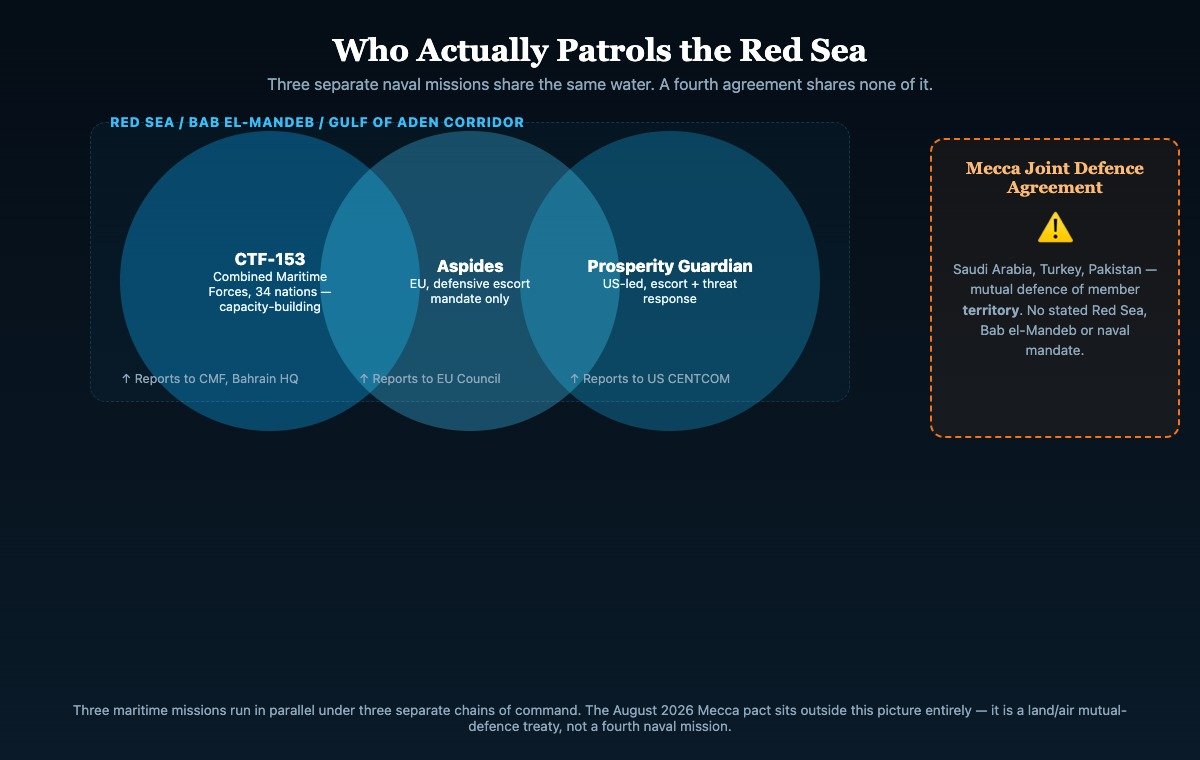
Four arrangements, four command chains, zero shared headquarters.
Opportunities for Deeper Cooperation
What could realistically improve, and who would actually benefit
- Maritime intelligence sharing: Better real-time data exchange between CTF-153, Aspides and Prosperity Guardian could reduce duplicated patrol effort. Benefits all three missions’ member states; obstacle is differing classification rules and national caveats on what each navy will share.
- Drone and missile detection cooperation: Pooling radar and early-warning coverage across Saudi, Egyptian and coalition assets could shrink reaction time against Houthi launches. Benefits Saudi Arabia and shipping insurers most directly; obstacle is the sensitivity of sharing radar picture data with non-allied militaries.
- Anti-piracy and search-and-rescue coordination: Extending CTF-153’s existing capacity-building mandate to formal SAR protocols with Djibouti, Somalia and Yemen’s internationally recognized government. Benefits mariners and coastal states; obstacle is Somalia and Yemen’s limited institutional capacity to hold up their end.
- Port security investment: Egypt, Saudi Arabia and Gulf states expanding physical and cyber security at Red Sea ports reduces shore-based vulnerability. Benefits port operators and cargo owners directly; obstacle is cost and the fact that most attacks so far have been at sea, not in port, reducing political urgency.
- Defense-industrial cooperation between pact members: Turkish drone technology combined with Saudi financing and Pakistani manufacturing experience could produce genuine joint capability over time. Benefits all three Mecca pact signatories’ defense sectors; obstacle is that none of this has moved past the framework-agreement stage as of August 2026.
- Diplomatic confidence-building with Iran: The 2023 China-brokered Saudi-Iran rapprochement showed de-escalation is possible even amid deep distrust. Benefits regional stability broadly; obstacle is that the 2026 Iran war has reset much of that goodwill, and Tehran’s rhetoric toward the Mecca pact has been openly dismissive.
Why a Single Red Sea Defence Alliance Would Be Difficult
Merging CTF-153, Aspides, Prosperity Guardian and the Mecca pact into one command would require solving problems none of the four currently has to solve, because none of them is trying to. Different rules of engagement is the most basic obstacle: Aspides is legally confined to defensive engagement, while Prosperity Guardian’s mandate has stretched to include offensive strikes on Houthi targets at various points – reconciling those two postures under one commander would require political agreement that simply does not exist among EU and US policymakers today. Funding is a second wall: EU missions run through Brussels’ own budget process with member-state reference amounts voted separately from US congressional appropriations for CENTCOM operations, and neither system was built to merge with the other.
Deeper still is the interest-alignment problem. Saudi Arabia wants Houthi capability degraded; Egypt wants the canal open and does not want to be seen fighting a Yemeni faction; the US wants freedom of navigation and Iran deterrence without a full Gulf war; European states want their shipping protected at minimum cost and political exposure; Iran wants none of the above to succeed. A formal alliance requires a level of interest convergence that, as of August 2026, exists on the narrow question of “keep ships moving” but not on the harder questions of who fights whom, under what authority, and who pays. The Mecca pact’s own language – collective deterrence against “aggression,” with no naval mandate stated – reflects exactly this limitation: it was easier to agree that an attack on member territory is unacceptable than to agree on any specific joint military action in the Red Sea itself.
Mecca Joint Defence Agreement vs. NATO
Atlantic Council analyst Allison Minor’s assessment is explicit: the Mecca pact “is not a NATO-like alliance, and it does not signal a discrete new regional bloc.” Some outlets have still reached for “NATO-style” as shorthand for the mutual-defence clause alone – a description this article deliberately avoids, since the clause is the only structural element the two actually share.
Economic Impact: Who Pays for a Longer Route
The cost of Red Sea avoidance shows up in layers. First, the direct cost of the Cape of Good Hope diversion itself: 10-14 extra days at sea, several thousand extra nautical miles of fuel burn, and extra crew-rotation costs for a longer voyage. Second, war-risk insurance premiums for vessels that do transit the Red Sea, which spike sharply whenever Houthi activity resumes, as happened again after the August 2026 tanker threats. Third, freight rates themselves – Asia-Europe container rates have run roughly 25% above pre-crisis norms during periods of heavy diversion, a cost that container lines pass through to shippers, who pass at least part of it to end consumers, though the exact pass-through rate varies by product and market.
Egypt absorbs a fourth, more concentrated cost: lost Suez Canal transit revenue, estimated at roughly $9-10 billion cumulatively across the worst period of the crisis, even as 2026 data shows a genuine, if partial, recovery – canal revenue rose 13% quarter-on-quarter in Q2 2026. India’s agricultural and marine-food exporters, per CRISIL’s analysis, have been disproportionately hurt because perishable cargo cannot simply wait out a longer voyage the way containerized manufactured goods sometimes can. None of these figures should be read as precise to the dollar – shipping-cost attribution is inherently a modeled estimate, not a metered bill – but the direction and rough scale are consistent across independent sources.
Energy Security: Red Sea and Hormuz Are Connected, Not the Same
It is worth being precise about a distinction that gets blurred in casual coverage: the Red Sea/Bab el-Mandeb corridor and the Strait of Hormuz are two separate chokepoints with two separate risk profiles, even though 2026 has been the rare year both faced serious disruption simultaneously. Hormuz, at the mouth of the Persian Gulf, carries roughly 20% of global daily oil supply and 20% of global LNG according to US Congressional Research Service estimates – a far larger share of energy-specific trade than the Red Sea corridor carries, which is more heavily weighted toward containerized goods than energy cargo, though tankers do use it too, including the Saudi tankers the Houthis threatened in August 2026.
The Suez Canal and the parallel SUMED pipeline (which moves crude overland around the canal for tankers too large to transit it) together form Egypt’s energy-transit infrastructure, distinct from Saudi Arabia’s own export terminals on both its Red Sea and Gulf coasts – a geographic redundancy Riyadh has invested in specifically so that a Hormuz disruption does not automatically strand its entire oil export capacity. That redundancy is precisely why the simultaneous 2026 disruption of both chokepoints registered as unprecedented to analysts: it was the first time in memory that the hedge and the primary route were both compromised at once.
The Technology Doing the Actual Fighting
The Red Sea conflict since 2023 has been fought largely with a specific, now-familiar toolkit: Houthi anti-ship ballistic and cruise missiles, one-way attack drones, and remote or crewed small boats on the offense; ship-based air-defence systems, naval helicopters, electronic warfare and close-in weapons systems on the naval-coalition defense. Radar and satellite surveillance, combined with Automatic Identification System (AIS) tracking, form the detection layer that both threatens and protects merchant vessels – which is exactly why US maritime advisories have recommended some US-flagged vessels transiting the corridor turn AIS off, trading collision-avoidance safety for reduced visibility to a hostile targeting system, a genuinely difficult trade-off with no clean answer.
Unmanned surface and underwater vessels remain a smaller but growing part of the naval-coalition toolkit for mine detection and reconnaissance, while cybersecurity has become a quieter but real concern for port operators and shipping companies whose logistics systems are themselves potential targets. None of this technology has proven capable of eliminating risk outright – interception rates against inbound threats have generally been high but not perfect, and even a small failure rate against a missile aimed at a laden tanker carries consequences no naval planner treats as acceptable background noise.
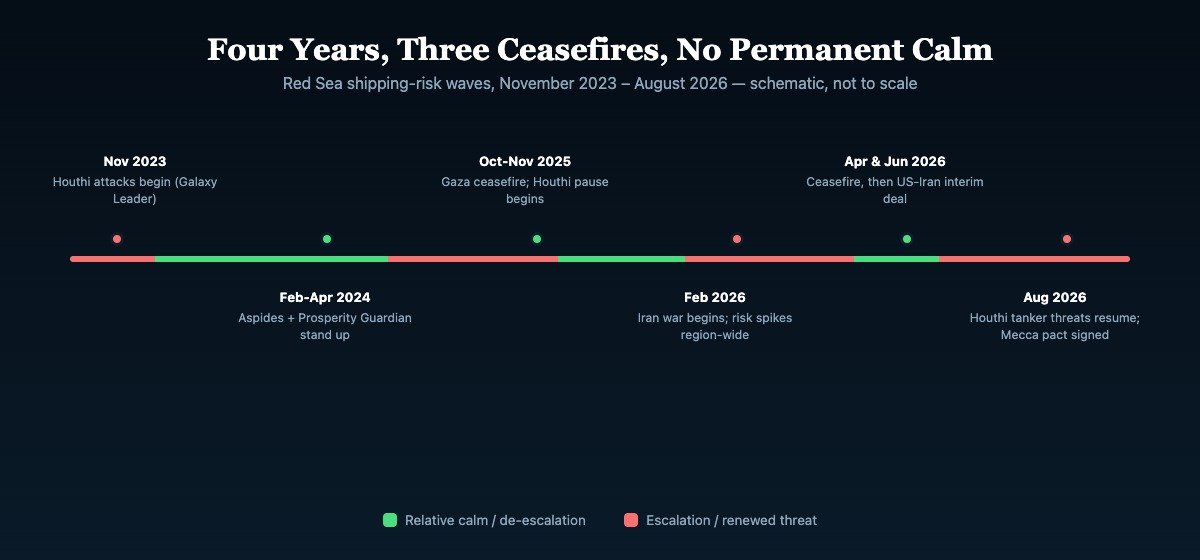
Four years, three ceasefires, none of them permanent.
What Happens When Ships Stop Using the Red Sea?
Picture a standard container journey the way a logistics planner actually maps it: a ship loads in Ningbo or Shenzhen, crosses the Indian Ocean, threads Bab el-Mandeb, transits the Red Sea, passes through Suez into the Mediterranean, and unloads in Rotterdam or Piraeus – roughly 26-30 days door to door in normal conditions. Reroute the same cargo around the Cape of Good Hope instead, and the ship sails past Sri Lanka, around the southern tip of Africa, up through the South and then North Atlantic, arriving 10-14 days later, having burned meaningfully more fuel and consumed more crew-rest cycles along the way. Multiply that delay and cost across the thousands of vessels that would ordinarily use the Suez route, and the aggregate effect is what shows up, eventually, as elevated freight rates and slower restocking on store shelves an ocean away from Yemen.
None of this is abstract for the people actually doing it. Crews on Red Sea-transiting vessels serve extended rotations under real threat awareness, insurers price war-risk premiums that can double or triple within days of a single incident, and cargo owners – an Indian textile exporter, a European retailer, a food-import company – absorb costs they had no hand in creating and no ability to negotiate away.
The Human Story Behind the Headlines
It is easy for a piece built around treaties and task forces to lose the people actually living this. Seafarers, disproportionately drawn from the Philippines, India, Ukraine and Eastern Europe, are the ones standing watch through a strait a missile might reach – the Galaxy Leader’s own crew, held for more than 430 days, were mostly Filipino nationals with families who spent over a year not knowing when, or whether, they would come home. Egyptian Suez Canal Authority employees and pilots depend on transit volume for the institution’s fiscal health and, indirectly, their own job security. Yemeni civilians endure a civil war whose international dimension – Houthi missile campaigns, Saudi-led coalition strikes, and now renewed war-adjacent tension – is only one layer of a humanitarian crisis that predates and will likely outlast the shipping story entirely. Port workers in Djibouti, Jeddah and Port Sudan see their livelihoods rise and fall with traffic volumes set by decisions made in Tehran, Washington, Riyadh and Sanaa, not by anything happening on their own docks.
And for the largest number of people affected – consumers in India, Europe and beyond – the connection is invisible until it isn’t: a slightly higher price on imported goods, a longer wait for an online order, a fractional addition to household inflation that is nearly impossible to trace back to a specific missile fired at a specific tanker months earlier, but is nonetheless real.
Red Sea Defence Alliance: Myth vs Fact
❌ Common Myths
- There is already a single, NATO-style “Red Sea Defence Alliance” with members and a headquarters.
- Every navy protecting Red Sea shipping belongs to one coalition under one commander.
- The August 2026 Mecca pact is explicitly directed at Iran.
- Naval patrols can fully eliminate the risk to merchant shipping.
- The Mecca pact extends Pakistan’s nuclear deterrent to Saudi Arabia and Turkey.
✅ What’s Actually True
- At least four separate arrangements exist – CTF-153, Aspides, Prosperity Guardian, and the Mecca pact – with different mandates, funding and command chains, none merged into the others.
- CTF-153, Aspides and Prosperity Guardian operate under three distinct chains of command that coordinate but do not answer to one authority.
- Officials from all three Mecca pact signatories describe it as defensive and “not directed at any specific actor,” even though its regional context makes Iran the obvious implicit concern to analysts.
- Interception rates have generally been high, but incidents still get through; insurers and shipping lines continue to treat the corridor as elevated-risk, not solved.
- No government has publicly confirmed a nuclear-sharing dimension; Pakistani officials have specifically walked back earlier suggestive comments.
Explore More Timelines
Three Scenarios for Where This Goes Next
Evidence-based possibilities, not predictions
Cooperation Deepens Gradually
Existing missions expand intelligence-sharing and the Mecca pact’s defense-industrial provisions mature into real joint capability. More likely if the Iran war stays contained and Gulf-Pakistan-Turkey defense-industrial projects reach delivery. Economic impact: gradual Suez traffic recovery continues; security impact: incremental, not transformative.
Overlapping Missions Persist, Unmerged
CTF-153, Aspides and Prosperity Guardian continue running in parallel indefinitely, each renewed on its own cycle, with the Mecca pact remaining a land/air deterrent unconnected to maritime operations. Would depend on none of the current interest-alignment problems resolving. Economic impact: steady but incomplete Suez recovery; security impact: status quo risk levels.
Regional Tensions Escalate Further
A renewed Iran war flare-up, a Houthi return to sustained tanker attacks, or a incident directly testing the Mecca pact’s mutual-defence clause pushes disruption back toward 2024 levels or worse. More likely if the fragile June 2026 US-Iran arrangement collapses entirely. Economic impact: renewed freight-rate spikes and Cape diversion; security impact: highest of the three scenarios, with genuine risk of wider conflict.
Things Worth Knowing
- The Suez Canal’s 1967-1975 closure, at eight years, remains longer than the entire 2023-2026 Red Sea crisis to date.
- Djibouti, a country of under 1 million people, simultaneously hosts US, French, Italian, Japanese and Chinese military bases.
- Bab el-Mandeb translates roughly as “Gate of Tears,” a name that long predates the current conflict.
- The Galaxy Leader’s hijacked crew came from five different countries, a snapshot of how international modern merchant crews really are.
- CTF-153 was the fourth task force created under the Combined Maritime Forces umbrella, not the first.
- Some US maritime advisories recommend turning AIS transponders off in the corridor – the opposite of normal international shipping safety practice.
⚠️ Editorial Note
This article separates confirmed developments (official government statements, treaty text, EU Council decisions, Combined Maritime Forces releases) from reported claims (news agency sourcing, named-official quotes) and from analysis (expert characterization, this publication’s own synthesis). Where a claim – Houthi targeting rationale, Iranian material support, casualty figures, or the exact economic cost of Red Sea disruption – is genuinely contested or imprecisely measured, that uncertainty is stated rather than smoothed over. This is a fast-moving, multi-actor security situation; details here reflect the best publicly available reporting as of August 9, 2026, and will be revised as the underlying situation changes. Nothing in this article should be read as advice for shipping, insurance, investment or travel decisions.
Sources & further reading
Every dated entry above was checked against these references. Last reviewed 15 September 2026.
- Council of the EU - Red Sea: Council extends the mandate of Operation ASPIDES
- Combined Maritime Forces - CTF 153: Red Sea Maritime Security
- US Department of Defense - Operation Prosperity Guardian briefing
- Atlantic Council - Why Saudi Arabia, Pakistan, and Turkey just signed a defense pact
- Al Jazeera - Turkiye, Saudi Arabia, Pakistan sign joint defence agreement: What's in it?
- Wikipedia - Strategic Mutual Defence Agreement (Saudi Arabia-Pakistan, 2025)
- Wikipedia - Mecca Joint Defence Agreement (2026)
- US Navy - Egyptian Navy Assumes Command of CMF's Red Sea Task Force