Germany’s Solar Bridge Story: From a 1996 Patent to Bonn’s Kennedybrücke
Germany's solar bridge: how a 1996 patent (withdrawn, never built) differs from Bonn's real Kennedybrücke array - 392 panels, 90 kW since 2011.
Latest Story
A bridge normally moves people and vehicles across a river. In Germany, one bridge has also become a small, working power plant. The Germany solar bridge story is older than most people searching for it probably expect: a German inventor filed a patent for a solar-powered bridge structure back in 1996, years before anyone actually built one. That patent was never turned into a real bridge, and it was later withdrawn. The bridge people actually mean when they picture a German “solar bridge” today is a different, later, physical thing entirely — the Kennedybrücke in Bonn, where a real photovoltaic array went up on the south side of the span in 2011, financed not by the state but by a private solar-panel maker. This article keeps those two histories separate: the 1996 idea, documented in a patent office filing, and the 2011 installation, documented in municipal and company records. Conflating the two is the single most common error in how this topic gets told online.
🔔 Latest Update — August 2026
No major new development in Germany’s bridge-solar story was identified as of this update. The Kennedybrücke installation in Bonn, commissioned in 2011, remains operational and is Germany’s best-documented example; the 1996 patent remains withdrawn and was never built. This article is primarily a historical and engineering explainer, not a breaking-news story — and it is presented that way rather than manufactured into one.
🧠 AI Overview Summary
Germany’s solar bridge story has two distinct parts. In 1996, engineer Manfred Bock filed German patent DE19650024A1 for a “solar power bridge construction” — a concept for mounting photovoltaic panels and solar thermal collectors directly onto bridge girders. It was published in 1997 and later withdrawn; it was never built. The real, physical example is Bonn’s Kennedybrücke over the Rhine, where a 392-module, 90-kilowatt solar array was installed on the bridge’s south face in March-April 2011, financed by SolarWorld AG, feeding Germany’s public grid.
Germany’s Solar Bridge: Key Questions
What to Know About Germany’s Solar Bridge History
- 1996 is a patent date, not a construction date. German engineer Manfred Bock filed DE19650024A1, “Solar power bridge construction,” on August 16, 1996; it published on May 15, 1997, and its legal status on Google Patents is withdrawn.
- The patent was never built. No bridge matching Bock’s design — solar cells and thermal collectors mounted on the girders and wind bracing themselves — is documented as constructed anywhere.
- Bonn’s Kennedybrücke is the real, physical German solar bridge. A 392-module, 90.16-kilowatt-peak array went up on its south face in March-April 2011.
- It was privately financed, not a government program. SolarWorld AG paid for and operates the installation itself, after the City of Bonn rejected funding it in March 2009 on profitability grounds.
- The electricity is real and grid-connected, producing enough for roughly 20 households and feeding Bonn’s public power grid; feed-in payments are donated to rotating local organizations.
- The Kennedybrücke itself predates the solar array by over 60 years. The current bridge opened in 1949 on the piers of an 1898 predecessor destroyed in 1945, and was renamed for John F. Kennedy in 1963.
- Germany’s feed-in-tariff law (EEG), in force since April 2000, is the policy backdrop that made bridge-mounted and every other unconventional form of solar generation financially plausible in Germany, though it did not itself fund the Kennedybrücke project.
- London’s Blackfriars Bridge, not a German project, is roughly ten times larger by module count (4,400 panels) and is usually the one described in English-language coverage as the “world’s largest solar bridge.”
- Solar bridges remain a niche form of building-integrated photovoltaics (BIPV) globally — vastly outnumbered by rooftop, ground-mount and solar-carport installations, because most bridges lack a large, unshaded, structurally simple surface to mount panels on.
Germany’s Solar Bridge Story Has Two Different Histories
Why this distinction is the article’s most important fact
Search “Germany solar bridge” and it is easy to come away thinking a single, continuous story exists: an idea from 1996 that eventually became a famous bridge. That is not what the record shows. There are two separate, only loosely connected histories here, and treating them as one is where most casual accounts of this topic go wrong.
The idea: In 1996, a German engineer, Manfred Bock, filed a patent application for a bridge design that integrated solar photovoltaic cells and solar thermal collectors directly into the bridge’s own structural surfaces — the main girders and wind-bracing members, angled toward the sun. The application was published by the German Patent and Trade Mark Office (DPMA) in 1997. Google Patents lists its current legal status as withdrawn. A withdrawn application means the applicant did not pursue it to grant — it says nothing about whether the underlying idea was good, only that this specific legal filing did not proceed. Crucially, a patent filing is a description of a proposed invention, not a construction record. Nothing in the patent record indicates the design was ever built.
The built project: The bridge people are usually actually asking about is the Kennedybrücke, a road bridge crossing the Rhine in Bonn, North Rhine-Westphalia. In March and April 2011 — fifteen years after Bock’s patent filing, and unrelated to it in the public record — a 392-module, 90-kilowatt-peak solar array was installed across the bridge’s southern face. It was proposed to the city in 2007, rejected on cost grounds in 2009, and ultimately self-financed by the solar manufacturer SolarWorld AG once panel prices had fallen enough to make the project worthwhile for the company as a visibility and demonstration project rather than a city-funded public utility.
These are not the same story continued. There is no public documentation connecting Bock’s 1996 patent application to the later Kennedybrücke project, its engineers, or its funders. The honest version of this history is: Germany produced an early concept for solar-integrated bridges in the 1990s, and a separate, later, privately funded project actually put solar panels on a German bridge in 2011. Both are real. Neither one is the other.
Complete Timeline: From Early PV Research to Bonn’s Kennedybrücke
Every entry is labeled by type — concept, patent, policy, or built/operating project
Oil-Shock-Era German PV Research Begins
What happened: Following the 1970s oil crises, West German research bodies began funding photovoltaic research programs. The Fraunhofer Institute for Solar Energy Systems (Fraunhofer ISE), which remains Europe’s largest solar research institute, was founded in Freiburg in 1981.
The 1,000 Roofs Programme
What happened: West Germany’s Ministry for Research and Technology (BMFT) subsidized 2,056 grid-connected residential PV systems totalling roughly 5.3 megawatts, Germany’s first large-scale field experience with grid-tied solar — rooftop, not bridge-related, but the direct policy ancestor of every later German PV incentive.
Manfred Bock Files a Solar Bridge Patent
What happened: German engineer Manfred Bock filed the priority application for “Solar power bridge construction” (later published as DE19650024A1) with the German Patent and Trade Mark Office. The design proposed mounting photovoltaic panels and solar-thermal collectors on inclined, sun-facing bridge surfaces — typically the main girders or wind-bracing members — connected to storage units, for applications including bridge lighting and road-surface heating.
Patent Application Published
What happened: DE19650024A1 was published by the DPMA. Google Patents’ current record lists the application’s legal status as withdrawn — it was not pursued to grant. No documentation ties this filing to a subsequent construction project anywhere in Germany.
The 100,000 Roofs Programme Launches
What happened: A federal soft-loan program aimed to fund 100,000 additional residential PV installations. It ran until mid-2003, ultimately supporting around 55,000 installations and roughly 261 megawatts of new capacity — the scale-up that set up the market Germany’s later feed-in-tariff law would accelerate further.
The Renewable Energy Sources Act (EEG) Takes Effect
What happened: Germany’s Erneuerbare-Energien-Gesetz guaranteed grid connection, priority dispatch and a fixed feed-in tariff (initially around 0.99 Deutsche Mark, about €0.51, per kilowatt-hour for solar) for up to 20 years. It is the single policy most responsible for turning German solar from a subsidized experiment into a mainstream, bankable investment — the financial backdrop, more than a decade later, against which SolarWorld could justify self-funding a demonstration project like Kennedybrücke.
City of Bonn Begins Reviewing a Kennedybrücke Solar Proposal
What happened: Bonn’s municipal administration opened review of a proposal to install a photovoltaic system on the Kennedybrücke, then already under a wider structural renovation begun April 16, 2007.
Bonn Rejects the Solar Proposal on Cost Grounds
What happened: The city administration declined to fund the project, citing insufficient economic viability at then-current solar-module prices — a rejection local politicians, including Bonn SPD councillors, continued to publicly push back against.
SolarWorld Revives the Project, Self-Funded
What happened: After a sharp fall in global solar-module prices, Bonn-headquartered manufacturer SolarWorld AG — under its then-CEO Frank Asbeck — agreed to finance, install and operate the Kennedybrücke array itself, rather than waiting on municipal funding.
The Kennedybrücke Solar Array Is Installed
What happened: 392 SolarWorld photovoltaic modules, rated at 90.16 kilowatts peak combined, were mounted across the full width of the bridge’s south side. Bonn’s own project description calls it the first such installation on a river bridge in Europe — a claim made by the city and SolarWorld, not an independently audited world record.
Kennedybrücke’s Wider Renovation Completes
What happened: The bridge’s four-year, roughly €45–51 million structural renovation and widening (from 18 to 26.8 metres) — the host project the solar array was attached to — was completed, later earning Germany’s Ingenieurbau-Preis (engineering construction award) in November 2010 for the widening technique.
Ongoing Operation
What happened: The array remains grid-connected, generating power described as equivalent to around 20 households’ consumption. SolarWorld donates the annual feed-in remuneration to a rotating selection of local Bonn organizations, and a public display near the Bonn Opera shows the system’s live output.
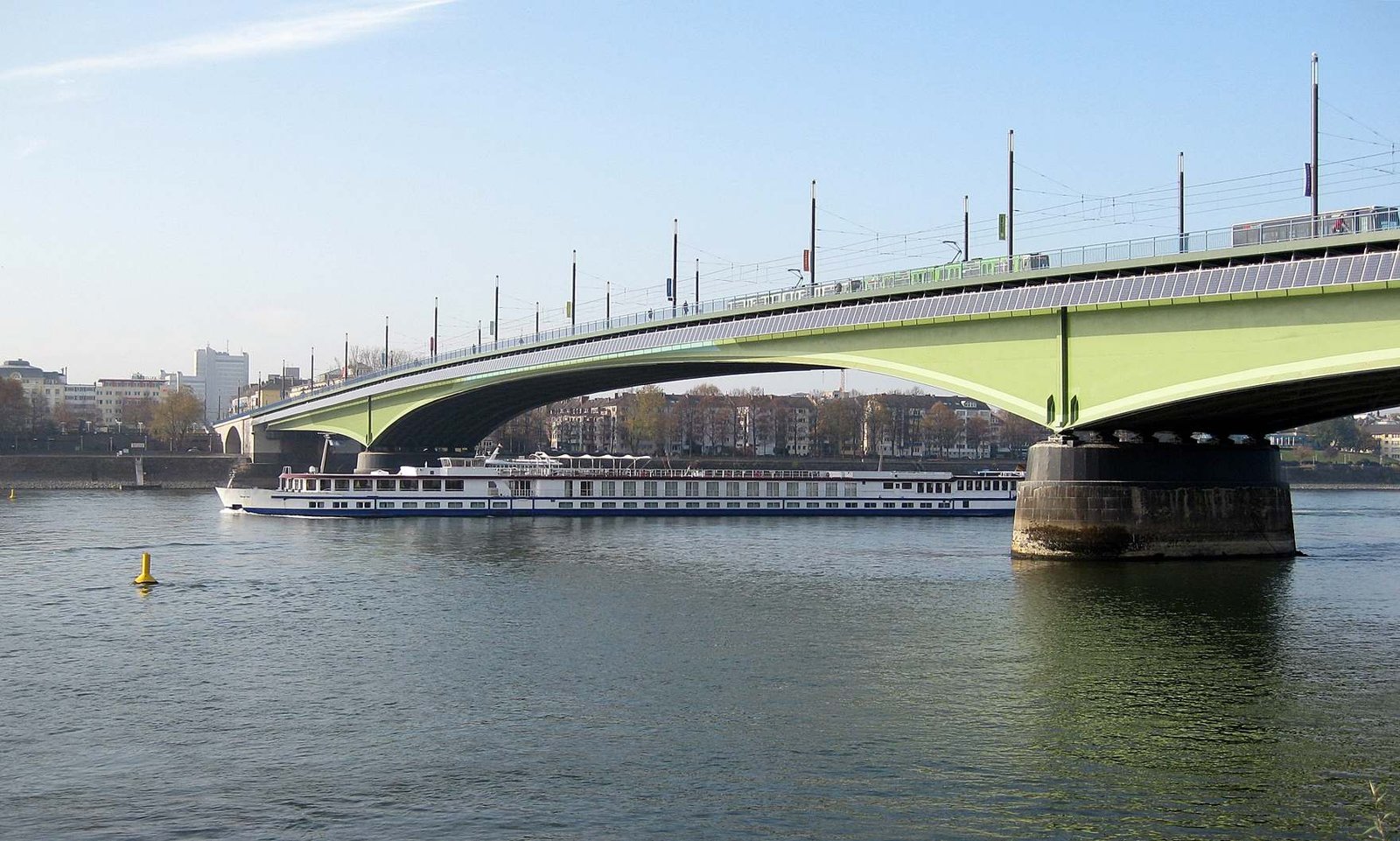
Solar panels on the south face of Bonn’s Kennedybrücke over the Rhine, photographed November 2011. Photo: Sir James, CC BY 3.0, via Wikimedia Commons.
Germany’s 1996 Solar Bridge Patent
DE19650024A1 — what it proposed, and what it did not prove
Patent DE19650024A1, titled “Solar power bridge construction” (Solarstrombrücke), was filed with a priority date of August 16, 1996 and published on May 15, 1997. Its listed inventor is Manfred Bock, a German engineer (Diplom-Ingenieur), filed as an individual applicant rather than through a company. Google Patents’ current record shows the application’s legal status as withdrawn — the applicant did not pursue it through to a granted, enforceable patent.
The design itself is genuinely inventive on paper. Rather than bolting standard solar panels onto an existing structure, Bock’s proposal integrated the generating surfaces into the bridge’s own structural elements: main girders and wind-bracing members angled to face the sun, doubling as both load-bearing structure and solar collector. The application describes variants for parallel-chord truss bridges, cable-stayed bridges and arch bridges, for both new construction and retrofits, with photovoltaic cells for electricity and separate solar-thermal collectors capable of heating road surfaces above 100°C — a de-icing application — plus an optional sound-dampening treatment on the roadway-facing side.
What the patent does and does not demonstrate: A patent application is a legal description of a proposed invention, examined for novelty and filed to establish priority — it is not a construction record, a funding commitment, or proof that anyone attempted to build the design. Being withdrawn specifically means Bock (or his representatives) chose not to complete the examination process, for reasons the public patent file does not explain — commonly cost, a decision the invention wasn’t commercially viable, or a simple lapse. No later German bridge project, including the Kennedybrücke, cites this patent as its technical basis in the sources available for this article. Treating the 1996 filing date as the date “Germany built its first solar bridge” is the specific factual error this article exists to correct.
Why Bonn’s Kennedybrücke Matters
Location, structure and what the project actually demonstrated
Bonn–Beuel, Rhine River, NRW
The Kennedybrücke is the middle of Bonn’s three Rhine crossings, linking Bonn’s city center with the Beuel district on the river’s right bank, on federal road B56.
A 1949 Bridge, Widened 2007–2011
The current bridge opened November 12, 1949, on the piers of an 1898 predecessor destroyed in March 1945; renamed Kennedybrücke in December 1963. A 2007–2011 renovation widened it from 18 to 26.8 metres.
Mounted, Not Structural
Unlike Bock’s 1996 concept, the Kennedybrücke’s panels are conventional modules mounted onto the existing south-facing bridge structure — a retrofit, not a solar-integrated structural design.
Proof a River Bridge Can Generate Power
The project showed a working, grid-connected, maintained solar installation could operate on a heavily trafficked river bridge for over a decade — a real operating case study other cities can point to.
How Do Solar Panels Work on a Bridge?
The same physics as rooftop solar, with bridge-specific engineering constraints
A bridge-mounted solar system works exactly like any other grid-connected photovoltaic array — the bridge simply supplies the mounting surface instead of a roof or a field.
- Sunlight hits the modules. Photovoltaic cells inside each panel convert sunlight directly into direct-current (DC) electricity through the photovoltaic effect. Orientation matters: south-facing surfaces (in the Northern Hemisphere) capture the most direct sun, which is why Kennedybrücke’s array sits on the bridge’s south side.
- Mounting frames carry the panels. On a retrofit like Kennedybrücke, aluminum or steel racking is bolted or clamped to the existing bridge structure, engineered to add minimal extra dead load and to withstand wind and vibration from passing traffic.
- DC cabling runs the current to inverters. Weatherproof cable runs, routed to avoid interfering with bridge maintenance access or expansion joints, carry the DC output to inverter units, typically housed in a weatherproof cabinet at one end of the span.
- Inverters convert DC to grid-compatible AC. Since the public electricity grid runs on alternating current (AC), inverters convert the panels’ DC output and synchronize its frequency and voltage to match the grid.
- The AC electricity feeds the public grid. A grid connection point ties the system into the local distribution network — at Kennedybrücke, into Bonn’s public grid — with metering to record how much electricity is generated and fed in, and a public display board showing live output.
Structural engineers additionally have to account for factors a rooftop installation rarely faces: the bridge’s own thermal expansion and contraction, live-load vibration from vehicles, wind loads specific to a span over open water, corrosion risk from river humidity, and maintenance access that cannot block the roadway or the waterway below.
Why Bridges? Advantages and Disadvantages
What makes bridge-mounted solar attractive, and where it struggles
✅ Bridges Can Offer
- Existing infrastructure, avoiding new land acquisition or planning battles over greenfield solar farms
- Large, often unshaded surfaces already exposed to open sky over rivers or valleys
- Proximity to urban electricity demand and existing grid connections
- Dual-use value: powering bridge lighting, signage or nearby municipal loads directly
- High visibility as a public demonstration of renewable-energy commitment
❌ Bridges Cannot Easily Avoid
- Structural load limits — not every bridge can safely carry added dead weight or wind load
- Vibration and traffic-induced stress that rooftop systems never experience
- Restricted access for maintenance without disrupting road or river traffic
- Shading from railings, cables or adjacent structures depending on orientation
- Corrosion and weather exposure specific to river or coastal crossings
- Vandalism and security risk on a publicly accessible structure
Are Solar Bridges Economically Viable?
What public record shows about the Kennedybrücke’s economics — and its limits
The Kennedybrücke’s own history is the clearest available answer, and it is not an unqualified “yes.” Bonn’s municipal administration reviewed a city-funded version of this exact project in 2007–2009 and rejected it specifically on profitability grounds — at the module prices and feed-in tariffs of that period, the numbers didn’t work for a public-sector business case. What changed the outcome wasn’t a new subsidy; it was a private company willing to accept a different return profile than a city government would. SolarWorld’s calculation is not fully public, but the project reads as much as a visibility and demonstration investment — a working advertisement for the company’s own panels, on a landmark public structure in its home city — as a pure electricity-revenue play, especially since it donates the feed-in remuneration rather than keeping it.
More generally, bridge-mounted solar carries cost factors that a ground-mount or rooftop system avoids: engineering review to confirm the structure can bear the added load, specialized mounting hardware suited to a bridge’s movement and vibration profile, and maintenance access that may require lane or river-traffic closures. Existing infrastructure can offset land-acquisition costs, but it doesn’t eliminate installation complexity. No public, itemized cost or return-on-investment figure for the Kennedybrücke project is available in the sources reviewed for this article; this article does not estimate one rather than guess. What is documented is that the site’s own economics failed a municipal viability test once, and only became attractive to a private funder with a different set of incentives.
Environmental Impact
Real generation, with real embodied costs — not a “zero-emission bridge”
The Kennedybrücke’s 90 kilowatts of installed capacity displaces a small amount of grid electricity that would otherwise come from Germany’s broader generation mix, and doing so on an existing structure avoids the land-use footprint of an equivalent ground-mounted solar farm. That is a genuine, if modest, environmental benefit — roughly enough generation for 20 households is not a large share of Bonn’s electricity demand, but it is real, metered, grid-connected renewable output sustained for over a decade.
It is not a “zero-emission bridge,” and this article avoids that framing. The bridge itself, and its 2007–2011 renovation, carried substantial embodied carbon from steel, concrete and construction machinery, entirely independent of the solar array. The panels themselves also carry embodied emissions from silicon refining, manufacturing and transport before they ever generate a kilowatt-hour, typically offset by clean generation within the first few years of operation but not zero from day one. End-of-life panel recycling, an increasingly regulated process across the EU, is a separate, later-stage environmental consideration this article notes but does not have Kennedybrücke-specific data on.
Germany’s Solar Policy Context
Why this became technically and politically plausible when it did
The Kennedybrücke project sits inside a much longer German policy arc, though it was not itself a government-funded program. West Germany’s 1,000 Roofs Programme (1990–1995) gave the country its first field experience with grid-connected residential solar. The 100,000 Roofs Programme, a federal soft-loan scheme running from January 1999 to mid-2003, scaled that up roughly tenfold. The decisive shift came with the Renewable Energy Sources Act (Erneuerbare-Energien-Gesetz, EEG), which took effect April 1, 2000, guaranteeing grid access and a fixed, above-market feed-in tariff for renewable generators for up to 20 years. That law is widely credited with turning German solar from a subsidized niche into a bankable mainstream investment, driving a roughly 70% fall in installation costs between 2000 and 2007 and pushing Germany’s share of renewables in electricity consumption from 6.2% in 2000 to well over 20% within a decade and a half.
By the time SolarWorld agreed to fund the Kennedybrücke array in 2010, this policy environment — not a bridge-specific subsidy — is what made a privately financed, grid-feeding installation on public infrastructure a financially coherent choice for a solar manufacturer, even after the city itself had already said no on cost grounds.
Germany vs. Europe’s Solar Bridges
Kennedybrücke, Bonn vs. Blackfriars, London — different scale, different country
Kennedybrücke (Bonn) vs. Blackfriars Bridge (London)
Blackfriars Bridge is a UK project in London — not part of Germany’s solar-bridge history — included here only as a European scale comparison. Source: Network Rail Media Centre; the Guardian.
Key Facts Table
Every verified event, dated and sourced
| Event / Project | Date | Location | Technology | Capacity | Status | Source |
|---|---|---|---|---|---|---|
| Solar bridge patent (DE19650024A1) | Filed Aug 16, 1996; pub. May 15, 1997 | Germany (individual filing) | PV + solar-thermal, structure-integrated | Not specified (concept) | Withdrawn, never built | Google Patents / DPMA |
| EEG feed-in-tariff law | Effective Apr 1, 2000 | Germany (national) | Policy, all renewables | N/A | Still in force (amended repeatedly) | German Federal Law Gazette |
| Kennedybrücke solar array | Installed Mar–Apr 2011 | Bonn, North Rhine-Westphalia | Mounted PV modules | 90.16 kWp / 392 modules | Operational | City of Bonn / SolarWorld AG |
| Blackfriars Bridge solar roof | Completed 2012 (station fully reopened 2012–2014) | London, United Kingdom | Mounted PV modules (Panasonic) | 4,400 panels, ~900,000 kWh/yr | Operational | Network Rail / the Guardian |
| A81 motorway solar-roof pilot | Oct 2023 | Baden-Württemberg, Germany | Solar highway canopy (not a bridge) | Pilot scale | Under study (Fraunhofer ISE) | Fraunhofer ISE / regional press |
Explore More Timelines
Solar Infrastructure Comparison
Why bridges are a niche form of building-integrated photovoltaics, not the dominant one
| Infrastructure Type | Typical Scale | Maturity | Example |
|---|---|---|---|
| Rooftop solar | kW (residential) to MW (commercial) | Mature, mainstream | Millions of German installations since the 1990s roofs programs |
| Ground-mount solar farms | MW to GW | Mature, dominant utility-scale form | Germany’s large-scale solar parks |
| Solar carports | kW to low MW | Mature, growing | Common at German retail and office sites |
| Solar noise barriers | kW to low MW along a corridor | Established niche | PV noise barriers along several German and Swiss motorways |
| Solar highways / canopies | Pilot scale | Emerging, experimental | A81 motorway pilot, Baden-Württemberg, Oct 2023, studied by Fraunhofer ISE |
| Solar bridges | Tens to low hundreds of kW per bridge | Niche, case-by-case | Kennedybrücke (Bonn, 90 kW); Blackfriars (London, far larger) |
Why Bridges Stay Niche
- Most bridges lack a large, continuously sun-facing, unshaded surface comparable to a rooftop or field
- Structural approval for added load and wind exposure is case-specific and can rule a bridge out entirely
- Maintenance access without disrupting traffic below or above is harder than on a stationary roof
- Every viable case documented so far — Kennedybrücke, Blackfriars — required a bridge already undergoing major renovation, not a standalone retrofit
People Also Ask
Frequently Asked Questions
Sources & further reading
Every dated entry above was checked against these references. Last reviewed 20 September 2026.