Electric Bikes in Nigeria: Why Riders Are Switching as Petrol Tops ₦1,300 a Litre
Electric bikes in Nigeria are gaining ground as petrol tops ₦1,300 a litre, but unreliable electricity limits how far the EV shift can scale.
Latest Story
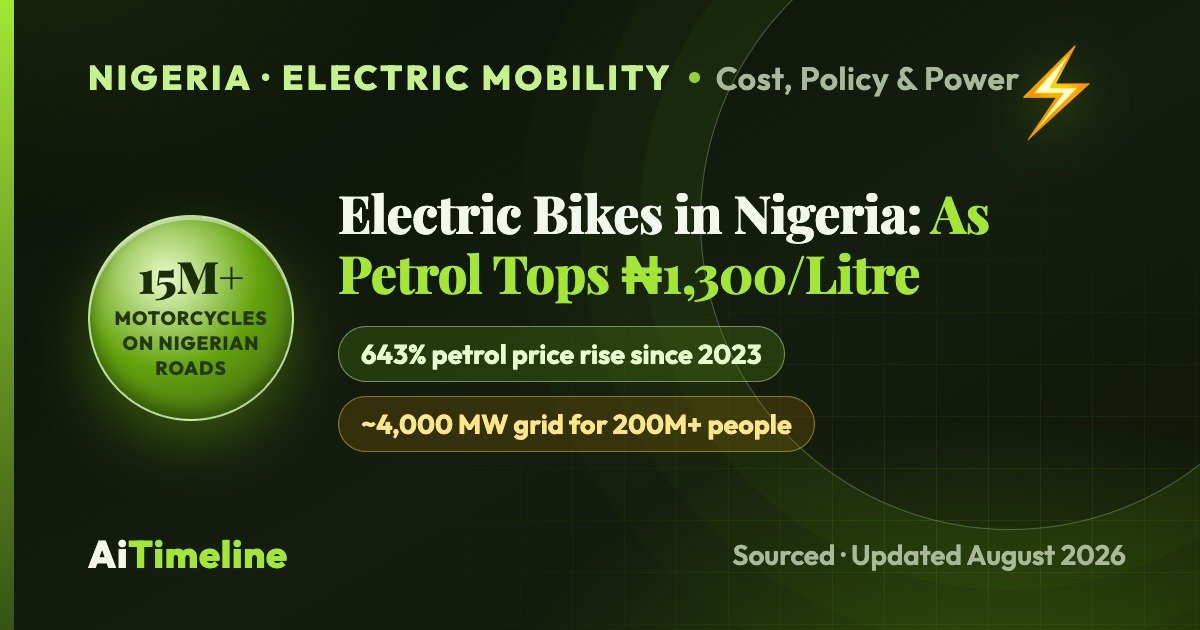
For a Nigerian motorcycle rider, fuel is not an abstract commodity — it is a line item that comes directly out of the day’s earnings before anything else gets counted. When President Bola Tinubu ended the petrol subsidy on 29 May 2023, pump prices that had sat around ₦175–200 a litre jumped within weeks and kept climbing, reaching roughly ₦1,300–1,400 a litre in most of the country by mid-2026 — a rise of more than 600% in three years. Electric bikes in Nigeria have moved from a curiosity to a real option in that gap, but the electricity that has to charge them comes from a national grid generating roughly 4,000 megawatts for a population of over 200 million — one of the lowest per-capita power supplies of any major economy. Whether electric motorcycles can scale here depends less on petrol prices than on whether that power problem gets solved first.
🧠 AI Overview Summary
Electric bikes are gaining ground in Nigeria because petrol prices rose roughly 643% after the government removed its fuel subsidy in May 2023, pushing pump prices from about ₦175 to over ₦1,300 a litre by 2026. Battery-swapping networks from companies like Spiro and MAX now let riders skip long charging waits, and the government has cut EV import duty to zero and exempted EVs from VAT. Nigeria’s unreliable electricity grid still limits how far the shift can scale.
Electric Bikes in Nigeria: Key Questions
What to Know About Electric Bikes in Nigeria
- Petrol drove this, not marketing: prices rose ~643% between May 2023 and mid-2026 after the subsidy was removed.
- Battery swapping, not home charging, is the practical model for most riders — Spiro and MAX both operate swap networks in Nigeria.
- The grid is the real ceiling: roughly 4,000 MW serves 200 million-plus people, so scaling home charging nationally isn’t realistic yet.
- Policy has moved fast in 2026: zero import duty, VAT exemption since 2024, and 3,947 tax waivers approved in H1 2026.
- Public charging/swap infrastructure remains thin — about 48 sites nationwide against a government projection of only ~60 by 2030.
- Lagos leads deployment, but its okada ban in six LGAs/nine LCDAs complicates where electric motorcycles can legally operate.
- EVs aren’t automatically zero-emission here — some swap stations rely on backup generators during outages.
- Upfront cost is still the barrier for most riders: electric motorcycles commonly start around ₦1 million.
- EVs remain under 1% of Nigeria’s total vehicle fleet — this is an early-stage shift, not a completed one.
Why Petrol Prices Matter to Nigerian Motorcycle Riders
Fuel isn’t discretionary spending — it’s the largest daily variable cost between fares and take-home pay
Petrol isn’t a discretionary cost for commercial riders — it’s the largest daily variable expense standing between gross fares and take-home income. Before the May 2023 subsidy removal, petrol sat around ₦175–200 a litre nationally. By mid-2026, most regions were paying ₦1,300–1,400 a litre, though Nigeria’s fuel market is regional: prices vary by state, distance from refineries, and local distribution costs, so a single national figure always understates local extremes. For a rider covering 80–120 km a day on a machine averaging roughly 30–35 km/litre, that increase alone can consume a third or more of daily earnings that previously went to fares, food, or savings. Delivery businesses built around thin per-trip margins feel this first, since fuel cost scales directly with the volume of trips that make a delivery model viable at all.
In Gombe, one of the towns where Reuters found riders already making the switch, a farmer named Ayuba Abubakar described charging his electric motorcycle only when travelling to remote areas, otherwise moving around town on a single charge for the day. He estimated the bike saved him about ₦5,000 a week compared with what he used to spend on petrol — but added a caveat worth keeping: “Even with those savings, the price needs to come down for most Nigerians to afford it.”
Are Electric Motorcycles Actually Cheaper to Run?
Often, under the right conditions — not as a blanket rule
Not universally — the honest answer is “often, under the right conditions.” Running cost depends on: the electricity tariff a rider pays (Band A customers pay roughly ₦206.80–225/kWh with 20+ hours of daily supply; other bands vary and get less reliable power), whether the rider charges at home or pays per-swap at a station, the vehicle’s battery capacity and real-world range (mainstream models run 75–80 km per charge, some newer ones claim up to 200 km), how many kilometres are ridden daily, and eventual battery-replacement cost. Upfront price is also a real factor: electric motorcycles in Nigeria commonly retail from roughly ₦1 million upward — several times a comparable used petrol motorcycle — so payback period matters as much as per-day savings.
Petrol Motorcycle vs Electric Motorcycle — Illustrative Daily Cost
Assumptions are clearly labelled and illustrative, not measured local data. Battery-swap pricing varies by provider and isn’t publicly standardised, so it isn’t shown as a fixed number. Your actual cost will vary by state, tariff band, motorcycle model and battery-swapping provider.
Why Battery Swapping Could Matter More Than Charging
Solving downtime, not just fuel cost
Battery swapping solves the problem charging can’t: downtime. A depleted battery, physically exchanged for a charged one at a station, takes under two to three minutes on the networks Spiro and MAX operate — compared to hours on a home charger, which matters enormously to a rider whose income depends on kilometres covered per day. It also decouples the rider from grid reliability at their specific location: the charging happens centrally at the station (sometimes backed by solar or generators), not at the rider’s unreliable home supply. Spiro alone reports over 2,500 swap stations and more than 100,000 electric motorcycles deployed across its African markets as of mid-2026, with a stated plan to scale Nigerian stations from roughly 100 toward 1,000. The tradeoff is standardisation: swapping only works at scale if batteries are interoperable across providers — a problem Rwanda has addressed by regulatory mandate, but Nigeria has not yet.
This model is especially relevant to delivery riders, commercial motorcycle operators and other high-mileage users, where even a few minutes of downtime per swap, repeated many times a day, adds up in lost earning time — unlike a personal rider who can plan around an overnight home charge.
The Biggest Problem: Nigeria Still Needs Electricity to Go Electric
The grid, not petrol prices, is the real constraint on scale
Nigeria’s installed generation capacity is around 13,625 MW on paper, but transmission bottlenecks and plant availability mean actual deliverable power is closer to 4,000 MW for a population Reuters puts at over 200 million — among the lowest per-capita electricity availability of any major economy. That’s the ceiling every home-charging plan runs into. It also means the emissions case for EVs in Nigeria is not automatic: an electric motorcycle charged from the grid is only as clean as the generation mix behind it, and many charging/swap operators lean on backup diesel generators during outages.
Muhammad Abubakar, CEO of the clean-energy company Sustenaa, put the tension directly to Reuters: “If we end up charging these bikes with generators, then what’s the point? We will just be moving the emissions from the exhaust pipe to the generator pipe, and we are back to square one.” He also pointed to the flip side of the current transport mix — “When you look at how many bikes are pumping out smoke daily across Lagos, Kano and Port Harcourt, air pollution levels are alarming” — the reason even generator-charged electric motorcycles can still represent a net improvement over petrol engines, even if not a clean-energy solution on their own.
Electric motorcycles have no tailpipe emissions while operating. They are not automatically “zero-emission” once electricity generation, battery manufacturing, battery life and eventual recycling are factored in — a distinction worth keeping precise rather than rounding up.
Where Nigeria’s EV Charging Infrastructure Is Growing
Nationally, Reuters counted roughly 48 public charging/swap sites as of the most recent count, against a government projection of only ~60 by 2030 — a modest target that underlines how early-stage this still is (for comparison, South Africa has 500+ stations). Lagos accounts for most of the growth, expanding from about 4 stations in 2022 to roughly 22 by 2026, concentrated on the Island and mainland retail corridors. Abuja remains more of a pilot ground than an operating network. Hybrid Motors has separately signed an agreement to deploy 110 EV “mega charging stations” across Lagos and Abuja over four years with a Chinese charging-technology partner — an announced plan, not yet built infrastructure, and should be read as such until stations are actually operating.
Electric Bikes in Lagos
Lagos is Nigeria’s most active electric-motorcycle market by a wide margin — it hosts the country’s densest charging/swap network, Saglev’s assembly plant in Ikorodu, and the bulk of MAX and Spiro’s commercial deployments. It is also where the tension in this story is sharpest: Lagos State maintains an okada ban across six LGAs and nine LCDAs (Ikeja, Surulere, Eti-Osa, Lagos Mainland, Lagos Island, Apapa) plus ten major highways and 40 bridges/flyovers, first expanded in 2020. Enforcement has fluctuated — commercial motorcycles have crept back into some areas like Ogba since 2024 despite the ban remaining official policy — and available reporting does not confirm whether electric motorcycles are treated any differently under these restrictions than petrol ones. Delivery and logistics riders operating outside the restricted zones are the segment most cited in reporting as early electric-motorcycle adopters.
Electric Mobility in Abuja
Abuja’s activity is smaller and more government-facing than Lagos’s — described in available reporting as a pilot ground for EV-charging concepts, sometimes tied to renewable-energy research, rather than a mature commercial network. It is one of the two cities named in Hybrid Motors’ planned 110-station rollout, but as of this writing that is an announced four-year plan, not deployed infrastructure. No verified reporting was found of large-scale commercial battery-swapping fleets operating in Abuja comparable to Lagos’s.
How Nigeria’s Electric-Bike Shift Compares With Africa
| Country | Two-wheeler EV approach | Notable policy |
|---|---|---|
| Nigeria | Battery swapping (Spiro, MAX) + local assembly (Saglev) | Zero EV import duty (2026), VAT exempt since 2024, 3,947 tax waivers H1 2026 |
| Kenya | 50+ e-mobility startups (Roam, Ampersand, Kiri EV) | National E-Mobility Policy; Kenya Power targeting 400+ charge/swap stations by 2027 |
| Rwanda | First African country to mandate battery-swap interoperability | RURA Regulation No. 011/Energy/RURA/2026; 30% e-motorcycle penetration target by 2030 |
| Ghana | Battery-swapping pilots in Accra’s dense urban grid | Phased EV policy 2024–2045; ~29% of Africa’s EV market via an 8-year zero-tariff window |
| South Africa | Passenger-EV and manufacturing focus more than two-wheelers | 150% tax deduction for local EV production; Green Transport Strategy |
Kenya and Rwanda are ahead of Nigeria specifically on two-wheeler regulatory maturity. Nigeria’s advantage is scale: 15 million-plus motorcycles and Africa’s largest population give it the largest addressable market on the continent, even if infrastructure lags.
Who Is Building Nigeria’s Electric-Mobility Ecosystem?
Company claims, kept separate from independent reporting
Spiro
Founded 2022 by Gagan Gupta; operates in Kenya, Rwanda, Uganda, Togo, Benin, Nigeria and Cameroon. Company-reported: 100,000+ electric motorcycles, 2,500+ swap stations, 30 million+ swaps (Feb–Jun 2026). Raised $50M (Feb 2026) and $215M (Jun 2026).
MAX (Metro Africa Xpress)
Founded 2015 by Adetayo Bamiduro and Chinedu Azodoh. Offers PAYGO financing and sub-2-minute battery swaps (company claim). Assembly capacity ~3,600 units/month. Raised $24M (Jan 2026) and $8M debt (May 2026).
Saglev
Nigeria’s first sub-Saharan EV assembly plant, Ikorodu, Lagos, partnered with China’s Dongfeng. 2,500-vehicle annual capacity, 17 EV models assembled. Recognised by NADDC as a pioneer in local EV manufacturing.
Sustenaa
A clean-energy company, not a vehicle seller, whose CEO Muhammad Abubakar was quoted by Reuters cautioning that generator-charged EVs relocate emissions rather than eliminate them — included here for balance.
Company production/deployment figures above are self-reported unless otherwise noted — treat them as company claims, not independently audited data.
Government Policy: What’s Actually Changed
| Policy | Detail | What it means |
|---|---|---|
| VAT exemption | Since 2024 | Removes a second tax layer previously stacked on import duty |
| Import duty cut | 0% from 5%, 2026 | Lower landed cost for qualifying EVs, EREVs (200km+ range), certified e-tricycles/motorcycles |
| Tax waivers | 3,947 approved, H1 2026 | Evidence of real implementation, not just announcement |
| NADDC production target | 30% of vehicles made in Nigeria electric by 2033 | A manufacturing/local-content goal — separate from the fleet target below |
| Energy Transition Plan target | 60% of vehicle fleet electric by 2050 | The official long-term ambition, set in 2022 |
Excluded from incentives: ordinary hybrids, dual-fuel CNG/petrol or CNG/diesel vehicles, and vehicles valued at $100,000 or more.
Why Delivery Riders Could Be Early EV Adopters
Delivery and logistics riders share three traits that make electric motorcycles a plausible early fit: high, predictable daily kilometres (which maximises fuel-cost savings relative to upfront price); fixed, repeatable routes (which make range limitations more manageable than for riders covering unpredictable territory); and employer or platform backing that can absorb the higher upfront cost through fleet financing rather than an individual rider’s own savings. Downtime from charging remains the practical obstacle — which is exactly the gap battery swapping is built to close. Not all delivery riders are switching; this is a segment with above-average suitability, not a completed transition.
Before Buying an Electric Motorcycle in Nigeria
Consumer Checklist
- Real-world range, not just the manufacturer’s claimed figure
- Battery warranty length and what voids it
- Battery replacement price today, in naira
- Charging time on a standard home outlet
- Swap-station availability on your actual routes, not just the nearest city
- Service network and spare-parts availability outside major cities
- Motor and controller warranty terms
- Brake and tyre specifications for local road conditions
- Financing terms if not paying upfront
- Likely resale value — still largely unproven in Nigeria’s market
- Whether the bike depends on a manufacturer’s app for basic function
Electric Motorcycle Safety in Nigeria
✅ Good Practice
- Use the charger supplied with the bike, with a voltage stabiliser
- Keep batteries away from direct water exposure during rainy-season flooding
- Follow the manufacturer’s specified charger and cable only
- Have overheating or unusual charging behaviour checked at an authorised service point
❌ Avoid
- Charging without a stabiliser — a Gombe rider told Reuters this is exactly how his charger burned out
- Attempting battery disassembly or repair outside authorised service
- Using third-party chargers not rated for the specific battery
- Ignoring overheating during charging, especially on shared or informal power sources
New Businesses Emerging Around Electric Motorcycles
Emerging Opportunities
- Battery-swapping station operation and franchising
- EV-specific maintenance and repair — a real skills gap as the fleet grows
- Spare-parts distribution
- Fleet leasing and financing for riders who can’t pay upfront
- Battery-health diagnostics and second-life battery management
- Delivery fleets built natively around electric motorcycles rather than converted from petrol
Explore More Timelines
Nigeria’s Electric-Bike Timeline: What Happened, and When
Reuters Reports From Gombe on Riders Switching to Electric Motorcycles
What happened: Reuters (via Al Jazeera, 16 August 2026) profiled riders and clean-energy voices weighing fuel savings against Nigeria’s electricity constraints.
Nigeria Confirms 3,947 EV Tax Waivers for H1 2026
What happened: Nigeria Customs Service confirmed the first batch of import-duty waivers processed under the current incentive scheme.
Spiro Raises $215 Million for African Battery-Swap Expansion
What happened: Spiro secured its largest funding round to date to expand battery-swapping infrastructure and EV supply.
EV Import Duty Cut to Zero From 5%
What happened: Nigeria Customs Service reduced import duty on qualifying EVs, EREVs and certified e-tricycles/motorcycles to zero.
Petrol Reaches ₦1,300–1,400 a Litre
What happened: Global oil-supply disruption tied to the US–Iran conflict fed through to Nigerian pump prices.
Spiro Raises $50 Million
What happened: Funding round to expand battery-swapping infrastructure and EV supply across Africa.
MAX Raises $24 Million
What happened: Combined equity and debt round to scale EV financing and battery-as-a-service infrastructure.
Spiro Targets 1,000 Nigerian Swap Stations
What happened: Spiro announced plans to scale from roughly 100 to 1,000 battery-swap stations in Nigeria by January 2026.
Saglev Recognised by NADDC as an EV Manufacturing Pioneer
What happened: Saglev’s plant, assembling vehicles with Chinese partner Dongfeng, became sub-Saharan Africa’s first EV assembly operation.
EVs Exempted From VAT
What happened: Nigeria removed VAT on electric vehicles, the first step in the current incentive stack.
Petrol Subsidy Removed
What happened: President Tinubu ended Nigeria’s decades-old petrol subsidy days after taking office; pump prices roughly tripled within weeks, from ~₦175–200 to over ₦500 a litre, then kept climbing over the following three years.
Nigeria Energy Transition Plan Sets 2050 EV Target
What happened: The government’s Energy Transition Plan projected EVs reaching 60% of the national vehicle fleet by 2050, with a near-term goal of only ~60 public charging stations by 2030.
Discover: Numbers Worth Knowing
- Nigeria’s petrol price rose faster in three years (2023–2026) than in the prior two decades combined, according to multiple Nigerian business outlets.
- Lagos’s public charging network grew from 4 stations in 2022 to roughly 22 by 2026 — a more than five-fold increase, though still small relative to South Africa’s 500+.
- Spiro’s reported 30 million-plus completed battery swaps across Africa is a scale few individual charging networks anywhere have reached.
- Nigeria’s 15 million-plus motorcycles make it, by vehicle count, one of the largest two-wheeler markets on the continent.
Sources & further reading
Every dated entry above was checked against these references. Last reviewed 15 September 2026.
- As petrol prices soar, electric bikes gain ground in Nigeria — Al Jazeera/Reuters, 16 Aug 2026
- Nigeria Approves Tax Waivers for Nearly 4,000 Electric Vehicles — Punch
- Nigeria Waives Import Duty, VAT on Fully CNG, Electric Vehicles — BusinessDay NG
- Nigeria Energy Transition Plan — Transport Sector Targets
- NADDC Lauds SAGLEV for Pioneering Electric Vehicle Manufacturing in Nigeria — Nairametrics
- Spiro Raises $215M to Expand Electric Motorcycle Battery-Swapping Network — WeeTracker
- Lagos Reiterates Ban on Okada in Restricted Areas — The Guardian Nigeria
- Spiro Targets 1,000 Battery Swap Stations in Nigeria by January 2026 — TechPoint Africa