Berlin Wall Anniversary: How a Note Opened the Border
Berlin Wall anniversary: how Schabowski's 9 Nov 1989 note, mass protests and departures opened the border, hour by hour, to reunification in 1990.
Latest Story
The Berlin Wall anniversary recalls the night of 9 November 1989, when an East German official’s muddled answer at a press conference sent crowds to the border and the checkpoints opened after 28 years of division. The famous note mattered, but it was not the whole story. This timeline runs newest first, from this year’s commemorations back to the divided city of 1945, and separates what the note did from what the protests, the departures and the guards did.
💡 Short Answer
On 9 November 1989 East German Politburo member Günter Schabowski said at a televised press conference that new travel rules applied “immediately, without delay”. They were meant to start the next day. Crowds went to the checkpoints, and the Bornholmer Straße gate was open by about 23:29. Months of protest and mass departures had already weakened the regime. Germany reunified on 3 October 1990.
The Fall of the Berlin Wall: Key Questions
The Berlin Wall’s Fall in Ten Points
- 28 years: the Wall stood from 13 August 1961 to 9 November 1989, 28 years and 88 days.
- Built to keep people in: East Germany had lost at least four million people by 1961.
- Cost in lives: the Berlin Wall Foundation records at least 140 deaths.
- Pressure first: Hungary opened its fence on 2 May 1989 and its border on 11 September.
- Streets decided: 70,000 in Leipzig on 9 October and 500,000 in Berlin on 4 November.
- The note: Schabowski’s answer at 18:53 on 9 November turned a next-day rule into an apparent immediate one.
- Guards decided: Bornholmer Straße was open by about 23:29.
- Brandenburg Gate: it opened only on 22 December 1989.
- Demolition: official demolition began on 13 June 1990.
- Reunification: 3 October 1990, and the 37th anniversary falls on Monday 9 November 2026.
Berlin Wall Timeline, Latest First
Each entry is tagged and ends with why it matters. Use the filter to isolate the night of 9 November.
Division, pressure, the night itself or the aftermath? Filter the Berlin Wall timeline by type.
–
2026
Berlin Freedom Week marks the 37th anniversary Aftermath
Berlin plans a week of events on freedom, democracy and human rights around the 37th anniversary, with Governing Mayor Kai Wegner as patron. visitBerlin says organisations can host their own events. No separate official ceremony for 9 November itself had been confirmed when this page was updated on 20 October 2026.
2026
Berlin marks 65 years since the Wall went up Aftermath
Political and public figures gathered on the memorial grounds on Bernauer Straße to honour people killed at the Wall, and an installation and open-air exhibition stood at the Brandenburg Gate. The Berlin Wall Foundation records at least 140 people killed at the Wall or in connection with the GDR border regime.
2018
The Wall has now been down as long as it stood Aftermath
On 5 February 2018 the Berlin Wall had been open for exactly as long as it had divided the city. Outlets differ by a day on the count, depending on whether the first or last day is included.
1990
Germany reunifies Aftermath
East Germany joined the Federal Republic on 3 October 1990, now German Unity Day. Opening the Wall made reunification possible, but it did not complete it: the process needed an election, a currency union, a treaty between the two German states and one with the four wartime powers.
1990
Official demolition of the Wall begins Aftermath
People had chipped at the Wall since 10 November 1989, but East German border troops began the official demolition on 13 June 1990. On 1 July 1990 East Germany adopted the West German mark and border controls between the two states ended. Parts were kept as memorials, including along Bernauer Straße.
1990
East Germany holds its first free election Aftermath
The first free vote for the East German parliament set the course towards unity. In the same weeks the Two Plus Four negotiations between the two German states and the four wartime powers began, and Mikhail Gorbachev agreed in principle that Germans should decide on unity themselves.
1989
The Brandenburg Gate opens Aftermath
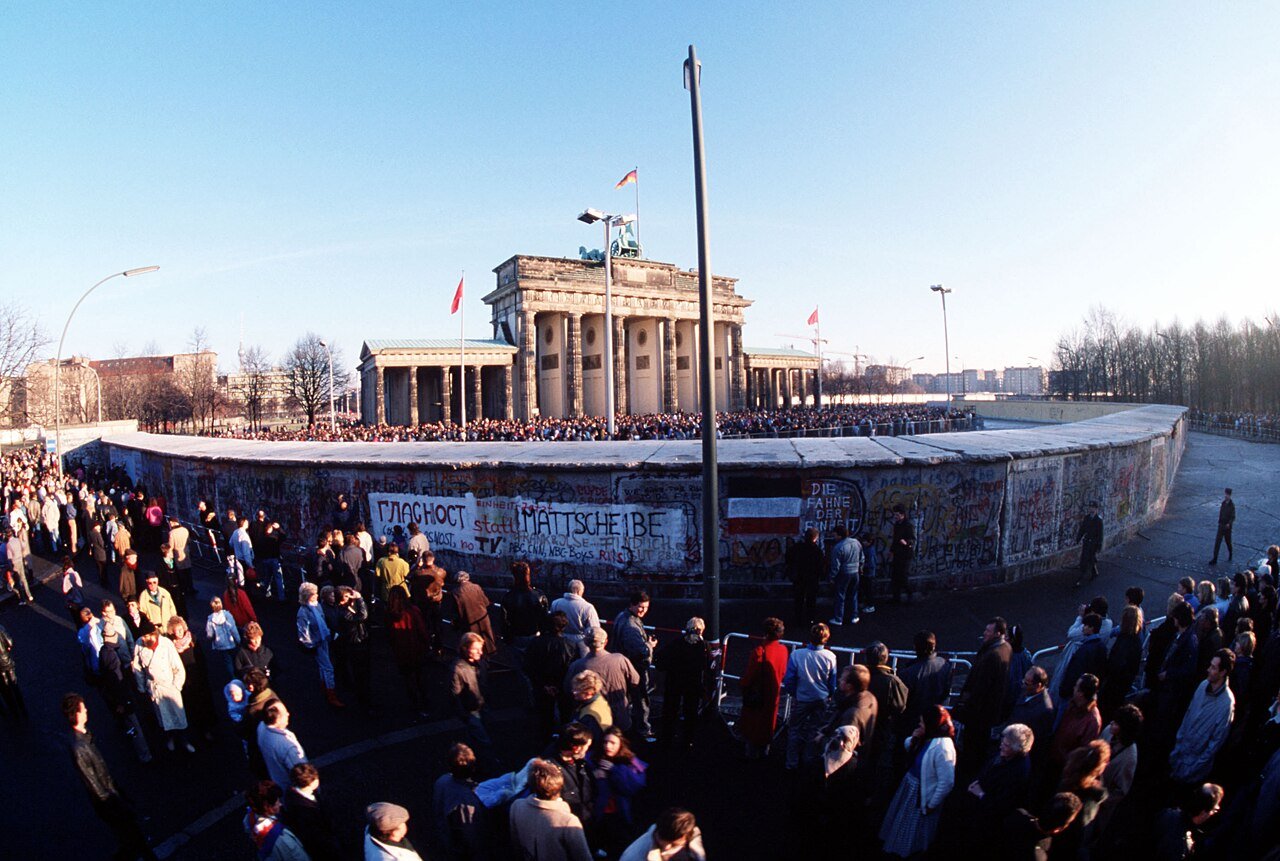
The most famous crossing point stayed closed on 9 and 10 November. People stood on the Wall beside it, as in the photograph, but the Gate itself opened on 22 December. The picture below was taken on 1 December, when the Gate was reachable from the East but not yet open to the West.
1989
Kohl presents his ten-point plan for unity Aftermath
Three weeks after the opening, Chancellor Helmut Kohl set out a ten-point programme towards German unification. Within days the SED leadership collapsed, and a Round Table of the opposition and the old state met on 7 December.
1989
Berliners celebrate and East Germans stream west Aftermath
The next morning brought reunions, climbing on the Wall and crowds at the border. The East German news agency reported that about one million GDR citizens visited West Berlin on the Saturday, and the authorities announced ten new crossings, including Potsdamer Platz, Glienicker Brücke and Bernauer Straße.
1989, night
Bornholmer Straße opens The night
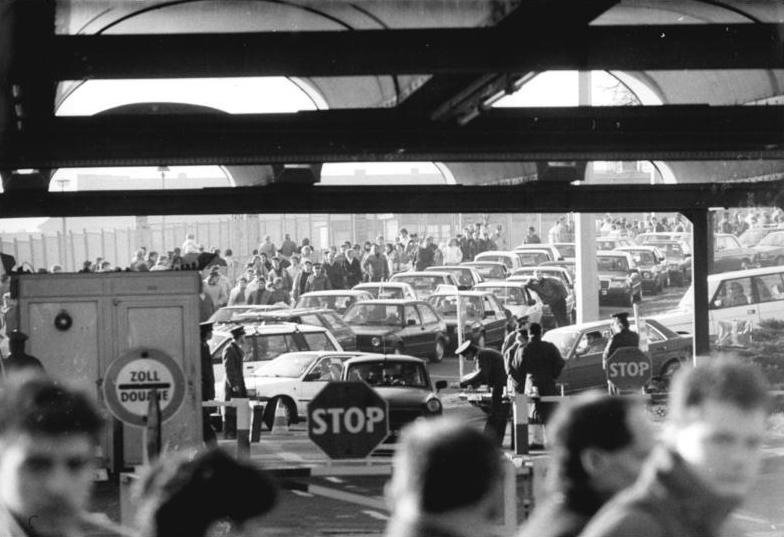
Thousands gathered at Bornholmer Straße, one of the main crossings, with no clear order from above. Lieutenant-colonel Harald Jäger, the commander, eventually gave way and had the barrier raised; the Haus der Geschichte records the way to West Berlin as open at 23:29, while some reports give 22:45 as the time of his order. Another gate, Waltersdorf-Rudow, may have opened a couple of hours earlier. Other crossings opened through the night.
It was not a single ceremonial act. It was a series of decisions at individual checkpoints, each under crowd pressure and without instructions from the centre.
1989, 18:53
Schabowski reads the note: “immediately, without delay” The night
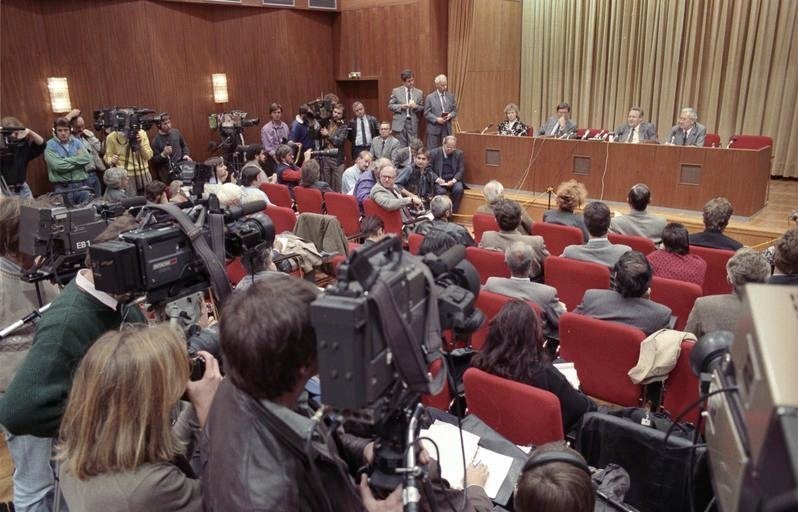
At a televised press conference Günter Schabowski presented the new travel rules. At 18:53 Riccardo Ehrman of the Italian agency ANSA asked whether the draft published on 6 November had been a mistake; Peter Brinkmann of Bild pressed on when the rules would apply. Both later claimed to have asked the key question, and accounts differ. Schabowski looked through his papers and answered that, as far as he knew, it was effective immediately, without delay (sofort, unverzüglich). Asked whether that included West Berlin crossings, he said it did.
Within minutes the West German agency dpa reported that East Germans could cross “immediately”. West German television carried the story at 19:17 and 20:00, and East Berliners watching West German channels went to the border.
1989, afternoon
Krenz hands Schabowski the travel text The night
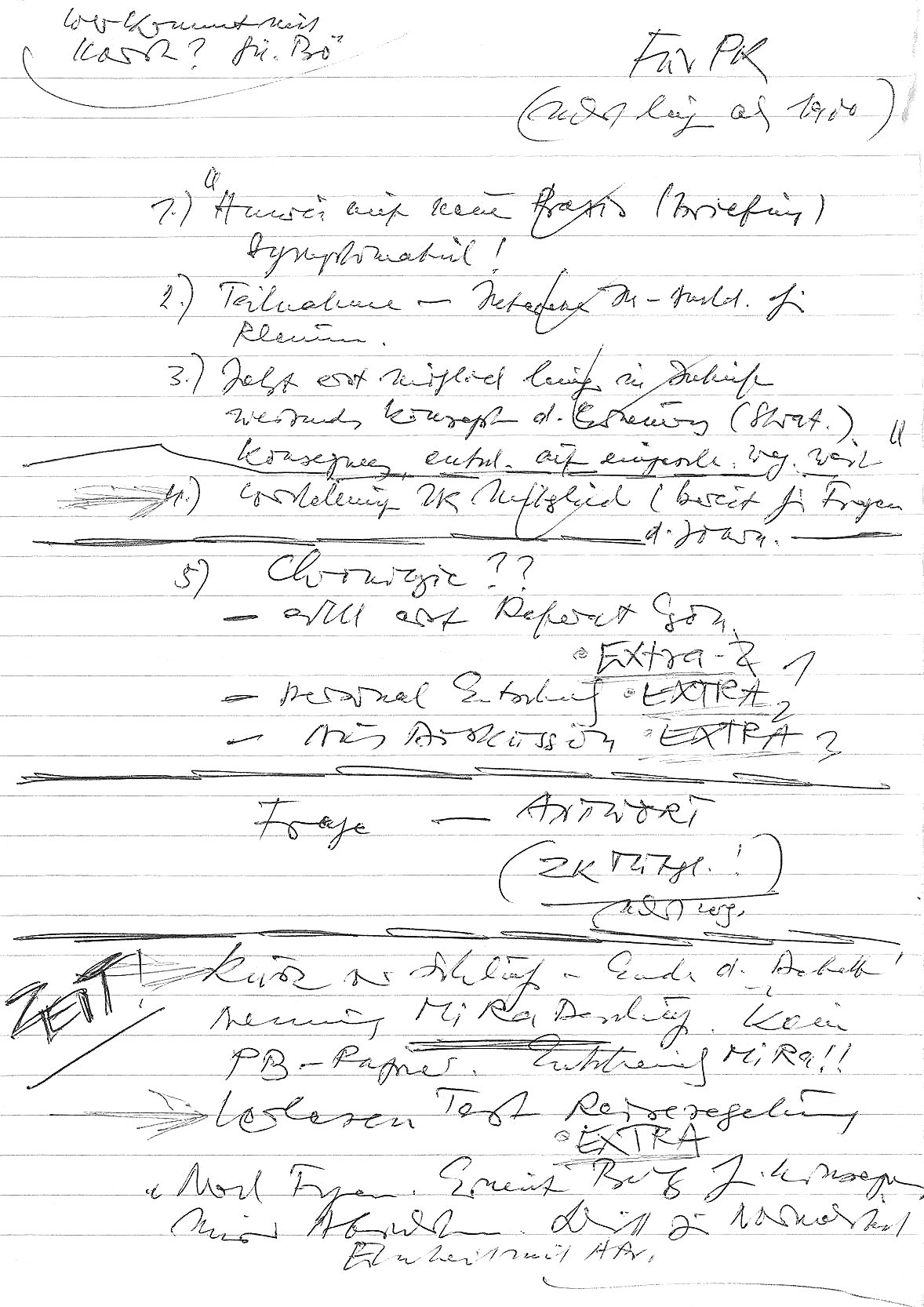
The leadership had prepared a travel regulation to ease pressure after weeks of protests and departures. The intent was to keep state control: citizens would apply, and the rules would be published by press release the next morning. Egon Krenz gave the text to Schabowski to announce at the press conference, although Schabowski had not been present for the discussion. The Haus der Geschichte notes that he read the exit rule from the draft but missed that its conditions applied only from the next day.
His handwritten sheet, preserved in the museum’s collection, carries the heading “Für PK (nicht länger als 1900)”: for the press conference, no longer than 19:00.
1989
Draft travel rules published; government and Politburo resign Pressure
On 6 November the Interior Ministry published draft travel rules, which West Berlin’s mayor Walter Momper rejected as “complete trash”. On 7 November Krenz approved the resignation of prime minister Willi Stoph and two-thirds of the Politburo, and the Central Committee re-elected him general secretary. On 8 November the Politburo enacted the part on permanent emigration.
1989
About 500,000 demonstrate at Alexanderplatz Pressure
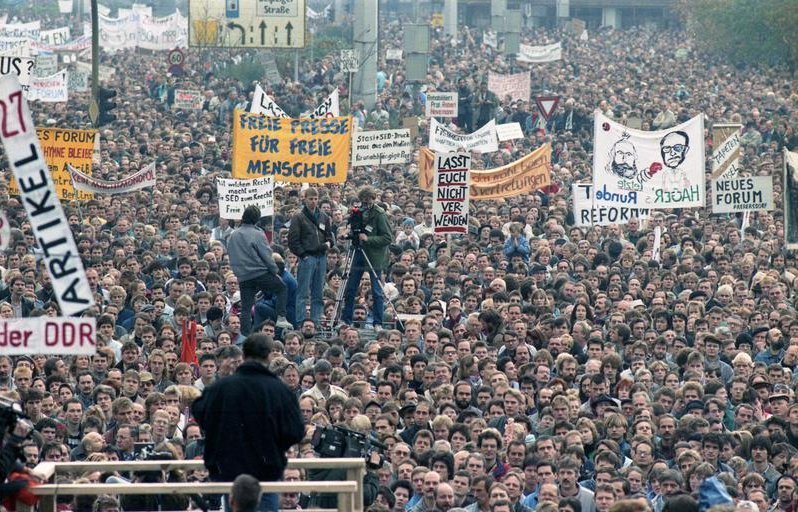
Five days before the Wall opened, hundreds of thousands filled Alexanderplatz in East Berlin, in a demonstration called by Berlin artists and cultural figures. Banners demanded free press and reform. The state allowed it, which showed how far its control had slipped.
1989
Leipzig marches and Honecker falls Pressure
On 9 October about 70,000 people marched in Leipzig after church services; no shots were fired. A week later about 120,000 marched. On 18 October Erich Honecker resigned and Egon Krenz took over. The German government calls 9 October the first major victory over the SED dictatorship.
1989
Genscher tells refugees in Prague they can leave Pressure
Thousands of East Germans had sheltered in the West German embassy in Prague. Foreign minister Hans-Dietrich Genscher told them they could leave for West Germany, and the first departures began the next day.
1989
Hungary opens its border to East Germans Pressure
On 11 September Hungary opened its border for East Germans, allowing them to travel to the West through Austria. It followed the Pan-European Picnic of 19 August, when tens of thousands set off for Hungary, and Hungary’s start on dismantling its border fortifications on 2 May 1989.
1989
Hungary begins dismantling its border fence Pressure
Hungary began taking down its border fortifications with Austria. As routes through Eastern Europe changed, East Germans found ways to leave without crossing the Berlin Wall, which put the East German government under new pressure.
The last deaths at the Wall Division
Chris Gueffroy was shot dead by border guards on the night of 5–6 February 1989 and is described as the last person killed by gunfire at the Wall. On 8 March Winfried Freudenberg died after his home-made gas balloon crashed, and he is usually described as the last person to die trying to escape across it. The Berlin Wall Foundation says the order to shoot was lifted in April 1989.
1961
East Germany seals the border and builds the Wall Division
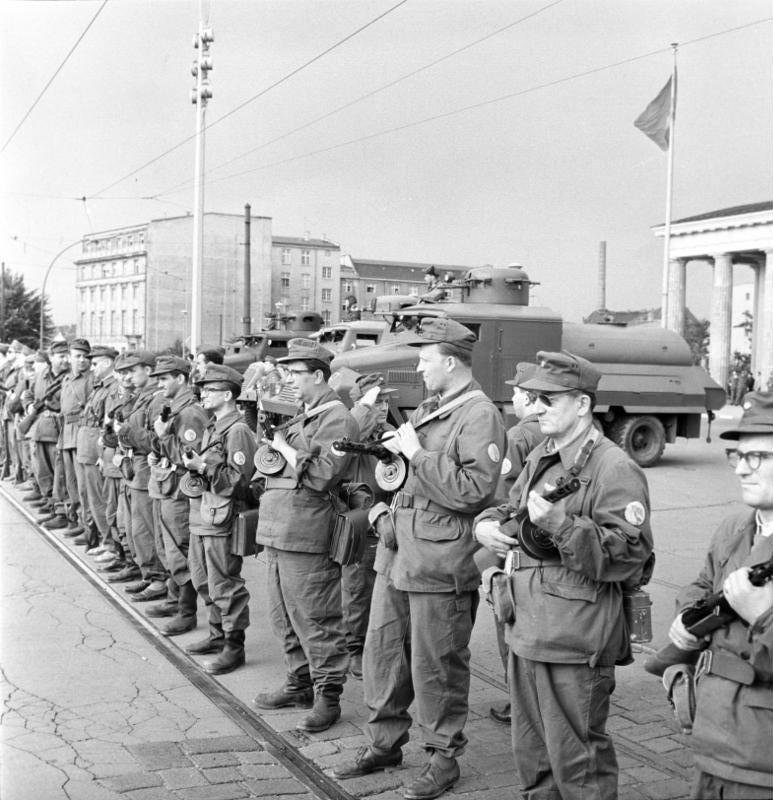
On 13 August 1961 East German authorities began sealing off West Berlin with barbed wire and barriers, which grew into walls, fences, guard positions and controlled crossings. They wanted to stop people leaving: by August 1961 the GDR had lost at least four million people, about a sixth of its population, according to the Berlin Wall Foundation. The barrier cut streets, rail lines and families in two.
Berlin becomes a divided city in a divided country Division
After the Second World War Germany was divided into American, British, French and Soviet zones, and Berlin, deep inside the Soviet zone, was divided among the same four powers. As relations soured the city became a Cold War front line: the Soviet blockade of the western sectors lasted from June 1948 to May 1949 and was met by the Western airlift. In 1949 the Federal Republic was founded in the West and the German Democratic Republic in the East.
The Night of 9 November in One Picture
Hour by Hour: 9 November 1989
Times from the German government chronology, the Haus der Geschichte and reference sources; they differ by minutes.
| Time (CET) | Event | Source note |
|---|---|---|
| 18:00 | Schabowski’s press conference begins, live on East German TV and radio | Wikipedia chronology |
| 18:53 | Ehrman (ANSA) asks about the 6 Nov draft; Schabowski says “immediately” | Who asked which question is disputed |
| 19:00 | Press conference ends | Matches the note’s “not longer than 19:00” |
| 19:04 | dpa reports East Germans may cross “immediately” | Wikipedia chronology |
| 19:17 | ZDF heute broadcasts excerpts | Wikipedia; Schabowski article |
| 20:00 | ARD Tagesschau leads with the story | Wikipedia chronology |
| 22:45 to 23:30 | Jäger orders Bornholmer Straße opened | Sources give different times |
| 23:29 | Way to West Berlin open at Bornholmer Straße | Haus der Geschichte |
Why the Berlin Wall Opened: Five Forces
1. Peaceful public demonstrations People in Leipzig, Berlin and other cities demanded freedom of expression, reform and the right to travel. On 9 October about 70,000 marched in Leipzig and no shots were fired; on 4 November about 500,000 filled Alexanderplatz.
2. Mass departures Citizens left through Hungary, Austria and the West German embassy in Prague. The Pan-European Picnic of 19 August and Hungary’s opening on 11 September showed that the Wall was no longer the only way out.
3. A weakening leadership Honecker resigned on 18 October, and Krenz struggled for public trust. By 7 November the prime minister and two-thirds of the Politburo had resigned.
4. Confusing communication The rules were meant to be published next morning. A press-conference answer made them sound immediate, and West German television broadcast it to East Berliners.
5. Decisions at the checkpoints Crowds demanded passage. Commanders such as Jäger, without clear orders, raised the barrier, which turned the announcement into a fact.
The Popular Story vs the Record
The “mistake” story is a useful shorthand, but it can hide how the border opened.
| Popular version | What the record shows |
|---|---|
| A slip of the tongue opened the Wall | The answer started the rush, but weeks of protest, exit through Hungary and Czechoslovakia and a collapsing leadership came first |
| The order came from the top | No order matched what people expected; commanders such as Jäger decided checkpoint by checkpoint |
| Everything opened at once | Crossings opened one by one through the night; ten more were announced afterwards |
| The Brandenburg Gate opened that night | It opened on 22 December 1989 |
| The Wall came down in November 1989 | Official demolition began on 13 June 1990 and ran for years |
| Germany reunified that week | Reunification took effect on 3 October 1990 |
The Wall in Numbers
| Measure | Figure | Source and caveat |
|---|---|---|
| Length | About 155 km | Berlin Wall Foundation; about 43 km between East and West Berlin itself |
| Watchtowers, 1989 | 302 | Wikipedia, Fall of the Berlin Wall |
| Recorded deaths | At least 140 | Berlin Wall Foundation; other estimates 136 to more than 200 |
| Years standing | 28 years, 88 days | 13 Aug 1961 to 9 Nov 1989 |
| People lost by East Germany before 1961 | At least 4 million | About a sixth of the population, Berlin Wall Foundation |
| Leipzig, 9 Oct 1989 | About 70,000 | German government chronology and Wikipedia |
| Alexanderplatz, 4 Nov 1989 | About 500,000 | German government chronology |
| Down as long as up | 5 Feb 2018 | 10,316 days either side; some counts 10,315 |
What Happened to the Original Schabowski Note?
It was lost, then found. The handwritten sheet was considered lost until 2015, when the Haus der Geschichte, after extensive research, added the original to its collection.
It was authenticated three ways. The museum cites a signed certificate of authenticity from Schabowski, handwriting comparisons, and material and production-technical examinations.
It is a briefing sheet, not an order. The notes include a reminder to read the travel regulation and a mention of the Council of Ministers decision. Its importance lies in the role it played in communicating the policy, not in any order to demolish the Wall.
It shows how decisions can depend on how they are communicated. A rule meant to be published the next morning reached television audiences as an announcement for that evening.
How the Fall Changed Europe
Families reunited. People separated by the border could meet and travel, and about one million visited West Berlin within two days of the opening, according to the East German news agency.
The state lost control of its border. Within weeks the Politburo resigned, and within a year East Germany ceased to exist.
Reunification became possible. It took an election on 18 March 1990, currency union on 1 July, the Two Plus Four treaty on 12 September and unity on 3 October.
The Cold War order shifted. The opening became one of the defining images of the end of communist rule in Eastern Europe.
A memorial landscape emerged. Surviving sections, museums and the Bernauer Straße memorial document the division and the people who died. The fall did not solve every problem: economic, social and political differences between East and West persisted after 1990.
Who Shaped the Night
Roles as described in public sources. Where sources differ, this page says so.
Günter Schabowski
SED Politburo member who announced the travel rules; died in 2015.
Egon Krenz
Succeeded Honecker on 18 October 1989 and handed Schabowski the travel text; his rule ended 6 December.
Harald Jäger
Commanded Bornholmer Straße and gave way to the crowd on the night of 9 November.
Riccardo Ehrman and Peter Brinkmann
ANSA and Bild reporters who both put questions to Schabowski; accounts of who asked which differ.
Helmut Kohl
Presented the ten-point plan on 28 November 1989 and walked through the Brandenburg Gate on 22 December.
Leipzig and Berlin demonstrators
The crowds of 9 October and 4 November 1989 that made the regime’s position untenable.
Explore More Timelines
People Also Ask
Frequently Asked Questions
Related AiTimeline Stories
⚠️ Editorial Note
This page is a dated, sourced record. Times and counts are taken from the Berlin Wall Foundation, the Haus der Geschichte, the German Federal Government’s 1989-1990 chronology and reference sources, and they differ by minutes or by definition in places, which the page flags. Two details in the original brief were corrected: Bornholmer Straße opened between 22:45 and 23:30 with the way open at 23:29 (not a single fixed 11:30 p.m.), and the Brandenburg Gate crossing opened on 22 December 1989, not on 10 November. The familiar “a mistake opened the Wall” story is shorthand; it should not obscure the peaceful revolution that made the opening possible. The 37th anniversary is Monday 9 November 2026; the 1990 reunification is a separate date.
Sources & further reading
Every dated entry above was checked against these references. Last reviewed 20 October 2026.
- The Berlin Wall: history, facts and figures
- Notizzettel Schabowski (the original handwritten note, 9 November 1989)
- Chronology of the events 1989-1990
- 9 November 1989: The Wall is open
- Opening and fall of the Berlin Wall
- Marking the 30th anniversary of the Berlin Wall's fall
- Fall of the Berlin Wall
- Gunter Schabowski
- Berlin Freedom Week 2026, 7-14 November
- Berlin Wall torn down: down as long as it stood (5 February 2018)