Berlin Airlift: History, How It Worked and Stalin’s Blockade
Berlin Airlift timeline: why Stalin blockaded West Berlin in 1948, how Allied aircraft flew 2.3 million tons of supplies, and why the blockade failed.
Latest Story
The Berlin Airlift was the Western Allies’ answer to Stalin’s blockade of West Berlin: from 26 June 1948 to 30 September 1949 American, British and other crews flew about 2.3 million tons of food, coal and supplies into a city that Soviet forces had cut off by road, rail and water on 24 June 1948. This timeline runs newest first, from the 2026 anniversary back to the 1945 occupation zones, and keeps the blockade’s end on 12 May 1949 separate from the airlift’s end on 30 September.
💡 Short Answer
The Berlin Airlift (26 June 1948 to 30 September 1949) was a US-British-led operation that supplied West Berlin by air after the Soviet Union blockaded it on 24 June 1948. About 2.3 million tons were delivered in more than 278,000 flights. The Soviets lifted the blockade on 12 May 1949, a tactical failure for Stalin, but the airlift continued until September to build stocks. It did not end the Cold War; it deepened Germany’s division.
Berlin Airlift: Key Questions
The Berlin Airlift in Ten Points
- Trigger: the Deutsche Mark of 20 June 1948 led to the 24 June blockade.
- Legal basis: only three air corridors were guaranteed in writing, on 30 November 1945.
- Start: Operation Vittles on 26 June 1948 and Plainfare two days later.
- System: Tunner’s strict timing from August 1948 turned improvisation into an air bridge.
- Morale: the Reichstag rally of 9 September and Halvorsen’s candy drops.
- Worst test: a foggy winter, with just 83 tons of American cargo reaching Berlin on 30 November.
- Record: the Easter Parade delivered 12,941 tons in 24 hours.
- Diplomacy: Stalin’s January 1949 offer led to the 4 May agreement.
- Dates: blockade lifted 12 May 1949; airlift ended 30 September 1949.
- Legacy: not the sole cause of NATO or the end of the Cold War, but a lasting symbol.
Berlin Airlift Timeline, Latest First
Each entry is tagged by theme and ends with why it matters. Use the filter to isolate a theme.
Politics, flying or aftermath? Filter the Berlin Airlift timeline by theme.
–
2026
The 78th anniversary: a Candy Bomber mural at Joint Base Charleston Aftermath & memory
On the 78th anniversary of Operation Vittles, the US Air Force’s Joint Base Charleston unveiled a mural honouring the Berlin Airlift outside the C-17 Aircrew Training Center, which carries the name of Colonel Gail Halvorsen, the “Candy Bomber”. The base’s account repeats the airlift totals: more than 2.3 million tons delivered in more than 278,000 missions between 26 June 1948 and 30 September 1949, with American crews flying nearly 190,000 of them.
2025
Berlin’s mayor lays a wreath at the Airlift Monument on the 76th anniversary Aftermath & memory
Berlin’s Governing Mayor Kai Wegner laid a wreath at the Airlift Monument in Tempelhof on Monday 12 May 2025, 76 years after the Soviet Union lifted the blockade. He thanked the people of many nations who took part and said the lessons of the airlift should not be forgotten. The city’s own account credits the Allies with “more than 270,000 flights” that kept a good two million people in western Berlin alive.
2024
Veterans and Berlin children gather at Tempelhof for the 75th anniversary Aftermath & memory
The Candy Bomber Foundation reported that veterans, Berlin schoolchildren, officials and members of the Halvorsen family gathered at the memorial at Tempelhof to mark the 75th anniversary of the end of the blockade. The foundation continues the work of Gail Halvorsen, who died in 2022, through aviation and science education for young people.
2022
Gail Halvorsen, the Candy Bomber, dies aged 101 Aftermath & memory
Halvorsen died of respiratory failure at 101. Wikipedia’s account says he arrived in Germany on 10 July 1948 to fly C-47s and C-54s, began dropping sweets on small handkerchief parachutes for children waiting at the Tempelhof fence, and later commanded Tempelhof Central Airport himself in 1970. After his death, Berlin’s then mayor Franziska Giffey said his “deeply human act has never been forgotten”.
2008
Tempelhof Airport closes; the airfield becomes a park Aftermath & memory
Tempelhof closed to all flights on 30 October 2008 after a court-backed decision to concentrate Berlin’s air traffic at one airport. A non-binding referendum in April 2008 drew 60.2% in favour of keeping it open, but only 21.7% of eligible voters, short of the 25% needed. In a 2014 referendum Berliners voted to keep the whole field free of development, and it is now a public park with the Airlift Monument at its edge.
1994
Western troops leave Berlin; Allied forces are deactivated Aftermath & memory
After the fall of the Wall, the United States Air Force’s 7350th Air Base Group at Tempelhof was inactivated in June 1993. In July 1994 British, French and American forces in Berlin were deactivated at a ceremony attended by President Clinton, and the US Army closed its Berlin aviation detachment in August 1994, ending a 49-year American military presence in the city.
The Airlift Monument rises in front of Tempelhof Aftermath & memory
The Luftbrückendenkmal, a 20-metre concrete arch designed by Eduard Ludwig, was inaugurated in 1951. Its three ribs stand for the three air corridors from Hamburg, Hanover and Frankfurt. A bronze band at its base lists those who died in the operation; berlin.de counts 39 British, 33 Americans and 5 German workers, while the US Air Force history gives 32 Americans, 39 British and nine to fourteen Germans.
1949
East Germany is founded, completing the division Aftermath & memory
The US State Department’s account says West Germany was established two weeks after the blockade ended, “soon followed by the creation of East Germany”. West Germany’s Basic Law took effect on 23 May 1949; the German Democratic Republic was proclaimed on 7 October. Berlin remained a four-power city in theory, but the two halves of Germany now belonged to rival camps.
1949
The airlift officially ends after 15 months Airlift operations
Flights continued after the blockade ended so that the Allies could stockpile supplies in case it returned. By the time the airlift closed on 30 September 1949, the US Air Force history says about 2,326,500 tons had been flown to Berlin in just over 278,100 flights; Wikipedia’s breakdown credits the USAF with 1,783,573 tons (76.4%) and the RAF with 541,937 tons (23.3%), nearly two-thirds of it coal. July 1949 had been the best single month, with over 250,000 tons.
1949
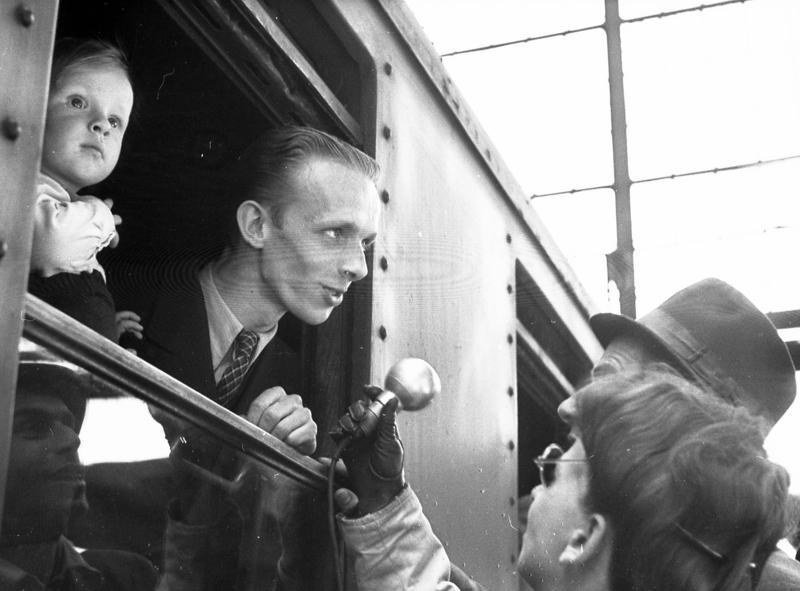
The Soviet Union lifts the blockade at one minute past midnight Blockade & politics
Land access reopened at 00:01 on 12 May 1949 after about 322 days. A British convoy drove through immediately, the first train from western Germany reached West Berlin at 5:32 a.m., and a large crowd celebrated that day. Some accounts say Moscow “lifted the blockade” on 11 May, the evening before it took effect. An internal State Department paper of 17 May 1949 called it “a tactical failure for the USSR” that nonetheless left Soviet policy on Germany unchanged.
1949
Four powers agree in New York to end the blockade in eight days Blockade & politics
The USAF history says US diplomat Philip Jessup asked his Soviet counterpart Yakov Malik on 15 February 1949 whether Stalin’s omission of the currency issue was intentional, and Malik confirmed a month later that it was. The TASS agency signalled openness on 25 April, and on 4 May the four powers announced the blockade would end eight days later.
1949
The Easter Parade: 12,941 tons in 24 hours Airlift operations
General William Tunner staged a maximum-effort day to keep crews from growing complacent, carrying only coal. In 24 hours from noon on 15 April, 12,941 tons were delivered in 1,398 flights; a plane landed at one of Berlin’s three airfields every 62 seconds. The USAF history says the daily average then settled at a higher level, rising from 6,300 tons in March to 7,850 in April and over 8,000 in May and June. (Wikipedia gives 1,383 flights.)
1949
NATO is founded in Washington while the blockade is still on Blockade & politics
The United States, Canada and ten Western European states signed the North Atlantic Treaty. The State Department’s milestone says the Western Allies created NATO shortly before the blockade ended, and the Park Service describes it as a collective-defence pact. The airlift did not create NATO, which had been under discussion since 1948, but it strengthened the case for it.
1949
Stalin tells a US journalist the blockade could end if a West German state is delayed Blockade & politics
FRUS records that Stalin publicly offered, in a statement to Kingsbury Smith on 30 January 1949, to trade the lifting of the blockade for a postponement of the western German state; the USAF history dates his reply 31 January. American diplomats noticed he had said nothing about Berlin’s currency, the sticking point since the previous summer, which opened the Jessup–Malik channel.
Feb 1949
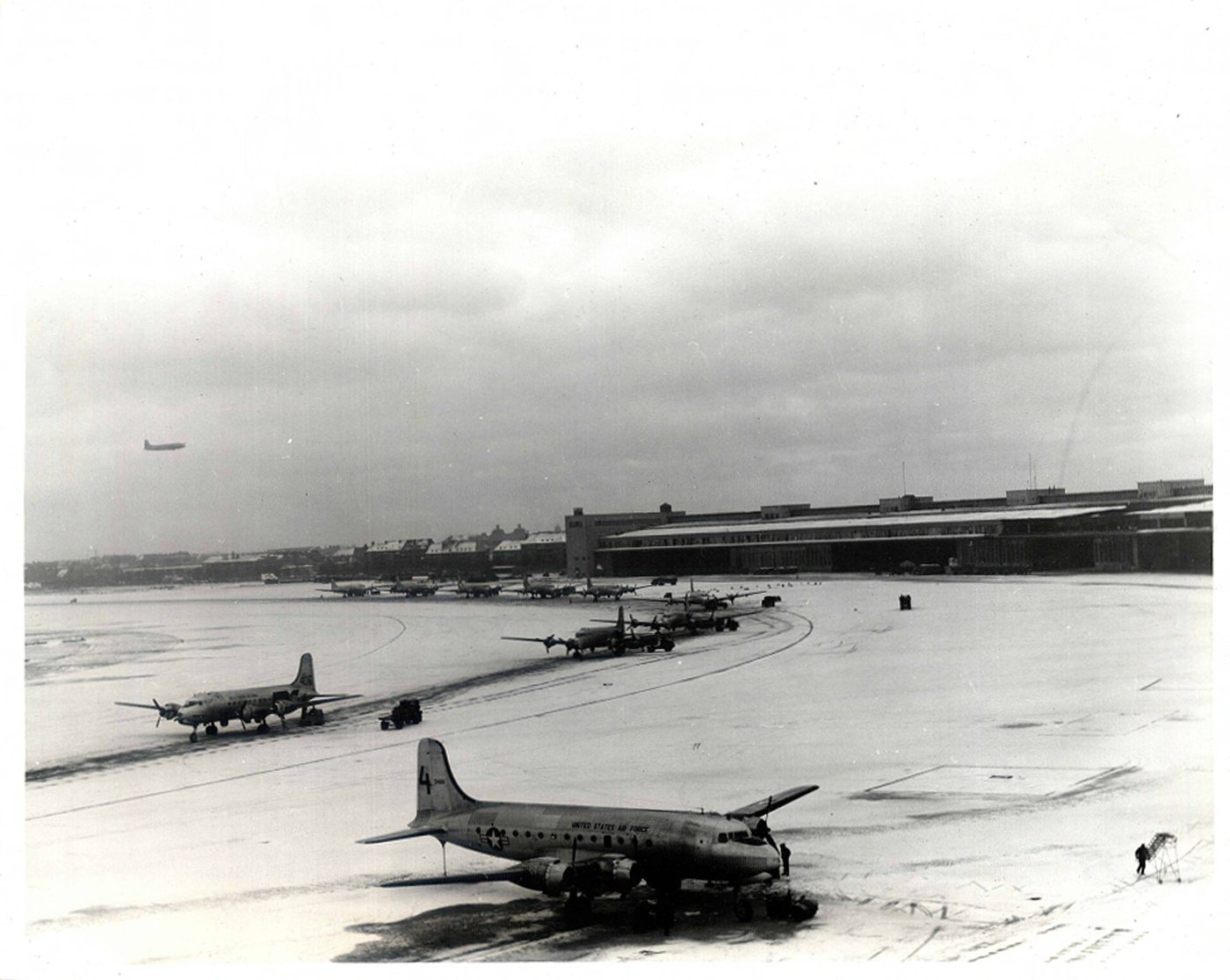
A foggy winter tests the airlift to its limit Airlift operations
The USAF history calls the weather “the worst of the entire blockade”. In November, of 720 hours only 63 allowed visual flying, and on 30 November just ten US planes reached Berlin with 83 tons, the worst day of the airlift. Fog lasted into December, and in February airfields were shut for 122 hours, yet Berlin still ended the month with the 21-day stock planners had set as the minimum. The history calls it “a very close call”; extra C-54s, new radar and lighting, and a push on coal in early January made the difference.
1948
Tegel opens to C-54s after Berliners build it in 93 days Airlift operations
The French provided the land for a third Berlin airfield. Beginning on 5 August 1948, up to 17,000 Berliners, more than half of them women, worked alongside US Army engineers and, in 93 days, built a 5,500-foot runway largely from wartime rubble. British Dakotas and Hastings began using Tegel regularly from 17 November, and American C-54s from 14 December. On 16 December French engineers blew up the Radio Berlin towers standing in the approach path, over Soviet objections.
1948
Berlin splits into two city governments Blockade & politics
After communist-led crowds disrupted the city assembly, the non-communist majority met in the British sector. On 30 November the Socialist Unity Party (SED) held an unconstitutional “extraordinary city assembly” in East Berlin that declared the elected city government deposed and installed an all-communist one under Friedrich Ebert Jr. On 7 December a new West Berlin government was elected with Ernst Reuter as Lord Mayor; Wikipedia notes a Soviet veto had earlier kept him from the post.
1948
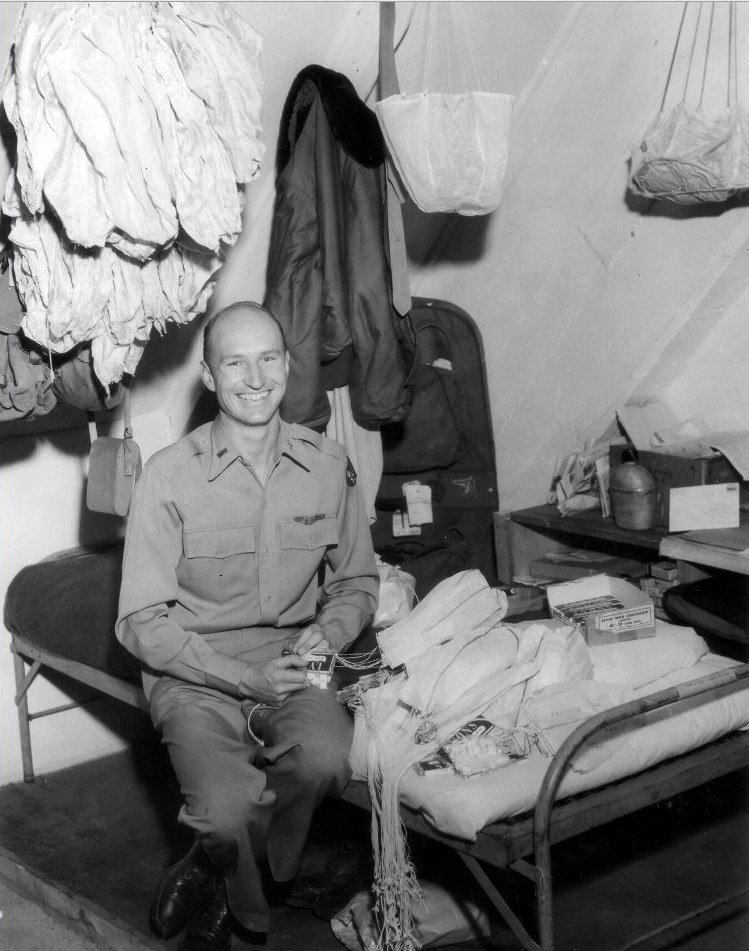
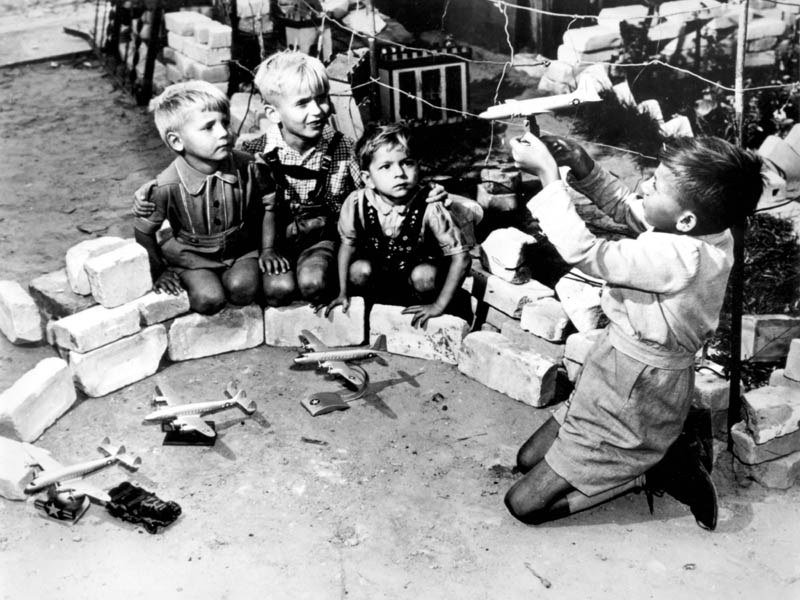
“Little Vittles”: Halvorsen’s candy drops become an official operation Airlift operations
Gail Halvorsen began dropping chewing gum and chocolate on tiny parachutes made of handkerchiefs for children at the Tempelhof fence in July 1948. When airlift commander William Tunner heard of it he approved “Operation Little Vittles”, officially from 22 September. Wikipedia’s account says American confectioners and schoolchildren supplied the sweets and that more than 23 tons were dropped from over 250,000 parachutes; the “raisin bomber” name (Rosinenbomber) followed.
1948
300,000 Berliners rally at the Reichstag; Reuter appeals to the world Blockade & politics
On 6 September the SED marched on the city council and forced it to adjourn. Three days later a huge crowd gathered at the Reichstag; Ernst Reuter told the world’s peoples that “this city, this people, must not be abandoned”. The State Department puts the crowd at 300,000 and Wikipedia at 500,000. The State Department says the turnout convinced the West to keep the airlift and the Deutsche Mark.
1948
Air Force Day: 6,988 tons in one day Airlift operations
To mark the US Air Force’s first birthday, the Americans and British staged a coal-only maximum effort: 6,988 tons (5,582.7 American, 1,405.3 British) in 897 flights, with a landing every 96 seconds despite 18 hours of instrument conditions. General Lucius Clay told Washington it proved “we can last indefinitely in Berlin”. Tonnage had risen from 2,185 tons a day in July to 3,835 in August and 4,593 in September.
1948
“Black Friday” at Tempelhof leads Tunner to ban stacking Airlift operations
The USAF history says driving rain blinded the Tempelhof radar; one plane overshot the steel-plank strip and exploded, another blew two tires and a third ground-looped, leaving nearly two dozen aircraft circling in cloud. Tunner, who was himself in the stack, ordered planes that missed an approach to fly out the central corridor instead of waiting, and he pressed Washington for the best air-traffic controllers available.
1948
General William Tunner arrives and turns improvisation into a system Airlift operations
Tunner, who had flown the wartime “Hump” airlift (his memoir is titled Over the Hump), reported to General Curtis LeMay at Wiesbaden on 28 July. The USAF history says that on 7 August his headquarters set strict procedures: every flight had a precise take-off time, route, altitude and speed, with planes entering the corridor three minutes apart (a spacing pilots themselves had suggested). He estimated 225 C-54s would be needed.
1948
Britain joins with Operation Plainfare Airlift operations
The State Department says the United Kingdom followed the Americans two days after 26 June with “Operation Plainfare”. The USAF history says aircrews from the US Air Force, US Navy, Royal Air Force and British civilian carriers flew cargoes from nine western airfields; Canadian, Australian, New Zealand and South African crews also helped the RAF. The British flew mainly into Gatow and delivered a daily average of 1,463 tons in August 1948.
1948
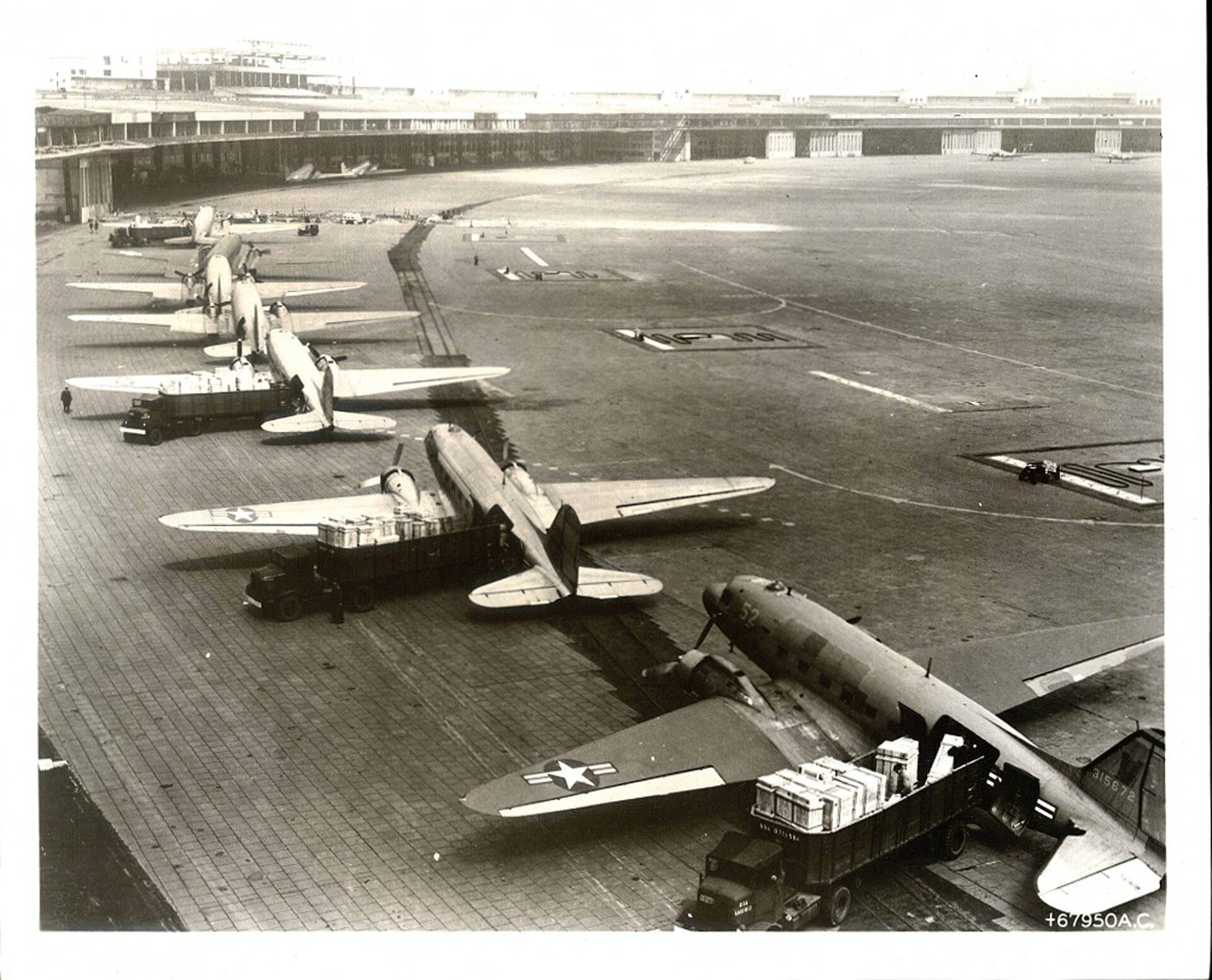
Operation Vittles begins: 32 C-47s carry 80 tons Airlift operations
General Clay ordered the airlift on 25 June and the next day 32 C-47s took off for Berlin with 80 tons, including milk, flour and medicine, according to Wikipedia. The State Department says the US launched “Operation Vittles” on 26 June. The USAF history describes it as “an improvised stopgap to buy time” that grew into a system keeping 2.2 million Berliners alive for nearly a year.
1948
The Soviet Union blockades West Berlin Blockade & politics
On 24 June the Soviets blocked rail and road traffic and canal barges into the western sectors of Berlin, calling it “technical difficulties”. Electricity to the western sectors was restricted to about two hours a day. The State Department says Soviet forces blockaded rail, road and water access that day; the only routes left were the three air corridors. General Clay had cabled on 13 June that staying in Berlin was “essential to our prestige” and had “become a symbol of the American intent”.
1948
The Deutsche Mark triggers the crisis Blockade & politics
The US, Britain and France announced the new Deutsche Mark on 18 June and introduced it in the western zones on 20 June; Wikipedia says the Soviets refused to let it be used in Berlin and announced their own Ostmark on 22 June. The State Department notes the currency came to West Berlin in June, without warning the Soviets, to curb the black market and to allow Marshall Plan aid. Accounts differ by a day or so on when the West Berlin version took effect. The Soviets had already begun harassing traffic in the days after the announcement.
1948
The “little blockade”: Soviet checks on Western traffic begin Blockade & politics
After the Allied Control Council met for the last time on 20 March 1948, the Soviets issued orders on 25 March restricting Western military and passenger traffic to Berlin. From 1 April no cargo could leave Berlin by rail without the Soviet commander’s permission and each train and truck was searched. The State Department notes the Soviets withdrew from the Council in March when they discovered Western plans for a new German state.
The Marshall Plan and Bizonia divide the West from the East Blockade & politics
On 1 January 1947 the US and UK merged their zones as “Bizonia”. In March the Moscow foreign ministers’ conference broke down and the Truman Doctrine was announced, and in June Secretary Marshall unveiled the European Recovery Program. The State Department says the plan was meant both to revive Western Europe and to draw it into America’s economic orbit.
1945
The Allied Control Council approves three air corridors to Berlin Blockade & politics
Land access to Berlin rested on a verbal understanding between Marshal Zhukov, General Clay and a British representative. The only written arrangement, approved on 30 November 1945, allowed three 20-mile-wide air corridors and a four-power air safety centre. The State Department says that agreement left the Western Allies with air corridors as their only secure connection to Berlin, and that an attack on an unarmed supply mission would put the blame on the Soviets.
Germany and Berlin are divided into four occupation zones Blockade & politics
After Germany’s defeat the US, UK, France and the Soviet Union divided the country and Berlin into occupation zones. The State Department notes Berlin lay deep inside the Soviet zone and that 2.5 million Berliners lived in a ruined city short of shelter, warmth and food. The Potsdam Conference in July 1945 did not settle Germany’s future.
How the Tonnage Grew
From 80 Tons to 12,941
The Story at a Glance
Dates and figures from US government and city sources.
| Date | Event | Detail |
|---|---|---|
| 30 Nov 1945 | Air corridors agreed | Three 20-mile corridors; the only written access deal |
| 1 Apr 1948 | Little blockade | Soviet checks on Western rail and road traffic |
| 20 Jun 1948 | Deutsche Mark | Introduced in the western zones; Ostmark answer 22 Jun |
| 24 Jun 1948 | Blockade | Rail, road, canal and electricity cut to West Berlin |
| 26 Jun 1948 | Operation Vittles | 32 C-47s, 80 tons on day one |
| 28 Jun 1948 | Operation Plainfare | RAF and charter carriers join |
| 28 Jul 1948 | Tunner arrives | Strict timing and fixed altitudes follow |
| 13 Aug 1948 | Black Friday | Rain at Tempelhof halts the American lift |
| 9 Sep 1948 | Reichstag rally | 300,000 to 500,000 Berliners |
| 18 Sep 1948 | Air Force Day | 6,988 tons in one day |
| 22 Sep 1948 | Little Vittles | Candy drops become official |
| 14 Dec 1948 | Tegel in use | C-54s land on a runway built in 93 days |
| 30-31 Jan 1949 | Stalin to Kingsbury Smith | Blockade tied to a West German state |
| 4 Apr 1949 | NATO signed | Twelve founding members |
| 15-16 Apr 1949 | Easter Parade | 12,941 tons, 1,398 flights |
| 12 May 1949 | Blockade lifted | Land access reopens at 00:01 |
| 30 Sep 1949 | Airlift ends | About 2.3 million tons, 278,000 flights |
| 2008 to 2026 | Remembrance | Tempelhof closes; wreaths and a 2026 mural |
How the Berlin Airlift Worked
1. Supplies were collected in the west. The British and American armies delivered food, coal and dozens of other necessities to nine airfields in western Germany, the USAF history says.
2. Planes flew a rigid schedule. From 7 August 1948 each flight had a precise take-off time, route, altitude and speed, and planes entered the corridor three minutes apart. All flights used instrument rules whatever the weather.
3. Three corridors gave legal cover. The written 1945 agreement allowed three 20-mile corridors. The Americans reasoned that firing on an unarmed supply flight would make the Soviets the aggressor.
4. Planes landed at three airfields. Tempelhof (American), Gatow (British) and Tegel (French sector), the last built by up to 17,000 Berliners in 93 days.
5. Unloading was fast. German and refugee labourers loaded and unloaded the planes; on Air Force Day one C-47 was unloaded at Tempelhof in 5 minutes 45 seconds.
6. Bad approaches did not stack. After Black Friday, planes that missed an approach flew out the central corridor instead of circling.
7. Maintenance and controllers kept it running. A network of support organisations on two continents kept aircraft flying, and radar and landing lights improved through the winter.
The central lesson: the airlift worked because of teamwork and logistics, not because of any single aircraft or hero.
| Term | Meaning | Why it matters here |
|---|---|---|
| Air corridor | A 20-mile-wide flight lane from western Germany to Berlin | The only written access right; three were agreed on 30 Nov 1945 |
| Bizonia | The US and UK zones merged on 1 Jan 1947 | Western integration that the Soviets opposed |
| Deutsche Mark | New currency introduced in the western zones in June 1948 | The immediate trigger for the blockade |
| Ostmark | Soviet-zone currency announced 22 Jun 1948 | The Soviet counter-move that split Berlin’s money |
| Operation Vittles | The American airlift name | Began 26 June 1948 |
| Operation Plainfare | The British airlift name | Began about two days later |
| Little Vittles | Halvorsen’s candy-drop effort | Official from 22 Sep 1948 |
| Stacking | Holding planes in circles above Berlin in bad weather | Banned by Tunner after Black Friday |
Who Is Who in the Story
General Lucius Clay
US military governor who cabled on 13 June 1948 that staying in Berlin was essential and ordered the airlift on 25 June.
General Curtis LeMay
Commander of US Air Forces in Europe; named Joseph Smith task force commander on 28 June and brought Tunner in.
Lt. Gen. William Tunner
Took over in late July 1948, imposed strict timing, banned stacking after Black Friday and staged the Easter Parade.
Joseph Stalin
Ordered the blockade and, in January 1949, offered to end it if a West German state was postponed.
Ernst Reuter
West Berlin’s Lord Mayor from December 1948; told the world on 9 September that Berlin must not be abandoned.
Lt. Gail Halvorsen
The Candy Bomber who began the sweets drops in July 1948; died on 16 February 2022, aged 101.
Philip Jessup
Asked Soviet delegate Malik on 15 February 1949 whether Stalin’s omission of the currency was deliberate.
Yakov Malik
Confirmed a month later that it was, opening the talks that ended the blockade.
Why Did Stalin Order the Berlin Blockade?
Germany, not just Berlin. A US State Department paper of 17 May 1949 says the blockade was designed to eliminate Western influence in Berlin and to change Western plans for Germany, which then centred on a West German state.
The currency trigger. The Soviets objected to the Deutsche Mark and answered with their own Ostmark. Wikipedia notes Soviet guards began halting trains the day after the currency announcement on 18 June.
A leverage play. In January 1949 Stalin told a US journalist the blockade could end if a separate West German government was postponed, omitting the currency demand.
Why it failed. The paper concludes the blockade hastened the formation of a West German state, strengthened the Western alliance and left the Soviets in a stalemate, a tactical failure that did not change their basic aim.
Why It Mattered
It avoided war. Allied leaders kept their presence in Berlin without a ground confrontation, and none of the Soviet harassment of the corridors stopped the flights.
It shifted public opinion. The State Department says it turned Berlin from a symbol of Prussian militarism into a symbol of democracy and freedom.
It deepened division. West Germany followed on 23 May 1949 and East Germany on 7 October, and the Western Allies stayed in Berlin until 1994.
It is still remembered. Berlin lays a wreath at the Airlift Monument each year, and in June 2026 the US Air Force marked the 78th anniversary with a Candy Bomber mural.
The Popular Story vs the Record
| Popular version | What the record shows |
|---|---|
| The airlift began the day the blockade did | The blockade began on 24 June; Operation Vittles began on 26 June and Plainfare about two days later |
| The blockade and airlift ended together | The blockade was lifted on 12 May 1949; the airlift continued to 30 September to build stocks |
| Americans flew the whole airlift | The USAF carried 76.4% of the tonnage, the RAF 23.3%, with British charter and Commonwealth crews; France supplied the land for Tegel |
| Berlin was completely sealed off | Wikipedia notes foot traffic and the U-Bahn and S-Bahn kept running between East and West |
| The Western Allies had a treaty right to the roads and railways | Only a verbal understanding existed; the sole written access agreement covered three air corridors |
| The airlift created NATO | NATO was signed on 4 April 1949, before the blockade ended; the crisis strengthened the case but was not the only cause |
| It was a quick fix | The USAF history calls it an improvised stopgap that took months to become a system; the worst weather came in November 1948 and February 1949 |
| The airlift ended the Cold War crisis for good | It ended the blockade, but it hardened the division: West and East Germany were founded within five months |
The Berlin Airlift in Numbers
| Measure | Figure | Source and caveat |
|---|---|---|
| Blockade length | 24 Jun 1948 to 12 May 1949, about 322 days | State Department; Wikipedia |
| Airlift length | 26 Jun 1948 to 30 Sep 1949, 15 months | US Air Force |
| Total cargo | About 2,326,500 tons (Wikipedia: 2,334,374) | USAF history; Wikipedia total differs slightly |
| Flights | Just over 278,100 (Wikipedia: 278,228) | USAF history; berlin.de says more than 270,000 |
| USAF and RAF share | 1,783,573 t (76.4%) and 541,937 t (23.3%) | Wikipedia |
| Best single month | July 1949, over 250,000 tons | USAF history |
| Best single day | 12,941 tons, 1,398 flights | USAF history; Wikipedia gives 1,383 flights |
| Landing interval, Easter Parade | One every 62 seconds | USAF history |
| Population supplied | About 2.2 million (2.5 million all Berlin) | USAF; State Department |
| Deaths | 32 US, 39 British, 9 to 14 German | USAF history; berlin.de: 33 US, 39 British, 5 German |
| Tegel runway | 5,500 ft built in 93 days, up to 17,000 workers | USAF history |
| Candy dropped | Over 23 tons from over 250,000 parachutes | Wikipedia (Halvorsen) |
Explore More Timelines
People Also Ask
Frequently Asked Questions
Related AiTimeline Stories
⚠️ Editorial Note
Facts were checked on 21 October 2026 against the US State Department Office of the Historian, the US Air Force history of the airlift, FRUS 1949 vol. III, berlin.de, DVIDS and Wikipedia for secondary detail. The blockade (24 June 1948 to 12 May 1949) is kept separate from the airlift (26 June 1948 to 30 September 1949). The airlift is not presented as the sole cause of NATO or of the Cold War’s end. Sources differ on some figures: the Reichstag crowd (300,000 or 500,000), deaths (32 or 33 Americans, five to fourteen Germans), Easter Parade flights (1,398 or 1,383), and the date of Stalin’s reply (30 or 31 January 1949).
Sources & further reading
Every dated entry above was checked against these references. Last reviewed 21 October 2026.
- The Berlin Airlift, 1948-1949
- The Air Force Can Deliver Anything: A History of the Berlin Airlift
- Foreign Relations of the United States, 1949, vol. III, doc. 458: The Soviet Approach at the Meeting of the C.F.M.
- The Berlin Airlift
- The Blockade of Berlin
- American Cold War Policy
- Berlin Blockade
- Berlin Airlift Monument
- Commemoration: 76th anniversary of end of airlift
- Operation VITTLES: The Legacy of the Berlin Airlift
- 75th Anniversary of the end of the Berlin Blockade
- Gail Halvorsen
- Berlin Tempelhof Airport
- Berlin Tegel Airport