Vande Bharat Sleeper & Kavach 4.0 Timeline (2024–2027): Routes, 160 km/h Trials & Safety Rollout
Track the Vande Bharat Sleeper rollout from BEML prototypes and 160 km/h trials to commercial routes, trainset orders and Kavach 4.0 safety deployment.
Latest Story
Vande Bharat Sleeper and Kavach 4.0 are two separate Indian Railways programmes that get talked about as one story because they intersect on the same corridors. The Sleeper is a self-propelled overnight trainset built to eventually take on the Rajdhani-era long-distance market; Kavach 4.0 is an indigenous Automatic Train Protection system being fitted to track, stations and locomotives to supervise speed and braking. As of August 26, 2026, exactly one Vande Bharat Sleeper route is in commercial service, a prototype has been CRS-cleared to 180 km/h, and Kavach 4.0 is commissioned on 2,633 route km of the Delhi–Mumbai and Delhi–Howrah corridors — a fraction of the 24,427 route km where implementation work is already under way. This page tracks both programmes on their own separate, verified timelines.
🧠 AI Overview Summary
Vande Bharat Sleeper is a 160 km/h-design, CRS-cleared-to-180-km/h self-propelled trainset for overnight travel; only its Howrah–Kamakhya service (since January 23, 2026) is commercial, with routes like Delhi–Patna, Delhi–Mumbai and Mumbai–Ahmedabad still reported or unconfirmed. Kavach 4.0, India’s indigenous Automatic Train Protection system, is commissioned on 2,633 route km of the Delhi–Mumbai and Delhi–Howrah corridors as of July 31, 2026, out of 24,427 route km where implementation has begun. The two programmes are related but separate: a faster trainset and a safer network are different engineering problems that happen to share the same two corridors.
Vande Bharat Sleeper & Kavach: Key Questions
Key Takeaways
- Only one Vande Bharat Sleeper route is commercial — Howrah–Kamakhya, since January 23, 2026 — despite public interest in Delhi–Patna, Delhi–Mumbai and Mumbai–Ahmedabad, none of which have launched.
- The prototype has been CRS-cleared to 180 km/h (December 30, 2025, Kota–Nagda section) — above its 160 km/h design speed — but that is a test-track result, not the train’s day-to-day commercial operating speed.
- Three manufacturers are building a combined 210 trainsets: ICF–BEML (10), Kinet Railway Solutions/RVNL–Transmashholding (120) and a Titagarh Rail Systems–BHEL consortium (80, plus a 35-year maintenance contract) — most are not yet delivered.
- Kavach 4.0 is commissioned on 2,633 route km of the Delhi–Mumbai and Delhi–Howrah corridors as of July 31, 2026 — up from 738 route km in December 2025 — a fast pace, not a stalled one.
- 24,427 route km is “implementation taken up,” not “commissioned.” That is roughly nine times the commissioned figure, and conflating the two overstates how much of the network is actually protected today.
- Kavach 4.0 replaced Kavach 3.2 after RDSO approved the newer specification on July 16, 2024, adding better location accuracy, bigger-yard signal handling and a direct interface to electronic interlocking.
- Kavach cannot prevent every kind of accident. It supervises speed, signals and braking on equipped trains and track — it does not detect track failure, bridge damage, landslides or obstructions unless a separate system reports them.
- A 160 km/h-capable train still needs a 160 km/h-ready railway — track certification, signalling, overhead power, Kavach coverage and timetable capacity all have to line up before a route can actually run at that speed.
- Vande Bharat Sleeper and Kavach 4.0 share the Delhi–Mumbai and Delhi–Howrah corridors because both trace back to the same Mission Raftaar-era push to raise permitted speeds on India’s two busiest trunk routes.
- Neither programme is finished. The Railway Ministry has stated an internal target of 12 sleeper Vande Bharat trains running nationwide by December 2026; Kavach implementation continues section by section, zone by zone.
Vande Bharat Sleeper & Kavach: Claim vs Reality
The most common overstatements about both programmes, corrected against verified data.
| Claim | Reality |
|---|---|
| Vande Bharat Sleeper runs on Delhi–Mumbai and Delhi–Howrah | Incorrect as of Aug 26, 2026 — the only commercial route is Howrah–Kamakhya; Delhi–Mumbai and Delhi–Howrah sleeper services remain unconfirmed |
| Delhi–Patna sleeper has already launched | Incorrect — reported and re-targeted (Dec 2025, then Jun 2026), no confirmed commercial launch as of this update |
| Mumbai–Ahmedabad has Vande Bharat Sleeper | No — and it should not be confused with the separate Mumbai–Ahmedabad bullet train (high-speed rail) project |
| The train runs commercially at 180 km/h | Incorrect — 180 km/h was a CRS test-track result on Dec 30, 2025; the design/permitted service speed is 160 km/h, and actual commercial average speed is lower still |
| 200+ Vande Bharat Sleeper trainsets are running | Incorrect — 210 trainsets are on order across three manufacturers; the large majority had not been delivered as of Aug 2026 |
| Rajdhani trains are being phased out immediately | No official blanket-replacement policy exists; Sleeper is expected to gradually supplement premium overnight capacity, not replace Rajdhani overnight |
| Kavach 4.0 covers 24,427 route km today | Incorrect — that is the route km where implementation has been taken up (sanctioned/in progress); commissioned (live) coverage on the two flagship corridors was 2,633 route km as of Jul 31, 2026 |
| Kavach coverage numbers keep contradicting each other | Not a contradiction — 738 (Dec 2025) → 1,452 (Jan 2026) → 2,490 (Jul 13, 2026) → 2,633 (Jul 31, 2026) route km is a fast, consistent commissioning pace on the same two corridors |
| Kavach prevents all train accidents | Incorrect — it reduces risk from SPAD, overspeed and certain collision scenarios on equipped track; it does not address track/bridge failure, landslides or obstructions |
| Izzatnagar’s 660 route km are already Kavach-protected | Incorrect — approved on Aug 12, 2026 at an estimated ₹295 crore; work had not been reported complete as of this update |
Vande Bharat Sleeper & Kavach Dashboard — August 2026
| Metric | Latest value | As of | Source type |
|---|---|---|---|
| Sleeper commercial routes | 1 (Howrah–Kamakhya) | Jan 23, 2026 | Indian Railways / PIB |
| Highest CRS-cleared trial speed | 180 km/h | Dec 30, 2025 | Commission of Railway Safety |
| Trainset design speed | 160 km/h | — | Manufacturer/RDSO spec |
| Trainsets on order | 210 (3 manufacturers) | 2023 contracts | Ministry of Railways |
| Kavach 4.0 commissioned (Delhi-Mumbai + Delhi-Howrah) | 2,633 route km | Jul 31, 2026 | Indian Railways |
| — of which Delhi–Mumbai | 1,423 route km | Jul 31, 2026 | Indian Railways |
| — of which Delhi–Howrah | 1,210 route km | Jul 31, 2026 | Indian Railways |
| Kavach implementation taken up (national) | 24,427 route km | Mar 26, 2026 | Railway Ministry review |
| Kavach installed (national, all zones) | 3,103 route km | Mar 26, 2026 | Railway Ministry review |
| Optical fibre cable laid for Kavach | 8,921 km | Mar 26, 2026 | Railway Ministry review |
| Telecom towers installed | 1,183 | Mar 26, 2026 | Railway Ministry review |
| Station Kavach Data Centres | 767 | Mar 2026 (steady since Feb 2026) | Indian Railways |
| Locomotives fitted with Kavach | 4,154 | Feb 2026 | Indian Railways |
| New Izzatnagar Division approval | 660 route km, ₹295 crore | Aug 12, 2026 | Ministry of Railways |
The optical-fibre, tower, station-centre and loco-Kavach figures are the most recent nationally reported snapshots this page could verify (Feb–Mar 2026); they are national totals across all Kavach-equipped zones, not limited to Delhi–Mumbai/Delhi–Howrah, and are almost certainly higher by the time you’re reading this — this page will update them as newer official figures are published.
Vande Bharat Sleeper & Kavach 4.0 Timeline: 2019–2026
Newest first. Both programmes’ milestones are interleaved and tagged so you can follow either thread on its own.
2026
Kavach 4.0 Approved for 660 Route Km of Izzatnagar Division
What happened: The Ministry of Railways approved Kavach 4.0 deployment across 660 route km of the Izzatnagar Division at an estimated cost of ₹295 crore, covering 53 stations on the Kasganj–Izzatnagar, Izzatnagar–Kathgodam and Bhojipura–Tanakpur routes, under the umbrella work “Provision of Kavach with communication backbone of LTE on balance sections of Indian Railways.”
Why it matters: This shows Kavach 4.0 expanding beyond the two flagship corridors into regional divisions — but it is an approval, not a commissioning.
2026
Kavach 4.0 Commissioned Coverage Reaches 2,633 Route Km
What happened: Cumulative commissioned Kavach 4.0 coverage on the two flagship corridors reached 2,633 route km — 1,423 route km on Delhi–Mumbai (including 1,327 route km across Tilak Bridge Junction cabin–Palwal–Mathura–Kota–Nagda–Ratlam–Vadodara–Virar, plus 96 route km on Vadodara–Ahmedabad) and 1,210 route km on Delhi–Howrah (including 563 route km across Chipyana–Tundla–Kanpur–Subedarganj and 260 route km across Chota Ambana–Bardhaman–Howrah, among other sections).
Why it matters: This is the current above-the-fold headline figure for Kavach 4.0’s flagship-corridor rollout.
2026
Kavach 4.0 Passes 2,490 Route Km
What happened: Cumulative commissioned coverage crossed 2,490 route km on the two corridors, continuing the steady month-on-month expansion from the March 2026 figure.
2026
Kavach 4.0 Commissioned on the Vadodara–Nagda Section
What happened: Western Railway commissioned Kavach 4.0 over 224.51 route km on the Vadodara–Nagda stretch of the Delhi–Mumbai line — Vadodara–Mangal Mahudi (122.5 km) and Panchpipaliya–Nagda (102.01 km).
2026
Railway Minister Reviews Kavach 4.0: 24,427 Route Km Under Implementation
What happened: Ashwini Vaishnaw reviewed nationwide progress: Kavach installed on 3,103 route km overall, with 1,638 route km specifically commissioned on the Delhi–Mumbai/Delhi–Howrah corridors, work under way on 7,100 route km of trackside installation, and implementation “taken up” across 24,427 route km of high-density and high-utilisation corridors. A centralised monitoring platform, SURAKSHA, was announced to track installations in real time. Supporting infrastructure stood at 8,921 km of optical fibre, 1,183 telecom towers and 767 station Kavach Data Centres.
Why it matters: This is the source of the 24,427 route km figure that is frequently — and incorrectly — quoted as already-commissioned coverage.
2026
Kavach Infrastructure Snapshot: 8,570 Km of Fibre Laid
What happened: A national infrastructure progress report put optical fibre laid for Kavach at 8,570 km, alongside 938 telecom towers, 767 station data centres, 5,672 route km of trackside equipment installed, and 4,154 locomotives fitted with Kavach.
Why it matters: This is the underlying physical buildout — fibre, towers, data centres, loco kits — that has to exist before a route km can be “commissioned.”
2026
Delhi–Amritsar Sleeper Announced
What happened: Minister of State for Railways Ravneet Bittu announced a dedicated Delhi–Amritsar Vande Bharat Sleeper route via Chandigarh, Ludhiana and Jalandhar, targeted “by winter” 2026.
Why it matters: This remains an announced target, not a confirmed commercial launch, as of this page’s August 2026 update.
2026
Kavach 4.0 Passes 1,452 Route Km After a Record 472 Km Day
What happened: Indian Railways commissioned a record 472 route km of Kavach 4.0 across three sections in a single day, pushing cumulative commissioned coverage on the two corridors to roughly 1,452 route km.
2026
Howrah–Kamakhya Vande Bharat Sleeper Enters Commercial Service
What happened: India’s first commercial Vande Bharat Sleeper service began running between Howrah and Kamakhya — 968 km, roughly 14 hours, six days a week, with AC First, AC 2-tier and AC 3-tier classes.
Why it matters: This is the only route where “Vande Bharat Sleeper” describes an actual, bookable, running train, not a prototype or an announcement.
2026
PM Modi Inaugurates the First Vande Bharat Sleeper Express
What happened: Prime Minister Narendra Modi flagged off the Howrah–Kamakhya Vande Bharat Sleeper Express, six days before it entered regular commercial service.
2025
CRS Clears Final High-Speed Trial at 180 km/h
What happened: Under Commissioner of Railway Safety supervision, the Vande Bharat Sleeper prototype reached a peak of 180 km/h on the Kota–Nagda section. Ride stability, oscillation, vibration, braking and emergency-braking performance were all assessed and declared satisfactory.
Why it matters: This cleared the technical path for commercial introduction — but 180 km/h is a test-track ceiling, not a promised commercial running speed.
Kavach 4.0 First Commissioned on 738 Route Km
What happened: The first flagship-corridor Kavach 4.0 commissioning milestone: 738 route km, split between the Palwal–Mathura–Nagda section (633 route km, Delhi–Mumbai) and the Howrah–Bardhaman section (105 route km, Delhi–Howrah).
Why it matters: This is the baseline every later “route km commissioned” figure builds on.
Early Dynamic Trials Reach 160–170 km/h
What happened: Following static, brake and oscillation testing, the prototype’s dynamic speed trials reached 170 km/h on one section and 160 km/h on another, ahead of the eventual 180 km/h CRS-certified peak nearly a year later.
Why it matters: Speed trials happen in stages — static test, brake test, oscillation test, then progressively faster dynamic runs — certification is not a single event.
2024
BEML Unveils the First Vande Bharat Sleeper Prototype
What happened: Railway Minister Ashwini Vaishnaw unveiled India’s first Vande Bharat Sleeper prototype at BEML’s Bengaluru facility — a 16-coach rake (11 AC 3-tier, 4 AC 2-tier, 1 AC first class), built jointly with propulsion from ICF, seating/berth capacity of 823 passengers plus 34 staff berths.
Why it matters: This is the physical starting point of the entire Sleeper programme — before this date, it existed only as contracts and specifications.
2024
RDSO Approves the Kavach 4.0 Specification
What happened: RDSO formally approved Kavach specification version 4.0, incorporating field experience from Kavach 3.2’s earlier deployment on 1,465 route km of South Central Railway. Key upgrades: increased location accuracy, better signal-aspect information in larger yards, a station-to-station Kavach interface over optical fibre, and a direct interface to existing electronic interlocking systems.
Why it matters: Every Kavach commissioning figure on this page from late 2025 onward refers to this version, not the earlier 3.2 deployment.
2024
Kavach 3.2 Baseline: 1,465 Route Km, 144 Locomotives
What happened: Before version 4.0’s rollout began, the Railway Minister confirmed Kavach (version 3.2) had been deployed on 1,465 route km and 144 locomotives, concentrated on South Central Railway — the zone where the system was originally piloted.
Why it matters: This is a different zone and an earlier software version from the Delhi–Mumbai/Delhi–Howrah 4.0 figures elsewhere on this page — the two should not be added together.
Titagarh Rail Systems–BHEL Consortium Wins 80-Trainset Contract
What happened: The Titagarh Rail Systems–BHEL consortium was awarded a contract to build 80 Vande Bharat Sleeper trainsets at Titagarh’s Uttarpara (West Bengal) factory, with an associated 35-year maintenance agreement.
Kinet Railway Solutions Wins 120-Trainset Contract
What happened: Kinet Railway Solutions, a joint venture between RVNL and Russia’s Transmashholding, was awarded a contract for 120 Vande Bharat Sleeper trainsets (roughly 1,920 coaches).
ICF–BEML Designated for the First 10 Trainsets
What happened: ICF (propulsion and design) and BEML (Bengaluru assembly) were designated to build the first 10 Vande Bharat Sleeper trainsets — the batch that produced the September 2024 prototype and the Howrah–Kamakhya service rake.
TCAS Is Rebranded “Kavach” and Scaled Nationally
What happened: The indigenous Train Collision Avoidance System, developed by RDSO with domestic vendors, was formally branded “Kavach” and prioritised for nationwide scale-up as part of the broader Atmanirbhar Bharat push in indigenous safety technology.
RDSO Develops TCAS, the System That Became Kavach
What happened: RDSO, working with domestic signalling vendors, developed the Train Collision Avoidance System (TCAS) — an indigenous Automatic Train Protection system later certified to Safety Integrity Level 4 (SIL-4) and rebranded Kavach.
Train 18 Becomes Vande Bharat Express
What happened: India’s first indigenously built, self-propelled semi-high-speed trainset entered service as the Vande Bharat Express, using distributed traction (motors spread across the train rather than one locomotive) instead of a locomotive-hauled design.
Why it matters: Every later Vande Bharat variant, including the Sleeper, is built on this same self-propelled trainset architecture.
Vande Bharat Chair Car vs Vande Bharat Sleeper
Same trainset family, different job.
| Feature | Vande Bharat Chair Car | Vande Bharat Sleeper |
|---|---|---|
| Main use | Day intercity travel | Overnight / long-distance travel |
| Seating | Reclining chair-car seats | AC 1st/2nd/3rd-tier berths (823 total) |
| Propulsion | Self-propelled, distributed traction | Self-propelled, distributed traction |
| Design speed | Up to 160 km/h (route-dependent) | 160 km/h design; 180 km/h CRS trial peak |
| Coaches | Varies by rake (8–16) | 16 (11×3AC, 4×2AC, 1×1AC) |
| Routes | Widely operational across India | 1 commercial route (Howrah–Kamakhya) |
| Typical competitor | Shatabdi-style day travel | Rajdhani/Duronto-style overnight travel |
The Sleeper is not simply a Rajdhani rebuilt with new coaches — it keeps the Vande Bharat family’s self-propelled architecture, which is why it accelerates faster than a conventional locomotive-hauled train even at a similar top speed.
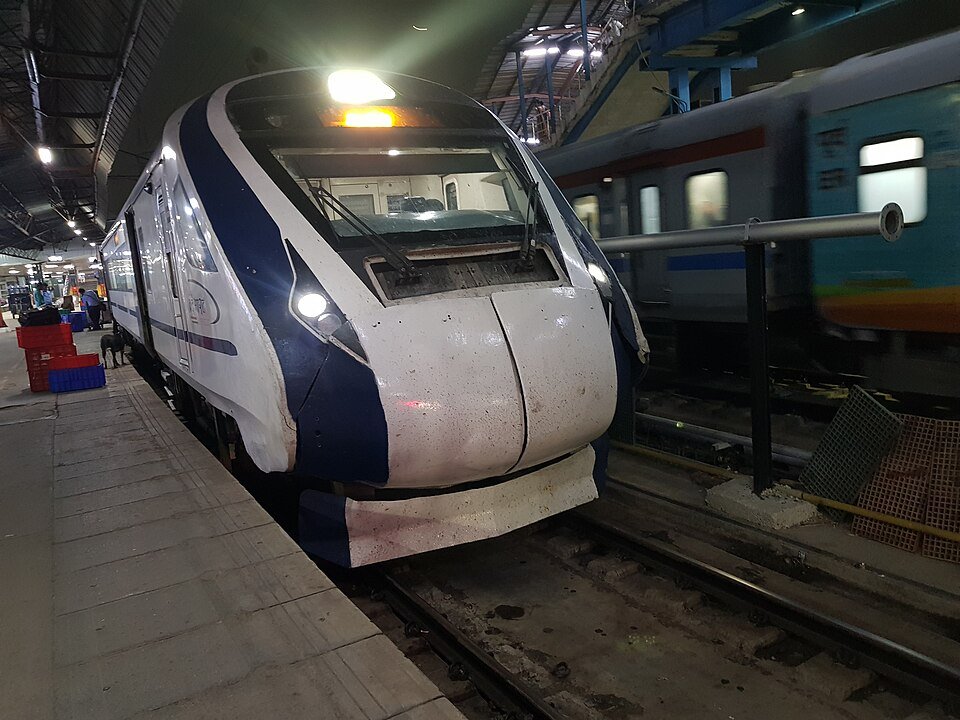
A Vande Bharat trainset — the same self-propelled architecture underlies both the chair-car and sleeper variants.
Inside the Vande Bharat Sleeper: BEML Prototype & Coach Configuration
The first Vande Bharat Sleeper prototype was unveiled at BEML’s Bengaluru facility on September 1, 2024, by Railway Minister Ashwini Vaishnaw, jointly built with ICF supplying propulsion and design. The standard rake is a 16-coach configuration: 11 AC 3-tier coaches (611 berths), 4 AC 2-tier coaches (188 berths) and 1 AC first-class coach (24 berths) — 823 passenger berths in total, plus 34 berths for onboard staff.
Passenger Features
Reported features include wider berths than existing LHB sleeper stock, improved reading lights with USB charging, modular pantries, sensor-based lighting, automatic doors, more spacious and accessible toilets (with a shower and hot water in the AC first-class coach), public-announcement and passenger-information systems, CCTV surveillance, and crashworthy structural design elements. This page does not describe it as a “luxury hotel on wheels” — these are documented feature upgrades over existing overnight coach stock, not independently verified comfort ratings.
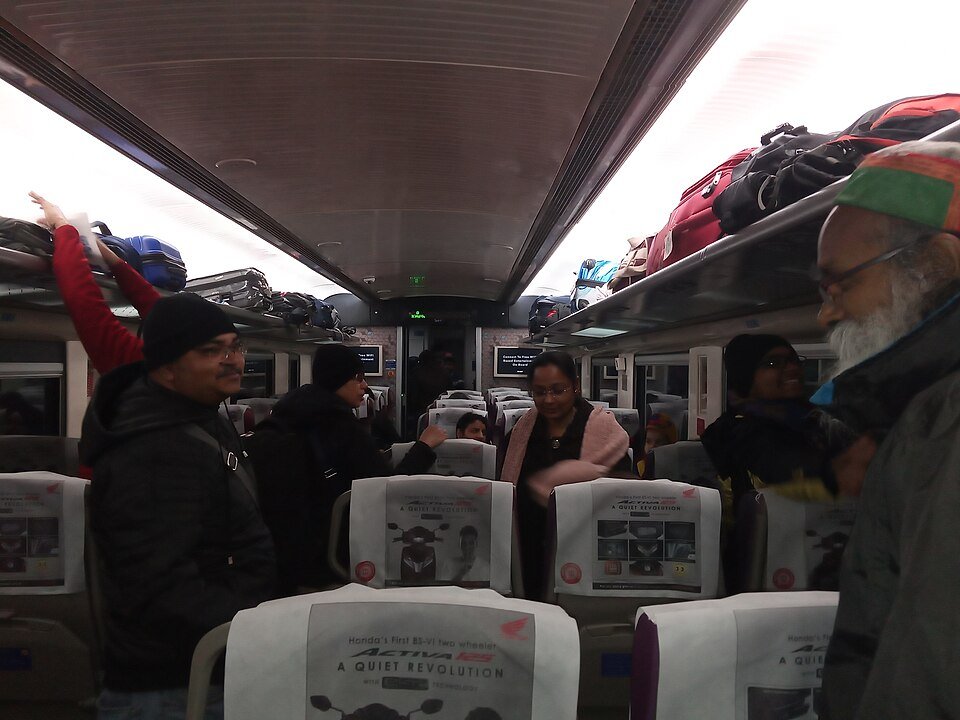
Interior of a Vande Bharat Express chair-car cabin — the Sleeper variant uses berths rather than seats within the same trainset family.
From Factory Floor to 180 km/h: How the Prototype Was Tested
After the September 2024 unveiling, the prototype went through progressively demanding stages: stationary structural and brake checks, then oscillation and ride-quality runs, then dynamic speed trials that reached 170 km/h on one section and 160 km/h on another in January 2025, and finally a Commission of Railway Safety-supervised high-speed trial that peaked at 180 km/h on the Kota–Nagda section on December 30, 2025 — assessing ride stability, oscillation, vibration, braking and emergency-braking performance, all declared satisfactory. That certification cleared the technical path to the January 2026 commercial launch.
160 km/h Design Speed ≠ 180 km/h Trial Peak ≠ Commercial Average Speed
⚠️ Three Different Numbers
Design speed (160 km/h) is what the trainset was engineered for. Trial peak (180 km/h) is what it demonstrated under CRS supervision on one test section, exceeding its own design spec — a margin of safety, not a promised commercial figure. Commercial average speed depends on track condition, curves, signalling, station stops, congestion and maintenance blocks along the actual route it runs, and is lower than either number. A successful high-speed trial proves stability, braking and bogie behaviour — it does not mean every route the train eventually serves will permit 160 km/h, let alone 180 km/h, or that its scheduled timetable will average anywhere near either figure.
Whether a route can actually run at a higher permitted speed depends on the train and the track together: certified track geometry, signalling capability, Kavach or equivalent Automatic Train Protection coverage, bridge and curve ratings, overhead electrification capacity, and available timetable path — all have to be in place, not just a capable trainset.
Vande Bharat Sleeper Routes — Live Tracker
🟢 Commercial service started · 🔵 Announced · 🟠 Reported / not confirmed
| Route | Status | Distance | Travel time | Detail |
|---|---|---|---|---|
| Howrah–Kamakhya | 🟢 Commercial since 23 Jan 2026 | 968 km | ~14 hours | Trains 27575/27576, six days a week |
| KSR Bengaluru–Mumbai CSMT | 🔵 Second rake in final testing | — | — | Rake at SMVT Bengaluru as of Aug 2026; not yet handed to Indian Railways |
| Delhi–Amritsar (via Chandigarh) | 🔵 Announced, Feb 18, 2026 | — | — | Targeted “by winter” 2026 — no confirmed launch date |
| Delhi–Patna | 🟠 Reported, re-targeted repeatedly | — | — | Originally targeted Dec 2025, then Jun 2026; not launched as of this update |
| Delhi–Mumbai | 🟠 No official commercial announcement | — | — | Do not confuse with the Kavach 4.0 corridor of the same name |
| Delhi–Howrah | 🟠 No official commercial announcement | — | — | Do not confuse with the Kavach 4.0 corridor of the same name |
| Mumbai–Ahmedabad | 🟠 No official commercial announcement | — | — | Separate from, and not to be confused with, the Mumbai–Ahmedabad bullet train (high-speed rail) project |
Railway Minister Ashwini Vaishnaw has stated an internal target of 12 sleeper Vande Bharat trains running nationwide by December 2026 — a company/ministry target, not a confirmed route list.
Will Delhi–Patna Get Vande Bharat Sleeper?
Reports through 2025 targeted a December 2025 launch; that slipped, and coverage through mid-2026 retargeted around June 2026 with a 16-coach configuration (11 AC 3-tier coaches among them). Neither date held. No official commercial route announcement for Delhi–Patna had been confirmed as of August 26, 2026 — treat it as reported and repeatedly delayed, not scheduled.
Does Mumbai–Ahmedabad Have Vande Bharat Sleeper?
No confirmed Vande Bharat Sleeper service exists on this route as of this update. It is also a name easily confused with the separate Mumbai–Ahmedabad bullet train, India’s under-construction high-speed rail (Shinkansen-technology) project — a different train, different technology, different programme entirely.
Vande Bharat Sleeper Production Tracker
| Manufacturer | Trainsets ordered | Contract date | Status |
|---|---|---|---|
| ICF – BEML | 10 | 2023 | Prototype delivered Sep 2024; rake in commercial service since Jan 2026 |
| Kinet Railway Solutions (RVNL–Transmashholding) | 120 (~1,920 coaches) | March 2023 | Production/testing under way; not yet in commercial service |
| Titagarh Rail Systems–BHEL | 80 | April 2023 (₹24,000 crore) | Production at Uttarpara, West Bengal; 35-year maintenance JV agreed |
| Total on order | 210 | — | Most trainsets not yet delivered as of Aug 2026 |
210 trainsets on order is not the same as 210 trains running. As of this update, only one rake was confirmed in commercial service, with a second in final testing.
Why Mass-Producing Sleeper Trainsets Is Harder Than Building One Prototype
Scaling from a single prototype to 210 production trainsets requires bogie manufacturing at volume, car-body fabrication, interior fit-out, propulsion and electrical system supply chains, repeated CRS certification for each production batch, and new or expanded maintenance depots capable of servicing self-propelled trainsets rather than conventional locomotive-hauled rakes. A successful prototype demonstrates that the design works; it does not by itself guarantee the supply chain and depot capacity to deliver 210 more of them on schedule.
Vande Bharat Sleeper vs Rajdhani Express
Vande Bharat Sleeper vs Rajdhani
Will Vande Bharat Sleeper replace Rajdhani? Not overnight, and no blanket replacement policy has been announced. With only one commercial Sleeper route running against dozens of established Rajdhani services, Sleeper is positioned to gradually supplement premium overnight capacity as more trainsets are delivered — not to immediately retire the Rajdhani fleet.
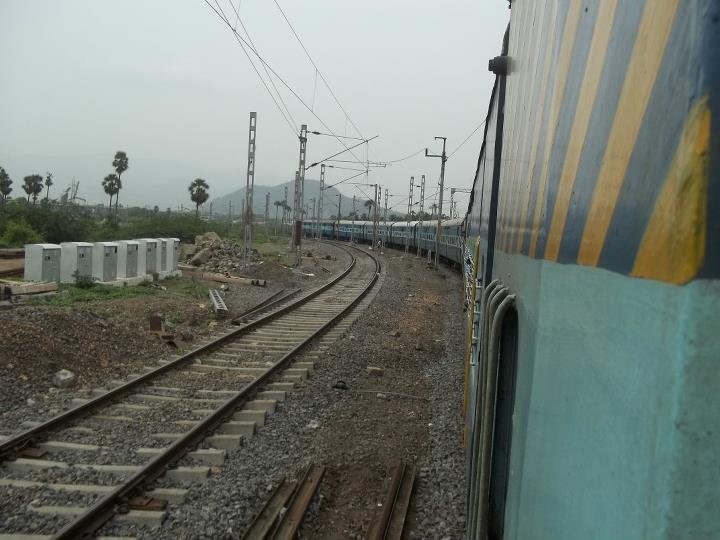
A conventional locomotive-hauled LHB train — the coach generation Vande Bharat Sleeper is designed to gradually complement on premium overnight routes.
Vande Bharat Sleeper vs Amrit Bharat
These serve different markets and should not be confused. Amrit Bharat is a non-AC, push-pull LHB train (locomotives at both ends) introduced from 2024 for affordable long-distance travel, with sleeper and general-class coaches. Vande Bharat Sleeper is a self-propelled, fully AC premium trainset. One is built for accessible fares at scale; the other for a faster, premium overnight experience — they are not competing products.
BEML, ICF & the Manufacturing Base
Integral Coach Factory (Chennai)
Designs the Vande Bharat Sleeper platform and supplies propulsion systems; also produces trainsets directly with BEML for the first 10-unit order.
BEML (Bengaluru)
Assembled and unveiled the first prototype (September 2024) at its Bengaluru facility, in partnership with ICF.
Kinet Railway Solutions
RVNL–Transmashholding joint venture building 120 trainsets (~1,920 coaches), the largest single order.
Titagarh Rail Systems–BHEL
Consortium building 80 trainsets at Uttarpara, West Bengal, with a 35-year maintenance agreement.
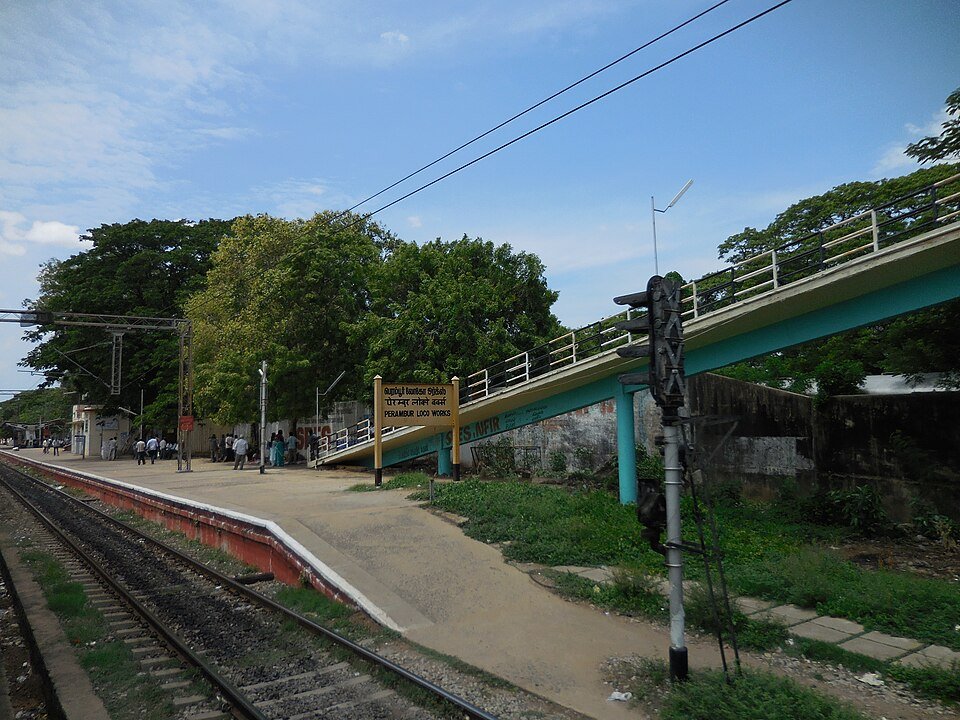
Perambur, Chennai — home to ICF’s works, where Vande Bharat coach design and propulsion originate.
Kavach 4.0: The Safety System Behind India’s Faster-Rail Ambitions
Kavach is India’s indigenous, RDSO-developed Automatic Train Protection (ATP) system, certified to Safety Integrity Level 4 (SIL-4) — the highest tier of the international functional-safety standard IEC 61508. It helps supervise permitted speeds, applies brakes automatically if a loco pilot fails to respond to a signal or speed restriction, and assists operation in dense fog and other low-visibility conditions. It began as the Train Collision Avoidance System (TCAS), developed by RDSO with domestic vendors from around 2020, and was rebranded Kavach as it was prioritised for nationwide scale-up.
What Does SIL-4 Mean?
SIL-4 is an engineering certification describing an extremely low tolerable rate of dangerous failure for a safety-critical function — it is a rigorous design and testing standard, not a claim of zero failure or a guarantee against every possible accident scenario.
Kavach Timeline: From TCAS to Version 4.0
| Version | Approved / deployed | Key detail |
|---|---|---|
| TCAS (early development) | From ~2020 | RDSO indigenous development with domestic vendors |
| Kavach (national branding) | ~2022 | Prioritised for nationwide scale-up |
| Kavach 3.2 | Deployed on South Central Railway | 1,465 route km, 144 locomotives (Aug 2024 figure) |
| Kavach 4.0 | Specification approved Jul 16, 2024 | Better location accuracy, bigger-yard signal handling, station-to-station OFC interface, direct electronic-interlocking interface |
Kavach 4.0 Coverage — Why the Numbers Keep Changing
📈 Rapid Commissioning, Not Contradictory Reporting
December 2025: 738 route km. January 30, 2026: ~1,452 route km. March 26, 2026: 1,638 route km (Delhi–Mumbai/Delhi–Howrah specifically). July 13, 2026: 2,490 route km. July 31, 2026: 2,633 route km. Each figure is a snapshot of the same two-corridor rollout at a different date — the increase reflects a fast, active commissioning pace, not inconsistent reporting.
⚠️ 24,427 Route Km “Under Implementation” ≠ Commissioned
Commissioned means Kavach 4.0 is live and operational on that stretch of track. Under implementation means work has been sanctioned and is in progress — trackside equipment, fibre, towers, station systems — but the section is not yet protected. As of March 26, 2026, implementation had been taken up across 24,427 route km, while commissioned coverage on the two flagship corridors stood far lower, at 1,638 route km on that same date (rising to 2,633 route km by July 31). Quoting 24,427 as “already commissioned” overstates current protection roughly ninefold.
Why Kavach Needs Thousands of Kilometres of Fibre
Kavach is not a single device bolted onto a locomotive — it is a distributed system requiring trackside equipment, RFID tags along the route, telecom towers, optical fibre linking stations, station-level Kavach Data Centres, and compatible onboard equipment in every locomotive that uses the section. As of the most recent verified national snapshot (February–March 2026): 8,921 km of optical fibre laid, 1,183 telecom towers, 767 station Kavach Data Centres, and 4,154 locomotives fitted with onboard Kavach equipment.
Why RFID Tags Are Placed Along the Track
RFID tags positioned along the right-of-way give the onboard Kavach system accurate, continuously updated location information, which it needs to correctly enforce speed limits and signal compliance for that exact stretch of track.
The Track Can Have Kavach and the Train Still Needs Compatible Equipment
Trackside Kavach, station-level systems and onboard loco Kavach all have to work together for a section to function as protected. A locomotive without Kavach equipment gets no benefit from running over Kavach-fitted track, and vice versa — which is why the loco-fitment count (4,154 as of the last verified figure) matters as much as the route-km commissioned count.
Delhi–Mumbai & Delhi–Howrah: The Two Flagship Corridors
These are Indian Railways’ two busiest trunk routes and the focus of both the Mission Raftaar-era push for higher permitted speeds and the Kavach 4.0 rollout — which is why Vande Bharat Sleeper and Kavach are discussed together, even though they are separate programmes.
Delhi–Mumbai: 1,423 Route Km Commissioned
As of July 31, 2026, commissioned sections include 1,327 route km across Tilak Bridge Junction cabin–Palwal–Mathura–Kota–Nagda–Ratlam–Vadodara–Virar, plus 96 route km on Vadodara–Ahmedabad and 224.51 route km on Vadodara–Nagda (commissioned separately on March 30, 2026, and included within the corridor total).
Delhi–Howrah: 1,210 Route Km Commissioned
Commissioned sections include 563 route km across Chipyana–Tundla–Kanpur–Subedarganj and 260 route km across Chota Ambana–Bardhaman–Howrah, along with the original 105 route km Howrah–Bardhaman section from the December 2025 milestone, plus additional sections commissioned through 2026.
What Kavach Can and Cannot Do
✅ Kavach Can
- Automatically apply brakes if a loco pilot fails to observe a speed restriction
- Help prevent Signal Passed at Danger (SPAD) consequences on equipped track
- Supervise permitted speeds continuously along a Kavach-fitted section
- Reduce risk of certain head-on or same-line collision scenarios between two Kavach-fitted trains on equipped track
- Assist safe operation during dense fog and other low-visibility conditions
❌ Kavach Cannot
- Detect or prevent track failure or rail fracture on its own
- Detect or prevent bridge failure
- Detect landslides or other geological obstructions unless a separate system reports them
- Protect a section, train or locomotive that is not itself Kavach-fitted
- Guarantee zero accidents — it reduces risk from specific, defined operational hazards, not every possible failure mode
Why India Still Needs Overnight Trains in the Aviation Era
Overnight rail keeps a distinct value proposition even as domestic aviation expands: city-centre-to-city-centre travel without airport transfer time, no baggage-weight anxiety, an overnight journey that doesn’t consume a waking day, generally lower fares than flying, and stops at intermediate cities that budget airlines rarely serve directly. Vande Bharat Sleeper’s bet is that a faster, more comfortable version of that same proposition can compete for travellers who might otherwise default to flying on trunk routes.
Vande Bharat Sleeper vs a Domestic Flight
A fair comparison isn’t fare-to-fare alone: it has to weigh door-to-door time (including airport access and security versus a city-centre station), whether the traveller values arriving overnight rather than losing a travel day, luggage handling, and route coverage — flights concentrate on a handful of high-demand city pairs, while rail serves the corridor continuously.
Mission Raftaar and the 160 km/h Corridor Push
Mission Raftaar is Indian Railways’ longer-running programme (launched 2016) to raise average train speeds through track, signalling and infrastructure upgrades on high-density trunk routes, including the Golden Quadrilateral–Golden Diagonal network that covers Delhi–Mumbai and Delhi–Howrah. It is the underlying reason these same two corridors are the priority for both higher permitted speeds and Kavach 4.0 rollout — a capable trainset and a capable, protected corridor were always meant to arrive together, not separately.
Explore More Timelines
People Also Ask
Frequently Asked Questions
⚠️ Editorial Note
This page separates confirmed government/CRS data, company-reported milestones, official announcements and AiTimeline’s own explanations, and labels every route and every Kavach figure by its exact status. Route-level speed, fare and launch-date claims for services not yet in commercial operation should be treated as reported or announced, not confirmed, until Indian Railways issues an official timetable. This is a living tracker and will be updated as further routes launch and Kavach 4.0 coverage expands.
Sources & further reading
Every dated entry above was checked against these references. Last reviewed 15 September 2026.
- PIB — Kavach 4.0 Commissioned on 738 Route Km (Palwal-Mathura-Nagda & Howrah-Bardhaman)
- PIB — Kavach: India's Automatic Train Protection System Reaches Version 4.0
- PIB — Vande Bharat Sleeper Train Completes CRS High-Speed Trial at 180 kmph on Kota-Nagda Section
- Indian Infrastructure — Kavach 4.0 Commissioned on 2,633 Rkm of Delhi-Mumbai and Delhi-Howrah Routes Till July 31, 2026
- Indian Infrastructure — Indian Railways Deploys 8,570 km of Optical Fibre Cable for Kavach
- Swarajya — Indian Railways Clears Rs 295 Crore Kavach 4.0 Deployment Across 660 Route Km of Izzatnagar Division
- News on Air — Railway Minister Reviews Progress of Kavach 4.0 Implementation Across the Country
- Deccan Herald — Union Minister Ashwini Vaishnaw Unveils Prototype Version of Vande Bharat Sleeper Coach