The AI Military Complex: Companies, India and the Future of Defence Technology
How AI actually enters modern defence: India's DRDO, iDEX and Defence AI Council, plus Anduril, Palantir and NATO's AI Strategy, explained with sources.
Latest Story
In a DRDO laboratory on the outskirts of Bengaluru, an engineer in her early thirties is annotating radar returns for a machine-learning model that will eventually help flag unusual vessel movements near the coast. She does not build weapons; she builds a filter — a way to help a small watch team notice one suspicious blip among ten thousand ordinary ones. A few hundred kilometres away, at an army planning cell, an officer is reviewing an early-stage decision-support tool that suggests optimal supply routes for a forward post during monsoon season, cross-checking its recommendation against terrain reports, fuel stocks and a dozen years of institutional judgment the software does not have access to. Neither of them is building an autonomous weapon. Both of them are, in a very literal sense, the AI military complex: not a single system or a single company, but a slow, distributed, heavily procedurally-governed effort spanning government laboratories, public-sector manufacturers, private contractors, startups and universities, most of it aimed at helping human operators see more clearly, decide faster and manage logistics better — not at replacing the humans making the decisions.
This guide is a reference, not a news bulletin. It traces how artificial intelligence entered military affairs — from 1950s air-defence computing through today’s generative-AI pilots — and how India built its own defence AI ecosystem through a specific, traceable sequence of task forces, councils and procurement programmes. It separates official government policy, public procurement records, peer-reviewed and think-tank research, industry announcements and independent journalism and analysis at every point where they diverge, because in defence AI — more than almost any other technology beat — a startup’s press release, a ministry’s policy paper and a classified capability are three very different things, and conflating them is how misinformation about “killer robots” and “AI-run militaries” spreads. This guide does not speculate about classified systems, does not predict operational outcomes, and does not treat a funding round or a product demo as proof of battlefield deployment.
Both scenes above are deliberately unremarkable. That is the point of this guide. Public discussion of “military AI” tends to jump straight to autonomous weapons and dystopian battlefield scenarios, because that is the version of the story that travels. The version supported by the actual public record — ministry orders, procurement filings, published research, company statements filed with regulators — is slower, more bureaucratic, and far more concentrated in logistics, maintenance and intelligence triage than in anything resembling an independently lethal machine. This guide is built entirely from that public record.
📋 Executive Summary
Defence AI is the application of machine learning and related techniques to military functions — overwhelmingly surveillance, logistics, cyber defence and decision support, not autonomous weapons. India’s programme traces to a February-June 2018 Ministry of Defence task force, the April 2018 launch of iDEX, and the February 2019 creation of the Defence AI Council and Defence AI Project Agency, built on DRDO’s research base and a growing layer of public-sector manufacturers, private majors and startups. Globally, the US (CDAO, Replicator), NATO (AI Strategy, 2021/2024) and China (documented military-civil fusion procurement) are the most consequential parallel efforts. No binding international treaty restricts autonomous weapons as of this update; UN talks continue, and India favours a non-binding declaration. This guide separates official policy, procurement, industry claims, research and independent analysis throughout.
🧠 60-Second Overview
The “AI military complex” refers to the network of defence ministries, armed services, public-sector manufacturers, private contractors, startups and research institutions that develop and field artificial intelligence for military use — overwhelmingly for surveillance, logistics, cyber defence, predictive maintenance and decision support, not for autonomous killing. India’s effort traces to a February-June 2018 Ministry of Defence task force, NITI Aayog’s June 2018 #AIforAll strategy, the April 2018 launch of iDEX to fund defence startups, and the February 2019 creation of the Defence AI Council and Defence AI Project Agency. Globally, the United States (via the Pentagon’s CDAO and the Replicator initiative), NATO (via a 2021 AI Strategy revised in July 2024), and China (via a state-documented military-civil fusion strategy) are the most consequential actors alongside India. No country has a legally binding international treaty restricting lethal autonomous weapons as of this update; talks continue at the UN’s Convention on Certain Conventional Weapons forum, with India favouring a non-binding political declaration over a binding instrument.
⚠️ Editorial Note & Scope
This is a YMYL (Your Money or Your Life) topic touching national security, government procurement and defence policy. This guide separates official policy (ministry orders, published strategies, parliamentary statements), public procurement (contracts, acquisition programmes with documented value and timelines), industry announcements (company press releases, funding rounds — treated as company claims, not independent verification), academic and think-tank research (peer-reviewed papers, CSIS/RAND/CSET-style institutional analysis), and independent journalism at every point they diverge. It does not speculate about classified capabilities, operational deployment details, or any specific country’s undisclosed military plans. Figures describing private valuations, contract ceilings and startup funding are sourced to company and press reporting current as of this update and can change; this guide notes the date attached to each figure rather than presenting it as fixed. It is maintained as a living reference and revised as the Ministry of Defence, DRDO, iDEX, NITI Aayog, NATO, the U.S. Department of Defense or peer-reviewed research publish new material.
Who, What, When, Where, Why and How
What the Record Actually Shows
- Most fielded military AI is AI-assisted, not autonomous: the documented, public record overwhelmingly shows systems that analyse data and present options to a human, not systems that independently select and engage targets.
- India’s defence AI policy has a specific, traceable start date: a Ministry of Defence task force constituted in February 2018 and reporting in June 2018, not a vague “recent push.”
- iDEX, not DRDO alone, is India’s main channel for startup-driven defence AI: launched April 12, 2018, it funds and trials innovations from MSMEs, startups and individual innovators alongside the traditional DRDO-DPSU pipeline.
- The Defence AI Council and Defence AI Project Agency, created February 2019, are India’s dedicated AI governance bodies — distinct from DRDO, which conducts research, and from iDEX, which funds startups.
- No country has ratified a binding international treaty restricting autonomous weapons as of this update; UN discussions continue at the Convention on Certain Conventional Weapons, with sessions scheduled through September 2026.
- India voted against the December 2023 UN General Assembly resolution on autonomous weapons, preferring a non-binding political declaration — a position distinct from opposing all regulation.
- The Pentagon’s Project Maven (2017) remains the most consequential early case study in industry-military AI friction, after Google’s involvement triggered internal protest and the company’s 2019 exit from the contract.
- Two published ethics frameworks currently govern the largest military AI programmes: the US Department of Defense’s five principles (2020) and NATO’s six Principles of Responsible Use (2021, revised 2024).
- Private-sector valuations in this sector are company claims, not independent verification: this guide cites reported figures from company and press statements with their date, not as audited facts.
- This is a living reference: as the Ministry of Defence, DRDO, iDEX, NITI Aayog, NATO, the U.S. Department of Defense or peer-reviewed research publish new material, this guide will be revised, not replaced.
What Defence AI Actually Is
The vocabulary this guide uses precisely, because the distinctions carry real policy weight.
Defence AI is the application of machine learning, computer vision, natural-language processing and related techniques to military functions — intelligence analysis, logistics, cybersecurity, maintenance, training and decision support. It is a broad, mostly unglamorous category: the great majority of publicly documented defence AI work looks less like a science-fiction weapon and more like an inventory-management upgrade, a radar-image classifier, or a chatbot that helps a logistics officer draft a supply request faster.
The single most important distinction in this field is between AI-assisted and autonomous systems. An AI-assisted system processes information and presents recommendations, but a human makes the consequential decision — this describes the overwhelming majority of fielded military AI, from predictive-maintenance dashboards to intelligence-fusion tools. An autonomous system, by contrast, can take a specific class of action — most sensitively, selecting and engaging a target — without a human approving that specific instance in real time. The U.S. Department of Defense’s governing policy on this, Directive 3000.09, does not ban autonomous weapon systems, but it requires that “autonomous and semi-autonomous weapon systems…be designed to allow commanders and operators to exercise appropriate levels of human judgment over the use of force” — a requirement for governed autonomy, not a requirement that a human person approve every individual engagement.
Military decision support is the category most defence AI investment actually targets: tools that fuse sensor feeds, flag anomalies, model logistics scenarios or summarise intelligence reporting for a human analyst or commander who retains decision authority. This is the least visually dramatic and most heavily funded category of defence AI, and it is where India’s public programme — from DRDO research to iDEX-funded startups — has concentrated its documented, non-classified output.
Dual-use technology describes tools with both civilian and military applications — computer vision, natural-language processing, autonomous navigation and predictive analytics are dual-use almost by definition, which is part of why a drone-delivery startup and a defence contractor can draw on overlapping underlying technology, and why India’s National Strategy for Artificial Intelligence, though not defence-focused in its five headline priority sectors, still shapes the broader talent and research base that defence AI draws on.
India’s AI ambitions in defence sit inside a larger self-reliance (“Atmanirbharta”) push: reducing dependence on imported defence hardware by building indigenous design, manufacturing and software capacity, with AI treated as one enabling layer among several — alongside indigenous engines, semiconductors and precision manufacturing — rather than as a standalone national objective. Official statements consistently frame AI as augmenting existing modernisation goals, not as a separate strategic pillar with its own budget line comparable to, say, aircraft carrier procurement.
Why AI is reshaping modern defence planning comes down to data volume: satellite constellations, distributed sensors, cyber-network telemetry and open-source intelligence now generate more material than human analysts can review unaided. The documented, unclassified case for military AI is fundamentally a case about triage and speed — helping a smaller number of trained people manage a much larger volume of information — rather than a case about replacing trained judgment, which every major published policy framework covered in this guide explicitly preserves as a human function.
The “global AI race” framing that dominates popular coverage of this topic is real in the sense that multiple governments — the United States, China, India, Israel and NATO member states among them — are visibly and simultaneously investing in defence AI, each publishing its own strategy documents and standing up its own institutions, documented throughout this guide’s timeline. It is misleading, though, when it implies a single finish line or a single dominant capability that one country will “win.” The public record instead shows several parallel, differently structured national programmes — India’s DPSU-anchored, startup-widening model; the US’s venture-backed contractor model; China’s documented civil-military fusion model — each optimising for its own institutional strengths and constraints, rather than converging on one template.
🧩 Technology Insight
Many military AI systems are explicitly designed to assist human operators rather than replace human decision-making. This is not a talking point unique to one country — it appears, worded differently, in the US Department of Defense’s ethics principles, NATO’s Principles of Responsible Use, and India’s own institutional design, where the Defence AI Council was created specifically to provide policy oversight rather than to run autonomous systems itself.
Core Concepts, Defined
Fourteen terms this guide uses precisely and consistently throughout.
Artificial Intelligence
Computer systems performing tasks that typically require human intelligence — pattern recognition, language understanding, planning — through statistical learning rather than fixed, hand-written rules.
Machine Learning
A subset of AI in which systems improve at a task by learning patterns from data, rather than being explicitly programmed with every rule — the technique underlying most modern defence AI applications.
Computer Vision
The machine-learning discipline focused on interpreting images and video — the technology behind satellite-image analysis, drone-footage triage and automated target recognition support tools.
Autonomous Weapon System (LAWS)
Under US policy (DoD Directive 3000.09), a weapon system that, once activated, can select and engage targets without further human intervention — also called “human out of the loop,” the most restricted and debated category of military AI.
Human-in-the-Loop
A semi-autonomous configuration in which the system engages only targets a human operator has already selected — the category most guided munitions fall into, per US defence policy.
Human-on-the-Loop
A human-supervised configuration in which the system can act with greater independence, but an operator can monitor the process and halt an engagement before it completes.
Decision Support System
Software that fuses data and models options for a human decision-maker without itself taking the consequential action — the largest category of publicly documented defence AI spending.
ISR
Intelligence, Surveillance and Reconnaissance — the collection and analysis of information about an operational environment, one of the earliest and most mature applications of military AI, from satellite imagery to signals analysis.
Electronic Warfare
Military action using the electromagnetic spectrum to sense, protect or attack — jamming, signal detection and spectrum management — an area increasingly assisted by machine learning for real-time signal classification.
Cyber Defence
The use of AI-assisted anomaly detection and automated response tools to protect military and critical-infrastructure networks from intrusion — a domain where speed of detection is the primary documented benefit of AI adoption.
Swarm Technology
Coordinated operation of multiple uncrewed systems — typically drones — using shared or distributed algorithms, an active research area for India’s DRDO and startups such as NewSpace Research and Technologies, and for the US Replicator initiative.
Digital Twin
A software model of a physical system — an aircraft engine, a ship, a supply chain — used to simulate performance and predict maintenance needs before a real-world failure occurs.
Edge AI
Machine-learning inference performed on a local device — a drone, a vehicle, a handheld unit — rather than sent to a remote data centre, valuable in military contexts where connectivity is limited or contested.
Dual-Use Technology
Technology with both civilian and military applications — computer vision, autonomous navigation and predictive analytics are dual-use by nature, which is why civilian AI research and defence AI research overlap so heavily.
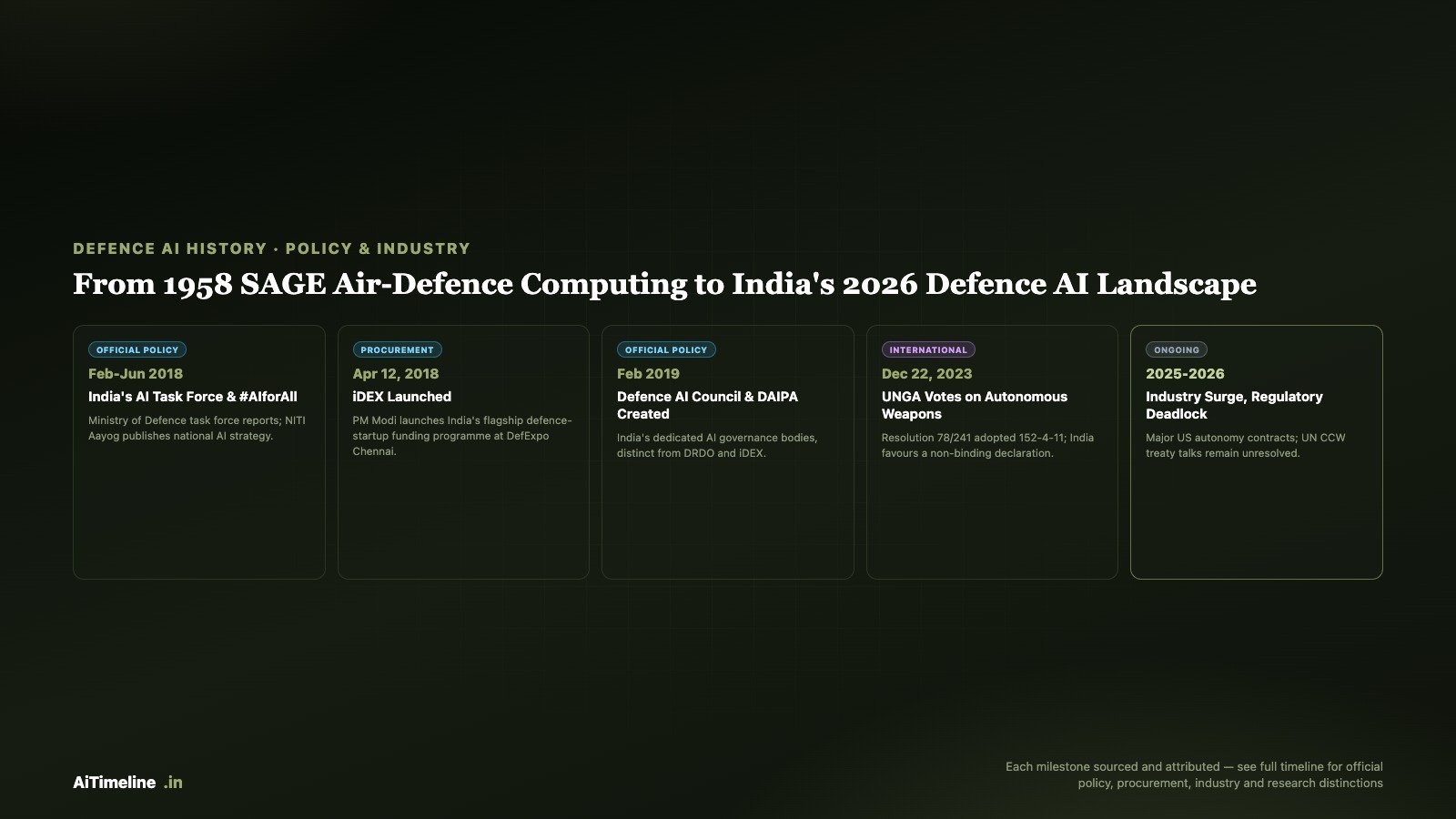
The Complete Timeline: From 1958 to the Present
Reverse-chronological. Each entry separates historical context, the technology or policy milestone, and its current relevance — tagged by source type.
Research Documents China’s Military AI Procurement Network, as UN Talks on Autonomous Weapons Remain Deadlocked
Research finding: The Center for Security and Emerging Technology (CSET) at Georgetown University analysed 2,857 AI-related contract notices issued by China’s People’s Liberation Army between January 2023 and December 2024, identifying 1,560 distinct organisations that won at least one AI-related contract. The report’s central finding is that while state-owned defence conglomerates still lead PLA AI procurement by value, a substantial and growing share of contracts goes to nontraditional, civilian-sector vendors and universities — documented evidence for China’s stated “military-civil fusion” strategy, without speculating about the classified capabilities those contracts ultimately produce.
International policy context: Separately, the UN’s Convention on Certain Conventional Weapons Group of Governmental Experts on lethal autonomous weapons systems remained without a consensus text as of late 2025, despite a 2023 mandate to produce one; sessions are scheduled for March and August-September 2026, with the ICRC and UN Secretary-General having jointly called for a legally binding instrument by the end of 2026 — a call the process has not yet met.
Current relevance: These two threads — documented civil-military technology integration in China, and stalled international regulation — are the two most consequential open questions in global defence AI policy as of this update.
Aero India 2025 and a Wave of US Autonomy Contracts Mark an Industry Inflection
India: Aero India 2025, the 15th edition of India’s premier aerospace and defence exhibition, was held February 10-14, 2025 at Air Force Station Yelahanka, Bengaluru, under the theme “The Runway to a Billion Opportunities,” with AI-driven systems shown alongside radar and drone technology and Defence Minister Rajnath Singh highlighting indigenous “niche and cutting-edge technologies.”
United States: Through 2025 and into 2026, US autonomy contractors reported a wave of major awards: Shield AI expanded its partnership with Palantir on command-and-control software for uncrewed systems and, per company statements, deployed its Hivemind autonomy software for the US Air Force’s Collaborative Combat Aircraft programme in February 2026; Anduril took over the Army’s Integrated Visual Augmentation System programme from Microsoft in February 2025 and, per reporting, was awarded an $86 million US Special Operations Command autonomy contract in March 2025.
Current relevance: This period marks the clearest documented shift of large-scale US military autonomy work from traditional defence primes toward venture-backed software-first contractors — a structural change independent analysts have flagged as significant, distinct from any specific system’s operational capability.
NATO Revises Its AI Strategy for the Generative-AI Era
Policy development: NATO published a revised Artificial Intelligence Strategy on July 10, 2024, updating its original 2021 strategy to account for advances including generative AI and AI-enabled information tools. The revision reaffirmed NATO’s six Principles of Responsible Use for AI in Defence — Lawfulness, Responsibility and Accountability, Explainability and Traceability, Reliability, Governability, and Bias Mitigation — and, for the first time, identified AI-enabled disinformation and information operations as issues of alliance-wide concern.
Institutional context: The strategy ties implementation to NATO’s Defence Innovation Accelerator for the North Atlantic (DIANA) and the NATO Innovation Fund, both mechanisms for closer cooperation with allied industry and academia.
Current relevance: This is the most recent formal multinational AI-in-defence strategy document from a major alliance, and the template against which India’s own, less centralised policy framework is often compared by independent analysts.
The Pentagon’s CDAO Launches the Replicator Initiative
Institutional background: The Pentagon’s Joint AI Center, established 2018, was absorbed into the newly created Chief Digital and Artificial Intelligence Office (CDAO) in 2022, broadening its mandate from AI specifically to digital transformation across the Department of Defense.
Programme launch: In 2023, the CDAO’s newly elevated Defense Innovation Steering Group identified Replicator — a plan to field thousands of attritable, AI-enabled autonomous systems across multiple domains — as its first major initiative. By 2024, the Pentagon had selected an initial tranche of capabilities, trained units, and secured close to $1 billion across fiscal years 2024-2025, targeting an initial capability goal by the end of August 2025; a second round of contracts was awarded in August 2024.
Current relevance: Replicator is the most heavily funded and most frequently cited US government autonomy programme discussed in the industry contracts documented in the 2025-2026 entry above.
The UN General Assembly Votes on Autonomous Weapons; India Declines to Support the Resolution
Official record: On December 22, 2023, the UN General Assembly adopted Resolution 78/241 on lethal autonomous weapons systems, expressing concern over their possible negative consequences for global security, by a vote of 152 in favour, 4 against, and 11 abstentions. India was among the four countries voting against the resolution.
India’s stated position: Per Ministry of External Affairs statements and independent policy analysis (Carnegie Endowment), India’s objection was not to AI-weapons regulation itself, but to what it called duplication of existing efforts at the UN’s Convention on Certain Conventional Weapons forum; India has instead supported a non-binding political declaration built on CCW guiding principles adopted in 2019, and does not support negotiating a legally binding instrument.
Current relevance: This remains India’s most recent formal, recorded international vote on autonomous-weapons regulation and the clearest documented statement of its regulatory preference: process-based caution over binding restriction.
India Unveils 75 AI-Enabled Defence Products at Its First “AI in Defence” Symposium
Event details: On July 11, 2022, Defence Minister Rajnath Singh launched 75 newly developed, AI-enabled defence products and technologies at the first-ever “Artificial Intelligence in Defence” (AIDef) Symposium and Exhibition, held at Vigyan Bhawan, New Delhi, and organised by the Department of Defence Production. The products spanned automation and robotics, cybersecurity, human-behaviour analysis, intelligent monitoring, logistics and speech/voice analysis, representing four years of combined work by the armed services, iDEX-funded startups, defence public-sector undertakings, DRDO and private industry.
Context: The launch was timed to India’s 75th independence anniversary (“Azadi Ka Amrit Mahotsav”) and framed explicitly around the government’s Atmanirbharta (self-reliance) push in defence manufacturing.
Current relevance: This remains the largest single public showcase of India’s defence AI output to date, and the clearest official evidence of how many distinct organisations — not just DRDO — now contribute to it.
NATO Publishes Its First Artificial Intelligence Strategy
Policy development: NATO adopted its first AI Strategy in 2021, alongside its six founding Principles of Responsible Use for AI in Defence — the first alliance-wide framework of its kind, later revised in July 2024 (documented above) to address generative AI.
Significance: The 2021 strategy set the template that several member states, and countries observing NATO’s approach, have referenced in shaping their own military AI governance, distinguishing it from purely national frameworks like the US Department of Defense’s 2020 principles.
Current relevance: Serves as the baseline against which the 2024 revision — and the broader gap between NATO’s approach and India’s non-aligned, domestically driven framework — is typically compared.
The Pentagon Adopts Five AI Ethics Principles
Policy development: On February 28, 2020, the US Department of Defense formally adopted five ethical principles for military AI — Responsible, Equitable, Traceable, Reliable and Governable — following a 15-month development process led by the Defense Innovation Board, involving consultation with AI researchers, DoD leadership and the public.
Substance: The principles commit DoD personnel to exercising appropriate judgment over AI capabilities, minimising unintended bias, ensuring transparent and auditable development processes, and limiting deployed systems to explicit, well-defined, tested uses.
Current relevance: These remain the US government’s governing ethical framework for military AI and a frequent reference point in comparative analysis of national defence AI governance, including India’s.
India Creates the Defence AI Council and the Defence AI Project Agency
Institutional creation: Acting on the recommendations of the 2018 AI Task Force, the Ministry of Defence in February 2019 created the Defence Artificial Intelligence Council (DAIC), chaired by the Defence Minister, to provide strategic guidance, and the Defence AI Project Agency (DAIPA), under the Secretary (Defence Production), to enable AI adoption across defence organisations. An AI roadmap for defence public-sector undertakings followed in August 2019.
Structural distinction: DAIC and DAIPA are policy and coordination bodies, distinct from DRDO (which conducts research) and iDEX (which funds external innovators) — a three-part structure this guide treats as India’s core defence AI governance architecture.
Current relevance: DAIC and DAIPA remain the primary named institutions in official Indian statements about defence AI policy coordination, as of this update.
Google’s Involvement in Project Maven Triggers an Industry-Wide Reckoning
Reporting and disclosure: Google’s involvement in the Pentagon’s Project Maven, reported by The Intercept and Gizmodo in early 2018, revealed that the company was applying machine learning to classify objects in drone footage under a Defense Department contract. More than 3,000 Google employees signed an internal petition demanding withdrawal, and several engineers resigned in protest.
Corporate outcome: Google Cloud’s then-CEO announced the company would not renew its Maven contract after it expired in 2019 — a decision widely cited, in independent reporting and academic analysis, as a turning point in Silicon Valley’s willingness to engage in defence work, and a reference case in India’s own, much smaller public debates about private-sector participation in defence AI.
Current relevance: Remains the most cited case study of tech-industry and military-AI friction in Western media and policy analysis, and a frequent comparison point when Indian commentators discuss startup participation in defence programmes like iDEX.
India Launches iDEX to Fund Defence Startups
Policy development: Prime Minister Narendra Modi launched Innovations for Defence Excellence (iDEX) on April 12, 2018 at DefExpo in Chennai — the Ministry of Defence’s flagship programme for engaging startups, MSMEs, individual innovators and academia in defence and aerospace technology development. iDEX is funded and managed by the Defence Innovation Organisation (DIO), a not-for-profit company founded by public-sector giants HAL and BEL under Section 8 of the Companies Act, 2013.
Structural role: iDEX is India’s primary channel for the private, startup-driven side of defence AI documented later in this guide — distinct from DRDO’s in-house research and from large private-sector contractors like Tata Advanced Systems or L&T Defence.
Current relevance: By 2025, industry tracking (Tracxn) recorded roughly $192 million raised across Indian military-tech startups in the year to date, much of it in companies that have participated in or been shaped by the iDEX ecosystem.
India Constitutes an AI Task Force and Publishes Its National AI Strategy
Task force: In February 2018, the Ministry of Defence’s Department of Defence Production constituted a multi-stakeholder task force on “Strategic Implementation of AI for National Security and Defence,” chaired by Tata Sons chairman N. Chandrasekaran, drawing members from government, the services, academia, industry and startups. The task force submitted its report to Defence Minister Nirmala Sitharaman in June 2018, recommending India build AI capability across aviation, naval, land systems, cyber, nuclear and biological-warfare-related domains.
National strategy: Separately, NITI Aayog published its discussion paper “National Strategy for Artificial Intelligence” (#AIforAll) on June 4, 2018, identifying five priority sectors — healthcare, agriculture, education, smart cities/infrastructure, and smart mobility — that notably did not include defence as a headline sector, even as the paper acknowledged AI’s broader national-security relevance and the Ministry of Defence pursued its own parallel track.
Current relevance: This four-month window is the clearest, most citable starting point for India’s formal defence AI policy, distinct from the informal DRDO research interest that predates it.
The Pentagon Stands Up Project Maven
Programme launch: The US Department of Defense established the Algorithmic Warfare Cross-Functional Team, known as Project Maven, in April 2017, tasked with building machine-learning tools to process drone surveillance footage and identify objects of interest, initially tied to the campaign against ISIS.
Significance: Maven is widely regarded, in independent defence-technology analysis, as the Pentagon’s first large-scale operational AI programme — distinct from earlier, smaller research efforts — and the direct predecessor to the industry involvement documented in the 2018 entry below.
Current relevance: Palantir later became a central contractor on the programme’s successor systems, including a “Maven Smart System” that, per reporting, secured a NATO contract in the mid-2020s — illustrating the programme’s long institutional afterlife.
Deep Learning’s Breakthrough Reaches Computer Vision
Technology milestone: The 2012 ImageNet competition, won decisively by a deep convolutional neural network, marked the moment deep learning demonstrated a clear, measurable advantage over prior computer-vision techniques — a civilian AI research result, not a defence-funded one, but the direct technical ancestor of the image-classification techniques later applied to drone footage under Project Maven and comparable programmes.
Why it matters here: This is the clearest illustration of dual-use technology in this guide’s timeline: a research breakthrough with no defence funding or intent became, within roughly five years, foundational to military computer-vision programmes worldwide.
Current relevance: The computer-vision techniques descended from this breakthrough remain the technical basis for most ISR-related image analysis discussed throughout this guide.
The DARPA Urban Challenge Adds Traffic, Judgment and Complexity
Technology milestone: Building on the 2004-2005 Grand Challenges, DARPA’s 2007 Urban Challenge required autonomous vehicles to navigate a simulated city environment in Victorville, California, merging, passing and negotiating intersections while obeying traffic law — a materially harder problem than open-desert navigation. Carnegie Mellon’s “Boss” finished first, followed by Stanford’s “Junior”; six vehicles completed the course.
Significance: The Urban Challenge is widely cited in autonomous-vehicle and robotics research as the point where the underlying technology matured enough to inform both civilian self-driving development and military unmanned-ground-vehicle research.
Current relevance: The sensor-fusion and real-time-decision techniques proven here underpin much of today’s uncrewed-ground-vehicle and autonomous-navigation research, including in India’s own DRDO robotics programmes.
The DARPA Grand Challenge Launches the Autonomous-Vehicle Era
Technology milestone: DARPA’s first Grand Challenge, held March 13, 2004, tasked fifteen vehicles with autonomously navigating a 142-mile desert route from Barstow, California to Primm, Nevada; none finished, with the furthest vehicle covering just 7.4 miles. A second Grand Challenge in October 2005 saw five of 195 teams’ vehicles complete a 132-mile course, with Stanford’s “Stanley” winning in just under seven hours.
Programme context: DARPA, the US Defense Department’s research arm, designed both challenges as open, prize-based competitions specifically to accelerate autonomous-vehicle research beyond what any single defence contract could achieve — a deliberately public, non-classified research model.
Current relevance: Widely credited, in independent robotics and autonomous-vehicle histories, as the founding event of the modern self-driving and autonomous-ground-vehicle research field, both civilian and military.
The Predator UAV Moves From Reconnaissance to Targeting Support
Technology milestone: General Atomics developed the MQ-1 Predator under a January 1994 contract, first flying it in July 1994; the design descended from the earlier “Amber” and “Gnat” drones developed by Abraham Karem, a former chief designer for the Israeli Air Force. The Air Force acquired the Predator after it demonstrated reconnaissance value over Bosnia in the mid-1990s, and during Operation Allied Force over Serbia in 1999, some Predators were equipped with laser designators to help mark targets for other aircraft.
Significance: This period established uncrewed aerial vehicles as a mainstream reconnaissance and targeting-support tool, well before onboard AI or autonomous targeting existed — the drone itself, not any AI aboard it, was the innovation; later AI applications were layered onto this and successor platforms over the following two decades.
Current relevance: The Predator/Global Hawk generation of platforms remains the direct ancestor of today’s AI-equipped ISR drones discussed in this guide’s India and global-industry sections.
DARPA’s Strategic Computing Initiative Pursues Machine Intelligence
Programme details: In 1983, DARPA announced a ten-year Strategic Computing Initiative aimed at advancing machine intelligence, backed by roughly $300 million in initial funding, targeting expert systems capable of processing tens of thousands of rules. Over the following decade, the programme spent more than $1 billion.
Outcome: The initiative did not achieve general machine intelligence and effectively wound down by 1993, but it is widely credited, in computing history and defence-research literature, with materially advancing chip design, computer architecture and expert-systems research — the “AI winter” era’s most instructive defence-funded case study in both the promise and the limits of ambitious AI programmes.
Current relevance: Frequently cited by defence-technology historians as a cautionary example against overpromising AI timelines — a lesson explicitly echoed in the more incremental, deployment-tested approach of programmes like India’s iDEX and the US Replicator initiative decades later.
GPS Is Approved and the First Satellite Launches
Technology milestone: The US Department of Defense approved the NAVSTAR Global Positioning System programme in December 1973, building on earlier satellite-navigation systems, with the Air Force beginning satellite and ground-system development in 1974. The first Block I GPS satellite launched in February 1978, with the system reaching military operational status in the early 1980s, split between a precise military signal and a deliberately degraded civilian one.
Significance: GPS is not an AI system, but it is the clearest historical precedent in this guide for a defence-funded technology becoming globally dual-use, and for the kind of long-horizon, government-funded infrastructure investment that today’s defence AI programmes are explicitly modelled on.
Current relevance: Nearly every AI-enabled navigation, logistics and autonomous system referenced elsewhere in this guide depends on GPS or a comparable satellite-navigation system as foundational infrastructure.
SAGE Becomes the First Real-Time Air-Defence Computer Network
Historical context: Following the Soviet Union’s first atomic-bomb test in 1949, the US Air Force turned to MIT’s Lincoln Laboratory to build a continental air-defence system capable of processing radar data from dispersed sites in real time.
Technology milestone: The Semi-Automatic Ground Environment (SAGE) system, built around IBM’s AN/FSQ-7 computer, linked 23 control centres across the US and Canada by 1958, processing radar, weather and tracking data at a central location — the first large-scale real-time computing system, though it predates machine learning by decades and relied on rule-based, not learned, processing.
Current relevance: SAGE is the conventional starting point in computing history for military real-time data processing and command-and-control — the direct conceptual ancestor, if not technical one, of today’s AI-assisted decision-support systems.
| Year | Development | Why It Matters |
|---|---|---|
| 1958 | SAGE air-defence network completed | First real-time military computing system |
| 1983 | DARPA Strategic Computing Initiative launched | First large defence-funded push for machine intelligence |
| 2004-2007 | DARPA Grand and Urban Challenges | Founded the modern autonomous-vehicle research field |
| Feb-Jun 2018 | India’s AI Task Force and #AIforAll strategy | Formal start of India’s defence AI policy |
| Apr 2018 | iDEX launched | India’s primary startup-funding channel for defence AI |
| Feb 2019 | Defence AI Council and DAIPA created | India’s dedicated AI governance architecture |
| Feb 2020 | US DoD adopts 5 AI ethics principles | First major national military AI ethics framework |
| Dec 2023 | UNGA Resolution 78/241 on autonomous weapons | First UN General Assembly vote of its kind; India voted no |
| 2023-2025 | Replicator initiative and major US autonomy contracts | Shift toward software-first defence contractors |
| 2025-2026 | CSET report on China; UN CCW talks stall | Most recent confirmed status as of this update |
Infographic Concepts for This Guide
- Evolution of military AI: a horizontal timeline from 1958 SAGE through 2026, matching the reverse-chronological entries above, plotted against defence-specific versus civilian-crossover milestones.
- India’s defence AI ecosystem: a layered diagram showing DRDO and DIAT research feeding DPSU manufacturing and iDEX-funded startups, coordinated by DAIC/DAIPA policy oversight.
- The AI decision-support loop: the six-step Sense-to-Feedback cycle diagrammed later in this guide, showing where human review sits relative to automated processing.
- Defence procurement lifecycle: the seven-step requirement-to-monitoring pathway detailed in this guide’s HowTo section, mapped against the specific institutions responsible for each stage.
- Human oversight framework: a side-by-side visual of human-in-the-loop, human-on-the-loop and fully autonomous configurations, keyed to DoD Directive 3000.09’s definitions.
- Dual-use AI ecosystem: a Venn-style diagram showing where civilian AI research (computer vision, NLP, robotics) overlaps with defence-specific hardening and testing requirements.
Did You Know?
- NITI Aayog’s 2018 “#AIforAll” strategy did not list defence among its five headline priority sectors — India’s defence AI policy developed on a parallel, Ministry of Defence-led track instead.
- iDEX is managed not by a government department directly but by the Defence Innovation Organisation, a not-for-profit company founded under Section 8 of the Companies Act by two public-sector giants, HAL and BEL.
- Google’s 2018 exit from Project Maven, driven by internal employee protest, remains one of the most-cited case studies worldwide when discussing whether commercial AI companies should take defence contracts — including in Indian industry commentary on startup participation in iDEX.
- DoD Directive 3000.09, the US policy most often invoked in “human-in-the-loop” debates, does not actually contain the phrase “human in the loop” — a frequently misunderstood detail of an otherwise widely cited document.
- The same deep-learning breakthrough that won the 2012 ImageNet competition — entirely civilian, academic research with no defence funding — became, within about five years, a foundational technique behind Project Maven’s drone-footage analysis.
🇦🇩 India Insight
India increasingly promotes collaboration between government laboratories, startups, academia and industry through innovation programmes rather than through a single centralised AI-weapons programme. iDEX’s structure — funded by DPSUs, open to individual innovators, and explicitly distinct from DRDO’s in-house research — reflects a deliberate policy choice to widen the base of contributors rather than concentrate defence AI development inside one institution.
India’s Defence AI Ecosystem
DRDO, public-sector manufacturers, private majors and startups — who does what, and how it’s funded.
DRDO (the Defence Research and Development Organisation) remains India’s primary in-house defence research body, operating a network of specialised laboratories, including work on AI and robotics concentrated in and around Bengaluru. DRDO’s role is fundamentally different from iDEX’s: DRDO conducts government-funded research and develops systems directly, while iDEX funds external startups and MSMEs to build solutions the services then evaluate and, if successful, procure.
Public-sector undertakings — principally Bharat Electronics Limited (BEL), Hindustan Aeronautics Limited (HAL), and Bharat Dynamics Limited (BDL) — form the manufacturing backbone that converts DRDO and private-sector AI research into fielded hardware and software at scale. BEL and HAL are also, notably, iDEX’s founding institutions through the Defence Innovation Organisation, giving public-sector manufacturers a direct institutional stake in the startup ecosystem rather than treating it as a purely external supplier base.
Private-sector majors have expanded their defence AI investment substantially since the late 2010s. Tata Advanced Systems Limited (TASL) and Larsen & Toubro (L&T) Defence are the most established, working across autonomous platforms, sensors and command-and-control software; Adani Defence & Aerospace and Bharat Forge’s Kalyani Strategic Systems have both expanded into unmanned systems and precision manufacturing relevant to AI-enabled platforms. These companies typically compete for and fulfil large-value defence contracts rather than operate on the startup-funding model iDEX uses.
Startups and listed defence-tech firms are the fastest-growing and most numerous part of India’s defence AI ecosystem, tracked closely by industry analysts. Zen Technologies (listed 2015) has built a specialisation in counter-drone systems combining radar, electro-optics and electronic countermeasures. ideaForge (listed 2023) supplies surveillance drones to Indian security forces. NewSpace Research and Technologies develops swarm-combat and drone-coordination systems and raised a reported $33 million Series B round. Sagar Defence Engineering focuses on maritime and naval uncrewed systems, with a reported $25.4 million Series A round. Tonbo Imaging (optics and night-vision) and Paras Defence (optics and electronics) round out the sensor-hardware side, while Raphe mPhibr’s reported $100 million Series B was, per Tracxn’s 2025 tracking, the largest single funding round in the sector that year. Data Patterns and Astra Microwave Products (listed 2004) supply defence electronics that increasingly incorporate AI-assisted signal processing.
Per Tracxn’s September 2025 military-tech report, India’s defence-tech startups raised approximately $192 million year-to-date in 2025, with Bengaluru the second-largest funding hub after the Delhi-NCR region, reflecting the city’s concentration of both DRDO facilities and private AI talent.
Industry bodies also shape this ecosystem without directly building or fielding systems themselves. NASSCOM, India’s national technology-industry association, has published policy commentary and convened industry discussion on defence and dual-use AI as part of its broader national AI advocacy work, positioning itself as a bridge between the commercial software industry and defence procurement rather than as a defence contractor in its own right. The Indian Army, Indian Navy and Indian Air Force each engage this ecosystem through their own service-specific requirements and trials — the naval and maritime-domain-awareness applications discussed later in this guide are a direct example of the Indian Navy’s role as an end-user setting requirements that DRDO, DPSUs and startups like Sagar Defence Engineering compete to meet.
The talent pipeline behind this ecosystem is worth naming explicitly, because it explains why Bengaluru and the Delhi-NCR region dominate the funding map above. India’s IITs and other engineering institutes feed both DRDO’s research cadre and the private and startup sides of this ecosystem through direct recruitment, faculty consulting arrangements, and, increasingly, iDEX’s own academia-facing funding stream, which extends the programme’s reach beyond commercial startups to university labs working on early-stage defence-relevant AI research.
| Organisation | Type | Focus Area | Notable, Sourced Detail |
|---|---|---|---|
| DRDO | Government research | AI, robotics, autonomous systems research | India’s primary in-house defence R&D body |
| Bharat Electronics (BEL) | Public sector (DPSU) | Electronics, radar, command systems | Co-founder of the Defence Innovation Organisation |
| Hindustan Aeronautics (HAL) | Public sector (DPSU) | Aerospace manufacturing | Co-founder of the Defence Innovation Organisation |
| Bharat Dynamics (BDL) | Public sector (DPSU) | Missile systems manufacturing | Key precision-systems manufacturer |
| Tata Advanced Systems | Private major | Autonomous platforms, sensors | Among the largest private defence contractors |
| L&T Defence | Private major | Command-and-control, naval systems | Long-standing defence-engineering major |
| Adani Defence & Aerospace | Private major | Unmanned systems | Expanded defence-AI investment since late 2010s |
| Zen Technologies | Listed (2015) | Counter-drone systems | Combines radar, electro-optics, electronic countermeasures |
| ideaForge | Listed (2023) | Surveillance drones | Supplies Indian security forces |
| NewSpace Research & Technologies | Startup | Swarm/drone coordination | Reported $33M Series B |
| Sagar Defence Engineering | Startup | Maritime/naval drones | Reported $25.4M Series A |
| Raphe mPhibr | Startup | Drone systems | Reported $100M Series B, largest 2025 round per Tracxn |
| Tonbo Imaging | Startup | Optics, night vision | Bengaluru-based sensor hardware |
| Paras Defence | Listed | Optics, electronics | Sensor and electronics manufacturer |
📜 Policy Insight
Many governments, India included, publish AI principles emphasising accountability, transparency and human oversight rather than detailed technical mandates. India’s approach has favoured institutional structures — DAIC, DAIPA, iDEX — over a single published “AI ethics charter” of the kind the US and NATO have issued, a structural difference independent policy analysts have noted without characterising either approach as more or less rigorous.
Research Institutions Behind the Ecosystem
The less-visible academic and laboratory layer that feeds both DRDO and private-sector defence AI.
Behind the companies and government agencies named throughout this guide sits a smaller, less publicised layer of research institutions that trains the engineers and produces the early-stage research those organisations later build on. DRDO’s own Centre for Artificial Intelligence and Robotics (CAIR), based in Bengaluru, is the laboratory most consistently named in official statements as the organisation’s dedicated AI and robotics research unit, working across areas including robotics, AI and information systems for defence applications. The Defence Institute of Advanced Technology (DIAT) in Pune, a DRDO-affiliated deemed university, trains postgraduate engineers specifically for defence research roles, including in AI-adjacent disciplines. India’s IITs contribute through a mix of direct DRDO collaboration, iDEX’s academia-facing funding stream, and the ordinary flow of graduates into both DPSU and private-sector defence engineering roles documented in the companies table above.
This guide treats this research layer distinctly from the companies and government bodies covered elsewhere: research institutions publish papers and train people; they do not, on their own, field operational systems. That handoff — from a DRDO lab or a university research group to a fielded capability — is exactly what the procurement lifecycle described later in this guide is designed to formalise.
| Institution | Type | Role |
|---|---|---|
| DRDO Centre for AI and Robotics (CAIR) | Government laboratory | Dedicated AI and robotics research unit, Bengaluru |
| Defence Institute of Advanced Technology (DIAT) | DRDO-affiliated deemed university | Postgraduate training for defence research roles, Pune |
| Indian Institutes of Technology (IITs) | Public technical universities | Talent pipeline; iDEX academia-stream research partnerships |
| iDEX Academia Stream | Government-funded research programme | Extends iDEX funding to university-based early-stage research |
Where Defence AI Is Actually Applied
Domain by domain, based on official and industry-documented use cases — not speculation about future capability.
Naval systems use AI primarily for sonar-signal classification, hull and engine predictive maintenance, and maritime-domain awareness — fusing radar, satellite and automatic-identification-system data to flag unusual vessel behaviour. Sagar Defence Engineering’s uncrewed maritime systems and DRDO’s naval research programmes are India’s most publicly documented efforts in this domain.
Air defence applications concentrate on radar-signal processing, threat classification and fire-control decision support — helping human operators prioritise which of many simultaneous tracks warrant attention, rather than autonomously deciding to engage. Zen Technologies’ counter-drone systems, which fuse radar, electro-optic and electronic-countermeasure data, are a clear, documented Indian example of this AI-assisted triage model.
Land systems AI work spans uncrewed ground vehicles, robotic logistics carriers and soldier-worn sensor systems, an area DRDO has researched since well before the 2018 policy formalisation, building on decades of interest in automation and robotics for reducing soldier exposure in high-risk roles.
Cybersecurity is one of the most mature and least controversial applications of defence AI: machine-learning-based anomaly detection to flag unusual network activity faster than manual monitoring allows, protecting both military networks and, increasingly, critical civilian infrastructure with military-relevant dependencies.
Logistics and predictive maintenance represent, by most industry accounts, the single largest and least visible category of fielded military AI: digital-twin models of aircraft engines, ships and vehicle fleets that predict component failures before they occur, and route-optimisation tools that manage the enormous logistics burden of moving supplies to forward units.
Satellite intelligence and border surveillance apply computer vision to satellite and sensor imagery to detect changes — new construction, vehicle movements, unusual activity patterns — along borders and in areas of strategic interest, an application area that draws directly on the same ImageNet-era computer-vision techniques discussed earlier in this guide’s timeline.
Command and control is the domain where “decision support” as a category is most concentrated: software that fuses intelligence, logistics and operational data into a single picture for commanders, explicitly designed — per every major published framework this guide cites — to inform rather than replace human command judgment.
Across all seven of these domains, the pattern this guide’s timeline established repeats: the technology that eventually reaches a fielded military system usually began as unclassified, often civilian, research — computer vision from academic labs, predictive-maintenance techniques from commercial aviation and manufacturing, anomaly detection from civilian cybersecurity — adapted and hardened for military reliability requirements rather than invented from scratch inside a classified programme. That adaptation process, not a single dramatic invention, is what most of the procurement lifecycle described later in this guide is actually built to manage.
Comparing the Core Distinctions
Four comparisons this field’s public debate most often conflates.
Public discussion of defence AI regularly collapses several distinct spectrums into one — treating “has AI” and “is autonomous” as synonyms, or assuming a country’s published strategy document describes what it has actually fielded. The four comparisons below are drawn directly from the definitions and sourced facts established earlier in this guide, laid out side by side specifically to make those collapses harder to make by accident.
AI-Assisted Systems
- Process data and present options; a human makes the consequential decision
- The overwhelming majority of fielded, publicly documented military AI
- Includes ISR analysis, predictive maintenance, logistics optimisation, decision-support dashboards
- Governed primarily by ordinary procurement, testing and operational-safety review
Autonomous Systems
- Can take a defined class of action, including target engagement, without real-time human approval of that instance
- A small, heavily governed and closely scrutinised category
- Subject to specific policy review (e.g. US DoD Directive 3000.09) before fielding
- The central subject of ongoing UN CCW international regulatory discussion
Human-in-the-Loop
- System engages only targets a human operator has already specifically selected
- Describes most guided munitions — “fire and forget” systems aimed at a human-identified target
- The most human-controlled configuration short of fully manual operation
Human-on-the-Loop
- System can act with greater independence, but a human supervises and can halt engagement
- Requires real-time monitoring capability and a functioning override mechanism
- The configuration most often discussed for air-defence and counter-drone systems, where reaction time is short
Civilian AI
- Optimised for cost, scale and user experience; iterated rapidly with frequent updates
- Governed by data-protection and consumer-safety regulation, not defence procurement standards
- Failure modes are typically reputational or financial, not physically catastrophic
Military AI
- Optimised for reliability, explainability and safety under adversarial and degraded conditions
- Governed by defence-specific ethics frameworks (DoD’s 5 principles, NATO’s 6 principles) and formal testing regimes
- Development is typically slower and more conservative, reflecting the higher cost of failure
| Dimension | India | United States | China |
|---|---|---|---|
| Lead Institutions | DRDO, DAIC/DAIPA, iDEX, NITI Aayog | CDAO, DARPA, individual services | PLA procurement offices, state-linked research institutes |
| Core Strategy Document | 2018 AI Task Force report; #AIforAll (defence not a headline sector) | 2020 DoD AI ethics principles; CDAO strategy | Military-civil fusion strategy (per CSET/state documentation) |
| Autonomous Weapons Stance (UN CCW) | Favours non-binding political declaration; voted against Dec 2023 UNGA resolution | Participates in CCW talks; no binding treaty commitment | Participates in CCW talks; no binding treaty commitment |
| Flagship Programme | iDEX-funded startup ecosystem | Replicator (thousands of autonomous systems target) | Documented AI-related PLA procurement network (CSET, 2023-2024 data) |
| Private-Sector Model | DPSU-anchored (BEL/HAL fund iDEX) plus independent startups | Venture-backed contractors (Anduril, Shield AI, Palantir) alongside traditional primes | Mix of state-owned conglomerates and civilian-sector vendors, per CSET analysis |
| Stage | Public Research | Operational Deployment |
|---|---|---|
| Funding Source | Government grants, academic budgets, prize competitions (e.g. DARPA Grand Challenge) | Formal defence procurement budgets and multi-year contracts |
| Testing Rigor | Benchmark competitions, peer review, open publication | Classified or restricted testing, formal acceptance trials, safety certification |
| Oversight | Institutional research ethics boards, academic norms | Defence AI ethics frameworks (DoD principles, NATO principles), chain-of-command review |
| Public Visibility | High — typically published and citable | Low — specific operational use is rarely publicly detailed |
| Example From This Guide | 2012 ImageNet breakthrough | 2017-onward Project Maven drone-footage analysis |
Responsible AI, Military Ethics and International Regulation
What is officially governed, what remains under negotiation, and where India stands.
Human oversight is the consistent, stated principle across every major published military AI framework this guide has reviewed — not a single country’s talking point. The US Department of Defense’s five principles (2020), NATO’s six Principles of Responsible Use (2021, revised 2024), and India’s institutional design through DAIC all frame AI as augmenting, not replacing, human command judgment, even as they differ in how formally that commitment is codified.
The UN’s regulatory process runs through the Convention on Certain Conventional Weapons (CCW), where a Group of Governmental Experts on lethal autonomous weapons systems has met periodically since the mid-2010s. Its current mandate, adopted in 2023, tasks the group with formulating, by consensus, elements of an instrument on LAWS, reporting to the CCW’s Seventh Review Conference in 2026. As of late 2025, negotiations remained deadlocked despite a joint ICRC-UN Secretary-General call for a legally binding instrument by the end of 2026; further sessions are scheduled for March and August-September 2026.
The UN General Assembly has separately weighed in through non-binding resolutions — most notably Resolution 78/241, adopted December 22, 2023, by a vote of 152 in favour, 4 against and 11 abstaining. India was among the four states voting against it, a position its government has explained not as opposition to regulation itself but as a preference for pursuing a non-binding political declaration through the existing CCW process, built on guiding principles the CCW adopted by consensus in 2019, rather than negotiating a new legally binding treaty.
What this means in practice is that, as of this update, no country is bound by an international treaty specifically restricting autonomous weapons; governance instead rests on national policy (like the US’s DoD Directive 3000.09), alliance-level frameworks (like NATO’s principles), and non-binding UN guidance — a patchwork this guide describes precisely rather than characterising as either adequate or inadequate, since that judgment is contested among the states and institutions involved.
Accountability and bias are the two concerns that recur most consistently across every published framework this guide has reviewed, independent of country. The US DoD’s “Equitable” principle commits to minimising unintended bias in AI capabilities; NATO’s framework names “Bias Mitigation” as one of six core principles rather than a peripheral concern. In practice, this means testing AI systems against a range of operating conditions before fielding them, and maintaining traceable records of how a system was trained and validated — documentation requirements that, per published policy, apply regardless of whether the system in question is autonomous or purely decision-support.
Industry self-regulation has also played a role distinct from government policy. Several AI companies with defence contracts, including firms named earlier in this guide, have published their own internal principles governing which military applications they will and will not pursue — a development independent analysts trace directly back to the 2018 Project Maven controversy, when Google’s employee backlash forced the broader tech industry to publicly articulate where it drew its own lines, well before most governments had done the same.
🔬 Research Insight
AI advances in defence overwhelmingly emerge from broader developments in computer vision, robotics and data science — civilian, academically published research — rather than from classified, defence-only breakthroughs. The 2012 ImageNet result feeding into Project Maven, and the DARPA Grand Challenge feeding into today’s autonomous-vehicle industry, are the two clearest documented examples in this guide’s timeline.
How AI Enters Indian Defence Procurement
The documented lifecycle from requirement to fielded system.
Requirement identification
The Indian Army, Navy or Air Force identifies an operational gap — faster threat detection, better logistics visibility — and defines it as a formal requirement.
Solution proposal
DRDO, a defence public-sector undertaking, a private major, or an iDEX-funded startup proposes a technical solution, often after an iDEX innovation challenge specifically invites proposals against the stated requirement.
Trials and evaluation
Prototypes undergo service trials against defined performance benchmarks — the stage at which most proposed AI solutions are narrowed down or rejected.
AI-specific policy review
Where a system involves autonomous functions or AI-assisted decision-making, the Defence AI Council and Defence AI Project Agency provide policy-level review distinct from ordinary technical trials.
Acceptance of Necessity and contracting
The Defence Acquisition Council approves formal acquisition, and a contract is signed with the winning DRDO lab, DPSU, private contractor or startup.
Induction and training
Personnel are trained on the new system, in some cases through dedicated facilities established for this purpose within the services.
Post-deployment monitoring
Fielded AI systems undergo ongoing performance review and human-oversight audit, consistent with the accountability principles published by DAIC and comparable international frameworks.
Explore More Timelines
The Global Industry Beyond India
Named companies and programmes, sourced to official contracts and company statements.
| Company / Programme | Country | Focus | Sourced Detail |
|---|---|---|---|
| Anduril Industries | United States | Autonomy software (Lattice), hardware | Reported $20B US Army contract for Lattice integration; reported $61B valuation |
| Shield AI | United States | Autonomy software (Hivemind) | Reported $12.7B valuation; Air Force Collaborative Combat Aircraft deployment, Feb 2026 |
| Palantir Technologies | United States | Data/targeting software (Maven Smart System) | Reported NATO contract; 2025 revenue reported at $2.8B |
| Lockheed Martin, Northrop Grumman, RTX | United States | Traditional prime contractors, AI-enabled platforms | Long-established defence manufacturers integrating AI into existing programmes |
| Elbit Systems | Israel | Uncrewed ground vehicles, electronic warfare | Co-developed the Guardium autonomous UGV with IAI |
| Israel Aerospace Industries (IAI) | Israel | UAVs, electronic warfare aircraft | Developer of the ELLYON electronic-attack aircraft concept |
| NATO (DIANA, Innovation Fund) | Multinational | Alliance-wide AI strategy and innovation funding | 2021 AI Strategy, revised July 2024; six Principles of Responsible Use |
| PLA-linked procurement network | China | State and civilian AI vendors (military-civil fusion) | CSET documented 2,857 AI contracts, 1,560 organisations, 2023-2024 |
| Programme | Country / Body | Date | Type |
|---|---|---|---|
| iDEX | India | Apr 2018 | Official policy / procurement |
| Defence AI Council & DAIPA | India | Feb 2019 | Official policy |
| Project Maven | United States | Apr 2017 | Official policy / procurement |
| DoD AI Ethics Principles | United States | Feb 2020 | Official policy |
| Replicator Initiative | United States | 2023-2024 | Official policy / procurement |
| NATO AI Strategy | NATO | 2021, revised Jul 2024 | Official policy |
| UNGA Resolution 78/241 | United Nations | Dec 2023 | International / non-binding |
👀 Future Watch
Based only on official channels and published research roadmaps: further UN CCW sessions on lethal autonomous weapons scheduled for March and August-September 2026; continued iDEX funding rounds and Aero India/DefExpo showcases from India’s Ministry of Defence; ongoing Replicator procurement milestones from the US CDAO; and any further revision to NATO’s AI Strategy as generative-AI capabilities evolve. This guide does not speculate about classified capabilities or predict specific operational outcomes beyond what official bodies, companies or researchers have themselves published.
Frequently Asked Questions
100 questions, from foundational definitions through India’s current defence AI landscape.
Qwen3.8-Max: Alibaba’s Open-Weight Flagship, Explained
Kimi K3 History and Timeline (2023-2026)
Passkeys Explained: Moving Beyond Passwords
India’s Renewable Energy Transition: The Complete Timeline
Explore All AiTimeline Stories
⚠️ Sources, Methodology & Update Policy
This guide draws on official Indian government sources including NITI Aayog’s published National Strategy for Artificial Intelligence, Press Information Bureau releases on the Ministry of Defence’s AI Task Force and the 2022 AI in Defence Symposium, and the Department of Defence Production’s iDEX documentation; official US sources including DoD Directive 3000.09 and the Department of Defense’s published AI ethics principles; NATO’s official AI Strategy publications; UN sources including General Assembly and CCW meeting records; institutional research from the Center for Security and Emerging Technology (CSET) at Georgetown University; and industry-tracking data from Tracxn’s 2025 military-tech report, cross-checked against company and press statements. Every company valuation, funding figure and contract value is attributed to its source and treated as a reported claim current to its date, not an audited fact. This guide does not speculate about classified capabilities, operational deployment specifics, or any country’s undisclosed military plans.
This is educational reference content on an evolving policy and technology area, not procurement advice, investment advice, or a substitute for official Ministry of Defence, DRDO, NITI Aayog, NATO or UN documentation. If you are evaluating a specific claim about a company’s defence AI capability or a country’s military AI programme, verify it against the official or primary source named above, since this guide’s last update may predate more recent developments.
Why Artificial Intelligence Is Reshaping Defence Responsibly
Set against the sweep of this guide’s timeline — from a room-sized air-defence computer in 1958 to iDEX-funded startups pitching swarm-coordination software in 2026 — the throughline is not a story of machines seizing control of warfare. It is a story of a specific, traceable, heavily documented set of institutions — DRDO, NITI Aayog, iDEX, the Defence AI Council, the Pentagon’s CDAO, NATO’s policy office, the UN’s CCW forum — each publishing, negotiating and revising a narrower and narrower set of rules for how AI enters military decision-making, at almost exactly the pace the underlying technology has matured.
The engineer annotating radar data in Bengaluru and the planner reviewing a logistics tool at the opening of this guide are not exceptions to how defence AI works; they are the norm, replicated across DRDO labs, DPSU engineering floors, private contractors and startup offices in India and allied countries alike. Most publicly documented military AI programmes — India’s included — focus on augmenting human decision-making, improving logistics efficiency and strengthening cyber resilience, not on removing human judgment from the use of force.
Readers evaluating any specific claim about military AI — a company’s product demo, a think-tank’s forecast, a headline about “autonomous armies” — are best served by returning to the official policy documents, defence research and peer-reviewed or institutional analysis this guide has drawn on throughout: NITI Aayog’s published strategy, the Ministry of Defence’s task-force report and iDEX documentation, DoD Directive 3000.09, NATO’s AI Strategy, and the ongoing, still-unresolved UN CCW process. None of those sources describes an AI-run military. All of them describe, in granular and often bureaucratic detail, an effort to keep responsible governance, transparency and human oversight at the center of how defence AI is built — and that, more than any single system or company, is the actual state of the field as of this update.
Sources & further reading
Every dated entry above was checked against these references. Last reviewed 15 September 2026.
- NITI Aayog: National Strategy for Artificial Intelligence (#AIforAll)
- PIB: AI Task Force Hands Over Final Report to Raksha Mantri
- PIB: First-Ever 'AI in Defence' Exhibition and Symposium
- Defence Innovation Organisation / iDEX Official Documentation
- US Department of Defense Directive 3000.09, Autonomy in Weapon Systems
- NATO: Revised 2024 Artificial Intelligence Strategy
- UN Press: First Committee Approves Resolution on Lethal Autonomous Weapons
- UN CCW Group of Governmental Experts on LAWS (2026 sessions)
- CSET Georgetown: China Is Using the Private Sector to Advance Military AI
- DARPA: The Urban Challenge (Innovation Timeline)