India’s COVID-19 Lockdown & Migrant Crisis: A Timeline of the 2020 Exodus
India COVID-19 lockdown migrant crisis: the 24 March 2020 shutdown, the walk home, Shramik trains, Supreme Court orders and what official counts miss.
Latest Story
The India COVID-19 lockdown migrant crisis began on 24 March 2020, when the Prime Minister announced a 21-day nationwide lockdown that took effect from midnight. Factories, construction sites, markets and public transport closed, and millions of workers living away from home lost their daily wages, their food supplies and any quick way back to their villages. Many began walking; governments opened relief camps, allowed buses from 29 April and ran Shramik Special trains from 1 May, and the Supreme Court took up the matter on its own motion on 26 May. This page separates what government orders said, what courts directed, what happened on the ground and what the official counts do and do not measure. For related stories see MGNREGA, India’s food security schemes and the 2016 note ban, another sudden shock to daily-wage incomes.
💡 Short Answer
India announced its COVID-19 lockdown on 24 March 2020 with a few hours’ notice. Workers who had lost income began leaving cities, buses were allowed on 29 April and Shramik Special trains began on 1 May. The Labour Ministry reported more than 1.04 crore workers returned home. The government said it kept no separate data on migrant workers who died, and 97 deaths on Shramik trains were reported to Parliament. The Supreme Court issued directions in 2020 and final directions on 29 June 2021.
The Crisis in Six Steps
A compact sequence from the announcement to the policy review. Tap a step.
Lockdown announced, workers stranded, relief camps, Shramik trains, Supreme Court intervention, policy review. Tap a step.
Choose a step above.
India’s Lockdown and Migrant Crisis: Key Questions
The 2020 Migrant Crisis in Ten Points
- The shutdown: announced 24 March 2020 for 21 days, effective from midnight.
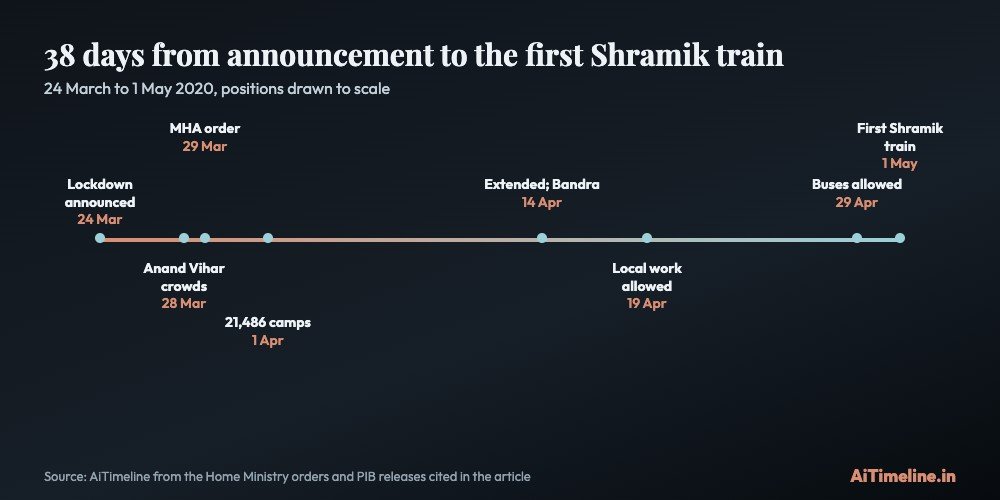
- The gap: 38 days passed between the announcement and the first Shramik train.
- The first responses: disaster funds for shelter on 28 March, an order on shelters, wages and rent on 29 March.
- The camps: 21,486 relief camps reported on 1 April, a government figure.
- The routes home: buses from 29 April, Shramik trains from 1 May.
- The tragedies: 16 killed near Aurangabad on 8 May and at least 24 near Auraiya on 16 May, per press reports.
- The Court: a plea dismissed on 15 May, suo motu action on 26 May, fare-free travel on 28 May.
- The counts: 1.04 crore returned, 63.07 lakh on trains, 97 deaths on trains.
- The missing count: no separate official data on migrant road deaths.
- The reforms: a migrant database, portable ration cards and registration were ordered or recommended by December 2020 and June 2021.
India COVID-19 Lockdown Migrant Crisis: The Timeline, Latest First
Each entry is tagged as a government action, court or Parliament step, event on the ground or official count, and ends with why it matters.
Government order, court direction, event on the ground or official count? Filter the timeline by type.
–
The Supreme Court orders portal registration, dry ration and community kitchens Court or Parliament
In In Re: Problems and Miseries of Migrant Labourers, the Court disposed of the case with seven directions (judgment). The Centre was to develop a portal with the National Informatics Centre for registering unorganised and migrant workers, to start by 31 July 2021 and finish registration by 31 December 2021. States were to bring in a dry-ration scheme by 31 July 2021, with the Centre supplying extra foodgrains on demand, and to implement One Nation One Ration Card by the same date.
It also directed states to register establishments and license contractors under the Inter-State Migrant Workmen Act, 1979, and to run community kitchens where migrant workers gather, for as long as the pandemic lasted.
What the page does not claim: AiTimeline did not verify whether every deadline was met. The orders show what the Court required, not what was delivered.
A parliamentary committee asks for a national plan and a migrant database Court or Parliament
The committee noted that the sudden lockdown caused unprecedented economic disruption and fear among migrant workers, leading to large-scale movement home. It recommended a national plan and guidelines under the Disaster Management Act and the Epidemic Diseases Act, a mechanism to coordinate the Centre and states, a national database of migrant workers, and inter-state operability of ration cards (PRS Legislative Research summary).
It also asked the Home Ministry to create a coordinated way to track the movement of migrant workers across states in real time, so that states could provide rations.
2020
A Lok Sabha answer: 1.06 crore workers returned, but no count of migrant road deaths Counts and accountability
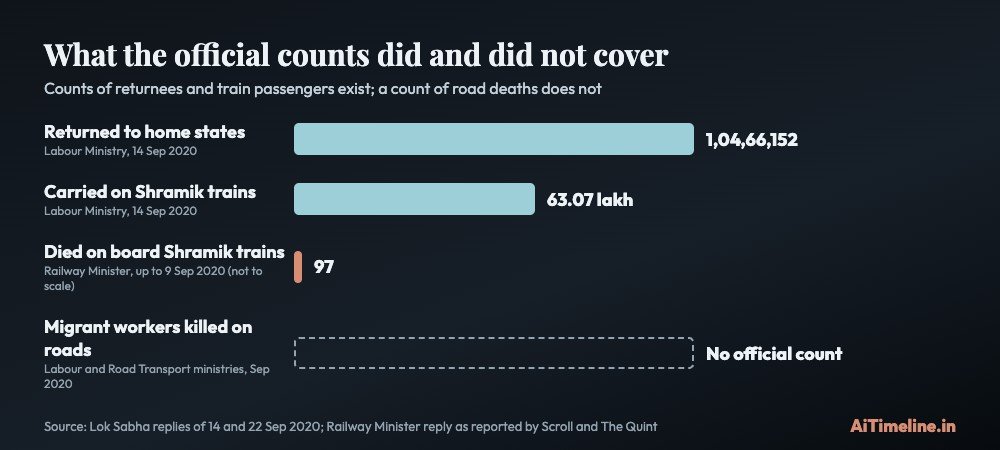
Asked how many migrant workers died in road accidents, the Minister of State said that, per data compiled by the Ministry of Labour and Employment, more than 1.06 crore migrant workers, including those who travelled on foot, returned to their home states. The Ministry gave provisional figures of 81,385 road accidents and 29,415 fatalities across March to June 2020, and said it “does not maintain separate data in respect of migrant workers who have died in road accidents during the lockdown” (Lok Sabha answer).
Read the figures carefully: 29,415 is the provisional count of all road deaths in those four months. It is not a count of migrant workers. The brief for this page dated this answer to March 2021 and credited the Labour Ministry; the document itself is dated 22 September 2020 and was answered by the Road Transport Ministry, citing Labour Ministry data.
2020
The Labour Ministry says it has no data on migrant deaths or job losses Counts and accountability
The Labour Ministry told the Lok Sabha it kept no data on migrant workers who died or lost jobs during the lockdown, so there was no question of compensation. It gave 1,04,66,152 as the number who returned to their states, with Uttar Pradesh receiving the most at 32.5 lakh, and said Railways ran more than 4,611 Shramik Special trains carrying more than 63.07 lakh workers (The Leaflet).
In the same fortnight the Railway Minister told Parliament that 97 people died on board Shramik Special trains up to 9 September, as reported (Scroll; The Quint). A report quoted post-mortem findings, including cardiac problems, for cases examined; AiTimeline has not independently verified the cause of each death.
Workers return home, and livelihoods stay uncertain Government action
As restrictions were relaxed in phases, many workers who had returned home stayed, while others went back to cities as businesses reopened. On 20 June 2020 the Centre launched the Garib Kalyan Rojgar Abhiyaan to boost employment and livelihood opportunities for migrant workers who had returned to villages (PIB). The Economic Survey 2020-21 lists the later measures taken to blunt the loss of livelihoods, including a higher allocation for MGNREGS (Economic Survey).
AiTimeline did not find a national figure for how many returnees went back to cities and how many stayed, so this page does not give one.
2020
The Supreme Court sets a 15-day window to send stranded workers home Court or Parliament
The Court directed all states and Union Territories to identify stranded migrant workers who wished to return and to complete their journeys by train or bus within 15 days. It recorded a demand for 171 Shramik trains and directed Railways to provide any additional trains within 24 hours of a request. States were also asked to detail schemes available to returnees (quoted in the 2021 judgment).
2020
The Supreme Court: no fare for the journey home, and food on the way Court or Parliament
Hearing the matter on Thursday 28 May, the bench directed that no fare be charged from stranded migrant workers for their journey home and that arrangements be made to provide them with food (The Indian Express). The brief for this page dated the order 29 May; that is the date the newspaper report appeared.
2020
The Supreme Court takes suo motu cognisance Court or Parliament
The Court noted that migrant labourers were walking on foot and cycles and using other modes of transport without food and facing untold miseries, and registered the case on its own motion. It issued notice to the Union and all states and asked the Solicitor General to assist (judgment; Sabrang).
Eleven days earlier, on 15 May, a different bench had dismissed an application seeking directions for walking labourers; the Solicitor General had argued that nothing could be done if people chose to walk, and the bench said it was impossible for the Court to monitor who was walking (LiveLaw; The Tribune). The Court then took up the issue on its own.
2020
A truck collision in Auraiya kills at least 24 workers travelling home On the ground
Early on 16 May a truck carrying workers from Rajasthan collided with another vehicle near Auraiya. Business Today reported 24 dead and 15 critically injured (Business Today). Reports differ: some counted 23 and one international agency counted at least 25. The NHRC issued notice after media reports that bodies were being carried with the injured in the same vehicle (SCC Online).
The workers were reported to be heading to Bihar and Jharkhand. The cause was under inquiry at the time and AiTimeline has not verified a final finding.
2020
The wage-payment order lapses in the new lockdown guidelines Government action
The 29 March order had told employers to pay wages without deduction for the closure period. The 17 May guidelines did not carry it forward, and earlier orders under the Disaster Management Act ceased to have effect from 18 May, which media reported as the order being withdrawn (Deccan Herald). The Supreme Court had on 15 May asked the Centre not to take coercive action against employers unable to pay full wages for a week, in a petition from a tools manufacturers’ association.
The wage question went on to the Court; on 12 June it passed interim directions and later told employers and workers to negotiate settlements.
2020
Free grain for migrants without ration cards, and portable ration cards Government action
Finance Minister Nirmala Sitharaman announced free foodgrains for about 8 crore migrants who had no central or state ration card, for two months, at a cost to the Centre of Rs 3,500 crore, with states responsible for identification and distribution. She also announced that ration cards would be made portable under One Nation One Ration Card (Onmanorama). Reports differ on the exact ration per person.
2020
Sixteen workers walking home are killed by a goods train near Aurangabad On the ground
A goods train ran over migrant workers who had fallen asleep on the track while walking from Jalna towards Bhusawal, hoping to reach Madhya Pradesh. Most outlets reported 16 deaths, though early reports said 14 (The Wire). The Railway Ministry said the driver tried to stop on seeing people on the track, and ordered an inquiry. Survivor and group-size numbers vary between reports.
2020
Shramik Special trains begin Government action
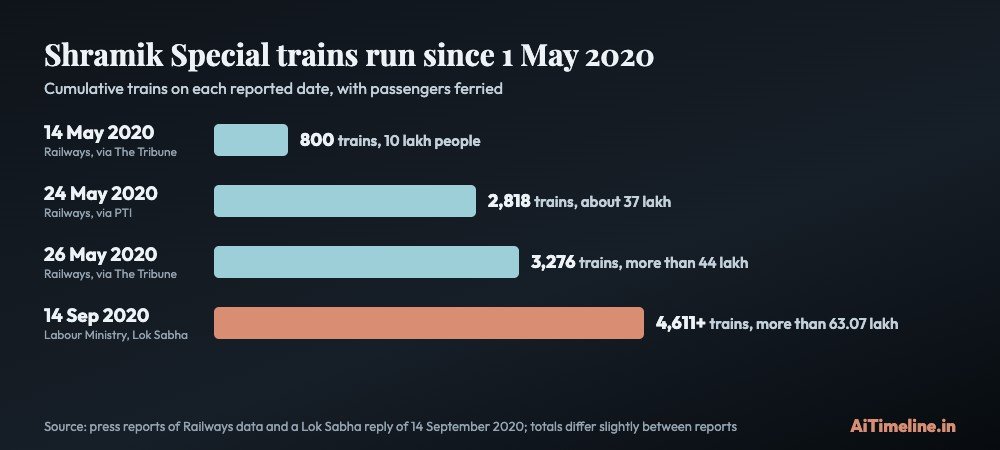
The Ministry of Home Affairs allowed stranded migrant workers to travel by Shramik Special trains from 1 May, with the sending and receiving states agreeing (PIB). The first train, from Lingampalli in Telangana to Hatia in Jharkhand, carried about 1,200 people; reports give 1,225 and a departure around 5 am, and said the operation was kept quiet to avoid crowds (The News Minute).
Numbers rose fast: 366 trains by 10 May, 1,773 by 20 May and 3,276 by 26 May with more than 44 lakh passengers, according to Railways data reported by the press (The Tribune). The final tally reported to Parliament was more than 4,600 trains and over 63 lakh passengers.
2020
Buses are allowed for stranded workers Government action
The Home Ministry order of 29 April allowed stranded migrant workers to travel to their native places by buses, with coordination between states (PIB). Access depended on arrangements by state governments.
2020
Limited movement and work allowed within states Government action
On 19 April the Home Ministry allowed migrant workers to move within their states so they could be engaged in industry, farming, construction, manufacturing and MNREGA work, as new activities were permitted outside containment zones from 20 April (PIB). It did not restore inter-state transport.
2020
Lockdown extended to 3 May; a crowd gathers at Bandra station On the ground
After the Prime Minister announced that the lockdown would run to 3 May, a crowd of migrant workers gathered near Bandra station in Mumbai in the afternoon. Estimates range from about 1,000 to 3,000. Maharashtra’s Chief Minister attributed it to a misleading report that trains would resume, and police used force to disperse the crowd (The Wire). Some social media users framed the gathering as religious; Mumbai Police said it was not.
2020
The Centre tells states to improve conditions in relief camps Government action
The Home Ministry wrote to states and Union Territories to comply with the Supreme Court’s directions for migrants in relief shelters: medical facilities, food, clean drinking water and sanitation, counsellors, humane treatment by police, and volunteers to supervise welfare (PIB).
2020
The government reports 21,486 relief camps Government action
The government said 21,486 relief camps had been set up, with 6,75,133 people sheltered and around 25 lakh given meals. The Cabinet Secretary asked states to ensure counselling in camps (PIB). These were government-reported figures at that date, not a measure of every worker’s access to food or shelter.
2020
The Centre tells the Supreme Court what it has done Court or Parliament
In a public interest petition about migrant labourers, the Centre filed a status report on steps taken, and told the Court that food was being provided to over 22 lakh migrant workers (SCC Online). The Government claimed the migration was the result of panic triggered by fake news and asked the Court to bar the media from publishing pandemic news without first checking with the Centre. According to Columbia University’s Global Freedom of Expression summary, the Court declined to order that direction, said it did not intend to curb free discussion, and expected the media to act responsibly (summary).
2020
Crowds at Anand Vihar bus terminal on the Delhi-UP border On the ground
Thousands of workers, many of whom had walked from across Delhi, gathered at Anand Vihar bus terminal to board buses home. The UP chief minister’s office had announced buses that morning and the Delhi government offered buses to the border; the Home Ministry later told the Supreme Court that misinformation was to blame, which The Wire disputed (The Wire; Scroll photo report). Counts of people differ by report and day.
2020
The Home Ministry tells states to create shelters, and employers to pay wages Government action
The order told states to set up relief shelters with food, to keep people who had already moved in nearby quarantine facilities for at least 14 days after screening, and told employers to pay wages on the due date without deduction for the closure period. Landlords were told not to demand rent for one month and not to force workers or students to vacate (PIB). It tried to prevent a mass movement to home states.
2020
States may use disaster funds for food and shelter Government action
The Centre allowed states to use the State Disaster Response Fund to provide food, health care and shelter to homeless people, including migrant workers (PIB). It created a funding route; delivery depended on local capacity.
2020
A Rs 1.70 lakh crore relief package is announced Government action
The Centre announced the Pradhan Mantri Garib Kalyan Yojana, totalling Rs 1.70 lakh crore. By September 2020 the government said around 42 crore poor people had received Rs 68,820 crore of financial assistance under it (PIB).
2020
India enters the first nationwide lockdown Government action
The lockdown came into force on 25 March under a Home Ministry order dated 24 March. Most commercial and industrial activity was suspended, with exemptions for essential services, and rail, metro and road passenger transport stopped (MHA order).
2020
The Prime Minister announces the lockdown in a televised address Government action
Prime Minister Narendra Modi announced a nationwide lockdown, initially for 21 days, in a televised address, with restrictions taking effect from midnight (MHA order). Public transport stopped within hours.
2020
States begin partial and full lockdowns Government action
Between 16 and 23 March most state governments and Union Territories introduced restrictions. The government’s later account records 451 cases and 9 deaths on 23 March 2020 (PIB).
2020
India reports its first confirmed COVID-19 case Government action
India’s first confirmed case was reported on 30 January 2020, after airport screening started on 18 January (PIB).
Why Were Migrant Workers Hit So Hard?
Sudden loss of income. Many depended on daily wages or informal work. When sites and businesses closed, income could stop at once, with no paid leave or savings for several weeks.
Housing tied to work. Workers often lived in rented rooms, employer housing or crowded settlements near workplaces. Losing work made rent impossible; the 29 March order told landlords to defer rent for a month, but The Wire reported evictions despite it.
Transport shutdown. With normal services suspended, workers could not book a train or bus home. Buses were allowed on 29 April and trains from 1 May, so the first five weeks left walking, cycling and improvised transport.
Uneven welfare. Food and shelter were organised locally. Workers outside their home districts could face barriers: ration cards were tied to a state, which is why portable cards were announced on 14 May.
Coordination. Central ministries, states, Railways, police and local authorities had to act together. Trains needed agreement from both sending and receiving states, and the parliamentary committee later asked for a Centre-state mechanism.
The Human Cost: What the Numbers Can and Cannot Tell Us
Each official figure measures something specific. Read what it excludes.
| Figure | Source and date | What it counts | What it does not count |
|---|---|---|---|
| 1,04,66,152 returned | Labour Ministry, Lok Sabha, 14 Sep 2020 | Migrant workers who returned to their home states during the lockdown | Workers who stayed in cities, lost jobs or took on debt |
| More than 1.06 crore returned | Road Transport Ministry citing Labour Ministry data, Lok Sabha, 22 Sep 2020 | Same measure, including those who travelled on foot | A separate count of those who walked |
| More than 4,611 trains; 63.07 lakh people | Labour Ministry, Lok Sabha, 14 Sep 2020 | Shramik Special trains and passengers | Workers who travelled by bus, truck or on foot |
| 97 deaths on board | Railway Minister to Parliament, up to 9 Sep 2020, as reported | People who died on board Shramik Special trains | Deaths on roads, on tracks or in camps; the cause of each death |
| 81,385 accidents; 29,415 fatalities | Road Transport Ministry, provisional, Mar-Jun 2020 | All road accidents and road deaths in India in four months | Migrant workers specifically; the same answer says no separate data is kept |
| 21,486 relief camps; 6,75,133 sheltered | Government briefing, 1 Apr 2020 | Camps and people sheltered on that date, as reported by the government | Conditions in each camp or workers outside camps |
| 16 deaths at Aurangabad; 23 to 25 at Auraiya | Press reports, May 2020 | Individual accidents | Any national total; the tolls differ between outlets |
The returnee figure measures scale of movement, not harm. The only official death figure tied to the journey, 97 on Shramik trains, covers one mode of travel up to 9 September 2020. Claims of a definitive national total of migrant deaths should be treated cautiously unless they name their method and sources. This page does not offer one.
What Changed After the Migrant Crisis?
Food. Free grain for migrants without ration cards was announced on 14 May 2020, and the Court ordered dry ration schemes and One Nation One Ration Card in June 2021.
Registration. The Court directed a portal for unorganised and migrant workers to start by 31 July 2021 with registration complete by 31 December 2021. AiTimeline did not verify whether the deadlines were met.
Preparedness. The parliamentary committee asked for a national pandemic plan and Centre-state coordination. AiTimeline did not check whether a national plan has since been adopted.
These steps did not undo the hardship of 2020. They show that emergency planning must include workers whose protection depends on where they work and live, not where they are registered. For earlier debates on food and wages see food prices versus minimum wages and, for how trains shaped national logistics, Indian Railways electrification.
The Story at a Glance
Dates from the sources listed below, with the type of each entry.
| Date | Event | Type |
|---|---|---|
| 30 Jan 2020 | First confirmed case | Government action |
| 24 Mar 2020 | Lockdown announced | Government action |
| 26 Mar 2020 | Rs 1.70 lakh crore relief package | Government action |
| 28 Mar 2020 | SDRF allowed for migrants | Government action |
| 28-29 Mar 2020 | Anand Vihar crowds | On the ground |
| 29 Mar 2020 | MHA shelter, wage and rent order | Government action |
| 1 Apr 2020 | 21,486 relief camps reported | Government action |
| 14 Apr 2020 | Lockdown extended; Bandra crowd | On the ground |
| 29 Apr 2020 | Buses allowed | Government action |
| 1 May 2020 | Shramik Special trains begin | Government action |
| 8 May 2020 | Aurangabad accident | On the ground |
| 14 May 2020 | Free grain and portable ration cards announced | Government action |
| 16 May 2020 | Auraiya accident | On the ground |
| 26 May 2020 | Supreme Court takes suo motu cognisance | Court or Parliament |
| 28 May 2020 | No fares, food on journey | Court or Parliament |
| 9 Jun 2020 | 15-day window for transport | Court or Parliament |
| 14-22 Sep 2020 | Parliamentary replies on counts | Counts and accountability |
| 21 Dec 2020 | Standing Committee report | Court or Parliament |
| 29 Jun 2021 | Supreme Court final directions | Court or Parliament |
| Term | Meaning | Why it matters here |
|---|---|---|
| Shramik Special | A train run by Railways for stranded workers, from 1 May 2020 | The main organised way home, alongside buses |
| Suo motu cognisance | A court taking up a matter on its own motion | How the Supreme Court began the migrant case on 26 May 2020 |
| SDRF | State Disaster Response Fund | Allowed for food and shelter for migrants on 28 March 2020 |
| Disaster Management Act, 2005 | The law under which lockdown orders were issued | The basis of the 29 March shelter, wage and rent order |
| One Nation One Ration Card | Portable ration cards usable in any state | Announced 14 May 2020; ordered by the Court for states by 31 July 2021 |
| Inter-State Migrant Workmen Act, 1979 | Law requiring contractors to register workers who move between states | The Court told states in June 2021 to enforce it |
| NDUW | National Database for Unorganised Workers | The registration portal the Court ordered in June 2021 |
| Dry ration | Uncooked foodgrains given to a household | The Court ordered states to bring a scheme for migrant labourers |
Who Is Who in the Story
Ministry of Home Affairs
Issued the lockdown orders under the Disaster Management Act, the 29 March shelter and wage order, and the bus and train permissions of 29 April and 1 May.
Indian Railways
Ran Shramik Special trains from 1 May 2020 with the sending and receiving states agreeing; press reports say it bore most of the cost.
Ministry of Labour and Employment
Supplied the returnee figure to Parliament and said it kept no data on migrant deaths or job losses.
States and Union Territories
Ran relief camps, arranged buses, and identified workers for trains; responsibility for implementation sat largely with them.
Suo Motu WP (C) 6 of 2020
Took up the matter on 26 May 2020, issued directions on 28 May and 9 June, and disposed of it on 29 June 2021.
Standing Committee on Home Affairs
Submitted its report on 21 December 2020 recommending a national plan and a migrant database.
Workers living away from home
Many were daily-wage or informal workers in rented rooms or employer-provided housing, dependent on the place they worked.
Industry, shops and property owners
The 29 March order told employers to pay wages and landlords to defer rent; the wage provision lapsed on 18 May.
The Popular Story vs the Record
| Popular version | What the record shows |
|---|---|
| The government counted how many migrant workers died | Parliamentary replies in September 2020 said the Labour and Road Transport ministries kept no separate data on migrant workers who died on roads or returning home. The 97 figure is only for deaths on Shramik trains |
| 29,415 migrant workers died on the roads | It is the provisional count of all road fatalities in India from March to June 2020. The same answer says no separate data on migrants is kept |
| 1.06 crore is the number of people affected | It is the number of migrant workers reported to have returned home. It does not count those who stayed and lost income |
| Shramik trains started on the first day of the lockdown | They began on 1 May 2020, 38 days after the lockdown was announced. Buses were allowed on 29 April |
| The Supreme Court acted immediately | A bench dismissed a plea on 15 May 2020. The Court took suo motu cognisance on 26 May and issued directions on 28 May and 9 June |
| The wage-payment order protected workers throughout | The 29 March order was not carried forward in the 17 May guidelines and lapsed from 18 May |
| The Court ordered fares to be waived on 29 May | The bench heard the matter on Thursday 28 May; newspapers reported it on 29 May |
Explore More Timelines
People Also Ask
Frequently Asked Questions
Sources and Further Reading
- Supreme Court of India: In Re: Problems and Miseries of Migrant Labourers, judgment of 29 June 2021
- Lok Sabha Unstarred Question 2044, answered 22 September 2020 (Road Transport and Highways)
- PIB: MHA order on shelters, wages and rent, 29 March 2020
- PIB: Relief camps and meals, daily briefing of 1 April 2020
- PIB: Welfare of migrant labourers in relief camps, 12 April 2020
- PIB: Government reply on migrant workers in the Lok Sabha, 15 September 2020
- PIB: Government account of COVID-19 prevention measures, 18 September 2020
- PIB: Nationwide lockdown order, 24 March 2020
- Ministry of Home Affairs: COVID-19 orders and notifications
- PRS Legislative Research: Management of COVID-19 Pandemic and Related Issues
- Economic Survey 2020-21, Volume 2, page 699
- The Indian Express: Supreme Court on fares and food for migrants, 29 May 2020
- The Leaflet: No government data on death of migrant workers, Lok Sabha
- Scroll: 97 people died on board Shramik Special trains
- The Quint: 97 people dead on Shramik trains till 9 September
- The Tribune: 800 Shramik Special trains run so far
- Business Standard (PTI): 2,818 Shramik Special trains have ferried around 37 lakh migrants
- The Tribune: 3,276 Shramik Special trains ferried more than 44 lakh migrants
- The News Minute: How Telangana rolled out India’s first migrant train
- The Wire: Aurangabad migrant workers killed by goods train
- Business Today: Auraiya road accident, 24 migrant workers killed
- SCC Online: Auraiya road accident, NHRC notice
- The Wire: Migrant workers at Anand Vihar bus terminal
- Scroll: At Delhi-UP border, thousands try to squeeze into state buses
- The Wire: Bandra migrant gathering in Mumbai
- Onmanorama: Free foodgrains for migrants, FM unveils second tranche
- LiveLaw: SC refuses to entertain plea for migrants on road
- The Tribune: Can’t stop migrants’ movement, says SC
- SCC Online: Food is being provided to over 22 lakh migrant workers, Centre tells SC
- Columbia Global Freedom of Expression: Alakh Alok Srivastava v. Union of India
- Sabrang India: SC takes suo motu cognisance of migrant crisis
- Deccan Herald: Government withdraws order on mandatory wage payment during lockdown
Related AiTimeline Stories
⚠️ Editorial Note
Last updated 23 October 2026. This article distinguishes official figures from press reports and estimates. The figure of more than 1.04 to 1.06 crore refers to migrant workers reported as returning to their home states; it is not a count of everyone affected. Official records cited here do not establish a comprehensive nationwide count of migrant-worker deaths during the lockdown, and individual accidents such as Aurangabad and Auraiya come from press reports with differing tolls. Corrections to the draft brief: the Lok Sabha answer is dated 22 September 2020 (not March 2021) and was given by the Road Transport Ministry citing Labour Ministry data; the 29,415 figure is all road fatalities, not migrants; the Court’s fare-free order was heard on 28 May (reported 29 May); the SDRF permission is dated 28 March (not 27-28); the 29 March order was a Home Ministry order; and the brief cited the 29 June 2021 judgment for the 26 May and 9 June 2020 orders, which this page sources to the same judgment, where those orders are quoted. Not verified: the cause of each death on Shramik trains, whether the 2021 deadlines were met, and the current state of the migrant database.
Sources & further reading
Every dated entry above was checked against these references. Last reviewed 23 October 2026.
- Supreme Court of India: In Re: Problems and Miseries of Migrant Labourers, judgment of 29 June 2021
- Lok Sabha Unstarred Question 2044, answered 22 September 2020 (Road Transport and Highways)
- PIB: MHA order on shelters, wages and rent, 29 March 2020
- PIB: Relief camps and meals, daily briefing of 1 April 2020
- PIB: Welfare of migrant labourers in relief camps, 12 April 2020
- PIB: Government reply on migrant workers in the Lok Sabha, 15 September 2020
- PIB: Government account of COVID-19 prevention measures, 18 September 2020
- PIB: Nationwide lockdown order, 24 March 2020
- Ministry of Home Affairs: COVID-19 orders and notifications
- PRS Legislative Research: Management of COVID-19 Pandemic and Related Issues
- Economic Survey 2020-21, Volume 2, page 699
- The Indian Express: Supreme Court on fares and food for migrants, 29 May 2020
- The Leaflet: No government data on death of migrant workers, Lok Sabha
- Scroll: 97 people died on board Shramik Special trains
- The Quint: 97 people dead on Shramik trains till 9 September
- The Tribune: 800 Shramik Special trains run so far
- Business Standard (PTI): 2,818 Shramik Special trains have ferried around 37 lakh migrants
- The Tribune: 3,276 Shramik Special trains ferried more than 44 lakh migrants
- The News Minute: How Telangana rolled out India's first migrant train
- The Wire: Aurangabad migrant workers killed by goods train
- Business Today: Auraiya road accident, 24 migrant workers killed
- SCC Online: Auraiya road accident, NHRC notice
- The Wire: Migrant workers at Anand Vihar bus terminal
- Scroll: At Delhi-UP border, thousands try to squeeze into state buses
- The Wire: Bandra migrant gathering in Mumbai
- Onmanorama: Free foodgrains for migrants, FM unveils second tranche
- LiveLaw: SC refuses to entertain plea for migrants on road
- The Tribune: Can't stop migrants' movement, says SC
- SCC Online: Food is being provided to over 22 lakh migrant workers, Centre tells SC
- Columbia Global Freedom of Expression: Alakh Alok Srivastava v. Union of India
- Sabrang India: SC takes suo motu cognisance of migrant crisis
- Deccan Herald: Government withdraws order on mandatory wage payment during lockdown