Atal Setu History: How India Built Its Longest Sea Bridge
Atal Setu history: from the 1963 harbour-crossing idea and failed bids to JICA loans, India's first steel-deck spans, the 2024 opening and traffic since.
Latest Story
The bridge took about six years to build. The idea took more than sixty. In 1963 the US consultancy Wilbur Smith and Associates suggested a road across Mumbai Harbour from Sewri to the mainland near Uran. It was shelved. A 1981 steering group chaired by JRD Tata recommended the Sewri–Nhava Sheva route, and the cost was put at about ₹350 crore in the mid-1980s. Then came two decades of rejected bids, lawsuits, turf wars and clearances. Work finally began in 2018, with Japanese loans and India’s first orthotropic steel decks, and on 12 January 2024 Prime Minister Narendra Modi opened the Atal Bihari Vajpayee Sewri–Nhava Sheva Atal Setu: 21.8 km long, 16.5 km of it over water, at an approved cost of ₹17,843 crore. This is the full Atal Setu history: why it stalled, what finally moved it, how it was built, and how it has actually performed since it opened.
🧠 AI Overview Summary
Atal Setu, formerly the Mumbai Trans Harbour Link (MTHL), is a 21.8 km six-lane bridge from Sewri in Mumbai to Chirle near Nhava Sheva, with about 16.5 km over the sea. First proposed in 1963, it stalled through failed bidding rounds from 2005 to 2013 before MMRDA took charge and JICA loans of about 242 billion yen financed it. Work began in 2018, it opened on 13 January 2024 at an approved cost of Rs 17,843 crore, and first-year traffic averaged about 22,700 vehicles a day, well below projections.
Atal Setu: Key Questions
Sixty Years of Atal Setu in Ten Lines
- 1963, an idea: Wilbur Smith and Associates proposed a Sewri–Uran harbour crossing. The shorter Vashi creek bridge was built instead.
- 1981, a route: a steering group chaired by JRD Tata recommended the Sewri–Nhava Sheva alignment.
- 2004–2013, a deadlock: IL&FS and MSRDC proposals, a Supreme Court fight over the Reliance–Hyundai bid, and later rounds where no one bid at all.
- Costs kept climbing: about ₹4,000 crore in 2005, ₹9,600 crore by 2013, ₹17,843 crore approved in 2017.
- 2009 and 2011, new owner: MMRDA took charge in 2009 and the project was re-labelled a regional development project in 2011.
- Japan paid most of it: JICA lent ¥242.459 billion (about ₹13,715 crore) across three tranches from 2017 to 2023.
- Three packages, three builders: L&T–IHI, Daewoo–Tata Projects and L&T won contracts in November 2017.
- A first for India: orthotropic steel deck spans, the first lifted into place on 14 January 2022 and the longest 180 m.
- Opened 12–13 January 2024: inaugurated by Narendra Modi and named after Atal Bihari Vajpayee.
- The traffic has lagged: first-year use averaged about 40% of the projection. Connectors to Worli and the Mumbai–Pune Expressway are due in 2027.
1963–1981: A Line on a Map
The crossing Mumbai proposed, then postponed.
Mumbai’s problem has always been geography. The island city sits at the tip of a narrow peninsula, and in the 1960s everything going to the mainland had to go north, round the harbour, through Thane Creek. In 1963 the US consultancy Wilbur Smith and Associates, in a transport study for the city, suggested a shortcut: a bridge from Sewri, on the island’s eastern shore, across the harbour to Uran on the mainland near what would become the Nhava Sheva port.
The idea did not go far. The mainland opposite was still thinly populated, and the city’s planners chose a cheaper answer to the same problem. The Thane Creek bridge at Vashi, opened in the early 1970s, became the road into the new township of Navi Mumbai, planned from the early 1970s. The harbour crossing, as Swarajya later put it, “went into cold storage, and stayed there for decades.”
It came back in 1981, when a steering group chaired by JRD Tata, then chairman of Tata Sons, recommended a transport link along the Sewri–Nhava Sheva route to decongest the island city. When the project was discussed again in the mid-1980s, its cost was put at about ₹350 crore. That figure would be multiplied roughly fifty-fold before the bridge was finished.
🚆 Road, rail or metro?
The link was not always meant to be only a road. Early plans included a rail component, and a metro line on the bridge was proposed and then dropped in 2012. It was re-examined in 2021–22 and again judged unworkable, because the piers had not been designed to carry the extra load. Atal Setu opened as a six-lane road bridge only.
2004–2013: Four Attempts, No Bridge
Unrealistic bids, a Supreme Court case and rounds where no one bid.
The modern revival began in 2004. The infrastructure lender IL&FS submitted a build-own-operate-transfer proposal. The Maharashtra State Road Development Corporation (MSRDC), which had just built the Mumbai–Pune Expressway, put up its own plan. Neither went ahead. MSRDC’s estimate then was about ₹4,000 crore.
In 2005 MSRDC invited bids, and the Ambani brothers ended up on opposite sides. Anil Ambani’s Reliance Energy, with Hyundai Engineering, quoted a toll concession of 9 years and 11 months. Mukesh Ambani’s Sea King Infrastructure quoted 75 years. Moneylife later called the process “the story of unrealistic bidding”. The Reliance–Hyundai consortium was first disqualified at the technical stage, went to the Supreme Court and won. It emerged as the winner, but the project still did not move. The state called fresh bids in 2008 with a cost of about ₹6,000 crore. Thirteen companies showed interest, and none submitted a bid.
Politics made it slower. In a Congress–NCP coalition, the question of which agency should own the project became a turf war. By the time the dust settled, the estimate was ₹8,800 crore (November 2011), then ₹9,360 crore (August 2012) and ₹9,600 crore (January 2013). A last attempt to find a private builder in 2013–14 also drew no takers. The market was saying the same thing each time: toll revenue alone could not pay for this bridge.
2009–2016: A New Owner and a Long List of Clearances
MMRDA, the environment ministry, the flamingos and a war room.
The institutional fix came by government resolution. On 4 February 2009 Maharashtra decided that the Mumbai Metropolitan Region Development Authority (MMRDA) would own and implement the project. On 8 June 2011 it was re-designated a Regional Development Project rather than a transport project. The difference was not cosmetic. A regional development project could be justified by the growth it opened up in Navi Mumbai and Raigad, not only by the tolls it collected.
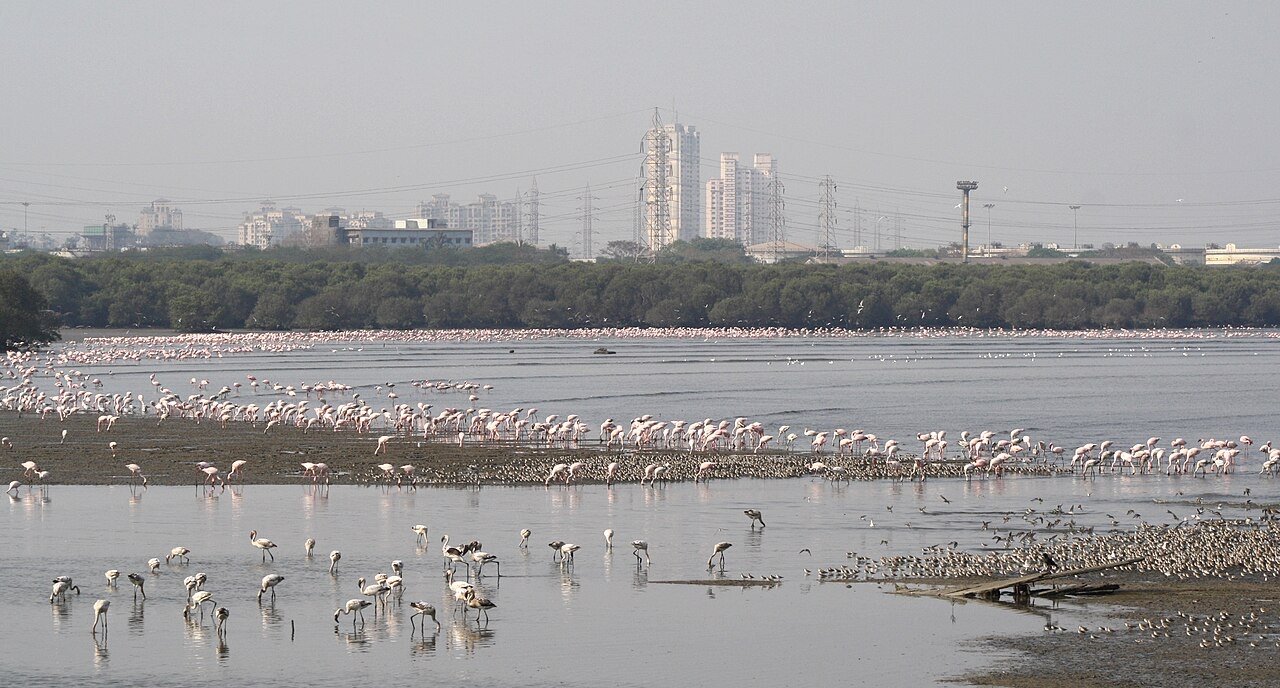
Then came clearances. The Union environment ministry granted environmental clearance in October 2012 with conditions. The Department of Economic Affairs approved about ₹1,920 crore of viability gap funding in January 2013, and coastal regulation zone (CRZ) clearance followed in July 2013. The hardest part was the forest clearance, because the alignment crossed mangroves and the Sewri mudflats, where tens of thousands of flamingos winter. In 2015 the Forest Advisory Committee held back approval until the impact on the birds was studied. Forest clearance came in January 2016.
What finally broke the logjam was money plus political attention. Devendra Fadnavis, chief minister from late 2014, put the project in his infrastructure “war room”, and in 2016 Japan’s development agency agreed to lend most of the cost. On 24 December 2016, Prime Minister Narendra Modi laid the foundation stone.
The Japanese Loan That Made It Buildable
Cheap, long money where toll-based bidding had failed.
Once the private-concession model had failed, the bridge needed patient, low-cost capital. The Japan International Cooperation Agency (JICA) provided it through official development assistance loans on concessional terms with a long repayment period. JICA signed three loan agreements: in March 2017, March 2020 and February 2023. By its own count they totalled ¥242.459 billion, about ₹13,715 crore, which is most of the ₹17,843 crore approved cost.
The partnership was technical too. JICA describes the orthotropic steel deck used on the bridge as “Japan’s bridge technology”, used in India for the first time, and a Japanese firm, IHI, was part of the joint venture that built the longest package. In JICA’s opening-day release, Japan’s ambassador Suzuki Hiroshi called the link “the game changer” for the Mumbai region.
| Package | Stretch | Contractor | Contract value |
|---|---|---|---|
| Package 1 | 10.38 km, Sewri end and sea section | Larsen & Toubro + IHI Corporation | ₹7,637 crore |
| Package 2 | 7.8 km sea section + Shivaji Nagar interchange | Daewoo E&C + Tata Projects | ₹5,613 crore |
| Package 3 | 3.6 km land viaduct to Chirle | Larsen & Toubro | ₹1,014 crore |
| Package 4 | Tolling and intelligent transport systems | Strabag | — |
Civil packages awarded 9 November 2017. Values as reported at award; Package 4 figures vary by source.
2018–2023: Building on Mud, Sea and Mangrove
Piers in the mudflats, girders on barges, and a pandemic.
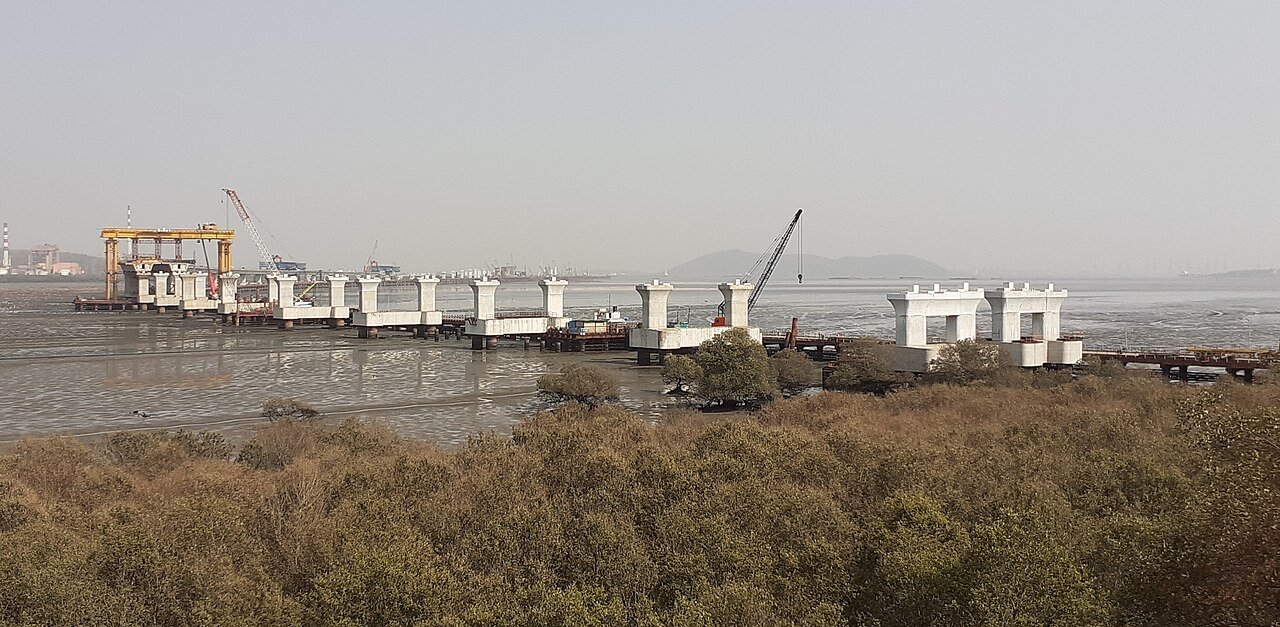
MMRDA dates the start of work to March 2018. The formal start was widely reported as 24 April 2018. The first pier went up at Sewri in May 2019, and in January 2020 the first large precast girder was launched. At the peak, more than 14,000 workers were deployed in round-the-clock shifts.
Much of the Mumbai end was built in the intertidal mudflats off Sewri, where the harbour drains almost dry at low tide. That ruled out ordinary barge work for part of the day and ordinary land work for the rest. The project used reverse circulation drilling for its foundations, a first in India according to project accounts, and large segments were cast on shore and moved into position.
The original schedule assumed completion in about four and a half years, around 2022. The COVID-19 pandemic cost roughly eight months, and the target moved to 2023 and then to the end of that year. JICA later credited the engineers with finishing despite difficulties “including the waves of COVID-19 pandemic”.
The Steel Deck: India’s First Orthotropic Spans
Why lighter steel meant fewer piers in the water.
Most of Atal Setu is a conventional precast concrete viaduct. Where it crosses navigation channels and sensitive areas it switches to orthotropic steel deck (OSD) spans: a steel plate stiffened underneath by a grid of ribs and cross-beams, so the deck carries load differently in two directions. Because it is much lighter than an equivalent concrete deck, a span can be longer. Longer spans mean fewer piers in the water, which leaves more room for ships and disturbs less of the seabed.
The spans were fabricated abroad, in Japan, Myanmar, Taiwan and Vietnam according to project reports, shipped to Mumbai, assembled into erection units and carried out on a special barge. JICA says the barge had lifting towers fitted with 16 strand jacks of 300 tonnes each, which raised each unit onto its piers.
The first OSD span, in Package 1, was erected on 14 January 2022. It was 118.8 metres long and weighed about 1,331 tonnes. The longest spans on the bridge are 180 metres, at roughly 2,200 to 2,400 tonnes each depending on the source, and Tata Projects says they are the longest steel deck spans in India. Package 2 alone used 32 OSD spans containing about 34,726 tonnes of steel.
How a steel span got onto the bridge
- Fabricate: steel deck blocks are made in overseas yards under factory quality control.
- Ship: the blocks arrive in Mumbai in multiple shipments.
- Assemble: blocks are joined into erection units on shore.
- Load: heavy modular transporters move each unit onto a lifting barge.
- Float: the barge is positioned between two finished piers.
- Lift: 16 strand jacks of 300 tonnes each raise the unit onto its bearings.
The Flamingo Question
A sea bridge next to one of Mumbai’s best-known bird habitats.
The Sewri end of the bridge sits beside the Sewri–Mahul mudflats, where lesser and greater flamingos gather every winter in numbers estimated at 20,000 to 30,000 when the project was being cleared. That is why the 2015 forest clearance was held up, and why the project commissioned studies of the birds before building.
The mitigation measures are specific. MMRDA says the steel-deck design and noise barriers were used to reduce disturbance to flamingos, and street lighting was designed to fall on the carriageway rather than spill onto the water. Compensation was paid to more than 1,500 fishing families whose grounds the construction affected. Whether the flamingos’ numbers are affected in the long term is still a question for monitoring, not something the opening settled.
January 2024: Mumbai Drives Across
A name, an inauguration and a toll.
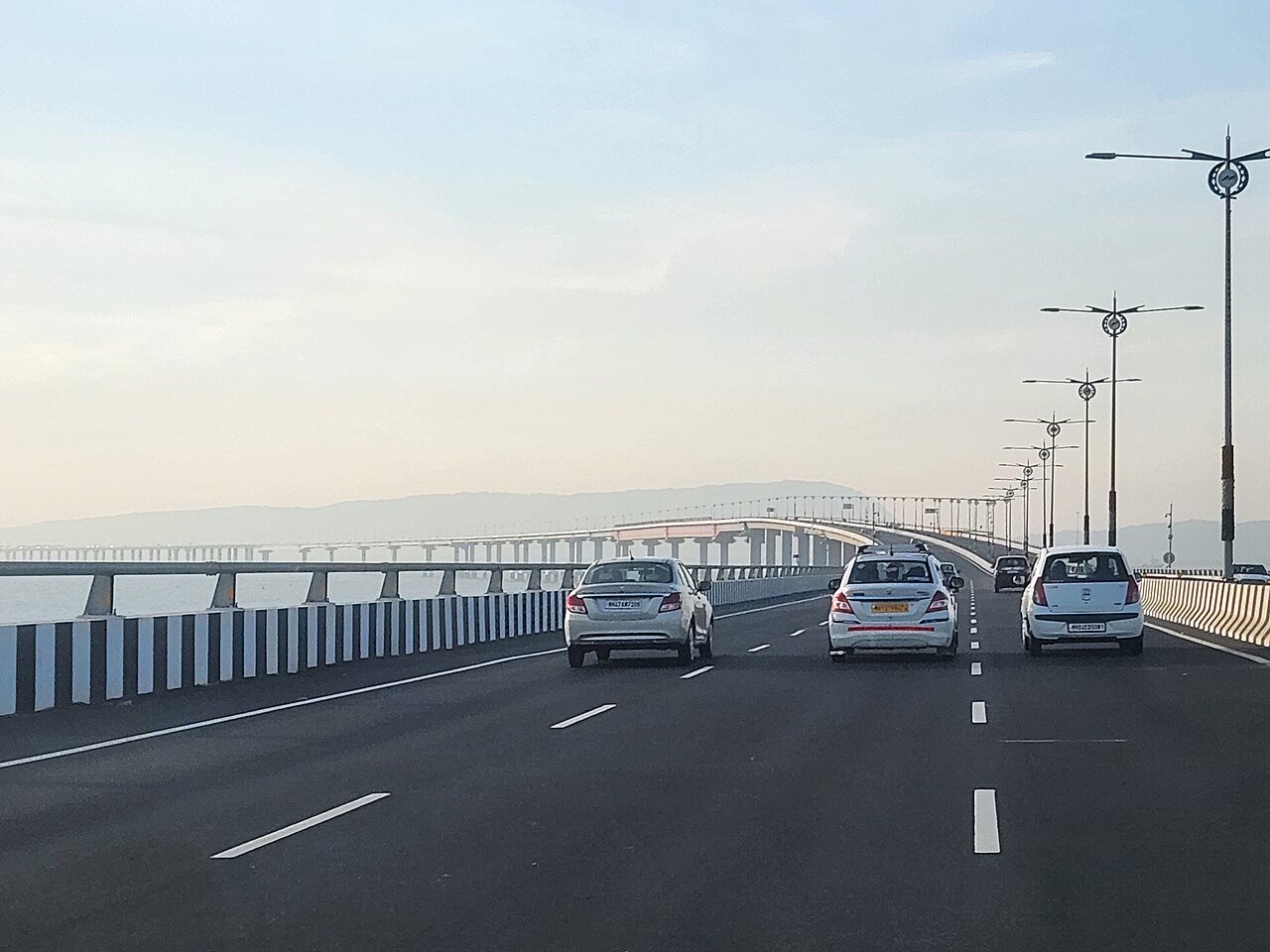
In June 2023, with about 95% of the work done, the Maharashtra cabinet decided to name the bridge after former prime minister Atal Bihari Vajpayee. MMRDA records construction as complete on 5 January 2024. On 12 January 2024 Narendra Modi inaugurated the Atal Bihari Vajpayee Sewri–Nhava Sheva Atal Setu, built, in the government’s words, at a cost of “more than Rs 17,840 crore”. It opened to traffic the next morning, 13 January. The next day, 14 January, was the busiest single day reported, at about 61,800 vehicles, many of them sightseers.
The rules marked it out from an ordinary city road. The speed limit is 100 km/h. Two-wheelers, auto-rickshaws, tractors and slow-moving vehicles are banned. Tolls are collected by open-road tolling. The one-way toll for a car was set at ₹250, or ₹375 for a same-day return, which is itself a 50% concession on the notified rate. In January 2026 the state extended that concession to 31 December 2026 and exempted electric cars and buses entirely.
In June 2024, the Congress’s Nana Patole showed cracks in the road and called it evidence of corruption. MMRDA replied that the cracks were minor longitudinal cracks in the asphalt of Ramp 5 of the Ulwe approach road, not the bridge structure, and repaired them the same day.
Before and after the harbour crossing
2024–2026: The Traffic Reality
Millions of trips, but fewer than forecast.
The headline numbers are large. MMRDA reported that 50,04,350 vehicles used the bridge between 13 January and 25 August 2024, including BEST, NMMT and MSRTC Shivneri buses. By the end of 2024 the cumulative count was close to 80 lakh.
The daily numbers tell a different story. In its first year Atal Setu averaged 22,689 vehicles a day, reported Business Standard, against a projection of about 57,525. An RTI reply reported by Moneylife put the gap between projected and actual traffic at close to 70% for one earlier forecast. Reports in 2026 put daily use at around 25,000.
Three causes come up again and again. The toll is steep compared with the Vashi route, which has been toll-free for cars since October 2024. The road links at either end were unfinished: at Sewri, traffic lands in the congested Eastern Freeway area, and at Chirle it still has to find its way to the Mumbai–Pune Expressway. And the demand the bridge was built for had not arrived yet. The Navi Mumbai International Airport, which the bridge was meant to serve, opened only in late 2025. A bridge designed for about 70,000 vehicles a day is, so far, a bridge with spare capacity.
| Measure | Figure | Source |
|---|---|---|
| Busiest single day | ~61,800 vehicles (14 Jan 2024) | Press reports |
| 13 Jan–25 Aug 2024 | 50,04,350 vehicles | MMRDA |
| First-year daily average | 22,689 vehicles | Business Standard, Jan 2025 |
| Projected daily traffic | ~57,525 vehicles | MMRDA projection, as reported |
| Design capacity | ~70,000 vehicles a day | Project reports |
2025–2027: Finishing the Roads at Either End
The bridge solved one gap. Three more links decide whether it gets used.
Navi Mumbai International Airport. Inaugurated on 8 October 2025, the airport began commercial flights on 25 December 2025. Atal Setu’s Shivaji Nagar interchange at Ulwe is its fastest road link from South Mumbai. That is the single biggest new source of demand for the bridge.
Sewri–Worli elevated connector. A 4.5 km, four-lane elevated road to carry Atal Setu traffic west to Worli, the Bandra–Worli Sea Link and the Coastal Road. Its foundation stone was laid in February 2021 and it was meant to open with the bridge. The rebuilding of the century-old Elphinstone road bridge over the railway slowed it down. Reports in July 2026 put its opening in early 2027.
Atal Setu–Mumbai–Pune Expressway connector. A 7.35 km, six-lane elevated corridor from Chirle to the expressway near Palaspe. In April 2026 MMRDA reported 143 of 176 foundations, piers at 141 locations, pier caps at 88 and 653 of 830 precast girders done, with completion targeted for February 2027.
Why Did Atal Setu Take 60 Years?
Each era had a different blocker, and each was cleared by a different fix.
| Period | What blocked it | What moved it |
|---|---|---|
| 1963–1981 | Thin demand on the mainland; cheaper Vashi creek bridge | Navi Mumbai’s growth; 1981 Tata steering group |
| 1981–2004 | No agency, no money, no urgency | Mumbai–Pune Expressway showed a toll road could be built |
| 2004–2008 | Rival proposals, unrealistic bids, Supreme Court litigation | Nothing; bids collapsed |
| 2008–2014 | Toll revenue could not cover cost; no bidders; agency turf war | MMRDA ownership (2009); regional-development status (2011) |
| 2012–2016 | Environmental, CRZ and forest clearances; flamingo habitat | Clearances with conditions; CM’s war room |
| 2016–2017 | Financing | JICA concessional loans |
| 2018–2023 | Marine engineering; COVID-19 | Steel decks, barge erection, 14,000-strong workforce |
| 2024–2027 | Unfinished approach roads; low traffic | Worli and expressway connectors; airport |
The pattern matters beyond Mumbai. Atal Setu did not wait for engineering. India could have built a sea bridge long before 2018. It waited for a financing model that did not depend on tolls covering the whole cost, and an owner with the mandate to justify the bridge by regional growth. Once both existed, the physical work took about six years.
Atal Setu Full Timeline, 1963–2027
Newest first.
Connectors Due
The 7.35 km expressway connector is targeted for February 2027, and the Sewri–Worli elevated road for early 2027.
Expressway Connector Progress
143 of 176 foundations and 653 of 830 girders complete on the six-lane Chirle–Palaspe corridor.
Toll Concession Extended
The 50% concession, ₹250 one way for a car, is extended to 31 December 2026. Electric cars and buses are exempted.
Navi Mumbai Airport Opens
Commercial flights begin at the airport the bridge was partly built to serve, after its inauguration on 8 October 2025.
One Year: Traffic Below Forecast
Average daily traffic in the first year is reported at 22,689 vehicles, against a projection of about 57,525.
50 Lakh Vehicles
MMRDA reports 50,04,350 vehicles have crossed since opening day.
The Cracks Row
Congress alleges cracks on the bridge. MMRDA says they are minor asphalt cracks on an approach ramp at Ulwe, not the bridge, and repairs them.
Inaugurated and Opened
Narendra Modi inaugurates Atal Setu on 12 January. It opens to traffic on 13 January, with a ₹250 car toll and a 100 km/h limit.
Named After Vajpayee
With about 95% of work done, the Maharashtra cabinet names the link after Atal Bihari Vajpayee.
First Steel Deck Span
A 118.8 m, 1,331-tonne orthotropic steel deck is lifted onto its piers by barge, India’s first. Later spans reach 180 m.
Girders and a Pandemic
The first large girder is launched in January. COVID-19 then costs the project roughly eight months. JICA signs its second loan in March.
Construction Begins
Work starts in the harbour and on the Sewri mudflats. The first pier follows in May 2019.
Loan Signed, Contracts Awarded
JICA’s first loan is signed in March, and the three civil packages are awarded to L&T–IHI, Daewoo–Tata Projects and L&T on 9 November.
Foundation Stone
Narendra Modi lays the foundation stone after forest clearance and JICA’s funding commitment earlier in the year.
Environmental Clearance
Clearance with conditions. Viability gap funding and CRZ clearance follow in 2013, but no builder bids.
A Regional Development Project
The link is re-designated a Regional Development Project, justified by growth in Navi Mumbai and Raigad, not only by tolls.
MMRDA Takes Over
Maharashtra decides MMRDA will own and implement the project.
The Ambani Bids
Reliance Energy–Hyundai (9 years 11 months) and Sea King (75 years) bid. The award goes through the Supreme Court and still does not produce a bridge. A 2008 round draws no bids.
The Revival Begins
Competing proposals at an estimated ₹4,000 crore. Neither goes ahead.
The JRD Tata Steering Group
A steering group chaired by JRD Tata recommends a Sewri–Nhava Sheva link. In the mid-1980s the cost is estimated at about ₹350 crore.
The First Proposal
A transport study proposes a harbour crossing from Sewri to Uran. The Vashi creek bridge is built instead.
Claims Checked
Details that circulate about Atal Setu, against the record.
What the record says
- “The first steel span was 180 m and 2,600 tonnes.” No. The first OSD span, erected on 14 January 2022, was 118.8 m and about 1,331 tonnes. The 180 m spans came later and are reported at about 2,200 to 2,400 tonnes.
- “Atal Setu starts in South Mumbai.” It starts at Sewri, on the eastern shore of central Mumbai. Drivers from South Mumbai reach it by the Eastern Freeway, which is why the Sewri–Worli connector matters.
- “Every trip to Navi Mumbai now takes 20 minutes.” JICA’s 20-minute figure and MMRDA’s 23-minute South Mumbai–Panvel figure are for specific trips. The time saved depends on where you start and end.
- “The bridge cracked within months.” The June 2024 cracks were in the asphalt of an approach ramp at Ulwe, according to MMRDA, not the bridge structure.
- “Reliance won the contract and walked away.” Simplified. The Reliance–Hyundai consortium won a contested 2005–08 tender after going to the Supreme Court, but it was never built under that award, and the state went back to the market in 2008.
Quiz: How Well Do You Know Atal Setu?
Tap a question to reveal the answer.
1. What was Atal Setu called before it was named?
2. Who first proposed the harbour crossing, in 1963?
3. Who chaired the 1981 steering group that recommended the route?
4. How much of the 21.8 km is over water?
5. Which technology was used on an Indian bridge for the first time?
6. When did Atal Setu open to traffic?
7. Which vehicles cannot use the bridge?
8. What was first-year average daily traffic?
Explore More Timelines
People Also Ask
Frequently Asked Questions
Related AiTimeline Stories
⚠️ Editorial Note
Project dates, length, cost and completion follow MMRDA’s project page; loan figures and the first steel-deck span follow JICA releases; the inauguration cost follows PIB; the 1981 steering group and span data follow the Tata group newsroom; bidding history and cost escalation follow Moneylife and Swarajya; traffic figures follow MMRDA and Business Standard. Some widely shared details are corrected or not used: the first steel span was 118.8 m and about 1,331 tonnes, not 180 m and 2,600 tonnes; we could not verify specific 1972 and 1978 committees or a 1994 feasibility study, or a total OSD steel figure of 87,452 tonnes. This is editorial, AI-assisted content.
Sources & further reading
Every dated entry above was checked against these references. Last reviewed 27 September 2026.
- MMRDA: Mumbai Trans Harbour Link project overview
- JICA: PM inaugurates JICA-funded Mumbai Trans-Harbour Link (12 Jan 2024)
- JICA: First orthotropic steel deck erected in Package 1 (14 Jan 2022)
- PIB: PM inaugurates Atal Bihari Vajpayee Sewri-Nhava Sheva Atal Setu
- Tata group: The Bridge over the Harbour
- Moneylife: Sewri-Nhava Sheva Trans-Harbour Link, the story of unrealistic bidding and spiralling cost (2013)
- MMRDA: Over 50 lakh vehicles travelled on Atal Setu in seven months
- Business Standard: One year on, Atal Setu registers average daily traffic of 22,689 vehicles
- Free Press Journal: Atal Setu-Mumbai-Pune Expressway link set for February 2027
- Swarajya: Mumbai Trans Harbour Link, first proposed in 1963