Maratha Reservation: From 58 Silent Marches to the 2026 Court Battle
Maratha reservation timeline: 58 silent marches, quota laws of 2014, 2018 and 2024, the 2021 Supreme Court verdict, Kunbi certificates and the 2026 case.
Latest Story
For four decades, the demand for Maratha reservation has been one of the biggest forces in Maharashtra’s politics. Two separate quota laws, in 2014 and 2018, were stayed or struck down. A third, giving Marathas 10% in 2024, is still being argued in the Bombay High Court, which has had to start the hearing again three times. Alongside it runs a second, quieter route: individual Marathas proving that their ancestors were recorded as Kunbi, a caste already in the state’s OBC list. This timeline keeps the two routes apart, because the law treats them very differently.
💡 Short Answer
Maharashtra gave Marathas a separate 10% quota in education and state jobs through the SEBC Act, 2024, after the Supreme Court struck down a 16% quota on 5 May 2021 for breaching the 50% ceiling. The 2024 law is under challenge, and a new Bombay High Court bench began hearing it afresh on 9 October 2026. Separately, Marathas who prove Kunbi ancestry can claim existing OBC benefits.
Maratha Reservation: Key Questions
The Story in Ten Points
- Two routes: a separate SEBC quota for Marathas, and Kunbi certificates that open the existing OBC quota to individuals who prove descent.
- 1982: Mathadi leader Annasaheb Patil marched for the demand on 22 March and died by suicide the next day.
- 2004: Maratha-Kunbi and Kunbi-Maratha entered the OBC list, the legal root of the Kunbi route.
- 2014: a 16% ordinance was stayed by the Bombay High Court within four months.
- 2016–17: 58 silent marches, sparked by the Kopardi crime, put reservation at the centre of state politics.
- 2018: the SEBC Act gave 16%; the High Court cut it to 12% and 13% in 2019.
- 5 May 2021: the Supreme Court struck the law down for breaching the 50% ceiling.
- 2023: police force at Antarwali Sarati made Manoj Jarange Patil the movement’s leader and the Kunbi route its main demand.
- 2024: a new 10% quota, on the Shukre commission’s report, with every benefit subject to the court’s final verdict.
- 2026: two more fasts, committees extended to June 2027, and a third High Court bench starting again from 9 October.
The Two Routes, Kept Apart
The most common mistake in coverage of this issue is treating these as one policy.
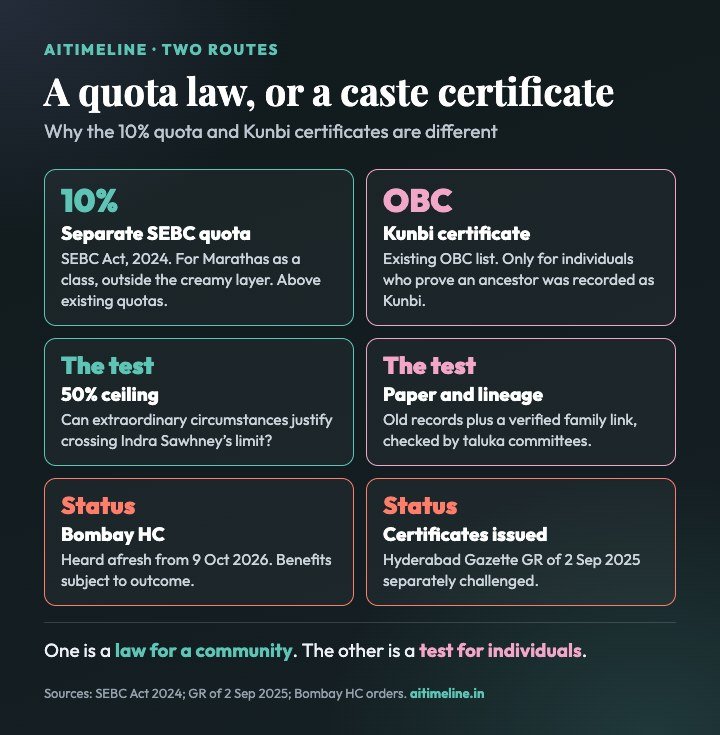
Separate 10% SEBC quota
- Created by the SEBC Act, 2024.
- Covers the Maratha community as a class, excluding the creamy layer.
- Sits above the existing reservations.
- Its validity turns on the 50% ceiling.
- Under challenge in the Bombay High Court.
Kunbi certificate route
- Uses the existing OBC list, which includes Kunbi.
- Covers only individuals who prove Kunbi ancestry.
- Shares the existing OBC quota.
- Turns on old records and genealogy checks.
- The 2025 Hyderabad Gazette resolution is separately challenged.
| Issue | Separate SEBC quota | Kunbi certificate route |
|---|---|---|
| Legal basis | SEBC Act, 2024 | Existing OBC list and caste certificate rules |
| Benefit | Separate 10% reservation | Access to the existing OBC quota |
| Who qualifies | Marathas, outside the creamy layer | Individuals who prove Kunbi ancestry |
| Main dispute | Constitutional validity, 50% ceiling | Evidence, genealogy, effect on existing OBCs |
| Status, Nov 2026 | Bombay HC hearing afresh since 9 Oct 2026 | Certificates being issued; GR challenges pending |
Timeline: From Kolhapur, 1902, to the Bombay High Court, 2026
Newest first. Colour shows which strand of the story each event belongs to.
Still no verdict on the 10% quota In court
Where things stand: The petitions against the Maharashtra State Reservation for Socially and Educationally Backward Classes Act, 2024 are being heard by a new three-judge bench. No final judgment has been delivered.
What applies meanwhile: Under the interim arrangement first set out in April 2024, admissions and appointments made under the 2024 Act stay subject to the final outcome of the petitions. The Act has not been stayed.
Hearing begins afresh, for the third time In court
Day one: Arguing for petitioners who oppose the quota, Arvind Datar said the legislature could not override the Supreme Court’s 2021 findings on the community’s status, relied on the 50% ceiling from Indra Sawhney, and argued that Marathas already have access to the 10% EWS quota.
Why it restarted: A case heard by a bench must be heard again when the bench changes. This was the third bench to start the case since 2024.
A third bench is constituted In court
The bench: Justice Makarand Karnik was named to head the bench. Justices N.J. Jamadar and Sandeep Marne, who had sat on the earlier bench, stayed on.
The cost of delay: The Ghuge bench had heard the case substantially from mid-2025 to August 2026. Its arguments had to be heard again before the new bench could rule.
Jarange ends a 20-day fast at Patoda On the street
Where it ended: Manoj Jarange Patil had set out from Antarwali Sarati towards Mumbai and halted at Patoda in Beed, where a delegation including ministers Radhakrishna Vikhe Patil and Dada Bhuse, MLC Prasad Lad and MLA Suresh Dhas met him.
What was promised: Chief Minister Devendra Fadnavis said the government had accepted 12 of his 13 demands. The delegation said action on the Satara, Kolhapur, Pune and Aundh Gazettes would come within about three months, after the Advocate General’s written opinion.
His terms: Jarange said suspending the fast did not end the agitation and that supporters would go to Mumbai if the promises were not kept in three months.
Justice Ghuge sworn in as Calcutta Chief Justice In court
What changed: Justice Ravindra Ghuge, then Acting Chief Justice of the Bombay High Court and head of the bench hearing the 2024 Act challenge, took oath as Chief Justice of the Calcutta High Court.
The effect: His bench could no longer sit, so the case had to be assigned to a new bench and heard again.
Jarange begins another indefinite fast On the street
The complaint: Jarange said the government had not carried out the September 2025 and May 2026 assurances: pending Kunbi certificates, caste-validity certificates, the use of identified records and other Gazettes beyond Hyderabad.
The government’s figures: The state said it had received about 14.3 lakh applications for Kunbi certificates and issued about 14.2 lakh. Jarange rejected the claim that the issue was largely resolved.
Genealogy committees extended to June 2027 Kunbi route
The decision: Maharashtra extended the taluka-level committees that verify family genealogies for Kunbi, Maratha-Kunbi and Kunbi-Maratha certificates by one year, to 30 June 2027. Their earlier term had ended on 30 June 2026.
Why: Work remained incomplete in many districts. The committees were told to clear pending cases and establish the family links certification needs.
A fast ends after midnight with a 12-point proposal On the street
The proposal: Jarange began an indefinite fast on 30 May and ended it shortly after midnight. He said the state agreed to issue certificates based on about 58 lakh Kunbi records already identified, to display those records at gram panchayat offices and to act against officials who failed to issue certificates despite valid records.
Also agreed: A review of the caste-validity certificate process after 15 days, and financial help within 15 days to families of people who died in the movement.
Challenges to the Hyderabad Gazette resolution Kunbi route
The objection: OBC groups argued that the resolution opened the OBC category to Marathas through the back door and would cut into the share of communities already in it.
The courts: The Supreme Court declined to entertain a direct challenge and the petitioners went to the Bombay High Court, which has not stayed the resolution. A Maratha group filed caveats asking to be heard first.
The Hyderabad Gazette resolution Kunbi route
What it does: The resolution set up a process for eligible Marathas of Marathwada to obtain Kunbi certificates using Hyderabad State records, including the Hyderabad Gazetteer, that recorded their ancestors as Kunbi.
What it does not do: It does not give OBC status to all Marathas. Each applicant must show a family link to a person recorded as Kunbi, verified through local inquiry.
Jarange’s fast at Azad Maidan, Mumbai On the street
The demand: Jarange began an indefinite fast in Mumbai demanding that Marathas, starting with Marathwada, be recognised as Kunbi using the Hyderabad Gazette records.
The pressure: The crowds strained traffic in south Mumbai, and the Bombay High Court took up the disruption. The fast ended on 2 September, when the government issued the resolution.
The Ghuge bench begins a full hearing In court
The hearing: A special full bench headed by Justice Ravindra Ghuge began hearing the challenges afresh, with arguments on the 50% ceiling, the Shukre commission’s data and whether the 2024 law cured the defects the Supreme Court found in 2021.
For students: In June 2025 the bench said the interim position would continue for that year’s admissions: seats could be filled under the quota, subject to the final result.
Supreme Court asks for an urgent bench In court
The request: Students facing the 2025 medical admissions told the Supreme Court the quota’s uncertain status was hurting them. The Court declined to intervene itself but asked the Bombay High Court to constitute a bench urgently.
The response: The High Court set up a special three-judge bench in mid-May 2025, after the first bench had broken up when Chief Justice D.K. Upadhyaya moved to the Delhi High Court in January 2025.
Admissions and jobs made subject to outcome In court
The order: The full bench refused an urgent stay of the 2024 Act but directed that any admission or appointment using the SEBC quota would be subject to the final outcome of the petitions.
What it means: People admitted or appointed under the quota have no guarantee their seat or post survives if the law is struck down.
The SEBC Act, 2024 is notified Law
The law: A separate 10% quota for Marathas as a Socially and Educationally Backward Class in state educational admissions and state public services, above the existing reservations and with a creamy-layer exclusion.
Its basis: The report of the Maharashtra State Backward Class Commission chaired by retired Justice Sunil Shukre, which found the community socially and educationally backward and said exceptional circumstances justified crossing the 50% ceiling.
Legislature passes the 10% quota unanimously Law
The vote: Both Houses passed the Maharashtra State Reservation for Socially and Educationally Backward Classes Bill, 2024 without opposition, four days after the Shukre commission submitted its report on 16 February.
The reaction: Jarange said a separate quota would not survive in court and kept pressing for Kunbi recognition and OBC benefits instead.
The “sage soyare” draft notification Kunbi route
The draft: As Jarange’s march neared Mumbai, the government issued a draft notification proposing that blood relatives (sage soyare) of a person holding a Kunbi certificate could also get one, after verification.
The aftermath: Jarange ended his march. The draft drew thousands of objections, many from OBC groups, and its final form became a recurring demand.
A second fast and the first certificates On the street
What happened: Jarange began a second fast on 25 October. Protests turned violent in parts of Marathwada, with the houses and offices of some legislators set on fire in Beed.
The response: The state began issuing Kunbi certificates to people whose ancestors appeared as Kunbi in records traced by the Shinde committee. Jarange ended the fast on 2 November and set a fresh deadline.
The Shinde committee to trace Kunbi records Kunbi route
The task: The committee was set up to work out how Marathas of Marathwada could prove Kunbi lineage from Nizam-era and other old records, and to search land, education, birth and revenue records for Kunbi entries.
The scale: Its search was later extended across the state and turned up lakhs of records.
Police baton charge at Antarwali Sarati On the street
What happened: Police used force to clear protesters at the site of Manoj Jarange Patil’s hunger strike. Images of injured protesters spread across the state.
Why it mattered: A local fast became a statewide movement, and Jarange became its best-known face. He ended that fast on 14 September after 17 days.
Maharashtra’s review petition dismissed In court
The ruling: The Supreme Court dismissed Maharashtra’s petition to review the 2021 judgment, finding no ground to reopen it. The Centre’s separate review on the 102nd Amendment point had been dismissed on 1 July 2021.
What next: The state filed a curative petition, the last remedy against a final Supreme Court judgment. It remains pending.
The 105th Amendment restores states’ power Law
The change: Parliament restored the power of states and Union territories to prepare their own lists of socially and educationally backward classes, undoing the majority view in the Maratha judgment on the 102nd Amendment.
The limit: It did not revive the 2018 quota and did not touch the 50% ceiling, which was the decisive ground in 2021.
Supreme Court strikes down the 2018 quota In court
The decision: The bench of Justices Ashok Bhushan, L. Nageswara Rao, S. Abdul Nazeer, Hemant Gupta and S. Ravindra Bhat unanimously struck down the SEBC Act, 2018. It found no extraordinary situation justifying a breach of the 50% ceiling and declined to refer Indra Sawhney to a larger bench.
The split: By 3 to 2, it held that after the 102nd Amendment only the President could identify SEBCs for the central list and states could not, a point Parliament reversed months later.
Protection: Admissions and appointments already made under the 2018 law before 9 September 2020 were protected.
The Supreme Court stays the quota In court
The order: A three-judge bench stayed the 2018 Act for admissions and appointments, while protecting post-graduate medical admissions already made, and referred the case to a larger bench.
Its weight: From this date no new seats or posts were filled under the SEBC quota.
Bombay High Court upholds a reduced quota In court
The ruling: The High Court upheld the 2018 Act and accepted that exceptional circumstances could justify crossing 50%, but held 16% was not justified by the commission’s own data.
The numbers: It allowed 12% in education and 13% in public employment, the figures the Gaikwad commission had pointed to.
The SEBC Act, 2018 becomes law Law
The law: The legislature passed the Maharashtra State Reservation for SEBC Bill, 2018 unanimously and without debate on 29 November; Governor C. Vidyasagar Rao signed it the next day.
The ceiling: It took total reservation in the state to 68%, well above the 50% limit.
The Gaikwad commission reports Law
The finding: The commission declared Marathas a socially and educationally backward class, inadequately represented in public services, and said exceptional circumstances justified a quota.
The data: Among its findings: about 77% of Maratha families depended on farming or farm labour, and about 6% of the community worked in government or semi-government jobs.
Agitation turns violent after a death On the street
What happened: Kakasaheb Shinde, a young protester, jumped into the Godavari river and died. Protests and road blockades spread, and parts of the state saw arson and clashes.
The pressure: Several other deaths by suicide were linked to the demand that year, adding to pressure for a law before the commission reported.
A commission is asked to study the community Law
The reference: The state referred the question of Maratha backwardness to the State Backward Class Commission, so that any new law would rest on a commission’s findings, a gap the courts had seen in the 2014 attempt.
The method: The commission ran surveys, public hearings and studies through 2017 and 2018.
The 58 silent marches On the street
The marches: Beginning in Aurangabad on 9 August 2016, the Maratha Kranti Morcha held 58 large, mostly silent marches across the state and abroad, ending with a march in Mumbai on 9 August 2017.
The demands: Reservation, justice in the Kopardi case, relief for farmers and changes to the SC/ST (Prevention of Atrocities) Act.
The Kopardi rape and murder On the street
The crime: A 15-year-old Maratha girl was raped and murdered in Kopardi village. The crime set off anger that fed into the wider grievance over jobs, education and farm distress.
The verdict: A sessions court at Ahmednagar sentenced three men to death in November 2017.
High Court stays the 2014 Act In court
The ruling: The High Court stayed the Act that had replaced the 2014 ordinance, as it had stayed the ordinance itself, pending a full hearing.
The result: The first legislated Maratha quota never operated for jobs.
The ordinance becomes an Act Law
The law: The new BJP-led government had the legislature pass a law replacing the Congress-NCP ordinance, keeping 16% for Marathas. The 5% quota for Muslims was allowed to lapse.
The timing: It was deemed to apply from 9 July 2014.
High Court stays the ordinance In court
The order: The court stayed the 16% Maratha quota in both education and jobs, and the 5% Muslim quota in jobs, pending hearing.
The concerns: The 50% ceiling and whether the Rane committee’s material showed backwardness.
The 16% ordinance Law
The decision: Months before the assembly election, the government issued an ordinance giving Marathas 16% reservation in education and state jobs, on the recommendation of the committee led by minister Narayan Rane.
The total: Together with existing reservations and the Muslim quota, it took the state well above 50%.
The Narayan Rane committee reports Roots
The recommendation: The committee led by industries minister Narayan Rane recommended a separate quota for Marathas, citing their share of the population and economic distress among farming families.
The weakness: It was not a statutory backward class commission, which later weighed against the quota in court.
Maratha-Kunbi and Kunbi-Maratha added to OBCs Roots
The decision: Following the recommendation of the Justice S.N. Khatri commission, Maharashtra included the entries Maratha-Kunbi and Kunbi-Maratha in its OBC list, alongside Kunbi.
Why it matters now: This is the legal hook for the Kunbi certificate route: a person who can show their family was recorded as Kunbi can claim OBC benefits.
Maratha organisations revive the demand Roots
The revival: Organisations including the Maratha Mahasangh and Maratha Seva Sangh led agitations seeking reservation, arguing that most Marathas were small farmers and not the political elite that the community’s leaders represented.
The backdrop: The Mandal report had been implemented for central jobs in 1993, sharpening comparisons with communities already in the OBC list.
Annasaheb Patil’s march and death Roots
The march: Annasaheb Patil, founder of the Mathadi labour union, led a march to the legislature in Mumbai on 22 March 1982 demanding reservation for economically weaker Marathas. Accounts date the start of his campaign to 1981.
His death: He had said he would end his life if the demand was not met. He died by suicide on 23 March 1982.
Shahu Maharaj’s reservation order in Kolhapur Roots
The order: Chhatrapati Shahu Maharaj reserved 50% of vacancies in his state’s administration for communities other than Brahmins, Prabhus, Shenvis and Parsis, one of the earliest reservation measures in India.
Why it is cited: Maratha leaders invoke it as part of the state’s tradition of affirmative action. Its categories do not map directly onto today’s SEBC or OBC lists.
Three Laws, Three Fates
Each separate quota has been passed with cross-party support, and each has run into the courts.
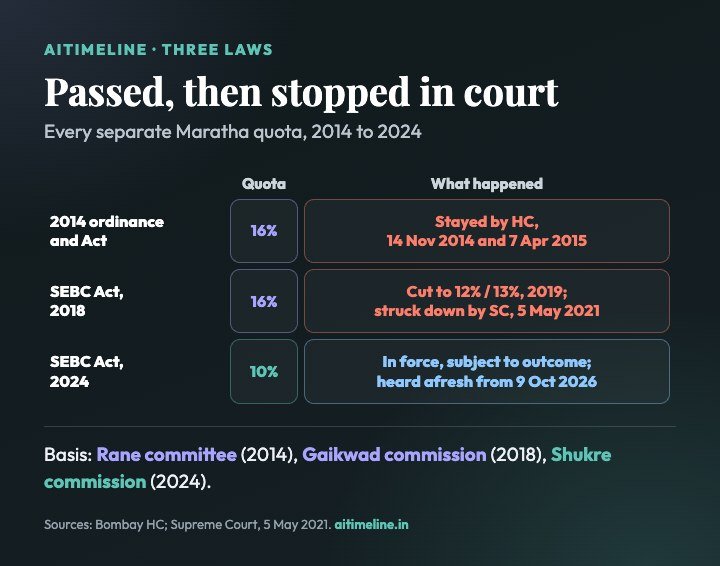
The 2014 quota was built on a ministerial committee’s report and issued months before an election. The courts stayed it almost at once. The 2018 quota was built on a statutory commission’s survey, which persuaded the High Court but not the Supreme Court. The 2024 quota is smaller, at 10%, excludes the creamy layer and rests on a fresh commission report; the state’s case is that this time the data are strong enough to justify crossing 50%.
Every party in Maharashtra has supported a Maratha quota in the legislature. The 2018 and 2024 bills both passed unanimously. The disagreement has always been in court, and lately between Maratha and OBC organisations, not between the parties on the floor of the House.
Why the 50% Ceiling Decides the Case
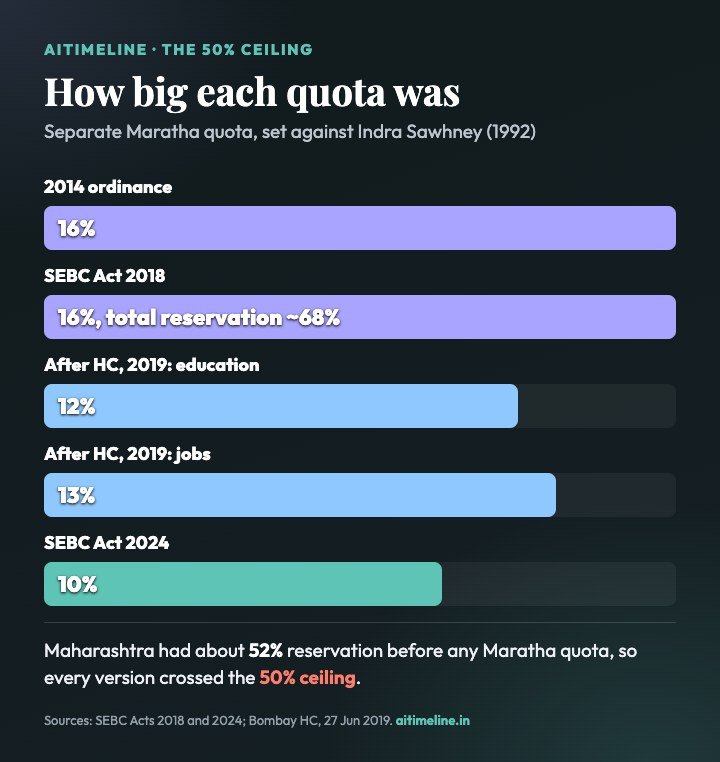
In Indra Sawhney v. Union of India in 1992, a nine-judge bench held that reservations should not normally exceed 50%, with room for exceptions in extraordinary situations such as remote, far-flung areas whose people are out of the mainstream. Maharashtra already had about 52% reservation before any Maratha quota, so any separate quota had to clear that bar.
In 2021 the Supreme Court held that the size of a community, or its political demand, is not an extraordinary situation, and declined to send Indra Sawhney to a larger bench. The Shukre commission’s 2024 report argued that a fresh survey changed the picture. On the first day of the new hearing, on 9 October 2026, petitioners argued that a legislature cannot override the Supreme Court’s findings simply by commissioning a new report. That is the question the High Court has to answer.
The Bombay High Court Case: Three Benches
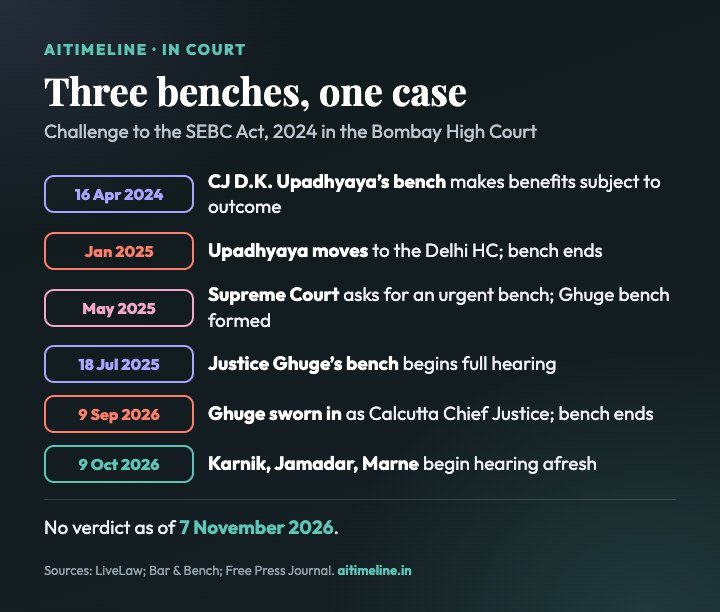
The challenge to the 2024 Act has outlasted two benches. Each change of presiding judge meant the arguments had to be heard again, because a judgment must be written by the judges who heard the case. Students caught in the uncertainty went to the Supreme Court in May 2025, which asked the High Court to form a bench urgently but left interim relief to it. The High Court has kept the same position throughout: the quota can be used, but anyone who benefits does so subject to the final verdict.
How a Kunbi Certificate Is Obtained
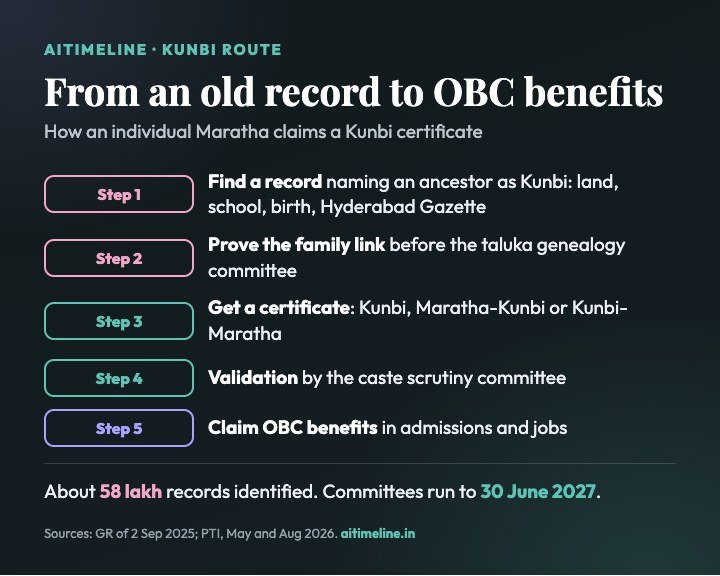
Kunbi is the name of the cultivating caste in Maharashtra, and many families now identifying as Maratha appear in older records as Kunbi. Since Kunbi is already in the OBC list, a person who shows that descent does not need a new law. What they need is paper: an entry naming a direct ancestor as Kunbi, and proof of the family link to that ancestor.
The Shinde committee and district officials have searched land, school, birth and revenue registers, turning up about 58 lakh entries by the government’s count. The Hyderabad Gazette resolution of September 2025 widened the usable records for Marathwada. A certificate must still be validated by a caste scrutiny committee before it is secure, and validity certificates have become a demand in their own right in 2026.
Jarange Patil’s Fasts
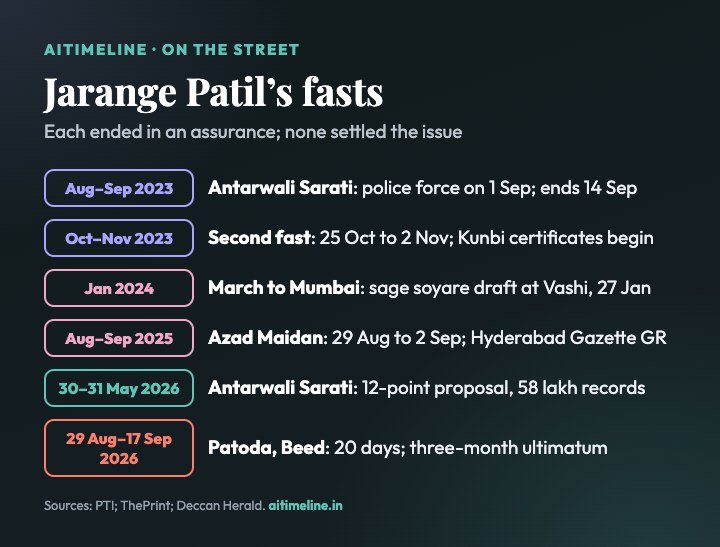
Jarange’s method has been the same since 2023: an indefinite fast, a delegation of ministers, a written assurance and a deadline. It has produced real results on the Kunbi route, including the Shinde committee, the sage soyare draft and the Hyderabad Gazette resolution. It has also hardened OBC opposition, with counter-protests and court challenges. His three-month deadline from September 2026 runs to mid-December.
What It Has Meant for Maharashtra
A cross-party demand
No major party opposes a Maratha quota. The 2018 and 2024 bills passed unanimously, and every government since 2014 has negotiated with the movement.
Maratha and OBC tension
OBC groups see the Kunbi route as a threat to their share. Counter-protests and petitions against the 2025 resolution followed.
Seats held subject to outcome
Every admission and appointment under the 2024 quota depends on a verdict that has had to restart three times.
Farm distress behind the demand
Small holdings and farm debt drive the demand, but courts ask about social and educational backwardness, not income alone.
Millions of records
Taluka committees checking genealogies have been extended to 30 June 2027 to handle the volume.
Delay as a policy outcome
Repeated bench changes have kept a provisional quota in place for over two and a half years.
Key People and Bodies
Manoj Jarange Patil
From Antarwali Sarati, Jalna. Leader of the agitation since 2023, pressing the Kunbi route.
Annasaheb Patil
Mathadi labour leader who marched for the demand in March 1982 and died the next day.
Gaikwad and Shukre
Retired Justices M.G. Gaikwad (2018) and Sunil Shukre (2024) headed the commissions behind the two SEBC laws.
Justice Sandeep Shinde
Headed the 2023 committee that traced Kunbi entries in old records.
Radhakrishna Vikhe Patil
Minister heading the cabinet sub-committee on Maratha reservation, the state’s chief negotiator in 2026.
Bombay High Court
Hearing the 2024 Act challenge and separate petitions against the 2025 Hyderabad Gazette resolution.
Key Facts at a Glance
| Detail | Information |
|---|---|
| State | Maharashtra |
| Early agitation | Annasaheb Patil, 1981–82 |
| OBC entries | Kunbi, Maratha-Kunbi, Kunbi-Maratha (2004) |
| First quota | 16%, ordinance 9 July 2014; stayed 14 November 2014 |
| Second quota | 16%, SEBC Act 2018; struck down 5 May 2021 |
| Supreme Court case | Jaishri Laxmanrao Patil v. Chief Minister, Maharashtra |
| Third quota | 10%, SEBC Act 2024, notified 26 February 2024 |
| Interim order | 16 April 2024: benefits subject to outcome |
| Kunbi route | Hyderabad Gazette GR, 2 September 2025 |
| Committees | Extended to 30 June 2027 |
| Status, 7 Nov 2026 | Third bench hearing afresh since 9 October 2026; no verdict |
Explore More Timelines
People Also Ask
Frequently Asked Questions
Checked against court reports, the Supreme Court judgment and contemporary coverage.
⚠️ Editorial Note
This account is based on the Supreme Court’s judgment of 5 May 2021, Bombay High Court orders as reported by LiveLaw, Bar & Bench and the Free Press Journal, PRS Legislative Research and PTI reports. The 10% SEBC quota and the Kunbi certificate route are different legal mechanisms and are kept separate throughout. Checking the brief this page began from: the 2018 Act was passed on 29 November 2018 and signed on 30 November; Justice Ghuge was sworn in as Calcutta Chief Justice on 9 September 2026, after the Centre’s notification of 5 September, not on 6 September; and Jarange’s 2026 fast ended on 17 September at Patoda in Beed, on its 20th day, not on 18 September. We could not independently confirm the figure of about 40 hearings before the third bench and have left it out. This is not legal advice.
Related Reading on AiTimeline
Sources & further reading
Every dated entry above was checked against these references. Last reviewed 8 November 2026.
- Supreme Court of India: Jaishri Laxmanrao Patil v. Chief Minister, Maharashtra (5 May 2021), via Indian Kanoon
- PRS Legislative Research: Maharashtra State Reservation for SEBC Bill, 2024
- LiveLaw: Jobs, admissions subject to outcome of pleas challenging Maharashtra Reservation Act (Apr 2024)
- Bar & Bench: NEET 2025, Supreme Court asks Bombay High Court to decide Maratha quota challenge urgently
- Bar & Bench: Maratha reservation case to be reheard for third time by Bombay High Court (Sep 2026)
- Free Press Journal: Bombay HC begins fresh hearing on petitions challenging 10% Maratha quota (9 Oct 2026)
- Bar & Bench: Justice RV Ghuge appointed Chief Justice of Calcutta High Court
- ThePrint (PTI): Jarange calls off 20-day-old fast, gives three months' ultimatum to govt (17 Sep 2026)
- NewsDrum (PTI): Maratha quota, Jarange ends fast after talks with govt delegation (31 May 2026)
- ThePrint: What is the Hyderabad Gazette, centrepiece of Jarange Patil's Maratha quota agitation
- ThePrint: 16% quota for Marathas gets unanimous thumbs up from Maharashtra Assembly (Nov 2018)
- Wikipedia: Maratha reservation agitation