Singur & Nandigram Land Protests: A Timeline of Change
Singur and Nandigram land protests timeline: the Tata Nano acquisition, the 2007 firing, the 2016 Supreme Court verdict and the 2025 High Court order.
Latest Story
The Singur and Nandigram land protests of 2006–2007 turned land acquisition into a defining political issue in West Bengal. At Singur, 997 acres were acquired for Tata Motors’ Nano factory; at Nandigram, a proposed chemical hub and special economic zone set off a conflict in which police firing on 14 March 2007 killed 14 people, according to the National Human Rights Commission. The Left Front lost power in 2011 after 34 years. The Supreme Court’s Singur judgment of 31 August 2016 concerned the legality of the land acquisition; Nandigram involved distinct incidents of police firing and political violence. For the car at the centre of Singur, see the Tata Nano history; for the wider industry, the India car industry timeline.
💡 Short Answer
Singur and Nandigram were two West Bengal land-acquisition protests. Tata Motors left Singur on 3 October 2008, and the Supreme Court quashed the acquisition on 31 August 2016. At Nandigram, police firing on 14 March 2007 killed 14, and the Calcutta High Court called it unconstitutional. In February 2025 the High Court revived ten Nandigram murder prosecutions; that order is not a conviction.
Singur and Nandigram: Key Questions
The Two Movements in Ten Points
- Singur: 997 acres acquired for the Tata Nano plant under the Land Acquisition Act, 1894.
- Nandigram: a preliminary notice of 28 December 2006 for a chemical hub and SEZ of about 10,000 acres.
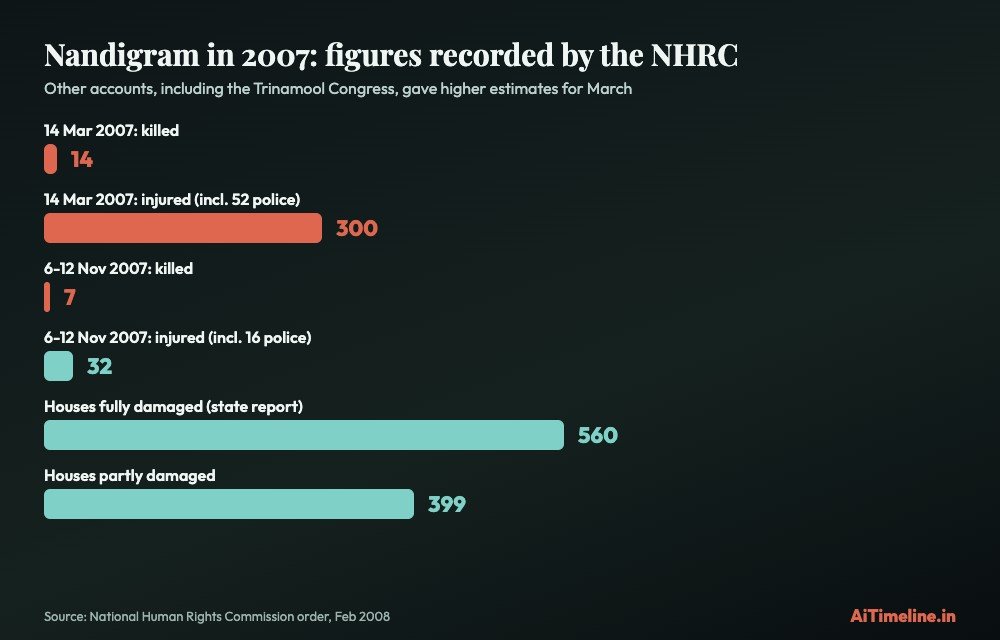
- The firing: 14 March 2007, 14 killed and about 300 injured, per the NHRC.
- The High Court: held the firing wholly unconstitutional on 16 November 2007 and directed the CBI to continue its inquiry.
- The second round: 6 to 12 November 2007, seven killed, per the NHRC; a separate event.
- Tata leaves: announced 3 October 2008; Sanand named on 7 October.
- The election: the Left Front lost in May 2011 after 34 years.
- The 2011 Act: struck down by a division bench in 2012 and stayed; the 2016 judgment did not rest on it.
- The verdict: 31 August 2016, an acquisition judgment, not a verdict on industry.
- The caution: the February 2025 order revives prosecutions; it is not a finding of guilt.
Singur and Nandigram Timeline, Latest First
Each entry is tagged by thread and ends with why it matters. Use the filter to isolate Singur, Nandigram, the courts or the politics.
Singur, Nandigram, the courts or the politics? Filter the timeline by thread.
–
Calcutta High Court orders revival of the Nandigram prosecutions Courts and law
In Dipak Mishra v. State of West Bengal (WPA(P) 67 of 2021, heard with Nilanjan Adhikary v. State of West Bengal, WPA(P) 68 of 2021), a division bench of Justices Debangsu Basak and Md Shabbar Rashidi on 10 February 2025 declared the state’s decision to withdraw criminal cases under Section 321 of the Code of Criminal Procedure bad in law, and set aside that decision and the Assistant Public Prosecutor’s decision to invoke Section 321 (para 103). It said the Public Prosecutor or Assistant Public Prosecutor would take suitable measures to ensure that the cases “are revived and prosecuted, in accordance with law”, including applying for revision of the Magistrate’s orders if required, within a fortnight (paras 104–105) (judgment text, Indian Kanoon). Hindustan Times reported it on 13 February after it was made public, describing 10 murder cases registered between 2007 and 2009 in East Midnapore (Hindustan Times; Deccan Herald).
The judgment records that a Cabinet memorandum dated 30 January 2014 proposed withdrawing prosecutions in offences connected with the Nandigram and Singur agitation. A Division Bench had on 5 March 2021 prima facie found the Magistrate’s consent orders to be stereotyped (as quoted in a later High Court order); a High Court order of 29 September 2026 treats the 10 February 2025 judgment as the operative decision ({L(IK26, ‘Indian Kanoon’)}).
This is an order to revive prosecutions, not a conviction and not a verdict of guilt. Whether private defence applied is for the trial. LiveLaw describes the order as a “fresh trial”; the judgment itself says the cases are to be “revived and prosecuted”. Appeal status: AiTimeline found no record of an appeal or stay against this judgment on Indian Kanoon’s High Court and Supreme Court pages and in press reports to 22 October 2026, but did not search the Supreme Court’s case-status portal, so the absence of an appeal is not confirmed.
An arbitral tribunal awards Tata Motors Rs 766 crore over Singur Courts and law
A three-member arbitral tribunal ruled that Tata Motors can recover Rs 765.78 crore from the West Bengal Industrial Development Corporation (WBIDC), plus 11% annual interest from 1 September 2016 until payment, and Rs 1 crore in costs. Tata Motors said the award was unanimous and dated 30 October 2023 (Bar & Bench; Wikipedia). The claim covered losses on the Singur facility, including capital investment.
The state government said the award was not the final word and that legal avenues remained open. AiTimeline has not found a later ruling on any challenge to the award.
2016
Land records go back to Singur farmers Singur
At a ceremony at Sanapara in Singur, Mamata Banerjee handed over land records (parchas) to farmers; India Today (IANS) reports 9,117 land records returned and 800 peasants compensated, at the same Sanapara spot on the Durgapur Expressway where she had held a 16-day sit-in in 2008 (India Today; Madhyamam). The state said it had surveyed and demarcated about 620 acres within two weeks, and that it would return land in parts.
Reports of later handovers described unclaimed land and cheques, so the ceremony marked the start of restoration rather than its end.
2016
The Supreme Court quashes the Singur land acquisition Courts and law
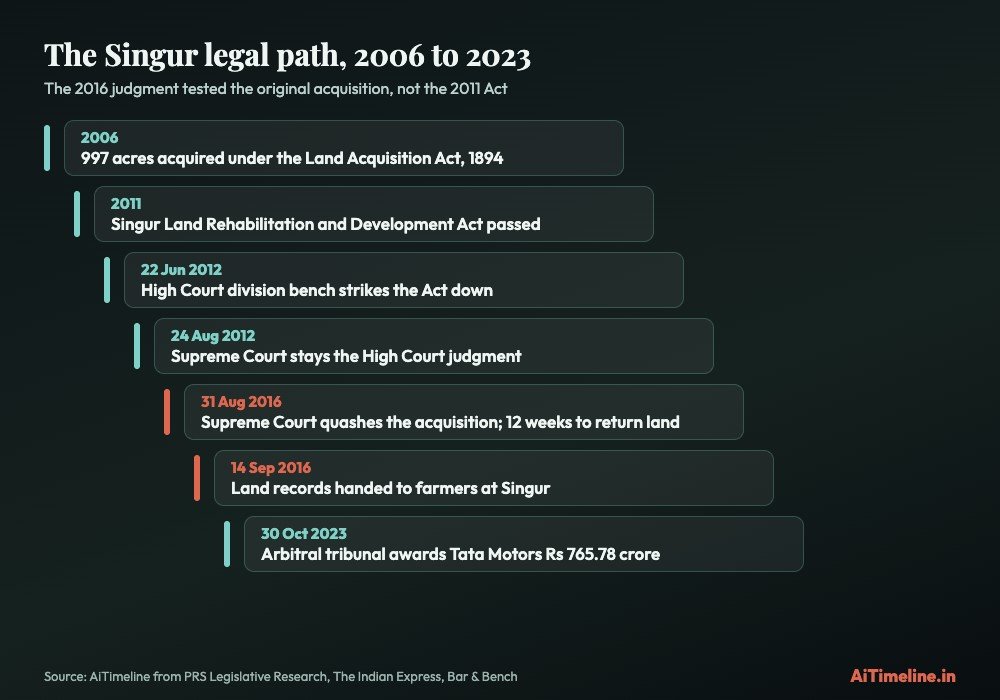
The Supreme Court called the 2006 decision to acquire 1,000 acres “grossly perverse and illegal”, quashed it and directed that the land be returned within 12 weeks (The Indian Express; Gulf News). The Indian Express reports that Justices V. Gopala Gowda and Arun Mishra agreed on setting the acquisition aside but gave different reasons, and disagreed over the government’s “public purpose” criteria; both found the process vitiated by non-compliance with the Land Acquisition Act, 1894. Gulf News says the Court noted that Sections 4 and 5, which require public notice and a hearing of objections, were not followed. Compensation already paid was to stay with the farmers.
What the judgment decided: the legality of the acquisition. It did not decide whether the Nano project was a good or bad idea, and it was not an endorsement of any party. Wikipedia records that the land was returned to 9,117 landowners ({L(WSG, ‘Wikipedia’)}).
The Singur Act is passed, struck down and stayed Courts and law
After Mamata Banerjee was sworn in on 20 May 2011, an ordinance on 9 June took over the 997 acres citing non-performance by Tata Motors, and on 14 June the Assembly passed the Singur Land Rehabilitation and Development Act, 2011, to reclaim the land; the Act aimed to return 400 acres to unwilling farmers (Business Standard). On 29 June the Supreme Court told the state not to distribute land until further notice, and on 28 September a Calcutta High Court single judge upheld the Act. Tata Motors appealed on 29 October.
On 22 June 2012 a division bench struck the Act down as void and unconstitutional, citing the lack of Presidential assent, conflict with the central Land Acquisition Act, 1894, and the view that returning land to farmers was not a “public purpose” under that Act. The state challenged it in the Supreme Court on 6 August, and the Court stayed the High Court judgment on 24 August 2012 (PRS Legislative Research).
The brief for this story did not mention the Act. It matters because the 2016 judgment did not rest on it: the Supreme Court looked at the original 2006 acquisition, not at the state’s 2011 law.
The Left Front loses power after 34 years Politics
The Trinamool-led alliance defeated the Left Front in the Assembly election and Mamata Banerjee became Chief Minister. Wikipedia records that Buddhadeb Bhattacharjee lost his own seat (Wikipedia).
Singur and Nandigram were major issues in the run-up, and the opposition won the 2008 East Midnapore zilla parishad polls, including all four seats in the two Nandigram blocks. The result reflects rural discontent and wider political factors, not one cause.
2008
Tata Motors leaves Singur for Sanand Singur
Ratan Tata announced the pullout from Singur at a press conference in Kolkata on 3 October 2008, and on 7 October Tata Motors said the Nano plant would be set up at Sanand in Gujarat (Wikipedia). Wikipedia notes that the decision to leave had reportedly been taken on 23 September.
The company had put more than Rs 1,000 crore into Singur by then, according to a 2023 report on the arbitration.
A blockade, a Governor’s deal and a deal that frays Singur
Business Standard’s IANS timeline records that on 18 August 2008 the Chief Minister invited Mamata Banerjee for talks, that talks failed on 20 August, and that on 22 August Ratan Tata said the Nano would leave West Bengal if the violence at Singur persisted. Tata Motors suspended work on 3 September, and Governor Gopalkrishna Gandhi agreed to mediate. A meeting was held at Raj Bhavan on 5 September, and on 7 September a Raj Bhavan release said the government would respond to farmers who had not received compensation; on 14 September the state announced an improved compensation package (Business Standard). India Today records that Banerjee’s 2008 sit-in on the Durgapur Expressway lasted 16 days and demanded 400 of the 997.11 acres (India Today).
Press reports say the deal frayed: by 17 September Banerjee said it was not honoured, and on 22 September she demanded 300 acres against a state offer of 70 (CounterPunch; India Environment Portal).
2007
Calcutta High Court holds the March firing wholly unconstitutional Courts and law
The judgment of 16 November 2007 in Association for Protection of Democratic Rights v. State of West Bengal (2007 (4) CHN 842; bench of Chief Justice S. S. Nijjar and Justice P. C. Ghose) records that the Court had first called the firing, prima facie, “wholly unconstitutional” in a suo motu order of 15 March 2007, the day after it, and had then sent a CBI team to Nandigram. In the final judgment the Court held that the police action at Nandigram on 14 March 2007 “was wholly unconstitutional and cannot be justified under any provision of the law” (para 140), that the High Court could direct a CBI inquiry without the State’s consent, and that the police action could not be justified on grounds of sovereign immunity (judgment text, 2007 (4) CHN 842).
The Court directed the State to pay Rs 5 lakh to the family of each of the dead, not less than Rs 1 lakh to each injured person and Rs 2 lakh to each identified rape victim, within one month, without prejudice to higher claims (paras 141–142). It directed the CBI to continue its inquiry, identify victims and offenders, report on any departmental or criminal action, and take steps, including registration and initiation of criminal proceedings if necessary, within a month (paras 144–145). The Court refused the Advocate General’s request to stay the judgment for three weeks (para 147). The petitioners’ figures, recorded in the judgment, were 14 killed (13 identified) and 162 injured.
The Supreme Court stage: a February 2008 report says the Supreme Court restrained the CBI on 13 December 2007 from initiating criminal proceedings in court against police officials over the firing, while the CBI probe continued (Oneindia, 25 Feb 2008). AiTimeline has not found the order itself. On 24 February 2012 the Supreme Court allowed the new state government to withdraw the state’s appeal against the High Court judgment, and the state said it accepted the findings, per DNA (DNA); the Indian Express had reported the decision to withdraw on 9 September 2011 (The Indian Express).
2007
Nandigram: the blockade is overrun Nandigram
The National Human Rights Commission (NHRC) records that on 6–7 November CPI(M) cadres, with outsiders and criminal elements, overran the blockade, after the Centre declined on 5 November the state’s request for CRPF deployment. Seven people were killed and 32 injured, including 16 police personnel, from 6 to 12 November; a state report of 3 December counted 560 houses completely and 399 partially damaged, and about 2,500 villagers backing the BUPC were driven out. The Centre ordered six CRPF companies on 11 November (NHRC).
The Commission found the state had failed to prevent the 6 November attack and should compensate the dead and injured on the High Court’s terms. It also said neither the CPI(M) nor the BUPC was free of responsibility. These were separate events from the 14 March firing.
A state affidavit on consent; the chemical hub moves Politics
Wikipedia records that a state affidavit in June 2007 admitted that about 30% of the Singur land was acquired from farmers without their consent, while the Chief Minister maintained that 912 acres were acquired voluntarily (Wikipedia). On 3 September 2007 Chief Minister Buddhadeb Bhattacharjee preferred Nayachar island, about 30 km from Haldia, for the chemical hub instead of Nandigram (Wikipedia).
2007
No land will be acquired for industry in Nandigram Nandigram
The District Magistrate of East Medinipur issued a notification that no land would be acquired for industry in Nandigram. The BUPC continued its agitation, and the NHRC records sporadic violence from March to October 2007 (NHRC). Wikipedia says the state government had announced cancellation of the chemical hub in early March.
Withdrawing the project did not end the conflict, because trust between the villagers, the police and the ruling party had broken down.
2007
Police firing at Nandigram kills 14 Nandigram
The state tried to re-establish control by force. The NHRC records that police fired on crowds, killing 14 people and injuring about 300, including 52 policemen (NHRC). Wikipedia gives the official toll as 14 farmers and says more than 100 were declared “missing”, and that the Trinamool Congress estimated 50 deaths (Wikipedia).
Home Minister Shivraj Patil’s statement in the Lok Sabha on 16 March 2007, relaying a preliminary report from the West Bengal government, gave 14 dead, 63 injured plus 12 policemen at that point and, later in the statement, 67 injured including 40 policemen; it described the police as acting in self-defence after the crowd threw bombs ({L(LS, ‘Lok Sabha Debates, via Indian Kanoon’)}). These were early government figures; the NHRC’s later account is higher on injuries. The 16 November 2007 judgment records the petitioners’ very different account, in which the crowd did not attack the police.
The NHRC dates the start of the confrontation to mid-January 2007, when BUPC supporters isolated five gram panchayats and blocked police. The High Court later called the firing unconstitutional (16 November 2007).
Nandigram: the BUPC blockade; construction begins at Singur Nandigram
As fears over the chemical hub grew, residents organised the Bhumi Uchhed Pratirodh Committee (BUPC). By mid-January its supporters had isolated five gram panchayats and blocked roads and bridges against police and government agencies; about 2,000 people believed to back the CPI(M) fled across the canal (NHRC). At Singur, Tata Motors ceremonially started construction of the plant on 21 January 2007 (Wikipedia).
2006
The Nandigram notice, and the end of Mamata Banerjee’s fast Nandigram
On 28 December 2006 the Haldia Development Authority circulated an informal notice showing the likely site of an SEZ and chemical hub covering about 10,000 acres in Nandigram Block-1 (NHRC; Lok Sabha statement of 16 Mar 2007). The notice was preliminary, and it alarmed residents who feared losing land and homes. Mamata Banerjee called off her hunger strike on 29 December, after appeals from President A. P. J. Abdul Kalam and Prime Minister Manmohan Singh (Business Standard; Wikipedia).
Singur becomes a national flashpoint Singur
Fencing of the acquired land began on 1 December 2006. Mamata Banerjee began an indefinite hunger strike in Kolkata in the first days of December. Business Standard dates it 3 December and Wikipedia 4 December; the Tribune reported on 27 December that she had been fasting “for the past 24 days”, which fits a 3 December start (Business Standard; Wikipedia; The Tribune). The Calcutta High Court is also recorded as declaring the Section 144 prohibitory orders at Singur illegal (a report dated 15 February 2007).
Tata Motors picks Singur for the Nano factory Singur
Tata Group chairman Ratan Tata announced the small-car Nano project at Singur on 18 May 2006, the day Buddhadeb Bhattacharjee was sworn in for another term as Chief Minister (Business Standard). The West Bengal Industrial Development Corporation acquired 997 acres of multi-crop land under the Land Acquisition Act, 1894, which permits takeover for public purposes (Wikipedia). Farmers demonstrated against what they called forcible acquisition on 25 May, and Mamata Banerjee sowed paddy near the site on 18 July.
The Left Front government saw the project as investment and jobs. The legal question that later decided Singur was whether the acquisition for a private company served a public purpose and followed the notice-and-hearing steps of the Act.
Singur vs Nandigram: What Made the Movements Different?
Related, but legally distinct.
| Issue | Singur | Nandigram |
|---|---|---|
| Proposed project | Tata Motors’ Nano factory | Chemical hub and special economic zone |
| Land involved | 997 acres acquired under the Land Acquisition Act, 1894 | About 10,000 acres in a preliminary notice of 28 Dec 2006; never acquired |
| Main turning point | Tata Motors announced its exit on 3 Oct 2008 | Police firing on 14 Mar 2007; violence again 6–12 Nov 2007 |
| Who decided it | Supreme Court, 31 Aug 2016: the acquisition was illegal | Calcutta High Court, 16 Nov 2007: the firing was wholly unconstitutional; CBI to continue its inquiry |
| Nature of the legal question | Was the acquisition lawful, with public purpose, notice and hearing? | Was the use of force lawful, and who answers for the deaths and violence? |
| Latest development | Arbitral award of Rs 765.78 crore to Tata Motors (30 Oct 2023) | High Court order reviving ten murder prosecutions (Feb 2025) |
| Wider lesson | Acquisition needs lawful procedure and consent | State force and political violence leave long accountability questions |
Court by Court: What Each Decided
From the first High Court rulings of 2007 to the 2025 order.
| Date | Court | What it decided |
|---|---|---|
| 15 Feb 2007 (report) | Calcutta High Court | Singur: Section 144 orders illegal; acquisition prima facie illegal, per Wikipedia |
| 15 Mar 2007 | Calcutta High Court (suo motu) | Prima facie held the Nandigram firing wholly unconstitutional; sent a CBI team to Nandigram |
| 16 Nov 2007 | Calcutta High Court | Nandigram firing of 14 Mar wholly unconstitutional (2007 (4) CHN 842); CBI to continue inquiry; compensation ordered |
| 13 Dec 2007 (press report) | Supreme Court | Reported to have restrained the CBI from starting criminal proceedings against police over the firing; probe to continue. Order not located |
| 28 Sep 2011 | Calcutta High Court (single judge) | Upheld the Singur Act, 2011 |
| 24 Feb 2012 | Supreme Court | Allowed the state to withdraw its appeal against the 2007 High Court judgment on the Nandigram firing |
| 22 Jun 2012 | Calcutta High Court (division bench) | Struck down the Singur Act, 2011 as void and unconstitutional |
| 24 Aug 2012 | Supreme Court | Stayed that High Court judgment |
| 31 Aug 2016 | Supreme Court | Quashed the Singur acquisition; land to be returned within 12 weeks |
| 30 Oct 2023 | Arbitral tribunal | Awarded Tata Motors Rs 765.78 crore plus 11% interest |
| 10 Feb 2025 | Calcutta High Court (division bench) | Set aside the state’s Section 321 withdrawal; cases to be revived and prosecuted (WPA(P) 67 and 68 of 2021) |
The 2011 Singur Act vs the 2016 Judgment
Two different legal routes to the same land.
| Question | Singur Act, 2011 | Supreme Court, 2016 |
|---|---|---|
| What was examined | A new state law to take the land back | The original acquisition for the Nano plant |
| Main reasons | Division bench (22 Jun 2012): no Presidential assent, conflict with the central Act, no “public purpose” | Acquisition illegal; Sections 4 and 5 notice and hearing not followed; separate reasons by two judges |
| Outcome | Struck down; Supreme Court stayed that judgment on 24 Aug 2012 | Acquisition quashed; land returned within 12 weeks |
The NHRC’s Three Phases at Nandigram
From the Commission’s order of February 2008.
| Phase (NHRC) | Period | What the Commission recorded |
|---|---|---|
| One | Mid-Jan to 14 Mar 2007 | The police lost control of the area; the 14 Mar firing occurred |
| Two | 15 Mar to 5 Nov 2007 | A lull in which arms were stockpiled and people mobilised; police largely passive |
| Three | 6 Nov 2007 onward | Police acted in a partisan way; the Tehkhali outpost was withdrawn and the blockade overrun |
The Story at a Glance
Dates from the sources listed below.
| Date | Event | Detail |
|---|---|---|
| 18 May 2006 | Tata Motors announces Singur | 997 acres |
| 3–4 Dec 2006 | Mamata Banerjee’s hunger strike begins | 3 Dec per BS and Tribune count |
| 28 Dec 2006 | Nandigram notice | About 10,000 acres |
| 21 Jan 2007 | Construction starts at Singur | Ceremonial |
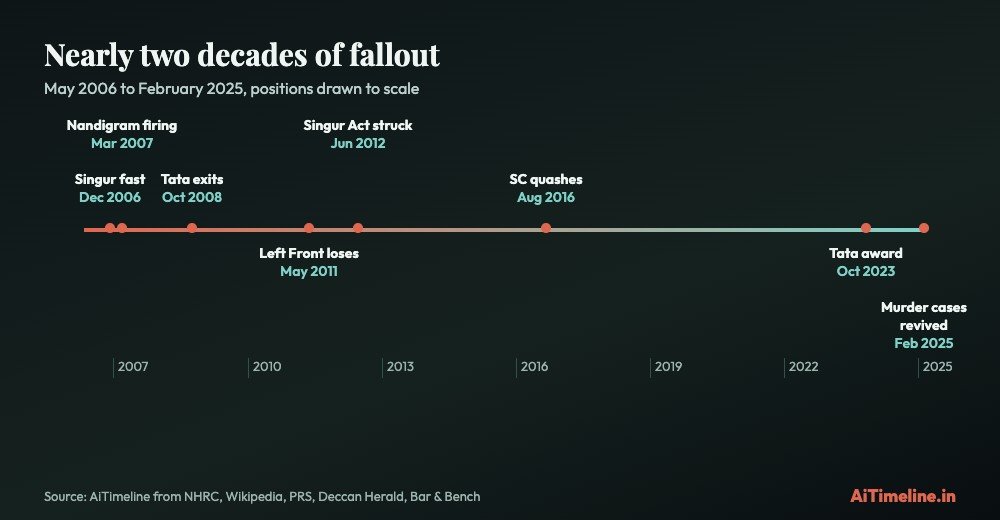
| 14 Mar 2007 | Nandigram firing | 14 killed (NHRC) |
| 19 Mar 2007 | No land for industry in Nandigram | District notification |
| 6–12 Nov 2007 | Nandigram violence returns | 7 killed (NHRC) |
| 16 Nov 2007 | High Court on the firing | CBI to continue inquiry |
| Sep 2008 | Governor-mediated deal at Singur | Frays by 17 Sep |
| 3 Oct 2008 | Tata Motors announces exit | Sanand on 7 Oct |
| May 2011 | Left Front loses | After 34 years |
| 22 Jun 2012 | Singur Act struck down | Stayed 24 Aug |
| 31 Aug 2016 | Supreme Court quashes acquisition | 12 weeks |
| 14 Sep 2016 | Land records handed over | 9,117 records |
| 30 Oct 2023 | Arbitral award | Rs 765.78 crore |
| 10 Feb 2025 | Murder prosecutions revived | Ten cases; public 13 Feb |
Why Did These Protests Change West Bengal Politics?
Land rights became an electoral issue. Questions of consent, compensation and livelihood moved to the centre of state politics. A June 2007 state affidavit admitted that about 30% of the Singur land was taken without consent, which made the farmers’ case part of the government’s own record.
The opposition gained momentum. In the 2008 East Midnapore zilla parishad polls the opposition won 35 of 53 seats, including all four seats in the two Nandigram blocks, per Wikipedia. By May 2011 the Trinamool-led alliance had won the Assembly. That result reflects rural discontent and wider political factors, not one cause; see the Emergency timeline for how an earlier electoral shift is recorded.
Industrialisation faced a trust test. Singur showed that a flagship investment could be stopped if acquisition lost public acceptance. For the other side of that loss, see the Tata Nano history, which follows the car that was built in Sanand instead.
Nandigram raised accountability questions. A police firing, a second wave of violence and a High Court order that the state had acted unconstitutionally left the courts with the question of who answers for the deaths. A comparable long search for accountability is recorded in the 1984 anti-Sikh riots timeline and the Bhagalpur riots timeline.
What Is the Lasting Legacy of Singur and Nandigram?
The two movements did not show that industry and agriculture cannot coexist. They showed the risks of acquiring land without consent, procedure and public legitimacy. Singur became a landmark in the legal debate over acquisition, and the Supreme Court’s reasoning rests on the notice and hearing steps of the 1894 Act. For another landmark Supreme Court ruling, see the electoral bonds timeline and the Article 370 timeline.
The story is not closed. The 2023 arbitral award shows that the cost of the Singur dispute fell on the state exchequer too, and the 2025 High Court order means the Nandigram prosecutions may be heard in court nearly 18 years after the events. The lesson that remains: development lasts longer when the people who bear its costs have a real voice in the decisions that affect them.
AiTimeline looked for existing stories on Indian land-acquisition law and on the 2011 West Bengal election and found none; the links above go to the nearest published timelines.
| Term | Meaning | Why it matters here |
|---|---|---|
| Land Acquisition Act, 1894 | The colonial law that lets the state take land for a public purpose | Used for the Singur acquisition; replaced by the 2013 Act |
| Public purpose | The test the 1894 Act applies to a state taking land | Central to whether Singur’s acquisition for a private factory was lawful |
| Sections 4 and 5 | Notice of acquisition and a hearing of objections | The Supreme Court found these steps not followed at Singur |
| BUPC | Bhumi Uchhed Pratirodh Committee | The coalition resisting acquisition in Nandigram |
| SEZ | Special economic zone | The proposed Nandigram project was a chemical hub and SEZ |
| NHRC | National Human Rights Commission | Its order of Feb 2008 is the main official account of Nandigram |
| CBI | Central Bureau of Investigation | Ordered by the High Court to investigate the March 2007 firing |
| Section 321 CrPC | Withdrawal of prosecution with the court’s consent | The route the state used, and the High Court rejected, in 2025 |
Who Is Who in the Story
Buddhadeb Bhattacharjee
Led the Left Front government during both disputes and lost his own seat in 2011.
Mamata Banerjee
Led the Singur protest, began a hunger strike in early December 2006 and became Chief Minister in May 2011.
Ratan Tata
Announced the pullout from Singur on 3 October 2008.
Gopalkrishna Gandhi
Mediated the 7 September 2008 deal at Raj Bhavan.
Justices V. Gopala Gowda and Arun Mishra
Gave the 31 August 2016 Singur judgment on separate reasons.
Justices Debangsu Basak and Md Shabbar Rashidi
Ordered revival of the ten Nandigram murder cases in February 2025.
Bhumi Uchhed Pratirodh Committee
The Nandigram coalition formed to resist acquisition.
National Human Rights Commission
Recorded three phases and state responsibility for the November 2007 attack.
The Popular Story vs the Record
| Popular version | What the record shows |
|---|---|
| Singur and Nandigram were the same dispute | They are related historically but distinct: Singur was a completed acquisition decided by the Supreme Court; Nandigram involved a proposed SEZ, a police firing and political violence |
| The Supreme Court judged the Nano project | It decided the legality of the 2006 acquisition. It did not rule on industry versus farming in general |
| The 2016 judgment upheld the Singur Act of 2011 | It did not rest on the Act, which a High Court division bench had struck down in 2012 and the Supreme Court had stayed |
| All 14 deaths in Nandigram came on one day, so the toll was final | The NHRC records 14 killed on 14 Mar 2007 and seven more from 6 to 12 Nov; other accounts give higher estimates for March |
| The February 2025 order convicted the accused | It revived prosecutions. Nobody is found guilty by it |
| The protests alone ended Left Front rule | They were major issues, but the 2011 result also reflected wider rural discontent and other factors |
| Tata Motors lost nothing when the plant left | It had put more than Rs 1,000 crore into Singur and later won a Rs 765.78 crore arbitral award |
Explore More Timelines
People Also Ask
Frequently Asked Questions
Sources and Further Reading
- National Human Rights Commission: Commission’s order on Nandigram, Feb 2008
- PRS Legislative Research: Supreme Court stays Calcutta High Court judgement on Singur Act
- Gulf News: Top court quashes land acquisition in Singur
- Deccan Herald: Calcutta High Court orders revival of 10 murder cases during Nandigram movement
- Bar & Bench: Arbitral tribunal awards Rs 766 crore to Tata Motors
- Madhyamam: Mamata redeems pledge, returns land to Singur farmers, Sep 2016
- Business Standard (IANS): Timeline of the Singur controversy, Aug 2016
- The Indian Express: Supreme Court quashes Singur Tata plant land acquisition, Sep 2016
- India Today (IANS): Mamata Banerjee returns 9,117 land records to Singur farmers
- Hindustan Times: Calcutta HC orders reopening of 10 Nandigram murder cases, Feb 2025
- The Indian Express: Govt to withdraw petition challenging High Court ruling on Nandigram firing, Sep 2011
- Calcutta High Court, Association for Protection of Democratic Rights v. State of West Bengal, 16 Nov 2007, 2007 (4) CHN 842 (full text)
- Calcutta High Court, Dipak Mishra v. State of West Bengal, WPA(P) 67 of 2021, 10 Feb 2025 (Indian Kanoon)
- Calcutta High Court, Milan Pradhan, 29 Sep 2026 (Indian Kanoon)
- Lok Sabha Debates: Home Minister’s statement on the Nandigram incidents, 16 Mar 2007 (Indian Kanoon)
- Oneindia (PTI): Supreme Court defers W. Bengal plea on Nandigram, 25 Feb 2008
- DNA: Nandigram case, WB govt withdraws petition, 24 Feb 2012
- The Tribune: NDA backs Mamata, 28 Dec 2006
- Wikipedia: Tata Nano Singur controversy
- Wikipedia: Nandigram violence
- Outlook: ‘Wholly Unconstitutional…’
- Kafila: Three years of Nandigram, an appeal
- CounterPunch: Impasse at Singur, Aug 2008
- India Environment Portal: Mamata ends stir, farmers to get land
Related AiTimeline Stories
⚠️ Editorial Note
Last updated 22 October 2026. The Singur acquisition case and the Nandigram violence are related historically but legally distinct: the Supreme Court’s 2016 judgment concerned the legality of the Singur land acquisition, while Nandigram involved separate incidents of police firing and political violence. Casualty figures are attributed to their sources, and the NHRC’s numbers are used where accounts differ. The February 2025 High Court order concerned reviving prosecutions; it is not a final verdict on the guilt of any accused. Corrections to the draft brief: the Nandigram High Court ruling is dated 16 November 2007, after the 6 to 12 November violence; the 2025 verdict was delivered on 10 February and made public on 13 February; and the 2011 Singur Act and its court history, the 2023 arbitral award and the NHRC’s three phases were added. Checked in a browser on 22 October 2026: Business Standard (the 18 May 2006 announcement, the 2011 Act and court dates, the 2008 sequence), The Indian Express (the 2016 bench and reasons), India Today (9,117 land records and 800 compensation payments), Hindustan Times (the 2025 verdict dates), the full text of the High Court’s 16 November 2007 judgment (as reproduced on a legal-blog copy that gives the CHN citation, not the court’s own site), the full text of the High Court’s 10 February 2025 judgment (Indian Kanoon) and the Lok Sabha statement of 16 March 2007 (Indian Kanoon). Corrections made after reading the primary texts: the High Court first called the firing prima facie wholly unconstitutional and sent the CBI to Nandigram on 15 March 2007, and the 16 November 2007 judgment held it wholly unconstitutional and told the CBI to continue; the 2025 judgment orders cases to be revived and prosecuted, a wording LiveLaw summarises as a fresh trial. Sources disagree on whether the 2006 hunger strike began on 3 or 4 December; the Tribune’s 27 December “24 days” count fits 3 December, and the Telegraph, Rediff and Times of India reports were not opened. Not confirmed: the 13 December 2007 Supreme Court order (known only from a February 2008 report; the order was not located), and whether any appeal against the 2025 judgment is pending (none found on Indian Kanoon or in the press; the Supreme Court’s case-status portal was not searched). Verify before republishing.
Sources & further reading
Every dated entry above was checked against these references. Last reviewed 22 October 2026.
- National Human Rights Commission: Commission's order on Nandigram issue, Feb 2008
- Supreme Court stays Calcutta High Court judgement on Singur Act
- Top court quashes land acquisition in Singur
- Calcutta High Court orders revival of 10 murder cases during Nandigram movement
- Arbitral tribunal awards Rs 766 crore compensation to Tata Motors
- Mamata redeems pledge, returns land to Singur farmers
- Tata Nano Singur controversy
- Nandigram violence
- 'Wholly Unconstitutional...'
- Three years of Nandigram: an appeal