Delhi Metro: India’s Punctual Urban Lifeline — A Timeline of Growth and Transformation
Delhi Metro history from the 2002 launch to 416.5 km today: network length by scope, record ridership, 99.95% punctuality and Phase IV and V(A) expansion.
Latest Story
The Delhi Metro history runs from a 1969 traffic study to a network that, as of 25 October 2026, is 374.47 km long on its core lines and 416.5 km once the Noida Aqua Line and Gurugram Rapid Metro are included. The first section, Shahdara to Tis Hazari, opened to the public on 25 December 2002. DMRC recorded 8.19 million passenger journeys on 8 August 2025 and reports 99.95% punctuality for 2026. Two Phase IV sections opened on 8 March 2026, Phase V(A) was approved on 24 December 2025, and the Golden Line is still under construction. Network-length figures vary widely in search results because they differ in date and scope, so this page labels both. For related infrastructure stories, see AiTimeline’s timelines of Indian Railways electrification, FASTag and highway tolls and India’s rising storm risk.
💡 Short Answer
As of 25 October 2026, the core Delhi Metro network is 374.47 km with 271 stations; including the Aqua Line and Rapid Metro, DMRC operates 416.5 km with 303 stations. It began public service on 25 December 2002 between Shahdara and Tis Hazari. Its ridership record is 81,87,674 journeys on 8 August 2025, and DMRC reports 99.95% punctuality for 2026. Phase IV is partly open; Phase V(A) is approved but not built.
How Long Is the Delhi Metro? Network Length as of 25 October 2026
Last updated: 25 October 2026. The same system has four commonly quoted lengths. Each is correct for its own scope and date.
| What is counted | Length and stations | As of | Source |
|---|---|---|---|
| Core Delhi Metro network (10 lines, no Aqua Line or Rapid Metro) | 374.47 km, 271 stations (243 if each interchange is counted once) | After the 8 Mar 2026 openings; no later opening found as of 25 October 2026 | Wikipedia, List of Delhi Metro stations |
| Combined network operated by DMRC (core plus Noida Aqua Line plus Gurugram Rapid Metro) | 416.5 km, 303 stations, 12 lines, 31 interchange stations | Aug 2026 (PTI quoting DMRC) | Tribune/PTI; Wikipedia |
| Aqua Line plus Rapid Metro alone | about 42 km, 32 stations (the difference between the two rows above) | Oct 2026, AiTimeline subtraction | Derived, not published as one figure |
| Core network before March 2026 | about 353 km, 254 stations (353.31 km on 14 Sep 2025) | Sep 2025; a Jan 2026 map gives 352.2 km | The Metro Rail Guy |
| Combined network before March 2026 | 394.25 km, 289 stations incl. 29 interchange stations, 12 lines | FY 2024-25 annual report | DMRC Annual Report 2024-25 |
| A still-circulating older figure | 393 km, 288 stations, 12 lines | Quoted by Business Today on 25 Jul 2026 | Business Today |
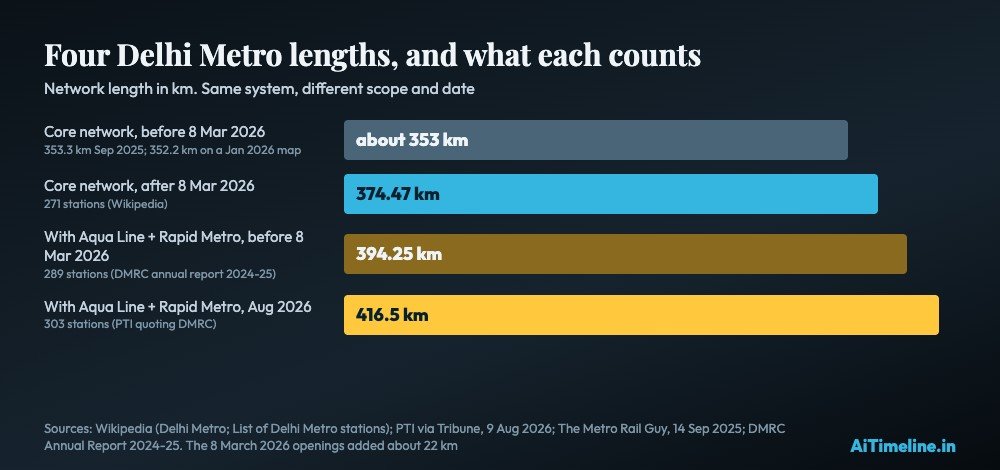
Why the numbers conflict. The 8 March 2026 openings added about 22 km in one day, which is the gap between 394.25 km and 416.5 km (the combined figure) and between about 353 km and 374.47 km (the core). Older pages and AI summaries keep repeating the pre-March numbers. A July 2026 business feature still quoted 393 km and 288 stations. When quoting a length, give the scope (core or combined), the date and whether it counts only open sections. AiTimeline could not open DMRC’s own network page, so the core figure rests on Wikipedia and the combined figure on a PTI report quoting DMRC and DMRC’s annual report.
Delhi Metro: Key Questions
Delhi Metro History in Ten Points
- Start: inaugurated on 24 December 2002, open to the public on 25 December.
- Core network: 374.47 km and 271 stations after the 8 March 2026 openings.
- Combined network: 416.5 km and 303 stations including the Aqua Line and Rapid Metro.
- Old figures: 394.25 km (DMRC annual report) and about 353 km were right before March 2026.
- Record: 8.19 million journeys on 8 August 2025.
- Punctuality: 99.95% in 2026 by DMRC’s measure, a 59-second threshold.
- Phase IV: about 24.25 km open; the Golden Line has no opening date.
- Phase V(A): 16.076 km approved on 24 December 2025, not open.
- Phase V(B): 97.158 km proposed and awaiting Union approval.
- Corrections: 25 December 2017 was a Magenta Line opening; the Airport Express opened in 2011.
Delhi Metro History Timeline, Latest First
Each entry is tagged and ends with why it matters. Approvals and proposals are marked Planned, not as network.
2026
DMRC reports 99.95% punctuality and a 416.5 km network Service
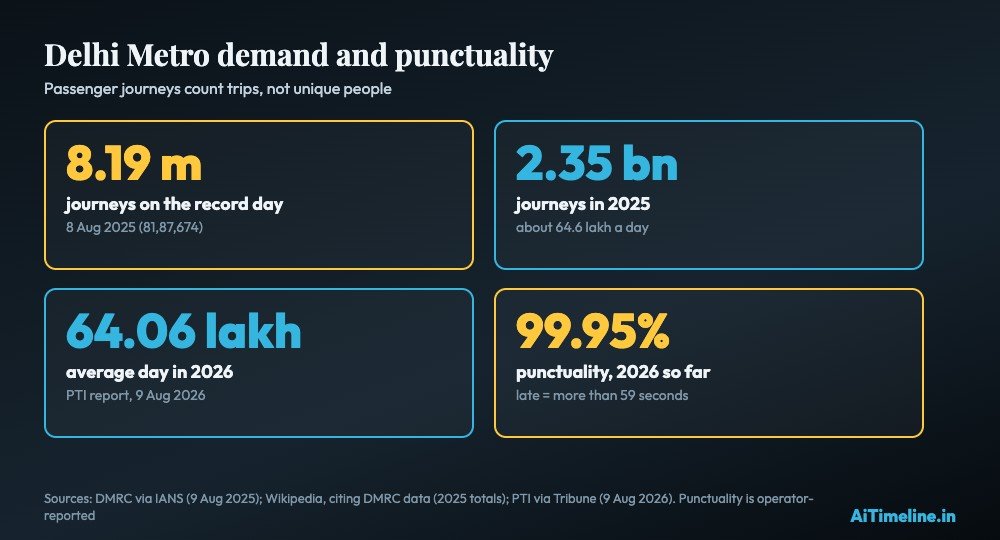
PTI, citing DMRC, reported punctuality of 99.95% for 2026 so far, with a train counted as late only if it arrives more than 59 seconds behind schedule. The same report gave the network as 416.5 km with 303 stations on 12 lines and 31 interchange stations, and average daily ridership of about 64.06 lakh journeys (Tribune/PTI).
The 416.5 km figure includes the Noida Aqua Line and Gurugram Rapid Metro, which DMRC operates. The core Delhi Metro network is 374.47 km. See the length table above.
2026
Delhi approves Phase V(B): seven more corridors proposed Planned
According to Wikipedia’s summary, the Government of Delhi approved seven Phase V(B) corridors totalling 97.158 km and 65 stations at an estimated ₹48,204 crore and sent the proposal to the Union Government (Wikipedia). A July 2026 Business Today feature put the combined Phase IV, V(A) and V(B) plan at about 217 km, 123 stations and 16 corridors (Business Today).
A state approval is not a Union approval, and neither is a construction start.
2026
Two Phase IV sections open, taking the core network to 374.47 km Network
Two stretches opened on 8 March 2026: Deepali Chowk to Majlis Park on the Magenta Line (9.92 km, seven stations) and Majlis Park to Maujpur Babarpur on the Pink Line (12.3 km) (Indian Infrastructure). All India Radio counted eight elevated stations on the Pink section and said it takes that line to about 71.56 km (AIR); the Indian Infrastructure list names ten, because it includes Majlis Park, which was already open.
The same event was billed to include foundation stones for three Phase V(A) corridors; AiTimeline found no post-event report confirming it. After these openings, Wikipedia lists the core network at 374.47 km and 271 stations (Wikipedia).
2025
Cabinet approves Phase V(A): three corridors, 16.076 km Planned
The Union Cabinet approved R.K. Ashram Marg to Indraprastha (9.913 km, with a Central Vista link to the Kartavya Bhawans), Aerocity to IGI Airport Terminal 1 (2.263 km) and Tughlakabad to Kalindi Kunj (3.9 km): 16.076 km at ₹12,014.91 crore (IANS). The report did not give a Phase V(A) completion year. It gave December 2026 only as the target for the separate Phase IV priority corridors.
Approval is a planning milestone. The corridors are not open.
2025
The first train, TS#01, marks 23 years Origins
DMRC marked 23 years since the 24 December 2002 inauguration and said the original train, TS#01, is still in service. DMRC says it began with four coaches, went to six in 2014 and to eight in 2023, and has run about 2.9 million km and carried over 60 million passengers (DMRC release). AiTimeline could not open that page, so these figures are as relayed in the source material, not independently checked.
About 2.35 billion journeys in a year Service
Wikipedia, citing DMRC data, gives about 235 crore (2.35 billion) passenger journeys in 2025 and an average of roughly 64.6 lakh a day (Wikipedia). A journey is a trip, so someone commuting both ways counts twice. The 2026 average reported by PTI is about 64.06 lakh.
2025
Record day: 81,87,674 passenger journeys Service
DMRC recorded 81,87,674 passenger journeys (about 8.19 million) across all lines on 8 August 2025, its highest single day, a day before Raksha Bandhan. It ran 92 additional trips that day and scheduled 455 extra on 9 August, and social media showed packed platforms on the Yellow, Blue and Violet lines (IANS). The Corporation’s own 2024–25 annual report also calls it “unprecedented” (DMRC annual report), and the 2026 Tribune/PTI report still treats it as the record.
2024
Line 4 reported carbon neutral Service
The Tribune reported on 14 October 2024 that DMRC’s Line 4, Yamuna Bank to Vaishali in Ghaziabad, had received a carbon-neutral certification (Tribune). The report did not name the certifier or standard, so treat it as a DMRC claim. The benefit of any metro depends on the electricity it uses and on how many car journeys it replaces.
2025
Phase IV opens its first section: Janakpuri West to Krishna Park Extension Network
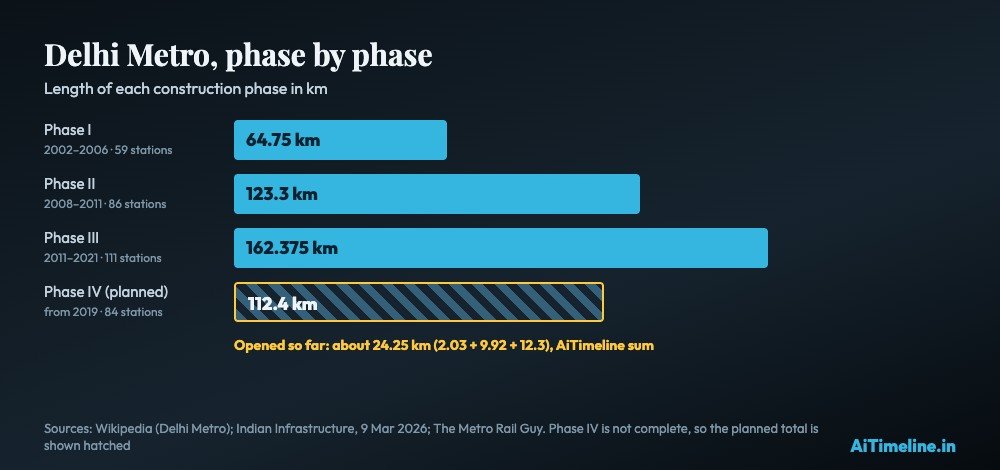
The first Phase IV section, Janakpuri West to Krishna Park Extension (2.03 km) on the Magenta Line, was inaugurated on 5 January 2025 (Metro Rail Guy; Wikipedia). Phase IV was finalised by the Delhi Government in December 2018 and construction began on 30 December 2019, with 2026 the expected completion year on Wikipedia’s page.
2023
Airport Express extends to Yashobhoomi Dwarka Sector 25 Network
The Airport Express line was extended from Dwarka Sector 21 to Yashobhoomi Dwarka Sector 25 on 17 September 2023 (Wikipedia). The line first opened as New Delhi to Dwarka Sector 21 on 23 February 2011.
2021
Phase III is completed Network
Phase III, which began in 2011 and totals 162.375 km and 111 stations, ended with the Grey Line extension to Dhansa Bus Stand on 18 September 2021 (Wikipedia). The Pink Line began driverless operation on 25 November 2021 and the Magenta Line on 28 December 2021. PTI says about 29% of the network now runs with unattended train operation.
2017
The Magenta Line opens Kalkaji Mandir to Botanical Garden Network
On 25 December 2017 the Magenta Line section from Kalkaji Mandir to Botanical Garden opened, linking south Delhi with Noida (Wikipedia). The Pink Line followed: its first listed section, Majlis Park to Durgabai Deshmukh South Campus, opened on 14 March 2018. A source brief called the 2017 opening a Pink Line milestone, but the record shows it was the Magenta Line. The brief’s 12.64 km length comes from DMRC’s 2017–18 annual report, which AiTimeline did not open.
Phase II is completed: 123.30 km, 86 stations Network
Phase II stations opened between 4 June 2008 and 27 August 2011, adding 123.30 km and 86 stations. The Airport Express opened from New Delhi to Dwarka Sector 21 on 23 February 2011 and was extended to Dhaula Kuan and Delhi Aerocity on 15 August 2011 (Wikipedia).
The Commonwealth Games deadline, and what was not ready Network
Delhi hosted the Commonwealth Games in October 2010, and Phase II work ran against that deadline. The Airport Express was not open during the Games: its first section opened on 23 February 2011 and its Aerocity extension in August 2011 (Wikipedia). A brief that places the airport link in the 2010 expansion needs that correction. AiTimeline did not find a verified list of which Phase II sections opened specifically for the Games.
Phase I is finished: 64.75 km, 59 stations Network
Phase I stations opened from 25 December 2002 to 11 November 2006, giving 64.75 km and 59 stations (Wikipedia). The underground Yellow Line section opened on 20 December 2004. In 2002 the Tribune expected a 63 km Phase I by 2005; it was completed about a year later than that (Tribune, 25 Dec 2002).
2002
Delhi Metro opens: Shahdara to Tis Hazari Origins
Prime Minister Atal Bihari Vajpayee inaugurated the Metro on Tuesday, 24 December 2002 and rode from Kashmere Gate to Seelampur before flagging the train on toward Shahdara. Public service began on 25 December. The Tribune gave the opening stretch as 8.3 km; other reports say 8.2 or 8.4 km, so treat “about 8 km” as safe (Tribune, 25 Dec 2002). Japan financed 56% of the project through a soft loan of up to ₹2,090 crore.
1998
Construction of Phase I begins Origins
Construction began on 1 October 1998. In 1997 Japan had granted official development assistance loans to finance the first phase (Wikipedia). Building through dense neighbourhoods meant moving utilities, closing roads and coordinating many agencies.
1995
DMRC is set up Origins
The Government of India and the Government of Delhi set up the Delhi Metro Rail Corporation on 3 May 1995, with E. Sreedharan as managing director (Wikipedia). It is a joint venture of the two governments on an equal footing. The Corporation’s own site was not readable to AiTimeline, so the date rests on Wikipedia.
From a traffic study to a mass-transit proposal Origins
Wikipedia traces the idea of mass rapid transit for Delhi to a 1969 traffic and travel study. In 1984 the Urban Arts Commission proposed a multi-modal system with three underground mass rapid transit corridors, plus better suburban rail and roads (Wikipedia). The opening in 2002 was the end of a long planning process, not a single decision.
Why Is the Delhi Metro Known for Punctuality?
What DMRC reports, and what that does and does not show.
PTI, quoting DMRC in August 2026, reported 99.95% punctuality for 2026 so far, with a train counted as late if it arrives more than 59 seconds behind schedule. Punctuality was reported at 98.27% in 2003 and 99.64% in 2005 and has stayed near 99.9% since. DMRC also cites a mean distance between failures of 2.72 million car-km, a minimum headway of 2 minutes 18 seconds on busy corridors (down from 7 minutes) and unattended train operation on about 29% of the network (Tribune/PTI).
Those are operator figures. Definitions matter: a 59-second threshold, the measurement period and whether partial disruptions count all change the result. AiTimeline found no independent audit in the sources reviewed. A high headline number is consistent with a well-run system and does not mean individual journeys are never delayed by equipment failures, crowding, security incidents or weather.
Delhi Metro Phase by Phase
Length, stations and status of each phase as of 25 October 2026.
| Phase | Length | Stations | Years | Status |
|---|---|---|---|---|
| Phase I | 64.75 km | 59 | 25 Dec 2002 to 11 Nov 2006 | Complete |
| Phase II | 123.30 km | 86 | 4 Jun 2008 to 27 Aug 2011 | Complete |
| Phase III | 162.375 km | 111 | From 2011 to 18 Sep 2021 | Complete |
| Phase IV | about 110 km (DMRC annual report) or 112.4 km (Wikipedia) | 84 (Wikipedia) | Construction began 30 Dec 2019 | Part open: about 24.25 km opened by Mar 2026 |
| Phase V(A) | 16.076 km, three corridors | 13 (10 underground, 3 elevated), per the Cabinet note | Cabinet approval 24 Dec 2025 | Approved, not open |
| Phase V(B) | 97.158 km, seven corridors (proposed) | 65 | Delhi approval 3 May 2026 | Awaiting Union approval |
How the Delhi Metro Changed the Capital
What the evidence in the sources supports.
Reach across the region. The combined network serves Delhi and neighbouring cities, with 303 stations and 31 interchange stations reported in August 2026. The core network is only part of that: the Aqua Line connects Noida and Greater Noida and the Rapid Metro serves Gurugram.
Daily use. About 2.35 billion journeys in 2025 and roughly 64 lakh a day show that the system is now part of ordinary travel. AiTimeline did not find an independent study in the sources reviewed that measures how many car or two-wheeler trips it has replaced, so claims about congestion or emissions benefits should be read as plausible, not measured. The October 2024 report that Line 4 earned a carbon-neutral certification did not name the standard.
Pressure points. The record day showed crowded platforms on the Yellow, Blue and Violet lines. A longer network helps most when interchanges, station access and the final stretch of a journey work well, which is why Phase IV’s stated aim is interconnectivity between existing sections.
What Comes Next for the Delhi Metro?
Approved, under construction and proposed are different things.
Phase IV remainder. The Golden Line (Aerocity to Tughlakabad, about 23.6 km) and the rest of the Magenta Line extension towards R.K. Ashram Marg are under construction, and no opening date was found. A December 2026 target appears for the priority corridors as a group (IANS, 24 Dec 2025). The three additional corridors (Rithala to Narela and Kundli, Lajpat Nagar to Saket G Block and Inderlok to Indraprastha) were approved but not open as of the last list reviewed (Metro Rail Guy).
Phase V(A). Approved by the Cabinet on 24 December 2025: R.K. Ashram Marg to Indraprastha with a Central Vista link, Aerocity to Terminal 1, and Tughlakabad to Kalindi Kunj. The Union Cabinet figure is ₹12,014.91 crore. A report said foundation stones were due on 8 March 2026 (AIR).
Phase V(B). Seven proposed corridors of 97.158 km and 65 stations, approved by the Delhi Government on 3 May 2026 and awaiting Union approval. For the larger picture of how India builds rail and road infrastructure, see AiTimeline’s Indian Railways electrification timeline and the Earth Day pledges review.
What Is Settled and What Is Not, as of 25 October 2026
Kept apart from the timeline because announcements and openings are different evidence.
| Question | Position of the sources | Status |
|---|---|---|
| How long is the core Delhi Metro? | 374.47 km and 271 stations after 8 Mar 2026; a figure with Aqua Line and Rapid Metro is a different number | Settled; scope labelled |
| How long is the combined DMRC-operated network? | 416.5 km and 303 stations in an Aug 2026 PTI report quoting DMRC | Settled |
| Is Phase IV complete? | No. About 24.25 km has opened; the Golden Line and the rest of the Magenta extension are still under construction | Part open |
| When does the Golden Line open? | No opening date was found. A Dec 2026 target appears for the priority corridors as a group | Unresolved |
| Is Phase V(A) built? | Cabinet-approved on 24 Dec 2025 and foundation stones were scheduled for 8 Mar 2026; the corridors are not open | Approved only |
| Is 99.95% punctuality independently verified? | It is DMRC’s reported figure with a 59-second late threshold; no independent audit was found | Operator-reported |
| Is the 8.19 million record still standing? | DMRC’s annual report and a 2026 PTI report both treat 8 Aug 2025 as the record | Standing, as far as found |
Figure, Release or Report?
The same story sorted by who said it and how strong it is.
| Figure or statement | Source | Type | Caution |
|---|---|---|---|
| 416.5 km, 303 stations, 12 lines; 99.95% punctuality; 64.06 lakh average day | PTI via Tribune, 9 Aug 2026 | News agency quoting DMRC | Operator figures |
| 394.25 km, 289 stations incl. Aqua Line and Rapid Metro; 8.19 million journeys on 8 Aug 2025 | DMRC Annual Report 2024-25 | Operator report | Pre-March 2026 length |
| 374.47 km, 271 stations (core) | Wikipedia, List of Delhi Metro stations | Reference compilation | Dated by the 8 Mar 2026 openings; not an official DMRC page |
| Two Phase IV sections opened on 8 Mar 2026 | Indian Infrastructure; All India Radio | News reports | Station counts differ between reports (eight or ten) |
| Phase V(A): 16.076 km, ₹12,014.91 crore | IANS, 24 Dec 2025 | News agency | Cabinet approval, not an opening |
| Phase V(B): 97.158 km, 65 stations, ₹48,204 crore | Wikipedia, citing the Delhi Government | Reference compilation | Proposal awaiting Union approval |
| 8.3 km opening stretch; inaugurated 24 Dec 2002 | Tribune, 25 Dec 2002 | Contemporary newspaper | Other reports say 8.2 or 8.4 km |
| TS#01: four, six then eight coaches; 2.9 million km; 60 million passengers | DMRC release, 24 Dec 2025 | Operator release | Relayed in source material; not independently checked |
| Line 4 carbon neutral | Tribune, 14 Oct 2024 | News report | Certifier and standard not named |
The Story at a Glance
Oldest first.
| Date | Event | Type |
|---|---|---|
| 1969– 1984 | From a traffic study to a mass-transit proposal | Origins |
| 3 May 1995 | DMRC is set up | Origins |
| 1 Oct 1998 | Construction of Phase I begins | Origins |
| 24–25 Dec 2002 | Delhi Metro opens: Shahdara to Tis Hazari | Origins |
| 2006 | Phase I is finished: 64.75 km, 59 stations | Network |
| Oct 2010 | The Commonwealth Games deadline, and what was not ready | Network |
| Aug 2011 | Phase II is completed: 123.30 km, 86 stations | Network |
| 25 Dec 2017 | The Magenta Line opens Kalkaji Mandir to Botanical Garden | Network |
| 18 Sep 2021 | Phase III is completed | Network |
| 17 Sep 2023 | Airport Express extends to Yashobhoomi Dwarka Sector 25 | Network |
| 5 Jan 2025 | Phase IV opens its first section: Janakpuri West to Krishna Park Extension | Network |
| 14 Oct 2024 | Line 4 reported carbon neutral | Service |
| 8 Aug 2025 | Record day: 81,87,674 passenger journeys | Service |
| 2025 | About 2.35 billion journeys in a year | Service |
| 24 Dec 2025 | The first train, TS#01, marks 23 years | Origins |
| 24 Dec 2025 | Cabinet approves Phase V(A): three corridors, 16.076 km | Planned |
| 8 Mar 2026 | Two Phase IV sections open, taking the core network to 374.47 km | Network |
| 3 May 2026 | Delhi approves Phase V(B): seven more corridors proposed | Planned |
| 9 Aug 2026 | DMRC reports 99.95% punctuality and a 416.5 km network | Service |
| Term | Meaning | Why it matters here |
|---|---|---|
| Core network | Delhi Metro lines operated as DMRC’s own, excluding Aqua Line and Rapid Metro | The 374.47 km figure |
| Combined network | Core plus Noida Aqua Line plus Gurugram Rapid Metro, operated by DMRC | The 416.5 km figure |
| Passenger journey | One completed trip, counted each time | Not a count of different people |
| Interchange station | A station where two or more lines meet | Counted once per line in headline station totals |
| Headway | Time between trains | PTI reports 2 min 18 sec on busy corridors |
| UTO | Unattended train operation, driverless running | About 29% of the network, per PTI |
| Phase | A government-approved block of corridors | Approval, construction and opening are separate steps |
Who Is Who
DMRC
Delhi Metro Rail Corporation, set up on 3 May 1995 as a joint venture of the Government of India and the Government of Delhi. Also operates the Aqua Line and Rapid Metro.
E. Sreedharan
DMRC’s managing director when it was set up in 1995, per Wikipedia.
Atal Bihari Vajpayee
Prime Minister who inaugurated the first section on 24 Dec 2002 and rode from Kashmere Gate to Seelampur.
Japan (JBIC)
Financed 56% of the first phase through a soft loan of up to ₹2,090 crore, per the Tribune in 2002.
Aqua Line and Rapid Metro
The Noida-Greater Noida Aqua Line and Gurugram’s Rapid Metro, counted only in the combined 416.5 km.
Union Cabinet
Approved Phase V(A) on 24 Dec 2025; Phase V(B) still awaits Union approval.
The Popular Story vs the Record
| Popular version | What the record shows |
|---|---|
| Delhi Metro is 352 km, or 394 km, or 416 km long | All three were right for their own scope and date: 352-353 km core before March 2026, 394.25 km combined before March 2026, 416.5 km combined after. The core network is now 374.47 km |
| The Pink Line opened on 25 Dec 2017 | The Magenta Line section Kalkaji Mandir to Botanical Garden opened on 25 Dec 2017. The first listed Pink Line section opened on 14 Mar 2018 |
| The Airport Express opened for the 2010 Commonwealth Games | It opened on 23 Feb 2011, after the Games, and reached Aerocity on 15 Aug 2011 |
| Delhi Metro started on 25 Dec 2002 | It was inaugurated on 24 Dec 2002 and opened to the public on 25 Dec |
| 8.19 million people rode on the record day | DMRC counts passenger journeys. Someone travelling both ways is two journeys |
| 99.9% punctuality means trains are almost never late | It is DMRC’s own measure, with a train late only after 59 seconds, and still allows delays on individual journeys |
| Phase V is already being built | V(A) is Cabinet-approved and had foundation stones scheduled; V(B) is a state-approved proposal |
Explore More Timelines
People Also Ask
Frequently Asked Questions
More Than a Metro Network
The Delhi Metro grew from an 8-km opening stretch in 2002 into a 374.47 km core network and a 416.5 km combined system serving Delhi and its neighbours. Its reputation for punctuality rests on operator-reported figures that look strong, and its ridership record shows demand that keeps growing. The next test is not only adding kilometres but finishing Phase IV, turning approved corridors into running lines and keeping reliability as crowds grow.
Related AiTimeline Stories
⚠️ Editorial Note
Last updated 25 October 2026. Network length depends on scope: the core Delhi Metro (374.47 km, 271 stations) excludes the Noida Aqua Line and Gurugram Rapid Metro, while the combined figure (416.5 km, 303 stations) includes them. Punctuality and ridership are operator-reported. Approved or proposed corridors are not sections open to passengers. DMRC’s own network and corporate pages could not be read by AiTimeline, so the core length rests on Wikipedia and PTI; the Phase V(A) approval page on the PM’s site was blocked and IANS was used instead. The source brief’s earlier 352.2 km and 394.3 km figures were correct for their date but out of date after 8 March 2026; its “Pink Line” label for 25 December 2017 was corrected to Magenta Line. No photographs are used because their licences could not be verified.
Sources & further reading
Every dated entry above was checked against these references. Last reviewed 25 October 2026.
- Delhi Metro Rail Corporation: Annual Report 2024-25
- Tribune with PTI: Delhi Metro records 99.95% train punctuality in 2026 - DMRC (9 August 2026)
- IANS: Delhi Metro records highest-ever daily ridership on August 8 (9 August 2025)
- IANS: Cabinet clears Delhi Metro Phase V(A) (24 December 2025)
- Indian Infrastructure: Two stretches under Delhi Metro Project Phase IV inaugurated (9 March 2026)
- All India Radio: PM to inaugurate two new Delhi Metro corridors, lay foundation for three more (6 March 2026)
- The Tribune: Inauguration of Delhi Metro (25 December 2002)
- The Tribune: Delhi Metro's Line 4 gets carbon neutral certification (14 October 2024)
- Wikipedia: Delhi Metro
- Wikipedia: List of Delhi Metro stations
- The Metro Rail Guy: Delhi Metro information and updates (14 September 2025)
- Business Today: Delhi Metro's biggest expansion ever (25 July 2026)