Abraham Accords: Signatory Countries, Timeline and Stalled Talks
Abraham Accords timeline: which countries signed, from the UAE and Bahrain to Kazakhstan, why Saudi talks stalled, and where things stand in October 2026.
Latest Story
In the late summer of 2020, four Arab states agreed in as many months to normalise relations with Israel, without waiting for a Palestinian peace deal. The Abraham Accords brought embassies, direct flights and billions of dollars in trade, and were meant to be the start of a wider Middle East realignment. Six years on, the picture is more mixed. The UAE relationship has survived the Gaza war, Morocco has just agreed to full embassies and Kazakhstan has joined. But Sudan never implemented its deal, and Saudi Arabia, the prize the whole project was built around, still says no without a path to a Palestinian state. This guide covers who signed, what each country got, and why expansion stalled, up to October 2026.
💡 Short Answer
The Abraham Accords are US-brokered agreements, first signed on 15 September 2020, normalising relations between Israel and Arab or Muslim-majority states. The UAE and Bahrain signed in September 2020, Sudan and Morocco followed by December 2020, and Kazakhstan’s accession was announced in November 2025. Sudan’s deal was never implemented. Saudi Arabia has not joined: it wants a clear path to a Palestinian state, and the Gaza and Iran wars have frozen expansion.
The Abraham Accords: Key Questions
The Abraham Accords in Ten Points
- A fast start: the UAE, Bahrain, Sudan and Morocco all announced deals between August and December 2020.
- Not one treaty: a general declaration plus different bilateral documents for each country.
- Bargains with Washington: Western Sahara recognition for Morocco, terrorism-list removal for Sudan, a suspended annexation for the UAE.
- The UAE leads: embassies, a free-trade deal and about $14.5 billion in cumulative trade by May 2026.
- Sudan never delivered: a coup in 2021 and civil war from 2023 froze its normalisation.
- Gaza changed everything: after 7 October 2023, expansion stopped and existing ties were strained.
- A long gap: 1,792 days passed between Morocco’s announcement and Kazakhstan’s.
- Saudi Arabia’s price: security guarantees, civil nuclear help and a credible path to a Palestinian state.
- 2026 shocks: the Iran war hit Gulf partners; Morocco upgraded to embassies anyway.
- What’s next: Israel’s 27 October 2026 election and the Iran conflict will decide whether expansion restarts.
Who Signed What, at a Glance
Each country signed a different kind of document. Scroll the table sideways on a phone.
| Country | Announced | What was signed | Status, October 2026 |
|---|---|---|---|
| United Arab Emirates | 13 Aug 2020 | Treaty of Peace, 15 Sep 2020 | Full relations; embassies; CEPA trade deal |
| Bahrain | 11 Sep 2020 | Declaration, 15 Sep 2020 | Formal ties intact; strained since 2023 |
| Sudan | 23 Oct 2020 | General declaration only, 6 Jan 2021 | Not implemented; civil war since 2023 |
| Morocco | 10 Dec 2020 | Joint declaration, 22 Dec 2020 | Embassies agreed 16 Sep 2026 |
| Kazakhstan | 6 Nov 2025 | Accession announced; ceremony pending | Relations with Israel since 1992 |
| Saudi Arabia | — | Not a signatory | Conditions: Palestinian state path, security, nuclear |
The Abraham Accords Timeline, Newest First
From October 2026 back to the August 2020 announcement. Tags mark deals, ties deepening, talks, strain, stalls and wars.
Expansion talk returns, election looms 2026
On 8 October the Council for a Secure America, a US group that backs the Accords, published an assessment of nine Muslim-majority states without ties to Israel. It ranked Kuwait most likely to join, followed by Lebanon and Syria, with Saudi Arabia fourth and Iran last, and cited a June 2026 poll in which over 80% of Israelis backed the Accords.
The bigger variable is Israel’s own politics: the Knesset dissolved on 17 July 2026 and the country votes on 27 October. Saudi officials have signalled they will not move before then.
Morocco upgrades; the Accords club meets again Ties deepen
A day after the sixth anniversary, Israel and Morocco agreed in New York to turn their liaison offices into full embassies, appoint ambassadors, restore direct flights with carriers from both countries and finish investment-protection and double-taxation treaties by the end of 2026.
On 24 September officials of the US, Israel, the UAE, Bahrain and Morocco held the first official meeting of the Accords countries since 7 October 2023, near the UN General Assembly, joined for the first time by Kazakhstan. ‘Nearly three years after October 7, the Abraham Accords countries are back together,’ said US Under Secretary of State Allison Hooker.
2026
The Iran war tests Gulf partners War
US and Israeli strikes on Iran began on 28 February 2026 and killed Supreme Leader Ali Khamenei. Iran fired waves of missiles and drones at Israel and at US bases and cities across the Gulf. The UAE says it intercepted 551 ballistic missiles, 2,265 drones and 29 cruise missiles; at least 15 people were killed there. A ceasefire on 8 April and a June memorandum gave way to renewed fighting in the summer.
The war cut both ways for the Accords: it highlighted the quiet security cooperation they made possible, but also the danger of being seen as Israel’s partner when Iranian missiles are in the air.
Kazakhstan joins; Saudi Arabia sets its price Deal
After a three-way call with Kassym-Jomart Tokayev and Benjamin Netanyahu, President Trump announced on 6 November that Kazakhstan would join the Accords, the first new member in almost five years and the first from Central Asia. Kazakhstan has recognised Israel since 1992, so the step was mostly symbolic.
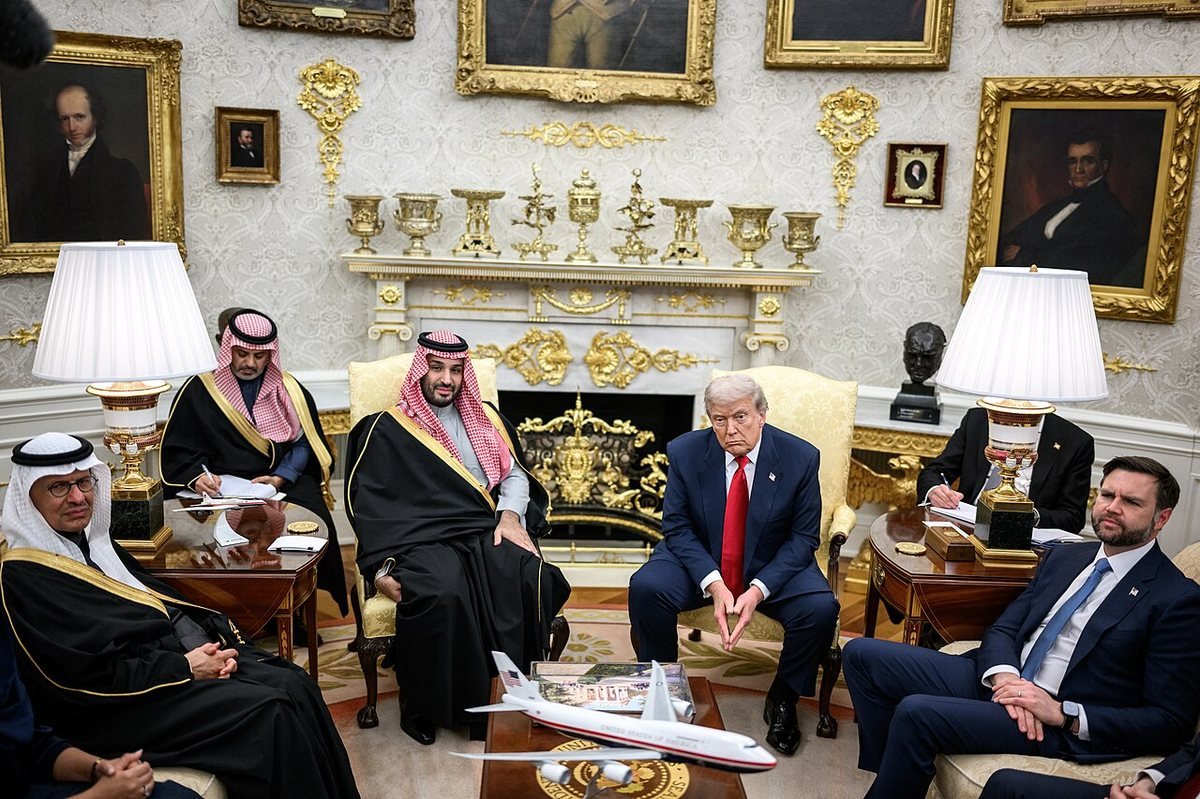
Twelve days later Crown Prince Mohammed bin Salman sat in the Oval Office and said: ‘We want to be part of the Abraham Accords, but we want also to be sure that we secure a clear path to a two-state solution.’ The visit produced a Strategic Defense Agreement, major non-NATO ally status, an F-35 sale and completed civil-nuclear talks, but no normalisation.
A Gaza ceasefire revives the push Talks
A ceasefire based on Trump’s 20-point Gaza plan took effect on 10 October, and living hostages were released on 13 October as Trump addressed the Knesset and co-chaired a summit in Sharm el-Sheikh. Washington immediately framed expansion of the Accords as the next step. Arab governments answered that a ceasefire was not the same as a political horizon for Palestinians.
The UAE draws a red line Strain
As Israeli ministers floated annexing most of the West Bank, senior Emirati official Lana Nusseibeh said annexation would be a ‘red line’ that would ‘severely undermine the vision and spirit’ of the Accords and end the pursuit of regional integration. It was the strongest warning yet from the Accords’ most important Arab member.
Days later Israel struck Hamas negotiators in Doha, the capital of a US partner, shaking Gulf confidence further.
Five years on: intact but frozen Stalled
On his May 2025 Gulf tour, Trump met Syria’s interim president Ahmed al-Sharaa in Riyadh and urged him to join the Accords. In Sudan, a Sudanese outlet reported, and Israel’s Ynet relayed, that an envoy of army chief Abdel Fattah al-Burhan had visited Israel offering to complete normalisation in exchange for support in the civil war; neither government confirmed a deal.
Analysts’ consensus at the five-year mark: no member had left, but the Accords would not expand while the Gaza war continued.
Bahrain’s parliament recalls ambassadors Strain
Weeks into the Gaza war, Bahrain’s elected lower house announced that Bahrain’s ambassador had been recalled from Israel, Israel’s ambassador had left Manama and economic ties were suspended. Israel replied that relations were stable, and the government in Manama never formally broke them off.
2023
The Hamas attack and the Gaza war War
The Hamas-led attack on southern Israel and Israel’s devastating military campaign in Gaza transformed regional politics overnight. Arab publics, including in Accords countries, turned sharply against normalisation. Saudi Arabia froze talks and hardened its insistence on Palestinian statehood.
The war exposed the Accords’ founding wager: that Arab–Israeli ties could advance while the Palestinian question was set aside.
Saudi talks peak; Sudan goes to war Talks
In February Israel’s foreign minister flew to Khartoum and said a peace agreement with Sudan would be signed later that year. Instead, on 15 April, fighting broke out between the Sudanese Armed Forces and the Rapid Support Forces. In July Israel recognised Moroccan sovereignty over Western Sahara.
US mediation for a Saudi–Israeli deal, tied to a US defence pact and Saudi civil nuclear programme, peaked in September, when Mohammed bin Salman told Fox News: ‘Every day we get closer.’
The Negev Summit Ties deepen
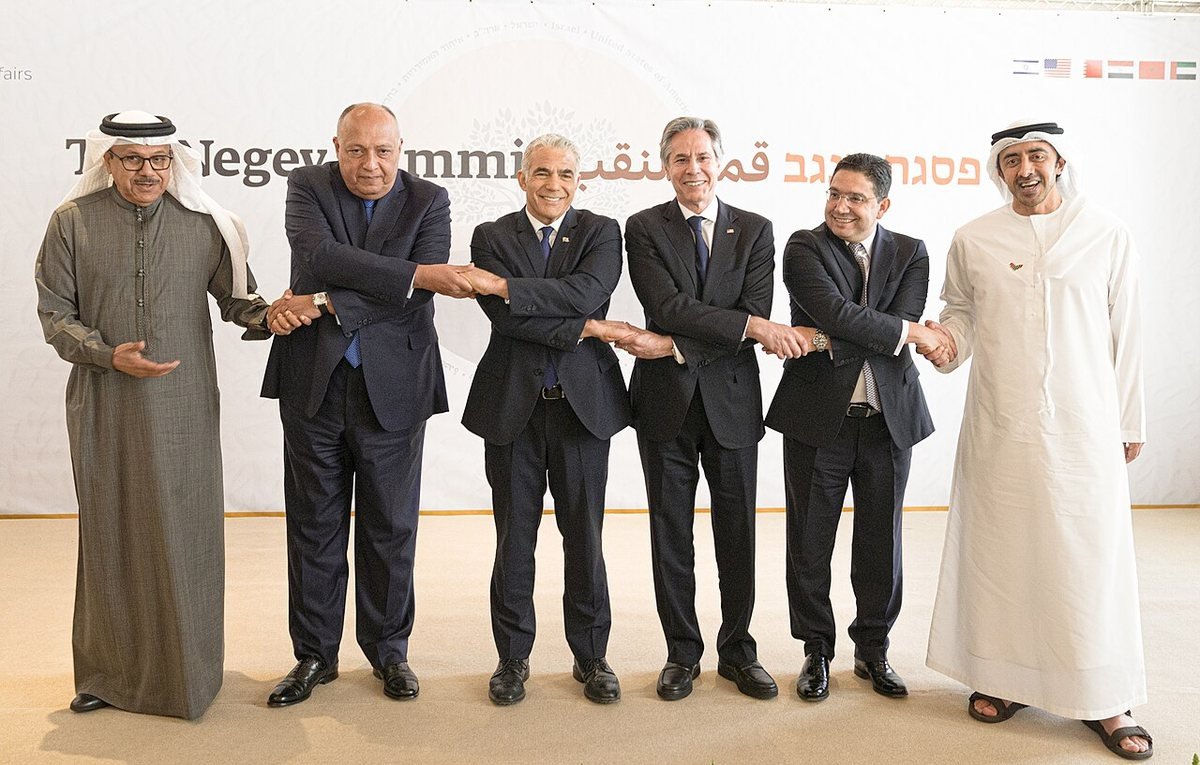
Israel hosted the foreign ministers of the UAE, Bahrain, Morocco and Egypt, with US Secretary of State Antony Blinken, at David Ben-Gurion’s desert retreat. The gathering set up the Negev Forum, with working groups on regional security, clean energy, food and water security, health, tourism and education.
Egypt’s presence was not a new normalisation: it has had a peace treaty with Israel since 1979.
Embassies open, Sudan signs a declaration Ties deepen
Sudan signed the Abraham Accords Declaration in Khartoum in the presence of US Treasury Secretary Steven Mnuchin. Israel’s foreign minister Yair Lapid opened embassies in Abu Dhabi in June and Manama in September, and the UAE opened its embassy in Tel Aviv. Direct flights, tourism and business delegations multiplied.
2020
Israel and Morocco sign a joint declaration Deal
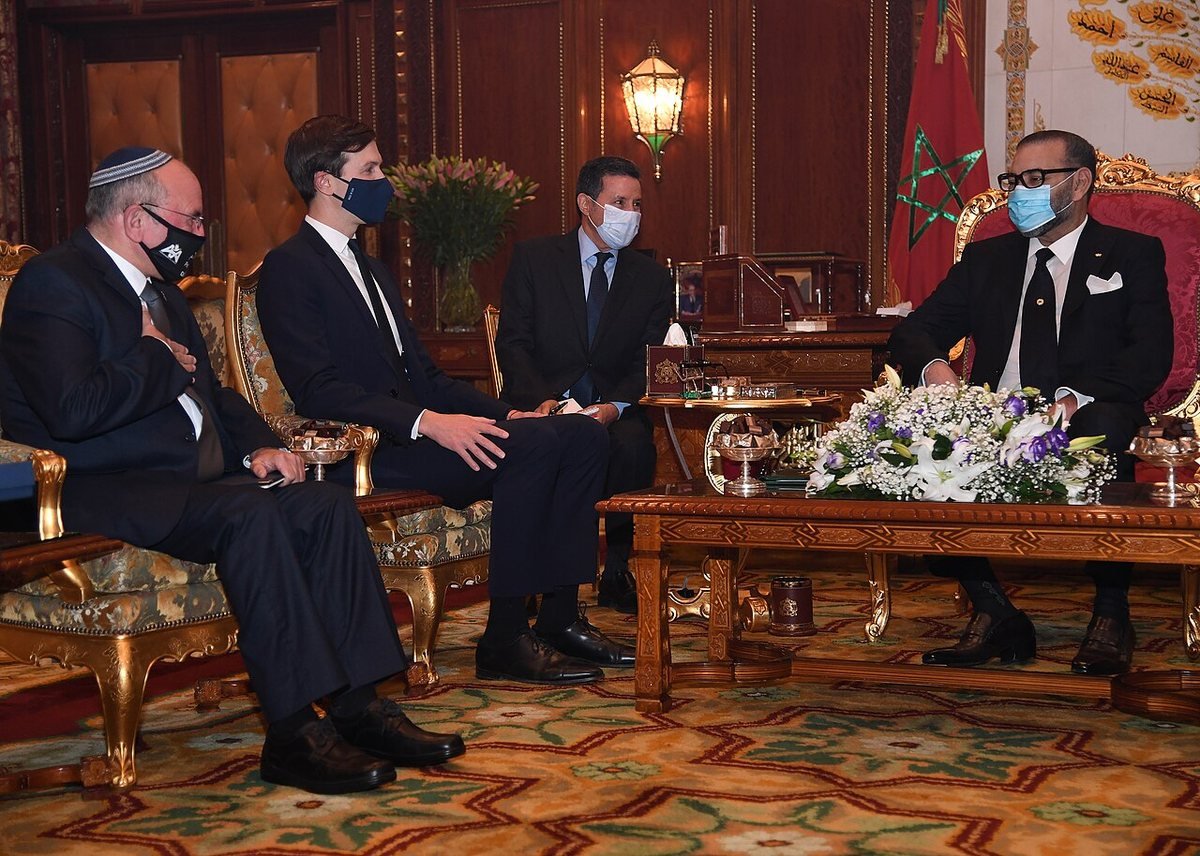
Jared Kushner and Israel’s national security adviser Meir Ben-Shabbat flew from Tel Aviv to Rabat on the first direct commercial flight between the two countries and signed a tripartite joint declaration with Morocco. It provided for reopening liaison offices, which Morocco had closed in 2000, and for cooperation on trade, tourism, water and energy.
2020
Morocco’s normalisation, and Western Sahara Deal
Trump announced that Morocco would normalise relations with Israel and, in the same move, signed a proclamation recognising Moroccan sovereignty over Western Sahara, a territory claimed by the Polisario Front and listed by the UN as non-self-governing. The deal showed how normalisation could be one part of a wider bargain with Washington.
2020
Sudan agrees to normalise Deal
Sudan, which hosted the Arab League’s 1967 ‘three noes’ summit in Khartoum (no peace, no recognition, no negotiations with Israel), agreed to normalise ties. The package was linked to Sudan’s removal from the US list of state sponsors of terrorism, vital to its post-Bashir economy.
2020
The White House signing Deal
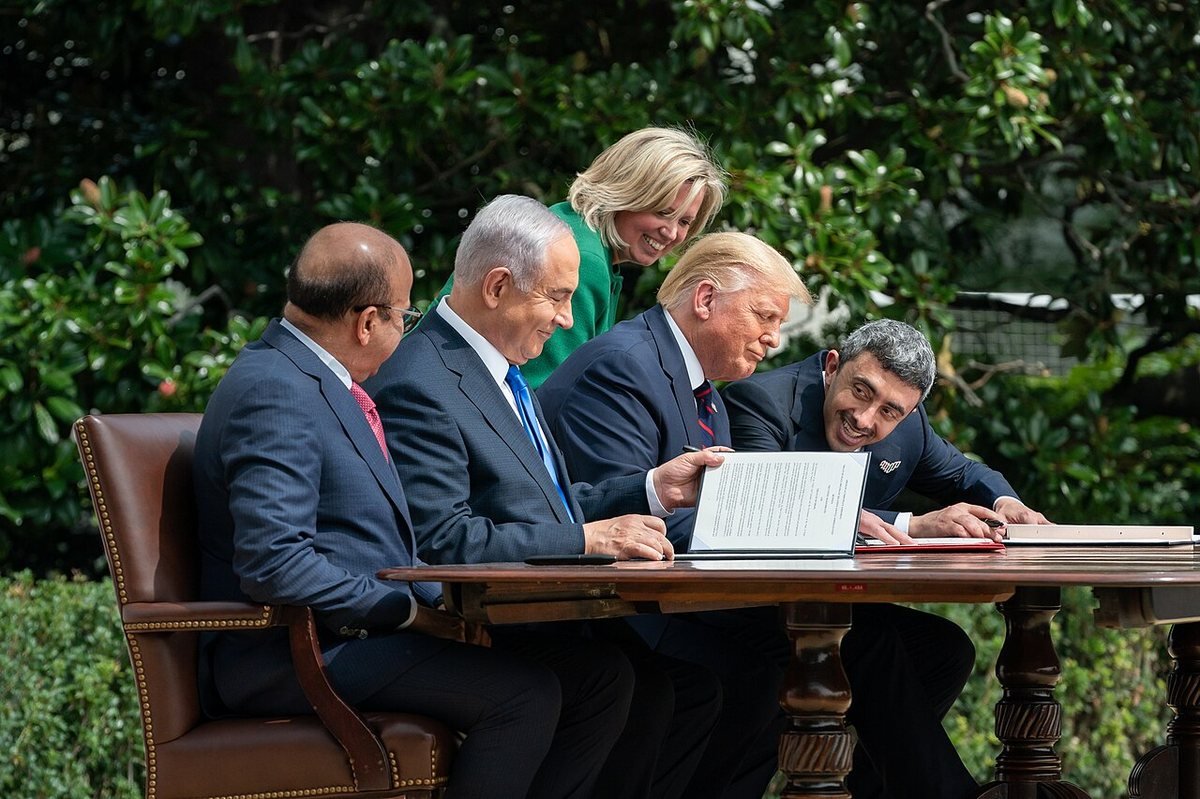
On the South Lawn, Netanyahu, UAE Foreign Minister Abdullah bin Zayed and Bahraini Foreign Minister Abdullatif Al Zayani signed the documents, with President Trump as witness. The UAE agreement was a full treaty of peace (later registered with the UN); Bahrain’s was a declaration establishing relations.
Bahrain became the fourth Arab state to recognise Israel, after Egypt (1979), Jordan (1994) and the UAE.
2020
The first direct flight Ties deepen
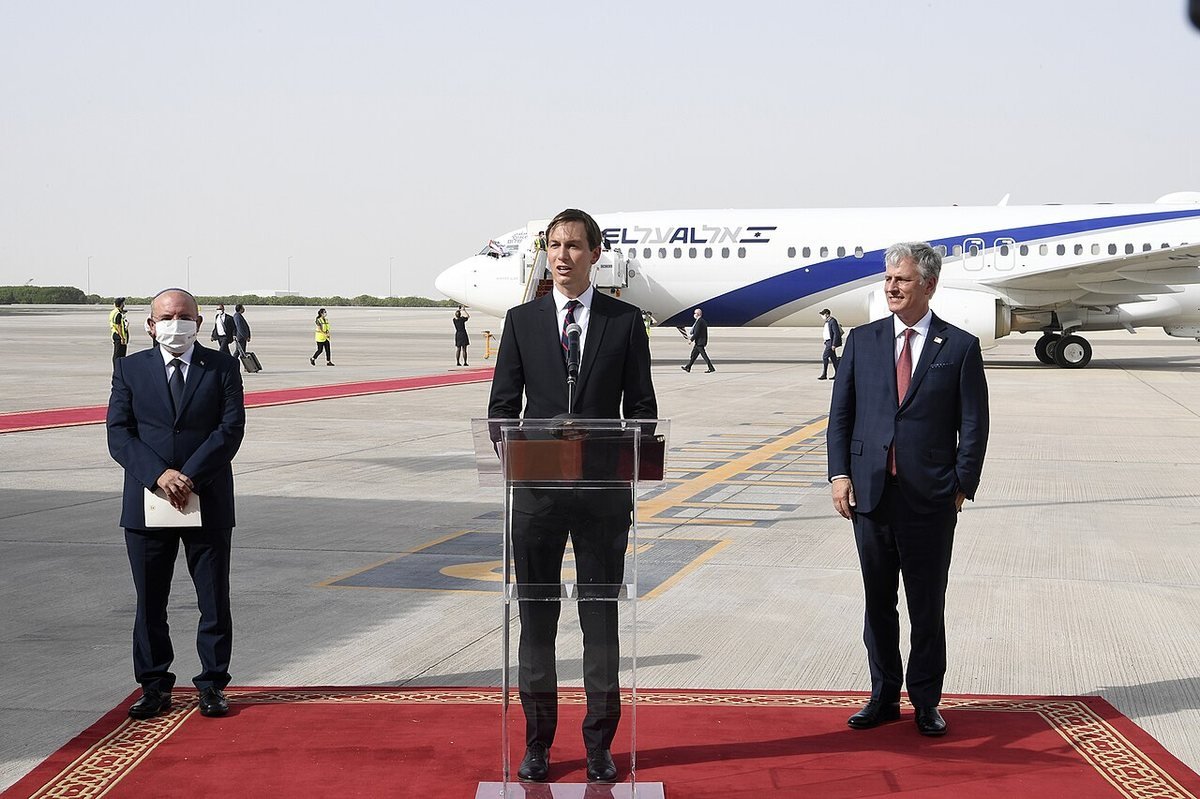
An El Al jet carrying Jared Kushner, US national security adviser Robert O’Brien and an Israeli delegation flew from Ben Gurion to Abu Dhabi, crossing Saudi airspace with Riyadh’s permission, a quiet sign of Saudi acquiescence.
2020
Israel and the UAE announce normalisation Deal
A joint statement announced full normalisation between Israel and the United Arab Emirates, the first Gulf state to establish open relations with Israel. Israel agreed to suspend its plan to annex parts of the West Bank, which the UAE presented as its main gain.
Behind it lay years of quiet contacts driven by shared concern over Iran and a shared interest in technology, trade and closeness to Washington.
Where Does Each Country Stand?
Five joiners, one holdout and one long shot.
Saudi Arabia next? Pick a country to see where it stands
The meter shows how far normalisation with Israel has gone, from no relations to full ties with deep trade. Status as of 14 October 2026.
The Signatories, Country by Country
What each one signed, what it got, and where it stands in October 2026.
1. United Arab Emirates: the anchor of the Accords
What it signed: a full Treaty of Peace, Diplomatic Relations and Full Normalization, signed on 15 September 2020 and later registered with the United Nations. Embassies opened in Abu Dhabi and Tel Aviv in mid-2021, and a Comprehensive Economic Partnership Agreement took effect in April 2023.
What it got: Israel’s suspension of West Bank annexation, access to Israeli defence and technology, and a closer relationship with Washington. UAE figures show goods trade of $3.254 billion in 2024 and $3.209 billion in 2025, and passenger traffic rising from about 892,000 to 1.53 million.
Why it matters: the UAE proved a Gulf state could hold open ties with Israel through a regional war. But it has also set limits, warning in September 2025 that annexation would be a ‘red line’.
2. Bahrain: following Saudi Arabia’s lead, one step ahead
What it signed: a Declaration of Peace, Cooperation and Constructive Diplomatic and Friendly Relations on 15 September 2020, announced only four days earlier. Israel opened an embassy in Manama in September 2021.
What it got: closer security ties with the US and Israel against Iran. Bahrain hosts the US Navy’s Fifth Fleet, and few believe it would have joined without Riyadh’s quiet approval.
Why it matters: Bahrain’s relationship is the most exposed to public anger. In November 2023 its parliament announced that ambassadors had been withdrawn, though the royal government did not break relations. Iranian strikes on Bahrain in 2026 underlined the risks.
3. Morocco: normalisation in exchange for Western Sahara
What it signed: a tripartite joint declaration with Israel and the US on 22 December 2020, after Washington recognised Moroccan sovereignty over Western Sahara on 10 December. Israel followed with its own recognition on 17 July 2023.
What it got: US and Israeli backing on its top foreign-policy priority, plus defence cooperation, tourism and investment.
Why it matters: Morocco’s case shows how normalisation can be one piece of a wider deal. After years of liaison offices, it agreed on 16 September 2026 to upgrade to full embassies, the clearest sign of new life in the Accords.
4. Sudan: the agreement that never took effect
What it signed: only the general Abraham Accords Declaration, in Khartoum on 6 January 2021, after an October 2020 deal tied to its removal from the US terrorism list.
What happened next: the military coup of October 2021 and the war between the Sudanese Armed Forces and the Rapid Support Forces from April 2023 left no stable government to finish the job. Army chief Abdel Fattah al-Burhan has been reported to want to complete the deal in exchange for support, but no treaty or embassy exists.
Why it matters: Sudan shows that a declaration is not the same as a relationship. It should not be counted alongside the UAE, Bahrain and Morocco.
5. Kazakhstan: a symbolic addition from Central Asia
What it signed: nothing yet. President Trump announced Kazakhstan’s accession on 6 November 2025; a formal ceremony has not been held.
Why it matters: Kazakhstan has had diplomatic relations with Israel since 1992, so nothing changed bilaterally. Its value is political: it is the first Central Asian and first non-Arab Muslim-majority member, and it took part in the members’ meeting of 24 September 2026.
And Saudi Arabia: the missing piece
Saudi Arabia is not a signatory. It allowed Israeli airlines to cross its airspace from 2020 and came close to a US-brokered package in 2023. Since the Gaza war it has made a credible path to a Palestinian state a firm condition, and Crown Prince Mohammed bin Salman repeated it at the White House in November 2025. As custodian of Islam’s two holiest mosques, a Saudi deal would carry far greater weight than all the earlier ones together.
What Would It Take for Saudi Arabia to Join?
Some boxes have been ticked since 2023; the hardest ones have not.
Pick a condition. How close is Riyadh to signing?
Saudi Arabia has tied normalisation to six things. The meter shows each one’s status as of 14 October 2026, based on public statements and reporting.
Why Have the Talks Stalled?
The issue that was set aside
The Accords deliberately did not wait for an Israeli–Palestinian settlement. That made 2020 possible, and it is now the main obstacle to Saudi Arabia joining.
Higher political costs
After 7 October 2023, images of destruction in Gaza made new deals almost impossible for Arab governments to defend publicly.
A package, not a signature
Riyadh wants security guarantees, civil nuclear help and statehood progress together; progress on one does not settle the rest.
A state at war with itself
Sudan’s obstacle is domestic: a civil war that has displaced millions and left no government able to implement a treaty.
Security cuts both ways
Fear of Iran drove the 2020 deals. The 2026 war showed that open alignment with Israel can also make a state a target.
Annexation and elections
Annexation proposals in 2025 alarmed the UAE, and Saudi Arabia is waiting for the result of Israel’s 27 October 2026 election.
What the Accords Have Achieved, and What They Haven’t
Formal ties that survived a war
Embassies in Abu Dhabi, Tel Aviv and Manama stayed open through the Gaza war, and Morocco is upgrading. No member has withdrawn.
Real trade and travel
About $14.5 billion in UAE–Israel goods trade from September 2020 to May 2026 and 1.53 million passengers in 2025.
Quiet cooperation
Air defence and intelligence links among Israel, Gulf states and US Central Command grew, and were tested in 2024 and 2026.
No Palestinian settlement
The Accords did not produce Palestinian statehood or prevent the Gaza war, and they did not bring public reconciliation.
No Saudi deal
The agreement that would have transformed the region has not happened, six years after the first signing.
No regional peace
Wars in Gaza, Lebanon, Yemen and with Iran followed the Accords, which were never designed to stop them.
Explore More Timelines
People Also Ask
Frequently Asked Questions
Conclusion: A Breakthrough, Not a Final Peace
The Abraham Accords proved that Israel could build formal, working relations with Arab governments without first resolving the Palestinian conflict. The UAE relationship in particular has delivered embassies, trade, travel and security cooperation that survived a regional war. Morocco’s embassy upgrade and the first all-member meeting since October 2023 show the framework is not dead.
But the stalled Saudi talks, Sudan’s unimplemented deal and a five-year gap before the next member show the limits of the 2020 formula. Expansion now depends less on incentives from Washington than on a credible answer to the Palestinian question, an end to the Iran war and the choices of Israel’s next government.
Related AiTimeline Stories
⚠️ Editorial Note
This guide summarises contested diplomacy. Dates and texts come from the US State Department archive, the UN Treaty Collection, the UK House of Commons Library and contemporary reporting; trade data are from the UAE Ministry of Foreign Affairs. Developments in 2025–2026, including the Iran war, Kazakhstan’s accession and Saudi positions, are current to 14 October 2026 and still unfolding. Reports of private negotiations, such as Sudan’s envoy contacts, are unconfirmed by the governments involved. Views of these agreements differ sharply across the region.
Sources & further reading
Every dated entry above was checked against these references. Last reviewed 14 October 2026.
- US Department of State (2017-2021 archive): The Abraham Accords, declaration and bilateral texts
- United Nations Treaty Collection: Abraham Accords Peace Agreement, Treaty of Peace between the UAE and Israel
- UK House of Commons Library: Israel and the Abraham Accords in 2025, five years on
- UAE Ministry of Foreign Affairs: UAE-Israel economic cooperation and trade figures
- The National: UAE warns annexation of West Bank would be a red line (3 September 2025)
- Axios: MBS tells Trump he wants to join Abraham Accords subject to path for Palestinian state (18 November 2025)
- Al-Monitor: Kazakhstan to join Abraham Accords as Trump pushes Mideast peace (November 2025)
- Al Jazeera: Israel and Morocco agree to open embassies, upgrading diplomatic ties (16 September 2026)
- CBS News: Abraham Accords countries hold first official meeting since Oct. 7 attacks (25 September 2026)
- The Times of Central Asia: Kazakhstan takes part in Abraham Accords meeting as Trump-promised signing awaits
- UK House of Commons Library: The conflict in Sudan