Indian Railways Electrification: How India Wired Its Railways, From One 16-km Line in 1925 to 99.6% in 2026
Indian Railways electrification from the first 1,500 V DC train in 1925 to 99.6% of broad gauge in 2026: 25 kV AC, trunk routes, mission mode, last 269 km.
Latest Story
On 3 February 1925, an electric train left Bombay Victoria Terminus for Kurla on a 16-km line powered at 1,500 volts DC. A century later, Indian Railways electrification covers 99.6% of the broad-gauge network, more than 70,000 route kilometres, with just 269 km left. The striking part is the timing: it took 89 years to wire the first 21,801 km, and about a decade to wire the next 46,900. This is the full record, from Bombay’s DC suburbs and the 1957 switch to 25 kV AC to the trunk routes, mission mode and the last few hundred kilometres, with the targets that were missed along the way.
💡 Short Answer
Indian Railways electrification began on 3 February 1925 with a 1,500 V DC train between Bombay VT and Kurla. Only 388 route km were electric at Independence. India adopted 25 kV AC in 1957, wired its trunk routes between 1977 and 2005, and then electrified at record speed after 2017. By May 2026, 70,002 of 70,271 broad-gauge route km, or 99.6%, were electrified, with 269 km left in five states.
Indian Railways Electrification: Key Questions
A Century of Electrification, in Ten Points
- The start: 3 February 1925, Bombay VT to Kurla, 16 route km on 1,500 V DC.
- Slow early decades: only 388 route km were electric at Independence in 1947.
- The key decision: 25 kV AC was adopted in 1957, not the 1980s; the first AC section opened in 1960.
- Freight first: the first AC line was an iron-ore route, and coal and mineral corridors led for decades.
- Trunk routes: Delhi–Howrah in 1977, then Delhi–Bombay, Howrah–Bombay and Delhi–Chennai by 1992.
- Two speeds: 21,801 route km in about 60 years before 2014, 46,900 in 2014–25.
- The real jump came in 2017–18, when annual output passed 4,000 km for the first time.
- Record: 7,188 route km in 2023–24, about 20 km every working day.
- Not quite 100%: 269 km were left in May 2026, after deadlines of 2021–22 and December 2023 were missed.
- Electric is not automatically green: the benefit depends on how clean India’s grid becomes.
The Four Eras of Indian Railway Electrification
From experiment to standard to network-wide.
Experiment: DC around the ports
1,500 V DC suburban and ghat lines around Bombay and Madras, then 3,000 V DC in Kolkata. Useful where trains were frequent or the gradients steep, but too costly for long distances.
Standardise: 25 kV AC
India picked the French-proven 25 kV AC system in 1957 and wired coal and iron-ore routes in the east first. Kolkata’s DC lines were converted by 1968.
Expand: trunk and freight routes
Electrify the densest corridors first: Delhi–Howrah in 1977, the main Golden Quadrilateral routes by 1992, the Howrah–Chennai gap in 2005. Mumbai finally left DC in 2012–16.
Accelerate: the whole network
Mission 100% Electrification wired branch lines too, at up to 7,188 route km a year, taking broad gauge from about 40% to 99.6%.
For most of the century the economics were simple. Wires, masts and substations cost a lot up front, and they pay back only where locomotives run many hours a day. So India electrified busy suburbs, steep ghats and heavy mineral routes first, then the trunk routes between the four metros. The shift after 2017 was to treat electrification as a network decision rather than a route-by-route test: once almost every main line was electric, the remaining diesel islands forced locomotive changes and kept two fleets alive, so wiring the rest made the whole system simpler.
Tap each link in the chain to follow electricity from the grid to the wheels, then compare it with diesel.
Simplified for a 25 kV AC electric locomotive. Updated 6 October 2026.
Choose a step above
The Electrification Curve: Slow, Then Very Fast
Only official figures; no intermediate values estimated.
The ministry’s own comparison is striking: about 1.42 km a day in 2004–14 against more than 15 km a day in 2019–25. Some of that speed came from simply deciding to do it, and some from method: standard designs, mechanised wiring trains, and sanctioning every new line and doubling project with electrification built in. The 2024–25 figure of 2,701 km is low only because there was little left.
Indian Railways Electrification Timeline, 1925–2026
Newest first. Tags mark the DC era, 25 kV AC, trunk routes, locomotives, mission mode, energy and missed targets.
99.6%: the last 269 route km Mission mode
The ministry told Parliament that 70,002 of 70,271 route km of broad gauge were electrified by 31 May 2026. What remains, 269 route km, is in five states: Karnataka 120, Tamil Nadu 68, Assam 55, Goa 16 and Rajasthan 10. The ministry listed forest clearances, shifting utilities, statutory approvals, terrain, law and order and short working seasons as the reasons the final stretches take longest.
Why it matters: the network is not quite ‘100% electric’, and the last kilometres are the hardest: ghats, forests and border areas.
Western freight corridor finished; 99.6% reached Trunk route
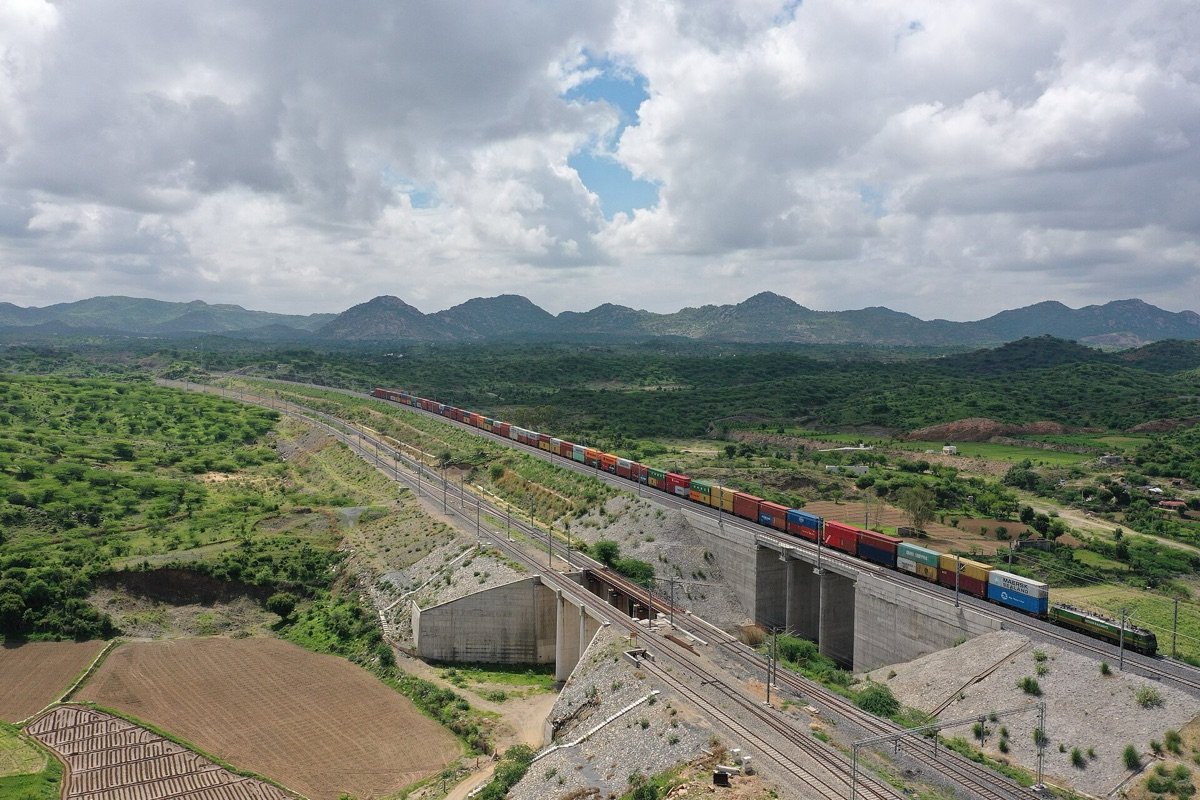
Trial container trains ran on the last 102-km JNPT–Vaitarna stretch on 31 March 2026, completing the 1,506-km Western Dedicated Freight Corridor from Jawaharlal Nehru Port to Dadri. Its final commissioning had been held up by signalling and overhead-wire work. The same month the electrified share of broad gauge reached 99.6%, or 69,873 of 70,142 route km. Chittaranjan Locomotive Works closed 2025–26 with a record 603 electric locomotives.
Why it matters: both freight corridors are now electric end to end, built for heavy, double-stack trains that only high-power electric traction can move efficiently.
99.2%, and the renewables push Energy
A ministry reply put electrification at 99.2% of broad gauge, 69,427 route km by November 2025, with 14 of 18 zones and 25 states and Union Territories at 100%. It also published the split that defines the story: 21,801 route km before 2014 and 46,900 route km in 2014–25. Separately, the railways said it had commissioned 812 MW of solar and 93 MW of wind for traction and tied up 1,600 MW of round-the-clock hybrid renewable power, toward a goal of becoming a net-zero carbon emitter by 2030.
Dahod: India’s first 9,000 HP locomotive plant Locomotives
Prime Minister Narendra Modi dedicated the railway’s locomotive plant at Dahod, Gujarat, and flagged off its first 9,000 horsepower electric freight locomotive. The Siemens Mobility contract covers 1,200 locomotives, each able to haul about 5,800 tonnes at up to 120 km/h, with propulsion parts made in Nashik, Aurangabad and Mumbai.
500th WAG-12B leaves Madhepura Locomotives
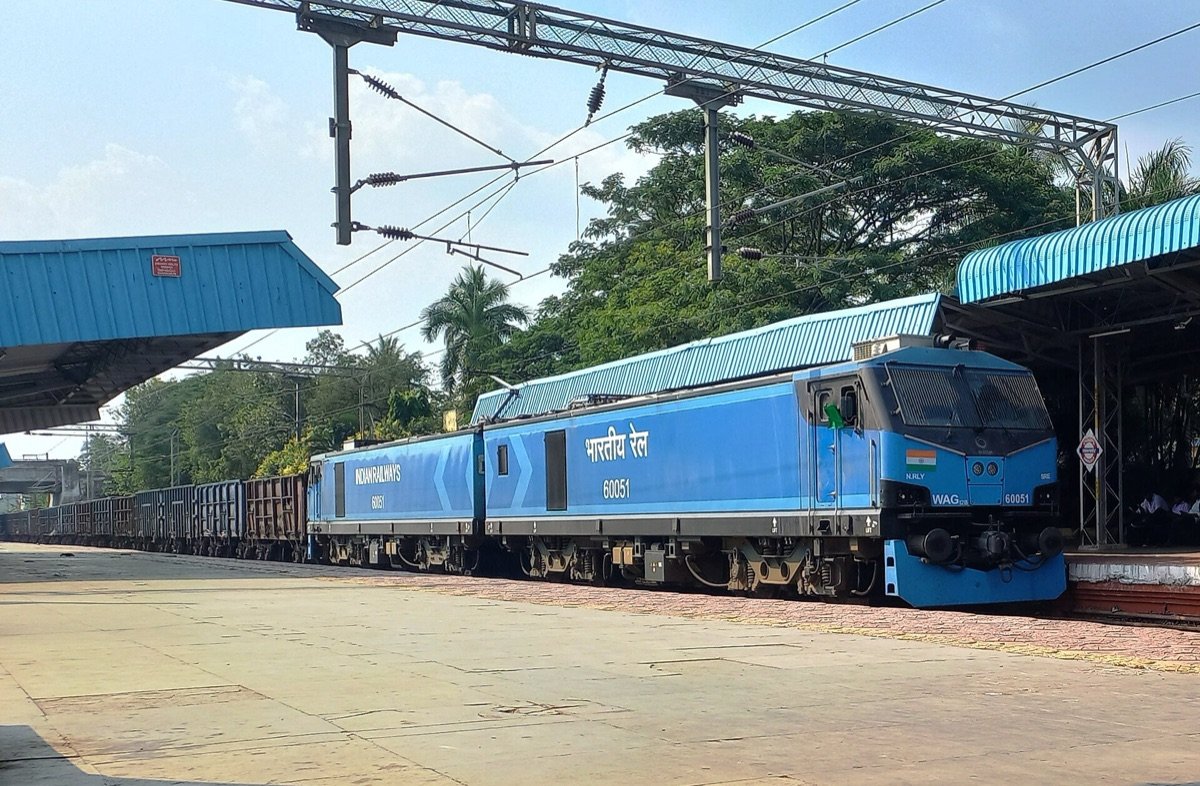
Alstom delivered the 500th of 800 WAG-12B locomotives from the Madhepura joint-venture factory. At 12,000 horsepower in two sections, it is India’s most powerful locomotive, built to haul about 6,000-tonne freight trains at up to 120 km/h.
The pace drops as the map fills in Mission mode
Electrification fell to 2,701 route km in 2024–25 from a record the year before, simply because most of the network was done. The ministry says the electrified share passed 96% by the end of 2024. All new lines and doubling projects are now sanctioned with electrification included.
A second deadline passes Missed target
In April 2021 the ministry said it planned to fully electrify its tracks by December 2023, after the 2018 Cabinet approval had set 2021–22. Both dates passed with work remaining. The gap was small, but the final few thousand kilometres ran through forests, ghats and the north-east, where approvals and working seasons set the pace.
Why it matters: nearly 100% is a real achievement, but the official targets were missed twice.
Record year: 7,188 route km Mission mode
Indian Railways electrified a record 7,188 route km in 2023–24, after 6,565 km in 2022–23 and 6,366 km in 2021–22, roughly 20 km of line every working day. Along the way Uttar Pradesh and the North Eastern Railway became fully electrified on 20 February 2023, Meghalaya was linked by electric traction on 15 March 2023, and the Bengaluru–Hubballi main line was wired end to end on 31 March 2023.
6,015 route km in a pandemic year Mission mode
Despite COVID-19, the railways electrified 6,015 route km in 2020–21, beating the previous best of 5,276 km in 2018–19, and commissioned a record 56 traction substations. By 31 March 2021, 45,881 of 64,689 route km (71%) were electrified. The ministry tied full electrification to its goal of being a net-zero carbon emitter by 2030, drawing traction power from renewables. On 18 May 2020 the first WAG-12B made its maiden commercial run, from Pt Deen Dayal Upadhyaya Junction to Shivpur.
Cabinet approves Mission 100% Electrification Mission mode
The Union Cabinet approved electrifying the remaining 13,675 route km of broad gauge, about 108 sections, at an estimated ₹12,134 crore, with the aim of a fully electric broad-gauge network by 2021–22. The policy question changed from ‘which route next?’ to ‘how fast can the rest be done?’.
Why it matters: branch lines that would never have passed a traffic-based test were now included, which is why the electrified share climbed so fast after 2018.
The real acceleration begins Mission mode
Although 2014 is often cited as the turning point, the step change came in 2017–18, when annual electrification jumped to 4,087 route km. From 2014–15 to 2016–17 it had averaged roughly 1,400 route km a year, already more than double the 2007–14 average of about 620. In April 2018 the Madhepura factory turned out its first WAG-12 locomotive.
Mumbai switches from DC to AC 25 kV AC
The city where Indian electric traction began was the last to give up DC. Mumbai’s 1,500 V DC suburban network was converted to 25 kV AC section by section: Western Railway completed the switch on 5 February 2012, Central Railway’s last main-line sections on 8 June 2015, and the Harbour line, home of the 1925 first train, in 2016.
Why it matters: AC allowed longer, faster, more energy-efficient local trains on the world’s most crowded suburban network.
The last trunk-route gaps close Trunk route
Prime Minister Atal Bihari Vajpayee inaugurated the electrified Howrah–Delhi route via Patna on 3 February 2002. On 29 November 2005, closing the Kharagpur–Waltair gap completed the Howrah–Chennai route. In July 2008 the railways trialled a 7.45-metre-high contact wire between Jakhapura and Tomka, then the world’s highest, for double-stack container trains.
WAP-7 arrives; a quarter of track is electric Locomotives
Chittaranjan Locomotive Works built the first WAP-7, a three-phase passenger locomotive derived from the ABB-designed WAG-9 freight engine imported from 1996. It became the standard express locomotive across India. According to the ministry, electrified track was about 24% of the network in 2000.
The Golden Quadrilateral goes electric Trunk route
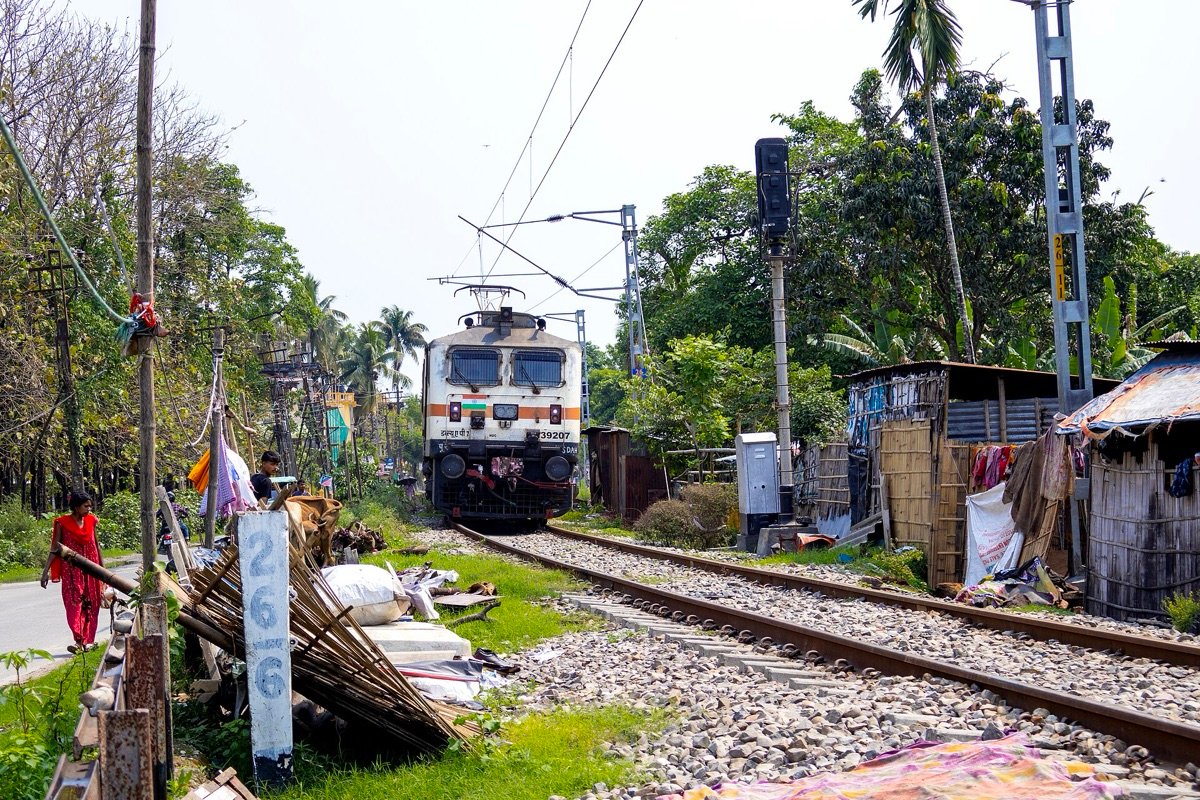
Trunk routes were commissioned one after another: Delhi–Bombay via Western Railway (1,388 route km) on 31 March 1987, Howrah–Bombay (1,976) on 31 January 1991, Delhi–Chennai (2,190) on 31 March 1991 and Delhi–Bombay via Central Railway (1,542) on 31 January 1992. In 1994–95 India commissioned its first 2 x 25 kV autotransformer system on the Bina–Katni and Katni–Bishrampur coal routes.
Delhi–Howrah: the first electric trunk route Trunk route
The Delhi–Howrah route, the busiest corridor linking the capital to Kolkata and the eastern coalfields, was commissioned with electric traction end to end. It set the pattern for the next 30 years: electrify the densest trunk and freight routes first, where locomotives work hardest.
Kolkata’s 3,000 V DC converted to AC 25 kV AC
The Howrah–Burdwan and Sheoraphulli–Tarakeswar lines, electrified on 3,000 V DC in 1954–58, were converted to 25 kV AC in 1966 and 1968. With that, every system outside Bombay and Madras was on the single national standard.
‘Lokmanya’: the first Indian-built electric locomotive Locomotives
Jawaharlal Nehru inaugurated Lokmanya, the first 1,500 V DC electric locomotive built at Chittaranjan, for the Bombay area. India introduced its first indigenous electric multiple units in September 1962. Domestic manufacture would later make the mass electrification of the 2010s possible without large-scale imports.
First 25 kV AC section energised 25 kV AC
Three years after choosing AC, India energised its first 25 kV section on an iron-ore route in the eastern mineral belt. Heavy mineral trains running all day were exactly the traffic that repaid the cost of wires and substations. A dedicated electrification project, later the Central Organisation for Railway Electrification (CORE), took charge of new schemes.
India adopts 25 kV AC 25 kV AC
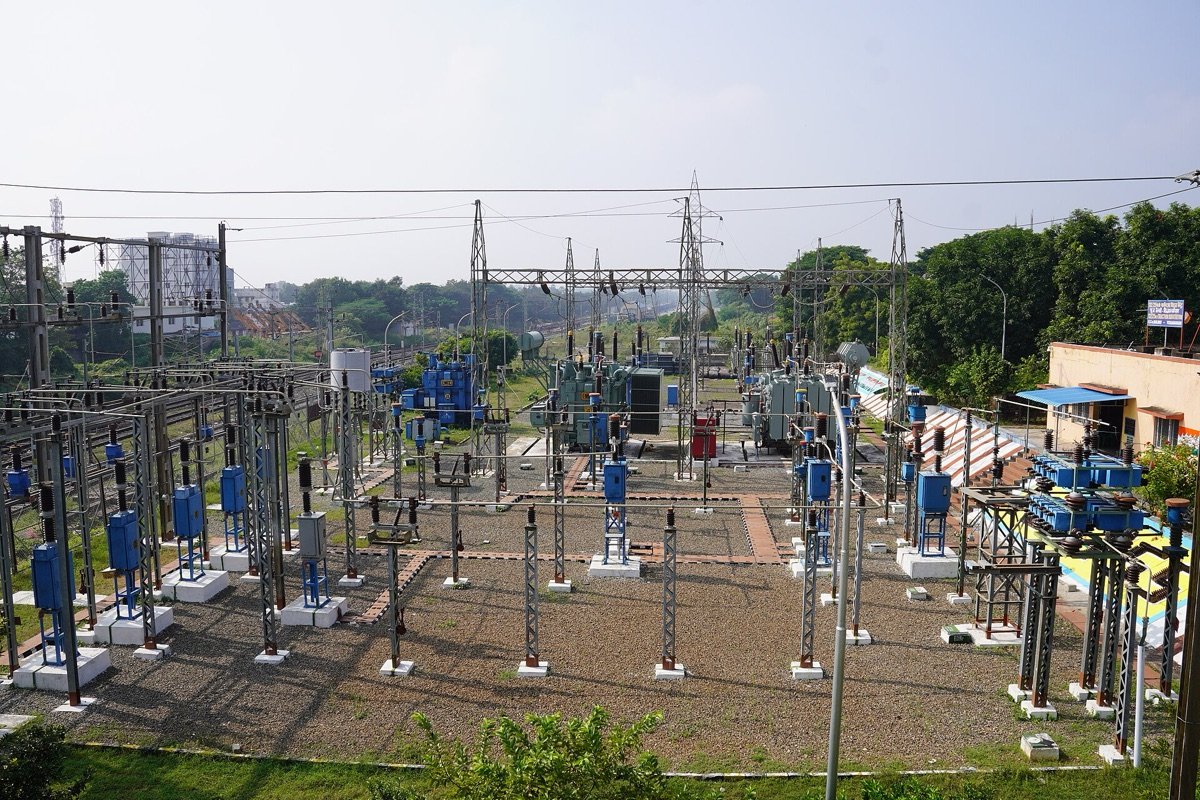
In 1955 SNCF had shown that 25 kV single-phase AC at the 50 Hz grid frequency needed far fewer substations than DC. Indian Railways adopted it in 1957, initially with SNCF as consultants. The decision came just as Kolkata’s 3,000 V DC lines opened: Nehru inaugurated Howrah–Sheoraphulli EMU services on 14 December 1957.
Why it matters: one national standard, chosen early, is what let India later wire tens of thousands of kilometres with the same design.
388 route km at Independence DC era
After two decades, India had just 388 route km electrified, around Bombay and Madras. Steam hauled almost everything else, and diesel had not yet arrived.
Electric traction spreads from the Harbour line DC era
The Bombay, Baroda and Central India Railway electrified its suburban line from Colaba to Borivali in January 1928. In 1930 the GIPR opened electric working on the Kalyan–Poona main line over the steep Bhor Ghat, where electric locomotives could haul heavier loads uphill than steam. Madras followed on 15 November 1931 with Beach–Tambaram on metre gauge.
India’s first electric train DC era
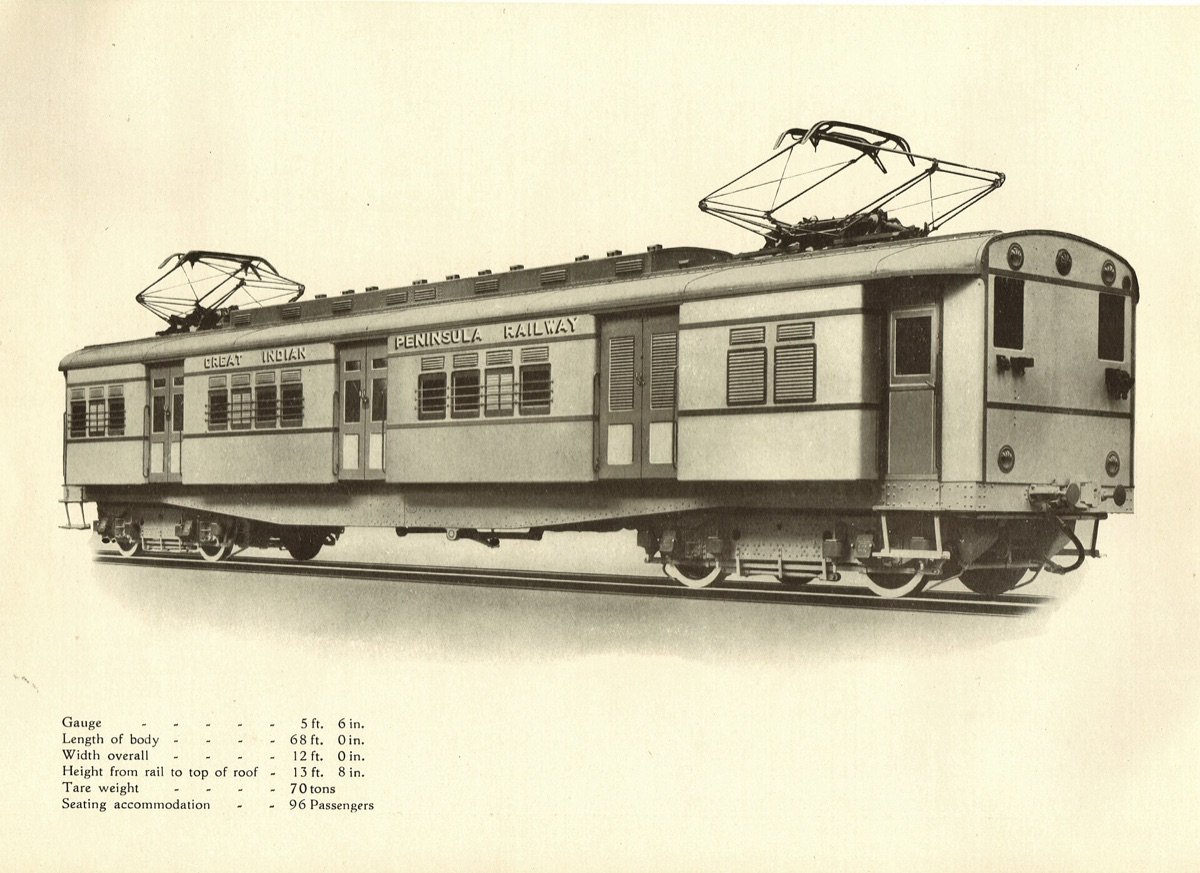
The Great Indian Peninsula Railway ran India’s first electric train from Bombay Victoria Terminus to Kurla on the Harbour branch, inaugurated by the Governor of Bombay, Sir Leslie Wilson. It used 1,500 V DC from overhead wires and British-built motor coaches. Frequent, crowded suburban trains that started and stopped every few minutes were the ideal first use.
Why it matters: every one of today’s 70,000-plus electrified route km traces back to this 16-km line.
When Each Trunk Route Went Electric
Commissioning dates from the Central Organisation for Railway Electrification. Swipe sideways on mobile.
| Electrified trunk route | Commissioned | Route km |
|---|---|---|
| Delhi–Howrah | 7 Jan 1977 | 1,445 |
| Delhi–Bombay (via Western Railway) | 31 Mar 1987 | 1,388 |
| Howrah–Bombay | 31 Jan 1991 | 1,976 |
| Delhi–Chennai | 31 Mar 1991 | 2,190 |
| Delhi–Bombay (via Central Railway) | 31 Jan 1992 | 1,542 |
| Howrah–Delhi (via Patna) | 3 Feb 2002 | 534 (final section) |
| Howrah–Chennai (Kharagpur–Waltair link) | 29 Nov 2005 | 1,117 (final section) |
The Locomotives That Made It Work
Electrification without domestic locomotive production would have meant decades of imports.
| Class | Role | Introduced | Power | Where built |
|---|---|---|---|---|
| Lokmanya (WCM-5) | Mixed, Bombay DC | 1961 | 1,500 V DC | Chittaranjan |
| WAP-4 | Passenger | 1993–94 | about 5,350 HP | Chittaranjan |
| WAP-5 | Fast passenger | 1995 | about 5,450 HP | ABB import, later Chittaranjan |
| WAG-9 | Heavy freight | 1996 | about 6,120 HP | ABB import, then Chittaranjan, Banaras, Patiala |
| WAP-7 | Passenger | 2000 | about 6,350 HP | Chittaranjan, Banaras, Patiala |
| WAG-12B | Heavy freight | 2018 (in service 2020) | 12,000 HP | Alstom joint venture, Madhepura |
| 9,000 HP (Siemens) | Heavy freight | 2025 | 9,000 HP | Dahod, Gujarat |
The quiet enabler of mission-mode electrification was manufacturing. Chittaranjan Locomotive Works built a record 603 electric locomotives in 2025–26, and the former Diesel Locomotive Works at Varanasi, renamed Banaras Locomotive Works in 2020, built 572 locomotives, mostly WAG-9 and WAP-7 electrics. Two foreign partnerships added heavy freight power: Alstom at Madhepura (WAG-12B) and Siemens at Dahod (9,000 HP).
Diesel vs Electric Traction
Why the railways wanted the switch, and what it does not change.
Diesel vs Electric on Indian Railways
The headline comparison that often appears beside electrification, 11.5 g of CO₂ per tonne-km by rail against 101 g by road (NITI Aayog, 2021), is about rail versus road, not electric versus diesel trains. Electrification’s own climate benefit depends on the grid. India’s power is still mostly from coal, so an electric train today shifts emissions more than it removes them; as solar and wind grow, the same wires carry progressively cleaner power without any change to the trains.
The Last 269 km
Where the remaining broad gauge is, and how fast it is shrinking.
| State | Left, Nov 2025 | Left, May 2026 | Share done, Nov 2025 |
|---|---|---|---|
| Karnataka | 151 route km | 120 route km | 96% |
| Tamil Nadu | 117 | 68 | 97% |
| Assam | 197 | 55 | 92% |
| Goa | 16 | 16 | 91% |
| Rajasthan | 93 | 10 | 99% |
| Total | 574 | 269 | 99.2% (all India) |
In six months the unelectrified balance more than halved, from 574 to 269 route km. Assam made the biggest gain. Goa’s 16 km did not move at all between the two counts. The ministry’s general explanation for the final stretches is forest and statutory clearances, utility shifting, difficult terrain and short working seasons. Note that these figures cover broad gauge only. Heritage metre-gauge and narrow-gauge lines such as the Nilgiri, Darjeeling and Kalka–Shimla railways are outside the 100% target.
Corrections and Clarifications
Claims in the material this page was built from, and in common coverage.
“1980s: 25 kV AC becomes India’s standard”
India adopted 25 kV AC in 1957 and energised its first AC section on 11 August 1960. The 1980s were when the big trunk routes were completed on that standard.
“2014: the acceleration begins”
Output roughly doubled from 2014, but the step change was 2017–18, when annual electrification jumped to 4,087 route km from roughly 1,400.
“About 99% by March 2025”
The ministry put the share at more than 96% at the end of 2024 and reported 99.2% for November 2025. 99.6% came in March 2026.
“Vadodara’s WAP-7 era”
The WAP-7 has been built at Chittaranjan since 2000, and later at Banaras and Patiala. Vadodara is one of the sheds where WAP-7s are based. Gujarat’s locomotive factory is at Dahod, and it builds 9,000 HP freight engines.
“WAG-12B is a Dedicated Freight Corridor locomotive”
It was bought for heavy freight generally and mostly works the regular network, such as the Samalkot freight shown above, as well as feeder routes to the corridors.
The missed targets and the DC systems
The material left out the 388 km at Independence, Kolkata’s 3,000 V DC lines, Mumbai’s DC-to-AC switch (2012–16), 2 x 25 kV, and that the 2021–22 and December 2023 deadlines were both missed.
What to Watch Next
Declaring 100%
Whether the last 269 km, led by Karnataka’s 120 km and Goa’s unchanged 16 km, are finished and the ministry formally declares broad gauge fully electric.
Round-the-clock renewables
The 1,500 MW solar, wind and storage package in the pipeline, and how much traction power actually comes from renewables, the real test of the 2030 net-zero goal.
Beyond the wires
Kavach train protection on 24,400 more km, automatic signalling and new freight corridors. Electrification is the foundation, not the capacity fix.
Diesel’s last role
How many diesel locomotives stay on standby, shunting and border duty once the network is fully wired, and the RDSO hydrogen-train pilot.
Did You Know?
- Ghats before cities: the 1930 Kalyan–Poona electrification was driven by the Bhor Ghat incline, where electric locomotives outclimbed steam.
- Metre-gauge first in Madras: the 1931 Beach–Tambaram line was electrified on metre gauge, not broad gauge.
- Nehru at both ends: he inaugurated Kolkata’s first EMUs in 1957 and the first Indian-built electric locomotive, Lokmanya, in 1961.
- Record wire height: a 7.45-metre contact wire was trialled in 2008 so double-stack container trains could run under it.
- Solar growth: railway solar capacity rose from 3.68 MW in 2014 to 898 MW by November 2025, per the ministry.
- Global context: the UIC’s June 2025 figures put the UK at 39% electrified, France at 60% and China at 82%.
Quick Quiz
1. Where did India’s first electric train run in 1925?
2. In which year did India adopt 25 kV AC as its standard?
3. How many route km were electrified at Independence?
4. What was the record annual electrification?
5. How much broad gauge was left to electrify in May 2026?
Explore More Timelines
People Also Ask
Frequently Asked Questions
The Bottom Line
India did not electrify its railways in one project. For 90 years it wired the places where electric traction paid for itself fastest: Bombay’s suburbs, the ghats, the coal and iron-ore belt and the trunk routes between the metros. Then, from 2017, it decided the whole broad-gauge network should be electric, and wired more track in a decade than in the previous nine.
The result is a railway that is now physically part of India’s power system. That makes the next questions less about wires and more about what flows through them: how clean the electricity becomes, and whether signalling, freight corridors and safety systems can make full use of a network that is, after a century, almost entirely electric.
Related AiTimeline Stories
⚠️ Editorial Note
Last updated 6 October 2026. Historical milestones and trunk-route dates are from the Central Organisation for Railway Electrification. Electrification totals, annual figures and state balances are from Ministry of Railways releases and parliamentary replies (April 2021, December 2025, January and April 2026, and data to 31 May 2026). Percentages for different years use the network size published at the time, which has grown as new lines open. Locomotive horsepower figures are approximate nominal ratings.
Sources & further reading
Every dated entry above was checked against these references. Last reviewed 6 October 2026.
- CORE (Indian Railways): Important landmarks of Indian Railways electrification
- PIB: Indian Railways nears full electrification at 99.2% of broad gauge network (Lok Sabha reply, 17 Dec 2025)
- PIB: Mission 100% Electrification, powering the future of Indian Railways (6 Jan 2026)
- PIB: From steam to speed, the ever-evolving journey of railways (15 Apr 2026)
- PIB: Railways log highest-ever 6,015 RKM electrification in 2020-21 (2 Apr 2021)
- Swarajya: Indian Railways nears complete broad gauge electrification, 269 route km left (data to 31 May 2026)
- Alstom: 500th electric locomotive for Indian Railways from Madhepura (Mar 2025)
- DD News: Indian Railways scales up renewable energy use for traction (Dec 2025)