Lula Wins 2026 Brazil Presidency: Historic Fourth Term
Luiz Inácio Lula da Silva has won Brazil's 2026 presidential runoff, defeating Flávio Bolsonaro after finishing second in the first round. Results, vote
Latest Story
Lula wins Brazil’s 2026 election: President Luiz Inácio Lula da Silva won the 25 October runoff with 51.79% of valid votes, defeating Senator Flávio Bolsonaro after finishing second in the first round. It is his fourth presidential victory, after 2002, 2006 and 2022, and his 64,256,232 votes are the most any Brazilian presidential candidate has received.
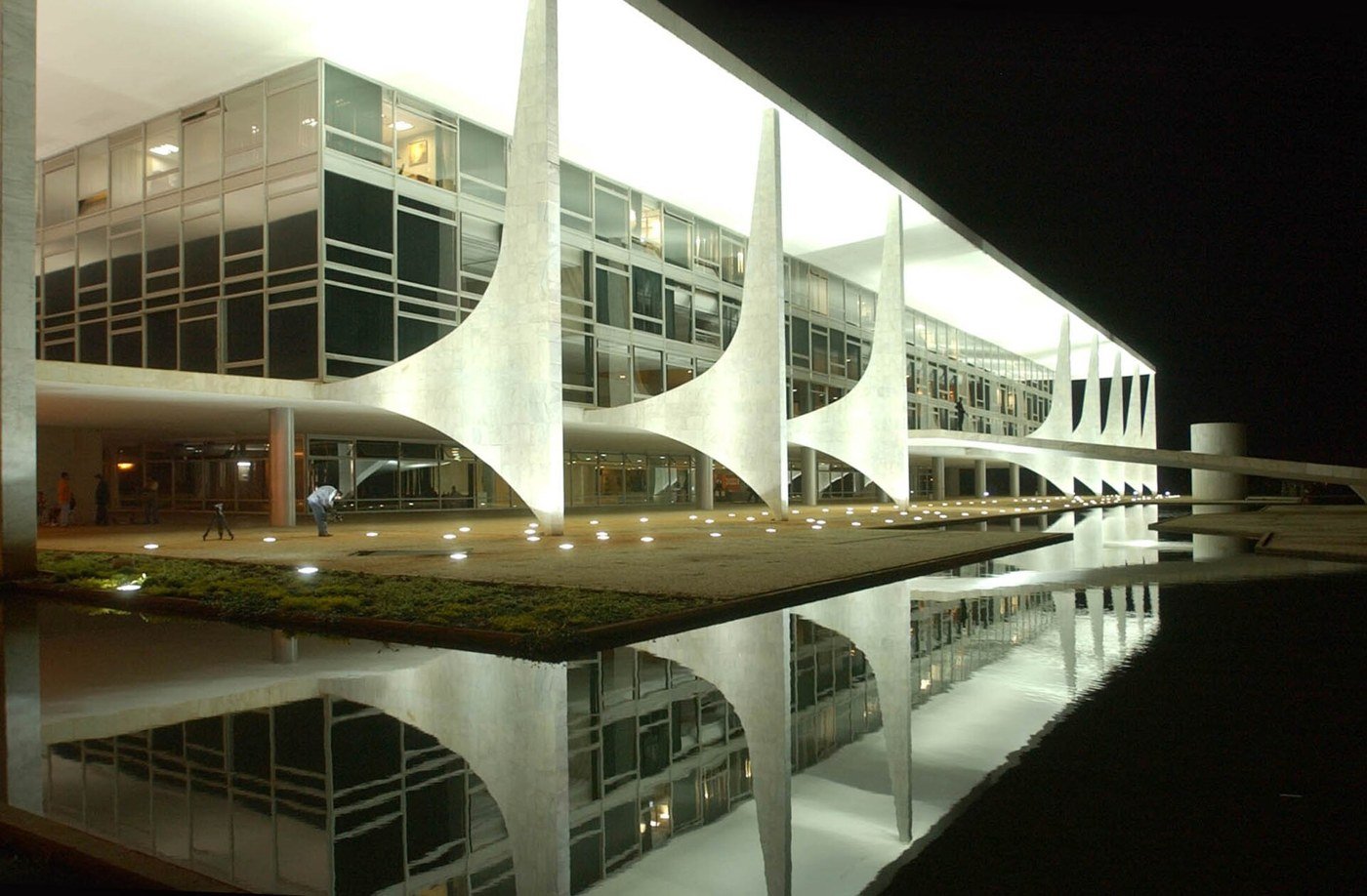
Result: Lula won the 25 October runoff with 51.79% of valid votes. The Superior Electoral Court has confirmed the count.
- Challenge: Flávio Bolsonaro has refused to concede and says he will seek annulment over the two-hour extension of voting. A filed petition or court ruling could not be confirmed, and the result stands.
- Inauguration: scheduled for 5 January 2027.
- Next update: when the electoral court rules on any challenge, and after the inauguration.
💡 Short Answer
Lula won Brazil’s 25 October 2026 runoff with 51.79% of valid votes, 64,256,232 to Flávio Bolsonaro’s 59,826,041, a margin of 3.58 points. Bolsonaro had led the 4 October first round, 47.03% to 45.16%. Bolsonaro has refused to concede; the electoral court has confirmed the result. Lula’s fourth term is due to start on 5 January 2027.
Brazil Election 2026: Final Results
Share of valid votes, as confirmed by the Superior Electoral Court.
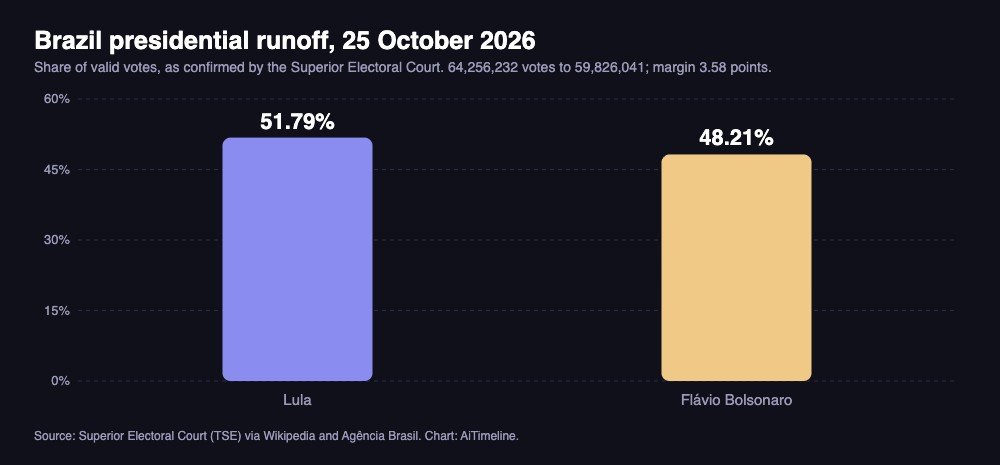
| Candidate | Party | Votes | Share of valid votes |
|---|---|---|---|
| Luiz Inácio Lula da Silva | Workers’ Party (PT) | 64,256,232 | 51.79% |
| Flávio Bolsonaro | Liberal Party (PL) | 59,826,041 | 48.21% |
| Winning margin | — | 4,430,191 | 3.58 points |
Turnout was 80.78%, up from 78.92% in the first round (Wikipedia). Valid votes exclude blank and spoiled ballots, which is why the shares add to 100%. The margin of 4,430,191 votes is narrow in a country with about 158 million registered voters, and the two finalists were separated by 3.58 points.
The Comeback: From 1.87 Points Behind to 3.58 Ahead
The 4 October first round and the 25 October runoff, side by side.
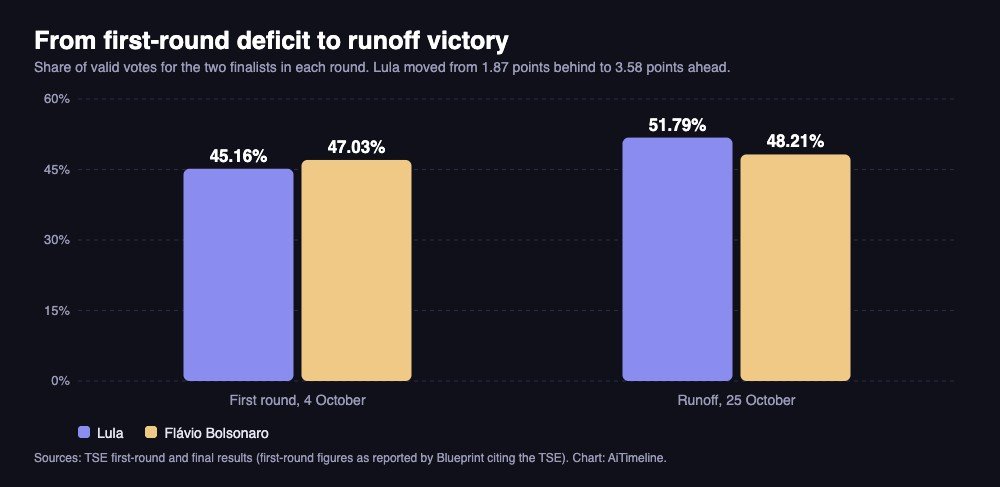
| Round | Lula | Flávio Bolsonaro | Gap |
|---|---|---|---|
| First round, 4 Oct 2026 | 45.16% | 47.03% | Lula 1.87 points behind |
| Runoff, 25 Oct 2026 | 51.79% | 48.21% | Lula 3.58 points ahead |
| Swing | +6.63 | +1.18 | 5.45 points in the margin |
Flávio Bolsonaro led the first round, but neither candidate reached the 50% needed to win outright. Lula gained 6.63 points between rounds and Bolsonaro 1.18, as voters who had backed other candidates chose between the finalists. It is the first time since direct presidential elections resumed in 1989 that the first-round leader lost the runoff (Wikipedia); AP describes it as a first since the end of military rule (PBS NewsHour).
Lula’s 2026 Win: Key Questions
The 2026 Brazil Election in Nine Points
- Result: Lula 51.79%, Flávio Bolsonaro 48.21% of valid votes.
- Votes: 64,256,232 for Lula, the highest total ever for a Brazilian presidential candidate.
- Margin: 4,430,191 votes, or 3.58 points.
- Comeback: Lula trailed by 1.87 points on 4 October and led by 3.58 on 25 October.
- First: the first time since 1989 that a first-round leader lost the runoff.
- Extension: voting ran two hours longer after both campaigns asked.
- Challenge: Bolsonaro refuses to concede; the court has confirmed the count.
- Congress: the Liberal Party is the largest party in both houses.
- Next: inauguration on 5 January 2027.
Lula Fourth Term Timeline, Latest First
From the 2026 runoff back to the founding of the Workers’ Party in 1980. Each entry is tagged and ends with why it matters.
2027
Fourth term scheduled to begin Ahead
Under Constitutional Amendment 111 of 2021, the president elected in 2026 is sworn in on 5 January 2027, not 1 January; governors take office the next day (TRE-PR). Lula will be 81, and a four-year term runs to January 2031.
2026
Court confirms the count; Bolsonaro refuses to concede 2026 result
The Superior Electoral Court (TSE) confirmed 64,256,232 votes (51.79%) for Lula and 59,826,041 (48.21%) for Flávio Bolsonaro (TSE; Wikipedia). TSE president Kassio Nunes Marques said the extra voting time did not affect the result (Fox News). Flávio Bolsonaro called the extension “unprecedented,” refused to concede and said he would ask for the election to be annulled; legal experts say the bar for that is high (Fox News; Buenos Aires Times). His Liberal Party president, Valdemar Costa Neto, said the party accepts the TSE-certified tallies (TRT World).
Status: a challenge has been announced. This page could not confirm a filed petition or a court ruling, and the result stands.
2026
Lula wins the runoff 2026 result
Lula won by 4,430,191 votes, 3.58 percentage points (TSE; Agência Brasil). Turnout was 80.78%, up from 78.92% in the first round (Wikipedia). Supreme Court Justice Cristiano Zanin ordered voting extended by two hours nationwide, three minutes before polls were due to close. Both campaigns had asked for it: Lula’s team cited transport problems, Bolsonaro’s cited heavy rain in the south (PBS NewsHour; Fox News).
2026
Flávio Bolsonaro leads the first round Campaign
Flávio Bolsonaro took 47.03% of valid votes to Lula’s 45.16%, a gap of 1.87 points or about 2.2 million votes; neither reached the 50% needed to win outright (TSE; Fox News). Voters also elected a new Congress that leans right: the Liberal Party (PL) became the largest party in both houses (Wikipedia).
2023
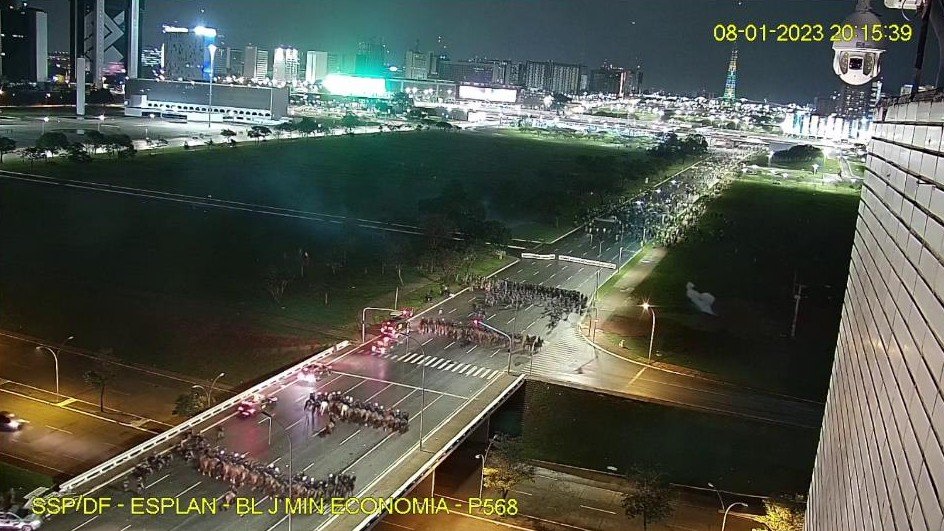
Attack on the Three Powers Plaza Campaign
Supporters of Jair Bolsonaro broke into the National Congress, the Planalto Palace and the Supreme Court in Brasília, a week after Lula took office (Wikipedia). Security forces cleared the buildings the same day.
2023
Third term begins Career
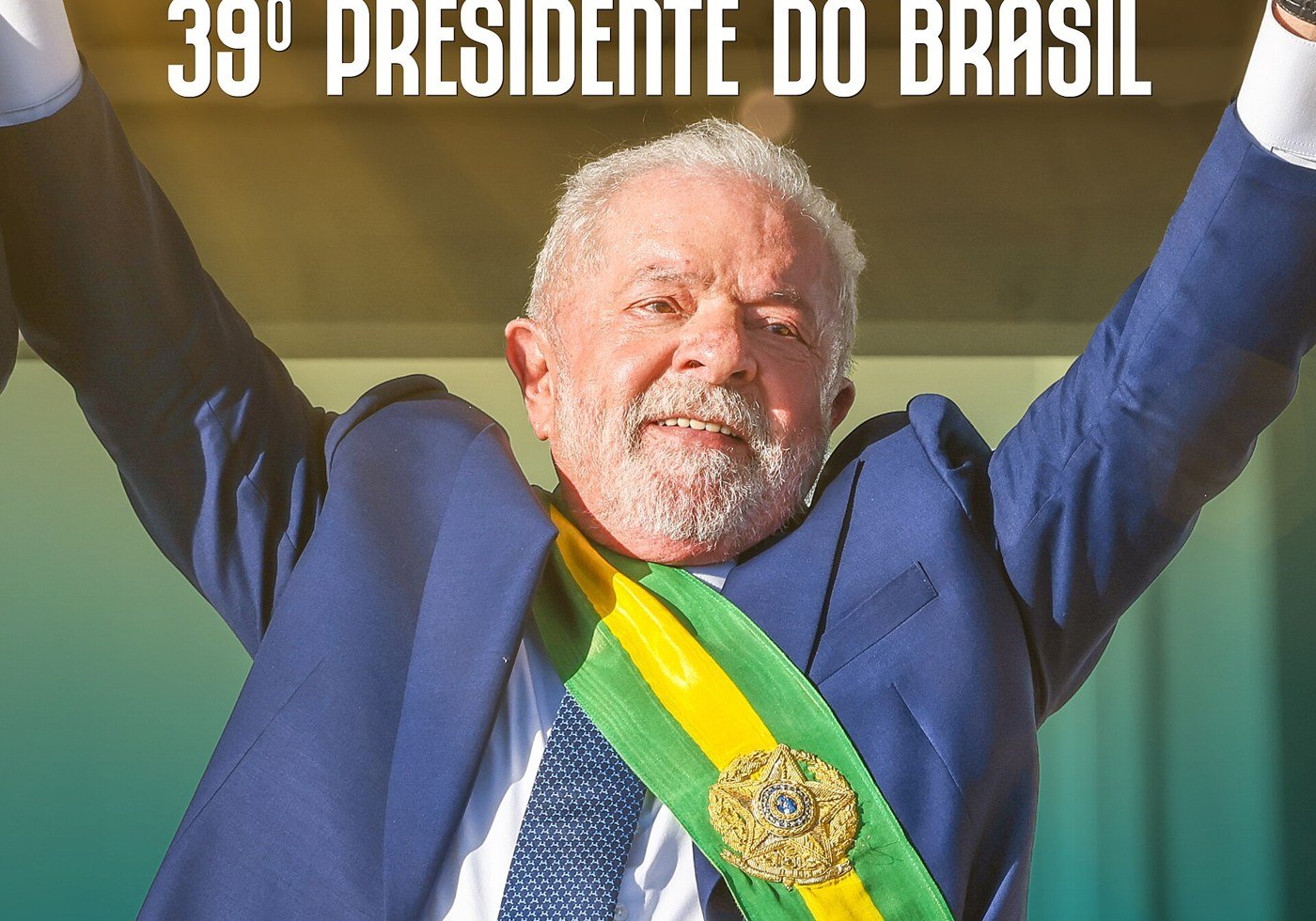
Lula was sworn in for a third term, the first president of Brazil’s democracy to win a third term (Latin America Daily Briefing; Brazilian government biography). The Planalto Palace described him as the 39th president of Brazil.
2022
Lula beats Jair Bolsonaro Career
Lula won the 2022 runoff with 50.90% of valid votes and 60,345,999 votes, the highest total in Brazilian history at that time (Wikipedia; Agência Brasil). Jair Bolsonaro became the first sitting president to lose a re-election bid since the end of military rule (Latin America Daily Briefing).
2021
Supreme Court annuls Lula’s convictions Court case
Justice Edson Fachin annulled Lula’s corruption convictions on 8 March 2021 because the federal court in Curitiba lacked jurisdiction over the cases, restoring his political rights. The full court upheld the decision 8-3 on 15 April (Wikipedia: imprisonment of Lula). The ruling did not declare him innocent; it sent the cases to another court.
8 Nov 2019
Lula jailed for 580 days Court case
Lula surrendered to police in Curitiba on 7 April 2018 to begin a sentence for corruption and money laundering, and was released on 8 November 2019 after the Supreme Court ruled that imprisonment before appeals are exhausted is unlawful (Wikipedia). The electoral court barred him from the 2018 election in September that year (Wikipedia).
2011
Lula leaves office with about 80% approval Career
Lula left the presidency with approval of about 80% (Wikipedia) and was succeeded by Dilma Rousseff, who won 55,752,529 votes in 2010 (Agência Brasil).
2006
Re-elected with 58.3 million votes Career
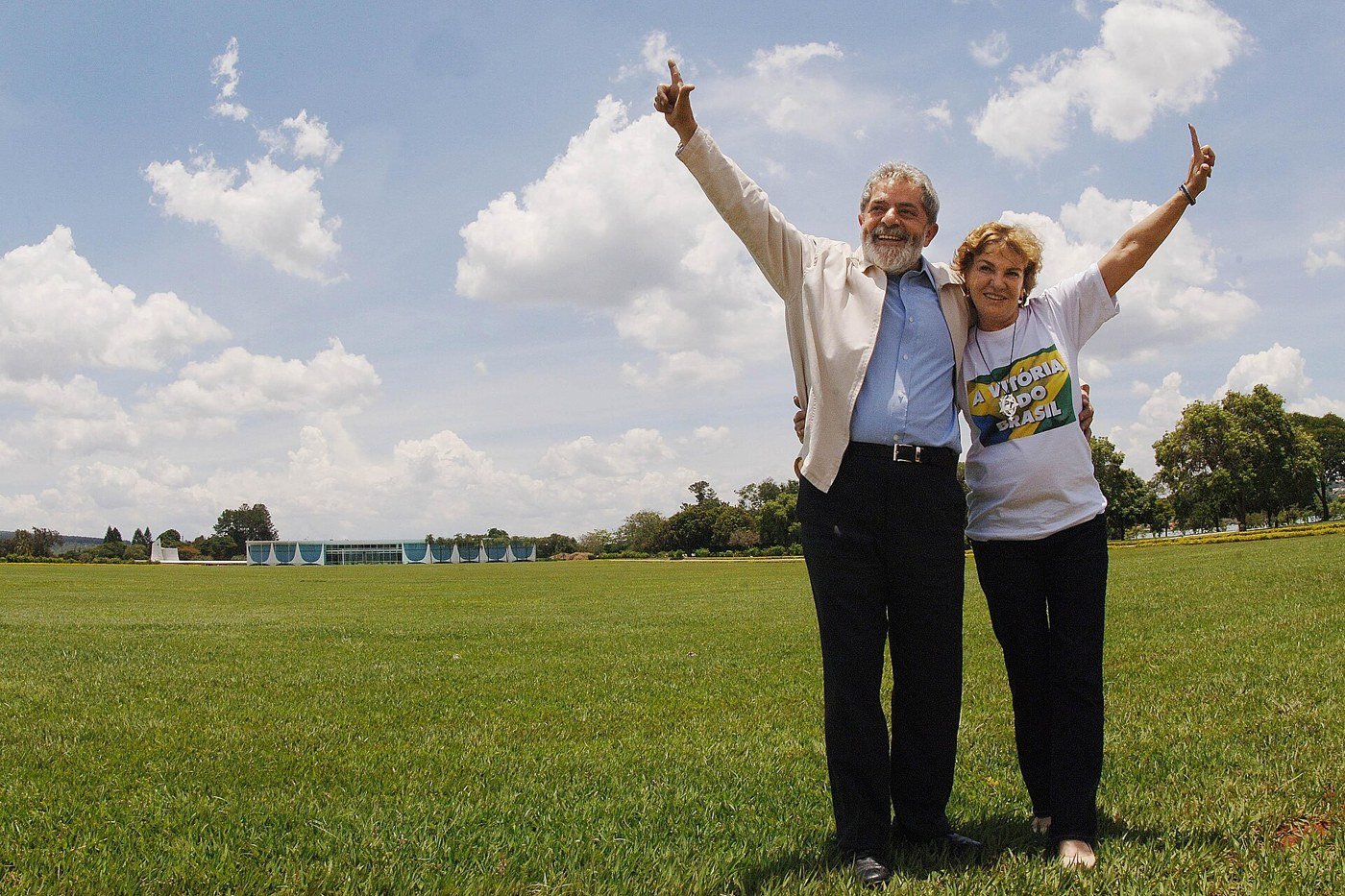
Lula won a second term in the runoff with 60.83% of valid votes and 58,295,042 votes (Wikipedia; Agência Brasil). He celebrated with supporters outside the Alvorada Palace the next day.
2002
First presidential victory Career
After three failed campaigns, Lula won the 2002 runoff with 61.27% of valid votes and 52,793,364 votes, and took office on 1 January 2003 (Wikipedia; Agência Brasil).
1989
First presidential run ends in defeat Career
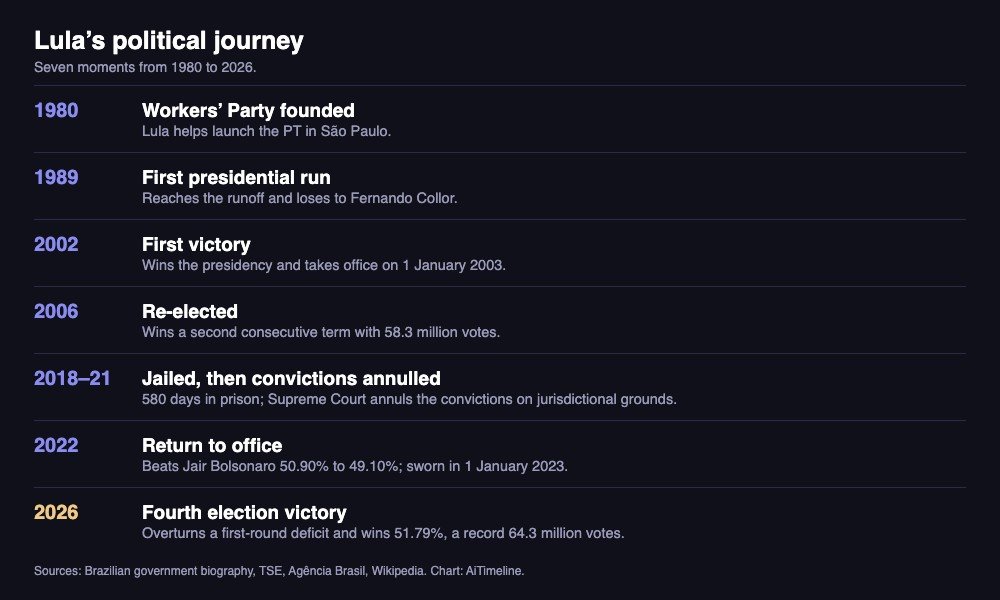
In Brazil’s first direct presidential election after military rule, Lula reached the runoff and lost to Fernando Collor de Mello, with 46.97% and 31,075,803 votes (Wikipedia). Collor won with 35,090,206 votes. Lula lost again to Fernando Henrique Cardoso in 1994 and 1998 (Agência Brasil).
1980
Workers’ Party founded Career
Lula was a founder of the Workers’ Party (PT), launched on 10 February 1980 out of the São Paulo metalworkers’ union movement (Wikipedia).
Lula’s Career at a Glance
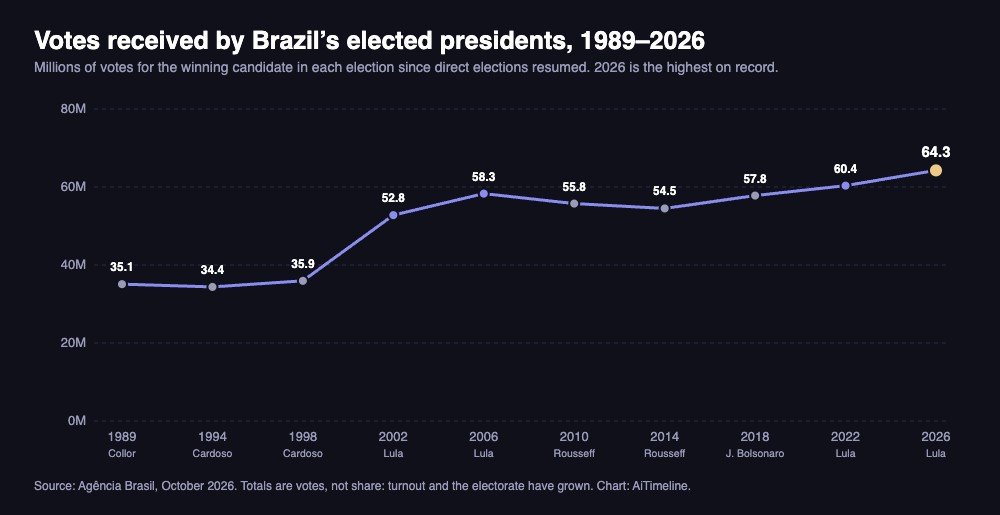
Brazil’s Presidential Vote Records, 1989–2026
Votes received by the elected president in each election since direct voting resumed.
| Election | Elected president | Votes received |
|---|---|---|
| 1989 | Fernando Collor de Mello | 35,090,206 |
| 1994 | Fernando Henrique Cardoso | 34,377,829 |
| 1998 | Fernando Henrique Cardoso | 35,936,916 |
| 2002 | Luiz Inácio Lula da Silva | 52,793,364 |
| 2006 | Luiz Inácio Lula da Silva | 58,295,042 |
| 2010 | Dilma Rousseff | 55,752,529 |
| 2014 | Dilma Rousseff | 54,501,118 |
| 2018 | Jair Bolsonaro | 57,797,847 |
| 2022 | Luiz Inácio Lula da Silva | 60,345,999 |
| 2026 | Luiz Inácio Lula da Silva | 64,256,232 |
The 2026 total is the largest in the series, ahead of Lula’s own 60,345,999 in 2022 (Agência Brasil). Totals are votes, not shares: the electorate and turnout have grown, so a higher total does not by itself mean a larger share of support. Lula’s four wins, by runoff share:
| Election | Opponent | Runoff share of valid votes | Votes |
|---|---|---|---|
| 2002 | José Serra | 61.27% | 52,793,364 |
| 2006 | Geraldo Alckmin | 60.83% | 58,295,042 |
| 2022 | Jair Bolsonaro | 50.90% | 60,345,999 |
| 2026 | Flávio Bolsonaro | 51.79% | 64,256,232 |
How Brazil’s Presidential Election Works
1. First round. Voters choose one candidate. A candidate who wins more than 50% of valid votes is elected outright.
2. Runoff. If nobody does, the top two meet in a runoff three weeks later: 4 October and 25 October in 2026.
3. Certification. The Superior Electoral Court (TSE) counts the votes, certifies the result and rules on disputes.
4. Inauguration. The winner is sworn in on 5 January under the 2021 amendment (TRE-PR). The Chamber of Deputies and Senate are seated on 1 February.
The New Congress Leans Right
Voters elected Congress on 4 October, the same day as the first round.
| Chamber of Deputies (513 seats) | Seats | Change |
|---|---|---|
| Liberal Party (PL) | 121 | +22 |
| FE Brasil (federation including the PT) | 88 | +7 |
| UPB | 87 | −19 |
| PSD | 43 | +1 |
| Republicanos | 41 | +1 |
| MDB | 36 | −6 |
The Liberal Party became the largest party in the 513-seat Chamber with 121 seats, up 22, and the largest bloc in the Senate, with 29 of 81 seats on Wikipedia’s tally (Wikipedia). Analysts describe the incoming majority as among the most conservative in Brazilian history (Fox News). Lula will need to negotiate budgets and laws with a Congress in which his own side is not the largest.
What the Record Shows About the Result
These are documented facts, not a full explanation of why Brazilians voted as they did.
Higher turnout. Turnout rose from 78.92% to 80.78% between rounds, bringing roughly three million more voters to the polls (Rio Times).
A US-facing campaign. Brazil faces tariffs imposed by Donald Trump, and Lula argued that a Bolsonaro presidency would let the United States control Brazil (PBS NewsHour).
Split tickets. The same electorate gave the right its biggest legislative result in years, so the presidential result was not a sweep for the left.
What Happens Next?
1. The challenge. Flávio Bolsonaro says he will seek annulment. Legal experts say the bar is high, the TSE president says the extension did not affect the result, and the Liberal Party says it accepts the certified tallies (Fox News; TRT World).
2. Congress. A conservative-leaning Congress will be seated on 1 February 2027, a month after the inauguration.
3. Inauguration. Lula is due to be sworn in on 5 January 2027, aged 81.
4. Relations with Washington. The tariffs imposed by the Trump administration remain a live issue (PBS NewsHour).
The Main Players
Luiz Inácio Lula da Silva
Born 27 October 1945; president 2003-2010 and from 2023. Won the 2026 runoff and is due to be sworn in for a fourth term on 5 January 2027.
Flávio Bolsonaro
Senator and son of Jair Bolsonaro. Led the first round on 4 October with 47.03% and lost the runoff; has refused to concede.
Jair Bolsonaro
President 2019-2022; lost to Lula in the 2022 runoff, 50.90% to 49.10%.
Cristiano Zanin
Ordered voting on 25 October extended by two hours; Bolsonaro allies note he was formerly Lula’s lawyer.
Kassio Nunes Marques
Head of the TSE, which confirmed the result and said the extension did not affect it.
Valdemar Costa Neto
Said the party accepts the TSE-certified tallies while seeking answers on pre-election social spending.
Explore More Timelines
People Also Ask
Frequently Asked Questions
A Result That Settles the Count, Not the Argument
Lula’s win is a record in votes and a comeback in shape: behind by 1.87 points on 4 October, ahead by 3.58 on 25 October. The electoral court has confirmed it. What it has not settled is the argument that follows: a refusal to concede, a conservative Congress and a divided electorate that gave Lula the presidency and the right the legislature. This page will be updated when the challenge is decided and after the 5 January 2027 inauguration.
Related AiTimeline Stories
⚠️ Editorial Note
Last updated 27 October 2026. Figures are from the Superior Electoral Court, cross-checked against Wikipedia, Agência Brasil and wire reports; the TSE pages blocked our automated checker, so quotes were verified from the secondary sources. We corrected the source brief on several points: both campaigns, not only Bolsonaro, asked for the extended voting hours; the comeback is the first since 1989 (AP says since 1985), not first in Brazil’s history; the Reuters link cited was a pre-election preview and is not used; claims about fiscal pressure and interest rates were unsourced and are omitted; and the annulment bid is described as announced because no filing could be confirmed.
Sources & further reading
Every dated entry above was checked against these references. Last reviewed 27 October 2026.
- Brazil's Superior Electoral Court (TSE): President announces Lula's re-election and second-round balance (26 October 2026)
- Brazil's Superior Electoral Court (TSE): Flavio Bolsonaro and Lula go to the runoff (October 2026)
- Agencia Brasil: Lula's vote count is the highest ever for a presidential candidate in Brazil (October 2026)
- PBS NewsHour: Lula beats Bolsonaro in Brazil runoff, securing a fourth presidential term (25 October 2026)
- Fox News: Incumbent leftist Lula da Silva wins fourth term as Brazil's president (October 2026)
- Buenos Aires Times: Flavio Bolsonaro to request annulment of Brazil election (26 October 2026)
- TRT World: Brazil's Liberal Party accepts runoff results despite Flavio Bolsonaro's call for annulment (October 2026)
- Rio Times: Brazil runoff turnout 80.8%, Lula ahead by 4.4 million (October 2026)
- Wikipedia: 2026 Brazilian general election
- Wikipedia: Imprisonment of Luiz Inacio Lula da Silva