Justice Yashwant Varma Cash Row: Full Timeline of the Controversy
Justice Yashwant Varma cash row timeline: the March 2025 fire, the Supreme Court inquiry, his resignation and the Parliament committee report tabled in
Latest Story
The Justice Yashwant Varma cash row began on the night of 14 March 2025, when a fire broke out in a storeroom at the official residence of a Delhi High Court judge and responders reportedly saw burnt currency notes in the debris. Varma denied the cash was his and alleged a conspiracy. The Supreme Court ran an in-house inquiry, Parliament ran a statutory one, and the judge resigned before it finished. On 12 August 2026 the Lok Sabha committee’s report was tabled, finding all three charges proved. This record separates what the inquiries found from what was alleged, and from what nobody has established, such as the amount.
💡 Short Answer
A fire at Justice Yashwant Varma’s Delhi residence on 14 March 2025 led to reports of burnt cash in a storeroom. A Supreme Court in-house committee found substance in the allegations; Parliament then formed its own committee. Varma resigned in April 2026. The committee’s report, tabled on 12 August 2026, found all three charges proved, but gave no amount and did not say he removed the notes himself. He denies the cash was his, and no criminal case has been reported.
Justice Varma Cash Row: Key Questions
The Case in Ten Points
- The fire: 14 March 2025, a storeroom at 30 Tughlaq Crescent, around 11:35 pm.
- The gap: the notes were never seized or counted, so the amount is unknown.
- The first inquiry: a three-judge in-house committee, set up 22 March, reported on 3 May 2025.
- The transfer: back to the Allahabad High Court, notified 28 March, with no judicial work.
- The recommendation: on 8 May 2025 Chief Justice Khanna wrote to the President and the Prime Minister recommending removal.
- The notice: 146 Lok Sabha MPs filed it on 21 July 2025; the Speaker formed a committee on 12 August.
- The courts: the Supreme Court rejected his challenges on 7 August 2025 and 16 January 2026.
- The resignation: reported 10 April 2026, before the hearing of his defence.
- The report: submitted 18 May and tabled 12 August 2026; all three charges proved.
- The limits: no amount, no proof he removed the notes, no evidence of a plot, no criminal conviction.
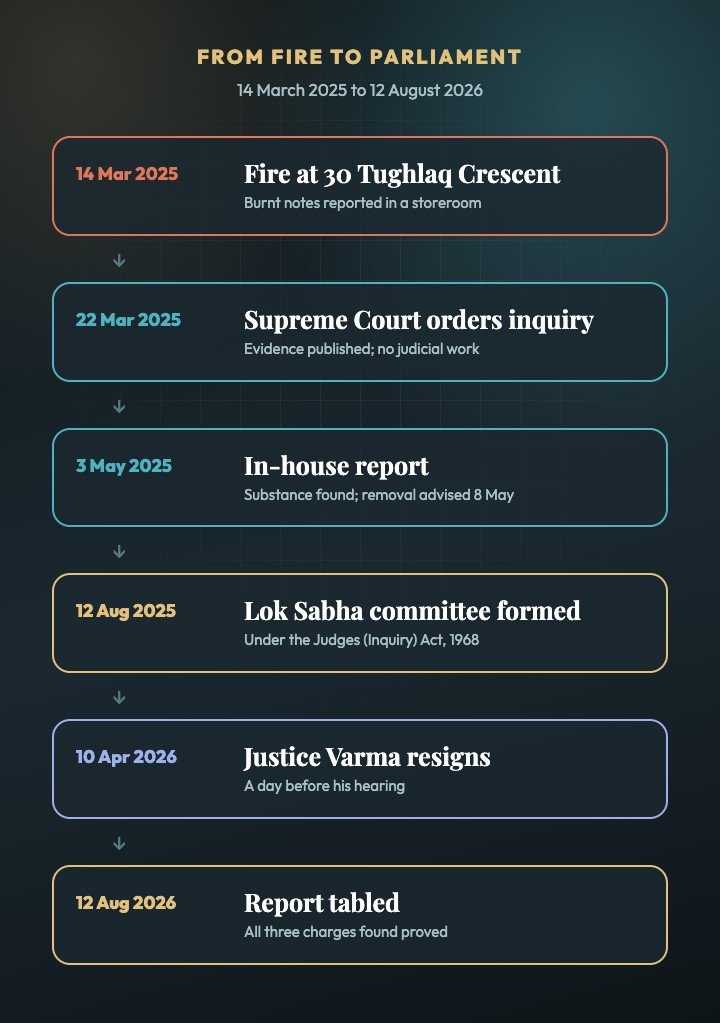
Timeline: Justice Yashwant Varma Cash Row, 2025–2026
Entries are colour-coded by track and run newest first. Findings are separated from allegations.
Inquiry report is tabled in Parliament: all three charges proved Parliament
What happened: The report, with the oral and documentary evidence, was laid before both Houses. The committee found that substantial ₹500 notes were present in the storeroom and that Varma failed to explain their presence, source or ownership. It also found the room was disturbed before it could be sealed and inspected, and that his explanations were evasive and unsatisfactory.
What it did not find: No page I could read gives a rupee figure, because the notes were never seized or counted. The committee did not say it had proved Varma personally removed them; its finding rested on failure to preserve evidence and acquiescence in the disturbance. It also found no evidence for his claim of a plot.
What comes next: Reports say the proceedings are now infructuous, since he has resigned, but that the findings are on the parliamentary record. As of 12 August the resignation had not been notified by the Union law ministry. I found no report of any further step after tabling.
Committee submits its report to Speaker Om Birla Parliament
What happened: The three-member committee, headed by Supreme Court Justice Aravind Kumar, handed its report to the Speaker. It had carried on after Varma’s resignation and his withdrawal from the proceedings, recording witness statements and examining photographs, videos and electronic material.
Justice Varma resigns, a day before his hearing was due Courts & resignation
What happened: Varma, by then a judge of the Allahabad High Court, wrote to the President resigning his post. Bar & Bench published the letter on 10 April; several outlets say it was sent on 9 April. The committee had been due to begin hearing his defence the next day.
The consequence: Under the Judges (Inquiry) Act the Houses can only vote to remove a sitting judge, so the removal motion lost its practical purpose. The committee still finished its report. Reports say the resignation had not been formally notified by 12 August.
Bombay High Court Chief Justice joins the committee Parliament
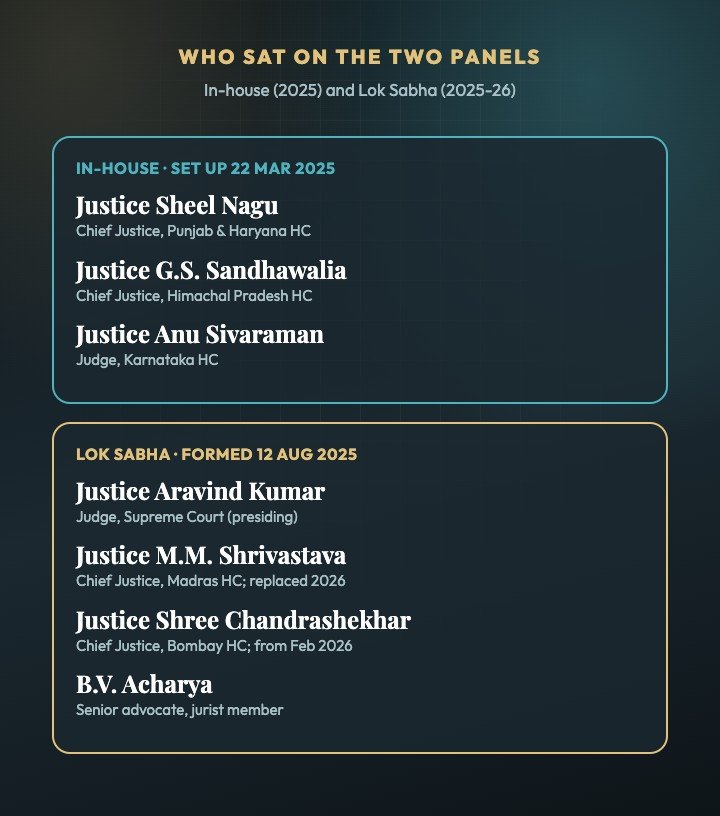
What happened: The Lok Sabha reconstituted the committee, with Bombay High Court Chief Justice Shree Chandrashekhar as the High Court member. Justice Aravind Kumar and senior advocate B.V. Acharya continued. The Madras High Court Chief Justice who had been on the original panel was due to retire.
Supreme Court rejects his challenge to the Lok Sabha panel Courts & resignation
What happened: Varma argued that notices had been given in both Houses on the same day, so the Speaker should not have formed a committee on her own while the Rajya Sabha was yet to decide. The Court found no illegality in the Speaker’s decision and said he was not entitled to relief.
Committee frames three articles of charge Parliament
What happened: According to reports, the committee, which first met in September, framed three charges. They concerned the unexplained currency, the failure to preserve the evidence and the quality of his explanations. Varma was given notice of the charges.
Speaker admits the motion and forms a three-member committee Parliament
What happened: Birla admitted the removal notice and constituted the committee under the 1968 Act. The Lok Sabha Secretariat told the Supreme Court the Rajya Sabha had not admitted its parallel notice, which is the point Varma later took to the Supreme Court. Birla said the proposal would stay pending until the committee reported.
Supreme Court dismisses his challenge to the in-house report Courts & resignation
What happened: Varma asked the Court to quash the in-house report and the Chief Justice’s removal recommendation. The bench held the petition not maintainable, said the in-house procedure has legal sanction, and noted that he had taken part in the inquiry before questioning its competence.
What the Court said: It also said the in-house report does not itself remove a judge: only Parliament, under the Constitution, can.
146 Lok Sabha MPs file the removal notice Parliament
What happened: On the first day of the Monsoon Session, MPs from across parties submitted notices to the Lok Sabha Speaker and the Rajya Sabha Chairman seeking Varma’s removal. Birla said he had received the proposal from 146 members, including Rahul Gandhi and Ravi Shankar Prasad.
Chief Justice Khanna writes to the President and the Prime Minister In-house inquiry
What happened: After Varma reportedly declined to resign, Khanna forwarded the committee’s report and his own recommendation that Parliament begin removal proceedings. This is the step that moved the matter from the judiciary to the Houses.
In-house committee finds substance in the allegations In-house inquiry
What happened: The three-judge panel examined witnesses and material from the night of the fire and concluded that there was enough substance in the allegations to warrant more serious action. The report was sent to the Chief Justice and later made public.
What it looked at: Who had access to the storeroom, what happened to the burnt material after the fire, and whether Varma’s explanations held up.
Transfer to Allahabad is notified, with no judicial work In-house inquiry
What happened: The Supreme Court Collegium proposed Varma’s return to his parent Allahabad High Court on 20 March and recommended it formally on 24 March. The government notified it on 28 March. The Chief Justice of Allahabad was told not to assign him judicial work for the time being.
The distinction: The Collegium treated the transfer as an administrative step, separate from the inquiry into the cash.
Chief Justice Khanna orders an inquiry and publishes the evidence In-house inquiry
What happened: Chief Justice Sanjiv Khanna appointed a three-member committee of High Court judges and directed that Varma be given no judicial work. In an unusual step the Court put the Delhi Chief Justice’s report, photographs and a video of the burnt notes on its website, along with Varma’s reply.
Delhi Chief Justice reports to the Chief Justice of India; Varma replies In-house inquiry
What happened: Upadhyaya sent a preliminary report. Varma was asked to explain the presence of cash, its source and the removal of the burnt material. He denied that he or his family had kept any cash there and said the storeroom was separate from his living area and open to staff.
Delhi police chief alerts the Chief Justice; Varma is questioned Fire & discovery
What happened: Photographs and video from the responders reached senior officials and the Delhi High Court Chief Justice was told. Varma, who had been away in Madhya Pradesh, returned to Delhi. On 17 March Upadhyaya met him; he said household items had been damaged, pointed out that the storeroom was open to staff and the CPWD, and raised the possibility of a conspiracy.
A storeroom fire at 30 Tughlaq Crescent, around 11:35 pm Fire & discovery
What happened: A fire broke out in a storeroom at the Delhi High Court judge’s bungalow. Firefighters and police who responded reportedly saw bundles of burnt and half-burnt currency notes in the debris. Varma was away from Delhi at the time.
What was not done: Nothing was seized, counted or inventoried on the night. That gap is why every later inquiry had to work from witness accounts, photographs and videos rather than a physical count.
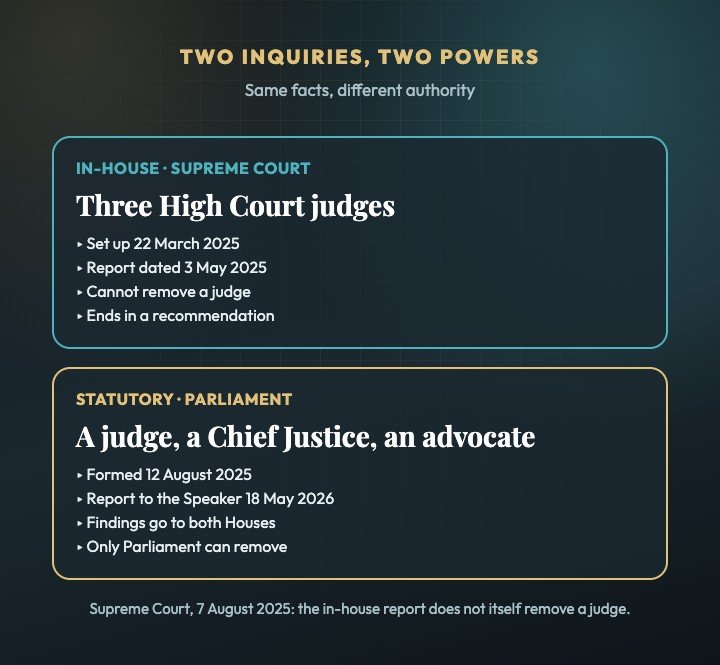
Two Inquiries, Two Powers
The judiciary could investigate and recommend. Only Parliament can remove.
The Supreme Court’s procedure
- Three High Court judges, set up 22 March 2025.
- Report dated 3 May 2025; found substance in the allegations.
- It cannot remove a judge.
The Judges (Inquiry) Act
- Formed by the Speaker on 12 August 2025.
- Report to the Speaker on 18 May 2026; tabled 12 August.
- Findings go to both Houses.
Two challenges, two refusals
- 7 August 2025: in-house report upheld as legally sanctioned.
- 16 January 2026: Speaker’s committee upheld.
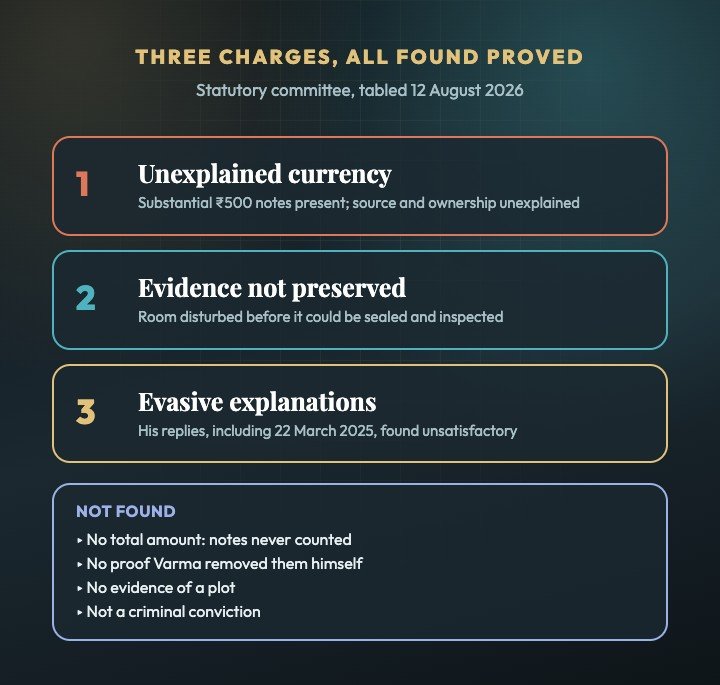
What the Report Found, and Did Not
A statutory finding, not a criminal verdict.
What the committee found
- Substantial Rs 500 notes were present in the storeroom.
- He did not explain their presence, source or ownership.
- The room was disturbed before it could be sealed and inspected.
- His explanations were evasive and unsatisfactory.
What it did not find
- No total amount: the notes were never counted.
- No proof that he personally removed them.
- No evidence the cash was planted or that anyone plotted against him.
- No criminal conviction.
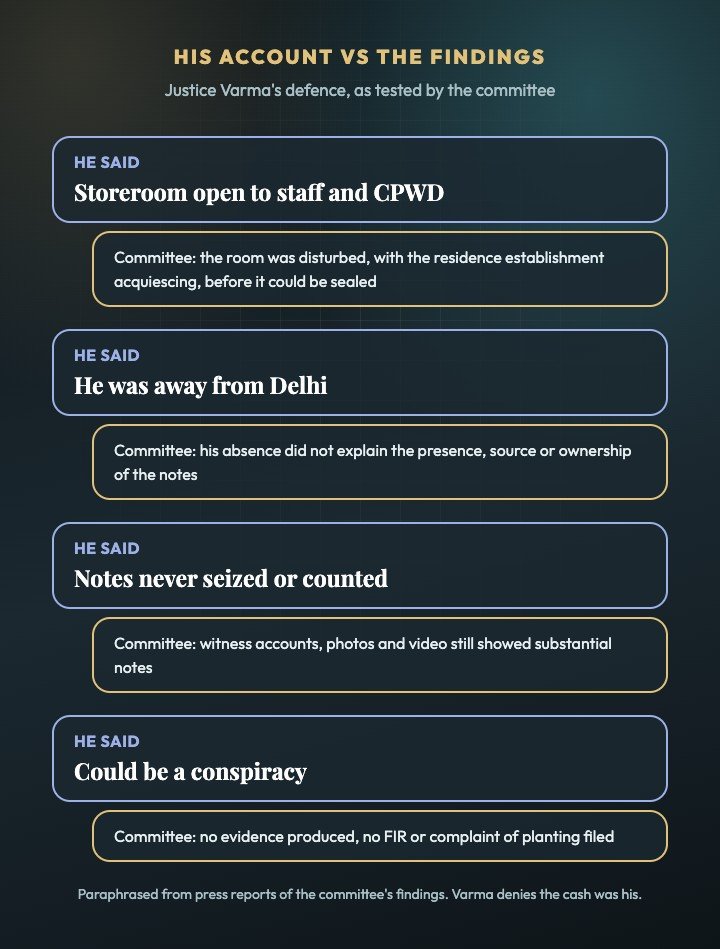
⚖️ His defence
Varma said the storeroom was separate from his living area and open to staff and CPWD personnel, that he was away, and that a conspiracy could not be ruled out. Reports on the findings say the committee accepted the accounts of official witnesses and the electronic evidence, found his explanations unsupported, and noted that no FIR or complaint alleging planting had been filed.
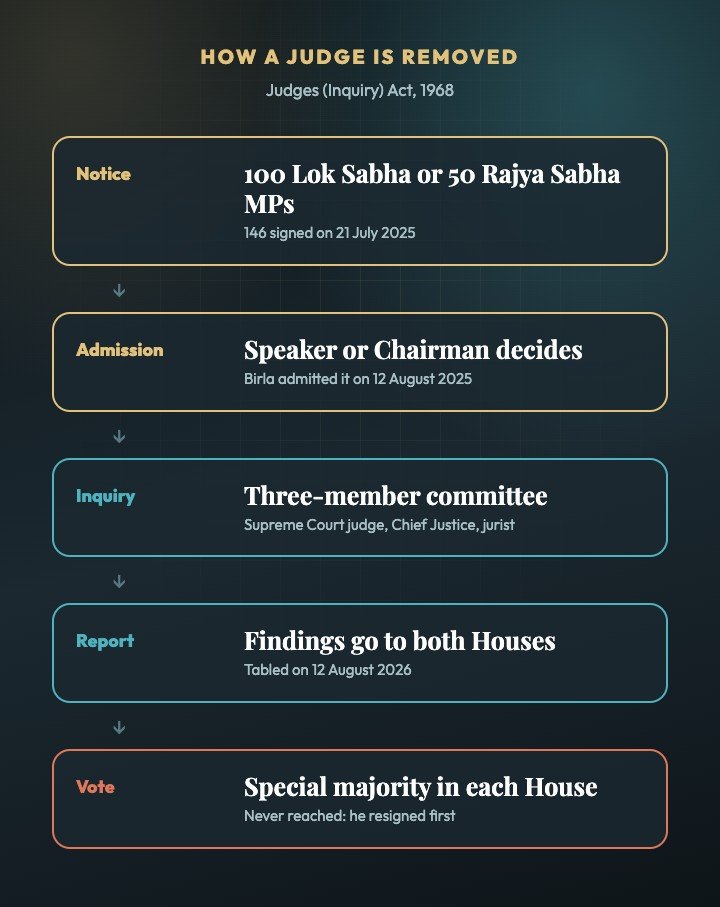
How a High Court Judge Is Removed
The steps under the Judges (Inquiry) Act, 1968, and where this case stopped.
| Date | Court or body | Decision |
|---|---|---|
| 22 Mar 2025 | Chief Justice of India | In-house committee formed; no judicial work for Varma |
| 8 May 2025 | Chief Justice of India | Removal recommended to the President and Prime Minister |
| 7 Aug 2025 | Supreme Court (Datta, Masih JJ.) | Challenge to in-house report dismissed |
| 12 Aug 2025 | Lok Sabha Speaker | Removal notice admitted; three-member committee formed |
| 16 Jan 2026 | Supreme Court | Challenge to the Speaker’s committee dismissed |
| 10 Apr 2026 | Justice Varma | Resignation reported |
| 12 Aug 2026 | Parliament | Report tabled in both Houses |
Why the Case Still Matters
Five questions it keeps raising.
Five lasting questions
- Evidence at the scene: nothing was seized or counted, so the central fact, the amount, is permanently unknown.
- Transparency: publishing photographs and video was unusual for the Supreme Court, and set a precedent.
- Two tracks: an in-house report cannot remove a judge, so the process needs Parliament to finish it.
- Resignation: leaving office ended the vote but not the findings.
- Accountability: the gap between a statutory finding and a criminal investigation is still open.
Key People
Roles as recorded in the reports.
| Name | Role | Part in the story |
|---|---|---|
| Justice Yashwant Varma | Judge, Delhi then Allahabad High Court | Owner of the residence; denies the cash was his; resigned April 2026 |
| Sanjiv Khanna | Chief Justice of India, 2025 | Formed the in-house inquiry; recommended removal on 8 May 2025 |
| D.K. Upadhyaya | Delhi High Court Chief Justice | First reported to the Chief Justice of India and questioned Varma |
| Sheel Nagu | Chief Justice, Punjab and Haryana High Court | Headed the in-house committee |
| G.S. Sandhawalia, Anu Sivaraman | High Court judges | Members of the in-house committee |
| Om Birla | Lok Sabha Speaker | Admitted the notice; formed the committee; received the report |
| Aravind Kumar | Supreme Court judge | Headed the parliamentary committee |
| Shree Chandrashekhar, B.V. Acharya | Bombay HC Chief Justice; senior advocate | Committee members (Chandrashekhar from February 2026) |
Explore More Timelines
People Also Ask
Frequently Asked Questions
Dated facts from the inquiry record.
⚠️ Editorial Note
This account is built from the Supreme Court’s published material and press reports. The committee’s findings are the result of a statutory inquiry, not a criminal trial, and Justice Varma has denied that the cash was his. I could not read the full report, so the three charges are paraphrased from press accounts and the exact wording may differ. Some details differ between outlets: the resignation is reported as sent on 9 April and published on 10 April, and the number of MPs signing the Lok Sabha notice is given as 145 or 146. Information is current as of 5 November 2026; I found nothing reported after 12 August on any further step in Parliament.
Related Reading on AiTimeline
Sources & further reading
Every dated entry above was checked against these references. Last reviewed 5 November 2026.
- Supreme Court of India: press release of 22 March 2025 on the Delhi High Court incident
- Supreme Court Observer: Justice Varma cash inquiry, the story so far
- The Week: Supreme Court dismisses plea challenging in-house inquiry report (7 August 2025)
- Free Press Journal: Speaker admits motion signed by 146 MPs (12 August 2025)
- The Indian Express: Supreme Court dismisses plea against inquiry committee (16 January 2026)
- Bar & Bench: Justice Yashwant Varma resigns as Allahabad High Court judge (10 April 2026)
- Press Information Bureau: Judges Inquiry Committee submits report (18 May 2026)
- Open: Parliament panel finds all three charges proved (12 August 2026)
- ThePrint: Probe report on Justice Yashwant Varma presented in Parliament (12 August 2026)