2001 Parliament Attack Timeline: Legal and Political Arc
Explore the 2001 Parliament attack timeline, from the December 13 assault and Operation Parakram to Afzal Guru's Supreme Court verdict and execution.
Latest Story
This 2001 Parliament attack timeline follows the case from the gun battle at Parliament House on 13 December 2001 to Afzal Guru’s execution in February 2013, and the arguments that have continued since. Five armed men were killed before they could reach the main building, but nine people died defending it. Within days India had arrested four people and begun Operation Parakram, a ten-month military standoff with Pakistan. In court, the four accused ended up with four different outcomes: one hanged, one released after a reduced sentence, and two acquitted. This page sets out what each court decided, corrects a common error about the High Court verdict, and keeps the prosecution’s case, the judges’ findings and the political debate separate.
💡 Short Answer
On 13 December 2001 five gunmen attacked India’s Parliament; nine defenders and all five attackers died. Four people were tried under POTA. The trial court sentenced three to death in December 2002, but the Delhi High Court acquitted two in 2003 and the Supreme Court cut a third sentence in 2005. Only Afzal Guru’s death sentence survived; he was hanged on 9 February 2013.
2001 Parliament Attack: Key Questions
The Case in Ten Points
- Attack: 13 December 2001, about 30 minutes of fighting at Parliament House.
- Toll: nine killed (eight security personnel and a gardener), 16 injured; all five attackers killed.
- Arrests: four people on 15 December 2001, in Delhi and Srinagar.
- Standoff: Operation Parakram ran from December 2001 to the pullback order of 16 October 2002.
- Trial: special POTA court, Judge S.N. Dhingra; three death sentences on 18 December 2002.
- High Court: 29 October 2003, Geelani and Afsan acquitted; death confirmed for Afzal and Shaukat.
- Supreme Court: 4 August 2005, Afzal’s death upheld; Shaukat’s cut to ten years.
- Confession: the Supreme Court excluded Afzal Guru’s POTA confession and relied on circumstantial evidence.
- POTA: repealed on 21 September 2004; pending cases continued under a saving clause.
- Execution: mercy plea rejected 3 February 2013; hanged in Tihar on 9 February 2013.
Timeline: The Attack, the Standoff, the Courts and After
Newest first. Colour shows which phase each event belongs to.
Approaching 25 years, the case is closed but still argued over After 2013
Where things stand: Afzal Guru was executed in 2013. S.A.R. Geelani and Afsan Guru were acquitted and their acquittals stand. Shaukat Hussain Guru served a reduced sentence and was released in 2010. No other person has been tried in India for the conspiracy; the Jaish-e-Mohammed leaders named by the prosecution were never brought to court.
What is still debated: The quality of Afzal Guru’s legal representation at trial, the Supreme Court’s “collective conscience” reasoning on sentence, and the way his execution was carried out remain subjects of legal and political argument.
Security breach inside the Lok Sabha on the 22nd anniversary After 2013
What happened: Two men jumped from the visitors’ gallery into the Lok Sabha chamber and released coloured smoke, while two others protested outside. All were arrested, and police later charged the group under the Unlawful Activities (Prevention) Act.
Why it matters: It happened on the anniversary of the 2001 attack and reopened questions about how visitors’ passes are issued and screened.
S.A.R. Geelani dies After 2013
Who he was: An Arabic lecturer at Zakir Husain College, Geelani was sentenced to death by the trial court in 2002, acquitted by the Delhi High Court in 2003, and had his acquittal upheld by the Supreme Court in 2005.
After acquittal: He remained a public campaigner on detention and Kashmir issues and was himself arrested in a sedition case in 2016 over a Delhi event, in which he got bail.
JNU event on the anniversary of the execution leads to sedition case After 2013
What happened: A campus event marking the third anniversary of Afzal Guru’s execution led to allegations that anti-India slogans were raised. Delhi Police filed a sedition case, and student leaders including Kanhaiya Kumar were arrested and later released on bail.
Why it matters: It showed how the case had moved from the courtroom into national politics, with the execution itself becoming a dividing line.
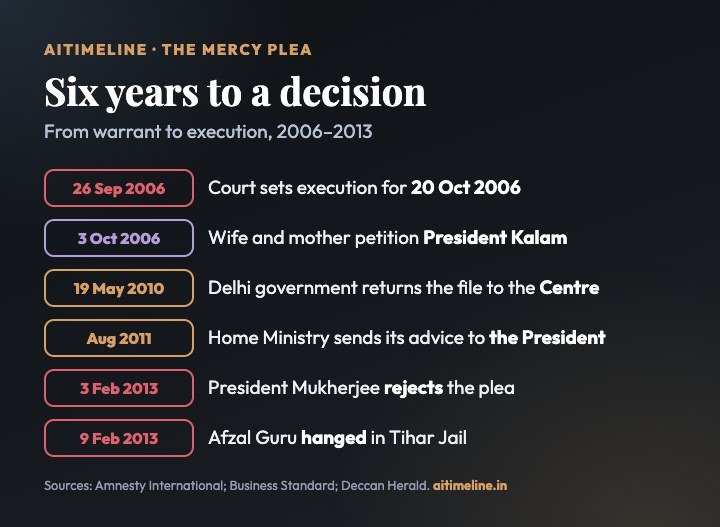
Afzal Guru hanged in Tihar Jail Mercy plea 2006-13
What happened: Afzal Guru was hanged in Tihar Jail, New Delhi, and buried inside the prison. Authorities imposed a curfew in parts of the Kashmir Valley.
The controversy: His family said they learned of the execution from news reports and that the official letter informing them arrived after he had been hanged. Critics also questioned why his mercy petition was taken up ahead of others pending longer.
President Pranab Mukherjee rejects the mercy petition Mercy plea 2006-13
What happened: President Pranab Mukherjee rejected Afzal Guru’s mercy petition, which had been pending since October 2006. The decision cleared the way for the execution six days later.
Process: Under Article 72 the President acts on the advice of the Union government; the Home Ministry had recommended rejection.
Home Ministry sends the mercy file to the President Mercy plea 2006-13
What happened: The Union Home Ministry forwarded its recommendation on Afzal Guru’s petition to Rashtrapati Bhavan, after years in which the file moved between the Delhi government and the Centre.
Why it took so long: Mercy petitions have no fixed time limit, and the long delay became a political issue in its own right, with the BJP accusing the UPA government of stalling.
Shaukat Hussain Guru released from Tihar Mercy plea 2006-13
What happened: Shaukat Hussain Guru walked out of Tihar Jail at the end of December 2010, about a year before his ten-year term would have ended, after earning remission.
His path through the courts: He was sentenced to death by the trial court and the High Court. The Supreme Court acquitted him of murder and conspiracy and convicted him only of concealing a design to wage war.
Delhi government returns the file, reportedly backing rejection Mercy plea 2006-13
What happened: The Delhi government sent Afzal Guru’s file back to the Union Home Ministry. Reports said it endorsed the rejection of the mercy plea.
Why Delhi was involved: Because the trial was held in Delhi, the territory’s government was asked for its view before the Centre advised the President.
Supreme Court dismisses the curative petition Appeals 2003-07
What happened: The Supreme Court dismissed Afzal Guru’s curative petition, the final stage of challenge after a review petition. His death sentence was now beyond any further court remedy.
Correction: Some timelines describe this as the review petition. The review was dismissed in 2005; the January 2007 order was on the curative petition.
Wife and mother file a mercy petition with President Kalam Mercy plea 2006-13
What happened: Afzal Guru’s wife, Tabassum, and his mother asked President A.P.J. Abdul Kalam to commute his death sentence. The execution set for 20 October 2006 did not go ahead.
Debate: The petition split opinion: some argued that his trial had been unfair, others that delaying the sentence dishonoured those killed in the attack.
Delhi court sets the execution for 20 October 2006 Mercy plea 2006-13
What happened: A Delhi sessions court issued the warrant fixing Afzal Guru’s execution for 6 a.m. on 20 October 2006 at Tihar Jail.
Next: The mercy petition filed a week later put the date on hold.
Review petition dismissed Appeals 2003-07
What happened: The Supreme Court rejected Afzal Guru’s petition asking it to review the 4 August 2005 judgment.
What was left: A curative petition, which the court dismissed in January 2007, and then a mercy petition to the President.
Supreme Court upholds Afzal Guru’s death sentence; Shaukat’s cut to ten years Appeals 2003-07
Afzal Guru: The court threw out his confession because the police had not followed the safeguards POTA required, but held that circumstantial evidence, including phone records and recoveries, proved his part in the conspiracy. It confirmed his death sentence, saying “the collective conscience of the society will only be satisfied if the capital punishment is awarded”.
The others: It upheld the High Court’s acquittals of S.A.R. Geelani and Afsan Guru. It acquitted Shaukat Hussain Guru of murder and conspiracy, convicting him only under Section 123 IPC for concealing a design to wage war, with ten years of rigorous imprisonment and a fine of Rs 25,000.
Geelani shot and wounded in Delhi Appeals 2003-07
What happened: While the Supreme Court appeals were pending, S.A.R. Geelani was shot several times by an unidentified gunman outside the home of a lawyer working on his case. He survived.
Investigation: No one was convicted for the shooting.
POTA repealed by ordinance Appeals 2003-07
What happened: The new UPA government repealed the Prevention of Terrorism Act, 2002, first by ordinance and then by an Act of Parliament deemed to be in force from 21 September 2004. At the same time it moved several anti-terror provisions into the Unlawful Activities (Prevention) Act.
Effect on this case: A saving clause kept pending prosecutions alive, so the Parliament attack appeals continued under POTA, even though the law no longer existed for new cases.
Seven appeals reach the Supreme Court Appeals 2003-07
Who appealed: Afzal Guru and Shaukat Hussain Guru challenged their convictions and death sentences. The State appealed against the acquittals of S.A.R. Geelani and Afsan Guru.
The questions: Whether intercepted phone calls and POTA confessions were admissible, whether circumstantial evidence proved conspiracy, and whether the death penalty was justified.
Delhi High Court acquits Geelani and Afsan, confirms two death sentences Appeals 2003-07
What it decided: The High Court dismissed the appeals of Afzal Guru and Shaukat Hussain Guru and confirmed both death sentences, adding a death sentence under Section 121 IPC (waging war) on the State’s appeal. It acquitted S.A.R. Geelani and Afsan Guru of all charges.
Correction: Many timelines, including the brief this page started from, say the High Court cut Shaukat’s sentence to ten years. It did not: it confirmed his death sentence. The reduction came from the Supreme Court in 2005.
Ghazi Baba killed in Srinagar Appeals 2003-07
What happened: Security forces killed Ghazi Baba, a Jaish-e-Mohammed operations chief, in an encounter in Srinagar. Indian authorities described him as one of the masterminds of the Parliament attack.
In the case: He was among the proclaimed offenders named by the prosecution who never faced trial.
Special POTA court convicts three and sentences them to death Trial 2002
Verdict: Afzal Guru, Shaukat Hussain Guru and S.A.R. Geelani were convicted of conspiracy, murder and waging war, and of offences under POTA and the Explosive Substances Act, and sentenced to death.
Afsan Guru: Navjot Sandhu, known as Afsan Guru, Shaukat’s wife, was acquitted of all charges except Section 123 IPC (concealing a design to wage war) and sentenced to five years of rigorous imprisonment.
India orders troops back from the border Attack and standoff
What happened: The Cabinet Committee on Security decided to pull back troops from forward positions on the international border, while keeping them along the Line of Control.
Cost: According to figures the Defence Minister gave Parliament, as reported by Outlook, 1,874 soldiers were killed or injured between December 2001 and October 2002, without a war being fought.
Trial under way; Afzal Guru’s defence becomes an issue Trial 2002
What happened: The prosecution’s evidence was heard through the second half of 2002. On 8 July Afzal Guru told the court he was not satisfied with his court-appointed lawyer and asked for a senior advocate; the court appointed another amicus, but he was effectively without a lawyer of his choice for much of the trial.
Why it matters: His lack of effective representation became the main argument of those who questioned the fairness of his trial. The Supreme Court considered it and held that he had not been denied a fair trial.
Charges framed against all four accused Trial 2002
What happened: The special court framed charges of conspiracy, murder, waging war against the government and terrorism offences under POTA. All four accused pleaded not guilty.
Background: POTA had been passed by a joint sitting of Parliament and came into force on 28 March 2002, replacing an ordinance in force at the time of the attack.
Kaluchak attack brings the standoff to a second peak Attack and standoff
What happened: Militants attacked a bus and an army family quarters at Kaluchak, killing more than 30 people, many of them women and children of soldiers.
Escalation: Coming during the mobilisation, the attack pushed India and Pakistan close to war again in May and June 2002, before US and British diplomacy helped ease tensions.
Delhi Police file the charge-sheet Trial 2002
What happened: The Special Cell of Delhi Police filed its final report against Afzal Guru, Shaukat Hussain Guru, his wife Afsan Guru and S.A.R. Geelani. Leaders of Jaish-e-Mohammed were named as proclaimed offenders.
The evidence: The case rested on phone records, recoveries such as a laptop and Rs 10 lakh found in a truck, disclosure statements and confessions recorded under POTA.
Musharraf bans Jaish-e-Mohammed and Lashkar-e-Taiba Attack and standoff
What happened: Pervez Musharraf announced bans on Jaish-e-Mohammed and Lashkar-e-Taiba and said Pakistan would not allow its territory to be used for terrorism, while maintaining support for the Kashmir cause.
Indian response: India welcomed the words but kept its troops in place, saying it would judge Pakistan by action on the ground.
India recalls its High Commissioner and cuts links Attack and standoff
What happened: India recalled its High Commissioner from Islamabad and later suspended the Samjhauta Express and the Delhi-Lahore bus.
Demand: India asked Pakistan to act against Lashkar-e-Taiba and Jaish-e-Mohammed and to hand over people it said were wanted for terrorism.
Operation Parakram: India mobilises for war Attack and standoff
What happened: India began its largest military mobilisation since 1971, moving troops to the international border and the Line of Control. The government later dated the operation from 19 December 2001. Pakistan mobilised in response.
The risk: With both countries nuclear-armed since 1998, the standoff was watched closely abroad, and the US, UK and others pressed both sides to step back.
Four arrested within two days Attack and standoff
What happened: According to the prosecution, S.A.R. Geelani was arrested at his Delhi home at about 10 a.m. and Afsan Guru at about 10.45 a.m. Srinagar police then stopped a truck registered in her name and arrested Afzal Guru and Shaukat Hussain Guru, recovering a laptop and Rs 10 lakh.
How they were traced: Police said phone numbers found on the dead attackers led them to the accused.
Five gunmen attack Parliament House Attack and standoff
What happened: Five heavily armed men drove into the Parliament complex in a white Ambassador car with a red beacon and a forged Home Ministry sticker. When security staff challenged them near Gate 11, the car hit the Vice-President’s vehicle and the men opened fire. A gun battle of about 30 minutes followed, and all five attackers were killed.
The toll: Nine people died: eight security personnel and a gardener. Sixteen were injured, 13 of them security men. The attackers never got inside the main building, where ministers and MPs were present.
The Legal Arc: Four Accused, Four Outcomes
The same evidence, three courts, and very different results.
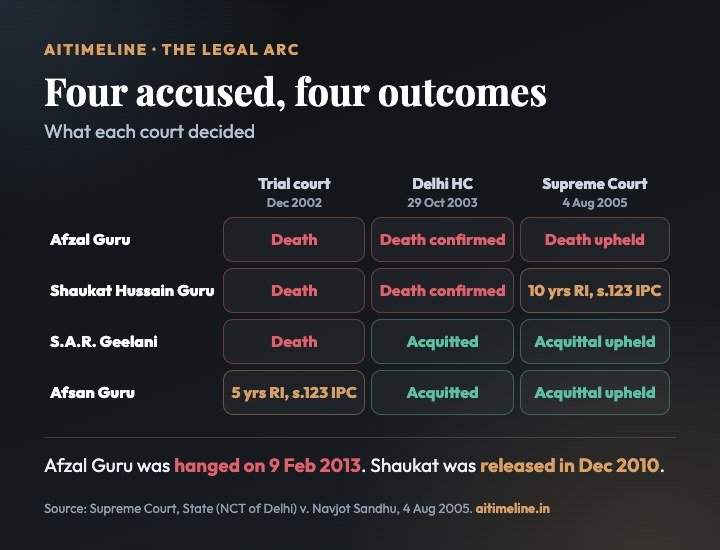
| Accused | Trial court, Dec 2002 | Delhi High Court, 29 Oct 2003 | Supreme Court, 4 Aug 2005 | What happened next |
|---|---|---|---|---|
| Mohammad Afzal Guru | Death | Death confirmed | Death upheld | Hanged 9 Feb 2013 |
| Shaukat Hussain Guru | Death | Death confirmed | 10 years RI, Section 123 IPC only | Released Dec 2010 |
| S.A.R. Geelani | Death | Acquitted | Acquittal upheld | Died 24 Oct 2019 |
| Navjot Sandhu (Afsan Guru) | 5 years RI, Section 123 IPC | Acquitted | Acquittal upheld | Free |
Often claimed
- The High Court reduced Shaukat Guru’s sentence to ten years.
- Afsan Guru served five years for the attack.
- All four accused were convicted.
What the record shows
- The High Court confirmed his death sentence; the Supreme Court gave ten years.
- She was acquitted by the High Court, and the acquittal was upheld.
- Two were acquitted; one was cleared of murder and conspiracy.
13 December 2001: Thirty Minutes at Parliament
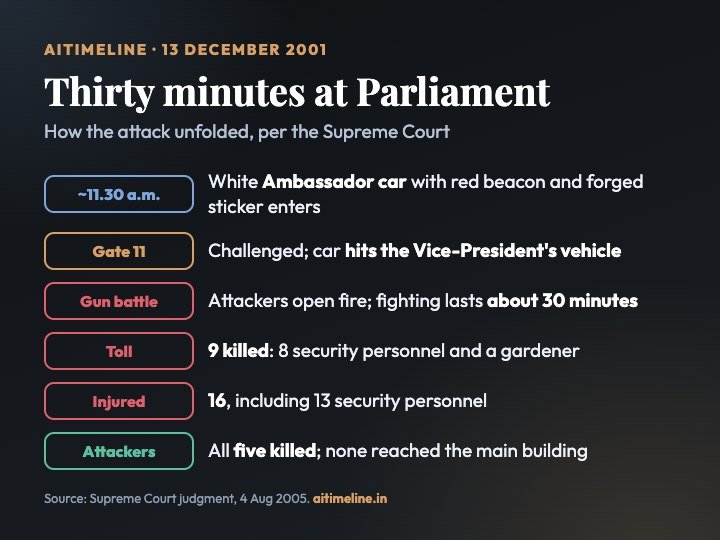
Both Houses had adjourned shortly before the attack, but ministers, MPs and staff were still inside. The men who stopped the attackers were Delhi Police personnel, CRPF and Parliament Watch and Ward staff, several of whom died at the gates. Constable Kamlesh Kumari of the CRPF, who raised the alarm and was killed, was posthumously awarded the Ashoka Chakra.
The Political Arc: From Parliament to the Brink of War
Diplomatic, economic and military pressure ran together for ten months.
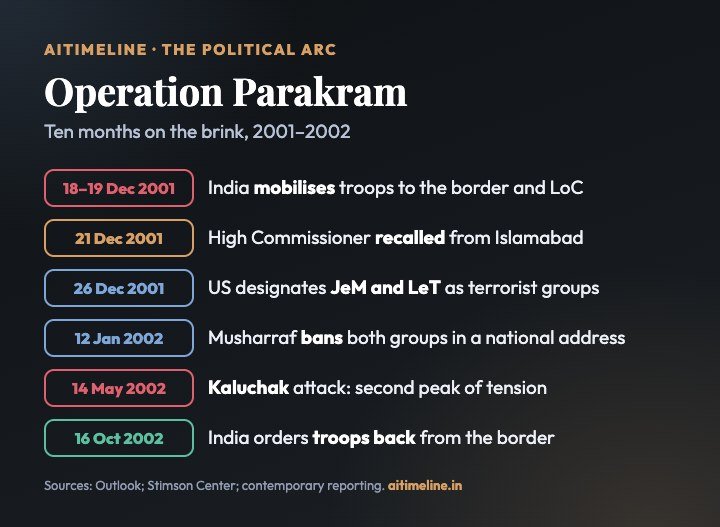
India’s demand was that Pakistan act against the groups it held responsible and hand over people wanted in India. Musharraf’s January 2002 ban on Jaish-e-Mohammed and Lashkar-e-Taiba eased the first crisis, but the Kaluchak attack in May brought the two armies close to war again. US and British envoys shuttled between the capitals. When India ordered the pullback in October 2002, it had not fought a war, and military writers have argued ever since over whether the mobilisation achieved its aims or showed the limits of coercion between nuclear-armed states.
Every Stage in Court
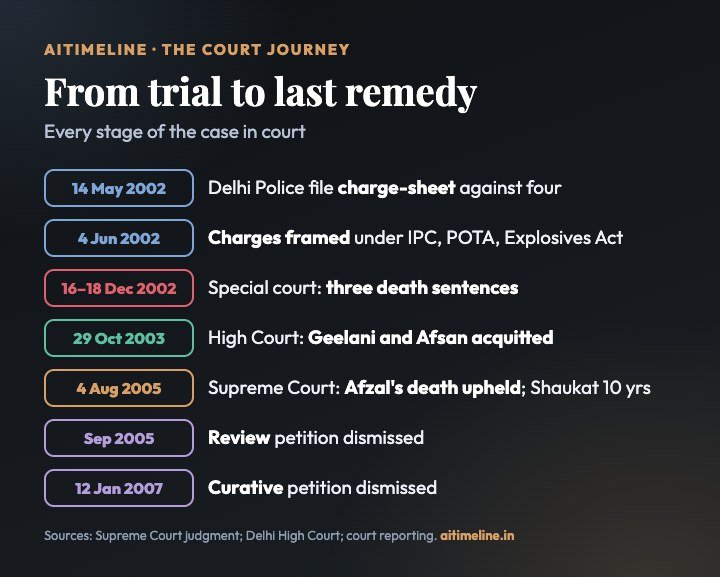
Circumstantial
- Phone records linking Afzal to the attackers.
- Laptop and Rs 10 lakh in a truck.
- Recoveries he led police to.
The confession
- Recorded under POTA.
- Safeguards not followed.
- Inadmissible, said the Supreme Court.
The sentence
- “Collective conscience” reasoning.
- Weak defence at trial.
- No direct evidence of his role in the attack itself.
The Mercy Plea and the Execution
Six years between the petition and the decision.
Why the execution is still argued over
- Notice: his family said they were not told in time to meet him or challenge the rejection.
- Burial: his body was buried inside Tihar Jail and not returned to his family.
- Order: critics asked why his petition was decided ahead of older ones.
- Politics: the six-year delay had been a campaign issue, which shaped how both the delay and the hanging were read.
- Later law: in 2014 the Supreme Court held that unexplained delay in deciding mercy petitions can justify commuting a death sentence, and that prisoners must be told of rejection.
The POTA Legacy: Security Versus Civil Liberties
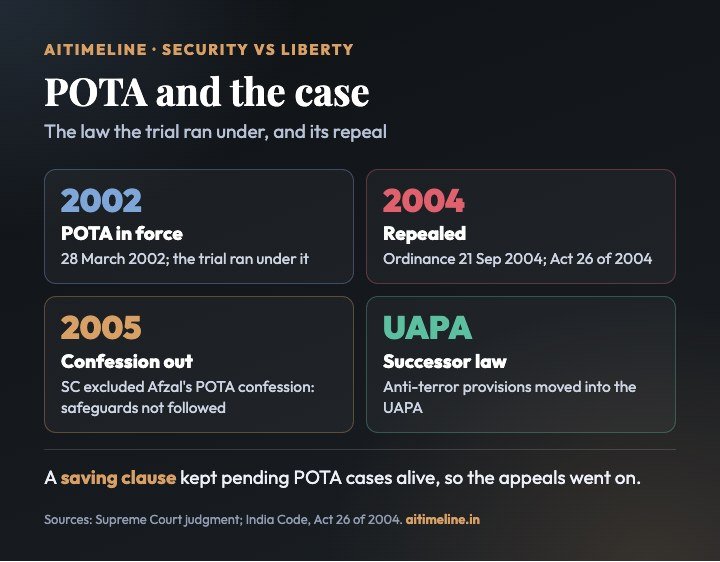
The Prevention of Terrorism Act allowed confessions to police officers to be used as evidence, a sharp departure from ordinary criminal law, in return for safeguards on how they were recorded. In this case the Supreme Court found those safeguards had not been followed and discarded Afzal Guru’s confession, while still upholding his conviction. That outcome is cited both by those who say the safeguards worked and by those who say the law invited abuse. After POTA’s repeal in 2004, many of its provisions lived on in an amended Unlawful Activities (Prevention) Act, which has been strengthened several times since.
Why the 2001 Parliament Attack Still Matters
| Theme | Why it matters |
|---|---|
| Security of institutions | Even Parliament in session was reachable with a forged sticker; perimeter security was rebuilt afterwards, and the 2023 breach reopened the question. |
| India-Pakistan relations | It triggered the largest mobilisation since 1971 and set a pattern of crisis after major attacks. |
| Judicial review | Two of four accused sentenced at trial were acquitted on appeal, and a third was cleared of the main charges. |
| Anti-terror law | The case was the best-known POTA prosecution; the law was repealed while it was on appeal. |
| Death penalty | The “collective conscience” reasoning and the handling of the mercy plea remain central to India’s death penalty debate. |
Explore More Timelines
People Also Ask
Frequently Asked Questions
Dated facts from the judgments and contemporary reporting.
⚠️ Editorial Note
This account is based mainly on the Supreme Court’s judgment of 4 August 2005 in State (NCT of Delhi) v. Navjot Sandhu, which sets out the facts of the attack, the trial and the High Court’s verdict, together with the Delhi High Court judgment of 29 October 2003, India Code for the POTA repeal, Amnesty International’s 2006 appeal, and reporting by Outlook, Business Standard, Deccan Herald and others. The brief this page started from said the Delhi High Court reduced Shaukat Hussain Guru’s sentence to ten years; the judgments show the High Court confirmed his death sentence and the Supreme Court reduced it. The brief also described the 12 January 2007 order as the dismissal of the review petition; it was the curative petition. It gave 4 July 2002 as the start of the trial, which we could not confirm, and listed Afsan Guru’s five-year sentence without noting that she was acquitted on appeal. The start date of Operation Parakram varies by source between 15 and 19 December 2001. The 22 September 2005 date for the review dismissal comes from secondary sources. This is not legal advice.
Related Reading on AiTimeline
Sources & further reading
Every dated entry above was checked against these references. Last reviewed 6 November 2026.
- Supreme Court of India: State (NCT of Delhi) v. Navjot Sandhu @ Afsan Guru (4 August 2005), via Indian Kanoon
- Delhi High Court: State v. Mohd. Afzal and Others (29 October 2003), via Indian Kanoon
- India Code: The Prevention of Terrorism (Repeal) Act, 2004 (Act 26 of 2004)
- Amnesty International: India, Imminent Execution of Mohammad Afzal (October 2006)
- Outlook: Burden of Peace, the cost of Operation Parakram
- Business Standard: Afzal Guru's execution timeline (9 February 2013)
- Governance Now: Parliament attack convict Shaukat Hussain Guru released (December 2010)
- Scroll.in: Fact sheet on SAR Gilani, Afzal Guru and the 2001 Parliament attack case