Narendra Dabholkar: The Fight Against Superstition and the 13-Year Justice Journey
Explore Narendra Dabholkar's life, the anti-superstition movement, 2013 murder, CBI investigation, 2024 convictions and 2026 bail developments.
Latest Story
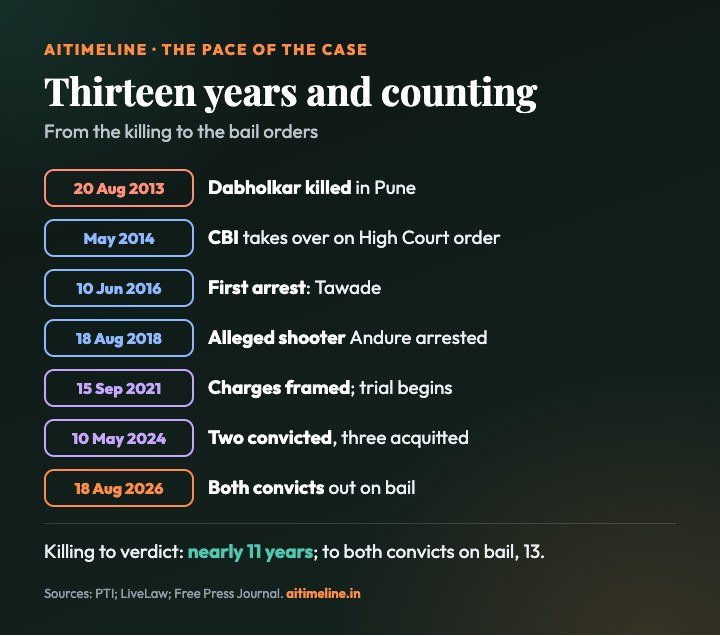
He spent a quarter of a century challenging fake miracles and exploitative rituals, and asking Maharashtra to make them a crime. On 20 August 2013 Narendra Dabholkar was shot dead on a Pune bridge during his morning walk. The law he had campaigned for came into force four days later. The Narendra Dabholkar murder case took far longer: the investigation passed from Pune police to the CBI, the agency named two different pairs of shooters, and in May 2024 a special court convicted two men and acquitted three. In 2026 the Bombay High Court released both convicts on bail while their appeals are heard. This timeline separates what investigators alleged from what the courts decided.
💡 Short Answer
Narendra Dabholkar, founder of the Maharashtra Andhashraddha Nirmoolan Samiti, was shot dead in Pune on 20 August 2013. The CBI took over in 2014. On 10 May 2024 a special court convicted Sachin Andure and Sharad Kalaskar of murder and acquitted three others. In 2026 the Bombay High Court suspended both life sentences and granted bail pending appeal.
Narendra Dabholkar Murder Case: Key Questions
The Case in Ten Points
- The man: a Satara doctor who founded MANS in 1989 to fight superstition and exploitation.
- The killing: shot dead on a Pune bridge on 20 August 2013, aged 67.
- The law: the anti-superstition ordinance followed on 24 August; the Act passed in December 2013.
- The handover: the Bombay High Court moved the case to the CBI in 2014.
- The first arrest: Dr Virendrasinh Tawade, alleged planner, on 10 June 2016.
- The change of theory: the CBI named Akolkar and Pawar as shooters in 2016, then Andure and Kalaskar in 2019.
- The verdict: on 10 May 2024, Andure and Kalaskar convicted of murder; three acquitted.
- The anti-terror charges: not proved against anyone.
- The bail orders: Kalaskar on 29 April 2026, Andure on 18 August 2026, sentences suspended.
- The open question: who planned the killing has not been established in court.
Timeline: From the Rationalist Movement to the Courtroom
Newest first. Colour shows which phase each event belongs to.
Where the case stands Appeals and bail 2024-2026
The record: Sachin Andure and Sharad Kalaskar remain convicted of Dabholkar’s murder under the May 2024 judgment. The Bombay High Court has suspended both life sentences and released both men on bail until their appeals are decided. Virendrasinh Tawade, Sanjeev Punalekar and Vikram Bhave stand acquitted.
What is pending: Three sets of appeals are before the High Court: Andure’s and Kalaskar’s against their convictions, and Mukta Dabholkar’s against the three acquittals and the dropping of the anti-terror charges. The family says it has gone to the Supreme Court against Kalaskar’s bail and would do the same over Andure’s.
Bombay High Court grants bail to Sachin Andure Appeals and bail 2024-2026
The order: The bench suspended Andure’s life sentence and released him on a personal bond of Rs 50,000 until his appeal is heard. It said that, even on a first look, the evidence against him was “extremely weak” and that he had “fair chances” of acquittal on appeal.
The reasons: The two eyewitnesses identified Andure in court for the first time about eight years and seven months, and nine years and three months, after the killing, and neither had picked out his photograph during the investigation. A witness to an alleged confession came forward only on 23 August 2018, five days after Andure’s arrest.
The context: Andure had spent about six years in jail and already had bail in the Govind Pansare murder case. The court said its observations were limited to the bail plea. Dabholkar’s son Hamid said the family would appeal to the Supreme Court.
Sharad Kalaskar released on bail Appeals and bail 2024-2026
The order: The High Court suspended Kalaskar’s life sentence and granted him bail pending his appeal. It noted he had been in custody since 3 September 2018, more than seven and a half years, and that his appeal was unlikely to be heard soon.
The reasons: The CBI never held a test identification parade. Instead, the two eyewitnesses were shown Kalaskar’s photographs on 25 and 27 December 2018, while he was already in custody. The bench said that identification “loses its sanctity”, called the witnesses “chance witnesses” and questioned why they had not gone to the police at once.
The response: The court refused the CBI’s request to stay the order for four weeks. Dabholkar’s family called the decision disappointing and said it would go to the Supreme Court.
Both sides appeal the verdict Appeals and bail 2024-2026
The family: Mukta Dabholkar, his daughter, challenged the acquittal of Tawade, Punalekar and Bhave, and the court’s refusal to convict Andure and Kalaskar under the anti-terror law. Her appeal argues the murder was part of a larger conspiracy.
The convicts: Andure and Kalaskar filed separate appeals against their convictions and life sentences.
The CBI: As of April 2026 the family said the CBI itself had not appealed against the three acquittals.
Two convicted, three acquitted Trial 2021-2024
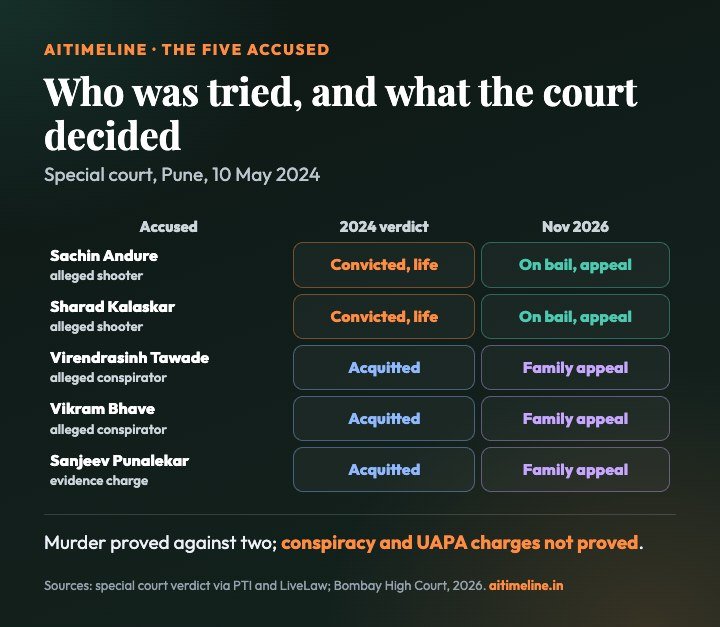
The verdict: The court convicted Sachin Andure and Sharad Kalaskar of murder under Section 302 read with Section 34 (common intention) of the Indian Penal Code, as the two men who shot Dabholkar. Each got life imprisonment and a fine of Rs 5 lakh.
The acquittals: Virendrasinh Tawade, Sanjeev Punalekar and Vikram Bhave were acquitted of all charges. The judge said there was “ample scope for doubt” against Tawade, the alleged mastermind, but the prosecution had failed to turn suspicion into evidence.
The terror charges: The anti-terror charges under the Unlawful Activities (Prevention) Act were not proved. The judge attributed that to the negligence of the officer responsible. The prosecution did not seek the death penalty.
The prosecution closes its case Trial 2021-2024
What happened: The CBI told the Bombay High Court its investigation was complete. In September the defence finished cross-examining S.R. Singh, the retired CBI officer who had investigated the case, and the prosecution told the trial court it had concluded its evidence.
Why it mattered: Mukta Dabholkar had asked the High Court to keep monitoring the probe, arguing that loopholes remained. With the investigation declared complete, the case moved to defence evidence and final arguments.
Charges framed; trial begins Trial 2021-2024
The charges: Tawade, Andure, Kalaskar and Bhave were charged with murder and criminal conspiracy under the IPC, with Section 16 of the Unlawful Activities (Prevention) Act and with offences under the Arms Act. Punalekar was charged under Section 201 of the IPC, causing evidence to disappear.
The trial: Three of the accused asked for more time before answering; the court refused, and all five pleaded not guilty. Witness evidence began the following month.
Vikram Bhave gets bail Trial 2021-2024
What happened: The High Court granted bail to Vikram Bhave, arrested in 2019, on stringent conditions. Punalekar had also been released on bail; Tawade, Andure and Kalaskar remained in jail through the trial.
Further chargesheet against Punalekar and Bhave CBI investigation 2014-2019
What happened: The CBI filed a further chargesheet setting out its case against Sanjeev Punalekar and Vikram Bhave.
The allegation: The agency alleged Punalekar advised an accused to destroy the weapons used in the killings of Dabholkar and others, and that Bhave helped reconnoitre the scene. Both denied it, and both were acquitted in 2024.
Punalekar and Bhave arrested CBI investigation 2014-2019
What happened: The CBI arrested Mumbai lawyer Sanjeev Punalekar, who had represented Sanatan Sanstha members, and his associate Vikram Bhave.
Why it mattered: They were the last of the five accused who would stand trial. The CBI now alleged a chain running from planning to the shooting to the disposal of the weapon.
CBI names Andure and Kalaskar as the shooters CBI investigation 2014-2019
What happened: The CBI filed a supplementary chargesheet alleging that Andure and Kalaskar fired the shots on 20 August 2013.
The contradiction: Its September 2016 chargesheet had named two other men, Sarang Akolkar and Vinay Pawar, as the shooters. The change of theory became a central defence argument at trial.
Sharad Kalaskar arrested by the CBI CBI investigation 2014-2019
What happened: The CBI arrested Kalaskar, who was already in the custody of the Maharashtra Anti-Terrorism Squad in an arms case. This is the date from which the High Court in 2026 counted his time in jail.
The identification: Months later, on 25 and 27 December 2018, the two eyewitnesses were shown his photographs. No identification parade was held, a gap the High Court would stress in granting him bail.
Sachin Andure arrested CBI investigation 2014-2019
What happened: The CBI arrested Andure after leads from the Maharashtra ATS investigation into a cache of arms and explosives. The agency now said he was one of the two men on the motorcycle.
Why it mattered: It was the first arrest of an alleged shooter, five years after the killing, and it overturned the CBI’s own account of who fired.
First CBI chargesheet: Tawade as conspirator CBI investigation 2014-2019
The allegation: The CBI charged Dr Virendrasinh Tawade with conspiring to kill Dabholkar, alleging that hostility to his anti-superstition work was the motive. It named Sarang Akolkar and Vinay Pawar, both absconding, as the shooters.
The outcome: Tawade denied the charge. The trial court acquitted him in 2024, saying suspicion had not been turned into proof.
Dr Virendrasinh Tawade arrested CBI investigation 2014-2019
What happened: The CBI made its first arrest in the case, of ENT surgeon Virendrasinh Tawade, describing him as a key planner of the murder. The agency linked him to the Hindu Janajagruti Samiti, an affiliate of Sanatan Sanstha.
Why it mattered: It came almost three years after the murder and two years after the CBI took over. Tawade would spend about eight years in jail before his acquittal.
High Court starts monitoring the probe CBI investigation 2014-2019
What happened: Dabholkar’s family had asked the High Court for an independent investigation team. The court instead began monitoring the CBI’s progress, calling for regular status reports.
The wider pattern: Months earlier, on 16 February 2015, Communist leader Govind Pansare and his wife Uma were shot in Kolhapur; he died on 20 February. Scholar M.M. Kalburgi was shot dead in Dharwad on 30 August 2015.
The case goes to the CBI CBI investigation 2014-2019
What happened: On petitions by activist Ketan Tirodkar and by Mukta Dabholkar, the High Court transferred the investigation from Pune police to the Central Bureau of Investigation.
Why it mattered: Nine months after the killing, the police had made no arrest that would stand. The CBI would take two more years to make its first.
Two arms dealers arrested, then released Murder and Pune police probe 2013-2014
What happened: Pune police arrested Nagori and Khandelwal, alleged illegal firearms dealers already held by Thane police in another case, on the basis of a ballistic report.
The allegation: Produced in court the next day, they claimed that the state’s ATS chief had offered them Rs 25 lakh to confess. The claim was never established.
The outcome: They received default bail in April 2014 when no chargesheet was filed in time, and were never charged in the case.
Padma Shri, after his death Murder and Pune police probe 2013-2014
What happened: Dabholkar was named for the Padma Shri, India’s fourth-highest civilian honour, in the Republic Day list for 2014.
The anti-superstition law is enacted Murder and Pune police probe 2013-2014
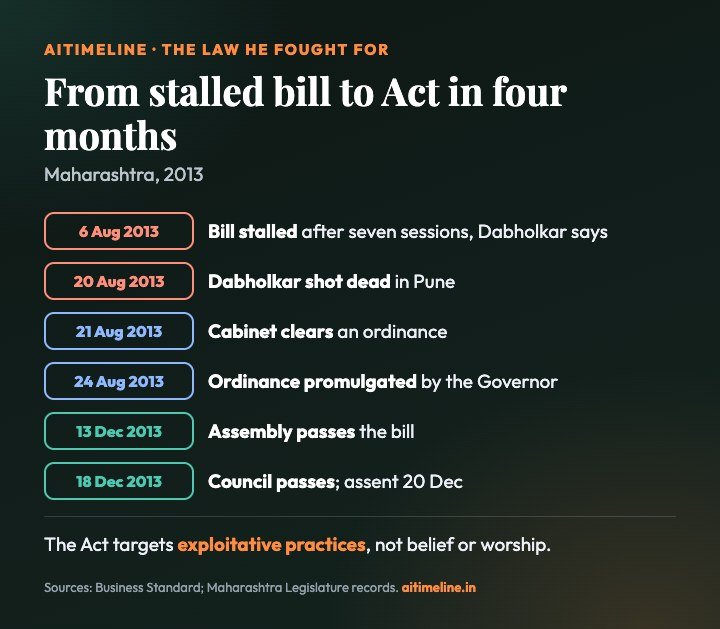
What happened: The Maharashtra Prevention and Eradication of Human Sacrifice and other Inhuman, Evil and Aghori Practices and Black Magic Act, 2013, passed the Assembly on 13 December and the Council on 18 December, and received the Governor’s assent on 20 December.
What it does: It criminalises specified practices: human sacrifice, harming people in the name of exorcism, fraudulent claims of supernatural powers used to cheat, and similar exploitation. It does not ban worship or religious belief.
The ordinance becomes law Murder and Pune police probe 2013-2014
What happened: The day after the murder, the state cabinet cleared an ordinance on the anti-superstition bill that had stalled in the legislature. Governor K. Sankaranarayanan promulgated it on 24 August.
Why it mattered: A bill that had been tabled repeatedly without a vote became law within four days of its campaigner’s death.
Shot dead on a morning walk Murder and Pune police probe 2013-2014
What happened: Two men on a motorcycle shot Dabholkar on the bridge near the Omkareshwar temple, behind the Balgandharva auditorium, during his morning walk. He died on the spot, aged 67.
The investigation: Deccan police station in Pune registered the case. The killing set off protests across Maharashtra and calls for the law he had campaigned for.
A last press conference on the bill Life and campaign 1945-2013
What happened: Dabholkar complained publicly that the anti-superstition bill had been tabled in seven sessions of the Assembly without being discussed.
His argument: He said the bill did not contain a single word about God or religion, and was aimed at fraudulent and exploitative practices.
He founds MANS Life and campaign 1945-2013
What happened: Dabholkar founded the Maharashtra Andhashraddha Nirmoolan Samiti and became its president.
Its work: MANS ran public demonstrations exposing “miracles”, awareness programmes in villages and schools, and campaigns against exploitative godmen, caste rules and harmful rituals.
From doctor to reformer Life and campaign 1945-2013
What happened: After about a decade of practice as a doctor in Satara, Dabholkar turned full-time to social work. He joined the Akhil Bharatiya Andhashraddha Nirmoolan Samiti, and campaigned on caste equality, including the “One village, one well” initiative.
The writer: He later edited the Marathi weekly Sadhana, founded by Sane Guruji, and wrote books on superstition and scientific thinking.
Born in Satara Life and campaign 1945-2013
Early life: Narendra Achyut Dabholkar was born to Achyut and Tarabai Dabholkar. He studied at New English School, Satara, and Willingdon College, Sangli, and took an MBBS degree from the Government Medical College, Miraj.
Who Was Narendra Dabholkar?
His public life was much longer than the case that followed his death.
From Miraj to Satara
He took an MBBS from the Government Medical College, Miraj, and practised in Satara for about a decade before turning to full-time social work.
MANS
He founded the Maharashtra Andhashraddha Nirmoolan Samiti to challenge superstition, expose fraudulent “miracles” and protect people from exploitation by self-styled godmen.
Sadhana weekly
He edited the Marathi weekly founded by Sane Guruji and wrote books making the case for scientific temper and questioning extraordinary claims.
Kabaddi
He captained Shivaji University’s kabaddi team, played for India against Bangladesh and won Maharashtra’s Shiv Chhatrapati award.
| Detail | Information |
|---|---|
| Full name | Narendra Achyut Dabholkar |
| Born | 1 November 1945, Satara |
| Died | 20 August 2013, Pune, aged 67 |
| Organisation | Maharashtra Andhashraddha Nirmoolan Samiti, founded 1989 |
| Honour | Padma Shri, posthumous, 2014 |
| Family | Wife Shaila; children Hamid and Mukta Dabholkar |
The Anti-Superstition Movement and the 2013 Law
The law arrived four days after he was killed.
What the movement campaigned against
- Human sacrifice and attempts to justify it as ritual.
- Fake healing: claims of supernatural cures that kept people from medical treatment.
- Exploitative godmen who used claims of miracles to extract money or control.
- Harmful rituals, including beatings and other abuse in the name of exorcism.
- Fraud through “occult powers” used to cheat vulnerable people.
The movement did not seek to outlaw belief. Dabholkar argued that the bill he drafted with MANS never mentioned God or religion, and that the Constitution’s guarantee of freedom of worship was untouched by it. His opponents, including Sanatan Sanstha, called the campaign anti-Hindu. Article 51A(h) of the Constitution makes it a fundamental duty of every citizen to develop scientific temper, humanism and the spirit of inquiry and reform, and MANS often cited it.
How the Investigation Changed Hands
Pune police, the CBI and two different accounts of who fired.
| Period | Agency or court | Development |
|---|---|---|
| Aug 2013 | Pune police | Murder case registered at Deccan police station |
| Jan 2014 | Pune police | Arms dealers Nagori and Khandelwal arrested; bailed in April, never charged |
| May-Jun 2014 | Bombay High Court, CBI | Case transferred to the CBI |
| Aug 2015 | Bombay High Court | Begins monitoring the CBI investigation |
| Jun-Sep 2016 | CBI | Tawade arrested; chargesheet names Akolkar and Pawar as shooters |
| Aug-Sep 2018 | CBI | Andure and Kalaskar arrested as the alleged shooters |
| 2019 | CBI | Supplementary chargesheets; Punalekar and Bhave arrested |
| 2021-2024 | Special court, Pune | Trial of five accused; verdict 10 May 2024 |
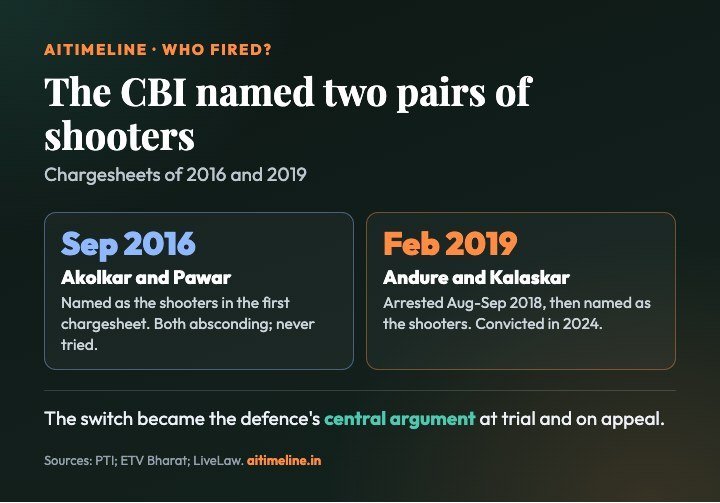
The first year of the investigation produced little. Pune police arrested two alleged arms dealers on a ballistic report; they were released on default bail and never charged, after claiming in court that they had been offered money to confess. The CBI took over in 2014, made its first arrest two years later and, in 2016, said two absconding men had fired the shots. It changed that account in 2018, after the Maharashtra ATS investigation of an arms cache led it to Andure and Kalaskar. Through all this the family pressed the Bombay High Court to monitor the probe, which it did from August 2015 until the CBI declared its investigation complete.
The 2024 Verdict: What the Court Decided
Special Judge P.P. Jadhav, Pune, 10 May 2024.
| Accused | Charged with | Trial court outcome |
|---|---|---|
| Sachin Andure | Murder, conspiracy, UAPA, Arms Act | Convicted of murder (s.302 r/w 34 IPC); life imprisonment |
| Sharad Kalaskar | Murder, conspiracy, UAPA, Arms Act | Convicted of murder (s.302 r/w 34 IPC); life imprisonment |
| Virendrasinh Tawade | Murder, conspiracy, UAPA, Arms Act | Acquitted for insufficient evidence |
| Vikram Bhave | Murder, conspiracy, UAPA, Arms Act | Acquitted for insufficient evidence |
| Sanjeev Punalekar | Causing evidence to disappear (s.201 IPC) | Acquitted for insufficient evidence |
Often claimed
- The court proved a conspiracy behind the murder.
- Five men were convicted.
- The convicts were acquitted in 2026.
- The killers were found guilty of terrorism.
What the record shows
- The conspiracy charge was not proved against the accused.
- Two were convicted; three were acquitted.
- They were granted bail; their convictions stand.
- The UAPA charges were not proved.
The 2026 Bail Orders: Why Both Convicts Are Out
Suspension of sentence is not an acquittal.
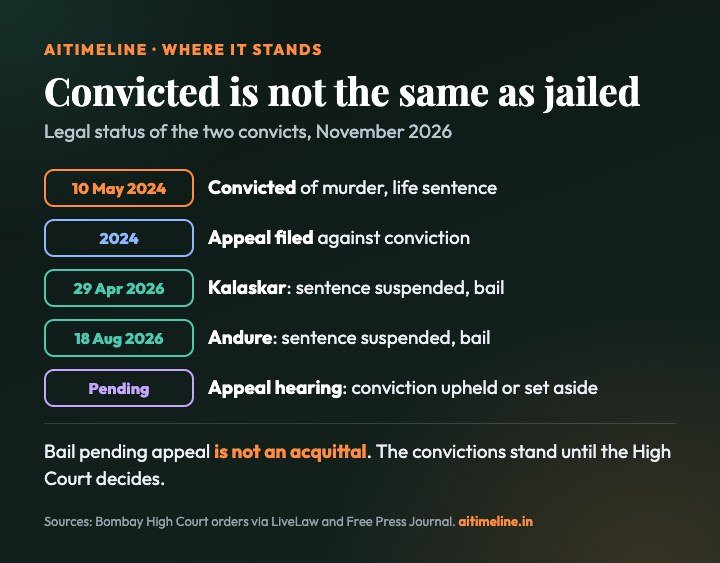
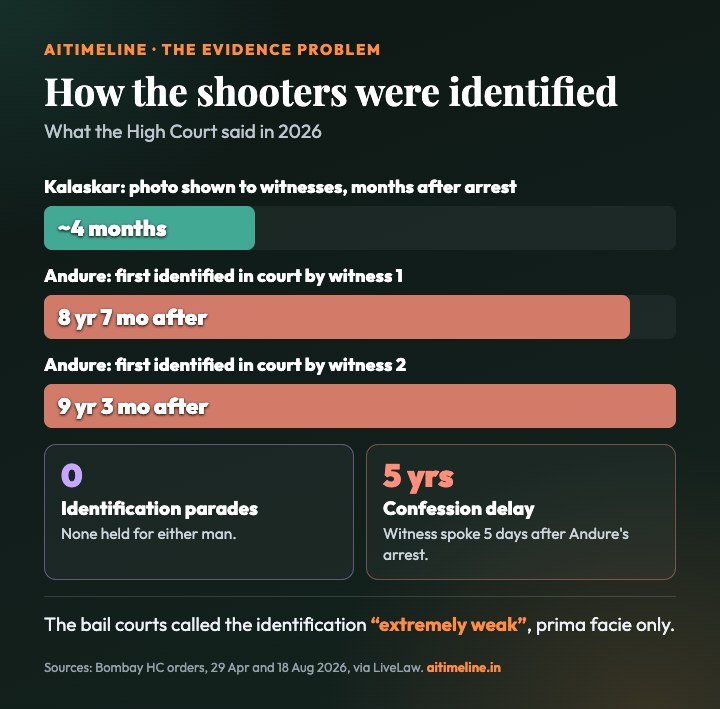
Under Indian law a convict serving a fixed sentence can ask the appeal court to suspend it while the appeal is pending, which can take years. The High Court granted this to Kalaskar on 29 April 2026, after more than seven and a half years in custody, and to Andure on 18 August 2026, after about six. Both benches focused on how the two eyewitnesses, a Pune municipal sanitation worker and a morning walker, came to identify the accused. Neither man faced a test identification parade. The CBI asked for Kalaskar’s order to be stayed for four weeks; the court refused. Dabholkar’s son Hamid has said the family went to the Supreme Court over Kalaskar’s bail and would do the same over Andure’s.
Four Killings, Separate Cases
Why the Dabholkar case is often read alongside three others.
Narendra Dabholkar
Rationalist, founder of MANS. Two convicted in 2024, both on bail pending appeal.
Govind Pansare
Communist leader and writer, died on 20 February 2015. Andure is also an accused in this case and has bail.
M.M. Kalburgi
Kannada scholar and former vice-chancellor, shot at his home.
Gauri Lankesh
Journalist and editor, shot outside her home. A Karnataka SIT chargesheeted 18 people; the trial is ongoing.
Investigators in different states have alleged links between these killings, and the Dabholkar family maintains that a single network was behind them. Those remain allegations. Each killing is a separate criminal case with its own evidence and its own court, and no court has found one proven conspiracy across all four.
Why the Case Matters
A larger conspiracy
- The planners were never convicted.
- UAPA charges were dropped.
- Similar killings followed.
A theory that kept changing
- Two different pairs of shooters.
- No identification parade.
- Witnesses who came forward late.
The appeals
- Convictions under challenge.
- Acquittals under challenge.
- Bail orders before the Supreme Court.
Five issues the case raises
- Freedom of expression: a campaigner was killed for arguments he made in public, with words and demonstrations.
- Scientific temper: his work drew on Article 51A(h), the citizen’s duty to develop the spirit of inquiry.
- Safety of reformers: the killing was the first of four attacks on writers and activists between 2013 and 2017.
- Investigation quality: changing theories and the lack of an identification parade became the defence’s strongest points.
- Stages of justice: conviction, appeal and suspended sentence are different things, and the case shows all three at once.
Explore More Timelines
People Also Ask
Frequently Asked Questions
Dated facts from court orders and contemporary reports, 1945 to 2026.
⚠️ Editorial Note
This account is based on reports of the 10 May 2024 judgment by All India Radio, PTI and LiveLaw; the Bombay High Court bail orders of 29 April and 18 August 2026 as reported by LiveLaw, The Free Press Journal and Verdictum; PTI, Business Standard and The Tribune for the investigation and charge framing; and Maharashtra legislative reporting for the 2013 law. The full trial judgment was not read. Checking the brief this page began from against those records: Sharad Kalaskar was arrested by the CBI on 3 September 2018, not August; the conviction was under Section 302 read with Section 34 of the IPC; the ordinance was cleared by the cabinet on 21 August and promulgated on 24 August 2013; the Act passed the Assembly on 13 December and the Council on 18 December 2013; the Andure bail bench was Justices Sarang Kotwal and R.R. Bhonsale, and the Kalaskar bench Justices Ajey Gadkari and R.R. Bhonsale. We could not confirm that Nagori and Khandelwal later called their bribery claim an emotional outburst, or the exact day of the 2016 and 2019 chargesheets, so those details are omitted or given by month. Allegations of a wider conspiracy are attributed to the CBI or the family. This is not legal advice.
Related Reading on AiTimeline
Sources & further reading
Every dated entry above was checked against these references. Last reviewed 7 November 2026.
- Pune Court Sentences Two To Life Imprisonment In Narendra Dabholkar Murder Case; Acquits Three Accused
- Narendra Dabholkar Murder Case: Bombay High Court Grants Bail To Alleged Shooter Sachin Andure
- Bombay High Court Grants Bail To Convict In Narendra Dabholkar Murder Case
- Narendra Dabholkar Murder Case: Special Court Charges Accused Of Murder, Criminal Conspiracy And Terror Act
- Bombay HC Grants Bail To Convict Sachin Andure, Suspends Life Sentence Citing Weak Evidence
- Bombay HC Grants Bail To Sharad Kalaskar; Cites Doubts Over Identification Evidence
- Bombay High Court Grants Bail To Convict In Dabholkar Murder Case, Suspends Life Sentence
- Bombay High Court grants bail to another convict in Narendra Dabholkar murder case
- Bombay HC suspends Sachin Andure's life sentence, grants bail
- Activist Dabholkar's murder: 2 convicted after decade-long probe. 10 points
- Dabholkar murder case: Two arrested by Pune cops
- Dabholkar murder: Two get lifer, Tawde among 3 acquitted
- The ongoing fight for justice for Narendra Dabholkar
- Narendra Dabholkar