Aarushi–Hemraj Case: The Double Murder That Shook India
Follow the Aarushi-Hemraj murder case from the 2008 Noida killings to the CBI investigation, 2013 conviction, 2017 acquittal and Supreme Court appeal.
Latest Story
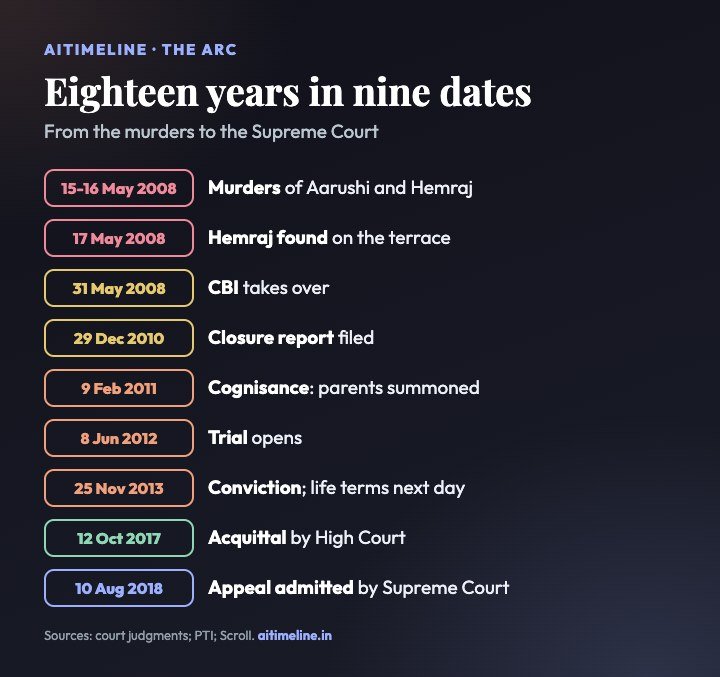
On the morning of 16 May 2008, 14-year-old Aarushi Talwar was found dead in her bedroom in a Noida flat. The family’s live-in help, Hemraj Banjade, was missing and was named as the suspect; a day later his body was found on the building’s terrace. The Aarushi–Hemraj murder case then passed from the Noida police to two CBI teams, through a closure report, a court that refused to close it, a trial that sent her parents to prison for life, and a High Court that set them free. Eighteen years on, nobody stands convicted of either killing, and the CBI’s appeal sits in the Supreme Court.
💡 Short Answer
Aarushi Talwar, 14, and domestic help Hemraj Banjade were murdered at the Talwar flat in Noida on the night of 15-16 May 2008. After the CBI sought to close the case in 2010, a court put her parents on trial. A special CBI court convicted Rajesh and Nupur Talwar in November 2013, but the Allahabad High Court acquitted them on 12 October 2017. The Supreme Court admitted the CBI’s appeal in August 2018; it was undecided as of November 2026.
Aarushi–Hemraj Case: Key Questions
The Case in Ten Points
- The murders: Aarushi, 14, and Hemraj, 45, killed in the same flat on 15-16 May 2008.
- The first mistake: the missing Hemraj was named as the killer; he was found dead on the terrace a day later.
- The police arrest: Rajesh Talwar held on 23 May 2008, released after 50 days.
- The CBI’s first theory: three men from nearby households arrested, then freed.
- The closure report: the second CBI team suspected the father but sought closure in December 2010.
- The court’s turn: a magistrate rejected closure and summoned both parents in February 2011.
- The conviction: life terms for Rajesh and Nupur Talwar in November 2013.
- The acquittal: the Allahabad High Court set them free on 12 October 2017.
- The appeal: admitted by the Supreme Court on 10 August 2018; still undecided.
- The result: two people murdered, and no one convicted for either killing.
Timeline: From the Night of the Murders to the Supreme Court
Newest first. Colour shows which stage of the case each event belongs to.
Where the case stands: the appeal is still undecided Supreme Court 2017-2026
The position: The Allahabad High Court’s acquittal of Rajesh and Nupur Talwar is the operative judgment. The CBI’s appeal and the petition by Hemraj’s widow were admitted in 2018, but we found no reported final hearing or judgment on them up to the date of this update.
What that means: Admitting an appeal means the court has agreed to hear it. It does not suspend or reverse the acquittal, and it is not a finding of guilt. Unless the Supreme Court rules otherwise, the Talwars stand acquitted, and no one has been convicted of either murder.
The Supreme Court admits the CBI’s appeal Supreme Court 2017-2026
The order: “Leave granted,” the bench said, agreeing to hear the CBI’s challenge to the acquittal. It tagged the appeal with the petition already filed by Hemraj’s widow, so that both would be heard together.
For the CBI: Additional Solicitor General Maninder Singh appeared for the agency.
Notice to the Talwars on the widow’s petition Supreme Court 2017-2026
The order: The Supreme Court admitted the petition filed by Khumkala Banjade, Hemraj’s widow, and issued notice to Rajesh and Nupur Talwar. The CBI’s own appeal was to be tagged with it once defects in its filing were cured.
Her argument: The High Court had accepted that Hemraj was murdered, she argued, so the investigating agency could not simply abandon the search for his killer.
The CBI files its appeal Supreme Court 2017-2026
The challenge: The CBI moved the Supreme Court against the High Court’s judgment, arguing that it was wrong on many counts. The agency had first needed the Law Ministry’s permission to appeal.
Hemraj’s widow goes to the Supreme Court first Supreme Court 2017-2026
The petition: Before the CBI acted, Khumkala Banjade challenged the acquittal herself, saying that someone had killed her husband and the judgment left that crime unpunished.
The Talwars walk out of Dasna jail Appeal and acquittal 2014-2017
The release: Rajesh and Nupur Talwar were freed once the certified copy of the High Court order and their release formalities reached the jail. They had spent almost four years there since the November 2013 sentence.
Allahabad High Court acquits Rajesh and Nupur Talwar Appeal and acquittal 2014-2017
The ruling: The bench set aside the trial court’s judgment of 25 November 2013 and its sentencing order of 26 November and acquitted both of all charges. It held that the chain of circumstances was not complete and that, where circumstances fit both guilt and innocence, the accused must get the benefit of the doubt.
On the trial judge: Justice Mishra wrote that the trial judge had tried to solve the case “like a mathematical puzzle” and could not act “like a maths teacher” who takes things for granted to reach an answer.
What it did not decide: The court did not say who killed Aarushi and Hemraj. It found that the prosecution had not proved the Talwars did.
Judgment reserved Appeal and acquittal 2014-2017
The hearing: After hearing both sides again, the division bench reserved its judgment and fixed 12 October for pronouncement.
The High Court decides to hear the appeals afresh Appeal and acquittal 2014-2017
Why: Having reserved judgment in January, the bench said it found contradictions in some of the CBI’s submissions and chose to rehear the appeals rather than rule.
The Talwars appeal their conviction Appeal and acquittal 2014-2017
The appeals: Nupur and Rajesh Talwar filed separate criminal appeals, numbered 293 and 294 of 2014, against the conviction and life sentences. They remained in Dasna jail while the appeals were pending.
Life imprisonment for both parents Cognisance and trial 2011-2013
The sentences: Both were sentenced to life imprisonment and a Rs 10,000 fine for murder (Section 302 read with 34 IPC), and five years’ rigorous imprisonment and a Rs 5,000 fine for causing disappearance of evidence (Section 201/34). Rajesh Talwar got a further year and a Rs 2,000 fine under Section 203 for giving false information. The sentences ran concurrently.
Then: They were taken to Dasna jail in Ghaziabad.
The Talwars are convicted Cognisance and trial 2011-2013
The verdict: The court found Rajesh and Nupur Talwar guilty of murdering Aarushi and Hemraj and of destroying evidence. It accepted the prosecution’s circumstantial case, including its view that no outsider had entered the flat after the family was last seen together at about 9:30 pm on 15 May.
The evidence: There was no eyewitness, no confession and no recovered weapon tied to the killings by forensic proof. The case rested on a chain of circumstances.
Arguments end; verdict date fixed Cognisance and trial 2011-2013
The step: After the defence completed its final arguments and the CBI gave its rebuttal, Judge Shyam Lal reserved the verdict for 25 November.
Supreme Court grants Nupur Talwar bail Cognisance and trial 2011-2013
The order: The Supreme Court granted bail but gave the trial court a week to examine remaining material witnesses first, after the CBI argued she could influence them. She was to be released by 25 September.
The release: The special court ordered her release on 25 September, and she walked out of Dasna jail that day after nearly five months inside.
The trial begins Cognisance and trial 2011-2013
The start: The court had fixed 4 June for the trial to begin; proceedings opened on 8 June. The prosecution relied on circumstantial evidence, beginning with witnesses to the scene on the morning of 16 May 2008.
Charges framed Cognisance and trial 2011-2013
The charges: The court framed charges of murder and causing disappearance of evidence against both, with common intention, and an additional charge against Rajesh Talwar of giving false information over the FIR he lodged. Both pleaded not guilty.
Nupur Talwar surrenders and is sent to jail Cognisance and trial 2011-2013
What happened: Nupur Talwar surrendered before the court, which rejected her bail plea and sent her to Dasna jail. She had not been arrested at any earlier stage of the case.
Supreme Court lets the trial go ahead Cognisance and trial 2011-2013
The ruling: The court dismissed Nupur Talwar’s appeal against the magistrate’s decision to take cognisance, which the High Court had upheld. It deliberately did not examine the facts, and said the accused should not be prejudiced at trial by anything said by the Supreme Court, the High Court or the magistrate.
Also: On 2 March 2012 another bench dismissed the couple’s petitions to move the case from Ghaziabad to Delhi.
High Court refuses to interfere; Supreme Court stays trial Cognisance and trial 2011-2013
The sequence: On 18 March the Allahabad High Court refused to quash the magistrate’s order. The next evening, a Saturday, a Supreme Court bench heard the Talwars’ petition at 7 pm and stayed the trial, asking them to deposit their passports.
Magistrate rejects the CBI’s closure report Cognisance and trial 2011-2013
The order: Acting on Rajesh Talwar’s protest petition against the closure report, the magistrate rejected the CBI’s conclusion and instead took cognisance against both parents for murder and destruction of evidence, summoning them to stand trial.
The irony: The Talwars had asked for further investigation to find the killers. The order put them in the dock.
Rajesh Talwar attacked outside court Cognisance and trial 2011-2013
What happened: Utsav Sharma, who had attacked former Haryana police chief S.P.S. Rathore a year earlier, slashed Rajesh Talwar with a cleaver at the court complex, injuring his face and hands.
CBI files a closure report CBI investigation 2008-2010
The report: The second CBI team asked for the case to be closed. It named Rajesh Talwar as the main suspect on circumstantial grounds but said the evidence was not enough to charge him. It cleared the three men the first CBI team had arrested.
The gaps: The report cited an unproved motive, no recovered murder weapon and critical gaps from the first days of the investigation.
A second CBI team takes over CBI investigation 2008-2010
The change: After Inspector Richh Pal Singh had worked the case from March to September 2009, the investigation was handed to AGL Kaul. The new team re-recorded witness statements and turned its attention back to the Talwars, including a set of golf clubs.
Narco-analysis tests on the parents CBI investigation 2008-2010
The tests: At the CBI’s request both parents underwent narco-analysis. In 2008 they and the three arrested men had also been through polygraph and other tests.
Their status: Results of such tests are not admissible as evidence by themselves. The Supreme Court held in Selvi v. State of Karnataka (2010) that they cannot be done without consent.
The three arrested men are released CBI investigation 2008-2010
Why: The CBI did not file a chargesheet against Krishna within 90 days of his arrest, so he was entitled to bail. Raj Kumar was bailed the same day, and the agency admitted it had no corroborative evidence against Vijay Mandal.
Rajesh Talwar released on bail CBI investigation 2008-2010
Why: The CBI told the court it had found no evidence to support continued detention, and he was released after about 50 days in custody.
CBI arrests Krishna, then two more CBI investigation 2008-2010
The arrests: The first CBI team arrested Krishna, who worked at Rajesh Talwar’s clinic, then Raj Kumar, a domestic help for a family friend, and Vijay Mandal, a domestic help for a neighbour. A khukri recovered on Krishna’s pointing out was tested; the stains on it were not human blood.
The CBI takes over CBI investigation 2008-2010
The handover: After heavy criticism of the Noida police, Chief Minister Mayawati’s government consented on 29 May to a CBI probe. The Centre’s notification and the CBI’s case registration followed on 31 May, and the team led by SP Vijay Kumar inspected the flat on 1 June.
Noida police arrest Rajesh Talwar Murders and police probe 2008
The arrest: Police arrested Aarushi’s father as the prime suspect in both killings and publicly set out a motive and sequence of events. The claims, made before any trial, were widely criticised and were never proved in court.
Why it matters: This early public narrative shaped coverage of the case for years.
Hemraj’s body is found on the terrace Murders and police probe 2008
The discovery: The body of Hemraj Banjade, whom police had treated as the suspect, was found on the terrace of the building after the locked terrace door was opened. He had been killed the same night as Aarushi.
The failure: Police had not opened and searched the terrace on the first day, although there were bloodstains on the stairs leading to it. The suspect was a second victim.
Aarushi Talwar found dead at home Murders and police probe 2008
The discovery: Aarushi, 14, was found dead in her bedroom on the morning of 16 May. The family’s live-in help Hemraj was missing, and Rajesh Talwar lodged an FIR naming him.
The scene: Police, media and visitors moved through the flat that day. The failure to secure the scene became one of the most criticised aspects of the whole case.
Two Courts, Two Verdicts
The same evidence, read two ways.
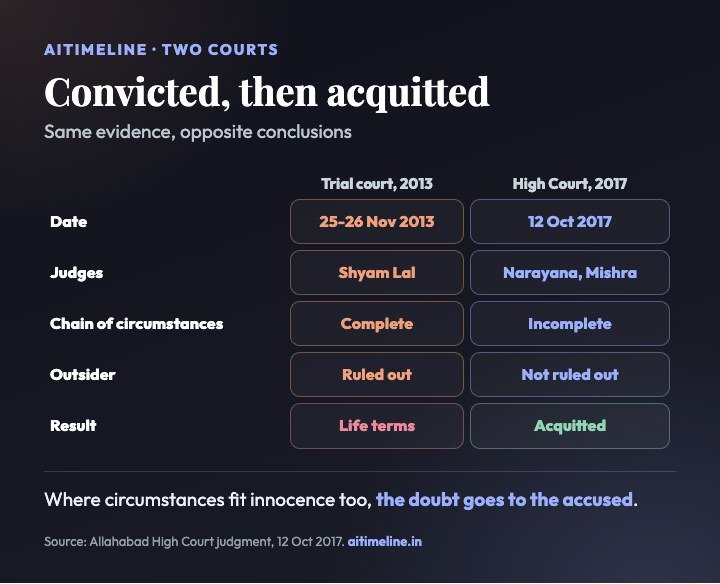
| Issue | Special CBI court, 2013 | Allahabad High Court, 2017 |
|---|---|---|
| Judge(s) | Shyam Lal, Additional Sessions Judge | B.K. Narayana and A.K. Mishra |
| Decision | Convicted both parents | Acquitted both parents |
| Evidence | Accepted the CBI’s chain of circumstances | Held the chain incomplete and the doubt real |
| Outsider theory | Found no evidence of an outsider entering after 9:30 pm | Did not accept that an outsider was ruled out |
| Sentence | Life imprisonment, plus concurrent terms | Conviction and sentences set aside |
| Effect | Talwars jailed in Dasna | Released on 16 October 2017 |
A conviction based only on circumstantial evidence needs every link in the chain to be proved, and the links together must rule out every reasonable explanation other than guilt. Judge Shyam Lal found that chain complete: the family was in the flat, there were no signs of forced entry, and in his view no outsider could have come in. The High Court looked at the same record and found gaps at almost every step, from the handling of the crime scene to how the CBI’s theory of the weapons and the sequence of events had changed. Where the circumstances could fit innocence as well as guilt, it said, the law requires acquittal.
How the Investigation Changed Hands
Four sets of investigators, three theories, one unsolved case.
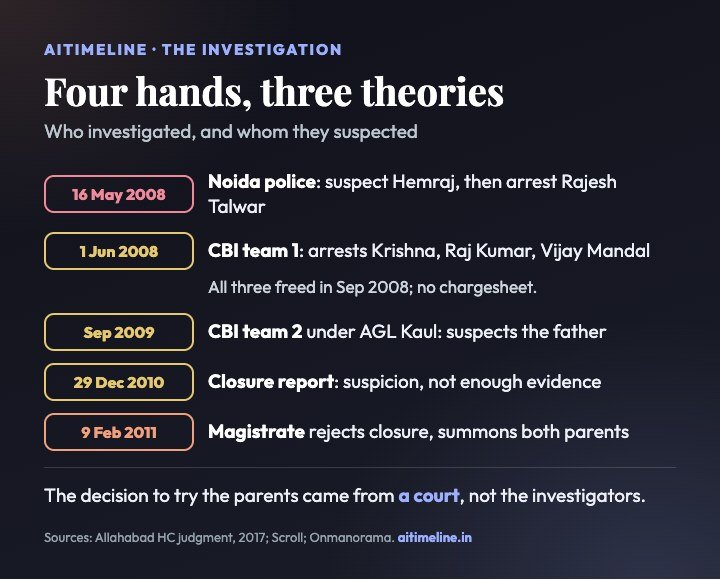
The case was damaged in its first hours. The flat was not sealed, the terrace was not opened and searched on the first day despite blood on the stairs, and the Noida police went public with a motive within a week. When the CBI’s first team took over on 1 June, it moved away from the parents altogether and arrested three men who worked in or near the household. When that line failed, a second team under AGL Kaul re-examined the evidence from September 2009 and came back to Rajesh Talwar, but concluded in December 2010 that it could not prove anything. The decision to try the parents came from a magistrate, not from the investigators.
Five Murder Weapons in Two Years
What investigators proposed between May 2008 and December 2010.
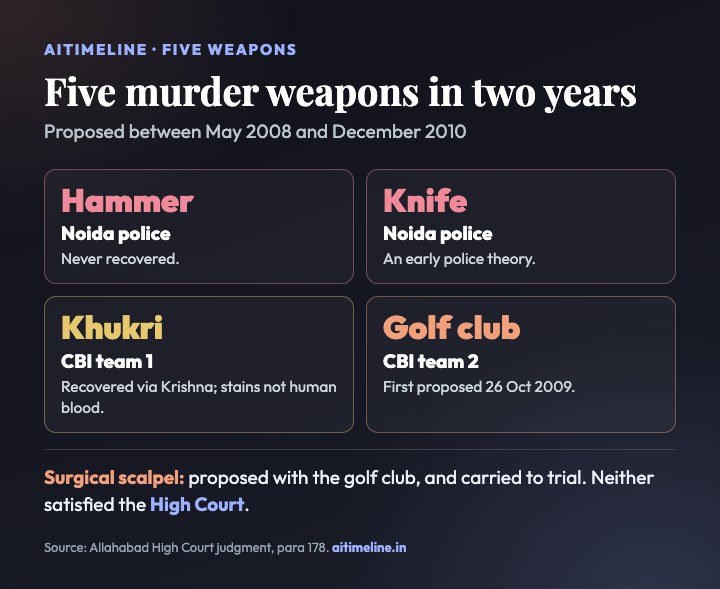
The High Court treated the shifting weapon theory as a sign of how unsettled the investigation was. The Noida police suggested a hammer, which was never recovered, and a knife. The first CBI team recovered a khukri on suspect Krishna’s pointing out, but tests found the stains on it were not human blood. Then, on 26 October 2009, a forensic expert proposed for the first time a golf club and a surgical scalpel, the theory the second team and the prosecution carried to trial.
Who Was Arrested, and What Happened to Them
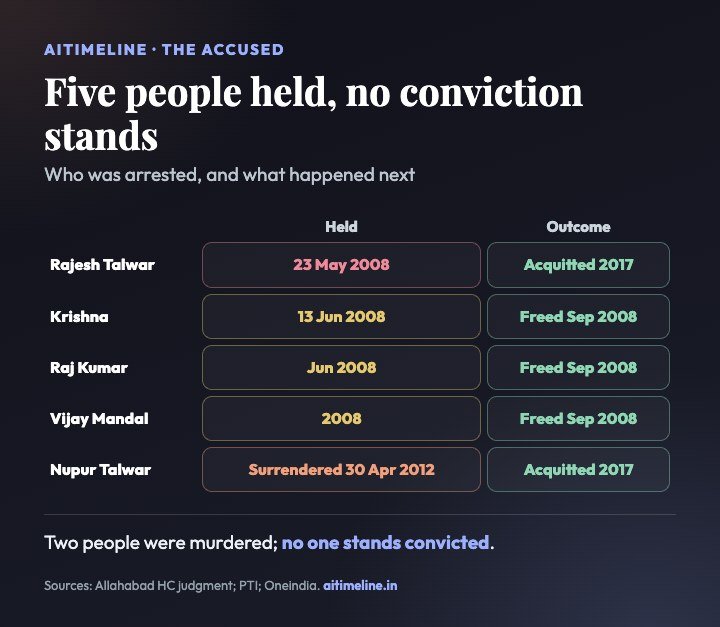
| Person | Held | Outcome |
|---|---|---|
| Rajesh Talwar | Arrested 23 May 2008; jailed again Nov 2013 | Bailed Jul 2008; convicted 2013; acquitted 2017 |
| Krishna | Arrested by CBI 13 June 2008 | Freed 12 Sep 2008; cleared in 2010 closure report |
| Raj Kumar | Arrested by CBI, June 2008 | Freed 12 Sep 2008; cleared in 2010 |
| Vijay Mandal | Arrested by CBI, 2008 | Freed Sep 2008; cleared in 2010 |
| Nupur Talwar | Surrendered 30 April 2012 | Bailed Sep 2012; convicted 2013; acquitted 2017 |
Often claimed
- The CBI closed the case because the Talwars were innocent.
- Nupur Talwar was arrested in 2012.
- The Supreme Court reversed the acquittal in 2018.
- Narco tests proved who did it.
What the record shows
- The closure report named Rajesh Talwar as the main suspect but said evidence was insufficient.
- She surrendered before the court on 30 April 2012.
- The court only admitted the appeal; the acquittal still stands.
- Such tests are not evidence on their own and proved nothing in court.
Where the Case Stands in the Supreme Court
Admitted, tagged, and undecided.
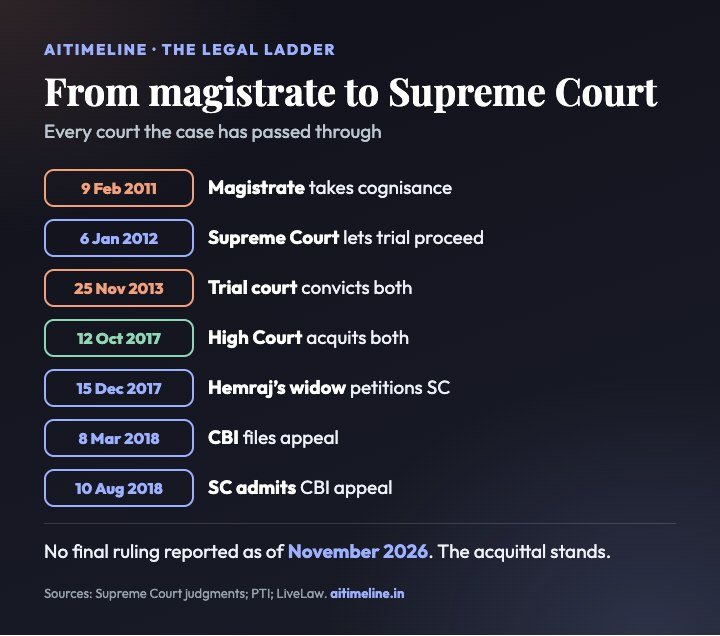
Two challenges to the acquittal are before the Supreme Court. Khumkala Banjade, Hemraj’s widow, filed first, on 15 December 2017, and the court issued notice on her petition on 19 March 2018. The CBI, having obtained the Law Ministry’s clearance, filed its own appeal in March 2018, and a bench led by Justice Ranjan Gogoi admitted it on 10 August 2018 and tagged it with hers. We could not find a reported final hearing or judgment after that. Until the Supreme Court rules, Rajesh and Nupur Talwar stand acquitted.
Why the Aarushi–Hemraj Case Still Matters
Protect the evidence
- Seal the scene at once.
- Search every room and roof.
- Record who goes in.
Suspicion is not proof
- Every link must be proved.
- Doubt goes to the accused.
- Tests are not evidence.
Restraint in reporting
- No trial by leaks.
- Protect victims’ dignity.
- Update when courts rule.
The case is taught as a warning about what happens when a crime scene is lost in the first hours: no later investigation could recover what was trampled, and every theory afterwards had to fill the gaps with inference. It is also a study in the standard of proof. One judge found the circumstances conclusive; two others found them consistent with innocence. And it is a lesson about coverage. Speculation about a dead teenager and a dead worker filled news bulletins for years, while the people who loved them are still waiting for an answer that the courts have not been able to give.
Explore More Timelines
People Also Ask
Frequently Asked Questions
Dated facts from the court judgments and contemporary reports, 2008 to 2026.
⚠️ Editorial Note
This account draws on the Allahabad High Court’s judgment of 12 October 2017, the Supreme Court’s judgments of 6 January and 2 March 2012, and contemporary reporting by PTI, IANS, The Tribune, Scroll, Onmanorama, Business Standard, LiveLaw and Bar and Bench. It separates investigators’ theories from court findings, and does not repeat unproved claims about the victims’ private lives. Checking the brief this page began from against those records: Nupur Talwar surrendered on 30 April 2012 rather than being arrested; the Supreme Court granted her bail on 17 September 2012, and 25 September was her release; the trial opened on 8 June 2012, not 11 June; and the trial court reserved its verdict on 12 November 2013, not after arguments ended on 18 October. Rajesh Talwar’s FIR named Hemraj rather than unknown persons. We added the 2011 court attack on Rajesh Talwar, the March 2011 stay, the High Court’s August 2017 decision to rehear the appeals, the Supreme Court’s March 2018 notice on the widow’s petition and the Talwars’ release on 16 October 2017. The Supreme Court appeal’s status reflects published reports to 7 November 2026, not the court’s docket.
Related Reading on AiTimeline
Sources & further reading
Every dated entry above was checked against these references. Last reviewed 7 November 2026.
- Dr. (Smt.) Nupur Talwar vs State of U.P. and Anr. (acquittal judgment, 12 October 2017)
- Dr. Mrs. Nupur Talwar vs CBI, Delhi and Anr. (6 January 2012)
- Rajesh Talwar vs CBI and Ors. (transfer petitions, 2 March 2012)
- SC agrees to hear appeal against Talwars' acquittal in Aarushi murder case
- Aarushi-Hemraj murder: SC notice to Talwars on plea challenging acquittal
- Hemraj's widow moves Supreme Court against Talwars' acquittal
- How the Aarushi Talwar-Hemraj murder case unfolded: A timeline
- Aarushi Talwar murder case: Timeline
- Trial in Aarushi-Hemraj twin murder case begins
- SC grants bail to Nupur but has to be in jail for 7 more days
- Aarushi case judgment Nov 25
- After 4 years, Talwars walk out of jail quietly; back home in Noida