17 Days Underground: How India Rescued 41 Workers from Silkyara Tunnel
Silkyara tunnel collapse timeline: 41 workers trapped on 12 November 2023, the auger failures, the rat-hole miners' breakthrough and rescue on 28 November.
Latest Story
At about 5:30 on the morning of Diwali, 12 November 2023, part of an unfinished road tunnel in Uttarakhand fell in and sealed 41 workers behind a wall of rock and steel. The Silkyara tunnel collapse set off one of India’s most closely watched rescues. A powerful auger drilled most of the way through and then broke; vertical shafts and side tunnels were started in parallel; and in the end a team of 12 rat-hole miners dug the last metres by hand. All 41 men came out alive on the evening of 28 November. The questions about how the tunnel was planned and built have lasted much longer.
💡 Short Answer
The Silkyara tunnel in Uttarkashi collapsed at about 5:30 am on 12 November 2023, trapping 41 workers. After an auger machine drilled about 47 metres and broke, rat-hole miners dug the final stretch by hand, and all 41 were rescued on 28 November 2023. A government panel later blamed lapses by NHIDCL, the contractor and the supervising engineer. The tunnel’s two ends met on 16 April 2025.
Silkyara Tunnel Collapse: Key Questions
The Rescue in Ten Points
- The collapse: about 5:30 am on 12 November 2023, Diwali morning.
- The trapped: 41 workers from eight states, in a 2 km finished stretch.
- The first lifeline: a 4-inch pipe carrying air, water and dry food.
- The first setback: the auger stopped at 22 metres on 17 November.
- The new strategy: five rescue plans run in parallel from 18 November.
- The second lifeline: a 6-inch pipe with hot food and a camera, 20-21 November.
- The breakdown: the auger broke on 25 November after about 47 metres.
- The breakthrough: rat-hole miners dug the last metres by hand, 27-28 November.
- The blame: an expert panel found lapses by NHIDCL, the contractor and the supervisor.
- The tunnel: its two ends met on 16 April 2025; it was still being finished in 2026.
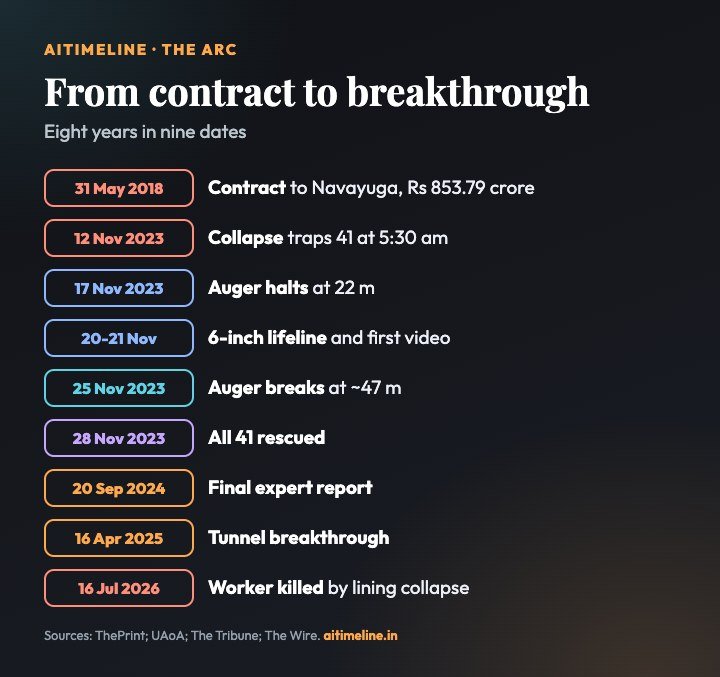
Timeline: From the Contract to the Tunnel’s Breakthrough
Newest first. Colour shows which phase each event belongs to.
A worker is killed inside the same tunnel Aftermath 2023-2026
What happened: At about 2 am a block of the tunnel’s concrete lining collapsed and fell on a 21-year-old worker from Jharkhand. He was taken to hospital in Naugaon and died during treatment.
The response: The Uttarkashi district magistrate asked the Barkot sub-divisional magistrate to find the cause and check whether the executing agency had followed safety standards, and to begin compensation for the family. NHIDCL ordered its own detailed investigation.
Breakthrough: the two ends of the tunnel meet Aftermath 2023-2026
The milestone: Excavation from the Silkyara and Barkot ends was joined, completing the bore of the 4.531 km two-lane tunnel. Road Transport Minister Nitin Gadkari called it a historic achievement that would save about an hour of travel and give all-weather access to Yamunotri and Gangotri.
The temple: Dhami attended the consecration of a temple to the local deity Baba Baukhnag at the tunnel mouth, credited the 2023 rescue to the deity’s blessings and said the tunnel would be renamed after it.
Still to do: A breakthrough is not an opening. Roadwork, lining and electrical and mechanical systems remained to be finished.
A national workshop on the first anniversary Aftermath 2023-2026
The event: On the first anniversary of the rescue, NIDM held a national workshop and brainstorming session titled “Lessons Learnt from Silkyara Tunnel and other Tunnel Disasters” with disaster managers, tunnel engineers and officials.
The themes: Discussions covered geological investigation, monitoring during construction, emergency access, rescue preparedness and tunnel resilience.
The expert committee’s final report: “profound” negligence Aftermath 2023-2026
The finding: According to ThePrint, the report, submitted to the road ministry on 20 September, said NHIDCL, the contractor Navayuga Engineering Company and the authority engineer had all overlooked their responsibilities, and called the negligence “profound”.
The lapses: It reportedly found that bid parameters were fixed without a geotechnical investigation, that rock was classed as better than it was, that the tunnel had seen 21 collapses in four years, and that the 2020 design had no separate dedicated escape passage.
The recommendations: Officials responsible should be identified and penal action taken, and the delay should not be treated as force majeure, with costs borne by the contractor.
Government says the contract provides for an escape passage Aftermath 2023-2026
The statement: The road ministry said NHIDCL had included a provision for an escape passage in the contract for the Silkyara bend-Barkot tunnel.
The design: The government had told Parliament in December 2023 that the single-tube tunnel is split by a partition wall into two corridors, each meant to serve as an escape route for the other, with cross openings at intervals.
Show-cause notices, and compensation explained Aftermath 2023-2026
The probe: The ministry said the expert committee had submitted a preliminary report on 22 December 2023, that show-cause notices had been issued to the contractor and to the consultant supervising construction, and that final action would follow the committee’s recommendations.
The money: PTI reported the reply as saying each trapped worker was paid Rs 2 lakh plus bonus and salary by the contractor. The Uttarakhand government paid Rs 1 lakh to each worker separately.
A rescuer’s house is demolished in Delhi Aftermath 2023-2026
What happened: The DDA demolished the home of Vakil Hasan, who had led the team of rat-hole miners, in an anti-encroachment drive. Hasan said he had asked for a house as his only reward.
The DDA’s account: The authority said the land was government land and that Hasan had refused the relief it offered, demanding a permanent house at or near the same spot.
Rewards, compensation and a preliminary report Aftermath 2023-2026
In Parliament: On 20 December the government told the Rajya Sabha that the executing agency had paid each worker Rs 2 lakh plus a month of paid leave, and that Uttarakhand had given Rs 1 lakh each.
The miners: On 21 December Chief Minister Dhami gave each of the 12 rat-hole miners a cheque for Rs 50,000. They accepted them but said they would not cash them, calling the amount inadequate and asking for jobs or homes.
The probe: On 22 December the expert committee submitted its preliminary report to the road ministry.
Airlifted to AIIMS Rishikesh Breakthrough 27-29 Nov
The flight: After a night at the community health centre in Chinyalisaur, the 41 workers were flown to AIIMS Rishikesh for checks.
The result: After examination, 40 of them were declared fit to go home.
All 41 workers come out alive Breakthrough 27-29 Nov
The breakthrough: Rat-hole miners cleared the last of the debris inside the 800 mm steel pipe and it was pushed through to the trapped section in the evening. The pipe ran for about 57 metres through the rubble.
The evacuation: NDRF teams brought the men out one at a time on wheeled stretchers. The first emerged at about 8 pm, and by about 8:50 pm the Uttarakhand government confirmed all 41 were out. Forty-one ambulances waited at the portal.
At the site: Chief Minister Pushkar Singh Dhami and Minister of State for Road Transport V.K. Singh greeted the workers.
The rat-hole miners go in Breakthrough 27-29 Nov
Clearing the pipe: By the evening, welders had cut out the broken auger and a damaged section of pipe, and a lump of shotcrete was broken up. The decision was taken to dig the rest by hand.
The method: A team of 12 manual excavators, skilled in the rat-hole technique used in small coal mines, crawled into the pipe in shifts, dug with hammers, chisels and shovels and passed out debris on a trolley.
In parallel: SJVN’s vertical shaft had reached about 32 metres and THDC’s rescue drift from the Barkot end about 12 metres.
Vertical drilling begins from the hilltop Setbacks 22-26 Nov
The shaft: SJVN began a 1-metre-wide vertical shaft from above the trapped section, which needed to go down about 86 metres. RVNL had already started a narrower 8-inch vertical bore for supplies.
The auger: A DRDO team flew in from Hyderabad with a plasma cutter to free the stuck auger, though gas cutting proved quicker on site.
The auger breaks and is stuck in the pipe Setbacks 22-26 Nov
The failure: While the auger was being pulled back, a joint broke after 15 metres had come out, leaving about 32 metres of auger and blades jammed inside the rescue pipe.
The verdict: International tunnelling expert Arnold Dix told reporters the machine was “busted” and that manual digging and vertical drilling were now the options.
Another obstruction at 46.9 metres Setbacks 22-26 Nov
The work: The auger was withdrawn, a radar scan checked for more metal in the path, and welders cut away bent steel. The tenth pipe section was pushed in, taking the total to 46.9 metres.
The halt: Pipe-pushing stopped again at another obstruction.
Steel girders in the debris Setbacks 22-26 Nov
Progress: The narrower 800 mm pipe had gone in without trouble from 22 to 44.1 metres.
The obstacle: The ninth pipe hit a lattice girder rib from the tunnel’s support system. NDRF and SDRF crews cut it with gas cutters by the afternoon of 23 November, and the auger platform needed repairs.
A 6-inch lifeline, hot food and the first video Lifeline 13-21 Nov
The pipe: On the third attempt, a 150 mm (6-inch) pipe was pushed through about 57 metres of debris. The case study by the Uttarakhand Academy of Administration dates its completion to 21 November; news reports say it went through on 20 November.
Food: Hot khichdi was sent in bottles for the first time, then dal, rice, roti, vegetables, fruit and medicines.
Sight: Early on 21 November an endoscopic camera pushed through the pipe sent out the first video of the men, all alive.
Roads up the mountain Lifeline 13-21 Nov
Roads: On 19 November the BRO built a 1.15 km road to the hillock above the tunnel for vertical drilling rigs.
ONGC: On 20 November an ONGC team visited the Barkot end to prepare a 24-inch vertical bore. Its approach road was still being built when the rescue ended.
Five plans at once Lifeline 13-21 Nov
The decision: After the auger halt, a meeting led by former PMO adviser Bhaskar Khulbe agreed to pursue several routes in parallel: horizontal drilling from Silkyara, vertical drilling from above by SJVN and RVNL, vertical drilling from the Barkot side by ONGC, and a rescue tunnel from the Barkot end by THDC.
The lifeline: Work also began on a second, 6-inch supply pipe.
The auger stops at 22 metres Lifeline 13-21 Nov
The problem: While the fifth pipe section was being positioned, after 22 metres of 900 mm pipe had gone in, the machine began to lift and its bearings were damaged.
The alarm: During further drilling a loud cracking sound caused panic among workers and police, and pipe-pushing was halted.
Clearing debris and bringing in machines Lifeline 13-21 Nov
First moves: Excavators cleared debris and shotcrete was sprayed to hold the loose roof, but more material kept falling.
The plan: Engineers decided to push wide steel pipes through the rubble with an auger to make an escape tube. The first auger proved unsuitable and a more powerful machine was flown in from Delhi.
The tunnel collapses on Diwali morning Collapse and background
The collapse: During the night shift, a section between about 203 and 240 metres from the Silkyara portal fell in, trapping 41 workers in the completed, roughly 2 km stretch beyond it.
Contact: Rescuers reached the men through an existing 100 mm water line and a 4-inch compressor pipe, which carried air, water, oxygen and dry food.
The count: The first official count was 40, taken from the contractor’s register; it was later corrected to 41. The men came from eight states, with the largest number, 15, from Jharkhand.
The contract, and early warnings about the rock Collapse and background
The contract: NHIDCL awarded the tunnel to Navayuga Engineering Company on 31 May 2018 on an EPC basis for Rs 853.79 crore, below the tender estimate, according to ThePrint.
The warnings: An early authority engineer flagged very poor, Class V rock in March 2019. The pre-construction geological report put 30 per cent of the alignment in poor or very poor rock, with exploratory drilling at only three locations.
How the Rescue Worked: Five Routes at Once
From 18 November, every backup was pursued in parallel.
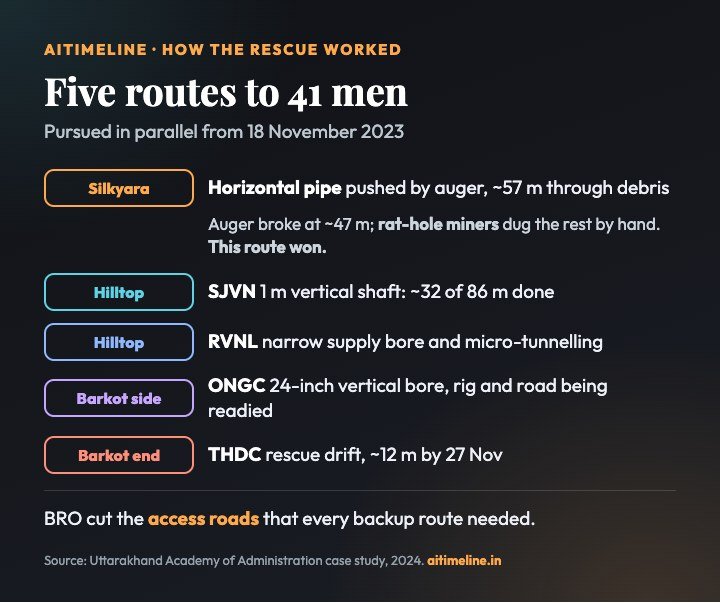
The first plan was simple: push wide steel pipes through the rubble with an auger and let the men crawl out. When the machine stopped at 22 metres on 17 November and a cracking sound sent people running, officials stopped relying on one method. A meeting on 18 November set out five routes. The horizontal pipe from Silkyara stayed the fastest bet. SJVN would drill a 1-metre shaft from the hilltop, RVNL a narrow supply bore and a horizontal approach, ONGC a 24-inch bore from the Barkot side, and THDC a rescue drift from the Barkot end. The BRO cut roads up the slope in days so that the rigs could reach their sites.
In the end the horizontal route won, but not by machine. After the auger broke on 25 November, welders spent two days cutting it out of the pipe, and on the night of 27 November a team of rat-hole miners crawled in with hand tools. They broke through on the evening of 28 November, while the vertical shaft was still about 50 metres short.
How the Trapped Workers Were Kept Alive
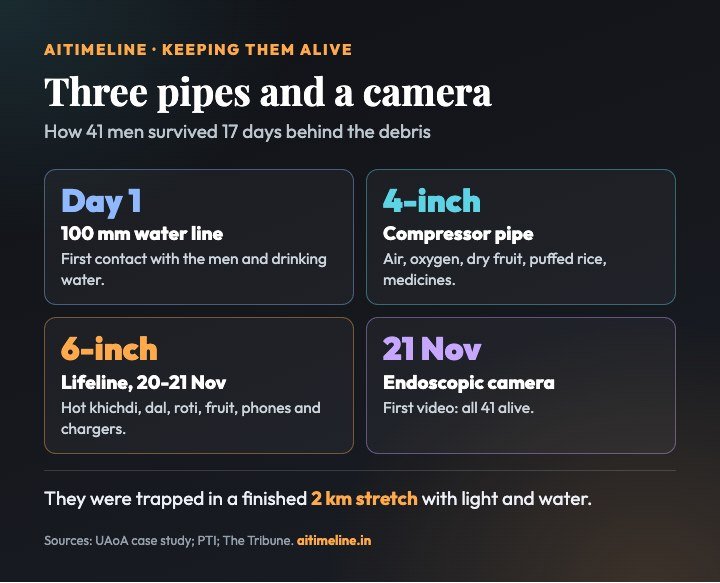
The men were lucky in one respect: they were trapped in a completed, roughly 2 km stretch of tunnel with lighting and water. Rescuers made contact on the first day through an existing water line, and a 4-inch compressor pipe carried air, oxygen, dry fruit and puffed rice. The turning point was the 6-inch pipe pushed through on the third attempt, on 20-21 November. It carried bottles of hot khichdi, then dal, rice, roti, vegetables, fruit and medicines, as well as an endoscopic camera that sent out the first pictures of the men on 21 November. Doctors stayed on call at the portal, and 41 ambulances and a temporary hospital at Chinyalisaur waited for the end.
The Auger: Metre by Metre
How far the rescue pipe got, and what stopped it.
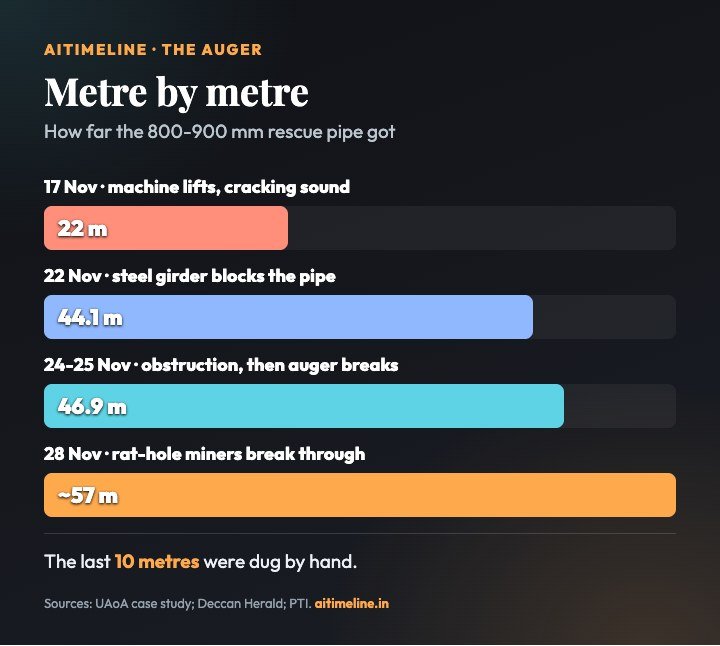
| Date | Pipe inserted | What happened |
|---|---|---|
| 17 Nov | 22 m (900 mm pipe) | Machine lifted, bearings damaged, cracking sound; halted |
| 22 Nov | 44.1 m (800 mm pipe) | Ninth pipe hit a lattice girder rib |
| 23 Nov | ~46 m | Girder cut; bent steel tangled in the auger |
| 24 Nov | 46.9 m | Radar scan, tenth pipe; halted again |
| 25 Nov | 46.9 m | Auger broke while being withdrawn; ~32 m jammed in the pipe |
| 26-27 Nov | 46.9 m | Auger cut out by gas cutters |
| 28 Nov | ~57 m | Rat-hole miners break through; all 41 out |
The Agencies and People Behind the Rescue
| Agency or person | Role |
|---|---|
| NDRF | Final evacuation through the pipe; cutting obstructions |
| SDRF and Uttarakhand Police | Rescue support, site security and coordination |
| NHIDCL and Navayuga | Project authority and contractor; first response on site |
| Border Roads Organisation | Access roads for the vertical drilling rigs |
| Indian Army | Engineers and welders; frames for the rescue drift |
| Indian Air Force | Airlifted machinery; flew the workers to AIIMS Rishikesh |
| SJVN | 1-metre vertical shaft from the hilltop |
| RVNL | Narrow vertical supply bore and horizontal micro-tunnelling |
| ONGC | 24-inch vertical bore from the Barkot side (prepared) |
| THDC | Rescue drift from the Barkot end |
| Arnold Dix and Chris Cooper | Australian tunnelling experts advising on site |
| Rat-hole miners | Twelve men led by Vakil Hasan dug the final stretch |
Why Did the Silkyara Tunnel Collapse?
Expert assessments, not court findings.
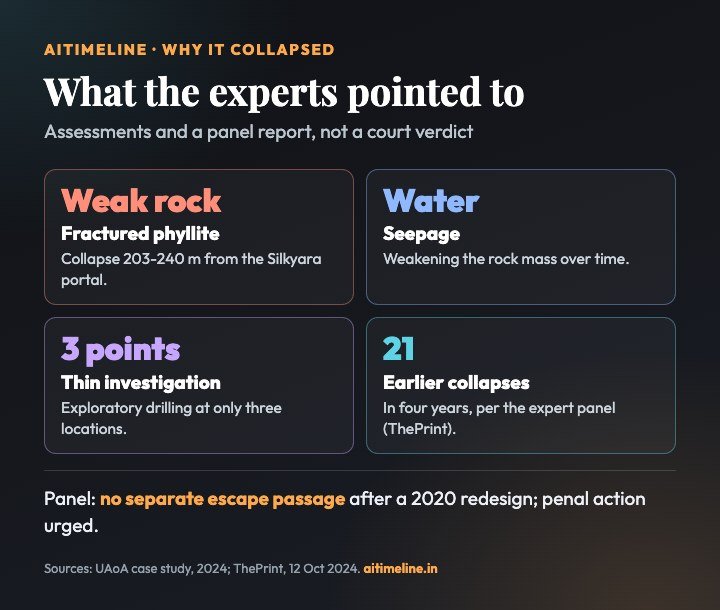
The Uttarakhand Academy of Administration’s case study, written after a site visit in January 2024, points to a hidden patch of fractured or weak rock about 200 to 300 metres from the portal, water seepage weakening it, and problems that are hard to detect during construction. The rock there is mostly phyllite, a clay-rich, weak metamorphic rock. The pre-construction geological report classed about 30 per cent of the route as poor or very poor rock, and exploratory drilling was done at only three locations.
The government’s expert committee, headed by BRO additional director general R.K. Dhiman, went further. According to ThePrint’s account of its final report, it found that bid parameters were set without a geotechnical investigation, that rock-mass ratings were altered to keep sections in a less demanding class, that the tunnel had suffered 21 collapses in four years, and that the 2020 redesign left no separate escape passage. It recommended penal action against those responsible.
Often claimed
- The government paid each worker Rs 3 lakh.
- The collapse was an unforeseeable natural event.
- The contractor has been punished.
- The tunnel opened after the rescue.
What the record shows
- Rs 1 lakh came from Uttarakhand; Rs 2 lakh came from the contractor.
- Weak rock was flagged before construction, and the panel found lapses.
- Show-cause notices were issued; no final penalty is on the public record.
- The bore broke through in April 2025; work was still going on in 2026.
Compensation, Rewards and Notices
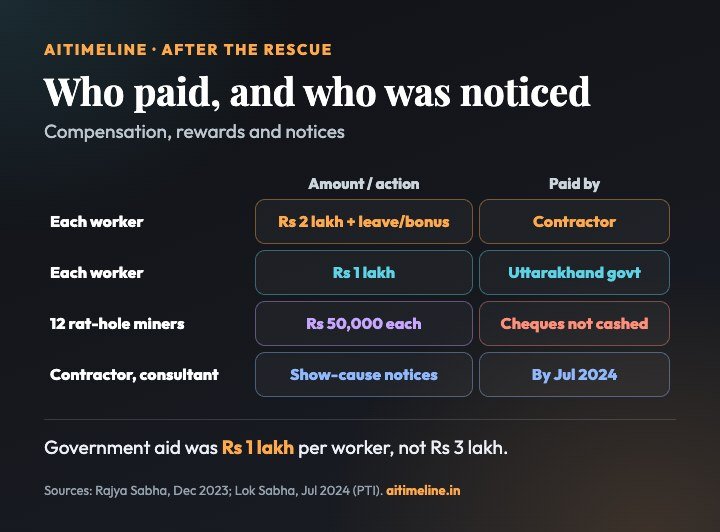
| Item | Amount or action | Source |
|---|---|---|
| From the contractor | Rs 2 lakh per worker, plus one month’s paid leave (Dec 2023) or two months’ bonus and salary (Jul 2024) | Parliament replies |
| From Uttarakhand | Rs 1 lakh per worker | Rajya Sabha reply, Dec 2023 |
| Rat-hole miners | Rs 50,000 each; cheques not cashed | PTI, Dec 2023 |
| Preliminary report | Submitted 22 Dec 2023 | Lok Sabha reply, Jul 2024 |
| Show-cause notices | Contractor and supervising consultant | Lok Sabha reply, Jul 2024 |
| Final report | Submitted 20 Sep 2024; penal action recommended | ThePrint, Oct 2024 |
What the Silkyara Rescue Taught India
Know the ground
- Drill more than three points.
- Classify rock honestly.
- Monitor movement daily.
Build a way out
- Dedicated escape passages.
- Clear emergency access.
- Alarms and ventilation.
Many plans, clear roles
- Run backups in parallel.
- One command centre.
- Value skilled hands.
The rescue showed what Indian agencies can do together under pressure, and the NIDM workshop on its first anniversary tried to turn that into lasting practice: better geological investigation, continuous monitoring, emergency access and agreed roles before a crisis rather than during it. The aftermath shows how much remains. A panel found that warnings about weak rock and repeated small collapses were not acted on, final accountability has not been publicly settled, and in July 2026 a worker was killed inside the same tunnel. The 41 men came out alive; the lesson is that they should never have needed rescuing.
Explore More Timelines
People Also Ask
Frequently Asked Questions
Dated facts from official records and contemporary reports, 2018 to 2026.
⚠️ Editorial Note
This account draws on the Uttarakhand Academy of Administration’s 2024 case study, the NIDM workshop proceedings, Parliament replies as reported by PTI, ThePrint’s October 2024 report on the expert committee’s findings, and contemporary reporting by PTI, The Tribune, Deccan Herald, Scroll and The Wire. We have not read the expert committee’s report itself. Checking the brief this page began from against those records: the NIDM workshop was held on 28 November 2024, the first anniversary, not in 2025 (its proceedings were published in 2025); the Rs 2 lakh per worker was paid by the contractor, not by the government, so total government assistance was Rs 1 lakh per worker, not Rs 3 lakh; and the 6-inch lifeline was pushed through on 20 November by news accounts, with first video on 21 November. We added events the brief omitted: the contract and early rock warnings, the expert panel’s final report, the rewards row and the demolition of Vakil Hasan’s house, the tunnel’s April 2025 breakthrough and the fatal collapse of July 2026. We left out the brief’s February 2024 Rajya Sabha entry because we could not confirm its wording.
Related Reading on AiTimeline
Sources & further reading
Every dated entry above was checked against these references. Last reviewed 7 November 2026.
- Silkyara Tunnel Section Collapse: A Case Study
- Proceedings: Lessons Learnt from Silkyara Tunnel and other Tunnel Disasters
- Govt panel puts Silkyara tunnel collapse onus on NHIDCL, contractor in damning report
- Silkyara tunnel collapse: Action against erring persons after expert panel report, says Gadkari
- Rescuers release first video of workers trapped in collapsed Uttarakhand tunnel
- Uttarkashi tunnel collapse: Setback to rescue work, expert says auger machine has busted
- Uttarakhand tunnel rescue: Rat-hole miners succeed where big machines failed
- Uttarkashi tunnel rescue's star rat miners refuse govt reward
- Uttarakhand tunnel rescuer's home demolished by Delhi Development Authority
- After 2023 setback, Silkyara tunnel breakthrough achieved
- Worker killed as part of Silkyara-Barkot tunnel collapses in Uttarakhand