Una 2016: The Flogging That Sparked a Dalit Rights Movement
Explore the Una flogging incident timeline, the 2016 Dalit Asmita Yatra, protests against caste discrimination and the March 2026 court verdict.
Latest Story
On 11 July 2016, a Dalit family near Una in Gujarat was skinning the carcass of a cow that had already died, the work their community had done for generations. A group of men accused them of killing it, beat them, and flogged four young men in public in Una town. They filmed it. The Una flogging incident could have stayed a district crime. Instead the video set off the largest Dalit mobilisation Gujarat had seen in decades: carcasses left outside government offices, a pledge by thousands to stop doing the work, and a ten-day march to Una that asked not for protection but for land. Nearly ten years later, on 16 March 2026, a special court convicted five men and acquitted 35. This page follows both stories, the movement and the case, and keeps the trial verdict separate from what is still unresolved.
An accusation, a chargesheet, bail, a conviction and an acquittal are different things, and we say which one each entry describes. Nobody is named as guilty here unless a court found them guilty. The timeline is colour-coded by strand: the assault, the state’s response, the movement, the courts, and the aftermath for the family. Where the brief we worked from had a detail the record contradicts, or one we could not verify, we say so.
💡 Short Answer
The Una flogging was the 11 July 2016 assault on seven members of a Dalit family in Gir Somnath, Gujarat, by men who accused them of killing a cow they were skinning after it died. Four were flogged in public in Una and the video spread, setting off the Dalit Asmita Yatra and a pledge to quit carcass work. In March 2026 a Veraval court convicted five men and acquitted 35.
Una Flogging Incident: Key Questions
Una in Ten Points
- The assault: seven members of the Sarvaiya family were attacked on 11 July 2016; four were flogged in public in Una town.
- The pretext: the attackers accused them of killing a cow. The family was skinning a carcass, which is lawful work.
- The video: the attackers filmed the assault, and the clips turned a local crime into national news.
- The state: on 18 July the case went to the CID-Crime, four policemen were suspended, and each victim got Rs 1 lakh.
- The refusal: Dalits left carcasses at government offices and, on 31 July, pledged to stop doing the work.
- The march: the Dalit Asmita Yatra walked from Ahmedabad to Una, 5 to 15 August 2016, demanding land.
- The case: the CID chargesheeted 34 in September 2016; 41 were eventually tried in Veraval from August 2018.
- The verdict: five convicted and 35 acquitted on 16 March 2026; the police accused were not convicted.
- The sentence: five years and Rs 5,000 each, largely already served in custody.
- Unfinished: the promised land and jobs never came, and the victims say they will appeal.
What Happened in Una on 11 July 2016?
The assault, as described in the investigation and the trial.
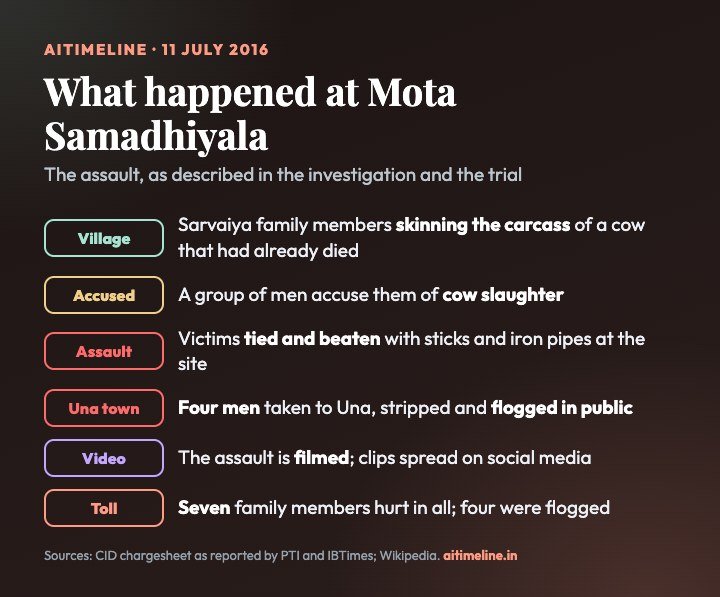
The Sarvaiyas of Mota Samadhiyala made part of their living the way many Dalit families in Saurashtra did: collecting the carcasses of cattle that had died, skinning them and selling the hides. On 11 July 2016 they were doing that when a group of men arrived and accused them of having killed the cow. The family was beaten in the village. Four young men, Vashram and Ramesh Sarvaiya and their relatives Ashok and Bechar, were then taken to Una town, stripped to the waist, tied to a vehicle and beaten with sticks and iron pipes in public. Vashram’s father Balu and other relatives who tried to intervene were also assaulted.
Two things made Una different from many similar assaults. The attackers filmed it and shared the clips, apparently as a warning. And the accusation was false on its face: there was no evidence the animal had been killed, and skinning a dead cow is not a crime in Gujarat. The question the video forced on the country was not whether the men had broken a law. It was why people doing work that society assigned to them, and depended on, could be beaten for it in the street.
How Did the Gujarat Government Respond?
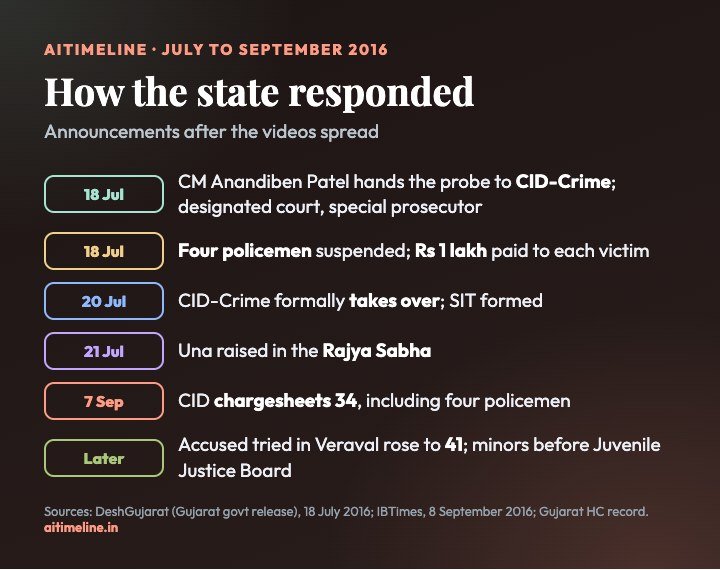
A week after the assault, with protests spreading, Chief Minister Anandiben Patel moved the case to the CID-Crime and promised a designated court, a special public prosecutor and a chargesheet within 60 days. Four policemen from Una police station were suspended, and each victim was paid Rs 1 lakh. The CID met its deadline: on 7 September 2016 it chargesheeted 34 people, including the four policemen, whom it accused of colluding with the attackers and forging documents linked to the FIR. Patel visited Mota Samadhiyala and, according to the family, promised land and government jobs. She announced her resignation on 1 August, citing her age; we have not treated Una as the cause, because she did not.
From Outrage to a Movement: the Carcass Pledge
Why refusing work became the protest.
The first protests were the familiar kind: road blockades in Ahmedabad on 12 July, a sit-in at Una’s Trikon Baug the next day, and clashes that injured protesters and police. Twelve young Dalit men attempted suicide in protest across the region; one died. Then the protest changed shape. In Surendranagar and elsewhere, Dalit workers dumped cattle carcasses outside government offices, and in many villages they simply stopped collecting dead animals.
On 31 July some 30 Dalit organisations, newly joined as the Una Dalit Atyachar Ladat Samiti, held a mass rally in Ahmedabad. Thousands pledged not to remove carcasses or clean sewers again. The logic was economic as much as moral. Work treated as polluting and assigned by caste was work everyone else relied on. By refusing it, the protesters made that dependence visible, and moved the demand from “protect us while we do this” to “give us something else to do”.
The Dalit Asmita Yatra: Ahmedabad to Una
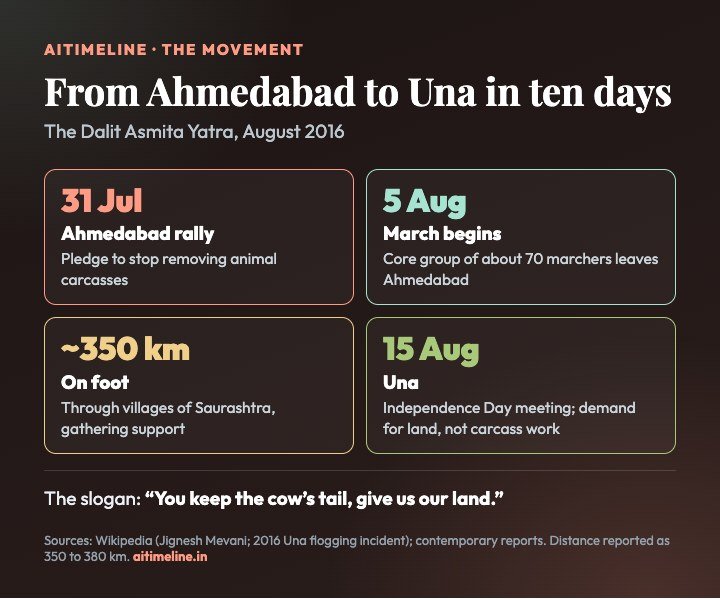
The march left Ahmedabad on 5 August with a core group of about 70 people led by Jignesh Mevani, a lawyer and activist who had become the movement’s convener. Over ten days it covered roughly 350 to 380 km through the villages of Saurashtra, gathering supporters from across the country. Its slogan, “You keep the cow’s tail, give us our land,” was a demand for redistribution: five acres for every Dalit family, rather than continued work in the occupations the caste order reserved for them.
On 15 August it ended with a large Independence Day meeting in Una, where Radhika Vemula, whose son’s suicide at the University of Hyderabad had set off campus protests that year, hoisted the flag. The day did not end peacefully: some participants were attacked on their way home. For background on the Hyderabad protests, see our Rohith Vemula movement timeline.
Timeline: The Una Flogging and the Dalit Rights Movement
Newest first. Colour shows the strand: the assault, the state’s response, the movement, the courts, or the aftermath.
Where the case stands Courts
Settled: A special court in Veraval has found five men guilty of assaulting the Sarvaiya family and of offences under the SC/ST (Prevention of Atrocities) Act, and has sentenced them to five years. The court accepted that the assault took place.
Not settled: Thirty-five acquittals, including three policemen, have not been tested on appeal in anything we could find. Vashram Sarvaiya said on the day of the verdict that the family would go to the Gujarat High Court and, if necessary, the Supreme Court. We could not confirm from public court records or reporting we could access that an appeal had been admitted or decided by 15 November 2026. The judgment on a juvenile accused was also reported pending in March.
Mayawati urges Gujarat to contest the acquittals Movement
What happened: BSP president Mayawati called on the Gujarat government to “properly” contest the acquittals of 35 accused in the High Court, saying there was “still an opportunity” for all the guilty to be punished. Dalit organisations made similar demands, including a fresh special public prosecutor and legal help for the victims’ family.
Why it matters: In a criminal case the state is the prosecutor. The victims can appeal, but an appeal by the state against acquittals would carry the government’s weight behind it. We found no report that the state had filed one.
Ten years after the flogging Aftermath
What happened: The tenth anniversary of the assault fell on 11 July 2026, four months after the trial verdict. The victims, who say they never received the land or jobs they were promised in 2016, have continued to describe the case as unfinished.
Context: The four main accused, all later convicted, had spent more than six years in custody before they were granted bail in 2022, which counted towards their five-year sentences.
Five years in prison and Rs 5,000 fine each Courts
What happened: The court sentenced the five convicted men to five years’ imprisonment under the SC/ST Act, with shorter concurrent terms under the Indian Penal Code, and a fine of Rs 5,000 each. Reports said the men had already spent between five and six years in custody as undertrials, so the sentence was largely served.
Reaction: The Free Press Journal quoted a victim’s relative: “We waited ten years for this day… But seeing the accused walk free so soon is painful.”
Five convicted, 35 acquitted Courts
What happened: Nearly ten years after the assault, the court convicted Ramesh Jadav, Rakesh Joshi, Nagjibhai Vaniya, Pramodgiri Gausvami and Balvantgiri Gausvami under IPC sections 323, 324, 342 and 504 and provisions of the SC/ST Act. It acquitted 35 others. The case against former police inspector Nirmalsinh Zala, who died during the trial, had abated. The three other policemen were acquitted.
What was not proved: The court did not convict on the most serious charges: attempt to murder (307), robbery (397), kidnapping (365), rioting (147), assault to dishonour (355) and criminal conspiracy (120-B). Defence lawyer V.C. Mavadhiya said the prosecution had not established the specific role of each of the others.
Victims: Vashram Sarvaiya, the complainant, called the verdict sad and said it would be challenged in the High Court.
High Court bails four accused after six years Courts
What happened: The High Court granted regular bail to four main accused, among them Ramesh Jadav, Rakesh Joshi and Pramodgiri and Balwantgiri Goswami, who had spent more than six years in jail as undertrials. It barred them from Gir Somnath district until the complainant and victims had testified, except to attend court.
The court on the trial: The order noted the special public prosecutor was often absent and directed the state’s Legal Department to make arrangements to finish the trial, with hearings adjourned only week to week.
Victims win day-to-day hearings Courts
What happened: On 1 July 2019 the court accepted the victims’ plea for a speedy trial and ordered day-to-day hearings from 29 July for three months. The prosecution had listed more than 300 witnesses; reports said only a few dozen had been examined.
Why it matters: The victims also asked for police protection for the public prosecutor, who said he had no office in Veraval to prepare witnesses.
A plea for euthanasia Aftermath
What happened: Vashram Sarvaiya wrote to the President seeking permission for euthanasia, citing the family’s condition and unfulfilled promises. The family later sat on an indefinite hunger strike outside the home of BJP MP Kirit Solanki.
Why it matters: The protest kept attention on what victims receive after an atrocity, not only on prosecution.
Trial begins in Veraval Aftermath
What happened: The trial began in August 2018 before the special court in Veraval, the district headquarters. The accused faced charges including attempt to murder, robbery, kidnapping, rioting and criminal conspiracy, with SC/ST Act offences.
Why it matters: The Atrocities Act calls for speedy trials in special courts. The Una trial took more than seven and a half years.
The Sarvaiyas embrace Buddhism Aftermath
What happened: Balu Sarvaiya, his wife Kunvar and his sons Vashram and Ramesh were among some 300 Dalits who converted to Buddhism near their village. Organisers put the number at about 450.
Why they did it: The family said Hinduism discriminated by caste and occupation, and that the state had not given the land and jobs offered after the assault. The conversion was presented as a protest.
Jignesh Mevani enters the Assembly Movement
What happened: Jignesh Mevani, convener of the Una Dalit Atyachar Ladat Samiti and the face of the 2016 march, won the Vadgam seat as an independent backed by Congress.
Why it matters: He used the seat to raise the Una victims’ demands; in 2018 the government told the Assembly it had no record of the promises of land and jobs.
First bail orders Courts
What happened: The High Court granted bail to four accused, among them two of the policemen. Over the next years most accused were released on bail. The main accused stayed in jail until 2022.
Why it matters: Victims later complained that accused out on bail lived near them and that witnesses were pressured.
CID chargesheets 34, including four policemen State response
What happened: The CID filed a chargesheet against 34 people, including four policemen of the Una police station, under IPC sections including 307, 397, 365, 355, 342, 147, 324 and 120-B, the SC/ST Act and the IT Act for circulating the videos. Minors were dealt with separately before the Juvenile Justice Board.
The police: The CID alleged that police had colluded with the attackers and forged documents linked to the FIR. The number of accused tried later rose to 41.
Independence Day in Una Movement
What happened: The march reached Una on Independence Day. Tens of thousands of people gathered; Rohith Vemula’s mother Radhika Vemula hoisted the national flag. Participants repeated the pledge not to remove carcasses and demanded five acres of land for every Dalit family.
Backlash: On the way home, some participants were attacked near Una; around ten were injured and vehicles were set on fire, according to reports at the time.
Prime Minister speaks on cow vigilantes Movement
What happened: After weeks of silence on Una, Prime Minister Modi said at a town hall in Delhi on 6 August that many self-styled cow protectors were anti-social elements running a racket, and asked states to prepare dossiers on them. In Hyderabad the next day he said: “If you want to shoot, shoot me, not my Dalit brothers.”
Why it matters: The remarks marked the first direct national response from the government to cow vigilantism.
Dalit Asmita Yatra sets out Movement
What happened: A core group of about 70 marchers, led by Jignesh Mevani, left Ahmedabad on foot for Una. The “Azadi Kooch” passed through villages of Saurashtra over ten days, gathering supporters.
The demand: Not just protection while doing caste-assigned work, but a way out of it: land, jobs and an end to carcass removal and manual scavenging.
Anandiben Patel offers to resign State response
What happened: Anandiben Patel announced she wanted to step down, citing the BJP convention of leaders standing aside near the age of 75. Vijay Rupani succeeded her on 7 August.
Context: Her government was under pressure from both the Una protests and the Patidar quota agitation. She did not cite Una, and we have not attributed her resignation to it.
The carcass pledge in Ahmedabad Movement
What happened: Around 30 Dalit organisations, under the new Una Dalit Atyachar Ladat Samiti with Jignesh Mevani as convener, held a large rally in Ahmedabad. Participants pledged to stop removing dead cattle and cleaning sewers.
Why it matters: The pledge turned a criminal case into an economic argument. If the work was degrading, those who depended on it would have to find someone else to do it.
Carcasses left at government offices Movement
What happened: In Surendranagar and other towns, protesters dumped cattle carcasses outside government offices, and Dalit workers in many villages stopped collecting dead animals. Twelve young Dalit men attempted suicide in protest across the region; one died.
Violence: Clashes during the protests injured a dozen people, including seven police personnel, and one of the injured died, according to contemporary reports. The state later filed 74 cases against Dalit protesters.
Una reaches Parliament State response
What happened: The Rajya Sabha discussed Una. Political leaders, including Rahul Gandhi, Arvind Kejriwal and Mayawati, visited or met the victims, who were being treated in hospital in Rajkot.
Why it matters: A district crime became a national political question within ten days.
CID-Crime takes over; four police suspended State response
What happened: The Gujarat government handed the investigation to the CID-Crime, promised a designated court, a special public prosecutor and a chargesheet within 60 days, and said each victim had been paid Rs 1 lakh. Four policemen, including the inspector, two assistant sub-inspectors and a head constable, were suspended.
The record: The High Court record says CID-Crime took over the case on 20 July 2016 and set up a Special Investigation Team.
The videos spread, and protests begin Movement
What happened: The attackers had filmed the assault. As the clips spread, more than 2,000 Dalits rallied in Chandkheda, Ahmedabad, on 12 July and blocked a highway; the next day protesters occupied Trikon Baug in Una.
The question: Not whether the men had killed a cow, which they had not, but why people doing the work of clearing a dead animal could be beaten for it in public.
The flogging at Mota Samadhiyala and Una The assault
What happened: Members of the Sarvaiya family, Dalits from Mota Samadhiyala, were skinning the carcass of a cow that had died earlier. A group of men accused them of killing it, tied them up and beat them with sticks and iron pipes. Four young men were then taken to Una town, stripped to the waist, tied to a car and flogged in public. In all, seven people were assaulted.
The victims: Vashram and Ramesh Sarvaiya, sons of Balu Sarvaiya, and their relatives Ashok and Bechar Sarvaiya were flogged. Balu and other family members were beaten when they tried to intervene.
The police: The CID later alleged that local policemen colluded with the attackers.
Nearly Ten Years in Court
From chargesheet to verdict.

The Atrocities Act requires special courts and speedy trials. The Una trial began only in August 2018, two years after the chargesheet, and by July 2019, when the Veraval court accepted the victims’ plea for day-to-day hearings, only a few dozen of more than 300 listed witnesses had testified. The public prosecutor said he had no office in Veraval to prepare them. Most accused were out on bail; the victims said some of them drove witnesses to court.
When the Gujarat High Court bailed the four main accused in July 2022, after more than six years in jail, Justice Nikhil S. Kariel recorded that the special prosecutor was often absent and ordered the state to make arrangements to finish the trial. It still took almost four more years.
The March 2026 Verdict
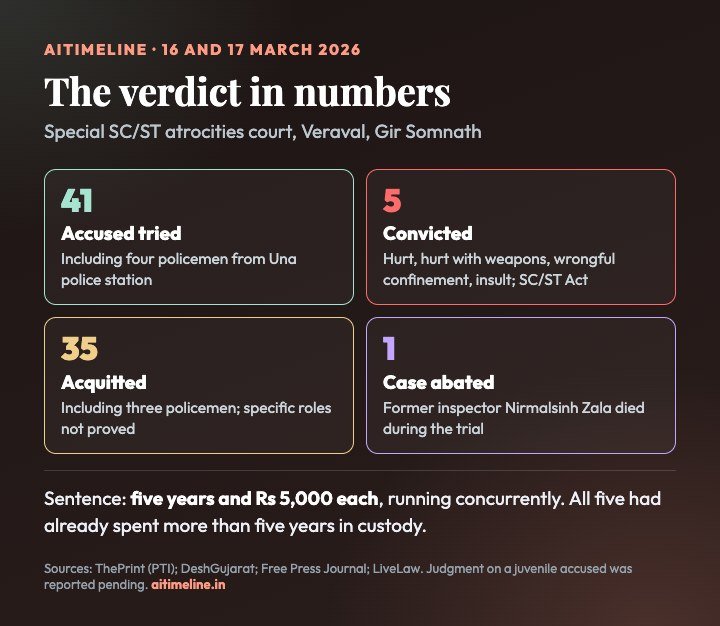
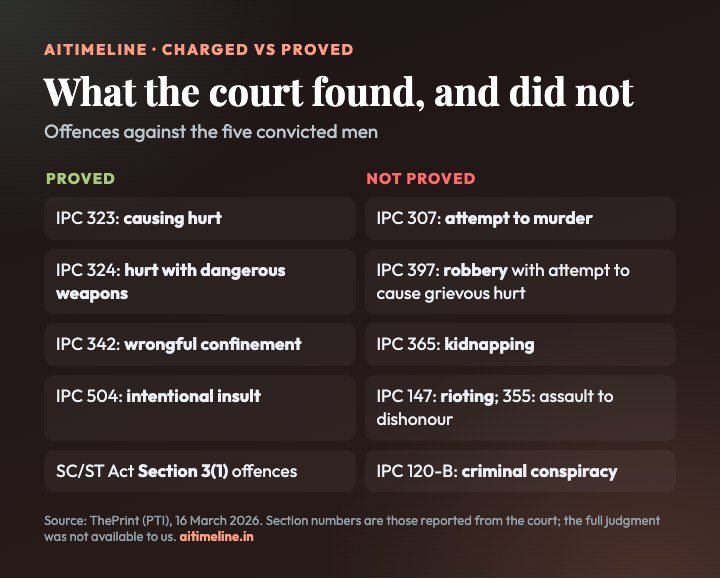
Additional Sessions Judge Jignesh Pandya convicted Ramesh Jadav, Rakesh Joshi, Nagjibhai Vaniya, Pramodgiri Gausvami and Balvantgiri Gausvami. Four of them were the men bailed in 2022. The convictions were for the assault itself, the confinement and the caste insult; the court did not find attempt to murder, robbery, kidnapping, rioting or conspiracy proved. All 35 others were acquitted, including three policemen; the fourth had died. The court accepted that the assault happened. What the prosecution failed to prove, according to the defence, was who among the rest did what.
An acquittal is not a finding that an assault did not take place, and a conviction on lesser charges is not a finding that the more serious ones were false. Both are conclusions about what the evidence in this trial established. The judgment, reported at about 340 pages, has not been published in full anywhere we could find, so we have relied on reports from the courtroom.
Land, Jobs and Promises
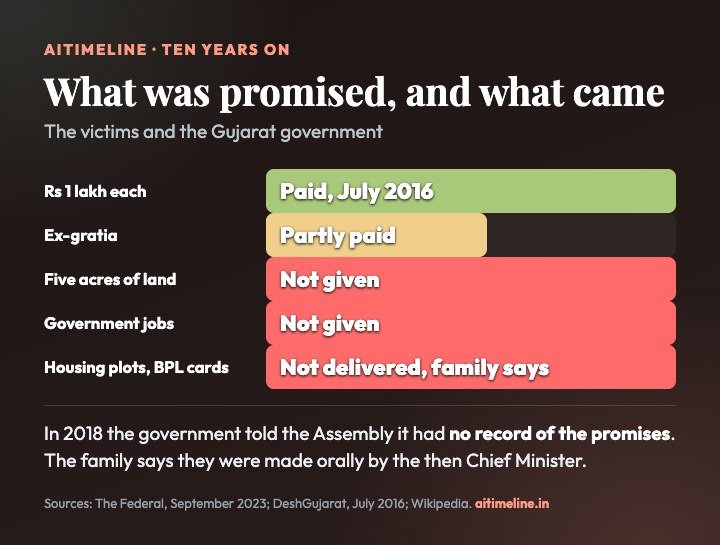
The family says that when Anandiben Patel visited Mota Samadhiyala in 2016 she offered five acres of farmland each, government jobs, housing plots and BPL cards. None of that was put in writing, and in 2018 the government told the Assembly, in answer to a question from Jignesh Mevani, that it had no record of the promises. The family has since converted to Buddhism in protest, written to the President seeking euthanasia, staged a hunger strike and filed a statement about the promises before the trial court. They still live in the village where the assault began.
Why Una Became a Dalit Rights Movement
- Caste and work. The victims were punished for doing work their caste was expected to do. The movement’s answer was to refuse the work, not to ask for safer conditions to keep doing it.
- Land over relief. The demand for five acres per family moved the debate from compensation for one crime to redistribution, a demand most Dalit families in Gujarat have never seen met.
- Cow vigilantism. Una made private violence in the name of cow protection a national issue and drew the Prime Minister’s first public criticism of self-styled cow protectors in August 2016.
- The Atrocities Act in practice. A special law, a special court and a special prosecutor still produced a trial of nearly eight years, a long list of hostile or absent witnesses and five convictions out of 41.
- New leadership. The movement made Jignesh Mevani a national figure and an MLA, and linked Gujarat’s Dalit politics to protests elsewhere, from Hyderabad to Bhima Koregaon.
For other cases where caste violence met the courts, see our timelines of the Hathras case and Bhima Koregaon and the Elgar Parishad case.
Key People and Institutions
| Person or body | Role |
|---|---|
| Vashram Sarvaiya | Flogged in Una; complainant in the case |
| Ramesh, Ashok and Bechar Sarvaiya | Flogged in Una |
| Balu Sarvaiya | Father of Vashram and Ramesh; assaulted in the village |
| Jignesh Mevani | Convener of the Samiti; led the 2016 march; MLA from 2017 |
| Una Dalit Atyachar Ladat Samiti | Coalition of about 30 Dalit groups behind the protests |
| Anandiben Patel | Chief Minister in July 2016; ordered CID probe |
| Gujarat CID-Crime | Investigated and chargesheeted the case |
| Special court, Veraval | Tried the case; verdict 16 March 2026 |
| Gujarat High Court | Bail orders 2016 and 2022; directions on the trial |
Facts at a Glance
| Detail | Information |
|---|---|
| Incident date | 11 July 2016 |
| Place | Mota Samadhiyala and Una, Gir Somnath, Gujarat |
| People assaulted | Seven; four flogged in public |
| CID takes over | Ordered 18 July 2016 |
| Ahmedabad rally | 31 July 2016 |
| Dalit Asmita Yatra | 5 to 15 August 2016 |
| Chargesheet | 7 September 2016, 34 accused |
| Trial began | August 2018, Veraval |
| Verdict | 16 March 2026: 5 convicted, 35 acquitted, 1 abated |
| Sentence | Five years and Rs 5,000 each |
| Appeal | Announced by victims; no High Court ruling found |
Explore More Timelines
People Also Ask
Frequently Asked Questions
Based on court reporting and records to 15 November 2026.
⚠️ Editorial Note
This timeline separates the reported assault, the protest movement, the prosecution’s allegations, the trial court’s findings and the appeal the victims announced. The 2026 acquittals are not presented as proof that the assault did not happen, and no one is described as guilty unless the court convicted them. We could not obtain the trial judgment and relied on reports from PTI, Scroll, LiveLaw, DeshGujarat and the Free Press Journal. Checking the brief we worked from, we corrected the chargesheet date (September 2016, not December), the length of the march (about 350 to 380 km, not 400) and the judgment’s reported length (about 340 pages). We could not verify, and so left out, the brief’s claims of a September 2025 High Court order on the victim’s oral arguments, a count of 80 hostile witnesses out of 239, and a High Court appeal filed in July 2026 and listed for 25 August 2026; Indian Express reports cited for them were not accessible to us. We will add them if they can be confirmed.
Related Reading on AiTimeline
Sources & further reading
Every dated entry above was checked against these references. Last reviewed 15 November 2026.
- Scroll.in: Gujarat court convicts five, acquits 35 others in 2016 Una flogging case (2026-03-16)
- ThePrint (PTI): 2016 Una flogging case: 5 convicted for thrashing Dalit men, 35 acquitted (2026-03-16)
- LiveLaw: Gujarat Court Sentences Five Convicts To 5-Years Imprisonment In 2016 Una Flogging Case (2026-03-17)
- DeshGujarat: 2016 Una Flogging Case: Five Convicted, 35 Acquitted by Gir Somnath Court (2026-03-17)
- Free Press Journal: A Decade After Una's Shame, Justice Is Served But Its Taste Turns Bitter As Convicts Walk Free On Time Served (2026-03-17)
- LiveLaw: Una Flogging Case: Gujarat HC Grants Bail To 4 Accused, Orders State To Make Appropriate Arrangements For Conclusion Of Trial (2022-07-26)
- DeshGujarat: Gujarat CM orders CID Crime probe into Una incident, chargesheet in 60 days, designated court (2016-07-18)
- IBTimes India: Gujarat CID chargesheets 34 including policemen for Dalit flogging in Una (2016-09-08)
- The Week: Una flogging case to be heard on daily basis from July 29 (2019-07-03)
- The Week: 300 Dalits including Una flogging victims embrace Buddhism (2018-04-29)
- The Federal: Una flogging: Seven years later, Dalit victims still wait for promised land, jobs (2023-09-12)
- Wikipedia: 2016 Una flogging incident (2026-11-01)