Mathura Custodial Rape Case: Law, Justice & Reform Timeline
Explore the Mathura custodial rape case timeline, the 1978 Supreme Court verdict, 1983 rape-law reforms and changes to India's consent laws today.
Latest Story
On the night of 26 March 1972, a young Adivasi woman known as Mathura was kept back at a police station in eastern Maharashtra after her family was told to go home. She said two policemen raped and molested her there. Three courts reached three different conclusions, and the last, a Supreme Court acquittal in 1978, set off India’s first national campaign against rape. This Mathura rape case timeline follows the case from the police station to the 1983 law it forced and the codes that carry that law today.
The Supreme Court judgment is dated 15 September 1978, not 1979; it is often misdated because it was reported in 1979, and the open letter came a year later. The case did not end in a conviction: both policemen were acquitted and the case was never reopened. And Mathura’s age was never proved: a doctor estimated 14 to 16, but the courts held it was not shown she was under 16.
💡 Short Answer
The Mathura case concerns a young Adivasi woman who said she was raped by two policemen at the Desai Gunj police station, Maharashtra, on 26 March 1972. The Sessions Court acquitted them in 1974, the Bombay High Court convicted them in 1976, and the Supreme Court acquitted them on 15 September 1978. The protests that followed led to the Criminal Law (Amendment) Act, 1983, which created the offence of custodial rape and a presumption of no consent.
Mathura Case: Key Questions
The Case in Ten Points
- The setting: a police station at night, where she had been brought over her brother’s complaint.
- The accused: two policemen on duty, Head Constable Tukaram and Constable Ganpat.
- Trial court: acquittal in 1974, relying heavily on her sexual history.
- High Court: conviction in 1976, holding that passive submission is not consent.
- Supreme Court: acquittal on 15 September 1978, citing the absence of injuries.
- The letter: four law teachers challenged the judgment in September 1979.
- The streets: protests on 8 March 1980 and new autonomous women’s groups.
- The law: the 1983 Act created custodial rape and a presumption of no consent.
- The gaps: sexual-history evidence was not barred until 2002 and 2013.
- The verdict stands: no one was punished, and the case was never reopened.
Three Courts, Three Verdicts, One New Law
The case in four stages, 1974 to 1983.
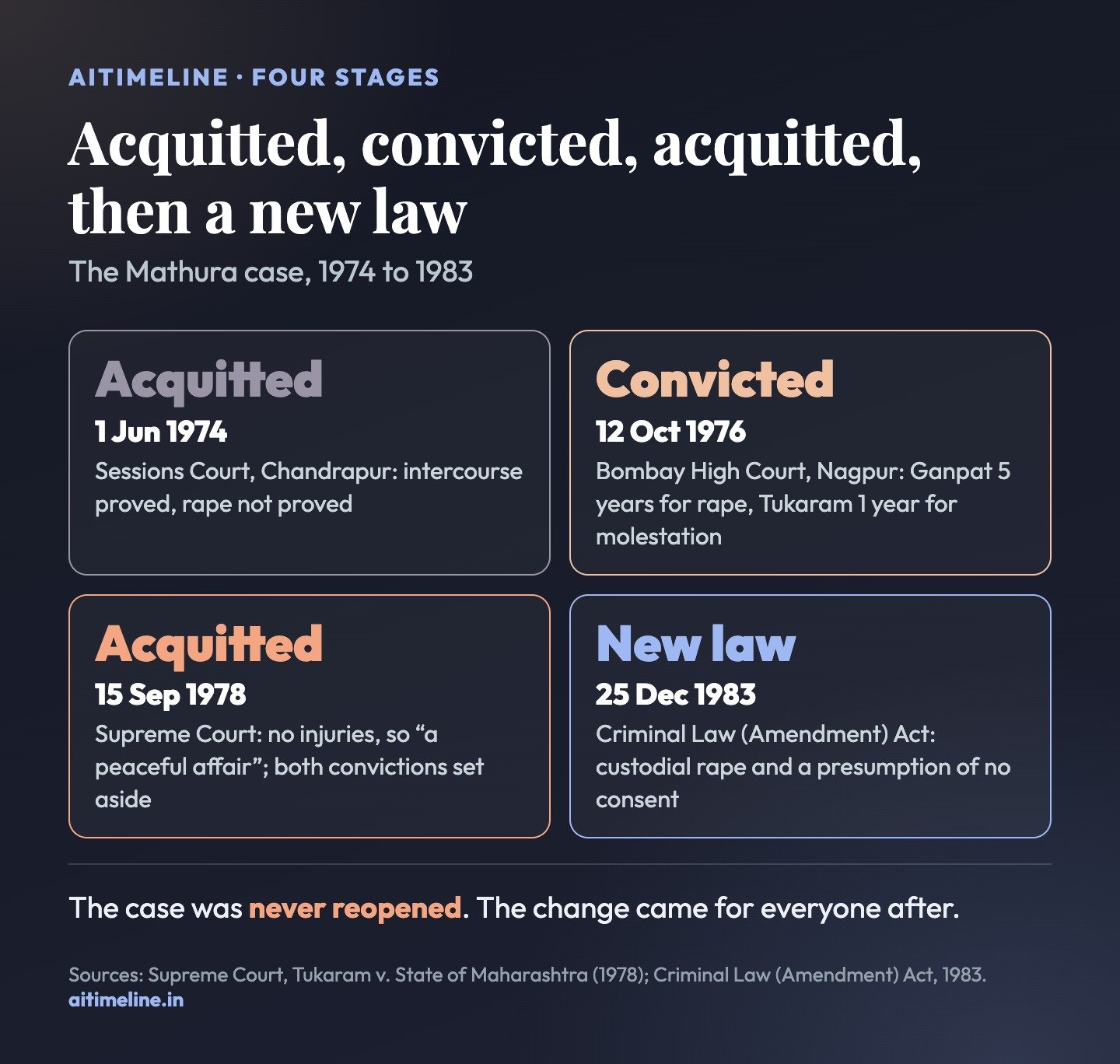
The same facts, read three ways. All three courts accepted that she had sexual intercourse at the police station. They disagreed on what it meant: a lie to save face, a rape by men she could not resist, or a consensual act because she bore no injuries.
A law, not a conviction. The 1983 Act did not reopen the case. Its importance lies in what it changed for everyone who came after.
The Night at Desai Gunj
26 and 27 March 1972, from the prosecution case recorded by the Supreme Court.

Why she was there. She had not been accused of anything. Her brother had complained that the man she wanted to marry and his family had kidnapped her, and the police brought everyone in to record statements.
The crowd. Her relatives waited outside. When the station’s lights went off and the door closed, they began shouting. The crowd that gathered threatened to burn the station, and only then was her complaint written down.
The examination. She was examined about 20 hours later. There were no injuries on her body. That one finding would decide the case in the Supreme Court.
Mathura Case Timeline, Newest First
Tagged by phase: the incident, the trial and High Court, the Supreme Court, the campaign, and the law reform that followed.
A Chief Justice calls the verdict an embarrassment Law reform
What happened: Chief Justice of India B.R. Gavai described the Supreme Court’s judgment in Tukaram v. State of Maharashtra as a “moment of institutional embarrassment”. His remarks were reported on 13 November 2025.
What he said: He said the legal system had failed to protect the person it was meant to safeguard, and that the judgment wrongly treated the absence of visible resistance as consent. He also called it a turning point, because of the protests and law reform that followed.
Why it matters: It was an unusually direct admission from the head of the judiciary about one of the Court’s own decisions, 47 years after it was delivered.
The new criminal codes take effect Law reform
What happened: The Bharatiya Nyaya Sanhita, Bharatiya Nagarik Suraksha Sanhita and Bharatiya Sakshya Adhiniyam, which received assent on 25 December 2023, came into force and replaced the IPC, the CrPC and the Indian Evidence Act.
What carried over: Rape by a police officer within his police station’s limits, in any station house, or of a woman in police custody is aggravated rape under BNS Section 64(2)(a). Custodial sexual intercourse by a person in authority is Section 68. Disclosure of a victim’s identity is punished under Section 72. The presumption of no consent is now BSA Section 120, and in-camera trials are BNSS Section 366.
Why it matters: Every safeguard that grew out of the Mathura campaign survived the change of codes, under new section numbers.
Consent is defined in the statute Law reform
What happened: After the December 2012 Delhi gang rape and the Justice J.S. Verma Committee’s report of 23 January 2013, the government issued an ordinance on 3 February. Parliament replaced it with the Criminal Law (Amendment) Act, which received assent on 2 April 2013.
The Mathura answer: Section 375 now defined consent as an “unequivocal voluntary agreement”, and added that a woman who does not physically resist penetration shall not, for that reason alone, be regarded as consenting. That is close to a direct reversal of the reasoning used against Mathura in 1978.
Other changes: The Act widened the definition of rape, created offences such as stalking and voyeurism, and extended the Section 114A presumption to all the aggravated categories in Section 376(2).
POCSO creates a separate law for children Law reform
What happened: The POCSO Act came into force, creating gender-neutral offences against children under 18, with child-friendly procedures for recording evidence and special courts.
The link: Mathura’s age was itself disputed in 1972-74: a doctor put her at 14 to 16, and the courts held it was not proved she was under 16. A separate law for children reflects how much the treatment of young survivors changed.
Character evidence is removed from the Evidence Act Law reform
What happened: Parliament deleted Section 155(4) of the Indian Evidence Act, which had allowed the defence in a rape case to show that the complainant was “of generally immoral character”.
The Mathura link: Women’s groups had asked for this in 1980. The Sessions Court’s description of Mathura as “habituated to sexual intercourse” was the kind of reasoning they wanted removed, but the 1983 Act had left it out.
What followed: The 2013 amendment went further, barring evidence of a woman’s character or past sexual experience on the question of consent.
State of Punjab v. Gurmit Singh Law reform
What happened: Reversing an acquittal in a rape case from Ludhiana, the Supreme Court criticised the trial court for casting stigma on the complainant and said a survivor’s evidence does not need corroboration in every case.
In-camera trials: The Court said the requirement in Section 327(2) of the CrPC, added in 1983, that rape trials be held in camera should be followed as a rule, and that courts should avoid disclosing the victim’s name.
Why it matters: It showed the 1983 procedural safeguards being enforced from the bench, in language very different from the 1978 judgment.
The Criminal Law (Amendment) Act, 1983 Law reform
Custodial rape: Section 376(2) created aggravated rape, including rape by a police officer within his station’s limits or of a woman in his custody, and rape by public servants, jail and remand-home staff and hospital staff. New Sections 376B to 376D made sexual intercourse by such persons with a woman in their custody an offence even where it did not amount to rape.
Presumption: New Section 114A of the Evidence Act said that in prosecutions under Section 376(2), once intercourse is proved and the woman says in court she did not consent, the court shall presume she did not.
Privacy and sentence: Section 327(2) of the CrPC required rape trials to be held in camera, and Section 228A of the IPC made it an offence to disclose a victim’s identity. A minimum of 10 years was set for aggravated rape and seven years in other cases, with limited power for courts to go lower.
A Joint Committee reports on the Bill Campaign
What happened: The Criminal Law (Amendment) Bill, 1980 had been sent to a Joint Committee of both Houses. It sought public opinion and reported in November 1982.
The dispute: Women’s groups objected to a clause that would have made publishing anything about a rape trial a non-bailable offence, since their campaign had relied on press coverage. The committee kept the restriction but made the offence bailable, according to Flavia Agnes’s review.
The government introduces a Bill Campaign
What happened: The government asked the Law Commission to examine the law on rape. Its 84th Report, in 1980, accepted both of the campaign’s main demands: a presumption of no consent and a bar on using a woman’s sexual history. The Bill was introduced in Parliament in August 1980.
What it left out: The Bill did not include the Commission’s proposals to regulate police powers, such as a ban on arresting women at night, and it dropped the sexual-history bar. It accepted the presumption only for custodial and other aggravated cases.
Women’s Day protests in several cities Campaign
What happened: On International Women’s Day, women’s groups held demonstrations in several cities, demanding that the Mathura case be reheard and that the rape law be changed.
The outcome in court: The case was not reopened. Accounts of the campaign record that the courts found campaigners had no legal standing in a criminal appeal to which they were not parties.
Why it matters: The protests made rape, previously treated as a private shame, a subject of public political debate, which Agnes called the campaign’s principal gain.
The Forum Against Rape is formed in Bombay Campaign
What happened: Women in Bombay who had read the open letter formed the Forum Against Rape. Accounts date its start to January 1980 or to a public meeting on 23 February 1980. It later renamed itself the Forum Against Oppression of Women.
Elsewhere: Groups formed in other cities around the same time, including Saheli in Delhi.
Four law teachers write an open letter Campaign
What happened: After the judgment appeared in the law reports, four law teachers, three from Delhi University and Vasudha Dhagamwar from Pune, wrote to Chief Justice Y.V. Chandrachud. The letter is commonly dated 16 September 1979.
What it argued: “Consent involves submission, but the converse is not necessarily true,” they wrote. They asked whether the Court had considered the power of two policemen over a young woman held at a police station, and asked for the case to be reheard by a larger bench.
Why it matters: It was the first public challenge to the judgment and became the founding document of the anti-rape campaign.
The Supreme Court acquits both policemen Supreme Court
What happened: A three-judge bench allowed the appeal. Justice A.D. Koshal, writing for the Court, set aside both convictions and sentences.
The reasoning on Ganpat: The Court said the absence of injuries showed the intercourse was “a peaceful affair” and that her account of resistance was false. Under the law then, consent was vitiated only by fear of “death or hurt”, and the High Court had made no such finding. Because she had been taken from among her relatives at the entrance, it said, she could not have been so overawed that she would not resist.
The reasoning on Tukaram: Her first report had named Tukaram for acts she later attributed to Ganpat, so the Court would not rely on her account against him.
The policemen appeal Supreme Court
What happened: Tukaram and Ganpat obtained special leave to appeal against the High Court’s judgment. They were represented by M.N. Phadke; the State by H.R. Khanna.
Their argument: There was no direct evidence about the nature of her consent, they argued, and the circumstances did not show she was under any fear or compulsion that would turn her submission into rape.
The Bombay High Court convicts both men Trial and High Court
What happened: The High Court reversed the acquittal. It convicted Ganpat of rape under Section 376 IPC and sentenced him to five years’ rigorous imprisonment. It convicted Tukaram of outraging her modesty under Section 354 and sentenced him to one year.
The reasoning: Both men were strangers to her, she was alone at the police station at night, and a complaint by her own brother was pending there. “Mere passive or helpless surrender of the body and its resignation to the other’s lust induced by threats or fear”, it said, could not be equated with consent.
On Tukaram: The court did not believe he had tried to rape her, but accepted that he had molested her.
The Sessions Court acquits Trial and High Court
What happened: The Sessions Judge acquitted both men. He found that she had sexual intercourse at the police station, probably with Ganpat, but held that rape was not proved.
The reasoning: He called her “a shocking liar”, described her as “habituated to sexual intercourse”, and suggested she invented the rape to appear virtuous before her lover. He said there was “a world of difference between sexual intercourse and rape”.
Why it matters: The use of her sexual history to judge consent was central to the later campaign.
The medical examination The incident
What happened: She was examined at about 8 pm the next day. The doctor found no injury on her body and estimated her age at between 14 and 16.
The forensic evidence: No semen was found in the samples taken from her body, but it was found on her clothes and on the pyjama taken from Ganpat. The High Court later put the negative samples down to the delay and the likelihood she had bathed.
Why it mattered: The absence of injuries became the Supreme Court’s main reason for treating the intercourse as consensual.
A crowd gathers outside the police station The incident
What happened: Her relatives grew suspicious when the station’s lights went out and its door was closed from inside. Their shouts drew a crowd. When she came out, she told them Ganpat had made her undress and raped her.
The complaint: A doctor told them to report to the police. The crowd grew restive and threatened to beat Ganpat and burn the station down. Head Constable Baburao, brought from his home, calmed it and recorded her statement as the first information report.
Kept back at Desai Gunj police station The incident
Why she was there: Her brother Gama had complained that she had been kidnapped by Ashok, the man she wanted to marry, and his relatives. All of them were brought to the station at about 9 pm.
What happened: After statements were recorded, they were told to leave. As they did, the two policemen told her to stay and her companions to go. The prosecution case was that Ganpat took her to a latrine, then to the back verandah, and raped her there, and that Tukaram then molested her but was too drunk to rape her.
Who she was: An orphaned Adivasi labourer who lived with her brother, described by the doctor as 14 to 16 years old. The station, spelt Desai Gunj in the judgment, is in today’s Desaiganj in Gadchiroli district, then part of Chandrapur district.
Court by Court: How Each Read the Evidence
Same facts, opposite conclusions.
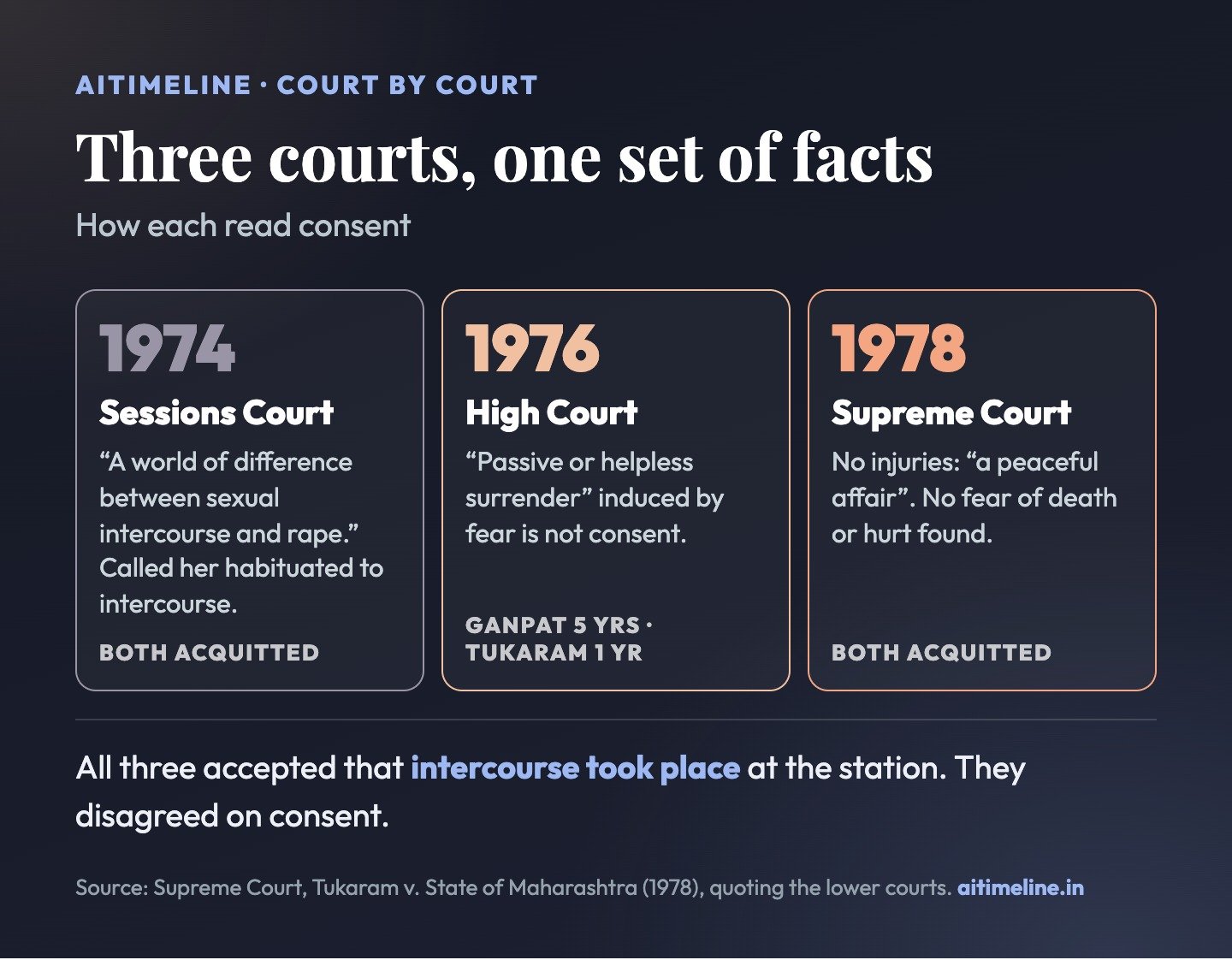
| Court | Date | On consent | Ganpat | Tukaram |
|---|---|---|---|---|
| Sessions Court, Chandrapur | 1 Jun 1974 | Intercourse proved, rape not proved | Acquitted | Acquitted |
| Bombay High Court, Nagpur | 12 Oct 1976 | Passive submission under fear is not consent | Section 376: 5 years RI | Section 354: 1 year RI |
| Supreme Court | 15 Sep 1978 | No injuries; no fear of death or hurt found | Acquitted | Acquitted |
The age question. Had she been proved to be under 16, the question of consent would not have arisen, because intercourse with a girl under 16 was rape under the fifth clause of Section 375. Her brother was asked to bring her birth record, but all three courts treated her age below 16 as unproved.
The first report. In her first statement she attributed some acts to Tukaram that she later attributed to Ganpat. The Supreme Court used that change to reject her evidence against Tukaram entirely.
The Consent Question
What the Court said, and what its critics answered.

“A peaceful affair”
No injuries were found, so the Court concluded there was no resistance, and that her account of a struggle was false.
Injuries are not the test
A woman alone with two policemen at night may not fight back. The absence of injuries does not show she agreed.
Fear of death or hurt
Under the third clause of Section 375, only consent obtained by fear of death or hurt was invalid, and no such fear was found.
Submission is not consent
“Consent involves submission, but the converse is not necessarily true,” the four law teachers wrote. The High Court had said the same.
She did not call for help
Taken from among her relatives at the entrance, she could have resisted and called to them, the Court reasoned.
Power was the point
Her brother’s complaint was pending at that very station. The men were police officers. The letter asked why that power counted for nothing.
What the 1983 Act Changed
Criminal Law (Amendment) Act, 1983 (Act 43 of 1983), assent 25 December 1983.

| Before 1983 | After the 1983 Act |
|---|---|
| No separate offence of custodial rape | Aggravated rape by police, public servants and custodial staff, Section 376(2) IPC |
| Consent proved by the prosecution in every case | Court presumes no consent in aggravated cases if she says so, Section 114A Evidence Act |
| Rape trials in open court unless a judge ordered otherwise | Rape trials held in camera, Section 327(2) CrPC |
| No specific bar on naming the victim | Disclosing a victim’s identity punishable, Section 228A IPC |
| No minimum sentence for rape | 10 years for aggravated rape, 7 years otherwise |
What campaigners won. The presumption of no consent in custodial cases answered the central problem of the Mathura trial: a woman’s word against two policemen, with the burden entirely on her side.
What they did not. The presumption did not extend to all rape cases, and the bar on using a woman’s sexual history was dropped. Flavia Agnes later found that courts often went below the new minimum sentences, citing “adequate and special reasons”.
From the IPC to the BNS
How the Mathura-era safeguards moved through later reforms.
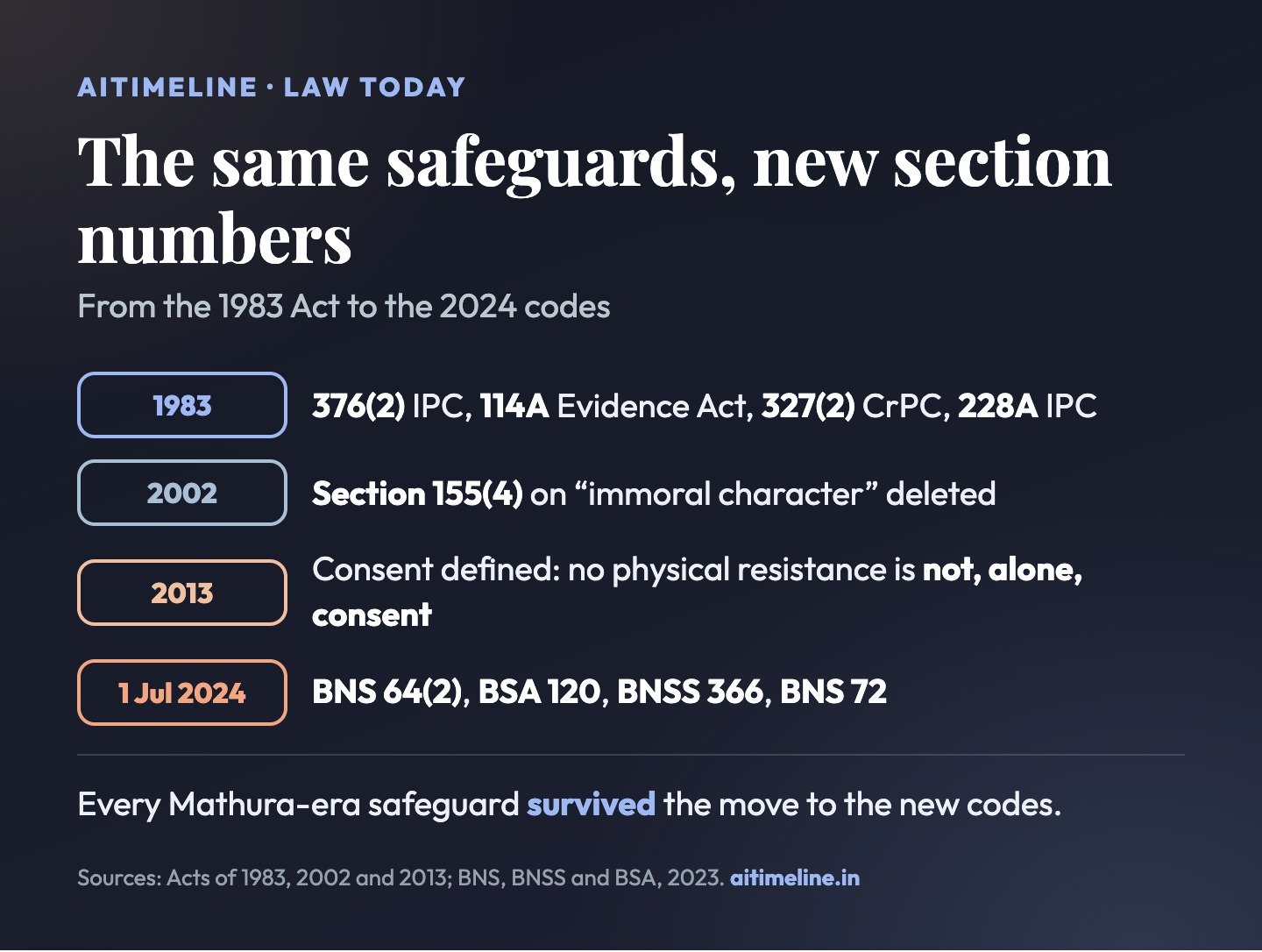
| Safeguard | 1983 provision | From 1 July 2024 |
|---|---|---|
| Aggravated rape by police | Section 376(2) IPC | BNS Section 64(2)(a) |
| Custodial sexual intercourse | Sections 376B-376D IPC | BNS Section 68 |
| Presumption of no consent | Section 114A Evidence Act | BSA Section 120 |
| In-camera trial | Section 327(2) CrPC | BNSS Section 366 |
| Victim’s identity | Section 228A IPC | BNS Section 72 |
The 2013 turn. After the 2012 Delhi gang rape, Parliament defined consent in the statute for the first time. Its explanation that a lack of physical resistance is not, by itself, consent reads almost as a reply to the 1978 judgment.
Law and practice. Statutory safeguards do not guarantee their use. Delays, police reluctance to register complaints and hostile questioning in court remain the subject of debate, as later cases on AiTimeline show.
By the Numbers

Who Was Who
Mathura
An orphaned Adivasi labourer, estimated by a doctor to be 14 to 16 in 1972. She has never been identified beyond the name used in the judgment.
Tukaram and Ganpat
Head constable and constable at the Desai Gunj police station. Convicted by the High Court, acquitted by the Supreme Court.
Justice A.D. Koshal
Wrote the 1978 judgment for a bench with Justices Jaswant Singh and P.S. Kailasam.
Baxi, Sarkar, Kelkar, Dhagamwar
Four law teachers whose September 1979 letter to the Chief Justice began the campaign.
Y.V. Chandrachud
Chief Justice of India from 1978 to 1985, to whom the letter was addressed.
Forum Against Rape
Formed in Bombay in early 1980; later the Forum Against Oppression of Women.
Did You Know?
- Not a suspect: she was at the police station only because her brother had filed a complaint about her relationship.
- A year apart: the open letter of September 1979 came almost a year after the judgment of September 1978.
- Three opposite findings: acquitted, convicted, acquitted, all on the same evidence.
- The crowd’s role: the FIR was written only after a crowd threatened to burn the station.
- Forty-one years later: the 2013 definition of consent said lack of physical resistance is not, alone, consent.
- Forty-seven years on: a sitting Chief Justice called the verdict a “moment of institutional embarrassment” in 2025.
Explore More Timelines
People Also Ask
Frequently Asked Questions
Based on the Supreme Court judgment, Flavia Agnes’s review in the Economic and Political Weekly, and later statutes.
⚠️ Editorial Note: What We Checked
We checked the brief we started from against the 1978 judgment and Flavia Agnes’s 1992 review. The medical examination was on 27 March 1972, about 20 hours after the incident, not at an unspecified date in March or April. The relatives grew suspicious when the station’s lights went off and its door was shut, and the FIR was recorded after a crowd threatened to burn the station. The Forum Against Rape cannot be dated to a specific day in January 1980; sources give January or a public meeting on 23 February, so we say early 1980. The 1983 presumption applied to all the aggravated categories in Section 376(2), including gang rape, not only custodial cases. We have not used one academic chapter cited in the brief because we could not verify its title. The open letter is commonly dated 16 September 1979; one report gives 6 September. Mathura’s age is not presented as established. This article describes court judgments and laws and is not legal advice.
Related Reading on AiTimeline
Sources & further reading
Every dated entry above was checked against these references. Last reviewed 18 November 2026.
- Indian Kanoon: Tukaram and Another v. State of Maharashtra, Supreme Court, 15 September 1978, (1979) 2 SCC 143 (full judgment)
- Flavia Agnes, 'Protecting Women Against Violence? Review of a Decade of Legislation, 1980-89', Economic and Political Weekly, 25 April 1992 (PDF)
- Supreme Court of India: State of Punjab v. Gurmit Singh, 16 January 1996, (1996) 2 SCC 384 (judgment PDF)
- PRS Legislative Research: Justice Verma Committee Report Summary (report submitted 23 January 2013)
- Ministry of Home Affairs: New Criminal Laws (Bharatiya Nyaya Sanhita, Bharatiya Nagarik Suraksha Sanhita, Bharatiya Sakshya Adhiniyam)
- The Indian Express: Amid marital rape debate, what the trajectory of laws on rape reveals (22 December 2025)
- LawChakra: CJI Gavai calls 1979 Mathura rape case verdict a 'moment of institutional embarrassment' (13 November 2025)
- Wikipedia: Mathura rape case