European Revolt: UK Farmers’ Protests and Food Security
UK farmers' protests timeline: Europe's tractor revolt, Westminster rallies, the £2.5m farm tax concession, supermarket blockades and UK food security.
Latest Story
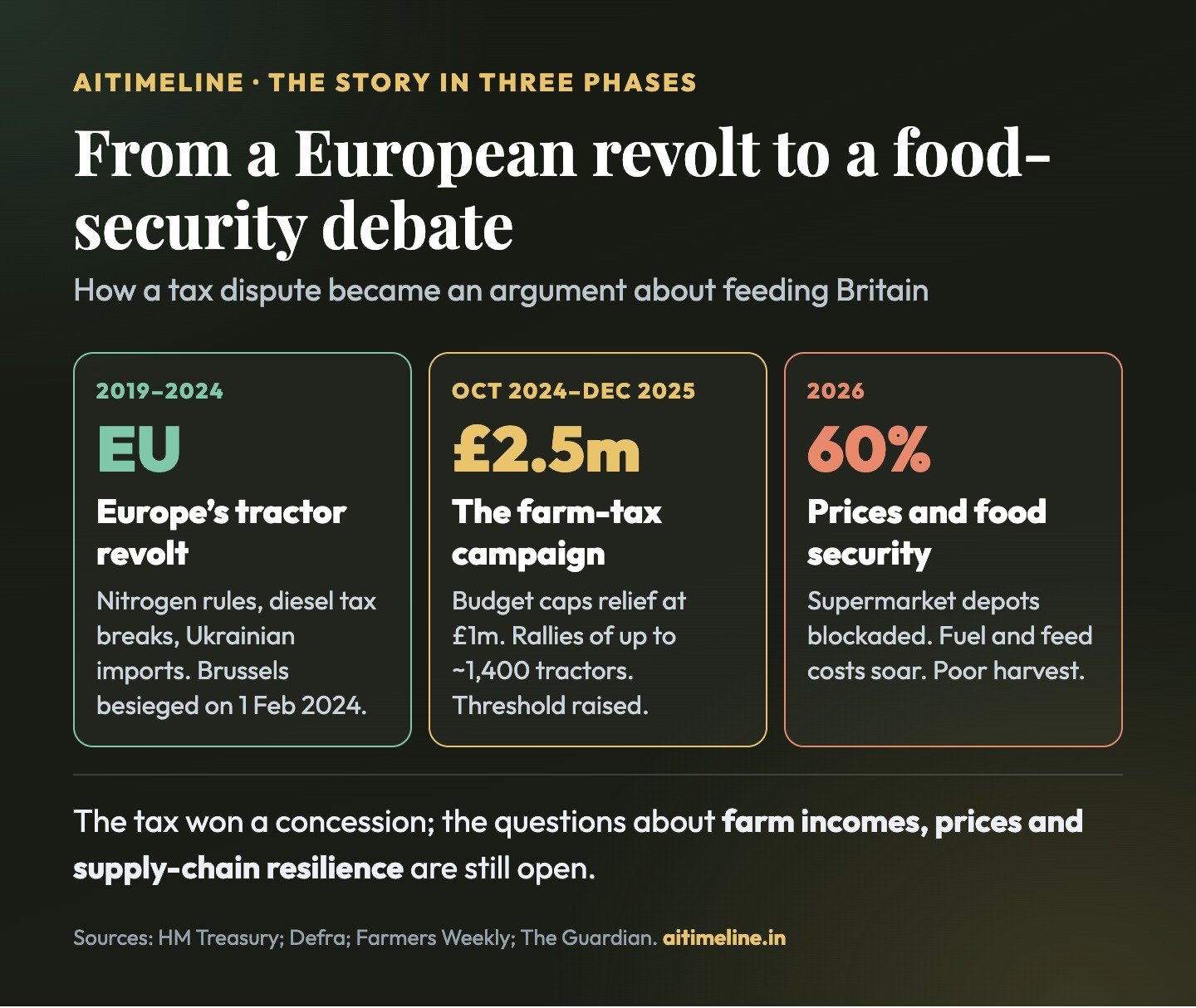
The UK farmers’ protests began as a fight over one line in the October 2024 Budget and became a national argument about whether Britain can keep feeding itself. They followed a wave of European farmers’ protests in 2023 and 2024, when tractors blocked roads from Berlin to Paris to Brussels. In Britain, thousands rallied in Westminster against changes to agricultural inheritance-tax relief, the government raised the threshold from £1 million to £2.5 million, and protesters then turned on supermarket distribution centres. This timeline traces every stage, explains the tax, and sets out what official figures say about UK food security.
The tax campaign (November 2024 to December 2025) was about Agricultural and Business Property Relief, and it won a major concession. The price and supply-chain campaign (from January 2026) targeted supermarkets, farm-gate prices, imports and input costs, and it has no single policy fix. Keeping the two apart explains why the protests did not stop when the tax changed.
💡 Short Answer
UK farmers protested from November 2024 against the Budget’s limits on inheritance-tax relief for farms, with tractor rallies of up to about 1,400 vehicles in Whitehall. In December 2025 the government raised the 100% relief threshold to £2.5 million per estate, and the rules took effect in April 2026. Protests then shifted to supermarket depots over prices and imports, as official figures showed the UK producing 60% of its food by value in 2025.
UK Farmers’ Protests: Key Questions
What to Know About the UK Farmers’ Revolt
- European roots: tractor protests swept the Netherlands, Germany, France, Poland and Brussels in 2019-2024.
- UK trigger: the October 2024 Budget’s cap on Agricultural and Business Property Relief.
- Scale: about 10,000 rallied on Whitehall in November 2024; about 1,400 tractors came in February 2025.
- Second grievance: the Sustainable Farming Incentive closed without warning in March 2025.
- Concession: the 100% relief threshold rose to £2.5 million per estate in December 2025.
- Now law: the revised rules took effect on 6 April 2026 under the Finance Act 2026.
- New front: January 2026 blockades of supermarket depots over prices and imports.
- Self-sufficiency: 60% of all food by value in 2025, down from 65% in 2024.
- 2026 squeeze: red diesel almost doubled and fertiliser and feed rose about 20% after the Iran conflict began.
Europe’s Tractor Revolt
Many national protests with overlapping grievances, not one coordinated movement.
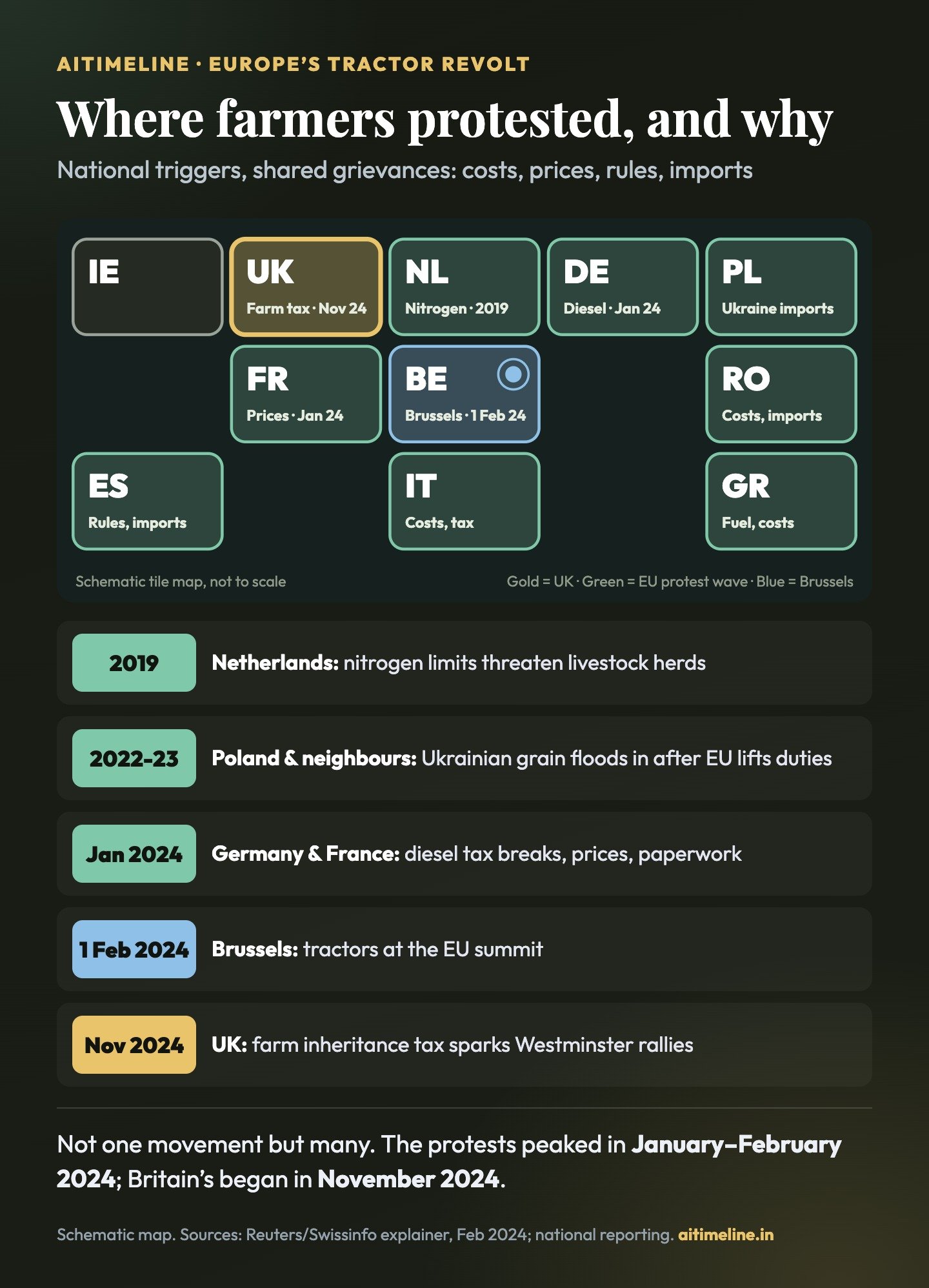
The European revolt had five recurring complaints. Costs rose sharply after Russia’s invasion of Ukraine pushed up energy, fertiliser and feed prices. Farm-gate prices did not keep pace. Environmental rules on nitrogen, pesticides and land use arrived, farmers said, without enough money to pay for them. Imports, especially Ukrainian grain after the EU lifted duties in June 2022, undercut farmers in neighbouring countries. And paperwork around subsidies kept growing.
Each country had its own spark. In the Netherlands it was nitrogen limits that threatened livestock herds. In Germany it was the plan to end tax breaks on agricultural diesel. In France it was prices, rules and a farm-diesel tax rise. In Poland it was Ukrainian imports. The protests worked: Brussels withdrew its pesticide law, eased some green conditions on subsidies and launched a Strategic Dialogue on the future of farming.
Britain had its own pressures. After Brexit, EU-era direct payments were being phased out and replaced with schemes that pay for environmental work. When the October 2024 Budget changed inheritance tax, it landed on a sector already unsure where its income would come from.
The Westminster Protests
From a mass lobby of MPs to 1,400 tractors on Whitehall, November 2024 to February 2025.
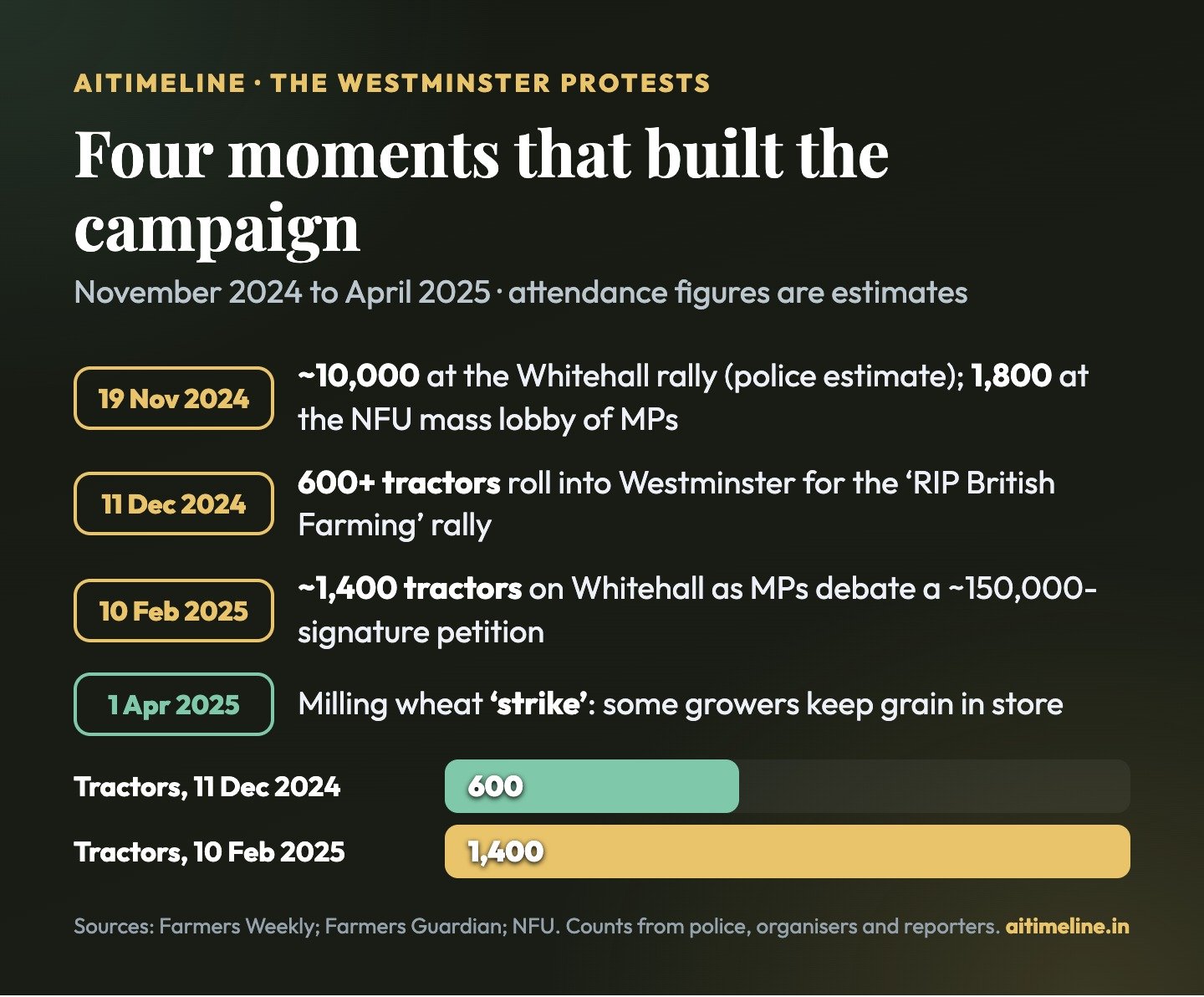
The first big day, 19 November 2024, combined two events: the NFU’s mass lobby of MPs at Church House, which drew about 1,800 members, and a rally on Whitehall that police estimated at about 10,000 people by midday. On 11 December more than 600 tractors drove into Westminster. On 10 February 2025, as MPs debated a petition of about 150,000 signatures, Save British Farming’s rally brought roughly 1,400 tractors to Whitehall.
The campaign also changed tactics. On 1 April 2025 some growers began a milling wheat ‘strike’, keeping grain in store, and farmers held rallies in Wales, Scotland and Northern Ireland. The NFU kept to lobbying and legal analysis; the tractor rallies were driven by campaign groups.
The Inheritance-Tax Dispute Explained
What the Budget proposed, what changed, and what became law.
| Feature | Original plan (Oct 2024) | As enacted (from 6 Apr 2026) |
|---|---|---|
| 100% relief allowance | First £1m per person | First £2.5m per estate |
| Relief above allowance | 50% | 50% |
| Effective rate above allowance | Up to 20% | Up to 20% |
| Spouse transfer | Not transferable | Transferable; up to £5m for a couple |
| Payment | 10 annual interest-free instalments | 10 annual interest-free instalments |
| Estates paying more (2026-27 est.) | ~375 | ~185 |
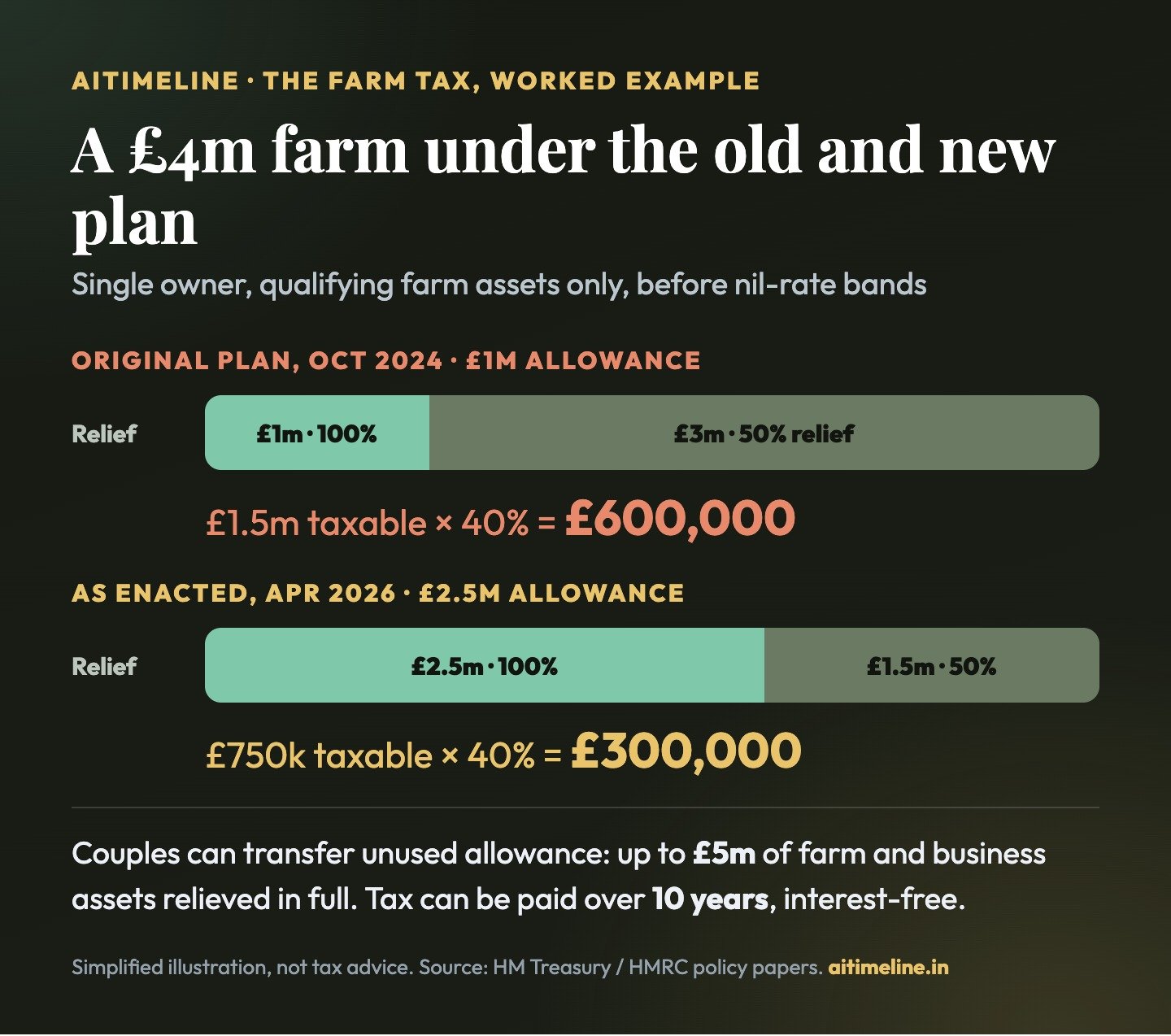
The worked example above is simplified: it ignores the nil-rate bands and other reliefs that most estates also use. Under the revised rules, £2.5 million of a £4 million farm is fully relieved; the remaining £1.5 million gets 50% relief, leaving £750,000 taxable at 40%, a bill of £300,000. Under the original £1 million allowance, £3 million would have received only 50% relief, so £1.5 million would have been taxable, a bill of £600,000.
The government argued that most farms fall below the threshold and that the largest estates had enjoyed generous relief. Farming groups argued that land values are high relative to farm incomes, so even a reduced bill can mean selling land. The Treasury’s estimates and the farming unions’ estimates of how many farms are affected have never matched.
Timeline: Europe’s Revolt and the UK Farmers’ Protests
Newest first. Labels mark the European wave, UK protests, policy, tax and food security.
Costs, a poor harvest and a resilience warning Food security
What happened: Reporting in October 2026 described a sector under strain from several directions at once. The Guardian reported on 11 October that red diesel, the lower-taxed fuel used in farm machinery, had almost doubled in price since the conflict involving Iran began in late February 2026, and that most fertilisers and animal feed had risen by about 20%. The Public Accounts Committee took evidence on 12 October on how resilient the UK food supply is to disruption.
Why it matters: The original protests were about tax. By late 2026 the debate had shifted to whether British farms can stay profitable enough to keep producing at all, and whether the supply chain behind them could absorb a serious shock.
Heat and drought hit the 2026 harvest Food security
The figures: Defra’s provisional estimates put the 2026 English wheat harvest at 10.8 million tonnes, up 0.8% on 2025 because better yields offset a smaller area. Barley fell 11% to 3.7 million tonnes and oats also fell; both were the smallest harvests since 2012. Defra said hot weather and limited rainfall during the growing season hampered the harvest, with northern regions faring better than the south.
A note on ‘worst on record’: Analysis by the Energy and Climate Intelligence Unit in August projected England’s worst combined harvest since 1984, and some reporting described a record low. The official provisional numbers are more mixed, so this page uses them. Final UK figures are due on 10 December 2026.
Official figures: the UK produces 60% of its food Food security
The figures: Defra’s updated farming statistics put the UK’s food production-to-supply ratio at 60% for all food and 72% for ‘indigenous-type’ food that can be grown in the UK, in 2025. In 2024 the figures were 65% and 77%.
How to read it: The ratio compares the farm-gate value of UK production with the value of food consumed. Because it is measured by value, a jump in import prices can lower it even if farms produce the same amount, and Defra’s figures suggest UK output by volume changed little between 2024 and 2025.
The revised inheritance-tax rules take effect Tax
What changed: From 6 April 2026, 100% relief applies to the first £2.5 million of combined qualifying agricultural and business property in an estate, and 50% relief to the value above that. At the standard 40% inheritance-tax rate, that means an effective rate of up to 20% on the value above the allowance, which can be paid in instalments over ten years.
Why it matters: The dispute moved from a proposal to law. Farming groups continued to argue that asset-rich, cash-poor farms with land worth more than the allowance still face hard succession decisions.
Tractors block three Lidl distribution centres UK protest
What happened: Farmers used tractors to block the entrances to Lidl distribution centres in Peterborough, Doncaster and Houghton Regis, near Luton, stopping lorries moving in or out. Reports counted nine tractors and trailers at Peterborough and about a dozen at Doncaster.
What they wanted: Spokesman Phil Weston, a Northamptonshire farmer, said the aim was to raise awareness of food security and the fragility of the UK food system, and warned that other supermarkets could be targeted. A week later, on 29 January, a blockade of Tesco and Asda depots at Didcot stood down after what farmers called ‘positive talks’ with both retailers.
Surprise overnight blockades of Tesco depots UK protest
What happened: Tractors and farm vehicles blocked access to Tesco distribution centres in Peterborough, Doncaster and Hinckley from shortly after midnight. Police attended at Hinckley as the protest continued into the morning. It followed a blockade of two Tesco depots and a Sainsbury’s site at Daventry, Northamptonshire, on 4-5 January by about 32 farmers.
Why it matters: The campaign had moved beyond inheritance tax. Protesters now listed farm-gate prices, supermarket buying power and imports produced to lower standards alongside agricultural property relief.
Government announces the return of the SFI Policy
What happened: Environment Secretary Emma Reynolds announced that the Sustainable Farming Incentive would reopen in 2026, in two application windows from June and September, with the first window limited to smaller farms and those without existing agreements. She acknowledged that ‘mistakes were made’ in 2025 and promised no more sudden closures.
Why it matters: The SFI is the main way English farmers are paid for environmental work now that EU-era direct payments are being phased out. Its abrupt closure in March 2025 had become one of the protesters’ core grievances.
The concession: relief threshold raised to £2.5m Tax
What changed: The government announced that the 100% relief threshold would be £2.5 million per estate rather than £1 million when the rules start in April 2026. Unused allowance can pass to a surviving spouse or civil partner, so a couple can pass on up to £5 million of qualifying agricultural and business assets free of inheritance tax, on top of the nil-rate bands.
The numbers: The government estimated that about 85% of estates claiming agricultural property relief in 2026-27, including those also claiming business property relief, would pay no additional inheritance tax, and that the number of estates paying more would roughly halve, from 375 to 185.
MPs criticise the government’s farming vision Policy
What the report said: The Commons Environment, Food and Rural Affairs Committee called on ministers to set out a clear, signposted vision for farming. It criticised the abrupt closure of the SFI, which it said had damaged trust, and urged the government to delay the inheritance-tax changes so that decisions were taken by October 2026 and took effect from April 2027.
Outcome: The government did not delay the start date, but in December 2025 it raised the threshold.
The milling wheat ‘strike’ UK protest
What happened: Some cereal growers stopped loading milling wheat out of their stores, in what organisers including Olly Harrison and Clive Bailye called the UK’s first farming strike. The action was aimed at the inheritance-tax plans and framed as a warning about food security and supply-chain fragility.
The response: Farming minister Daniel Zeichner said there was too much milling wheat in the country, which was why premiums had been falling. There is no evidence that the action caused flour shortages.
SFI suddenly closes to new applications Policy
What happened: Defra closed the SFI 2024 offer to new applications with immediate effect, saying the budget had been allocated. Farmers who were part-way through applications, or planning to apply, were left without an agreement.
Why it matters: With direct payments being phased out after Brexit, the SFI was the main replacement income for many farms. The closure became, alongside inheritance tax, a second front in the dispute.
About 1,400 tractors fill Whitehall UK protest
What happened: Save British Farming’s rally brought what organisers and later reports put at about 1,400 tractors to Whitehall, on the same day MPs debated a petition of roughly 150,000 signatures calling for the ‘family farm tax’ to be scrapped. Pre-event coverage had expected more than 1,000 tractors.
Why it matters: It was the largest of the tractor rallies and showed the campaign had survived the winter. All four UK farming union presidents spoke alongside Save British Farming founder Liz Webster.
More than 600 tractors roll into Westminster UK protest
What happened: Farmers Weekly reported that more than 600 tractors drove into Westminster for a rally against the Budget’s impact on farming, with speeches on Whitehall and a slow drive past Parliament. Other outlets reported ‘hundreds’.
Why it matters: It turned the dispute into a recurring London spectacle, with tractors becoming the symbol of the campaign.
Thousands of farmers protest in Westminster UK protest
What happened: Two events ran side by side. The NFU held a mass lobby of MPs at Church House with about 1,800 members, three times the number first planned. A separate rally on Whitehall, opposite Downing Street, drew about 10,000 people by midday according to police estimates, with more arriving later.
Why it matters: It was the first big show of strength against the Budget, three weeks after it was announced.
The Budget announces the ‘family farm tax’ Tax
What changed: The Autumn Budget limited 100% Agricultural Property Relief and Business Property Relief to the first £1 million of combined qualifying property from April 2026, with 50% relief above that, an effective inheritance-tax rate of up to 20% on the excess.
The two sides: The government said the change targeted the largest estates and that most farms would not be affected. Farming groups said land values bear little relation to farm incomes, so families could be forced to sell land or assets to pay the bill.
Protests spread and Brussels retreats Europe
What happened: Through February, protests spread across the continent, including blockades on the Polish-Ukrainian border over Ukrainian imports. On 6 February Ursula von der Leyen announced the withdrawal of the proposed law to halve pesticide use, and in March the Commission proposed loosening some green conditions attached to farm subsidies.
Why it matters: The protests changed EU policy quickly, and showed British farmers that direct action could work.
Tractors converge on Brussels Europe
What happened: Farmers from several countries drove tractors into Brussels’ European quarter during a summit of EU leaders, protesting about regulation, imports and low incomes.
Why it matters: It turned dozens of national disputes into a single European story, months before the June 2024 European Parliament elections.
France and Germany erupt; EU opens a Strategic Dialogue Europe
Germany: A week of tractor protests began on 8 January against plans to end tax breaks on agricultural diesel, culminating in a large rally in Berlin on 15 January. The government had already softened the plan, phasing the diesel cut in over several years.
France and the EU: French farmers blocked motorways, and from 29 January roads around Paris, over prices, paperwork and rules; the government dropped a planned rise in farm-diesel tax and promised more support. On 25 January the European Commission launched a Strategic Dialogue on the future of EU agriculture.
War in Ukraine squeezes Europe’s farms Europe
What happened: Russia’s full-scale invasion of Ukraine in February 2022 drove up energy, fertiliser and feed prices. In June 2022 the EU suspended duties and quotas on Ukrainian farm imports to help Ukraine’s economy.
Why it matters: Grain and other produce flowed into neighbouring states, and in 2023 Poland, Hungary and Slovakia imposed their own bans on some Ukrainian products to protect their farmers.
Dutch farmers rise against nitrogen rules Europe
What happened: Dutch farmers drove tractors into The Hague against plans to cut nitrogen emissions, which they feared would shrink livestock herds and force farm buyouts.
Why it matters: The protests fed the rise of the Farmer-Citizen Movement (BBB), founded in 2019, which became the largest party in the 2023 provincial elections.
Can Britain Feed Itself?
What Defra’s 2025 figures say about domestic production and imports.
Domestic production compared with domestic supply, by value. The white line marks 100%: bars past it mean the UK produces more than it consumes. Gold: above 100%. Green: 60-99%. Clay: below 60%.
All food: 60%. Indigenous-type food: 72%. Source: Defra, Farming evidence key statistics, September 2026.
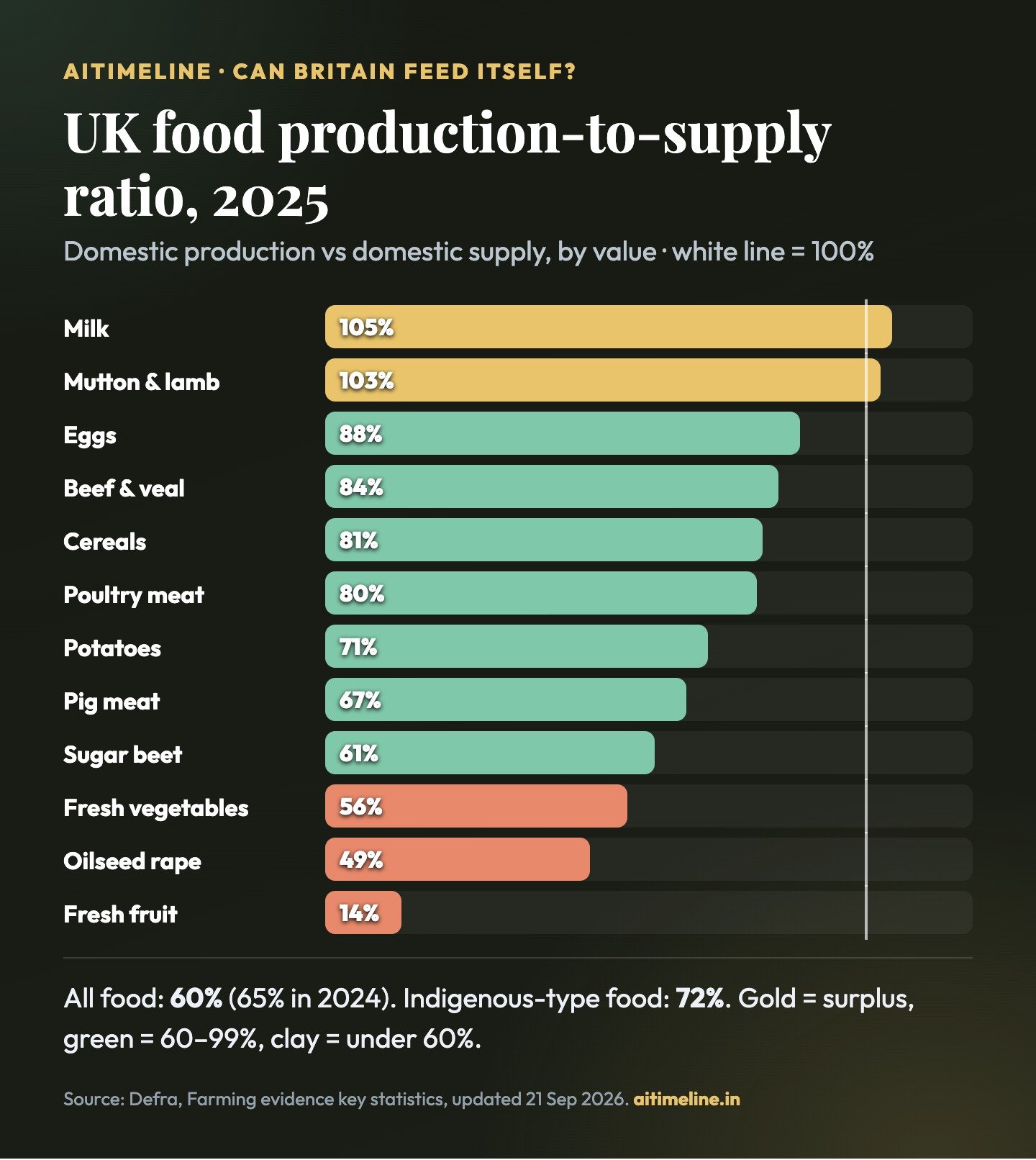
The headline measure fell from 65% in 2024 to 60% in 2025. That sounds like a collapse in farming, but it is mostly a price effect: the ratio is measured by value, import prices rose, and UK output by volume changed little. It is still a useful warning sign, because a country that imports 40% of its food by value is exposed to exchange rates, shipping disruption and other countries’ harvests.
A ratio above 100% does not mean independence from imports. The UK produces more milk than it consumes, but still imports dairy products, animal feed and the fertiliser and fuel that grassland and dairy farms rely on.
| Product | UK ratio, 2025 |
|---|---|
| Milk | 105% |
| Mutton and lamb | 103% |
| Eggs | 88% |
| Beef and veal | 84% |
| Cereals | 81% |
| Poultry meat | 80% |
| Potatoes | 71% |
| Pig meat | 67% |
| Sugar beet | 61% |
| Fresh vegetables | 56% |
| Oilseed rape | 49% |
| Fresh fruit | 14% |
| All food | 60% |
| Indigenous-type food | 72% |
From Farm to Supermarket
Farm-gate prices, buying power and the choke points in the supply chain.
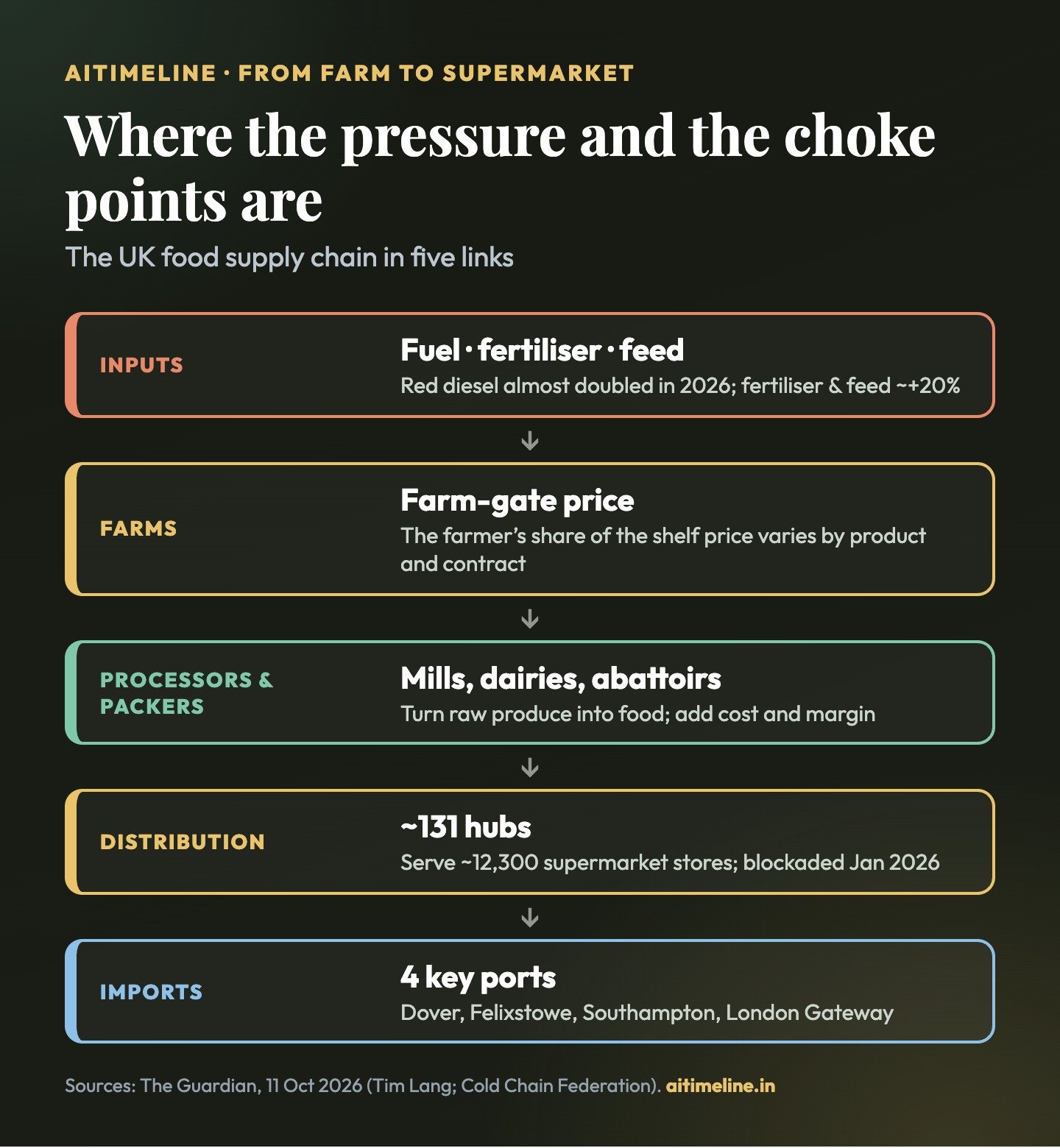
Farm-gate prices. A farmer sells raw produce to a processor, packer or retailer. Between the field and the shelf come processing, manufacturing, packaging, transport and retail, and the farmer’s share of the final price varies widely by product and contract. Protesters argue that the largest retailers use their buying power to push farm prices down even when shelf prices stay high. Supermarkets say they work in a fiercely competitive market and have to keep food affordable.
Distribution hubs. UK supermarkets are supplied through about 131 distribution hubs serving some 12,300 stores, a figure cited by food expert Tim Lang. That is efficient, but it also explains why a few dozen tractors at a handful of depots could empty shelves in January 2026.
Ports and inputs. The Cold Chain Federation has warned that most UK food imports arrive through four ports: Dover, Felixstowe, Southampton and London Gateway. Domestic farms also depend on imported fertiliser, feed and fuel, so a crisis abroad reaches British fields directly. That is what happened in 2026, when red diesel almost doubled after the conflict involving Iran began.
Climate. The 2026 summer brought heatwaves, drought and the driest July on record in England and Wales. Barley and oats had their smallest harvests since 2012. Climate resilience is not separate from food security; it is one of its foundations.
Key Stakeholders
| Stakeholder | Role in the dispute |
|---|---|
| National Farmers’ Union (NFU) | Led lobbying against the original tax change; ran the November 2024 mass lobby |
| Save British Farming | Organised tractor rallies, including 10 February 2025 |
| Independent farmer groups | Ran the January 2026 supermarket depot blockades |
| HM Treasury | Designed and announced the inheritance-tax reforms |
| Defra | Farming policy, the Sustainable Farming Incentive and food statistics |
| EFRA Committee | Scrutinised the government’s vision for farming (May 2025 report) |
| Supermarkets | Central to the dispute over farm-gate prices and imports |
| European Commission | Ran the 2024 Strategic Dialogue and revised EU rules after the protests |
What Changed After the Protests?
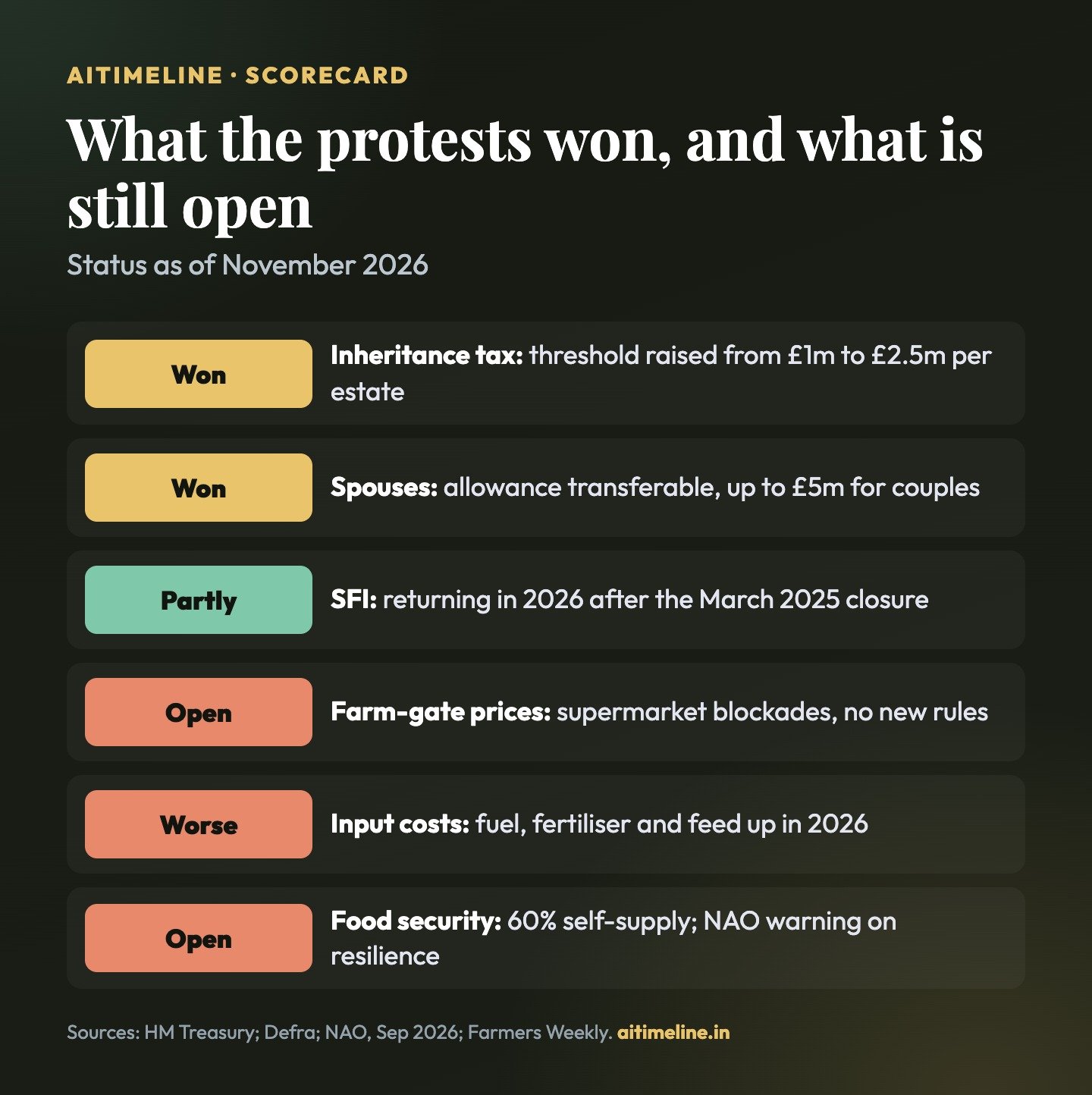
A major tax concession, but not a settlement.
| Issue | Response or development |
|---|---|
| Inheritance-tax relief | Threshold raised from £1m to £2.5m per estate |
| Spouse transfer | Made transferable; up to £5m for couples |
| Sustainable Farming Incentive | Return announced January 2026, windows from June and September |
| Farm-gate prices | Unresolved; blockades in January 2026 |
| Input costs | Worse in 2026 after the Iran conflict |
| Food security | NAO and Public Accounts Committee scrutiny in autumn 2026 |
The revised threshold sharply reduced the number of estates expected to pay more. But the January 2026 blockades showed the campaign had outgrown the tax. The questions now are about income: whether farms earn enough, from markets and from public schemes, to keep producing through the next price spike, drought or supply shock.
Facts at a Glance
| Detail | Information |
|---|---|
| European protest wave | 2019-2024, peaking January-February 2024 |
| UK trigger | Autumn Budget, 30 October 2024 |
| First major London protest | 19 November 2024 |
| 600+ tractors in Westminster | 11 December 2024 |
| ~1,400 tractors on Whitehall | 10 February 2025 |
| SFI closed | 11 March 2025 |
| Milling wheat strike | From 1 April 2025 |
| Threshold raised to £2.5m | 23 December 2025 |
| Supermarket blockades | 4-29 January 2026 |
| Revised rules in force | 6 April 2026 |
| UK food production-to-supply ratio | 60% all food, 72% indigenous-type (2025) |
Explore More Timelines
People Also Ask
Frequently Asked Questions
⚠️ Editorial Note
Protest attendance and tractor counts are estimates from police, organisers and news reports, and are labelled as such. Inheritance-tax examples are simplified illustrations and are not tax advice. The food production-to-supply ratio is a value measure published by Defra. Where reports conflicted, for example on whether the 2026 harvest was the worst on record, this page follows the official statistics and says so.
Related Stories
Sources & further reading
Every dated entry above was checked against these references. Last reviewed 22 November 2026.
- GOV.UK (HM Treasury / Defra): Inheritance tax reliefs threshold to rise to £2.5m for farmers and businesses, 23 December 2025
- House of Commons Library: Changes to agricultural and business property reliefs for inheritance tax (CBP-10181)
- Defra: Farming evidence key statistics, food production to supply ratio by commodity 2025, updated 21 September 2026
- Defra: Provisional cereal and oilseed production estimates for England 2026, 8 October 2026
- House of Commons EFRA Committee: The Government's vision for farming, First Report (HC 906), 16 May 2025
- National Audit Office: Resilience of the food supply chain to disruptions, September 2026
- The Guardian: How pressure on farmers threatens UK food security, 11 October 2026
- Farmers Weekly: Tractors take over London as farmers ramp up protests, 11 December 2024
- Farmers Weekly: Farmers shut down Lidl depots in price protests, 22 January 2026
- Reuters via Swissinfo: Explainer, why farmers are protesting in Europe, February 2024