Wayanad E-Waste-Free District: India’s First Initiative Timeline
Wayanad's e-waste-free district initiative explained: 102.85 tonnes collected, four-phase campaign, Noolpuzha milestone and Kerala's environmental vision.
Latest Story
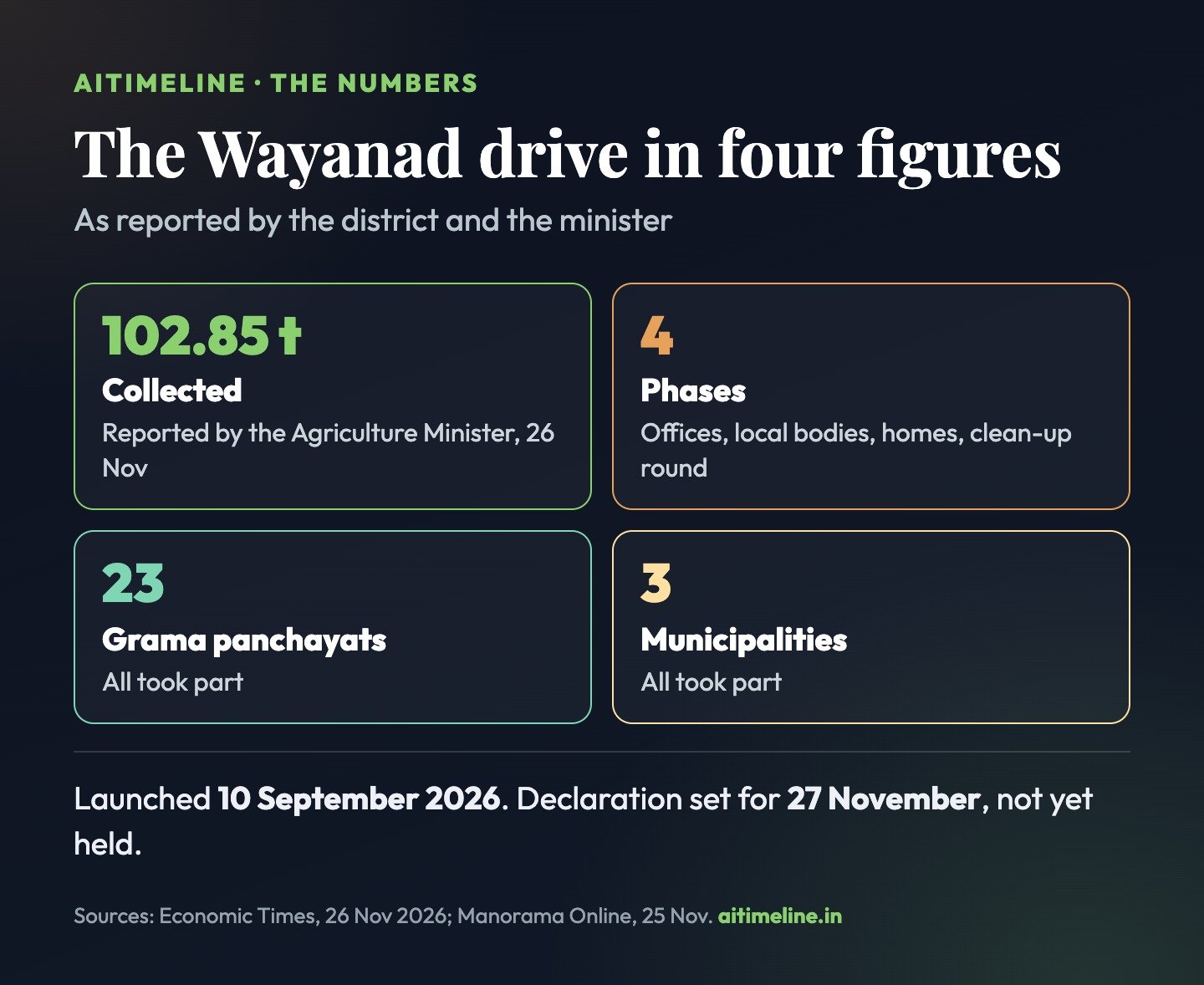
Wayanad in Kerala is about to be declared India’s first e-waste-free district. Between 10 September and late November 2026 the district reports collecting 102.85 metric tonnes of discarded electronics from offices, households and public places. This guide sets out how the drive worked, what the numbers do and do not show, and what must happen after the declaration.
The formal declaration has not happened yet. Chief Minister V.D. Satheesan is scheduled to declare Wayanad e-waste-free on 27 November 2026 at 4 pm in Kalpetta. Until then, “India’s first” is the state’s stated goal, not a completed ceremony.
💡 Short Answer
Wayanad’s e-waste-free campaign began on 10 September 2026 and reports 102.85 tonnes collected across all 23 grama panchayats and three municipalities. Collection ran in four phases, from government offices to door-to-door rounds by Haritha Karma Sena workers, and the material went to Clean Kerala Company for processing. Noolpuzha was declared first on 27 October. The Chief Minister’s formal declaration is set for 27 November. Independent verification has not been published.
The Campaign in Numbers
Figures as reported by the district administration and the Agriculture Minister.
Wayanad E-Waste-Free District: Key Questions
The E-Waste-Free Drive in Eight Points
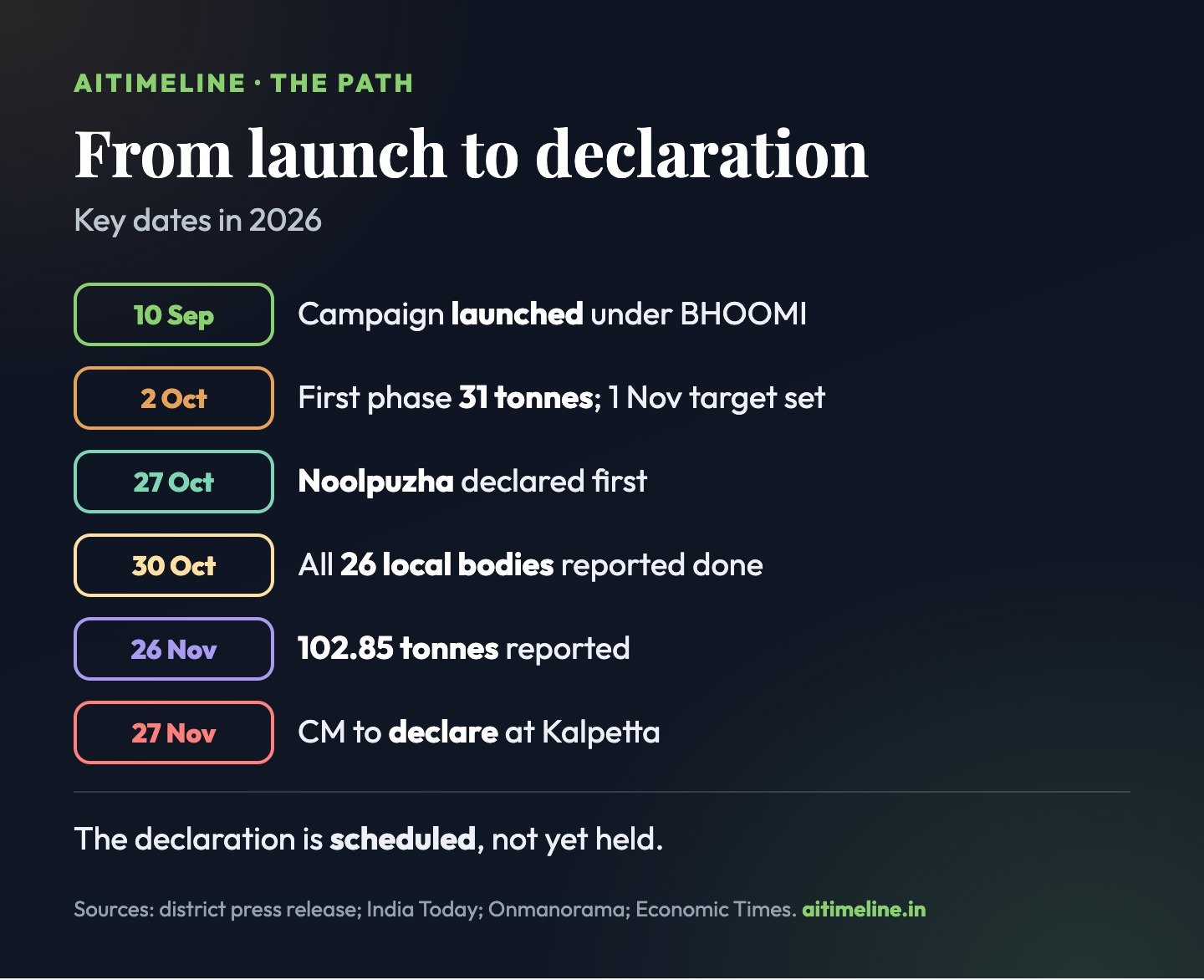
- Scale: 102.85 tonnes reported, up from 31 tonnes on 2 October and 80 tonnes on 31 October.
- Coverage: all 23 grama panchayats and three municipalities took part.
- Method: four phases, from government offices to door-to-door rounds and clean-up points.
- Workers: Haritha Karma Sena members reached every house in phase three.
- First local body: Noolpuzha, 5,423 kg, declared on 27 October.
- Not yet official: the Chief Minister’s declaration is set for 27 November.
- Unverified: checks by several agencies were planned; no results are public.
- The real test: keeping collection permanent after the ceremony.
Timeline: Wayanad’s E-Waste-Free Campaign, 2022 to 2026
Newest first. Labels mark background, campaign steps, milestones, policy and the declaration.
Formal declaration scheduled at Kalpetta Declaration
The event: District Panchayat president Chandrika Krishnan said the declaration is set for 4 pm, with Local Self-Government Minister K.M. Shaji, Agriculture Minister T. Siddique and Women and Child Development Minister Bindhu Krishna attending. A rally of Haritha Karma Sena members, Kudumbashree workers, NSS, NCC and SPC cadets is planned at noon from the HIM UP School ground to the auditorium.
Awards and a second drive: The Chief Minister is to hand certificates and mementos to Haritha Karma Sena members and to the local bodies that handed over the most e-waste, and a scheme to make the district’s tourist destinations plastic-free is to be launched at the same function.
Minister puts the total at 102.85 tonnes Milestone
The figure: Siddique said 102.85 metric tonnes of e-waste had been collected across all 23 grama panchayats and three municipalities and handed over for authorised scrapping and scientific waste management. The Economic Times attributes the collection to households; Manorama’s account lists households, institutions, offices and government departments.
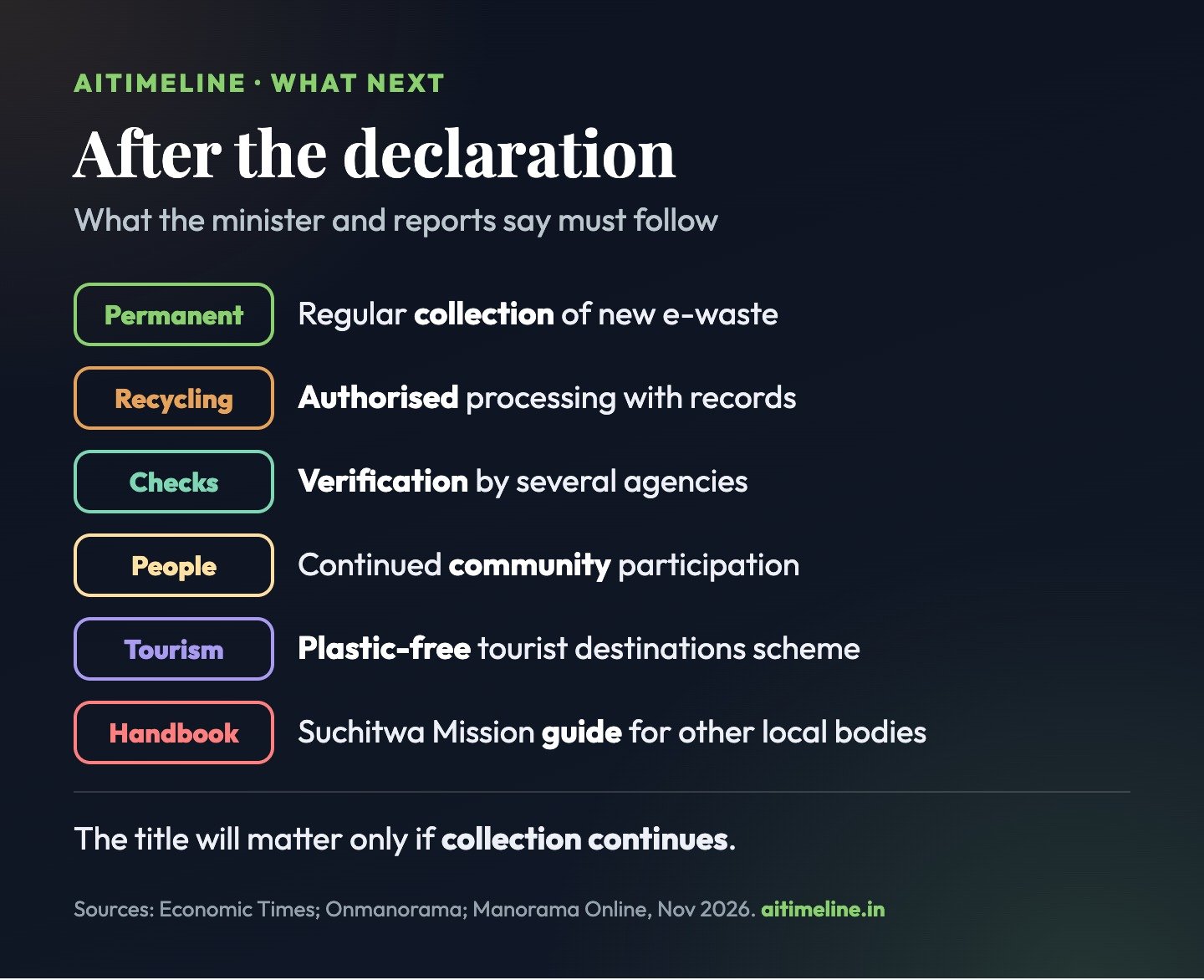
Credit and next step: He credited Wayanad MP Priyanka Gandhi Vadra for her support and named the next step as institutionalising permanent e-waste collection, authorised recycling and processing, environmental monitoring and community participation. The Suchitwa Mission has prepared a handbook so that other local bodies can build similar systems.
District summarises a four-phase collection Milestone
The phases: Phase one cleared government institutions, about 32 tonnes. In phase two local bodies set up collection points at various centres. In phase three Haritha Karma Sena members visited every house. In phase four each local body opened special collection points for people who had missed the earlier rounds.
The total: Across the four phases 102.8 tonnes was collected and handed to Clean Kerala Company for scientific processing, in a drive Manorama describes as two months long.
Declaration date announced Milestone
What was said: Siddique told PTI that the Chief Minister would declare Wayanad e-waste-free on 27 November at Chandragiri Auditorium, Kalpetta. He credited local bodies, Haritha Karma Sena members, sanitation workers, officials, residents, traders and restaurant owners, and said waste had been gathered from households, government offices, educational institutions, tourist destinations and public establishments.
What comes after: The district will then work towards becoming plastic-free and environment-friendly, with carbon neutrality as a later target.
Buffer period for missed households ends Campaign
Why a buffer: In its 31 October report Onmanorama said the Suchitwa Mission had allowed until 10 November to fix operational glitches so that no household or institution was left out. A call centre at the Wayanad Collectorate took complaints, and anyone reporting uncollected e-waste was directed to the nearest collection point.
Verification: The Mission also planned multi-layered checks by various agencies to test the e-waste-free claim and find any remaining gaps.
First target date, Kerala Piravi Day, passes Milestone
The target: On 2 October Siddique had said the aim was to make Wayanad India’s first e-waste-free district by 1 November, the state’s formation day. Onmanorama reported on 31 October that the district would mark the achievement on that Sunday.
What changed: The Chief Minister’s formal declaration was instead fixed for 27 November. The reports we read do not explain the change; the 31 October Onmanorama report had named 20 November as the Chief Minister’s date.
80 tonnes after a 50-day campaign Milestone
The count: The administration said the campaign had collected 80 tonnes of discarded electronic and electrical equipment, 31 tonnes of it from government offices, with 184 government institutions taking part.
Who helped: Partners named included Clean Kerala Company, EY Global Delivery Services, actor Mohanlal’s ViswaSanthi Foundation, Green Worms, Konaris and Royal MRC. Siddique attended more than 30 meetings on the campaign, and more than 70 posters and 12 videos were made for the awareness drive.
All 26 local bodies reported e-waste-free Milestone
The claim: According to the district administration’s press release, every local body in Wayanad had achieved e-waste-free status by 30 October.
The caveat: That is the administration’s own description. The Suchitwa Mission said it would run checks through several agencies, so the status is reported rather than independently audited.
Noolpuzha declared e-waste-free Milestone
The declaration: Sulthan Bathery block panchayat president Prasanna Sasheendran declared Noolpuzha e-waste-free at a function in the panchayat hall. It had collected 3,395 kg in the first phase and 2,028 kg in the second, 5,423 kg in all.
First in the country or the state?: Onmanorama and the district press release call Noolpuzha the country’s first e-waste-free panchayat; Manorama Online’s report calls it the state’s first. We could not find a national register, so treat the national claim as the district’s own.
Follow-up: Panchayat president M.K. Jaya said continued collection and public awareness would follow, and that Haritha Karma Sena members and officials had been central to collecting from homes and establishments.
Gandhi Jayanti event: first phase reported, 1 November target set Campaign
What the minister said: Speaking at a Gandhi Jayanti event on Friday, Siddique said 31 tonnes of e-waste had been collected from government offices between 28 and 30 September. He gave the split as 12 tonnes from Kalpetta, 12 from Sultan Bathery, five from Mananthavady and two from Panamaram, and said it had gone to Clean Keralam Company.
Phase two: The second phase would cover households, private institutions, commercial establishments and residents’ associations. The waste would be sorted into around 50 categories before final disposal, and a fixed amount would be paid for what was collected.
Nirmalam: He also launched the district rollout of the five-year Nirmalam waste-management campaign, which aims to make the state completely clean by 30 March 2031, observed as Zero Waste Day. Officials of 184 government institutions and 56 contingent employees at the Collectorate received certificates.
First phase clears government offices Campaign
Where it came from: Kalpetta and Sultan Bathery gave about 12 tonnes each, Mananthavady five and Panamaram two, according to the minister. Manorama’s later district summary puts phase one at 32 tonnes.
Scope: Phase one covered government institutions only. Households, schools and private establishments came in later phases.
Wayanad launches the e-waste collection drive Campaign
The launch: According to the district press release the project began on 10 September under the state government’s BHOOMI project, which promotes sustainable development, ecological regeneration and social welfare in Wayanad.
The sponsor: The Economic Times says the initiative was led by Siddique, who represents Wayanad in the Assembly, with backing from Wayanad MP Priyanka Gandhi Vadra.
New national e-waste rules come into force Policy
What changed: The 2022 rules took effect on 1 April 2023, replacing the 2016 rules. They apply to manufacturers, producers, refurbishers, dismantlers and recyclers handling the equipment listed in Schedule I, and exclude micro enterprises and waste batteries, which fall under the Battery Waste Management Rules, 2022.
Producer duty: Producers must meet extended producer responsibility targets set in Schedules III and IV, through the Central Pollution Control Board’s online portal, and file annual and quarterly returns there.
Ministry notifies the E-Waste (Management) Rules, 2022 Policy
The notification: The Ministry of Environment, Forest and Climate Change notified the rules on 2 November 2022 after a draft (S.O. 360(E)) was published on 19 May 2022 with 60 days for objections.
Why it matters here: These rules are the national framework within which authorised recyclers receive and process material such as the tonnage Wayanad handed over.
The global picture behind the campaign Background
The numbers: The World Health Organization estimates that about 62 million tonnes of e-waste were produced worldwide in 2022 and that only 22.3% was documented as formally collected and recycled.
The risk: WHO says unsound recycling, including open burning, can release up to 1,000 different chemical substances, with lead a common one, and that children and pregnant women are especially vulnerable.
Haritha Karma Sena: Kerala’s door-step network Background
What it is: The Government of Kerala describes Haritha Karma Sena as a professional team of Kudumbashree women who collect, transport and process waste with local governments and the Suchitwa Mission, focusing on non-organic waste.
How it works: There are to be at least two members per ward, each collecting non-biodegradable waste from around 250 households for a user fee, and the Harithamithram app monitors door-to-door collection.
How the Four Phases Worked
From offices to every doorstep, then a clean-up round.
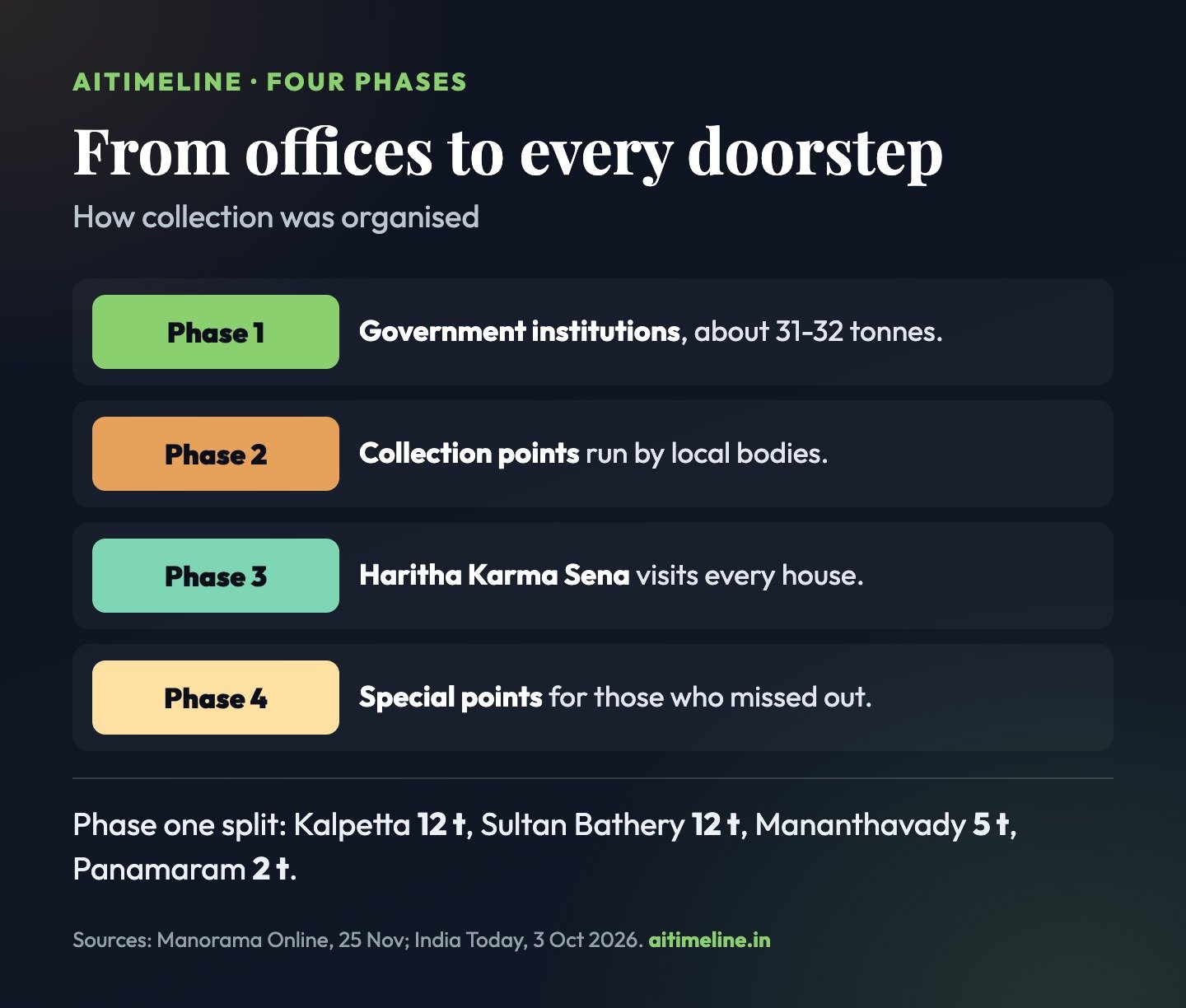
| Phase | Who was covered | How |
|---|---|---|
| One | Government institutions | Collected from offices; about 31-32 tonnes |
| Two | Public and local-body areas | Collection points set up by local bodies |
| Three | Every household | House visits by Haritha Karma Sena members |
| Four | People who missed earlier rounds | Special points in each local body |
The structure matters because e-waste is bulky and easy to postpone. Asking households to carry old televisions or refrigerators to one central site rarely works. Local-body collection points and a house-to-house round by an existing workforce lowered that barrier, and the last phase let latecomers hand material in.
How the Tonnage Grew
Four reported checkpoints.
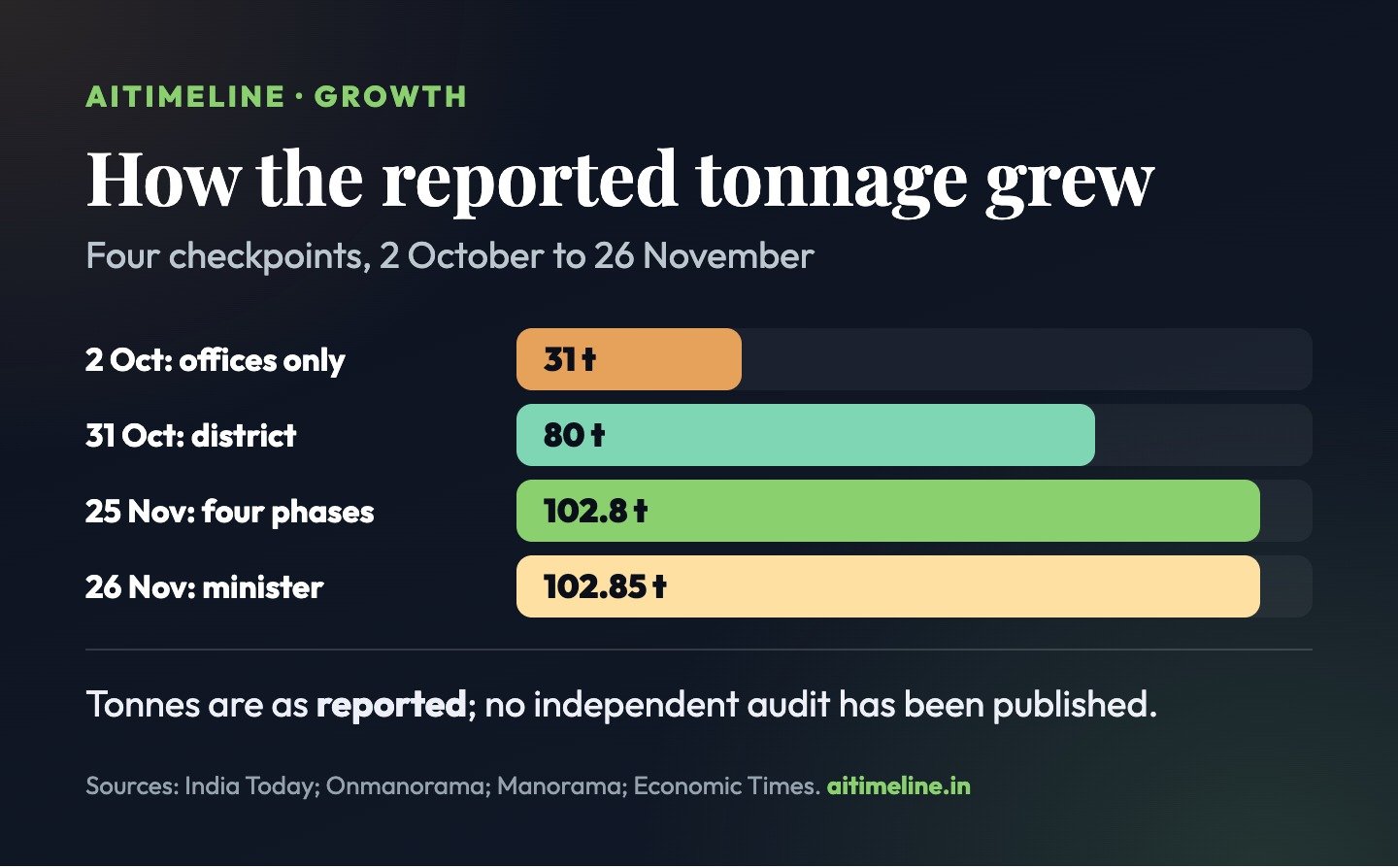
| Date | Reported total | Source |
|---|---|---|
| 2 Oct 2026 | 31 tonnes (offices only) | Minister, via India Today |
| 31 Oct 2026 | 80 tonnes | District release, via Onmanorama |
| 25 Nov 2026 | 102.8 tonnes | Manorama Online |
| 26 Nov 2026 | 102.85 tonnes | Minister, via Economic Times |
Noolpuzha: The First Local Body
A small panchayat that set the template.
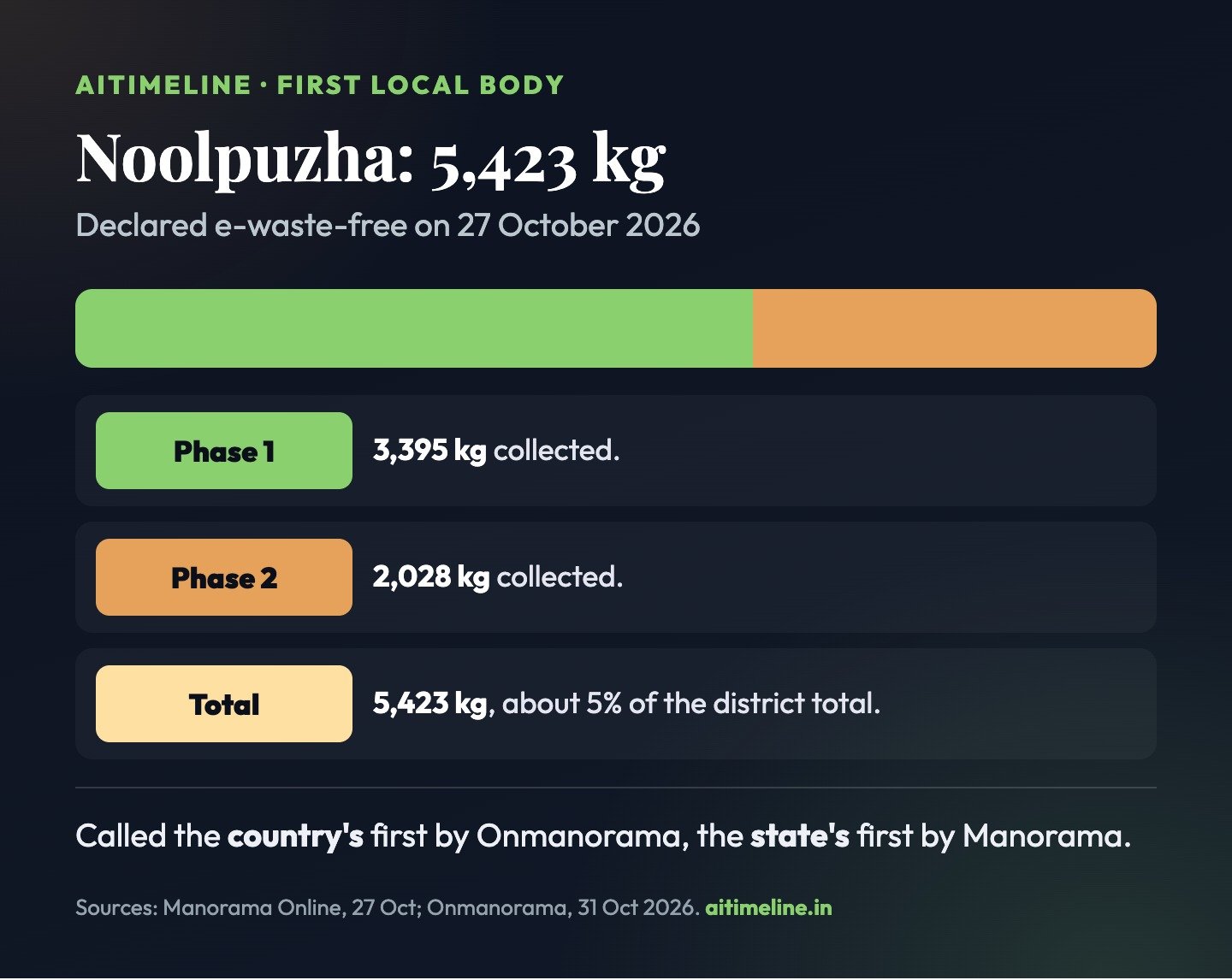
Noolpuzha’s collection is about 5% of the district total, but it was the proof of concept. Reports differ on the claim: Onmanorama and the district release say it was the country’s first e-waste-free panchayat, while Manorama Online says the state’s first. We could not find a national register either way.
Why E-Waste Matters
The risk and the resource.
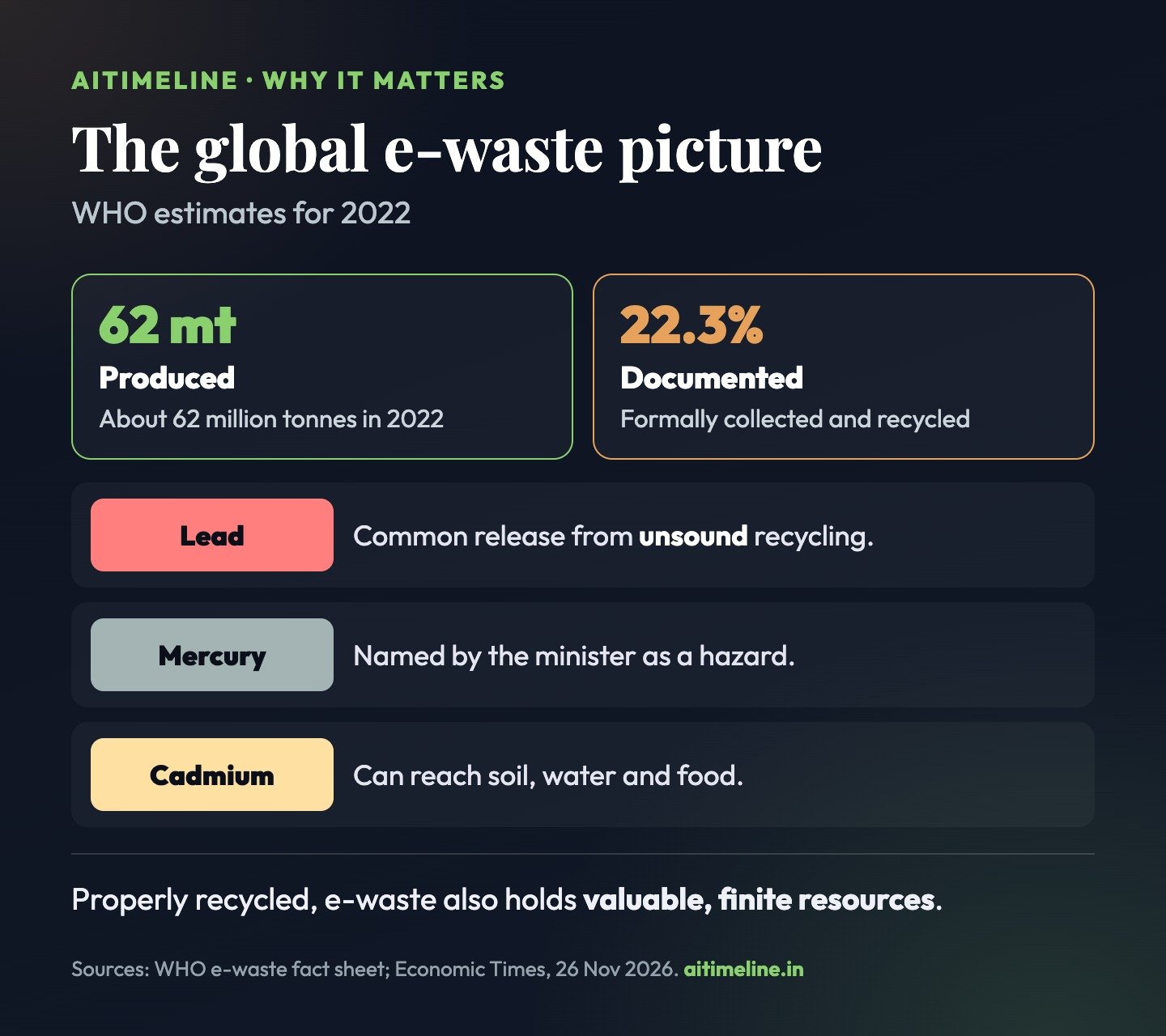
Discarded electronics hold both hazards and value. Lead, mercury and cadmium can contaminate soil and water if equipment is dumped, burned or dismantled without safeguards. At the same time, e-waste contains copper, aluminium, iron and other materials that proper recycling can recover. Wayanad’s mix of farming, tourism and fragile hill terrain, which the minister and Manorama both stress, raises the stakes of getting disposal right.
Who Did What
| Group | Role reported |
|---|---|
| District administration | Coordination; published campaign updates |
| Local bodies | Collection points and mobilisation |
| Suchitwa Mission | Support, a call centre and a handbook on the model |
| Haritha Karma Sena | House-to-house collection in phase three |
| Clean Kerala Company | Received material for scientific processing |
| Government departments | 184 institutions gave 31 tonnes in phase one |
| Partners | EY GDS, ViswaSanthi Foundation, Green Worms, Konaris, Royal MRC |
The National Rules Behind It
The E-Waste (Management) Rules, 2022 were notified on 2 November 2022 and came into force on 1 April 2023. They put extended producer responsibility on manufacturers and producers, who must meet recycling targets through the Central Pollution Control Board’s portal, and they govern refurbishers, dismantlers and recyclers. They do not by themselves collect a single phone from a household, which is the gap that local drives such as Wayanad’s try to fill.
What Happens After the Declaration
The part that decides whether the title means anything.
| Challenge | Why it matters |
|---|---|
| New e-waste | Households and offices keep buying and discarding electronics |
| Informal channels | Some equipment may still reach unregulated dismantlers |
| Traceability | Public records of where the 102.85 tonnes ended up are not yet available |
| Verification | Planned multi-agency checks have no published results |
| Funding | A fixed payment for collected e-waste was announced; rates, costs and funders are not disclosed |
Conclusion: A Campaign Now Needs a Habit
Wayanad has shown that a district can pull more than 100 tonnes of old electronics out of offices and homes in under three months by combining local bodies, a door-to-door workforce and a processing partner.
What the declaration will certify is a clean-up, not a permanent system. The minister has named permanent collection and authorised recycling as the next step. If Wayanad publishes where the material went and keeps the collection points open, the model can travel. If not, the title will fade with the ceremony.
Explore More Timelines
People Also Ask
Frequently Asked Questions
⚠️ Editorial Note
This timeline relies on the Economic Times and Onmanorama (26 November), Manorama Online (25 November and 27 October), PTI via India Today (24 November), India Today (3 October), Onmanorama (31 October), the WHO fact sheet, the Government of Kerala and the Gazette notification of 2 November 2022. Several details differ from the brief we received: the 31-tonne first-phase figure was announced at a Gandhi Jayanti event on 2 October, not 3 October; the brief’s 2 October “milestone”, 20 October review meeting and 20 November figure of 97.26 tonnes (from a secondary compilation we did not open) are dropped for lack of a primary report, and the 31 October total of 80 tonnes is used instead; Manorama Online calls Noolpuzha the first in the state, not the country; the Chief Minister’s date was reported as 20 November on 31 October before 27 November; and the brief’s CPCB portal link did not load, so eprewaste.cpcb.gov.in is used. The 2023 to 2025 rule amendments in the brief are not covered because we did not verify them. The e-waste-free status is the district’s own description and is unaudited. This is editorial information, not environmental or legal advice.
Related Stories
Sources & further reading
Every dated entry above was checked against these references. Last reviewed 26 November 2026.
- Economic Times: Keralam to declare Wayanad India's first e-waste-free district on November 27 (26 Nov 2026)
- Onmanorama: Wayanad moves closer to e-waste-free status after district-wide collection drive (26 Nov 2026)
- Manorama Online: Wayanad declaration on 27 November, four-phase collection of 102.8 tonnes (25 Nov 2026, Malayalam)
- India Today (PTI): Wayanad set to become India's first e-waste-free district on November 27 (24 Nov 2026)
- Onmanorama: Wayanad set to become India's first e-waste-free district from November 1 (31 Oct 2026)
- Manorama Online: Noolpuzha declared e-waste-free grama panchayat (27 Oct 2026, Malayalam)
- India Today: Wayanad sets November 1 deadline to become India's first e-waste-free district (3 Oct 2026)
- Ministry of Environment, Forest and Climate Change: E-Waste (Management) Rules, 2022, G.S.R. 801(E)
- World Health Organization: Electronic waste (e-waste) fact sheet
- Government of Kerala: Garbage Free Kerala through Haritha Karma Sena