Trump Suspends Iran Strikes: The Complete Timeline of US-Iran Tensions
Trump suspends planned Iran strikes as US-Iran tensions ease. Explore the full timeline from 1953 to the 2026 war, sourced to the White House, UN and IAEA.
Latest Story
On the evening of August 2, 2026, officials in Washington, Muscat, Doha and Tehran were doing what officials in this conflict have done many times over the preceding eighteen months: waiting to see whether a president’s public statement on a private social media platform would hold. President Donald Trump had announced, via Truth Social, that he was calling off a newly planned wave of strikes on Iranian energy infrastructure, saying the “perimeters of a deal” had been reached after Iran and several Gulf governments asked for a pause. It was not the first such announcement. It would likely not be the last. And on its own, it explains very little about why the United States and Iran have spent parts of five decades moving between negotiation and confrontation, or why a single Truth Social post could matter to oil traders in Singapore, shipowners in the Strait of Hormuz, and diplomats at the United Nations in New York, all at once.
That is the argument of this guide: a single Trump Iran timeline announcement is a data point, not a story. The story is longer, and it runs through a 1953 change of government in Tehran, a 1979 revolution, a 444-day hostage crisis, an eight-year war with Iraq, a nuclear deal signed in 2015 and abandoned in 2018, a commander’s death in a 2020 drone strike, a ceasefire in mid-2025 that carried its own expiration date, and a full-scale war that began the hour that ceasefire lapsed. Modern crises like this one are shaped only partly by which side has more aircraft or missiles. They are shaped just as much by diplomacy conducted through intermediaries in Oman, Qatar and Pakistan; by intelligence assessments that rarely become public in real time; by alliances that constrain what any single government can do alone; and by economic considerations as basic as the price of a barrel of oil moving through a 21-mile-wide strait. This guide separates what is officially confirmed from what is independently reported, what diplomats have said from what analysts believe, and what has actually happened from what remains, as of this update, still unresolved.
Latest Update — September 2026
What changed since the August 2 pause announcement
The pause President Trump announced on August 2 did not hold: strikes resumed by early September, and overnight on September 8-9 Iranian ballistic missiles struck Jordan’s Muwaffaq Salti Air Base, which hosts US aircraft alongside the Royal Jordanian Air Force, damaging several jets with no US casualties reported. A new pause has since held, with no confirmed Iranian missile or drone launch reported for roughly nine days as of September 18, per open-source conflict tracking. On September 15, the House passed a third war-powers resolution, 220-204, directing US forces to withdraw from hostilities with Iran; seven Republicans crossed party lines, but as with two earlier rounds the measure remained non-binding and had not reached the president’s desk. On September 16, President Trump told reporters he had spoken with Iranian officials “directly” and said he expects the war to end “immediately after” the November midterm elections, though he offered no confirmation of a signed agreement.
🧠 60-Second Answer
On August 2, 2026, President Trump announced he was suspending a planned wave of US strikes on Iranian energy infrastructure, citing progress toward a deal after Iran and Gulf governments requested a pause. The announcement is the latest turn in a war that began February 28, 2026 — when a US-Israeli operation killed Iran’s Supreme Leader Ali Khamenei — itself triggered by the expiration of a ceasefire from an earlier, shorter 2025 conflict. As of this update, indirect talks continue over the Strait of Hormuz and Iran’s nuclear program, but no successor agreement has been confirmed signed, and previous pauses in this conflict have not always held.
Who, What, Why, When, Where, How
What to Understand Before Reading Further
- This is not one crisis but two: a shorter 2025 Israel-Iran war and a larger 2026 US-Israel-Iran war, connected by a ceasefire that expired on a fixed date.
- August 2’s announcement is a pause, not peace: officials describe “perimeters of a deal,” not a signed, final agreement.
- US-Iran tensions predate 2026 by over seven decades, running through 1953, 1979, the 1980s, 1988, the 2015 nuclear deal and its 2018 collapse, and the 2020 Soleimani strike.
- Diplomacy has run in parallel with combat, not after it — Oman, Qatar, Switzerland and Pakistan have all mediated active talks during periods of ongoing strikes.
- The UN Security Council has acted: Resolution 2817 (March 2026) condemned Iranian strikes on Gulf states and Jordan, adopted 13-0 with China and Russia abstaining.
- The IAEA has lost verified track of Iran’s enriched uranium stockpile for extended periods due to denied inspector access — a fact distinct from any claim about what Iran has done with that material.
- The US Congress has repeatedly, though narrowly and non-bindingly, voted to constrain the war under the War Powers Resolution, without changing US policy.
- Casualty figures are genuinely disputed across sources and should be read as ranges attributed to named trackers or governments, not as a single settled number.
- The Strait of Hormuz is the conflict’s clearest economic transmission channel to the rest of the world, moving oil prices and shipping insurance costs even for countries with no direct stake in the war.
- Nothing here is final — this is a developing situation, and this guide is maintained as new official statements are published.
Executive Summary & One-Minute Summary
The essentials, for readers who need the shape of the story before the detail
Executive Summary (150 words): The United States and Iran are in the second year of a war that began February 28, 2026, when US and Israeli forces launched a coordinated strike campaign — codenamed Operation Epic Fury by the Pentagon and Lion’s Roar by Israel — after a ceasefire from a shorter 2025 conflict expired on a pre-set date. The initial strikes reportedly killed Iran’s Supreme Leader Ali Khamenei, prompting a succession process that installed his son, Mojtaba Khamenei, as Iran’s third Supreme Leader in March 2026. The war has since moved through a UN Security Council resolution condemning Iranian strikes on Gulf states, an April 2026 ceasefire, a June 2026 Islamabad Memorandum of Understanding, a July collapse after Hormuz shipping incidents, and an August 2, 2026 announcement from President Trump suspending a newly planned strike wave pending a possible deal. Diplomacy, sanctions and military pressure have all operated simultaneously throughout, not in separate phases.
One-Minute Summary: This is not a single event but the latest chapter of a decades-old relationship that turned into open warfare in 2026. A 2025 Israel-Iran war ended in a ceasefire that was always due to expire; when nuclear talks failed in February 2026, the US and Israel struck first, killing Iran’s top leader. Since then, the war has cycled through UN condemnation of Iranian retaliation against Gulf neighbors, a brief ceasefire, a negotiated framework agreement, a breakdown over shipping in the Strait of Hormuz, and repeated — sometimes reversed — announcements of paused strikes, most recently on August 2, 2026. Congress has twice voted, narrowly and without binding effect, to constrain the war. No final peace agreement has been confirmed as of this update.
Introduction: Why This Relationship Shapes Global Affairs
Stakeholders, strategic geography, and why one country’s foreign policy became everyone’s business
Four categories of stakeholder sit inside this story, and confusing them is the single most common source of misunderstanding in casual coverage. The direct combatants are the United States, Iran and — since February 2026 — Israel as an active military participant, not merely an interested party. The regional stakeholders include the Gulf Cooperation Council states (Saudi Arabia, the UAE, Qatar, Kuwait, Bahrain, Oman), which have been targeted by Iranian strikes, host US military infrastructure, and depend on the Strait of Hormuz for their own oil exports, plus Iraq, Jordan and Lebanon, where Iran-aligned armed groups operate. The mediators — Oman, Qatar, Pakistan and, at points, Switzerland and Egypt — have carried messages between Washington and Tehran precisely because they maintain working relationships with both. And the international institutions — the United Nations Security Council, the International Atomic Energy Agency (IAEA), and the US Congress — provide the closest thing this conflict has to a public, documented record, through resolutions, board reports and floor votes.
Iran sits at the center of the Middle East’s strategic geography in a way few countries do. It borders the Persian Gulf and controls, jointly with Oman, the northern shore of the Strait of Hormuz — a chokepoint roughly 21 miles wide at its narrowest, through which close to a fifth of the world’s seaborne oil and a substantial share of global liquefied natural gas normally passes. It also borders Iraq, Afghanistan, Pakistan, Turkey and the Caucasus, giving it reach into multiple regional conflict systems simultaneously. Iran’s government has, for decades, cultivated relationships with non-state armed groups across the region — a network US and allied officials describe as the “axis of resistance” and Iran describes as a network of allied movements — which is why a US-Iran military exchange rarely stays contained to the two countries alone; the June 2026 Islamabad Memorandum explicitly addressed a “Lebanon front” as part of ending hostilities.
Energy security is the most direct channel through which this conflict reaches people who have never followed Middle East politics. When Iran briefly declared the Strait of Hormuz closed in March 2026, war-risk insurance premiums for tankers reportedly rose to four or five times normal levels, and oil benchmark prices recorded one of their largest monthly increases on record, according to World Bank commodity market reporting. Those costs move through fuel prices, shipping rates and, eventually, consumer goods far beyond the Gulf. That is the practical reason this story attracted sustained worldwide attention rather than being treated as a regional dispute: a Gulf war is one of the few conflicts anywhere with a near-immediate, measurable transmission mechanism into the global economy.
Finally, this is a story about diplomacy operating under fire, which is unusual and worth naming directly. Oman-mediated nuclear talks were active in the weeks immediately before the February 2026 strikes. Pakistan mediated a ceasefire in April 2026 while both sides were still exchanging strikes. Switzerland hosted technical talks at Lake Lucerne in June 2026 to implement a memorandum signed while the war’s core disputes — the Strait of Hormuz and Iran’s nuclear program — remained unresolved. Understanding this conflict means holding two facts at once: that military action and diplomatic negotiation were not sequential phases here, but simultaneous, overlapping tracks.
📜 History Insight
US-Iran relations have evolved through decades of diplomacy, sanctions, conflict and negotiation rather than through any single event. Reading the events of 2025-2026 without that longer arc — a 1953 change of government, a 1979 revolution, an eight-year war with Iraq, a nuclear deal signed and later abandoned — risks mistaking a chapter for the whole book.
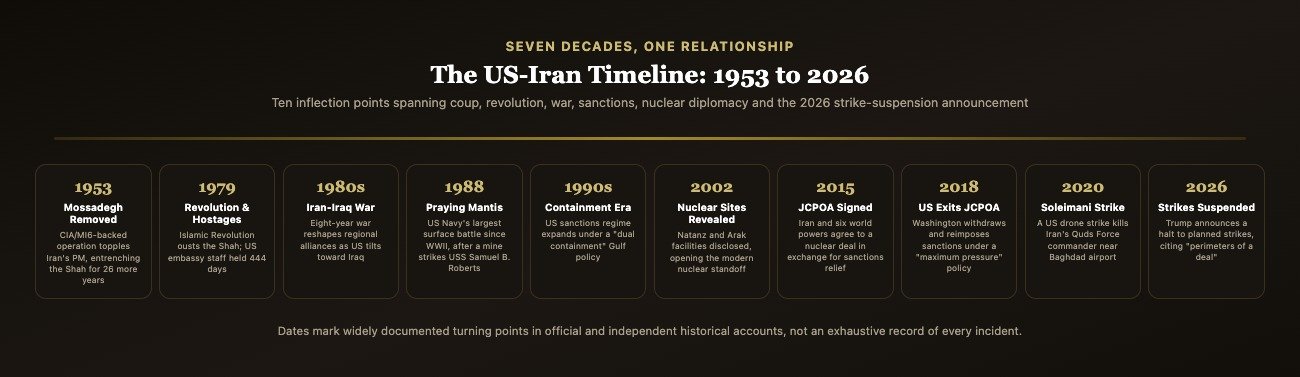
The Complete US-Iran Timeline: 1953 to 2026
Fourteen milestones, each separating historical background, political context, military context, diplomatic developments and current relevance
A Coup Reshapes Iran’s Political Path
Historical background: After Prime Minister Mohammad Mossadegh nationalized Iran’s oil industry in 1951, a covert operation backed by the US Central Intelligence Agency and British intelligence removed him from power in August 1953, consolidating authority around Shah Mohammad Reza Pahlavi.
Political context: Cold War-era Western governments were concerned about Soviet influence over a nationalized Iranian oil sector.
Military context: The operation was covert and political rather than a conventional military campaign.
Diplomatic developments: None directly; the episode was not conducted through open diplomatic channels.
Current relevance: Iranian officials and independent historians alike continue to cite 1953 as a foundational point of distrust toward US involvement in Iran’s internal affairs.
Revolution Ends the Shah’s Rule; Embassy Staff Held 444 Days
Historical background: The Iranian Revolution (January-February 1979) ends the Shah’s rule and establishes the Islamic Republic under Ayatollah Ruhollah Khomeini. In November, students storm the US Embassy in Tehran, holding 52 American hostages for 444 days until January 20, 1981.
Political context: Formal diplomatic relations between Washington and Tehran are severed and remain unrestored; Switzerland has served as the US “protecting power” in Iran ever since.
Military context: A US rescue attempt, Operation Eagle Claw (April 1980), fails in the Iranian desert, killing eight US servicemen without reaching the hostages.
Diplomatic developments: The Algiers Accords (January 1981), negotiated through Algeria as intermediary, secure the hostages’ release.
Current relevance: The absence of a US embassy in Tehran since 1979 is the direct reason so much of this conflict’s diplomacy in 2025-2026 has run through third-country mediators rather than direct channels.
The Iran-Iraq War Realigns the Region
Historical background: Iraq invades Iran in September 1980, beginning an eight-year war among the costliest conventional conflicts of the twentieth century.
Political context: The US officially maintained neutrality but provided intelligence favoring Iraq for parts of the war, while separately, in the Iran-Contra affair (1985-87), US officials covertly sold arms to Iran — a contradiction that became a major domestic political scandal.
Military context: UN investigations later confirmed Iraqi use of chemical weapons against Iranian forces and civilians.
Diplomatic developments: UN Security Council Resolution 598 (1987) calls for a ceasefire, accepted by both sides in 1988.
Current relevance: Iranian strategic thinking about deterrence and domestic weapons production is still widely described by analysts as shaped by memories of this war.
Operation Praying Mantis: Direct US-Iran Naval Combat
Historical background: On April 18, 1988, after the USS Samuel B. Roberts struck an Iranian naval mine while the US Navy was escorting reflagged Kuwaiti tankers during the “Tanker War,” US forces conducted Operation Praying Mantis, sinking or damaging several Iranian naval vessels and oil platforms in a single day.
Political context: The operation demonstrated Washington’s willingness to engage Iran directly and conventionally outside any formal declared war.
Military context: Described by naval historians as the US Navy’s largest single-day surface engagement since the Second World War.
Diplomatic developments: No direct negotiations followed the engagement itself; three months later, the accidental shootdown of Iran Air Flight 655 by the USS Vincennes killed 290 civilians, an incident the US later expressed regret over and paid compensation for without a formal admission of legal fault.
Current relevance: Military planners on both sides still cite 1988 as precedent for how quickly a Gulf naval incident can escalate into direct confrontation.
Washington Adopts “Dual Containment”
Historical background: Following the 1991 Gulf War, the Clinton administration formalizes a “dual containment” policy treating both Iran and Iraq as threats to be isolated rather than engaged diplomatically.
Political context: The Iran-Libya Sanctions Act (1996) extends US sanctions pressure to foreign companies investing in Iran’s energy sector.
Military context: No direct US-Iran conflict during this period.
Diplomatic developments: Limited outreach occurs late in the decade under Iranian President Mohammad Khatami’s “Dialogue Among Civilizations” initiative, without a substantive breakthrough.
Current relevance: Establishes sanctions as Washington’s default pressure tool well before Iran’s nuclear program became the central point of contention.
Natanz and Arak Disclosed, Opening the Modern Nuclear Standoff
Historical background: In August 2002, an Iranian opposition group publicly discloses a previously undeclared uranium enrichment facility at Natanz and a heavy-water facility at Arak.
Political context: The disclosure — not a US or Israeli intelligence release — triggers the modern era of Iran nuclear diplomacy, IAEA scrutiny and sanctions.
Military context: None directly at this stage.
Diplomatic developments: IAEA inspections begin; a multi-year process of Board of Governors non-compliance findings follows through the 2000s.
Current relevance: The same facilities disclosed in 2002 remain the subject of both ongoing diplomacy and, in 2026, direct military strikes.
Iran and Six World Powers Sign the JCPOA
Historical background: On July 14, 2015, Iran and the P5+1 (the US, UK, France, Russia, China and Germany) sign the Joint Comprehensive Plan of Action (JCPOA) in Vienna, limiting Iran’s nuclear program in exchange for sanctions relief; Implementation Day follows on January 16, 2016.
Political context: UN Security Council Resolution 2231 (2015) formally endorses the agreement.
Military context: None — the deal is explicitly framed as a diplomatic alternative to military confrontation.
Diplomatic developments: Negotiated over roughly 20 months, with the IAEA granted an expanded verification and monitoring role.
Current relevance: Repeatedly invoked in 2026 as the benchmark for what a negotiated nuclear settlement can achieve.
“Maximum Pressure” Replaces the Nuclear Deal
Historical background: On May 8, 2018, President Trump announces US withdrawal from the JCPOA, reimposing sanctions lifted under the deal and layering on new ones under a “maximum pressure” campaign.
Political context: European co-signatories attempt to preserve the deal without US participation; Iran gradually reduces its own compliance with enrichment limits starting in 2019.
Military context: No strikes tied directly to the withdrawal, though regional tensions escalate, including tanker incidents in the Gulf in 2019.
Diplomatic developments: Multiple attempts at indirect US-Iran re-engagement follow over subsequent years without a breakthrough.
Current relevance: Cited by Iranian officials as a central reason for distrust of negotiated settlements with Washington.
A Drone Strike Kills Iran’s Most Prominent Military Commander
Historical background: On January 3, 2020, a US drone strike near Baghdad International Airport kills Qassem Soleimani, commander of the IRGC’s Quds Force, alongside Iraqi militia leader Abu Mahdi al-Muhandis.
Political context: US officials cited an imminent-threat justification; independent international law scholars and Iranian officials disputed its legal basis under the UN Charter.
Military context: Iran retaliates five days later with ballistic missile strikes on US forces at Ain al-Asad airbase in Iraq, causing traumatic brain injuries to more than 100 US service members but no fatalities.
Diplomatic developments: Iraq’s parliament passes a non-binding vote calling for foreign troop withdrawal; both sides stop short of full-scale war.
Current relevance: Widely cited as the closest prior brush with open US-Iran war before 2026.
Failed Nuclear Talks Precede a “Twelve-Day War”
Historical background: Indirect Vienna talks (2021-2022) attempt and fail to revive the JCPOA. Amid the Gaza war beginning October 2023 and Red Sea shipping attacks by Iran-aligned Houthi forces, direct Israel-Iran conflict arrives in June 2025: Israel strikes Iranian nuclear and military sites, Iran retaliates against Israel, and the US strikes Iranian nuclear facilities at Fordow, Natanz and Isfahan. Iran fires on a US base in Qatar in a reportedly telegraphed, largely intercepted response.
Political context: This “Twelve-Day War” is the first confirmed instance of direct US strikes on Iranian nuclear infrastructure.
Military context: A ceasefire mediated by the US and Qatar takes effect June 24, 2025 — but, unusually, carries a fixed further expiration date rather than standing indefinitely.
Diplomatic developments: The ceasefire holds through early violations on both sides before stabilizing.
Current relevance: The 2025 ceasefire’s built-in expiration date is the direct, documented bridge to the war that began in February 2026.
Feb
Coordinated US-Israeli Strikes Kill Iran’s Supreme Leader
Historical background: On February 28, 2026, as the 2025 ceasefire expires and indirect Oman-mediated nuclear talks collapse, the US and Israel launch a coordinated campaign — named Operation Epic Fury by the Pentagon and Lion’s Roar by Israel — conducting nearly 900 strikes in roughly 12 hours against Iranian missile forces, air defenses, military infrastructure and senior leadership.
Political context: Supreme Leader Ali Khamenei is killed in the strikes; Iran confirms his death on March 1. Iran’s Assembly of Experts holds a succession vote March 3-8, announcing his son, Mojtaba Khamenei, as the country’s third Supreme Leader on March 9. Elected President Masoud Pezeshkian remains in his separate governmental role throughout.
Military context: Officials describe the opening strikes as the largest coordinated air campaign against Iran to date; Iran declares the Strait of Hormuz closed on March 4. Reporting also describes a strike near a naval base in Minab, close to Bandar Abbas, that hit a girls’ school — casualty figures for this specific incident are disputed by source and are not asserted here as a single settled number.
Diplomatic developments: The UN Security Council adopts Resolution 2817 on March 11, condemning Iranian strikes against Bahrain, Kuwait, Oman, Qatar, Saudi Arabia, the UAE and Jordan, passing 13-0 with China and Russia abstaining — cosponsored by 135 member states, the largest cosponsorship of any Security Council resolution on record.
Current relevance: Sets the war’s baseline; Mojtaba Khamenei’s succession is now a fixed fact of Iran’s governing structure referenced throughout the rest of this timeline.
Apr
A Ceasefire Holds Briefly; Islamabad Talks Fall Short
Historical background: On April 8, 2026, following what reporting describes as 40 days of sustained combat, a Pakistan-mediated ceasefire takes hold, including safe passage through the Strait of Hormuz. On April 11-12, senior officials meet at the Serena Hotel in Islamabad: the US team led by Vice President JD Vance alongside envoys Steve Witkoff and Jared Kushner; Iran’s team led by chief negotiator Mohammad Bagher Ghalibaf and Foreign Minister Abbas Araghchi; Pakistan’s Prime Minister Shehbaz Sharif and Field Marshal Asim Munir mediating.
Political context: Talks reportedly reach agreement on roughly 10 ceasefire terms, but not on the Strait of Hormuz or the nuclear program — the war’s two most strategically significant open questions.
Military context: Strikes pause during the ceasefire window.
Diplomatic developments: The first direct, in-person senior-level talks of the war establish the negotiating-team structure that recurs through subsequent rounds.
Current relevance: The two issues left unresolved here — Hormuz and the nuclear file — are the same two issues still unresolved as of the August 2026 update.
Jun
Trump and Pezeshkian Sign a 14-Point Framework
Historical background: On June 12, 2026, US and Iranian negotiators reach agreed text. On June 17, President Trump (signing from the G7 summit in France), Iranian President Masoud Pezeshkian (Tehran) and Pakistani PM Shehbaz Sharif (Islamabad, as endorser and host) sign the Islamabad Memorandum of Understanding — a 14-point framework providing for an end to military operations “on all fronts, including in Lebanon,” and toll-free commercial shipping through the Strait of Hormuz for 60 days.
Political context: Described across multiple outlets as the war’s most significant diplomatic breakthrough to date.
Military context: Strikes halt under the framework’s terms.
Diplomatic developments: Technical talks to implement the framework begin June 21 at Lake Lucerne, Switzerland, led by VP Vance and Iran’s Ghalibaf. Separately, the IAEA Board of Governors (June 8-12) passes a US-backed resolution demanding Iran declare and allow verification of its enriched-uranium stockpile, after Director General Rafael Grossi’s June 4 report found 97 days without inspector access and an unverifiable stockpile of 440.9 kg of 60%-enriched uranium.
Current relevance: The 60-day Hormuz toll-free window this agreement created was still the operative arrangement referenced in the August 2026 developments below.
Jul
Hormuz Incidents Break the Framework; Congress Splits Again
Historical background: In July, Iran reportedly strikes three commercial vessels that had bypassed its preapproved Hormuz shipping route; the US resumes strikes in response, and President Trump announces a reimposed naval posture in the strait along with a threatened, but not confirmed as implemented, 20% cargo fee on shipping.
Political context: On July 23, the House passes a second non-binding war-powers resolution 214-208, while a binding Senate joint resolution fails 47-49 — following an earlier June round in which the House passed a non-binding resolution 215-208 and the Senate passed one 50-48, neither sent to the White House for signature. Four Senate Republicans and four House Republicans crossed party lines across the two rounds.
Military context: Strikes resume following the framework’s collapse.
Diplomatic developments: Described by outlets as the war’s most serious institutional pushback yet from the US legislative branch, without a change in executive branch policy.
Current relevance: Demonstrates that even a signed framework agreement can collapse over an unresolved implementation detail — in this case, Hormuz shipping routes.
Aug
Trump Announces a Pause, Citing “Perimeters of a Deal”
Historical background: On August 2, 2026, President Trump posts on Truth Social that he is cancelling a newly planned large-scale strike on Iran’s energy infrastructure, citing progress toward a deal after Iran and Gulf governments — reported to include Saudi Arabia, Qatar and the UAE — requested a hold.
Political context: Iran’s chief negotiator Ghalibaf states the same week that the Strait of Hormuz “will not return to pre-war conditions,” and that fees are planned once the 60-day toll-free window from the June memorandum expires around August 17.
Military context: No new large-scale US strikes are reported in the immediate aftermath of the announcement, as of this update.
Diplomatic developments: Oman-mediated talks continue on Hormuz shipping arrangements, described by Iran’s foreign ministry as in their “final stages” as of August 2.
Current relevance: This is the most recent confirmed development as of this guide’s last update; reporting, including from the Washington Times, has separately noted a documented pattern across this conflict of announced suspensions that have not always held — a pattern, not a prediction about this specific instance.
Sep
August Pause Breaks Down; a New Fire Pause Follows a Third War-Powers Vote
Historical background: The August 2 pause did not hold beyond a few weeks: fighting resumed by early September, and overnight on September 8-9, Iranian ballistic missiles struck Jordan’s Muwaffaq Salti Air Base — which hosts US aircraft alongside the Royal Jordanian Air Force — reportedly damaging several US jets; no US casualties were reported.
Political context: On September 15, the House passed a third war-powers resolution, 220-204, directing US forces to withdraw from hostilities with Iran under Rep. Seth Moulton’s measure; seven Republicans crossed party lines. As with two earlier rounds in June and July, the measure was non-binding and had not reached the president’s desk as of this update.
Military context: No confirmed Iranian missile or drone launch had been reported for roughly nine days as of September 18, per open-source conflict tracking — the conflict’s longest confirmed pause since the August announcement.
Diplomatic developments: On September 16, President Trump told reporters he had spoken with Iranian officials “directly” and that he expects the war to end “immediately after” the November midterm elections; Iran’s foreign ministry separately said Oman-mediated talks on reopening the Strait of Hormuz were continuing, though Oman had not confirmed a specific plan.
Current relevance: The pattern flagged in the prior entry held again: an announced suspension was followed by renewed strikes within weeks, underscoring why this guide treats each pause as provisional until confirmed by a signed, implemented agreement.
Twelve Terms This Conflict Runs On
Plain-English definitions of the concepts that recur through every stage of this timeline
History of US-Iran Relations: The Pattern Behind the Events
Reading seventy years of interaction as a pattern, not a list
Read end to end, the fourteen milestones above form a recognizable pattern rather than a random sequence: engagement attempts are followed by rupture, rupture is followed by a long period of managed hostility, and managed hostility periodically breaks into direct confrontation before both sides pull back — until, in 2026, they did not. The 1953 coup and the 1979 revolution are the founding traumas each government cites to justify distrust of the other. The 1980s and 1988 established that direct US-Iran military engagement, while rare, was not unthinkable even during a period without formal diplomatic ties. The 2015 nuclear deal and its 2018 collapse showed that a negotiated settlement could be reached, implemented, and then abandoned by a change in US administration — a sequence Iranian officials cite whenever a new US proposal is on the table. And the 2020 Soleimani strike showed that even a strike against Iran’s most prominent military figure could stop short of full war, right up until, in 2026, a similarly dramatic strike did not stop short.
What is genuinely new about 2025-2026 is not any single tactic — strikes on nuclear facilities, sanctions, mediated ceasefires and congressional pushback have all happened before — but their compression. Where past cycles of tension and de-escalation played out over years, this cycle moved from a ceasefire’s expiration, to a leader’s death, to a UN resolution, to a ceasefire, to a signed framework, to that framework’s collapse, to a fresh suspension announcement, in under six months. Any single-article snapshot of this conflict risks freezing one frame of a still-moving picture.
Military Balance and the Decision-Making Process
How capability differs from decision-making — and how crisis decisions actually move
The US retains, by nearly every public measure — carrier strike groups, precision munitions, regional basing access, air superiority platforms — a conventional military advantage over Iran that is not seriously disputed by independent defense analysts. Israel adds a qualitative edge in intelligence penetration of Iranian territory and a demonstrated willingness to strike Iranian soil directly, as it did in June 2025 and again in February 2026. Iran’s military strength runs in a different direction: a large inventory of ballistic and cruise missiles, an extensive naval mine and fast-attack-craft capability suited to contesting the narrow Strait of Hormuz rather than open-ocean combat, and — historically — a network of aligned armed groups across the region that can pressure US and allied interests without direct Iranian state action.
That capability gap is precisely why so much of this conflict has been fought through sanctions, proxy pressure and controlled strikes rather than a symmetric conventional war: Iran cannot match US and Israeli airpower directly, so its leverage runs through asymmetric tools — Hormuz shipping disruption, missile retaliation calibrated to signal resolve without inviting overwhelming response, and regional proxy pressure — while Washington and Israel have generally avoided a full ground invasion or occupation, which would carry costs and risks neither has been willing to absorb.
🛡️ Security Insight
Regional stability depends on multiple state and non-state actors — Gulf governments, Iran-aligned groups, Israel, and outside mediators — making any single escalation or de-escalation difficult to predict from military capability alone.
Crisis decisions inside a conflict like this one do not move in a straight line from threat to strike. Officials and outside analysts generally describe a recognizable sequence, illustrated below, though which stage any specific real-world decision reached is not always publicly knowable in real time.
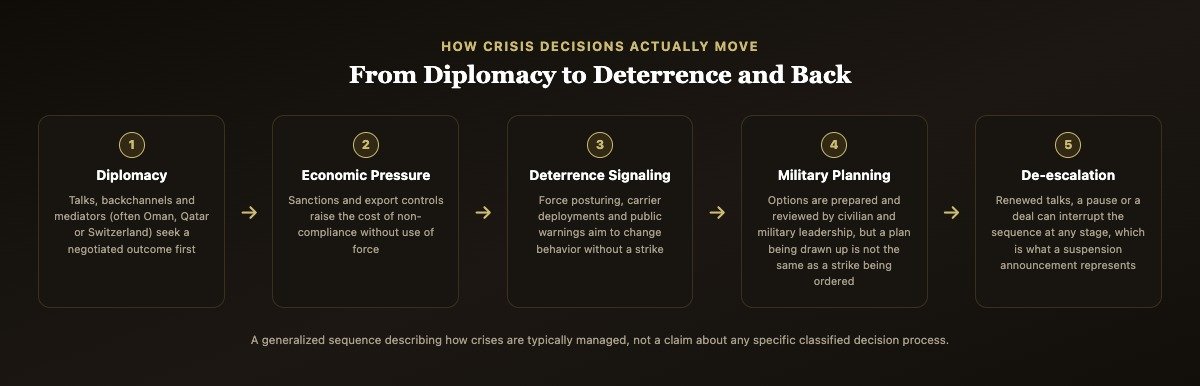
- Diplomacy first: talks, backchannels and mediators — often Oman, Qatar or Switzerland in this conflict — attempt a negotiated outcome before other tools are used.
- Economic pressure: sanctions and export controls raise the cost of non-compliance without the use of force.
- Deterrence signaling: force posturing, carrier deployments and public warnings aim to change an adversary’s behavior without a strike.
- Military planning: options are prepared and reviewed by civilian and military leadership — a plan being drawn up is not the same as a strike being ordered, and this guide does not speculate about which specific plans exist at any given time.
- De-escalation: renewed talks, a pause or a deal can interrupt the sequence at any stage — which is what an announcement like the one on August 2, 2026 represents.
🧠 Did You Know?
Major military decisions of this kind are rarely made by one office alone. They typically involve coordination across civilian leadership, military planners, intelligence agencies and allied governments — which is one reason public announcements and actual operational decisions do not always align in timing.
Diplomatic Negotiations: Who Talks to Whom, and How
Mediators, tracks and the mechanics of talking without an embassy
Because the US and Iran have had no direct diplomatic relations since 1979, nearly every substantive exchange between them runs through an intermediary. Oman has been the most consistent channel, having mediated the indirect nuclear talks active immediately before the February 2026 strikes and the Hormuz-related discussions described by Iran’s foreign ministry as in their “final stages” as of early August 2026. Qatar co-mediated the 2025 ceasefire alongside the US. Pakistan — through Prime Minister Shehbaz Sharif and Field Marshal Asim Munir — mediated the April 2026 ceasefire and hosted the Islamabad talks and the June memorandum’s signing. Switzerland, which also serves as the US “protecting power” inside Iran, hosted the technical implementation talks at Lake Lucerne in June 2026.
This mediator structure has real consequences for how the conflict is reported and understood. Messages pass through a third party rather than being exchanged directly, which slows clarification of misunderstandings, gives each mediating government its own stake in the outcome, and means that a “deal” is frequently a framework requiring further technical negotiation — as the June memorandum’s Lake Lucerne follow-up talks illustrate — rather than a single, final document.
🤝 Diplomacy Insight
Military decisions in this conflict have repeatedly been influenced by diplomatic negotiations occurring in parallel and often out of public view — the April 2026 ceasefire, the June memorandum, and the August 2026 pause were each preceded by mediator-led talks that received far less coverage than the strikes themselves.
Iran’s Nuclear Programme: From the JCPOA to 2026
What changed, what didn’t, and what the IAEA can and cannot currently verify
Iran’s nuclear program has been the fixed center of gravity around which this entire conflict rotates. The 2015 JCPOA capped Iran’s uranium enrichment level, reduced its centrifuge count and enriched-material stockpile, and subjected the program to IAEA monitoring in exchange for sanctions relief. The 2018 US withdrawal removed the sanctions-relief side of that bargain while leaving Iran’s nuclear infrastructure largely intact; Iran progressively increased enrichment levels in the years that followed, reaching 60% enrichment — far above the JCPOA’s 3.67% cap, though still below roughly 90% weapons-grade — well before the 2025 and 2026 conflicts began.
The IAEA’s position since the 2025 strikes has been unusually stark. Director General Rafael Grossi’s June 2026 report to the Board of Governors documented 97 days without inspector access to Iranian nuclear sites and described roughly 440.9 kg of 60%-enriched uranium as unverifiable in that period — a technical finding known as a loss of “continuity of knowledge.” In IAEA terms, that phrase means something specific: the evidentiary chain has been broken, and the agency cannot reconstruct what happened to the material during the access gap even if full cooperation resumes. That is a statement about verification, not a claim about what Iran has or has not done with the material — a distinction this guide maintains deliberately, in line with IAEA’s own careful language.
The Role of Allies and Regional Partners
Israel, the Gulf states, and the mediating governments
Israel has been a direct military participant since June 2025, not merely a US partner offering support from the sidelines — a distinction that matters for accurately describing this as a US-Israeli campaign rather than a purely American one. Gulf Cooperation Council states (Saudi Arabia, the UAE, Qatar, Kuwait, Bahrain and Oman) occupy a more complicated position: several were targeted by Iranian strikes and were named in UN Resolution 2817, several host US military infrastructure, and several — Qatar and Oman chief among them — have simultaneously served as mediators trying to end the war. Saudi Arabia, Qatar and the UAE were reported among the governments that requested the pause behind the August 2, 2026 announcement, illustrating how directly Gulf states’ own security interests are entangled with the war’s continuation or resolution. Pakistan emerged as the most active new mediator of the 2026 phase, hosting both the April talks and the June signing. Iraq, Jordan and Lebanon remain regional stakeholders exposed to spillover without being primary combatants themselves.
Energy Markets and Global Economic Implications
Why a Gulf war moves prices everywhere, not just in the region
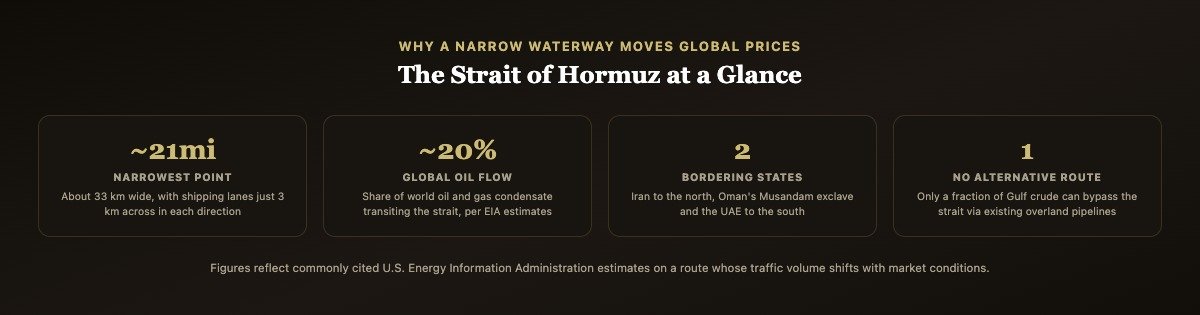
The clearest economic transmission channel runs through the Strait of Hormuz, a waterway roughly 21 miles wide at its narrowest point, bordered by Iran to the north and Oman’s Musandam exclave and the UAE to the south, through which the US Energy Information Administration has long estimated close to a fifth of global oil and gas condensate consumption transits. When Iran declared the strait closed in early March 2026, benchmark oil prices recorded one of their largest monthly increases on record according to World Bank commodity market analysis, and war-risk insurance for tankers reportedly rose to several times normal levels. Independent estimates cited in market analysis described global oil output falling by several percentage points year-over-year in the following quarter — among the steepest quarterly drops attributed to a single geopolitical event in recent years.
These effects reach far beyond the Gulf because oil is a globally priced commodity: a shipping disruption that raises the cost of insuring or routing a tanker in the Gulf raises fuel costs in import-dependent economies with no direct stake in the conflict, from European manufacturers to South and Southeast Asian consumers. The June 2026 memorandum’s 60-day toll-free Hormuz shipping window was, in that light, as much an economic confidence-building measure as a military one — and Iran’s stated intention to introduce shipping fees once that window expires around August 17, 2026 is itself a data point markets are likely to price in ahead of the actual date.
📈 Economic Insight
Middle East tensions influence global energy prices, shipping costs and investor confidence largely through expectations, not only through confirmed physical disruption — markets moved on Iran’s declaration that the strait was “closed” and on the threat of a cargo fee, independent of whether either was fully enforced.
Impact on Commercial Shipping
What has actually happened to vessels moving through the Gulf
Beyond the general price effects above, specific shipping incidents have punctuated the conflict directly. Iran’s March 2026 declaration that the strait was closed was followed, according to reporting, by a period of sharply reduced voluntary commercial transits and elevated insurance costs rather than a complete physical blockade. The June 2026 memorandum’s toll-free passage provision was a direct response to that disruption, aimed at restoring shipping confidence. Its collapse in July, following Iran’s reported strikes on three commercial vessels that had bypassed its preapproved route, shows how a single enforcement action against specific ships — rather than a blanket policy — can undo months of restored shipping confidence within days. Any reader tracking this conflict’s economic dimension should watch Hormuz-specific shipping and insurance reporting separately from broader oil-price commentary, since the two do not always move together.
Regional Security Beyond the Two Combatants
Why this is not only a US-Iran story
Regional security in the Gulf and wider Middle East has never rested on the US-Iran relationship alone. Gulf states balance their own security guarantees from Washington against economic and geographic proximity to Iran. Iraq hosts both US forces and Iran-aligned armed groups within its own territory, making it a frequent site of indirect friction. Lebanon’s inclusion by name in the June 2026 memorandum’s “all fronts” language reflects the reality that Israel-Hezbollah tensions have been treated, in this conflict’s diplomacy, as linked to the broader US-Israel-Iran confrontation rather than separate from it. This layered structure — bilateral tension with genuinely multilateral consequences — is why single-country framing of this conflict consistently understates its actual complexity.
International Organizations and the Documented Record
The UN, the IAEA and the US Congress as the conflict’s paper trail
Three institutions provide the closest thing this conflict has to a continuous, citable public record. The UN Security Council adopted Resolution 2817 in March 2026 condemning Iranian strikes on Gulf states and Jordan — a resolution notable both for its near-unanimous vote (13-0, with China and Russia abstaining rather than vetoing) and its unprecedented 135-country cosponsorship, though it is worth noting the resolution addressed Iranian retaliatory strikes specifically, rather than ruling on the war’s initial cause. The IAEA has issued repeated Board of Governors reports and a US-backed verification resolution documenting its loss of continuity of knowledge over Iran’s enriched uranium stockpile — a technical, monitoring-focused record distinct from any government’s political statements. The US Congress has voted four times across June and July 2026 on War Powers Resolution measures aimed at constraining the war, with the House twice passing non-binding measures by narrow margins and the Senate splitting between a narrow non-binding pass in June and a narrow defeat of a binding version in July — a documented, if legally inconclusive, institutional pushback.
Media Misinformation During Active Conflicts
Why casualty figures, operation names and “confirmed” claims deserve extra scrutiny here
Fast-moving military conflicts are reliably accompanied by unverified claims, and this one is no exception. Casualty totals attributed to independent conflict trackers have varied by a factor of two or more depending on the source and the date the estimate was made — a normal feature of wartime reporting, not evidence that any particular tracker is acting in bad faith, but a strong reason to treat any single casualty figure presented without a named source and date as unreliable. Operation codenames, exact troop movements and classified planning details are especially prone to conflation, garbling or premature reporting in the early hours after a strike; this guide has deliberately avoided asserting any detail it could not trace to an official statement or a named, reputable outlet’s reporting. Readers seeking to verify a specific claim about this conflict are best served by checking it against the White House, Department of Defense, State Department, UN or IAEA’s own published statements before treating it as settled.
Comparisons: The Frameworks Behind the Headlines
Four head-to-head comparisons that explain recurring terms in this conflict’s coverage
Diplomacy vs Military Action
Deterrence vs Escalation
| Dimension | Sanctions | Military Pressure |
|---|---|---|
| Primary tool | Financial and trade restrictions | Strikes, deployments, blockade threats |
| Speed of effect | Gradual, months to years | Immediate |
| Reversibility | Can be lifted by policy change | Damage and casualties are not reversible |
| 2026 example | Reimposed measures alongside “maximum pressure” legacy sanctions | Feb 2026 strike campaign; July naval posture and cargo-fee threat |
| Legal basis cited | National and multilateral economic authorities | Contested — self-defense claims disputed by some scholars |
| Framework | Period | Core Mechanism | Outcome |
|---|---|---|---|
| NPT Safeguards (baseline) | 1970-present | Standard IAEA monitoring under the Non-Proliferation Treaty | Ongoing; insufficient alone to catch undeclared sites (see 2002) |
| Post-2002 Board findings | 2003-2015 | IAEA non-compliance findings, incremental UN sanctions | Pressure builds without a comprehensive settlement |
| JCPOA | 2015-2018 | Enrichment cap, stockpile limits, expanded verification for sanctions relief | Implemented, then abandoned by US withdrawal |
| Post-2026 verification push | 2026-ongoing | US-backed IAEA resolution demanding declaration and access | Developing; continuity of knowledge not yet restored |
| Period | Measure | Context |
|---|---|---|
| 1979-81 | Asset freeze, trade restrictions | Response to the embassy hostage crisis |
| 1996 | Iran-Libya Sanctions Act | Extends pressure to foreign energy investors |
| 2006-2010 | Multiple UN Security Council sanctions resolutions | Response to nuclear non-compliance findings |
| 2016 | Most nuclear-related sanctions lifted | JCPOA Implementation Day |
| 2018-present | “Maximum pressure” sanctions reimposed and expanded | Follows US JCPOA withdrawal |
| Date | Incident | Confirmed By |
|---|---|---|
| Apr 1988 | Operation Praying Mantis | US Navy historical record |
| Jan 2020 | Soleimani strike and Iranian missile retaliation | DoD, Iraqi government statements |
| Jun 2025 | Twelve-Day War strikes and ceasefire | US, Israeli and Iranian government statements |
| Feb 28, 2026 | Operation Epic Fury / Lion’s Roar coordinated strikes | Pentagon, Israeli government, Iranian state media |
| Jul 2026 | Strikes on three commercial vessels; US strikes resume | Media reporting; not yet independently adjudicated |
| Actor | Alignment | Role in This Conflict |
|---|---|---|
| Israel | US-aligned | Direct co-combatant since June 2025 |
| Saudi Arabia, UAE, Qatar | US security partners | Targeted by Iranian strikes; Qatar also a mediator; requested the Aug 2026 pause |
| Oman | Non-aligned mediator | Lead nuclear and Hormuz talks channel |
| Pakistan | Non-aligned mediator | Hosted April talks and June memorandum signing |
| Iran-aligned armed groups | Iran-aligned | Regional pressure points in Lebanon, Iraq, Yemen |
| Indicator | Reported Move | Period |
|---|---|---|
| Benchmark oil price | One of the largest monthly increases on record | March 2026 |
| Tanker war-risk insurance | Several times normal levels | March 2026 onward |
| Global oil output, year-over-year | Down by a significant single-digit percentage | Q2 2026 |
| Hormuz shipping fee | Threatened, not confirmed implemented | Post-Aug 17, 2026 (planned) |
| Agreement | Date | Status |
|---|---|---|
| JCPOA | Jul 2015 | Abandoned by US withdrawal, May 2018 |
| 2025 Ceasefire | Jun 24, 2025 | Expired Feb 28, 2026 as scheduled |
| April 2026 Ceasefire | Apr 8, 2026 | Partial; Hormuz and nuclear issues unresolved |
| Islamabad Memorandum of Understanding | Jun 17, 2026 | Collapsed in July after Hormuz incidents |
| August 2026 pause | Aug 2, 2026 | Announced; not yet a signed successor agreement |
| Year | Event | Global Importance |
|---|---|---|
| 1953 | Mossadegh removed from power | Founding grievance in Iran’s view of US intervention |
| 1979 | Revolution and hostage crisis | Ends formal US-Iran diplomatic relations |
| 1988 | Operation Praying Mantis | Establishes direct-conflict precedent in the Gulf |
| 2015 | JCPOA signed | High-water mark of negotiated nuclear diplomacy |
| 2018 | US exits JCPOA | Reopens the path toward confrontation |
| 2020 | Soleimani strike | Closest prior brush with open war |
| 2025 | Twelve-Day War and ceasefire | Ceasefire’s expiration date schedules the 2026 war |
| 2026 | War begins; strikes suspended | Most significant US-Iran military event in decades |
Key Institutions and Places to Know
The entities whose statements and geography define this conflict’s official record
The White House
Source of presidential statements and announcements on strikes, pauses and negotiations, including the August 2, 2026 Truth Social post central to this guide.
U.S. Department of Defense
Confirms military operations, casualty figures for US forces, and operation codenames such as Operation Epic Fury.
U.S. Department of State
Handles diplomatic messaging, coordination with mediating governments, and formal positions on negotiations.
U.S. Congress
Has voted four times in 2026 on War Powers Resolution measures aimed at constraining the war, all narrowly decided and non-binding or defeated.
United Nations Security Council
Adopted Resolution 2817 in March 2026 condemning Iranian strikes on Gulf states and Jordan, with 135 cosponsors.
International Atomic Energy Agency
Monitors Iran’s nuclear program and has reported a loss of continuity of knowledge over its enriched uranium stockpile since 2025.
Israel
A direct military co-participant with the US since June 2025, and a party to the February 2026 coordinated strike campaign.
Oman
The most consistent diplomatic channel between Washington and Tehran, mediating nuclear talks before the war and Hormuz talks since.
Persian Gulf
The shared body of water bordering Iran and the GCC states, and the theater for nearly all of this conflict’s naval and shipping dimensions.
Strait of Hormuz
The roughly 21-mile-wide chokepoint through which close to a fifth of global oil transits, and the conflict’s clearest economic pressure point.
What This Record Can and Cannot Tell You
Being explicit about the edges of what is verifiable right now
✅ This Guide Can
- Confirm the dates and content of official White House, Pentagon, State Department, UN and IAEA statements cited above
- Trace the documented sequence of ceasefires, frameworks and their collapses through 2025-2026
- Explain the concepts — deterrence, sanctions, proxy conflict — that recur in coverage of this war
- Report disputed figures as disputed, attributed to their named source
❌ This Guide Cannot
- Predict whether the August 2026 pause will hold or produce a final agreement
- Confirm classified military plans or resolve competing casualty totals into one number
- Offer a legal ruling on the war’s justification under international law — that is contested among scholars, not settled
- Guarantee that any development described as “most recent” remains so after this guide’s last update
Interesting Facts
- The 2025 ceasefire’s expiration date effectively scheduled the next war — a rare, documented instance of a peace agreement containing its own end date.
- UN Resolution 2817’s 135 cosponsors made it the most-cosponsored resolution in Security Council history.
- The Islamabad Memorandum was signed from three different countries simultaneously — Trump in France, Pezeshkian in Tehran, and Sharif in Islamabad.
- Four sitting US Senators and four Representatives, all Republicans, crossed party lines across two rounds of war-powers votes without changing the outcome of US policy.
- The Strait of Hormuz is narrow enough that its two shipping lanes — one for each direction — are each only about 3 kilometers wide.
👀 Future Watch
What to track next, from official sources only: White House statements confirming or denying a signed successor agreement; Department of Defense releases on any resumption or continuation of the strike pause; State Department briefings on Oman-mediated Hormuz talks; UN Security Council sessions addressing developments after Resolution 2817; and IAEA Board of Governors reports on whether inspector access to Iranian nuclear sites has been restored. This guide does not speculate about outcomes beyond what these sources confirm.
Explore More Timelines
People Also Ask
Frequently Asked Questions
100 expert questions, organized by topic
Why Diplomacy and History Matter More Than Headlines
Return, for a moment, to the officials waiting on the evening of August 2, 2026. What made that moment hard to interpret in real time was not a shortage of information — it was the opposite. A single social media post, a Gulf government’s private request, a negotiator’s public quote about the Strait of Hormuz, and a documented pattern of prior pauses that had not always held were all true and available at once. Understanding what any one of them meant required the other thirteen milestones in this timeline, the mediators’ names and track records, the specific unresolved issues that had broken past frameworks, and a willingness to say plainly where the record simply is not yet clear.
That is the case this guide has tried to make throughout: a development involving the United States and Iran is best understood within the broader history of diplomacy, regional security, international law and strategic decision-making that produced it — not as an isolated headline. The 1953 coup, the 1979 rupture, the 2015 deal and its 2018 collapse, the 2020 strike that stopped short of war, and the ceasefire that scheduled the next one are not background trivia. They are the reason a Truth Social post about “perimeters of a deal” carries the specific weight it does. Any single announcement, including this one, represents only one point on a much longer timeline.
For verified updates beyond this guide’s last revision, the most reliable path runs through the same official channels cited throughout: White House and State Department statements, Department of Defense releases, UN Security Council records, IAEA Board of Governors reports, and reputable international wire and broadcast journalism — read together, and read for what they actually confirm rather than what a single dramatic headline implies.
⚠️ Editorial Note
This guide separates official government and UN statements, IAEA and congressional records, and independent journalism from analysis throughout, and avoids speculation about classified military planning or unverified casualty claims. It is maintained as a living reference and updated as new official developments are published; nothing here should be treated as legal or investment advice, and it may not reflect developments after its last update.
Sources & further reading
Every dated entry above was checked against these references. Last reviewed 19 September 2026.
- UN Press: Security Council Adopts Resolution 2817 (2026) Condemning Iran's 'Egregious Attacks'
- NPR: Iran's Supreme Leader, Ayatollah Ali Khamenei, Has Been Killed
- Al Jazeera: Trump Cancels Iran Strike, Says 'Deal Perimeters' Reached
- NPR: Read the Full Text of Trump's Preliminary US-Iran Agreement to End the War
- Britannica: 12-Day War (June 2025)
- CNBC: Iran After Khamenei — What's Next and What It Means for the Country
- ISIS-Online: Analysis of IAEA Iran Verification and Monitoring Reports, June 2026