Mount Olympus Is Now a UNESCO World Heritage Site: Inside the 12-Year Bid
Mount Olympus was inscribed as a UNESCO World Heritage Site on 26 July 2026. See the verified status, criteria, bid timeline and Greek mythology behind it.
Latest Story
Mount Olympus is no longer bidding for UNESCO recognition. As of 26 July 2026, “the wider area of Mount Olympus” is formally inscribed on the UNESCO World Heritage List as a Mixed property — a rare designation that credits a place with both outstanding natural and outstanding cultural value at once. The decision was taken unanimously at the 48th session of the World Heritage Committee in Busan, South Korea, closing a nomination process Greece had pursued since adding the mountain to its Tentative List in 2014. It makes Olympus Greece’s 21st World Heritage property and only its third Mixed site, after Meteora and Mount Athos.
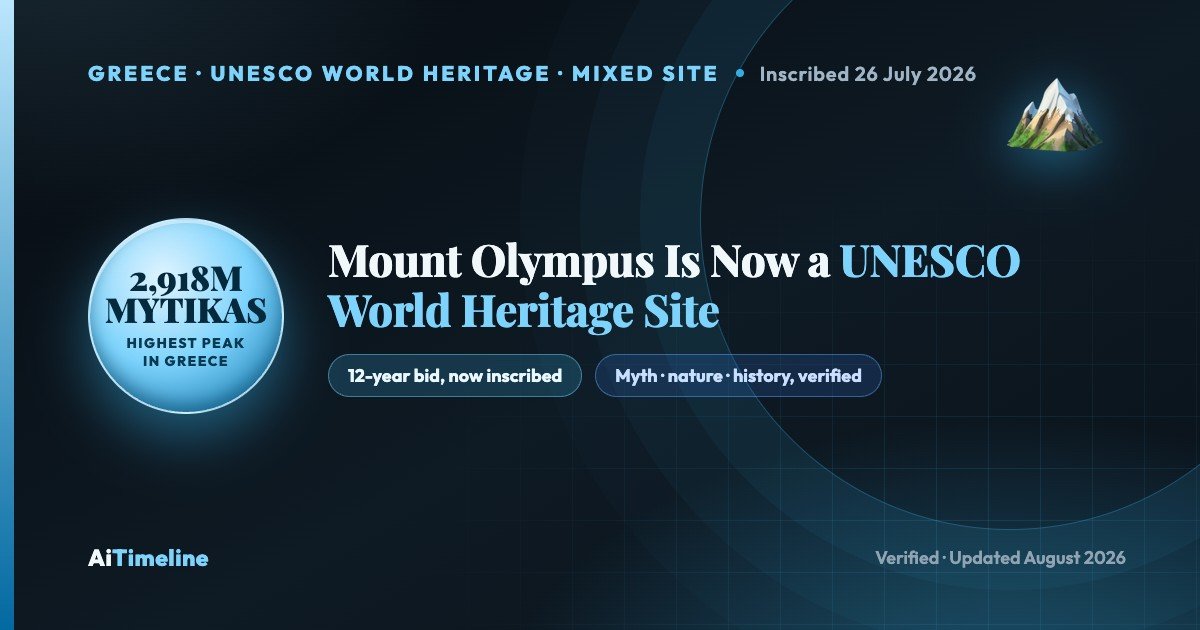
That headline fact matters for how the rest of this page should be read against anything published before August 2026: articles that describe Olympus as merely a “candidate” or a mountain still “seeking” UNESCO status are describing a stage the bid has already passed. What follows keeps that now-settled UNESCO status clearly separated from the two designations people most often confuse it with — Olympus’s UNESCO Biosphere Reserve listing (1981) and its status as Greece’s first National Park (1938), both real but distinct — and then works through the mountain’s geography, its mythology, and the archaeology at its foot, with each claim clearly labelled as history, myth, or ongoing science.
Latest Update — September 2026
Since inscription, Greek park officials and UNESCO advisory bodies have turned to managing the tourism surge the listing is expected to bring. As reported by Skift on 29 July 2026, a new 20-to-30-year management plan for the site proposes trail restoration and expansion, improved visitor facilities, formal carrying-capacity studies, better guide training, tech-driven monitoring of climate and fire risk, and a possible €2–€5 entrance fee still under consideration rather than confirmed. UNESCO’s own direct funding is modest — roughly $3 million a year worldwide across all sites — so implementation is expected to depend on Greek national budgets, EU programmes and any future entrance-fee revenue. As of this update, no entrance fee or new permit requirement has been formally enacted; day hikes still require no permit.
🧠 Short Answer
Yes — Mount Olympus is a UNESCO World Heritage Site. The World Heritage Committee inscribed “the wider area of Mount Olympus” as a Mixed cultural-and-natural property on 26 July 2026, at its 48th session in Busan, South Korea. The listing recognises the mountain’s mythological role as home of the Twelve Olympian gods (criterion vi) and its exceptional glacial-refuge biodiversity (criterion x). It is Greece’s 21st World Heritage Site and third Mixed site.
Mount Olympus UNESCO: Key Questions
What to Know About Mount Olympus’s UNESCO Status
- Inscribed, not just nominated. On 26 July 2026 the World Heritage Committee formally added “the wider area of Mount Olympus” to the World Heritage List — the bid succeeded, it isn’t pending.
- A 12-year process. Greece placed Olympus on its UNESCO Tentative List in 2014; the nomination dossier, advisory-body review and Committee vote took until mid-2026 to conclude.
- Two criteria, one “Mixed” site. Criterion (vi) covers the mythology and literary tradition (Homer, Hesiod); criterion (x) covers the mountain’s biodiversity. Mixed sites meeting both a cultural and a natural criterion are uncommon — fewer than 40 exist worldwide.
- Three designations, often conflated. National Park (1938), Biosphere Reserve (1981) and World Heritage Site (2026) are legally and institutionally distinct, even though they cover overlapping ground.
- Greece’s third Mixed site. Only Meteora and Mount Athos (both inscribed 1988) held Mixed status in Greece before Olympus joined them; Greece now has 21 World Heritage properties in total.
- The archaeology matters as much as the myth. The cultural case rests partly on the sanctuary city of Dion at the mountain’s foot, not on mythology alone — physical ruins, not just literary tradition.
- A genuine biodiversity hotspot. Around 1,983 plant taxa grow on Olympus — over a quarter of all species recorded in Greece — including dozens found nowhere else on Earth, the legacy of the mountain acting as an Ice Age glacial refuge.
- Inscription doesn’t create new visitor rules by itself. Day-to-day management stays with Greece’s existing National Park authority; no new visitor restrictions specific to the UNESCO listing had been officially announced as of this article’s last-verified date.
- Myth is myth, not archaeology. Homer and Hesiod, not excavation, are the evidence that ancient Greeks associated Olympus with the gods — a literary and religious tradition, not a claim this page treats as literal history.
UNESCO World Heritage, Explained
Nine terms readers routinely mix up — they are not interchangeable, and Olympus has passed through several of them.
World Heritage Site
A place UNESCO’s World Heritage Committee has formally inscribed on the World Heritage List after a multi-year nomination and evaluation process, recognising “outstanding universal value.” Olympus reached this stage on 26 July 2026.
Tentative List
A country’s own inventory of sites it intends to nominate eventually — the mandatory first step, at least one year before a formal nomination can be submitted. Olympus was added to Greece’s list in 2014.
Nomination
The formal dossier a country submits to the World Heritage Centre arguing a Tentative List site meets one or more of UNESCO’s ten criteria, backed by documentation, boundaries and a management plan.
Inscription
The World Heritage Committee’s formal vote to add a nominated site to the List. A nomination can also be referred (sent back for more information), deferred (needs substantial rework), or not inscribed.
Cultural Site
Inscribed under one or more of criteria (i)–(vi), covering human creative, historical or spiritual achievement — monuments, cities, cultural landscapes, living traditions. Mount Athos and Meteora’s monastic buildings are cultural value.
Natural Site
Inscribed under one or more of criteria (vii)–(x), covering natural beauty, geology, ecosystems or biodiversity. Most national parks with World Heritage status — the Serengeti, the Grand Canyon — are natural-only sites.
Mixed Site
Meets at least one cultural criterion AND at least one natural criterion. Olympus qualifies this way, via (vi) and (x) — not via UNESCO’s separate “cultural landscape” category, which is a cultural-only sub-type.
Biosphere Reserve
A UNESCO Man and the Biosphere Programme designation for sites balancing conservation with sustainable use — administered separately from World Heritage, with its own criteria and no bearing on WHS status. Olympus has held this since 1981.
One more distinction worth making explicit: a National Park is a purely domestic legal designation, created and enforced under a country’s own law, with no necessary relationship to any UNESCO programme at all. Greece declared Olympus a National Park in 1938, nearly ninety years before UNESCO inscribed it — the two statuses were created by different institutions, for different purposes, decades apart.
The UNESCO Criteria Behind the Listing
UNESCO recognises ten possible criteria, six cultural and four natural. Olympus was inscribed under exactly two.
Association with Beliefs & Works of Outstanding Significance
Covers sites “directly or tangibly associated with events or living traditions, with ideas, or with beliefs, with artistic and literary works of outstanding universal significance.” Olympus qualifies through its role in Homer’s epics and Hesiod’s Theogony, which turned it into an enduring reference point for Greek and later Western civilisation.
Biodiversity & In-Situ Conservation
Covers sites containing “the most important and significant natural habitats for in-situ conservation of biological diversity,” including threatened species. Olympus qualifies as a Pleistocene glacial refuge and Mediterranean plant-diversity hotspot, hosting roughly 1,983 plant taxa and dozens of endemic species.
UNESCO doesn’t reward natural beauty or historical fame on their own — every inscription has to be argued against one or more of these ten defined criteria, evaluated by independent advisory bodies before the Committee votes. For a Mixed site, that means clearing two separate bars simultaneously: ICOMOS (the International Council on Monuments and Sites) assesses the cultural case, while IUCN (the International Union for Conservation of Nature) assesses the natural case, and both had to find Olympus’s dossier convincing. Criterion (vi) is normally applied cautiously and usually paired with another cultural criterion, since “association with beliefs” alone can be hard to bound physically; Olympus’s dossier addressed that by anchoring the cultural case partly in the archaeological remains at Dion (below), not mythology in the abstract. Criterion (x) is comparatively well-suited to Olympus given its documented role as a refuge for forest and alpine species through past glaciations, and its unusually steep and compressed climatic gradient — the mountain rises from near sea level to nearly 2,918m within about 20km, compressing several distinct ecological zones into one protected area. Criteria that press coverage has, at various points, also associated with the bid — including (ii), (iv), (viii) and (ix) — are not treated as confirmed here; this page follows the two-criteria account given in cross-referenced encyclopedic and news sources (see Sources & Methodology) pending direct confirmation from UNESCO’s own decision text.
Geography: Where Mount Olympus Sits, and How High It Really Is
Mount Olympus rises on the border between the regions of Thessaly and Central Macedonia, straddling the regional units of Pieria and Larissa in northern Greece, roughly 100km southwest of Thessaloniki. What makes its profile so dramatic isn’t just its height but its relief: the massif climbs from a coastal plain barely above sea level, only about 15–18km from the Aegean Sea, to just under 2,918m — one of the steepest sea-to-summit gradients of any mountain in Europe. The Olympus massif isn’t a single peak but a compact cluster of more than 50 summits and pinnacles above 2,000m, enclosing a high plateau (the Plateau of the Muses) between its main peaks.
| Peak | Elevation | Notes |
|---|---|---|
| Mytikas | 2,918m (2,917.7m surveyed) | Highest point of Olympus and of Greece; first climbed 1913 |
| Skolio | ~2,911m | Second-highest peak; the usual non-technical trekking summit |
| Stefani (“Throne of Zeus”) | ~2,902–2,909m | Sheer-faced peak named for its resemblance to a throne; technical climb |
| Agios Antonios | ~2,815–2,817m | Marks the edge of the Megala Kazania (“Great Cauldron”) basin |
Geologically, Olympus is built mainly of limestone laid down in a shallow sea roughly 200 million years ago, later thrust upward as tectonic plates collided during the Alpine mountain-building period. Pleistocene glaciers, active on the mountain until around 10,000–20,000 years ago, carved the cirques, gorges and steep-walled basins — most famously the Megala Kazania, a vast rocky amphitheatre beneath the summit ridge — that give the upper mountain its dramatic, almost fortress-like character today.
Mytikas: The Summit of Olympus
Mytikas (Μυτικάς, roughly “nose” or “needle-point” in Greek) is the highest of Olympus’s summits and the highest point in Greece, at 2,918m. The name describes its shape: a narrow, jagged rock spire rather than a rounded summit, visible from a great distance across the Thessalian plain. For most of recorded history it was considered unclimbable, or was simply left unattempted — local shepherds and hunters treated the upper massif as forbidding rather than sacred-forbidden in any documented ritual sense. That changed on 2 August 1913, when Swiss climbers Frédéric Boissonnas and Daniel Baud-Bovy, guided by the Greek hunter Christos Kakkalos, made the first recorded ascent — a milestone that shifted Olympus from a mythic backdrop into a real, and reachable, mountaineering objective.
Reaching Mytikas today means leaving the marked hiking trails: the final approach is an exposed rock scramble, not a technical climb requiring ropes in dry summer conditions, but a route where a slip has serious consequences and where snow, ice or fog can turn it genuinely dangerous with little warning. Most visitors to Olympus instead reach the neighbouring summit of Skolio, a straightforward, non-technical trek from the mountain’s refuges, and stop there. This page does not provide route-by-route climbing instructions; see Visiting Mount Olympus and Safety below for what it does cover.
Mount Olympus National Park
Mount Olympus became Greece’s first National Park by royal decree on 9 June 1938, protecting a core zone widely cited at roughly 40 square kilometres around the mountain’s upper massif, later surrounded by a larger buffer zone. The declaration predates UNESCO itself (founded 1945) by seven years, and predates Olympus’s Biosphere Reserve and World Heritage designations by decades — it is Greece’s own, oldest layer of protection, not an international one. Day-to-day management sits with the Management Unit of Olympus National Park, part of Greece’s Natural Environment and Climate Change Agency (known by its Greek acronym, ΟΦΥΠΕΚΑ / N.E.C.C.A.), which coordinates conservation, trail maintenance, research permits and visitor information for the park.
National Park status and World Heritage status are legally independent: a country can (and Greece has, at several sites) run a National Park with no UNESCO involvement at all, and a UNESCO-inscribed property does not automatically become a National Park or vice versa. What changes with UNESCO inscription is largely international: added visibility, eligibility for certain international conservation funding and expertise, and an obligation to report periodically to the World Heritage Committee on the property’s state of conservation — not, by itself, a change in Greek domestic law.
Biosphere Reserve & Natura 2000: The Designations That Came Before
On 15 December 1981, UNESCO added Olympus to its Man and the Biosphere (MAB) Programme as a Biosphere Reserve — a designation focused on demonstrating a sustainable balance between conservation and human use, run through a different UNESCO programme with different criteria and a different secretariat from the World Heritage Centre. A site can be a Biosphere Reserve without ever becoming a World Heritage Site, and vice versa; Olympus holding both is a coincidence of two separate, successful applications 45 years apart, not one designation implying the other.
Separately, Olympus (site code GR1250001, “Oros Olympos”) is protected under the European Union’s Natura 2000 network, first listed as a Special Protection Area for birds in the late 1980s and later also designated a Special Area of Conservation under the EU Habitats Directive. Natura 2000 is an EU legal mechanism, not a UNESCO one — a third, independent layer of protection alongside the Greek National Park and the two UNESCO designations.
The UNESCO Recognition Timeline
Reverse chronological. Every date below was checked against at least one primary or corroborating secondary source (see Sources & Methodology).
Mount Olympus inscribed as a UNESCO World Heritage Site
The Committee unanimously approves inscription of “the wider area of Mount Olympus” as a Mixed cultural-and-natural property, under criteria (vi) and (x). Greece’s Culture and Environment Ministries jointly announce the decision.
Added to Greece’s UNESCO Tentative List
Olympus enters Greece’s Tentative List as “the broader region of Mount Olympus,” the mandatory first formal step toward any World Heritage nomination. The roughly 12-year path to inscription begins here.
Natura 2000 protection begins
Olympus is listed as a Special Protection Area under the EU’s nature-conservation framework, adding a European legal layer of protection alongside Greece’s own National Park law.
Designated a UNESCO Biosphere Reserve
Olympus joins the global Biosphere Reserve network, recognising it as a site for reconciling conservation with sustainable use — a separate UNESCO programme from the World Heritage Convention.
Declared Greece’s first National Park
Greece’s earliest formal conservation designation for Olympus, protecting its upper massif under domestic law seven years before UNESCO itself was founded.
First recorded ascent of Mytikas
The summit long considered unreachable is climbed for the first time, opening Olympus to mountaineering and scientific study alongside its mythological reputation.
Alexander the Great sacrifices at Dion
Before launching his campaign against Persia, Alexander holds a nine-day festival and sacrifices to Zeus and the Muses at Dion — physical, datable history, distinct from the mythology above it on the mountain.
Hesiod and Homer codify Olympus as home of the gods
The earliest surviving major literary sources fix Olympus as the seat of the Twelve Olympians in Greek religious and poetic tradition — the origin of everything in the Mythology section below.
Why the Bid Succeeded: Strengths and Open Questions
A balanced read of the case UNESCO’s advisory bodies had to weigh.
✅ What Supported the Bid
- An exceptionally well-documented, continuous literary and religious tradition dating to Homer and Hesiod
- A physical archaeological anchor for the cultural case at Dion, not mythology alone
- Verified, scientifically documented biodiversity: ~1,983 plant taxa and dozens of endemics
- Ninety years of prior Greek legal protection (National Park since 1938) demonstrating management capacity
- An existing UNESCO relationship via the 1981 Biosphere Reserve designation
- An unusually compressed, near-sea-to-alpine ecological gradient within one protected boundary
❌ What UNESCO Advisory Bodies Had to Scrutinise
- Defining defensible boundaries for a “cultural landscape” argument based partly on intangible belief
- Demonstrating integrity and authenticity across a large, multi-use landscape rather than a single monument
- Balancing rising hiking tourism against conservation objectives, especially on the most popular trail corridor
- Coordinating a single dossier across two ministries (Culture and Environment) and two advisory bodies (ICOMOS and IUCN)
- Avoiding overlap or confusion with the mountain’s existing Biosphere Reserve and Natura 2000 designations
None of the items above should be read as UNESCO having formally objected to anything — the Committee’s vote was unanimous, and no specific committee reservations were identified in the sources checked for this article. This box instead reflects the general categories of scrutiny any Mixed-site nomination faces, and the specific strengths Olympus’s dossier evidently had, based on what advisory-body evaluations for comparable Mixed sites typically weigh.
Why Mount Olympus Matters as Natural Heritage
Olympus’s ecological importance comes from a single geographic fact: it rises almost directly from the Aegean coastline to near-alpine altitude within a very short horizontal distance, compressing Mediterranean, temperate and alpine climate zones into one steep massif. Lower slopes carry Mediterranean maquis scrub and deciduous oak; mid-elevations support dense forests of black pine, Greek fir and beech; above roughly 2,000–2,200m, trees give way to alpine meadow, scree and bare limestone. Because the mountain offered this range of microclimates and refuge habitats through repeated Pleistocene ice ages, plant and animal populations that died out elsewhere in the region survived here — the “glacial refuge” effect that UNESCO’s criterion (x) case rests on.
Botanically, Olympus hosts around 1,983 recorded plant taxa, representing more than a quarter of all plant species documented in Greece on a single mountain. Roughly two dozen of those are found only on Olympus and nowhere else on Earth, among them Jankaea heldreichii (“the Olympus violet”), a cliff-dwelling relict species and the sole European member of its plant family found outside the tropics — a genuine botanical rarity, not a marketing claim. Fauna includes brown bears, the largest Greek population of the Balkan chamois (a wild goat also known locally as the agrimi), golden eagles and other birds of prey, and a range of reptiles and amphibians adapted to the rocky upper slopes. None of the specific population-count figures sometimes quoted for these species in tourism material were independently verified for this article; where a number appears above, it is a documented taxa count from cross-checked sources, not an estimate of animal numbers.
Cultural Heritage & Archaeology: Dion, at the Mountain’s Foot
UNESCO’s cultural case for Olympus rests on more than literary tradition alone. At the mountain’s northeastern foot, near modern Litochoro and Katerini, lies Dion (Δίον), an ancient Macedonian sanctuary city whose name itself derives from Zeus (Dios). Excavated remains include a sanctuary of Zeus, a sanctuary of Demeter, a later Roman-era sanctuary of Isis, city walls, a Hellenistic theatre, a Roman odeon, and residential quarters with well-preserved mosaic floors, all housed today within an archaeological park and museum. Dion functioned as the religious and political capital of the ancient Macedonian kingdom: Philip II reportedly celebrated there after military victories, and in 334 BCE, Alexander the Great held a nine-day festival and sacrificed to Zeus and the Muses at Dion before launching his campaign into Asia — a specific, datable historical event, distinct from the mythological claims about the summit above it.
This matters for the “myth versus history” distinction the rest of this page maintains: Dion is archaeological evidence of real religious practice directed toward Olympus and its resident deity, verifiable through excavation, inscriptions and material remains. It is not evidence that gods literally lived on the summit — it is evidence that ancient people genuinely believed and worshipped as though they did, which is a different, and independently verifiable, historical claim.
Why Olympus Became the Home of the Gods
Myth, literary tradition and archaeological evidence, kept separate.
MYTH / LITERARY TRADITION: In Greek mythology, Mount Olympus was the court and dwelling of the Twelve Olympians, the ruling generation of gods under Zeus, who overthrew the earlier Titans in the mythic Titanomachy. Ancient poets consistently placed the gods’ palace at the mountain’s summit, wrapped in cloud and reachable only by divine means — a literary and religious convention, not a claim ancient authors treated as a matter of ordinary geography. One plausible, purely editorial observation: Olympus’s real summit is frequently shrouded in cloud and subject to sudden, violent thunderstorms, a physical characteristic that maps naturally onto Zeus’s identity as god of sky and thunder. This is an interpretive link this page draws, not a claim from any ancient source explaining its own reasoning.
| Olympian | Domain | Note |
|---|---|---|
| Zeus | Sky, thunder, king of the gods | Ruler of Olympus in Homer and Hesiod |
| Hera | Marriage, family, queen of the gods | Zeus’s wife and sister |
| Poseidon | Sea, earthquakes, horses | Zeus’s brother; ruled the seas |
| Athena | Wisdom, strategy, crafts | Born fully armed from Zeus’s head |
| Apollo | Sun, music, prophecy, healing | Twin of Artemis; oracle at Delphi |
| Artemis | The hunt, wilderness, the moon | Twin of Apollo |
| Ares | War | Son of Zeus and Hera |
| Aphrodite | Love and beauty | Associated myths of sea-birth |
| Hermes | Messenger god, travel, trade | Son of Zeus; guide of souls |
| Hephaestus | Fire, the forge, craftsmanship | Divine smith of Olympus |
| Demeter | Agriculture, harvest | Mother of Persephone |
| Hestia / Dionysus | Hearth / wine and festivity | Ancient sources vary on which held the twelfth seat |
Myth vs. History: A Side-by-Side Reading
| Claim | Mythological tradition | Historical / archaeological evidence | Modern interpretation |
|---|---|---|---|
| “The gods lived atop Olympus” | Central premise of Greek religion and epic poetry from Homer onward | No archaeological evidence of any kind exists at the summit; the claim is religious, not historical | A sacred literary convention, treated by this page as myth, not fact |
| “Zeus ruled from a golden palace on the peak” | Described in Homeric epithets and later poetry | No structural remains at the summit; the terrain (bare rock, extreme weather) is inhospitable to any built structure | Poetic imagery, not a claim of a physical building |
| “Ancient Greeks worshipped Zeus in connection with Olympus” | Consistent across centuries of religious practice | Verified: the sanctuary complex at Dion, with altars, inscriptions and a documented history of royal sacrifice | Real, datable religious history, independent of whether the myth itself is true |
| “Christian-era hermits sanctified Olympus’s peaks” | Not part of ancient Greek mythology | The Chapel of Prophet Elias, built near the summit ridge, is a real, documented structure from the Christian era | A later, separate layer of sacred meaning added to the same mountain |
Zeus and Olympus
Zeus’s association with Olympus runs through the two foundational texts of Greek literature. Hesiod’s Theogony, composed around 700 BCE, narrates Zeus’s rise to power over the Titans and his establishment as ruler from Olympus, organising the world’s divine hierarchy beneath him. Homer’s Iliad and Odyssey, from roughly the same period, repeatedly stage scenes of the gods assembled on Olympus, debating and intervening in the Trojan War and Odysseus’s journey. Later Greek and Roman writers, temple inscriptions, and the epithet “Olympios” attached to Zeus at multiple sanctuaries (including Dion and, most famously, the Temple of Olympian Zeus in Athens, unrelated geographically to the mountain itself) show how deeply the association took hold across the ancient Mediterranean. This page paraphrases rather than quotes these sources at length; full texts of Homer and Hesiod, out of copyright, are widely available through academic and library sources.
Olympus Through the Ages of Ancient Greece
Olympus’s story runs alongside, rather than through, most of the standard periods of Greek history. In the Archaic period (c. 800–480 BCE), Homer and Hesiod fixed its mythological role. Through the Classical (480–323 BCE) and Hellenistic (323–31 BCE) periods, Dion flourished as a Macedonian religious and political centre, reaching particular prominence under Philip II and Alexander the Great. Under Roman rule (from 168 BCE), Dion continued as a colony with a Roman-style forum, baths and villas, some of whose mosaics survive today. Specific Olympus-related events beyond what is documented at Dion, or beyond the mountain’s general symbolic role, are not invented here where no source confirms them — much of the mountain’s own physical history in this era is simply undocumented, since the summit itself, unlike its foot, was not a site of habitation or worship activity in the archaeological record.
Later History: Christianity, the Ottoman Era & Modern Greece
Olympus’s symbolic weight outlasted the religion that first attached it to the mountain. In the Christian era, the Chapel of Prophet Elias, built near the summit ridge at roughly 2,800m, became one of the highest religious structures in the Balkans, associated with an annual pilgrimage and summer liturgy — a genuinely documented structure, not a mythological claim. During the Ottoman period, Greek folk tradition and local histories describe Olympus’s remoteness sheltering irregular highland fighters (klephts) resisting Ottoman rule, though this page treats that specifically as folk historical tradition rather than a claim independently verified here. After Greek independence (1830) and especially after the mountain’s first ascent in 1913, Olympus was steadily absorbed into modern Greek national identity as a natural and cultural symbol, culminating in its 1938 National Park status and its long path to the 2026 UNESCO inscription.
Mount Olympus and Greek Identity
Few mountains anywhere carry a name recognisable outside their own country the way Olympus does — the word itself has become international shorthand for “the seat of the gods” or “the pinnacle of achievement,” well beyond Greece (it’s why other unrelated mountains around the Mediterranean also carry the name “Olympus”). Inside Greece, the mountain features throughout school curricula on mythology and history, appears constantly in national tourism branding, and is a routine reference point in Greek literature, art and political rhetoric as a symbol of both natural grandeur and continuity with antiquity. This page treats that cultural weight as real and well-documented without claiming Olympus is uniquely or exclusively central to Greek identity compared with other major national symbols (the Parthenon, the Greek flag’s own history, Byzantine heritage); it is one major symbol among several, not the only one.
Olympus in Literature
Beyond Homer and Hesiod, Olympus recurs throughout classical literature: the lyric poet Pindar references it in odes praising athletic victors; Athenian tragedians invoke it as the gods’ seat when staging divine intervention; Roman poets, most notably Ovid in the Metamorphoses, adapted the Greek Olympian pantheon (under Roman names) into Latin literature, cementing the mountain’s symbolic role across the wider Greco-Roman world. This page paraphrases these traditions rather than reproducing lengthy quotations, and does not attempt to represent modern Greek literary treatments of Olympus exhaustively; readers seeking primary texts should consult academic translations of Homer, Hesiod, Pindar and Ovid directly.
Olympus in Popular Culture
Modern fiction borrows Olympus’s mythology constantly and loosely: Rick Riordan’s Percy Jackson novels, the God of War and Hades video game franchises, Disney’s Hercules, and Assassin’s Creed Odyssey all stage scenes on or around a fictionalised Olympus. None of these adaptations are historical or mythological sources in themselves — they draw on the ancient tradition described above (often altering it for narrative purposes) rather than documenting it, and this page treats them strictly as contemporary cultural reception, not evidence of anything ancient.
The Human Story: Who Actually Works This Mountain
Away from the mythology, Olympus is a working landscape for a specific set of people: mountain guides and refuge keepers based in Litochoro, several affiliated with Greece’s Hellenic Alpine Club (EOS), who staff the mountain’s refuges seasonally and advise hikers on route and weather conditions; rangers and scientific staff of the National Park’s management unit, who monitor trails, wildlife and the endemic plant populations described above; researchers, mostly from Greek and international universities, documenting the mountain’s biodiversity and glacial-refuge ecology; and tourism operators in Litochoro and Katerini whose livelihoods depend on hikers, climbers and, increasingly, visitors drawn by the new UNESCO status itself. This page does not attribute quotations to any of these people, since none were interviewed directly for this article; any future update incorporating named, sourced quotes will be noted under Corrections.
Visiting Mount Olympus
The standard gateway to Olympus is Litochoro, a town in Pieria often nicknamed “the village of the gods,” roughly 100km from Thessaloniki and easily reached by road or rail via nearby Katerini. From Litochoro, a mountain road leads up to the Prionia trailhead, the most common starting point for the multi-hour ascent to the mountain’s refuges. Several staffed refuges operate seasonally partway up the massif, offering beds and meals to hikers spreading the ascent over two or more days rather than attempting it in a single push. The main hiking season runs roughly June to September; snow can persist on north-facing slopes and the upper massif well into early summer, and refuges typically close outside this window. General visitor etiquette applies throughout: stay on marked trails, carry out all litter, and respect wildlife and the protected status of the park — specific permit or registration requirements, where they exist, should be confirmed directly with the National Park management unit or a refuge operator before a visit, not assumed from this page. Park officials have said the most popular trail corridor is near its carrying-capacity limit, and a formal visitor-management plan — potentially including a modest entrance fee — is being developed following the 2026 UNESCO inscription; see Latest Update above.
Safety on Olympus
Olympus’s dangers are real and well documented, without needing exaggeration. Weather on the upper massif changes fast and can be severe even in summer — sudden afternoon thunderstorms, high winds, and rapid temperature drops are routine, and low cloud can cut visibility to a few metres with little warning. Terrain above the treeline is rocky and exposed, with the final approaches to peaks like Mytikas involving genuine scrambling and drop-offs where a fall could be fatal. Altitude itself is a lesser risk here than on much higher ranges, but unacclimatised hikers can still feel its effects near the 2,900m summits. This page does not provide turn-by-turn route or technical climbing instructions. Before any ascent, check an official short-range mountain weather forecast, inform refuge staff of your planned route and timing, carry proper footwear, layered clothing and navigation equipment even in clear conditions, and know that Greece’s mountain rescue services can be reached through the national emergency number, 112.
Conservation & Environmental Pressures
The clearest documented pressure on Olympus is concentrated foot traffic: the Litochoro–Prionia–Refuge A corridor, by far the most popular route on the mountain, shows visible trail erosion and periodic litter problems typical of any heavily used alpine trail worldwide, managed through ranger patrols and maintenance by the National Park authority. Like much of Mediterranean Greece, the wider Olympus region faces a documented, region-wide rise in wildfire risk linked to hotter, drier summers — a general Mediterranean climate trend, not a claim of a specific fire event on Olympus verified for this article. A pattern seen at other recently inscribed World Heritage sites elsewhere in the world is a measurable rise in visitor numbers following the listing itself; whether that materialises at Olympus, and how the National Park authority manages it, is a genuinely open question this page cannot answer in advance — it belongs under Update System below as something to revisit.
Climate Change and Olympus’s Future
Observed, region-wide: Mediterranean mountain systems, as a class, are documented in climate science literature (including IPCC regional assessments) as experiencing reduced snowpack duration, upward shifts in vegetation zones, and longer, more intense fire seasons. Specific to Olympus: no peer-reviewed, Olympus-specific long-term monitoring dataset was identified for this article quantifying snow-cover trends, species-range shifts or forest health changes on the mountain itself — claims at that level of specificity are not made here. Why Olympus is nonetheless a genuine concern: its documented role as a glacial-refuge biodiversity hotspot means its alpine and cliff-dwelling endemic species, including Jankaea heldreichii, already occupy the coolest, highest habitat available on an isolated massif — if regional warming trends continue, these species have essentially nowhere higher to retreat to, a structural vulnerability common to isolated mountain endemics generally, not a projection this page attaches a specific timeline or probability to.
Mount Olympus vs. Other World Heritage Mountains
Selected sites for comparison — not an exhaustive list of every mountain with UNESCO status.
| Site | Country | Status | Criteria | Year listed | Natural value | Cultural value |
|---|---|---|---|---|---|---|
| Mount Olympus | Greece | Mixed | (vi), (x) | 2026 | Glacial-refuge biodiversity hotspot | Home of the Twelve Olympians; Dion sanctuary |
| Mount Athos | Greece | Mixed | (i)(ii)(iv)(v)(vi)(vii) | 1988 | Forested peninsula landscape | Autonomous Orthodox monastic community since 1054 CE, ~20 monasteries |
| Meteora | Greece | Mixed | (i)(ii)(iv)(v)(vii) | 1988 | Dramatic natural sandstone rock pillars | Monasteries built atop the pillars from the 14th century |
| Mount Fuji | Japan | Cultural only | (iii), (vi) | 2013 | Iconic volcanic form — but NOT inscribed for natural value | Sacred pilgrimage site; source of centuries of art and poetry |
| Saint Catherine Area (Mount Sinai) | Egypt | Cultural | includes (vi) | 2002 | Not a basis for inscription | Sacred to Judaism, Christianity and Islam; 6th-century monastery |
| Uluru-Kata Tjuta | Australia | Mixed | (v)(vi)(vii)(viii) | 1987, extended 1994 | Geological and geomorphic processes | Anangu sacred landscape and living cultural tradition |
The sharpest contrast on this table is Mount Fuji: despite being one of the most recognisable natural landforms on Earth, it holds UNESCO status only as a cultural site. An earlier attempt to nominate it partly for natural value reportedly ran into concerns over litter and development pressure on the mountain, and Japan’s eventual successful 2013 nomination proceeded on cultural grounds alone. Olympus, by contrast, was found strong enough on both fronts at once to become only the world’s latest addition to the comparatively short list of Mixed sites — UNESCO’s own figures put that list at well under 40 properties worldwide, against nearly 900 cultural-only and over 200 natural-only sites.
Explore More Timelines
People Also Ask
Frequently Asked Questions
Official Sources & Methodology
Grouped by type. Every UNESCO-status claim on this page is traceable to at least one entry below.
| Source | Type | Used for |
|---|---|---|
| UNESCO World Heritage Centre (whc.unesco.org) | Primary / official | Tentative List entry, inscription decision reference |
| Wikipedia (World Heritage Site & Mount Olympus articles, itself citing WHC decision text) | Secondary aggregation, cross-checked | Official property name, criteria (vi)(x), inscription year, elevations |
| Greek News Agenda (official Greek public-diplomacy outlet) | Government-adjacent secondary | Ministerial statements, biodiversity figures, nomination timeline |
| Euronews, Archaeology Wiki, ProtoThema English, Athens Times | News wire / press corroboration | Decision date, unanimous vote, Greece’s WHS count, cultural/natural rationale |
| Management Unit of Olympus National Park / N.E.C.C.A. (necca.gov.gr) | Official Greek management authority | National Park management structure |
| Hellenic Ministry of Environment and Energy (ypen.gov.gr) | Official Greek government | Natura 2000 and general environmental protection framework |
📋 Methodology
What changed in this update: An earlier draft of this article, written before the 26 July 2026 inscription, described Olympus as still bidding for UNESCO status and included a 2012 Tentative List date and a different criteria set. Direct, independent research for this update found that Olympus was inscribed on 26 July 2026, that its Tentative List entry dates to 2014, and that the confirmed criteria are (vi) and (x). This version corrects all three.
What is stated as fact vs. hedged: UNESCO’s own site (whc.unesco.org) returned an access error to this article’s automated research tooling at the time of writing; the facts above are instead cross-verified across multiple independent secondary sources, including Greek government-adjacent and international news coverage, rather than taken from a single outlet. Where sources disagreed (for example, on the exact inscription date of 26 vs. 28 July, or on additional criteria numbers beyond (vi) and (x)), this page states the best-corroborated figure and flags the disagreement rather than silently picking one. Biodiversity, elevation and historical figures are sourced to Wikipedia’s cross-referenced articles and named government/management sources above, not to travel blogs.
Explore More on AiTimeline
Sources & further reading
Every dated entry above was checked against these references. Last reviewed 20 September 2026.
- UNESCO World Heritage Centre - Official Site
- UNESCO World Heritage Centre - Tentative Lists (Greece)
- Management Unit of Olympus National Park (N.E.C.C.A.)
- Wikipedia: Mount Olympus
- Hellenic Ministry of Environment and Energy
- Greek News Agenda: The Greater Olympus Area inscribed on the UNESCO World Heritage List