Porsche 911 Manual Transmission: The Legacy from 1963 to 2026
The Porsche 911 manual transmission's full history: Sportomatic, G50, PDK, the 991's world-first 7-speed manual, and the 2026 Carrera S manual return.
Latest Story
Every long-lived performance car survives by trading something away. The Porsche 911 manual transmission is the one part of the car Porsche has spent six decades refusing to surrender completely, even while rebuilding almost everything else around it — the engine went from air-cooled to water-cooled, the layout gained turbochargers and now an electric motor, and the dashboard gained a touchscreen. The gearbox changed too: four gears became seven, a clutch pedal briefly became optional, and in 2008 a dual-clutch automatic arrived that was faster than any human hand. Yet in August 2026, Porsche put a six-speed stick back into the Carrera S for North America, citing demand it could measure. This is not a spec sheet. It is the story of how one company kept treating the act of changing gear as something worth protecting, generation after generation, even as the rest of the performance-car world moved on. The transmission is the thread connecting 1963 to today; the 911 itself is the legacy.
🧠 AI Overview Summary
The Porsche 911 has offered a manual transmission continuously since its 1963 debut, evolving from an early four/five-speed gearbox through the semi-automatic Sportomatic, the 915, the G50, a standard six-speed in the 993, and the world’s first seven-speed manual production car in the 2011 991. PDK, Porsche’s dual-clutch automatic, arrived in 2008 and now outsells manuals overall, but manual take rates on driver-focused models like the GT3 remain around 80 percent. In August 2026 Porsche reintroduced a six-speed manual Carrera S for North America.
Porsche 911 Manual Transmission: Key Questions
What to Know About the Porsche 911’s Manual Legacy
- The 911 has never gone a single generation without offering a manual gearbox, from its 1963 debut through the 992 generation on sale today.
- Porsche experimented with reducing clutch work as early as 1967, with the semi-automatic Sportomatic — a driver still selected gears, but without a clutch pedal.
- The 993, Porsche’s last air-cooled 911, was the first generation to make a six-speed manual standard, in 1994.
- PDK, Porsche’s dual-clutch automatic, traces its roots to 1980s Group C racing — a prototype ran in a 956 Le Mans car in 1983, and a PDK-equipped 962C won the World Sportscar Championship in 1986.
- The 991-generation 911, launched in 2011, introduced the world’s first seven-speed manual gearbox in a series-production car.
- Manual take rates on driver-focused 911 variants remain unusually high — around 80 percent of 911 GT3 buyers choose the manual over PDK, far above the broader sports-car market.
- Porsche’s first street-legal hybrid 911, the 2024 Carrera GTS T-Hybrid, is PDK-only — there is no manual option once an electric motor is integrated into the transmission.
- On August 13, 2026, Porsche brought a six-speed manual back to the 911 Carrera S for North America, a configuration that had been PDK-only since the current 992.2 update.
- Porsche’s own CEO has framed the decision in narrow terms: not that everyone wants a manual, but that nothing substitutes for it among drivers who do.
Why the 911 Survived: A Legacy Built Around the Driver
The central question isn’t which gearboxes the 911 used — it’s why Porsche kept building them
Nameplates rarely last sixty-three years without reinventing themselves beyond recognition. The Ford Mustang did it by cycling through pony-car, muscle-car and modern-EV identities. The 911 took a stranger path: it kept almost everything about its original 1963 formula — rear-mounted engine, silhouette, flat-six layout — while quietly rebuilding the engineering underneath it decade after decade. Air cooling gave way to water cooling in 1998. Naturally aspirated engines gave way to standard turbocharging after 2016. In 2024, an electric motor joined the drivetrain for the first time. Any one of those changes could have severed the car’s identity from what came before it.
What didn’t change, generation after generation, was Porsche’s insistence that a driver could still choose to do the shifting themselves. That’s a different claim than “Porsche never made an automatic” — it made several, starting with Sportomatic in 1967. The claim is narrower and more interesting: across sixty-three years of engine, chassis and drivetrain revolutions, Porsche never let the manual gearbox quietly disappear from the 911 range, even after it stopped being the default choice. PDK now outsells manuals across the 911 lineup as a whole. Porsche built PDK anyway, then kept building manuals anyway. That tension — between what’s fastest and what keeps a driver most involved — is the throughline connecting a 1963 Frankfurt motor show stand to a Monterey Car Week press release in August 2026.
1963–1964: The 911 Arrives as the 901
A rear-engined answer to the aging 356, launched into a naming dispute it didn’t start
Porsche presented its 356 successor at the Frankfurt International Motor Show (IAA) on September 12, 1963, under the internal project name 901. The car paired a rear-mounted, air-cooled flat-six — producing 130 PS, enough for roughly 210 km/h — with fully independent suspension and a manual gearbox, the Type 901 transmission, offered across four- and five-speed configurations depending on model and market. Full production began a year later, in September 1964, at Porsche’s Zuffenhausen factory.
Weeks after the Frankfurt unveiling, French manufacturer Peugeot objected: it held trademark rights across France to three-digit model names with a zero in the middle, a naming convention Peugeot had used since the 1920s. Rather than fight it, Porsche swapped the middle digit, and the 911 was born ahead of its 1964 market launch. The dispute is a footnote worth knowing, not the headline of the origin story — the more consequential fact is what Porsche built underneath the new name: a rear-engine sports car unusual enough, mechanically, that rivals spent decades trying to replicate its handling balance without copying the layout that created it.
1967: Sportomatic — Reducing Clutch Work Without Removing the Driver
Not “the first automatic Porsche” — a semi-automatic built to keep the driver selecting gears
From 1967, Porsche offered the 911 with Sportomatic, a semi-automatic four-speed transmission built around a torque converter and a vacuum-operated clutch. There was no clutch pedal — the system engaged and disengaged the clutch automatically when the driver touched the gear lever — but the driver still chose each gear manually. That distinction matters: Sportomatic wasn’t Porsche’s attempt at a conventional automatic for drivers who wanted to disengage from the car. It was an early experiment in removing the most repetitive part of manual driving (left-leg clutch work in traffic) while leaving the part enthusiasts actually valued — deciding when and into what gear to shift — entirely in the driver’s hands.
Sportomatic wasn’t a badge-only oddity, either. At the 1967 Marathon de la Route, an 84-hour endurance race run on the Nürburgring, drivers Hans Herrmann, Vic Elford and Jochen Neerpasch won outright in a 911 R fitted with Sportomatic — proof, early in the car’s life, that reducing clutch-pedal fatigue didn’t have to mean reducing performance credibility.
1972–1986: The 915 Gearbox and the G-Series Era
A less-loved manual that nonetheless carried the 911 through its first great sales era
In 1972, Porsche replaced the original Type 901 gearbox with the Type 915, a five-speed manual that stayed in the lineup through the G-Series 911’s production, including the 930-generation Turbo. Enthusiast consensus, then and now, is that the 915 was mechanically robust but notchy in feel — a gearbox to be respected rather than loved, particularly on cold shifts into second gear. It nonetheless carried the 911 through the 1970s and into the mid-1980s, a period in which the model’s future inside Porsche was, at points, genuinely uncertain, overshadowed internally by the front-engined 928 and 944.
1986–1987: The G50 — a Gearbox Enthusiasts Still Talk About
Getrag’s five-speed replacement brought a hydraulic clutch and a shift feel that defined late-G-Series cars
The G50 gearbox, developed with Getrag and introduced for the 1987 model year on the 911 Carrera 3.2, was the biggest powertrain change to the 911 since the 915. Two things set it apart: a hydraulically operated clutch, replacing the heavier cable-actuated setup, and Borg-Warner synchronizers that proved more durable and easier to live with than the 915’s. The result — a lighter clutch pedal and notably crisper, shorter throws — is why the G50 has a reputation among long-time 911 owners that outlasts the car it was built for; it’s frequently cited as one of the best-shifting manual gearboxes Porsche ever built. One small usability quirk survives in enthusiast trivia: the G50 also moved the reverse-gear position, from bottom-right to front-left of the shift gate.
The G50 underpinned Porsche’s manual gearboxes through the rest of the G-Series and into the 964, where an all-wheel-drive variant (G64) served the Carrera 4, launched at the 1988 Frankfurt Motor Show with production beginning in January 1989.
1994: The 993 and the First Standard Six-Speed Manual
The last air-cooled 911 was also a manual-transmission milestone in its own right
The 993, produced from January 1994 to March 1998, is remembered first as the final air-cooled 911 — the end of a mechanical lineage stretching back to 1963. It deserves equal recognition as a transmission milestone: the 993 was the first 911 generation to make a six-speed manual gearbox standard equipment, replacing the 964’s five-speed. A four-speed Tiptronic automatic was offered as an option on Carrera and Carrera S variants. Porsche’s own historical materials describe the 993 as a generation of engineering refinement rather than reinvention — more sophisticated suspension, a more powerful evolution of the air-cooled 3.6-liter flat-six, and, in the manual gearbox, tighter, shorter shift throws than the G50 that preceded it. For a generation defined by “last of its kind,” the 993 was quietly also a “first of its kind.”
1998–2004: The 996 and the Water-Cooled Break
The 911’s most technologically disruptive generation kept the manual gearbox unchanged in principle
The 996, launched in 1998, replaced air cooling with water cooling across the entire 911 range — the single biggest engineering break in the model’s history to that point, driven by tightening emissions and noise regulations that an air-cooled engine could no longer meet. It’s remembered publicly for its “fried egg” headlights, borrowed initially from the Boxster, and for real (if often overstated online) reliability concerns tied to its intermediate-shaft bearing. What it is not remembered for, because it didn’t change, is the transmission: a six-speed manual remained the core gearbox, with a Tiptronic S automatic as the option. The 996 is a useful reminder that the 911’s manual-transmission story and its engine-technology story ran on separate tracks — the car around the gearbox changed completely; the choice to keep offering a stick did not.
2004–2011: The 997 and the Arrival of PDK
The most consequential transmission decision in 911 history, explained on its own terms
The 997, produced from 2004 to 2012, kept the six-speed manual as its core gearbox — and in 2008 introduced PDK (Porsche Doppelkupplungsgetriebe), a seven-speed dual-clutch automatic, to the Carrera and Carrera S. It’s worth being precise about what PDK actually is, because “automatic” undersells it: two sub-transmissions, each with its own clutch, share the gearset. While one gear is engaged and driving the car, the next gear up or down is already selected and waiting on the second clutch. A shift happens by simultaneously opening one clutch and closing the other — no interruption in torque delivery, no pause for a torque converter to catch up. Porsche says PDK shifted up to 60 percent faster than the outgoing Tiptronic S automatic, without the traction interruption of a conventional automatic, and weighed roughly 10 kilograms less than it.
PDK wasn’t a 2008 invention. Porsche’s motorsport department began developing dual-clutch technology in the early 1980s, once electronic actuator control finally made the concept practical. A prototype PDK ran in a Porsche 956 at Le Mans in 1983; by 1985 it was racing in the Porsche 962 C, which won the World Sportscar Championship in 1986. It took roughly two more decades, and a three-year development program with transmission supplier ZF starting around 2005, to turn that motorsport concept into something reliable enough for a road-going Carrera. That gap between “raced in 1983” and “sold to customers in 2008” is itself a story about how conservatively Porsche treated any change to the driver-machine connection at the heart of the 911.
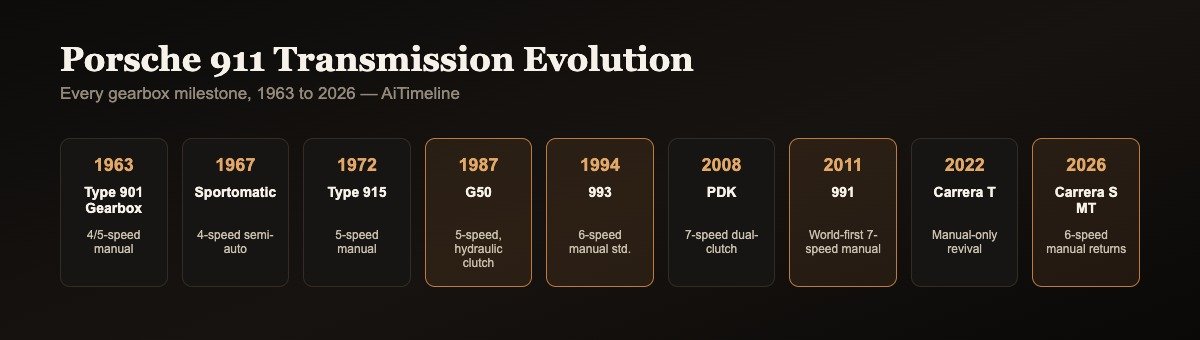
Every 911 transmission milestone, 1963 to 2026 — AiTimeline
2011: The 991 and the World’s First Seven-Speed Manual
A genuine engineering first, not a marketing claim
The 991-generation 911, unveiled at the 2011 Frankfurt Motor Show, introduced a gearbox Porsche describes plainly as a world first: the first seven-speed manual transmission fitted to a series-production car, available alongside a seven-speed PDK. The engineering logic wasn’t “more gears for their own sake.” Gears one through six were spaced closely for performance driving, matching the ratios enthusiasts already expected from a 911 manual. Seventh gear was a distinctly taller, overdrive-style ratio, intended to drop cruising RPM on the highway and improve fuel economy — a gear a driver would use for motorway cruising, not for acceleration.
The gearbox drew mixed reactions at launch. Some drivers found the extra gate added a moment’s hesitation hunting for the right slot, particularly moving between sixth and seventh. But as an engineering achievement — adding a gear specifically to satisfy efficiency regulation without diluting the six gears enthusiasts actually used hard — it stands as one of the clearest examples of Porsche trying to keep a manual gearbox both regulation-compliant and genuinely engaging, rather than choosing one over the other.
2019–Present: The 992, GT3 Manual, and the Return of Carrera T
In the current generation, the manual became a purist’s choice rather than the default
By the 992 generation, launched in 2019, PDK had become the default gearbox across most of the 911 range, and for a period the standard Carrera and Carrera S in some markets were offered PDK-only. Porsche didn’t let the manual disappear, though — it concentrated it on the models built specifically for driving purists. The 911 GT3, Porsche’s naturally aspirated, motorsport-adjacent flagship, offers a six-speed manual as a genuine, no-cost alternative to its seven-speed PDK, and the take rate tells its own story: roughly 80 percent of GT3 buyers choose the stick. The GT3 Touring, a lower-wing, more understated take on the same car, offers the identical choice.
In 2022, Porsche reintroduced the 911 Carrera T (Touring), a lightweight, rear-seat-delete variant built explicitly around the manual gearbox — its debut version paired a seven-speed manual with a shortened shift lever and a walnut-topped shift knob marked “MT.” As the 992 generation moved to its mid-cycle 992.2 update, the Carrera T’s manual gearbox shifted to a six-speed unit, the same core gearbox Porsche would go on to offer in the Carrera S MT Package in 2026 — effectively making the Carrera T the proving ground for the manual Carrera S’s return.
🔔 Porsche 911 Manual Transmission — 2026 Updates
Announced: August 13, 2026, debuting at Monterey Car Week, via Porsche Newsroom North America. What changed: the 911 Carrera S gains a six-speed manual “MT Package” option for the first time in the 992.2 generation — the Carrera S had been PDK-only in North America since that update. Powertrain: the manual pairs with the Carrera S’s existing 473-hp, 3.0-liter twin-turbo flat-six, rear-wheel drive only. Weight: 3,327 lbs for the MT Package coupe, just 11 lbs over the lighter Carrera T. Standard equipment: rear-axle steering, PASM Sport suspension lowered 10mm, a walnut shift handle, Sport Chrono Package, center-lock wheels, four-way Sport Seats Plus, a titanium exhaust with black trim, SportDesign front fascia and a red “S” script. Pricing: from $167,100 (coupe) and $181,000 (Cabriolet), plus a $2,350 delivery/processing/handling fee, for the 2027 model year. Availability: North America exclusive; deliveries expected by the end of 2026. Why: Porsche cited sustained customer demand, reinforced internally by the roughly 80 percent manual take rate on the GT3 — a data point industry reporting says directly helped justify the Carrera S business case. President and CEO Timo Resch put it directly: “Managing a clutch and shift lever isn’t for everyone, but for drivers who want it there really is no substitute.” Sources: Porsche Newsroom North America; corroborated by Forbes, Motor1 and autoevolution reporting from the same week.
Also new for 2026: Porsche Newsroom announced the 911 GT3 S/C on April 14, 2026 — an open-top, motorsport-focused GT3 variant offered exclusively with the short-ratio, lightweight six-speed GT Sport manual gearbox, with no PDK option at all. It is priced from $273,000 plus a $2,350 delivery/processing/handling fee, and as of this update (September 2026) arrival at U.S. Porsche Centers is still expected by fall 2026. Combined with the Carrera S MT Package, the GT3 S/C makes 2026 the year Porsche both restored a manual to a PDK-only model and launched a new 911 that cannot be ordered with anything but a manual.
Complete Porsche 911 Generation Table
Eight generations, one continuous transmission story
| Generation | Years | Major Transmission Development | Why It Matters |
|---|---|---|---|
| 901/911 (Ur-Elfer) | 1963–1973 | Type 901 gearbox, 4/5-speed manual; Sportomatic semi-auto added 1967 | Established the manual-first driver relationship the 911 never fully abandoned |
| G-Series | 1973–1989 | Type 915 5-speed manual (1972–1986); G50 5-speed with hydraulic clutch (1987) | G50 remains one of the most respected manual shift-feels Porsche ever built |
| 964 | 1989–1994 | G50-derived 5-speed (G64 for AWD Carrera 4); 4-speed Tiptronic auto added | Brought all-wheel drive to the 911 without displacing the manual |
| 993 | 1994–1998 | First 911 with a 6-speed manual as standard equipment | Last air-cooled 911 and a manual-transmission milestone at the same time |
| 996 | 1998–2004 | 6-speed manual continues; first water-cooled 911 | Proved the manual’s continuity survived the model’s biggest engineering break |
| 997 | 2004–2012 | 6-speed manual continues; PDK 7-speed dual-clutch introduced 2008 | The turning point where a dual-clutch automatic first outperformed the manual |
| 991 | 2011–2019 | World-first 7-speed manual; PDK also becomes 7-speed | Proved a manual could gain a gear for efficiency without losing its character |
| 992 | 2019–present | 6-speed manual on GT3/GT3 Touring; Carrera T manual; 2026 Carrera S MT Package | The manual becomes a deliberate purist’s choice, backed by verified take-rate data |
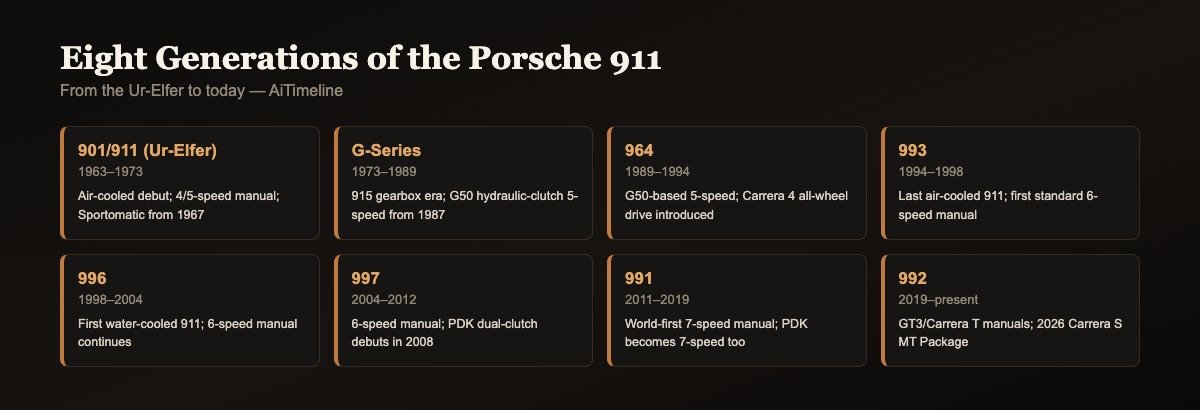
Eight generations of the Porsche 911, at a glance — AiTimeline
Porsche 911 Transmission Timeline
Year, gearbox, significance and where it’s verified
| Year | Generation | Transmission | Significance | Driver Experience | Source |
|---|---|---|---|---|---|
| 1963–64 | 901/911 | 4/5-speed manual (Type 901) | Establishes the 911’s manual-first identity | Direct, unassisted, mechanical linkage | Porsche Newsroom |
| 1967 | 901/911 | Sportomatic (4-speed semi-auto) | Removes clutch pedal, keeps driver-selected gears | Reduced fatigue in traffic; won a 1967 endurance race | Porsche Newsroom; Hagerty |
| 1972 | G-Series | Type 915 (5-speed manual) | Carries the 911 through the 1970s and early 1980s | Robust but notchy, especially when cold | Elferspot; Total 911 |
| 1987 | G-Series | G50 (5-speed manual) | First hydraulic clutch on a 911; Borg-Warner synchros | Lighter pedal, shorter and crisper throws | Porsche Newsroom; Pelican Parts |
| 1994 | 993 | 6-speed manual (standard) | First 911 generation with 6 gears as standard | Tighter gearing across a wider ratio spread | Porsche Newsroom; Hagerty |
| 2008 | 997 | PDK (7-speed dual-clutch) | First dual-clutch automatic in a series-production 911 | Shifts with no interruption in torque delivery | Porsche Newsroom |
| 2011 | 991 | 7-speed manual | World’s first 7-speed manual in a series-production car | Tall 7th gear for cruising; close 1–6 ratios preserved | Porsche press kit (“60 Years”) |
| 2021 | 992 | 6-speed manual (GT3/GT3 Touring) | No-cost manual option confirmed alongside 7-speed PDK | Manual take rate ~80% among GT3 buyers | Motor1; Robb Report |
| 2022 | 992 | 7-speed manual (Carrera T, later 6-speed) | Manual-first special edition reintroduced | Short-throw lever, walnut MT-badged knob | Porsche Newsroom; Motor1 |
| 2026 | 992.2 | 6-speed manual only (GT3 S/C) | First 911 sold exclusively with a manual, no PDK offered at all | Short-ratio GT Sport manual; open-top motorsport halo car | Porsche Newsroom |
| 2026 | 992.2 | 6-speed manual (Carrera S MT Package) | Manual returns to Carrera S for North America | Shared gearbox with Carrera T; walnut shift handle | Porsche Newsroom North America |
Manual vs PDK: Two Philosophies, Not a Verdict
Each is better suited to a different kind of driving, not objectively superior
Manual vs PDK
| Category | Manual | PDK |
|---|---|---|
| Driver involvement | Maximum — driver controls clutch, timing and gear choice | Paddle-assisted; the car chooses and executes the shift |
| Shift speed | Limited by driver skill and reflexes | Milliseconds, no interruption in torque delivery |
| Learning curve | Real — heel-and-toe and rev-matching take practice | Minimal; usable at full performance from the first drive |
| Straight-line performance | Slightly slower — GT3 manual is ~0.5 sec behind to 62 mph | Faster 0–62 mph and quicker lap times with launch control |
| Traffic and daily use | More physically involved in stop-and-go conditions | Better suited to daily commuting and heavy traffic |
| Track use | Rewards a well-executed shift; punishes a missed one | Consistent, repeatable shifts under hard braking and corner entry |
| Weight | Generally the lighter gearbox in like-for-like trims | Slightly heavier, offset by faster acceleration |
| Best suited to | Drivers who value engagement and control over outright pace | Drivers who value maximum performance and daily usability |
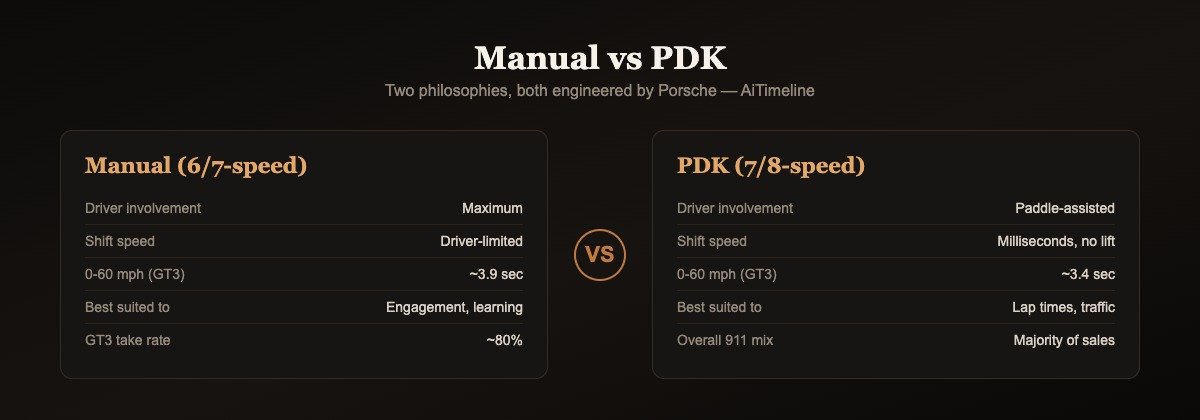
Manual and PDK solve different problems — AiTimeline
Motorsport DNA: Where the Gearboxes Were Actually Tested
Not every road-car transmission came from racing, but the engineering relationship is real
The 911’s motorsport record runs from the 1973 Carrera RS 2.7, a homologation special built to qualify the car for GT racing, through decades of class wins at Le Mans, to the modern GT3 and GT3 RS, both directly informed by Porsche’s factory GT racing program. It would overstate the case to say every road-going 911 gearbox was a direct transplant from competition — most weren’t. But the relationship is real and specific in at least one major case: PDK itself began as a motorsport-only technology, racing in the Porsche 956 and 962 C in the 1980s roughly two decades before it reached a customer Carrera. The GT3 badge, meanwhile, signals a road car built by Porsche’s motorsport division rather than its regular product line — which is part of why its transmission choices (offering a genuine manual, at no cost, well after most rivals dropped theirs) reads as a deliberate enthusiast decision rather than a legacy holdover.
The Human Side: Why Drivers Still Choose to Shift Themselves
Not “because it’s fun” — a more specific set of reasons
A manual gearbox asks something of a driver that PDK doesn’t: anticipation. Before a corner, a manual driver is already thinking two moves ahead — which gear the exit demands, whether a downshift needs to happen before or during braking, whether the engine’s revs need matching to the road speed so the rear axle doesn’t unsettle under a clumsy clutch release. Heel-and-toe downshifting, blipping the throttle with the side of the right foot while braking with the same foot’s ball and clutching with the left, exists specifically to keep that rear axle settled during a downshift under braking. None of this is decorative. Get it wrong and the car steps sideways under load; get it right and the transition from braking to cornering is seamless.
That’s the mechanical case for engagement. The less tangible one is responsibility: a manual gearbox makes the driver an active participant in every gear change, not a supervisor of one the car performs automatically. Corner entry, throttle response and engine braking all route back through a decision the driver made a half-second earlier, rather than an algorithm’s. For drivers who value that loop — decide, execute, feel the result, adjust — no amount of PDK shift speed replaces it, which is precisely the distinction Porsche’s own leadership has drawn rather than argue outright superiority.
The Future of the Manual: An Open Question, Not a Verdict
Regulation, electrification and demand are pulling in different directions
Two forces are working against the manual gearbox’s long-term future, and one is working for it. Emissions and noise regulations have already reshaped the 911 once, forcing the water-cooled break in 1998; further tightening rules, particularly in Europe, keep pressure on every internal-combustion component, gearboxes included. Electrification is the newer, sharper pressure: Porsche’s first street-legal hybrid 911, the 2024 Carrera GTS T-Hybrid, integrates a 20-kilowatt electric motor directly into its transmission housing to spool its turbocharger instantly and add torque — and it is available only with PDK. Wiring an electric motor and its control electronics into a transmission built around a driver-operated clutch is a materially harder engineering problem than doing the same with a dual-clutch unit that’s already computer-controlled; nothing in Porsche’s public technical material describes a production-ready manual-hybrid solution.
Working the other way is demand Porsche can now measure precisely: an 80 percent GT3 manual take rate, and a business case strong enough to justify reviving the manual Carrera S in August 2026 specifically because of it. Porsche has not said the manual 911 is guaranteed to continue, and it has not said it’s ending. The honest framing is the question itself: can Porsche keep engineering a manual gearbox into an increasingly electrified 911, for as long as enough drivers keep proving they want one badly enough to pay for it?
Common Porsche 911 Manual Myths
Six claims worth checking against the record
| Myth | Fact |
|---|---|
| “The 911 always had a manual, full stop, no exceptions” | Mostly true of the core lineup, but Sportomatic (1967) and Tiptronic (from 1990) were real automatic/semi-automatic options offered alongside the manual, not replacements for it |
| “The seven-speed manual was only a gimmick” | It solved a real regulatory and usability problem — a tall cruising gear for economy — while keeping gears one through six closely spaced for performance |
| “PDK killed the manual” | PDK became the majority choice, but Porsche kept building manuals throughout, and reintroduced one to the Carrera S in 2026 |
| “Manual is always faster than PDK” | The opposite is true in a straight line — PDK’s launch control and shift speed make it quicker to 62 mph in like-for-like GT3 testing |
| “Every 911 can be ordered with a manual” | False as of August 2026 — the T-Hybrid Carrera GTS, the Turbo/Turbo S, and most non-T Carrera/Carrera S configurations outside the new MT Package are PDK-only |
| “The manual 911 is definitely ending” | Unproven — Porsche just expanded manual availability in August 2026; the honest position is uncertain, not doomed |
💡 Did You Know
- The 1967 Marathon de la Route was won outright by a 911 R fitted with the semi-automatic Sportomatic gearbox — not a full manual.
- Porsche’s dual-clutch PDK concept first raced in 1983, a full 25 years before it reached a customer Carrera in 2008.
- The 991’s seventh gear wasn’t built for speed — it exists purely to lower highway cruising RPM and improve fuel economy.
- The G50 gearbox moved the reverse-gear position in the shift gate, from bottom-right on the 915 to front-left.
- The 2026 Carrera S MT Package’s curb weight is just 11 lbs heavier than the lighter, more stripped-out Carrera T.
Explore More Timelines
People Also Ask
Frequently Asked Questions
⚠️ Editorial Note — How We Built This Timeline
This timeline was compiled by cross-checking Porsche’s own historical record — Porsche Newsroom, Porsche’s official 60-years press kits, and Porsche Newsroom’s April and August 2026 product announcements — against reporting from Hagerty, Motor1, Forbes, autoevolution and other automotive publications. Historical transmission specifications can vary by model year and market; where a figure (a take rate, a weight, a price) is specific to North America or to a particular model year, this article says so directly. This is editorial content, not a Porsche buying guide or investment advice; verify current pricing and availability directly with Porsche before making a purchase decision.
Related Automotive Legacy Timelines
Sources & further reading
Every dated entry above was checked against these references. Last reviewed 20 September 2026.
- Porsche Newsroom - 1st Generation Porsche 911 (Ur-Elfer), 1963-1973
- Porsche Newsroom - 50 Years of the Porsche 911 G-Series
- Porsche Newsroom - The 997: PDK and the Seven Generations of the 911
- Porsche Newsroom - The 991: The 911 Passes the One Million Mark
- Porsche Newsroom North America - The Manual 911 Carrera S Returns to North America
- Hagerty - 1970 911T Sportomatic: Porsche's First Move Toward Self-Shifting
- Motor1 - Porsche GT3 Manual Take Rate Helped Justify Carrera S Manual
- Forbes - Three Pedals Return: Porsche's Carrera S Gets Its Stick Shift Back