India Shipbuilding Timeline 2026: The Race to Become a Global Maritime Manufacturing Hub
Track India shipbuilding from early yards to INS Vikrant, Cochin Shipyard, Mazagon Dock, GRSE and the 2026 Rs 69,725-crore push to rival China and Korea.
Latest Story
India can build an aircraft carrier. Cochin Shipyard delivered INS Vikrant in 2022 with roughly three-quarters of its structure built domestically, and Mazagon Dock now turns out frigates, destroyers and submarines on overlapping production lines. What India has not yet built is a commercial shipbuilding industry that global shipowners choose on price and delivery date rather than obligation. That gap is the subject of the India shipbuilding timeline 2026: a Rs 69,725-crore ($8.3 billion) policy package approved by the Union Cabinet in July 2026, a new greenfield cluster at Porbandar, a ship-repair yard rising at Vadinar, and a technology partnership with South Korea’s HD Hyundai that has already been renegotiated once. This article tracks what has actually been approved, built, delivered or exported through August 24, 2026 — and what is still an MoU, a target, or a plan.
🧠 AI Overview Summary
India’s 2026 shipbuilding push centers on a Rs 69,725-crore government package (Shipbuilding Financial Assistance Scheme, Maritime Development Fund, Shipbuilding Development Scheme), a new Porbandar shipyard cluster in Gujarat, and a Rs 1,570-crore ship-repair facility at Vadinar. India already builds sophisticated warships — INS Vikrant, P-17A frigates, Scorpene submarines — but its share of global commercial shipbuilding remains under 1%, against a combined 91% held by China, South Korea and Japan (UNCTAD, 2025). Government targets aim for a top-10 global rank by 2030 and top-5 by 2047.
India Shipbuilding 2026: Key Questions
What to Know About India’s 2026 Shipbuilding Push
- India can build sophisticated warships but not yet commercial ships at scale. INS Vikrant, P-17A frigates and Scorpene submarines prove design and integration capability; global commercial orders are a different, harder test.
- The Rs 69,725-crore package is real and its numbers add up exactly — Rs 24,736 crore (SBFAS) + Rs 25,000 crore (Maritime Development Fund) + Rs 19,989 crore (Shipbuilding Development Scheme).
- The Cochin Shipyard-HD Hyundai equity joint venture for a Kochi block-fabrication facility was called off in 2026. What remains is non-equity technical cooperation — a materially smaller arrangement than “Korea is building India’s shipyards.”
- Porbandar (Gujarat) is a genuine greenfield project, not yet built. ~2,000 acres, targeting 1.2-1.5 million gross tonnes/year capacity, approved mid-2026 — construction has not started.
- Vadinar’s Rs 1,570-crore facility is ship repair, not shipbuilding — a 650-metre jetty and two floating dry docks for vessels up to 300 metres, a genuinely different business from building new ships.
- China, South Korea and Japan built about 91% of the world’s ships by tonnage in 2025 (UNCTAD) — the scale India’s policy push is trying to dent, not overtake.
- India’s global shipbuilding share remains small — under 1% of deliveries — while India separately holds a much larger, and growing, share of global ship recycling (about 35% via Alang) — a different industry entirely.
- Tamil Nadu has two separate Rs 15,000-crore shipyard proposals — one from Cochin Shipyard, one from Mazagon Dock, both still at the MoU stage in Thoothukudi.
- Real export wins exist but are modest: GRSE has delivered patrol vessels to Mauritius, Seychelles, Guyana and Bangladesh, and is building a 12-vessel hybrid cargo-ship series for Germany’s Carsten Rehder — genuine commercial exports, not headline-scale ones.
- Naval shipbuilding success does not automatically transfer to commercial competitiveness — different customers, different economics, different production runs.
Building a Carrier Is Not the Same Business as Building a Container Ship
The tension that runs through this entire article
An aircraft carrier proves a country can integrate extraordinary engineering complexity — combat systems, propulsion, radar, thousands of compartments, one ship at a time, built to a government customer’s specification with no competing bid on price. A commercial shipyard faces a different test entirely: can it deliver bulk carrier after bulk carrier, tanker after tanker, on price and on schedule, to buyers who can just as easily place their next order in Shanghai, Ulsan or Nagasaki? India has spent seven decades proving the first. The 2025-2026 policy reset is the first serious, funded attempt to prove the second — and the two are not the same industry, even though they share a coastline, a workforce and, in places, the same shipyards.
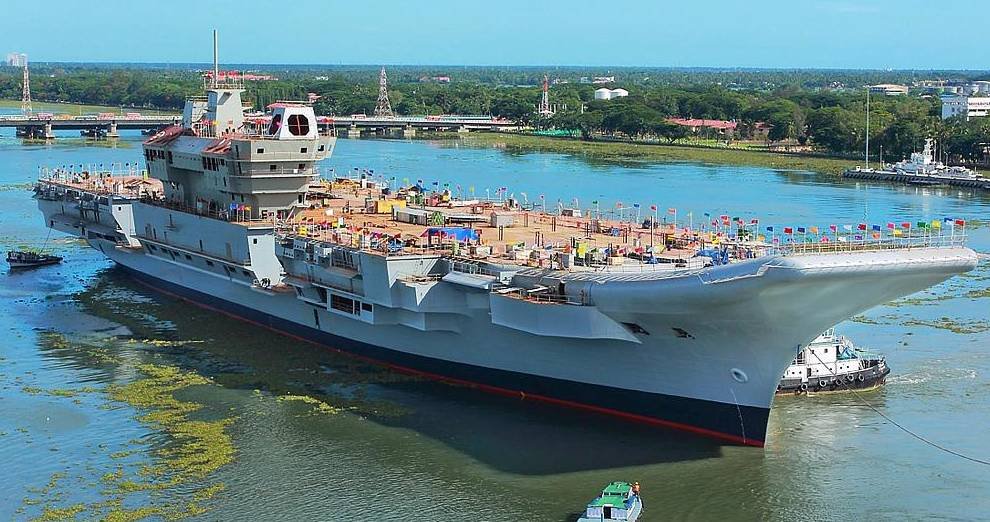
INS Vikrant undocked at Cochin Shipyard, 2015 — commissioned into service September 2, 2022. Photo: Cochin Shipyard / Wikimedia Commons (GODL-India)
Timeline: India’s Shipbuilding Industry, 1947 to 2026
Newest first — from the current policy reset back to the public-sector base it’s built on
Union Cabinet Approves the Rs 69,725-Crore Shipbuilding Package
Three components: the Shipbuilding Financial Assistance Scheme (Rs 24,736 crore), the Maritime Development Fund (Rs 25,000 crore) and a new Shipbuilding Development Scheme (Rs 19,989 crore). Government projections attached to the announcement cite a target of 4.5 million gross tonnes of annual capacity and roughly 30 lakh jobs by 2030 — stated ambitions, not delivered outcomes.
Porbandar Greenfield Shipbuilding Cluster Approved
A new special-purpose vehicle, NSHIP-Gujarat (Ministry of Ports, Shipping & Waterways with the Gujarat Maritime Board), targets 1.2-1.5 million gross tonnes of annual shipbuilding capacity on greenfield land, backed by an estimated Rs 27,000 crore in combined public and private investment. This is a construction-not-started, in-principle approval, not an operating shipyard.
Cochin Shipyard Leases Land for a New Kochi Block-Fabrication Project
The Kerala government leased 18.16 acres at Ramanthuruth to Cochin Shipyard for a roughly Rs 5,000-crore ship-block fabrication facility — a CSL-led project, not the earlier HD Hyundai joint venture (that JV was called off; see below). Exact annual-tonnage capacity for this specific facility has not been independently confirmed as of this writing.
HD Hyundai Pulls Out of the Cochin Shipyard Equity Joint Venture
The originally planned ~$500-million, 50:50 joint venture between Cochin Shipyard and HD Hyundai for a Kochi block-fabrication facility was called off in 2026. What remains is non-equity technical cooperation — design and procurement support, plus HD Hyundai engine supply for CMA CGM feeder containerships being built at Cochin. This is a materially smaller arrangement than the equity partnership originally announced, and coverage that still describes it as an active joint venture is out of date.
Rs 1,570-Crore Vadinar Ship-Repair Facility Cleared
A joint project — Deendayal Port Authority funding roughly Rs 650 crore of civil infrastructure, Cochin Shipyard the remainder — for a 650-metre jetty and two floating dry docks able to service vessels up to 300 metres long. Projected capacity: about 34 ships a year once built (construction timeline roughly 36 months), with an estimated 290 direct and 1,100 indirect jobs. This is ship repair capacity, not new-ship construction — a genuinely different business (see below).
Shipbuilding Financial Assistance Scheme Guidelines Notified
A Rs 24,736-crore corpus offering 15-25% financial assistance per vessel by category, contingent on a minimum 30% domestic-content floor, valid through March 2036 (extendable to 2047). MoPSW’s own projection: the scheme could support roughly Rs 96,000 crore of shipbuilding activity over a decade — a multiplier estimate, not a guarantee.
Two Separate Rs 15,000-Crore Tamil Nadu Shipyard MoUs Signed
Cochin Shipyard signed an MoU with Tamil Nadu’s Guidance investment agency for a roughly Rs 15,000-crore shipyard in Thoothukudi (projected ~10,000 jobs, HD Hyundai named as a technology collaborator on this specific MoU). Separately, Mazagon Dock signed its own, unrelated Rs 15,000-crore Thoothukudi shipyard MoU. Combined state commitment across both is reported near Rs 30,000 crore and roughly 55,000 jobs — both remain MoU-stage, not funded or under construction.
Maritime Development Fund Announced in the Union Budget
Structured as a Rs 20,000-crore Maritime Investment Fund (equity, with government contributing up to 49% at concessional terms and the remaining 51% raised commercially) plus a Rs 5,000-crore Interest Incentivisation Fund to reduce shipowners’ and shipbuilders’ borrowing costs — the financing-side counterpart to the SBFAS’s vessel-level subsidies.
Mazagon Dock Delivers a Frigate, a Destroyer and a Submarine in One Week
P-17A frigate INS Nilgiri (delivered Dec 20, 2024) and P-15B destroyer INS Surat (also delivered Dec 20, 2024) were commissioned together with the sixth Scorpene-class submarine INS Vaghsheer (delivered Jan 9, 2025) — three different warship classes reaching the Navy within weeks of each other, evidence of the parallel production capacity Mazagon Dock has built up over two decades of indigenous-warship programs.
INS Vikrant Is Commissioned
India’s first indigenously built aircraft carrier — roughly 45,000 tonnes full-load displacement — was commissioned by Prime Minister Narendra Modi. Structural/”float” content is commonly cited at about 76% indigenous; a significant share of “fight” and “move” systems (radar, weapons, some propulsion components) were internationally sourced. Warship-grade DMR 249A steel, developed jointly by DRDO and SAIL, was used throughout the hull. More than 550 domestic vendors and 100 MSMEs were involved; the program is credited with roughly 2,000 direct and 12,500 indirect jobs over its build life.
Make in India Folds Shipbuilding Into National Industrial Policy
Shipbuilding was one of the sectors named under the Make in India program, tying it to broader defence-indigenization and domestic-manufacturing goals rather than treating it as a standalone shipping-ministry concern. This did not create Indian shipbuilding — the public-sector yards were already decades old — but it raised the sector’s political priority and set the stage for the financing schemes that followed a decade later.
The Indigenous-Warship Era Accelerates
Successive frigate and destroyer classes — including the Shivalik-class frigates and Kolkata-class destroyers — moved a larger share of design and systems integration in-house at Mazagon Dock and GRSE. Each program built welding capability, naval-architecture expertise, radar/electronics integration skill and a specialist shipyard workforce that the 2010s and 2020s programs (P-17A, P-15B, Scorpene) directly inherited.
Cochin Shipyard Is Incorporated and Begins Operations
Founded as a Government of India undertaking, Cochin Shipyard began commercial operations in the mid-1970s and would go on to become the yard that built INS Vikrant, the Vadinar repair facility’s lead partner, and the site of the now-reworked HD Hyundai cooperation — the single most consequential shipyard in India’s modern shipbuilding story.
India’s Older Public-Sector Yards Are Nationalized and Expanded
Mazagon Dock (a private dockyard dating to the 18th century) and Garden Reach Workshops (est. 1884) were both nationalized around 1960 and rebuilt as defence-shipbuilding PSUs. Goa Shipyard, established in the 1950s under Portuguese administration, came under Indian government control after Goa’s 1961 integration and was formally reconstituted in 1967. Together these yards became the base on which India’s naval-shipbuilding capability was built.
Hindustan Shipyard’s Origins
Originally established by the Scindia Steam Navigation Company, the Visakhapatnam yard delivered independent India’s first domestically built ocean-going ship, Jala Usha, in 1948, before being nationalized in 1952 as Hindustan Shipyard — the earliest of the public-sector yards that would carry India’s shipbuilding industry through the following seven decades.
How Much of an Indian Warship Is Actually “Indigenous”?
The distinction the site’s own audit flagged: cost, weight, and systems are not the same number
“Indigenous” is the single most misused word in coverage of Indian shipbuilding, and INS Vikrant is the clearest example of why. The commonly cited figure — about 76% indigenous — refers to structural or “float” content: the hull, warship-grade steel, cabling, piping and general construction, which is genuinely built and sourced in India, largely through more than 550 domestic vendors and 100 MSMEs. It does not mean 76% of the ship’s value, and it does not mean the whole ship. A large share of the “fight” systems (radar, weapons, sensors, combat-management software) and some “move” systems (specific propulsion and gearbox components) were sourced internationally. Applying one warship’s indigenous percentage to “the Indian Navy fleet” as a whole is a category error this article deliberately avoids — every class has a different figure, and no single number describes them all.
Hull & Structure
Steel, welding, hull construction, cabling, piping — the category where Indian content is highest, typically cited in the 70-90% range depending on the ship class.
Propulsion
Mixed picture — Indian integration and some gearbox/shaft manufacture, but major gas turbines and marine diesel engines are frequently imported, especially for larger classes.
Weapons & Sensors
The category with the heaviest import dependence — radar, missile systems, and combat-management electronics are commonly sourced from Russia, Israel, France and other partners, even on “indigenous” hulls.
Electronics & Software
Combat-management systems, navigation and automation increasingly carry Indian software integration layered over a mix of Indian and imported hardware.
Mazagon Dock: India’s Busiest Warship and Submarine Builder
Frigates, destroyers and submarines on overlapping production lines
Mazagon Dock Shipbuilders (MDL) is currently running three major indigenous-warship programs simultaneously: the P-17A stealth-frigate class (INS Nilgiri delivered Dec 20, 2024, commissioned Jan 15, 2025; a fourth ship, INS Mahendragiri, delivered Apr 30, 2026), the P-15B Visakhapatnam-class destroyers (INS Surat delivered and commissioned alongside Nilgiri), and the Scorpene-class (Kalvari-class) submarines under Project-75, whose sixth boat, INS Vaghsheer, was delivered Jan 9, 2025 and commissioned Jan 15, 2025 — the same week as Nilgiri and Surat. Reports from November 2025 point to a roughly Rs 36,000-crore Scorpene follow-on order and a separate roughly Rs 70,000-crore six-submarine program moving toward approval, which would keep MDL’s submarine line running well into the next decade. This kind of overlapping, multi-class production is exactly the manufacturing discipline — parallel lines, standardized processes, repeat orders — that a commercial shipyard also needs, even though MDL’s customer here is entirely the Indian Navy.
GRSE: From Navy Orders to Real Ship Exports
Delivered vessels and signed contracts only — no proposals counted as exports
Garden Reach Shipbuilders & Engineers (GRSE), Kolkata, has the most credible export track record of any Indian yard, though it remains modest against global scale. GRSE delivered CGS Barracuda to Mauritius in 2014 — India’s first exported warship — followed by PS Zoroaster to Seychelles in 2021 and MV Ma Lisha to Guyana in 2023. It is separately building patrol boats and a dredger for the Government of Bangladesh. Its largest current commercial-export program is a 12-vessel contract with Germany’s Carsten Rehder Schiffsmakler & Reederei for CORAL 7500-DWT hybrid multi-purpose vessels — four ships signed in June 2024, expanded to a full run of twelve (including four hybrid-propulsion units) by September 19, 2025, with the third vessel’s keel laid February 23, 2026. GRSE states nine of the 26 commercial vessels currently under construction at its yards are for export — a real, if small, foothold in commercial shipbuilding built through a warship-focused yard.
| Vessel / Program | Customer | Shipyard | Date | Status |
|---|---|---|---|---|
| CGS Barracuda | Mauritius | GRSE | 2014 | Delivered |
| PS Zoroaster | Seychelles | GRSE | 2021 | Delivered |
| MV Ma Lisha | Guyana | GRSE | 2023 | Delivered |
| Patrol boats + dredger | Bangladesh | GRSE | Ongoing | Under construction |
| 12x CORAL 7500 DWT hybrid MPV | Carsten Rehder (Germany) | GRSE | Signed Jun 2024 – Sep 2025 | Under construction, 3rd keel laid Feb 2026 |
| 2 (+2 option) autonomous electric ferries | ASKO Maritime (Norway) | Cochin Shipyard | Contract signed Jul 2020 | Established capability — not a new 2026 win |
Cochin Shipyard: From INS Vikrant to Ship Repair and Block Fabrication
India’s most consequential single shipyard, verified project by project
Cochin Shipyard’s résumé spans nearly every part of this article: it built INS Vikrant, it is CSL’s Vadinar joint venture with Deendayal Port Authority that adds India’s largest planned ship-repair capacity, and it is the shipyard at the center of the reworked HD Hyundai relationship — first an equity joint venture (called off in 2026), now non-equity technical cooperation plus engine supply for CMA CGM feeder containerships being built at Cochin. Its 2020 contract to build autonomous electric ferries for Norway’s ASKO Maritime remains the clearest evidence that an Indian yard can win specialized, high-spec green-vessel orders in competitive European markets — a genuinely different customer relationship from anything the Indian Navy provides, and one worth more editorial weight than a single newer, unconfirmed contract would carry.
Why the HD Hyundai Deal Is Smaller Than It Was Announced to Be
A joint venture became a technical-cooperation agreement — the difference matters
The original plan, announced under a broader July 2025 memorandum of understanding, was for Cochin Shipyard and HD Korea Shipbuilding & Offshore Engineering to form a roughly $500-million, 50:50 joint venture to build a Kochi block-fabrication facility. That equity JV was called off in 2026, per Reuters and Hellenic Shipping News reporting. What survives is technical cooperation only: HD Hyundai design and procurement support, plus HD Hyundai engine supply for CMA CGM feeder containerships under construction at Cochin. Separately — and this is where coverage most often conflates distinct projects — HD Hyundai is pursuing its own roughly $4-billion greenfield shipyard proposal in Tamil Nadu, and is also named as a technology collaborator on Cochin Shipyard’s separate Thoothukudi MoU. Three different HD Hyundai-linked projects exist in India as of August 2026: the collapsed Kochi JV, HD Hyundai’s own Tamil Nadu proposal, and its collaborator role on CSL’s Thoothukudi plan. None of them should be described as “Korea building India’s shipyards” without that qualification.
Two Rs 15,000-Crore Tamil Nadu Shipyards — Not One
Cochin Shipyard and Mazagon Dock are pursuing separate, unrelated projects in the same city
| Project | Lead company | Location | Cost | Status |
|---|---|---|---|---|
| Thoothukudi shipyard (CSL) | Cochin Shipyard | Thoothukudi, Tamil Nadu | ~Rs 15,000 crore | MoU signed Sep 2025, ~10,000 projected jobs |
| Thoothukudi shipyard (MDL) | Mazagon Dock | Thoothukudi, Tamil Nadu | ~Rs 15,000 crore | MoU signed Sep 2025, separate project |
| Greenfield TN facility | HD Hyundai (independent) | Tamil Nadu (site TBD) | ~$4 billion (~Rs 33,000 crore) | Proposed, not yet an MoU-confirmed site |
Combined, the two confirmed Tamil Nadu MoUs represent roughly Rs 30,000 crore of state-level commitment and about 55,000 projected jobs — both still at the memorandum stage, with neither funded nor under construction as of August 2026.
What Is India’s Rs 69,725-Crore Shipbuilding Package?
Three components that reconcile exactly against the headline figure
| Component | Amount | Purpose | Status |
|---|---|---|---|
| Shipbuilding Financial Assistance Scheme (SBFAS) | Rs 24,736 crore | 15-25% per-vessel subsidy by category, min. 30% domestic content | Guidelines notified Dec 27, 2025; valid to Mar 2036 |
| Maritime Development Fund — Maritime Investment Fund | Rs 20,000 crore | Equity financing, govt up to 49% at concessional terms | Announced Union Budget 2025 |
| Maritime Development Fund — Interest Incentivisation Fund | Rs 5,000 crore | Interest-cost reduction for shipbuilders/shipowners | Announced Union Budget 2025 |
| Shipbuilding Development Scheme (SbDS) | Rs 19,989 crore | New shipyard/cluster infrastructure support | Part of Jul 2026 Cabinet approval |
| Total | Rs 69,725 crore | Approved by Union Cabinet, Jul 24-25, 2026 | |
Government projections attached to the package cite roughly 4.5 million gross tonnes of annual shipbuilding capacity, close to 30 lakh jobs, and about Rs 4.5 lakh crore of investment by 2030 as intended outcomes. These are stated targets from the announcement, not independently verified results — treat them as ambition, not achievement, until measured against real capacity and output data in coming years.
Why Indian Shipyards Need Financial Support to Compete
The cost gap is structural, not a matter of Indian yards simply being expensive
Global shipowners choose a yard on a handful of factors: price, delivery date, financing terms and prior reliability. Indian yards are currently disadvantaged on most of them at once. Financing costs are higher than in China, South Korea or Japan, where state-backed export credit and shipbuilding-specific lending are mature and cheap. Production scale is smaller, so per-unit costs stay high — a yard building five ships a year cannot match the unit economics of one building fifty. The domestic marine-engineering supply chain is thinner, meaning more components are imported, adding cost and lead time. Working capital needs are large relative to Indian shipbuilders’ balance sheets, because a ship under construction ties up capital for years before a buyer pays in full. And buyer preference itself is a barrier: established Asian yards carry decades of delivery-reliability track record that a new or smaller Indian yard has not yet built. The SBFAS and Maritime Development Fund exist specifically to offset the first and fourth of these — subsidizing unit cost and cheapening capital — while leaving scale, supply-chain depth and buyer trust as problems only time and repeat orders can solve.
Porbandar: India’s New Greenfield Shipbuilding Cluster
Gujarat, ~2,000 acres, targeting 1.2-1.5 million GT/year — not yet built
Approved in mid-2026, the Porbandar cluster at Kuchhadi is being developed through a dedicated special-purpose vehicle, NSHIP-Gujarat, jointly formed by the Ministry of Ports, Shipping & Waterways and the Gujarat Maritime Board. The plan covers roughly 2,000 acres, targeting between 1.2 and 1.5 million gross tonnes of annual shipbuilding capacity, backed by an estimated Rs 27,000 crore in combined common infrastructure (about Rs 3,300 crore) and private investment (about Rs 23,700 crore). As of August 2026 this remains a greenfield, pre-construction project — the approval is real, but no shipyard exists on the site yet, and none of its capacity figures should be read as current output.
Rs 1,570-Crore Vadinar: Ship Repair, Not Shipbuilding
Two different industries, deliberately kept distinct in this article
Vadinar, on the Gulf of Kutch, is a joint Cochin Shipyard-Deendayal Port Authority project: a 650-metre jetty and two floating dry docks able to service vessels up to 300 metres, with projected capacity of about 34 ships a year once operational, roughly 36 months after construction begins. Deendayal Port Authority is funding around Rs 650 crore of the Rs 1,570-crore total for civil infrastructure, with Cochin Shipyard covering the remainder; the project is expected to create about 290 direct and 1,100 indirect jobs. Ship repair and ship building are different businesses with different economics — repair work turns around faster, needs less working capital per job, and competes on dry-dock availability and turnaround speed rather than new-build price. A country does not need to win new-construction orders to build a real maritime-services industry around repair, refits and maintenance.
India Doesn’t Need to Build Every Ship to Win Maritime Business
Repair, refit and maintenance are a separate, real opportunity
Vadinar is India’s most concrete bet on ship repair as a standalone growth line, but the logic extends further: India’s coastline sits close to major East-West shipping lanes, giving it a locational advantage similar in principle to established repair hubs like Singapore and Dubai’s Drydocks World, even though India’s repair capacity remains far smaller today. Growing this segment — repair, refits, dry-docking, naval maintenance contracts for allied navies — does not require India to out-build China on new commercial tonnage; it only requires reliable dry-dock capacity, competitive turnaround times, and proximity to traffic that is already passing by.
India vs. China vs. South Korea vs. Japan: Who Actually Builds the World’s Ships?
Same year, same metric, clearly labeled — deliveries by gross tonnage, 2025 unless noted
| Factor | India | China | South Korea | Japan |
|---|---|---|---|---|
| Global deliveries share, 2025 (GT) | Well under 1% | ~54% | ~27% | ~13% |
| Combined China+Korea+Japan share | 91% of global ship completions by GT, 2025 (UNCTAD) | |||
| Global orderbook share | Not in top tier | Roughly two-thirds | Strong, especially LNG | Moderate, declining share |
| LNG carrier orderbook (2026) | Minimal | Growing | ~66% by capacity | Limited |
| Naval shipbuilding | Strong domestic capability | Strong | Strong | Strong |
| Ship repair | Growing (Vadinar, Alang-adjacent) | Strong | Strong | Strong |
| Financing ecosystem | Developing (SBFAS/MDF, 2025-26) | Mature, state-backed | Mature, state-backed | Mature |
Exact global orderbook shares vary by data provider and are not always directly comparable — this table hedges deliberately where sources disagree rather than presenting a false precision. The one number every major tracker agrees on: China, South Korea and Japan together delivered about 91% of the world’s ship tonnage in 2025.
Why China, South Korea and Japan Dominate Shipbuilding
Scale, supply chains and financing India’s package is trying to partially offset
The 91% concentration is not an accident of geography. It reflects enormous single-yard capacity that lets a Chinese or Korean shipyard build multiple sister ships on parallel slipways at once; standardized hull designs that cut engineering time per vessel; deep domestic supply chains for steel, marine engines, propellers and electronics that keep almost everything a shipyard needs within a short trucking distance; state-backed export-credit financing that makes borrowing cheap for both the yard and the buyer; and, perhaps hardest to replicate quickly, decades of delivery-reliability track record that keeps repeat customers coming back. India’s 2026 policy tools — SBFAS, the Maritime Development Fund, Porbandar, Vadinar — target the financing and scale legs of that stool directly. Supply-chain depth and buyer trust are the two legs no subsidy can build overnight.
How Big Is India in Global Shipbuilding Today?
Shipbuilding, ship ownership, ship recycling and ship registration are four different numbers
India’s current share of global shipbuilding deliveries is small — commonly cited under 1% of global gross tonnage, with government and industry sources placing India’s rank anywhere from around 11th to 20th depending on the exact measure used (deliveries vs. orderbook vs. capacity). That range itself is telling: even official framing does not converge on one clean number, which is a reason for caution rather than a reason to round up to the more flattering end. This is a completely different figure from India’s position in ship recycling, where its global share is both much larger and independently verified (see below) — the two are frequently, and wrongly, conflated in casual coverage as if recycling capacity were evidence of shipbuilding capacity. They are not related industries.
India Is Already a Major Maritime Player — Through Ship Recycling
Alang: a real, growing global share, in a different business from shipbuilding
Alang, on Gujarat’s Gulf of Khambhat, is the world’s largest ship-recycling yard by volume, and India’s global recycling share rose from about 30.1% in 2024 to about 35.4% in 2025 — real, measured growth, backed by a modernization push (reportedly Rs 20,000-25,000 crore) targeting roughly 50% global share. Compliance matters here too: the Hong Kong International Convention on ship recycling entered into force on June 26, 2025, and by mid-2026, 115 of Alang’s 128 plots were reported HKC-compliant, with two Alang yards separately reported added to the European Union’s approved ship-recycling facility list in August 2026. The genuinely interesting editorial question is whether India can climb the maritime value chain from recycling, through repair, into shipbuilding proper — each stage draws on adjacent skills (steel handling, dry-dock operations, marine engineering) without being the same industry as the one before it.
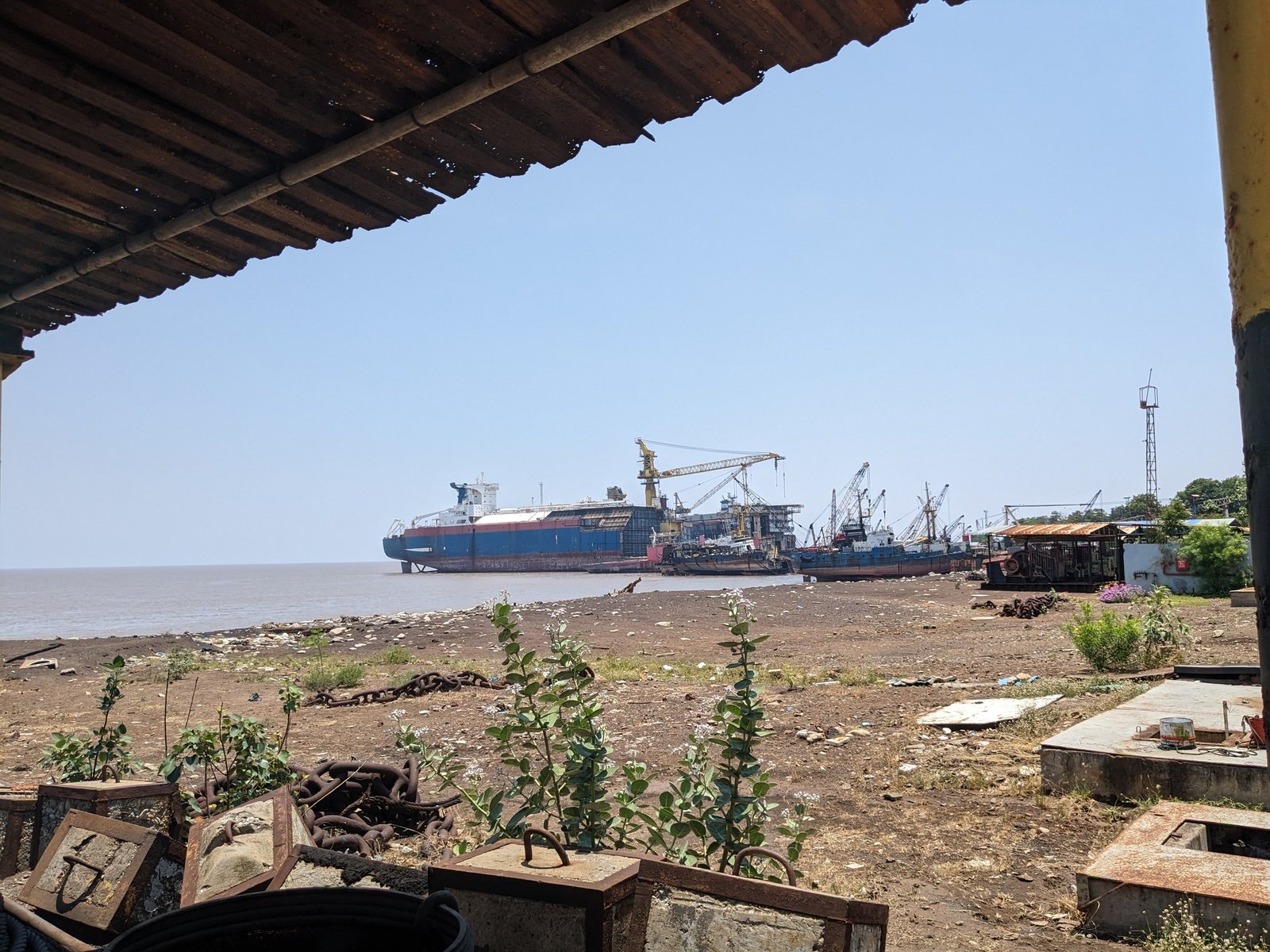
Alang, Gujarat — the world’s largest ship-recycling yard by volume; India held about 35% of global recycling share in 2025. Photo: Wikimedia Commons (CC BY-SA 4.0)
Why One Shipyard Creates an Industrial Ecosystem
Shipbuilding’s real economic case is the supply chain it pulls along, not the ship itself
A single shipbuilding order draws on a long chain of adjacent industries: marine-grade steel producers, engine and gearbox manufacturers, propeller foundries, electrical and cabling suppliers, radar and sensor integrators, navigation-software firms, paint and coatings specialists, hundreds of MSME component suppliers, a skilled welding and fabrication workforce, and the ports and logistics networks needed to move steel in and finished ships out. INS Vikrant alone drew on more than 550 domestic vendors and 100 MSMEs — a real, documented example of that multiplier effect, even though no independently verified single “jobs per ship” ratio exists across the industry as a whole (a number this article deliberately does not invent).
Why Shipbuilding Creates Skilled Manufacturing Jobs
Project-linked estimates only — no industry-wide multiplier invented
Every confirmed project in this article carries its own jobs estimate, and they are worth reading as a set rather than summed into one invented industry-wide total: INS Vikrant’s build is credited with about 2,000 direct and 12,500 indirect jobs; Vadinar’s repair facility with about 290 direct and 1,100 indirect jobs; the two Tamil Nadu Thoothukudi MoUs, combined, project roughly 55,000 jobs; and the Rs 69,725-crore package’s own headline target cites close to 30 lakh jobs by 2030 nationally — a government projection, not yet a measured outcome. The trades involved span welders, naval architects, marine engineers, electricians, systems-integration software engineers, pipefitters, quality inspectors and logistics staff — a genuinely broad skilled-manufacturing base when a shipyard is running at capacity.
Shipbuilding Is Also a Steel Story
DMR 249A and the limits of “domestic steel”
Warship-grade DMR 249A steel — developed jointly by DRDO and state-owned SAIL — has been used across recent Indian naval construction, including INS Vikrant, and represents a genuine domestic materials-science achievement: high-tensile, weldable steel purpose-built for hull construction rather than adapted from commercial-grade stock. That domestic capability is proven for naval-grade steel; it does not automatically mean every plate used on every Indian-built commercial vessel is domestically sourced, and this article does not claim that.
The Engine Problem: Where India Still Depends on Global Suppliers
Naval propulsion and commercial marine engines are different supply chains
Propulsion is where “indigenous” claims are weakest across the industry. Naval propulsion on Indian-built warships mixes domestic integration with imported gas turbines, specific gearbox components and shaft systems — the “move” category discussed above, where India typically has partial rather than full domestic content. Commercial marine engines are a separate, even more import-dependent supply chain: large commercial diesel engines and their licensing typically come from a small number of established European and Asian engine builders, and no Indian yard currently manufactures large commercial marine engines domestically at scale. This is one of the clearer components of India’s remaining industrial gap, and one none of the 2025-2026 financing schemes directly target — SBFAS and the Maritime Development Fund lower the cost of buying ships and components, they do not build a domestic marine-engine industry by themselves.
Can Indian Shipyards Become Major Defence Exporters?
Real, delivered exports only — MoUs and proposals excluded
GRSE’s Mauritius, Seychelles and Guyana deliveries, plus its ongoing Bangladesh patrol-boat and dredger program, are India’s clearest defence-export track record — modest in absolute tonnage next to global naval-export leaders, but genuinely delivered, contracted vessels rather than proposals. The pattern so far favors smaller patrol and offshore vessels for regional partner navies over larger combatants, which fits both GRSE’s production scale and India’s current diplomatic emphasis on Indian Ocean-region maritime-security partnerships.
Commercial Ships May Be the Harder — and Bigger — Prize
What global buyers actually weigh before placing an order
Commercial shipowners buy on a narrower, harder-nosed set of criteria than defence customers: price per deadweight tonne, guaranteed delivery date, quality-inspection track record, available financing, and confidence in decades of after-sale service and spare-parts support. GRSE’s Carsten Rehder contract and Cochin Shipyard’s ASKO Maritime ferries are evidence India can win specific, specialized commercial orders — hybrid cargo vessels and autonomous electric ferries are niche, technically demanding categories, not commodity bulk carriers. Winning commodity-scale orders (standard bulk carriers, container ships, tankers) at the volume China and South Korea handle would require exactly the scale, financing and supply-chain depth the 2025-2026 package is trying to build, and has not yet demonstrated at scale.
Green Shipping Could Give India a New Entry Point
A genuinely emerging category, not yet a mature one
Global shipping’s shift toward methanol-ready, ammonia-ready and LNG dual-fuel vessels, plus electric ferries for short-haul routes, is still an emerging category industry-wide — most of these propulsion technologies remain in early commercial deployment even among the established shipbuilding powers. Cochin Shipyard’s autonomous electric ferries for Norway’s ASKO Maritime (contracted 2020) are real evidence that an Indian yard can compete for specialized green-vessel orders in a demanding European market; that single contract should not be read as proof India has broad green-shipbuilding maturity, but it is a legitimate foothold worth building on rather than a claim to overstate.
The Indian Navy Is India’s Biggest Shipbuilding Advantage — and Its Limitation
A stable customer that does not, by itself, create a competitive export industry
The Indian Navy’s steady, sophisticated demand — P-17A frigates, P-15B destroyers, Scorpene submarines, and the carrier program behind INS Vikrant — has been the single biggest reason India has any shipbuilding capability worth discussing at all. It has funded decades of continuous work at Mazagon Dock, Cochin Shipyard, GRSE and Goa Shipyard, building the welding, systems-integration and naval-architecture skills every later program has drawn on. But naval demand is also a limitation: a government customer that does not compete on price against Chinese or Korean bids does not, by itself, teach a shipyard how to win commercial orders in a competitive global market. That is precisely the skill the 2025-2026 financing and cluster programs are trying to build separately.
Naval Shipbuilding vs. Commercial Shipbuilding
Why India Wants More Indian-Built and Indian-Owned Ships
Built, owned, and flagged are three different things
An Indian-built ship is one constructed in an Indian yard, regardless of who owns or operates it. An Indian-owned ship is one where an Indian company holds title, regardless of where it was built or which flag it sails under. An Indian-flagged ship is one registered under India’s flag for regulatory purposes, again independent of build location or ownership. India’s strategic interest in growing all three stems from the same source: a country that imports most of its energy and exports much of its manufactured goods pays foreign shipping lines for a large share of that freight movement, and building a bigger, Indian-owned and Indian-built commercial fleet would keep more of that freight-payment value at home while reducing dependence on foreign carriers during a crisis.
Can Indian Cargo Demand Support Indian Shipyards?
Domestic procurement as a base-load customer
India’s own energy-import volumes, dry-bulk trade, container traffic and coastal-shipping needs represent a large potential base-load of demand that domestic shipyards could serve if procurement policy directed more of it their way — state-owned shipping operators like the Shipping Corporation of India, and oil-PSU shipping joint ventures, are the most obvious levers for that kind of directed domestic demand, though the scale of any such shift as of 2026 is not independently quantified in public reporting.
India’s Shipbuilding Map
Major centers, by category — naval, commercial, repair, or proposed/expanding
Kolkata — GRSE
Warships plus a growing commercial-export line (Germany, Bangladesh).
Mumbai — Mazagon Dock
Frigates, destroyers, submarines; India’s busiest warship builder.
Goa — Goa Shipyard
Lead yard on the 11-vessel Shachi-class offshore patrol vessel program (with GRSE as second yard); 8 vessels under construction.
Kochi — Cochin Shipyard
INS Vikrant, Vadinar repair JV, Ramanthuruth block-fabrication project, HD Hyundai technical cooperation, ASKO Maritime ferries.
Gujarat — Porbandar, Vadinar, Alang
Porbandar (greenfield, pre-construction), Vadinar (repair, under development), Alang (operating, ship recycling).
Tamil Nadu — Thoothukudi, Kattupalli
Two separate MoU-stage shipyards (CSL, Mazagon Dock) plus HD Hyundai’s independent proposal; L&T’s existing Kattupalli facility nearby.
Visakhapatnam — Hindustan Shipyard
India’s oldest yard (1941); proposing a new greenfield Andhra Pradesh facility and a Rs 305-crore Ship Technology Centre.
India’s Private Shipyards: The Missing Scale Question
L&T Shipbuilding — real capacity, no confirmed submarine order yet
L&T Shipbuilding operates two major facilities: Kattupalli, near Chennai (roughly 600,000 square metres, a 450-metre waterfront and a 20,000-tonne ship-lift), and Hazira in Gujarat. Both have been named as candidate sites under a dual-shipyard strategy for future submarine construction linked to the long-discussed Project-75I program, positioning L&T as India’s most credible large private-sector shipbuilder. As of August 2026, no confirmed, signed submarine-construction order has been publicly verified for either facility — this remains readiness and bid positioning, not an active build, and should not be reported as a done deal.
Why Ship Financing Can Matter as Much as Ship Design
Export credit, long-term loans and lease finance decide orders as much as engineering does
A shipowner placing a large order typically needs export credit, long-term financing, lease structures and low interest rates as much as they need a well-engineered hull — China, South Korea and Japan all run mature, state-supported maritime-finance ecosystems that make borrowing to buy a ship from their yards cheap and straightforward. India’s Maritime Development Fund — the Rs 20,000-crore equity Maritime Investment Fund plus the Rs 5,000-crore Interest Incentivisation Fund — is a direct, if still young, attempt to close that specific gap rather than a general industrial subsidy.
The Productivity and Scale Gap
Block construction, modular assembly, and the economics of repeat orders
Competitive shipyards run on block construction and modular assembly — building large hull sections in parallel, then joining them, rather than building a hull sequentially from keel up. That approach depends on standardized designs, heavy-lift cranes, and fast dry-dock turnaround, all of which scale better with repeat, similar orders than with one-off or highly customized builds. The economic logic runs in one direction: repeat orders enable standardization, which lowers unit cost and shortens delivery time, which in turn wins more orders — a flywheel Chinese and Korean yards have been running for decades and Indian yards are only now positioned, via SBFAS-backed subsidies and new capacity at Porbandar and the Tamil Nadu clusters, to attempt at scale.
Why 2026 Could Be a Turning Point — Or Just Another Announcement Year
What actually changed in 2025-2026, weighed against what remains unbuilt
The honest case for 2026 as a genuine inflection point rests on a real, reconciled Rs 69,725-crore funding package, a notified and operative SBFAS, a structured Maritime Development Fund, a cleared Vadinar repair project, and an approved Porbandar cluster — more concrete policy movement in eighteen months than the previous decade produced. The honest caveat is that Porbandar has not broken ground, the HD Hyundai equity partnership that anchored early coverage of this push has already collapsed once, both Tamil Nadu shipyards remain MoUs, and India’s measured 2025 output growth of 41% moved the country from 40,923 to 57,637 gross tonnes — a genuinely large percentage gain on a genuinely small base, not evidence of a step-change in global competitiveness yet. Both of those things are true at once, and this article treats them as such rather than picking the more flattering half.
India Shipbuilding Dashboard — August 2026
Verified figures only; unavailable data marked as such rather than estimated
| Indicator | Latest value | Date | Source |
|---|---|---|---|
| Government support package | Rs 69,725 crore | Jul 2026 | Union Cabinet / MoPSW |
| SBFAS corpus | Rs 24,736 crore | Dec 2025 (notified) | MoPSW / PIB |
| Maritime Development Fund | Rs 25,000 crore | 2025 Budget | Union Budget |
| India shipbuilding output growth | +41% YoY (40,923 → 57,637 GT) | 2024 → 2025 | UNCTAD, via MoPSW |
| Global concentration (China+Korea+Japan) | 91% of deliveries by GT | 2025 | UNCTAD Review of Maritime Transport |
| India ship-recycling global share | ~35.4% | 2025 | Industry data, Alang |
| India commercial shipbuilding global share | Under 1% (rank cited 11th–20th) | 2025-26 | Multiple government/industry sources, not fully reconciled |
| National shipbuilding employment (2030 target) | Not publicly available as measured data — ~30 lakh cited as a government projection | Target: 2030 | MoPSW package announcement |
What India Must Do to Challenge China, Korea and Japan
Ten requirements, none of them solved by policy announcements alone
- Bigger single-yard capacity, not just more yards
- Faster construction cycles through standardized, repeatable hull designs
- Lower financing cost for both shipbuilders and buyers
- A deeper domestic marine-engineering supply chain (engines, electronics, propellers)
- Large, directed domestic cargo demand as a base load
- Standardized commercial vessel designs, not one-off customization
- Demonstrated delivery reliability that earns repeat global shipowner orders
- A larger skilled-labor pool trained specifically for commercial (not just naval) production
- Domestic or licensed marine-engine manufacturing at commercial scale
- Mature export-credit and lease-finance instruments for foreign buyers
Don’t Frame This as India vs. China Only
South Korea and Japan are separately formidable, in different segments
China’s scale dominates the broadest commodity categories — bulk carriers, container ships, tankers — by sheer yard capacity. South Korea’s edge is narrower but sharper: it holds roughly two-thirds of the global LNG-carrier orderbook by capacity as of 2026, a high-value, technically demanding category where India currently has no meaningful presence. Japan remains a major builder in its own right, even as its global share has gradually declined relative to China and Korea over the past two decades. India’s real competitive set is not one rival but an entire established East Asian shipbuilding ecosystem, and any framing that reduces this to a two-country contest misses where the actual technical and financial barriers sit.
India’s 2030 and 2047 Shipbuilding Ambitions
Government targets, clearly labeled as targets — not forecasts
India’s official long-term shipbuilding ambitions are set out in the Maritime India Vision and the Maritime Amrit Kaal Vision 2047: a top-10 global shipbuilding rank by 2030, rising to a top-5 rank by 2047, alongside an annual-output target commonly cited in the multi-million-gross-tonne range by 2047. These are government policy targets — the word this article uses throughout is “aims to” or “targets,” never “will become,” because a target is a stated ambition, not a forecast, and India’s current global share (under 1% of deliveries) means the distance between today and either milestone is substantial.
Can India Really Become a Global Shipbuilding Power?
The closing argument this article has been building toward
India no longer needs to prove it can build complicated ships. INS Vikrant, the P-17A frigates, the Scorpene submarines and GRSE’s export vessels have already demonstrated real design and integration capability. The harder question is industrial, not technical: China, South Korea and Japan dominate global commercial shipbuilding because they combine enormous single-yard capacity, mature domestic suppliers, cheap state-backed finance, standardized repeatable production and decades of delivery trust from international shipowners — a combination that took each of them decades to build, not a single funding cycle. India’s 2026 policy push — the Rs 69,725-crore package, Porbandar, Vadinar, the (now smaller) Korean technical cooperation — is a genuine, funded attempt to build that missing ecosystem, not a symbolic gesture. But the real test will not be another Cabinet approval or another MoU signing. It will come when global shipowners start placing repeat commercial orders with Indian yards not because of subsidy or obligation, but because Indian yards offer the best combination of price, quality and delivery date on the table. India has shown it can build world-class ships. Becoming a world-class shipbuilding industry means proving it can build them at global scale, on global schedules, against global competition — and that test has barely begun.
Explore More Timelines
People Also Ask
Frequently Asked Questions
⚠️ Editorial Note
This article separates confirmed, dated facts from government targets and MoU-stage proposals throughout — projects described as “approved” or “cleared” have official sanction but may not yet be built; projects described as “MoU” or “proposed” carry no funding commitment. Figures are sourced to the Ministry of Ports, Shipping & Waterways, PIB, UNCTAD’s Review of Maritime Transport, Cochin Shipyard and Mazagon Dock corporate disclosures, and Reuters/maritime trade press reporting current through August 24, 2026. Where sources conflicted (India’s exact global rank, exact orderbook shares), this article states the range rather than picking one figure. This is editorial content, AI-assisted and compiled from publicly available sources; it is not investment or policy advice, and figures tied to projects still under construction or MoU stage should be independently reconfirmed before being relied upon.
Sources & further reading
Every dated entry above was checked against these references. Last reviewed 15 September 2026.
- PIB: Shipbuilding Financial Assistance Scheme guidelines notified
- UNCTAD: Review of Maritime Transport 2025
- Hellenic Shipping News: HD Korea ends Cochin JV talks, pursues technical collaboration
- The Week: Vadinar ship-repair facility approved
- Business Standard: Govt approves greenfield shipbuilding cluster in Gujarat (Porbandar)
- Tribune India: Union Cabinet approves Rs 69,725-crore shipbuilding package
- Indian Masterminds: India shipbuilding output rises 41% in 2025
- IBEF: India targets 5% share of global shipbuilding market by 2030