Royal Enfield Himalayan Timeline 2016–2026: 411, 450 & the New 440
Royal Enfield Himalayan history from the 2016 411 to the 2023 450 and the new 440 launching Sept 4, 2026 — engine, power, price and specs, verified.
Latest Story
In 2016, Royal Enfield launched a motorcycle that looked almost unfinished — a simple long-stroke single, long-travel suspension, a 21-inch front wheel, and the idea that adventure riding in India shouldn’t need a superbike budget. Ten years on, the brand has done something unusual: instead of only moving the Himalayan further upmarket, it built a more advanced Himalayan 450 in 2023 — and is now, on September 4, 2026, launching a second, simpler Himalayan 440. This Royal Enfield Himalayan timeline tracks all three generations, what’s officially confirmed about the 440 versus what’s still an expectation, and the real question behind the launch: why build a simpler Himalayan after spending years building a more advanced one?
Data last verified: 2 September 2026. The Himalayan 440’s launch date is officially confirmed by Royal Enfield. Its price, power, torque, gearbox, suspension, wheel sizes, weight, ground clearance, variants, electronics and full specifications are not yet officially confirmed and are labelled EXPECTED throughout, based on its presumed shared engine with the Scram 440.
🧠 AI Overview Summary
The Royal Enfield Himalayan launched in 2016 with a simple 411cc air-cooled engine, evolved through BS4, ABS, BS6 and Tripper Navigation updates, then was fundamentally reinvented as the liquid-cooled, 40.02 PS Himalayan 450 in November 2023. On September 4, 2026, Royal Enfield is launching a second model, the Himalayan 440, officially confirmed via its own teaser page (“And the mountains will answer,” #TenYearsofHimalayan) and dealership sightings from September 1. It is expected — not yet confirmed — to use the 443cc air-cooled LS440 engine from the 2025 Scram 440 (25.4 bhp, 34 Nm, 6-speed), positioned below the 450 as a simpler, more accessible Himalayan.
Himalayan 440: What’s Confirmed, What Isn’t
What’s actually settled as of September 2, 2026
- September 4 is real, not rumoured. Royal Enfield’s own Himalayan 440 page carries the date and campaign line — this is a company-confirmed reveal, not media speculation.
- No official specification sheet exists yet. Every power, torque, weight, price or wheel-size figure attached to the 440 today is either a Scram 440 reference or a reported expectation.
- The 440 is not replacing the 450. Nothing in Royal Enfield’s own communication suggests the 450 is being discontinued or downgraded.
- The engine link to Scram 440 is reported, not guaranteed identical. Royal Enfield could retune the LS440 for the Himalayan differently — different mapping, gearing or exhaust.
- “Simpler” does not mean “2016 technology.” Even the Scram 440 already runs fuel injection, dual-channel ABS and LED lighting — a long way from the original 411’s spec sheet.
- Dealership sightings increase confidence, not certainty. Production-ready units reaching dealer stockyards by September 1 strongly suggests a real commercial launch on September 4, not just a teaser reveal.
- The Himalayan 411 line itself evolved for seven years — BS4 fuel injection, ABS, BS6, and Tripper Navigation all arrived before the 411 generation ended in 2023.
- Displacement went 411 → 452 → 443 — that is not a step backward. The Sherpa 450’s liquid-cooled architecture and the LS440’s air-cooled long-stroke design are built for different performance and cost targets.
🔴 Reading the labels used throughout this article
🟢 OFFICIAL — published by Royal Enfield or Eicher Motors. 🟡 EXPECTED/REPORTED — based on the related Scram 440 or credible pre-launch reporting, not yet Royal Enfield’s own Himalayan 440 figure. 🔵 HISTORICAL — a confirmed fact about an earlier generation. ⚪ ANALYSIS — this article’s own editorial interpretation, not a manufacturer claim.
Why Is Royal Enfield Launching a Simpler Himalayan After Building a More Advanced One?
The question that drives this entire timeline
The Himalayan 450 solved most of the original 411’s real limitations: modest highway power, no ride-by-wire, no navigation, a chassis and suspension that felt dated by 2020s adventure-bike standards. It is, on every measurable spec, a better motorcycle. But those improvements also moved the Himalayan name into a higher price and complexity bracket. The 440 appears to answer a different question — what if a rider wants the Himalayan’s upright ADV format, long-stroke character and rough-road capability, without needing 40 PS, liquid cooling or the 450’s full electronics package?
That doesn’t make the 440 a replacement for the 450. It potentially makes Royal Enfield’s Himalayan strategy a two-tier family: the 440 for accessibility and simplicity, the 450 for performance and technology. Until September 4, this positioning remains analysis based on the confirmed model, reported hardware and Royal Enfield’s existing lineup — not a company statement.
THE 450 DIDN’T REPLACE THE HIMALAYAN IDEA.
IT MOVED THE HIMALAYAN UP A CLASS.
THE 440 MAY BE COMING TO FILL THE SPACE IT LEFT BEHIND.
Expected vs. Confirmed
Every disputed Himalayan 440 field, checked against what Royal Enfield has actually published
This table updates the moment Royal Enfield’s own Himalayan 440 specification sheet goes live — check back after September 4.
The Himalayan Family Split
One motorcycle became two lineages
            HIMALAYAN 411 (2016)
                  |
      -----------------------
      |                     |
  SCRAM 411 (2022)       HIMALAYAN 450 (2023)
      |                     liquid-cooled · 40.02 PSSCRAM 440 (2025)
      |
  HIMALAYAN 440 (Sept 4, 2026)engine link expected, not yet confirmed
Two lineages from one nameplate: 411 → Scram 411 → Scram 440 → Himalayan 440 (simplicity), and 411 → Himalayan 450 (performance).
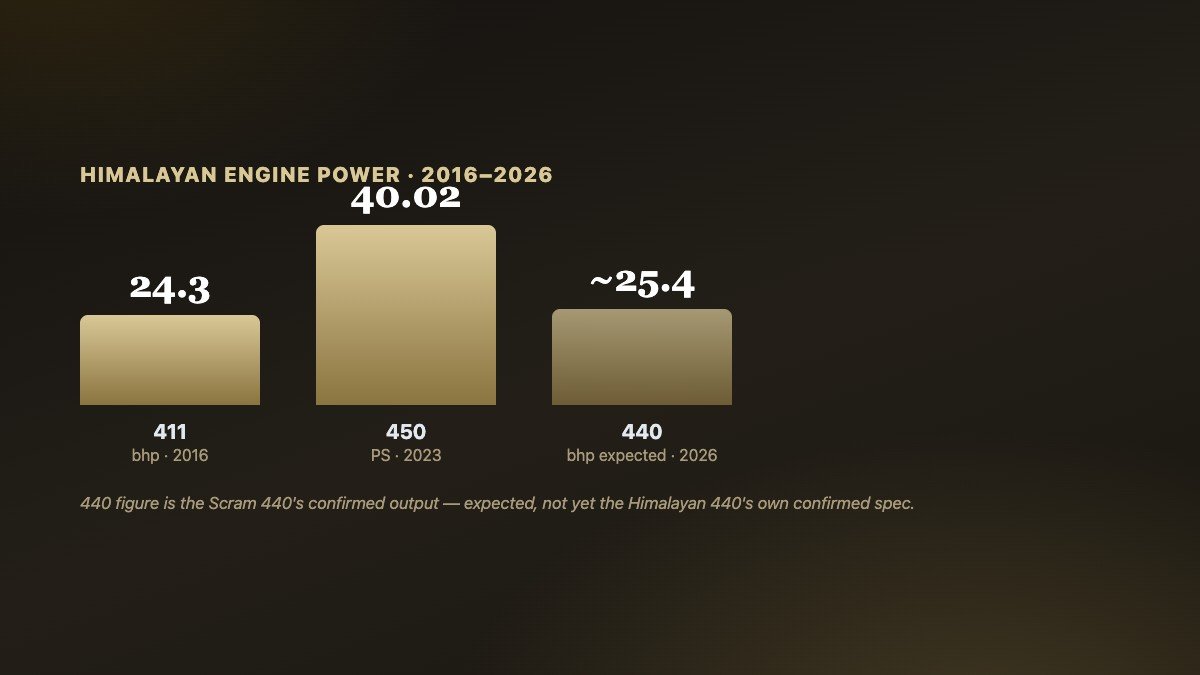
Himalayan 411 vs 450 vs 440
Every 440 field is labelled EXPECTED until Royal Enfield's own sheet is live
| Feature | Himalayan 411 | Himalayan 450 | Himalayan 440 |
|---|---|---|---|
| Era | 2016–2023 | 2023–present | Sept 4, 2026 |
| Status | Discontinued | Current | Officially teased — launch imminent |
| Engine | 411cc LS410 | 452cc Sherpa | 443cc LS440 (expected) |
| Cooling | Air-cooled | Liquid-cooled | Air-cooled (expected) |
| Max power | 24.3 bhp | 40.02 PS @ 8,000 rpm | 25.4 bhp (expected) |
| Torque | 32 Nm | 40 Nm @ 5,500 rpm | 34 Nm (expected) |
| Gearbox | 5-speed | 6-speed | 6-speed (expected) |
| Throttle | Cable | Ride-by-wire | To be confirmed |
| Display | Analog/digital | 4-inch TFT, Google Maps nav | Twin-pod seen; final spec awaited |
| Front fork | Telescopic | 43mm USD | To be confirmed |
| Front wheel | 21-inch | 21-inch | To be confirmed |
| Positioning | Original accessible ADV | Modern/global Himalayan | Simpler, lower-positioned (expected) |
Simple ≠ Old: What the Scram 440's Confirmed Spec Sheet Already Shows
Even the Scram 440 — the motorcycle the 440 is reported to share an engine with — is already far from 2016-era hardware. Its officially confirmed spec sheet lists a 443cc, SOHC, air-cooled, fuel-injected single producing 25.4 bhp at 6,250 rpm and 34 Nm at 4,000 rpm, through a 6-speed gearbox with a wet multi-plate clutch, at a kerb weight of 196 kg with a 15-litre tank. That's fuel injection, dual-channel ABS and LED lighting as standard — not a return to a carburettor-and-drum-brake Himalayan. If the 440 shares this architecture, "simpler than the 450" is accurate; "primitive" is not.
10 Years of Himalayan: The Full Timeline
Newest first
Himalayan 440 — Official Reveal/Launch
What's confirmed: Royal Enfield's own product page carries the tagline "And the mountains will answer," the date 04.09.2026, and the hashtag #TenYearsofHimalayan — a direct callback to the original Himalayan's 2016 launch.
What's not yet confirmed: price, final specifications, variants, colours and electronics package. Treat any number published before this date as a reported expectation, not a Royal Enfield figure.
Himalayan 440 Spotted at Dealership Stockyards
Significance: Motoroids and other outlets reported production-ready Himalayan 440 units arriving at dealer stockyards ahead of the September 4 reveal — strong evidence this is a genuine commercial launch, not just a teaser event.
What photos show: ADV bodywork, twin-pod instrumentation consistent with Tripper Navigation, wheel configuration and luggage mounting points. What they don't show: confirmed internal specifications — appearance alone doesn't prove electronics or engine tune.
Scram 440 Launched — The Engine Reference Point
Engine: 443cc single-cylinder, 4-stroke, SOHC, air-cooled, fuel-injected LS440, producing 25.4 bhp at 6,250 rpm and 34 Nm at 4,000 rpm through a 6-speed gearbox.
Why it matters: the Scram 440 is the closest confirmed reference for the Himalayan 440's likely engine — but Royal Enfield could retune it differently for the Himalayan's own character.
Himalayan 450 — The Big Reset
Engine: 452cc (451.65cc) Sherpa — single-cylinder, DOHC, 4-valve, liquid-cooled — producing 40.02 PS at 8,000 rpm and 40 Nm at 5,500 rpm, through a 6-speed gearbox.
Technology: ride-by-wire, switchable ride modes, a 4-inch TFT display with Google Maps-powered full-map navigation, USB-C charging and dual-channel switchable ABS. Chassis: 43mm USD front fork, 200mm travel front and rear, 21-inch front and 17-inch rear wheels, 17-litre tank.
Scram 411 — The Engineering Bridge
What it was: an ADV-crossover derived from Himalayan 411 architecture, with a smaller front wheel and road-biased setup aimed at urban riders who wanted Himalayan looks without full off-road capability.
Why it matters: Scram creates the lineage bridge between the original Himalayan 411 and today's Scram 440 / Himalayan 440 story — a separate line from the 411 → 450 upgrade path.
Tripper Navigation Added
Update: Royal Enfield's Tripper turn-by-turn navigation pod, paired via Bluetooth to a phone app, was added to the Himalayan 411's instrument cluster — part of the model's gradual modernization before the full 450 redesign.
BS6 Transition
Update: the Himalayan 411 was updated to meet India's BS6 emissions norms, effective April 2020, alongside the rest of Royal Enfield's range.
ABS Era
Update: anti-lock braking became standard across the Himalayan range as regulatory requirements tightened, following the earlier BS4/fuel-injection transition.
BS4 / Fuel-Injection Evolution
Update: the Himalayan's carbureted early units transitioned to fuel injection alongside India's move to BS4 emission norms, improving reliability and cold-start behaviour — addressing some of the early quality concerns reported by owners of the first 2016 batches.
Himalayan 411 — The Original Launch
Engine: LS410 — 411cc, single-cylinder, SOHC, long-stroke — with an early launch specification of approximately 24.5 bhp and 32 Nm; the later official Himalayan spec settled at 24.3 bhp. Some year-on-year variation is normal across model-year and emissions updates.
Hardware: 21-inch front and 17-inch rear wheels, long-travel suspension, a 15-litre tank, high ground clearance and a simple chassis — characteristics that defined the Himalayan formula more than peak horsepower ever did.
Price: approximately ₹1.56 lakh ex-showroom Maharashtra at launch.
The Price Story
Ex-showroom prices only — never mixed with on-road figures
The original Himalayan 411 launched at roughly ₹1.56 lakh ex-showroom Maharashtra in 2016. The Himalayan 450 launched in late 2023 at a meaningfully higher price point, reflecting its liquid-cooled engine, ride-by-wire and full electronics package. The Himalayan 440's price is not yet officially announced — any specific rupee figure circulating before September 4 should be read as a reported expectation, not a confirmed number.
The real business-story question is whether the 450's move upmarket created room below it. The 450's higher price and greater complexity created space for a lower-priced, simpler Himalayan — that is analysis this article can support with the product lineup, not a claim that Royal Enfield has said so directly, and not a claim that any specific group of buyers was "alienated" by the 450.
Should You Wait for the 440, or Buy the 450?
A use-case question, not a "which is better" question
✅ What the 450 already offers, confirmed today
- 40.02 PS, liquid cooling, ride-by-wire
- 4-inch TFT with Google Maps navigation
- 43mm USD fork, dual-channel switchable ABS
- A proven, current production model with real ownership history
❌ What the 440 cannot offer yet
- A confirmed price to compare against
- A confirmed power/torque figure specific to this model
- Any real-world ownership or reliability data
- Confirmed electronics, suspension or wheel specification
Until the 440 is ridden and tested, this article will not claim it is more reliable, more comfortable, or better on rough roads than the 450 — specs alone don't prove real-world performance. The honest post-launch question isn't "is the 440 better than the 450?" — it's "who needs the 440, and who still needs the 450?"
The Real Story Isn't 411 → 450 → 440
Ask an owner of the original Himalayan what made the motorcycle memorable, and the answer rarely begins with horsepower. For many riders, the appeal was that the bike felt understandable — a long-stroke single, a straightforward chassis, room for luggage, and enough suspension to stop worrying about where the tarmac ended. The Himalayan 450 is objectively far more sophisticated. But sophistication and simplicity solve different problems. The 440 may exist because Royal Enfield no longer needs one Himalayan to solve both.
On paper, the strange part is the number. Royal Enfield went from 411, to 452, and now back to 443 — that looks like a step backward. It isn't necessarily: the Sherpa 450 is a modern liquid-cooled high-output engine, while the LS440 is a long-stroke air-cooled platform. They're designed for different performance, cost and complexity targets, not ranked on a single displacement scale. The real story isn't a simple upgrade path — it's one Himalayan nameplate becoming two different kinds of adventure motorcycle.
Explore More Timelines
Engine Family at a Glance
LS410 (411cc)
Air-cooled, SOHC, long-stroke single. 24.3–24.5 bhp, 32 Nm. Powered the original Himalayan and Scram 411 for seven years.
Sherpa (452cc)
Liquid-cooled, DOHC, 4-valve single with ride-by-wire. 40.02 PS, 40 Nm. Powers the current Himalayan 450 — not related to the LS-series architecture.
LS440 (443cc)
Air-cooled, SOHC single, fuel-injected. 25.4 bhp, 34 Nm, 6-speed. Powers the Scram 440 — the closest reference point for the Himalayan 440's likely engine.
Himalayan 440's Engine
Reported to be LS440-derived. Royal Enfield could retain the Scram 440 tune or adjust mapping, gearing or exhaust — unconfirmed until Sept 4.
💡 Worth Knowing
- The Himalayan 440's twin-pod instrument cluster, seen at dealerships, is consistent with Tripper Navigation — but visible hardware doesn't confirm the software feature set.
- Royal Enfield's #TenYearsofHimalayan campaign directly ties the 440's launch to the original 2016 Himalayan's anniversary, not to the 450.
- The Himalayan name has now spawned four distinct model lines in ten years: 411, Scram 411, 450, and Scram 440 — before the 440 itself.
- No Royal Enfield executive statement has been quoted explaining the strategic reasoning behind a second Himalayan — the two-tier framing in this article is editorial analysis, not a company quote.
Frequently Asked Questions
⚠️ Editorial Note
This article separates Royal Enfield's own official statements (its Himalayan 440 and Himalayan 450 product pages and technical-specification PDFs) from pre-launch media reporting (Autocar India, Motoroids, Cartoq) and this publication's own editorial analysis. Historical facts about the 411 and 450 generations are drawn from Royal Enfield's published specifications. Nothing in this article should be read as purchase advice — specifications alone do not prove real-world reliability, comfort or off-road performance, and the Himalayan 440 has not yet been ridden or tested by anyone outside Royal Enfield.
Related Reading
Sources & further reading
Every dated entry above was checked against these references. Last reviewed 15 September 2026.