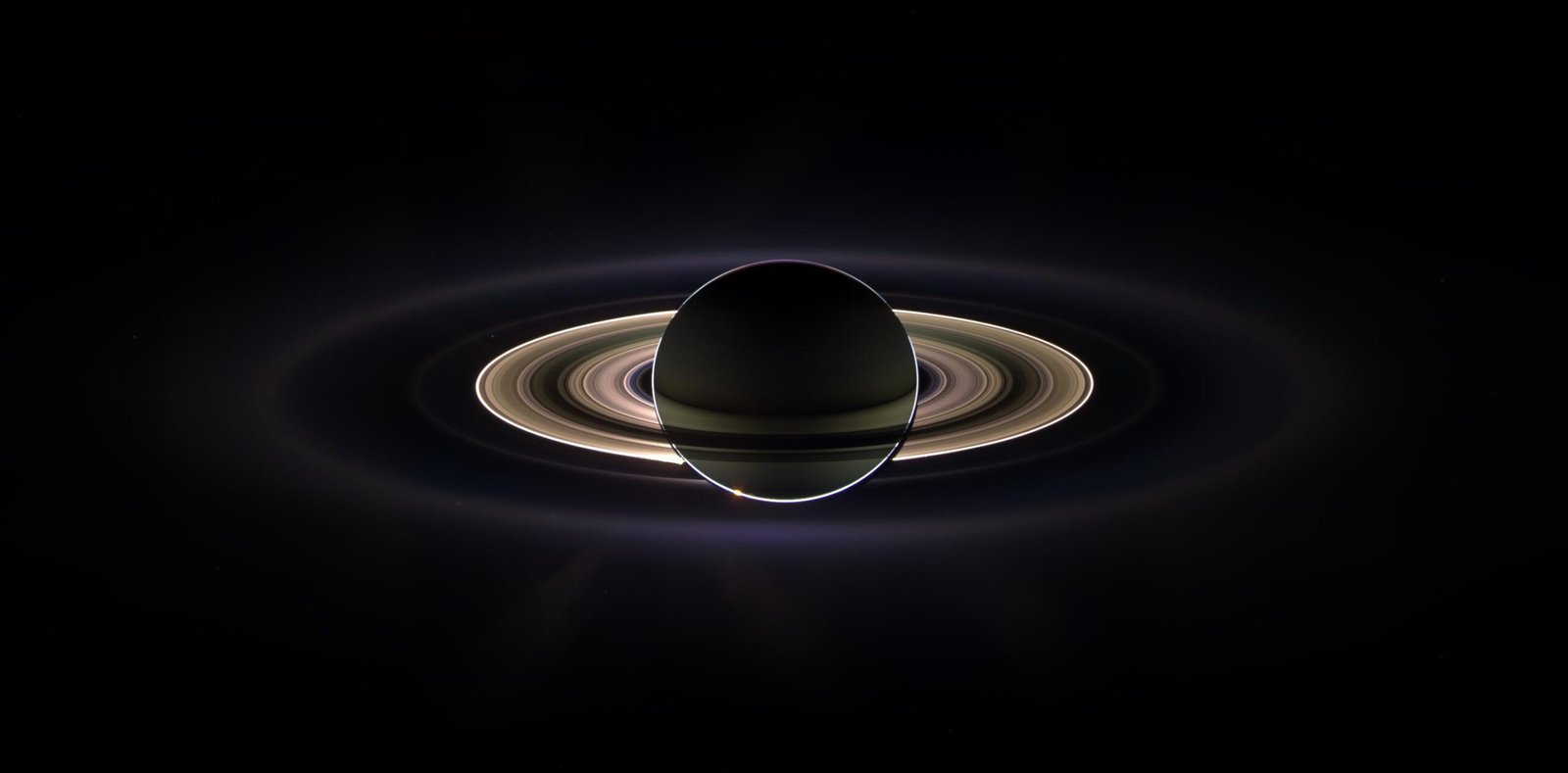
Saturn’s Polar Mystery Timeline 1981–2026: From the Giant Hexagon to a New Decagon
Saturn's north-polar hexagon now has a south-polar counterpart: a newly observed decagon. Explore Voyager, Cassini, Hubble and the 2026 discovery.
Latest Story
For more than 40 years, Saturn has kept a six-sided secret spinning above its north pole — a wave in its atmosphere so regular it looks engineered. Now Hubble Space Telescope observations, published on 2 September 2026, show Saturn’s south pole has a shape of its own: a ten-sided wave scientists are calling a decagon. Neither is a solid object. Both are atmospheric waves riding inside powerful jet streams in Saturn’s hydrogen-helium atmosphere. Together they turn a 45-year-old oddity into a pattern — and this timeline traces how scientists went from a blurry Voyager flyby to that discovery.
What did scientists find at Saturn’s south pole in 2026?
Scientists found a giant, ten-sided atmospheric wave — called a decagon — circling Saturn’s south pole, embedded in one of the planet’s jet streams near 63°S latitude. It is different from Saturn’s famous six-sided north-polar hexagon, but both appear to be linked to powerful jet streams rather than any solid structure. The finding, led by researcher Agustin Sanchez-Lavega and published in Science Advances, is a weather pattern in Saturn’s hydrogen-helium atmosphere — not a physical object, a storm wall, or a “second hexagon.”
| North pole | South pole | |
|---|---|---|
| Shape | Hexagon | Decagon |
| First seen | Voyager-era images, 1980–1981 | Clearly identified in 2026 research |
| Sides | Six | Ten |
| Behaviour | Long-lived and relatively stationary | Moving and evolving, still under study |
Source: NASA, ESA/Hubble, Science Advances (Sanchez-Lavega et al., 2026) — verified September 2026
Saturn’s Two Polar Puzzles
Infographic 2 — Hexagon vs Decagon: Saturn’s two polar patterns
| Feature | North-polar hexagon | South-polar decagon |
|---|---|---|
| Shape | Six-sided wave | Ten-sided wave |
| Location | Roughly 78°N | Centred near 63°S |
| First observed | Voyager-era images, 1980–1981 | Hubble observations traced back to October 2023 |
| Main observing missions | Voyager, Cassini, Hubble | Hubble (OPAL programme); Cassini saw no sign of it |
| Atmospheric setting | Polar jet stream | Polar jet stream |
| Behaviour | Long-lived and relatively stable | Vertices drift on a roughly 32-day cycle — appears to be evolving |
| What scientists know | Four decades of direct observation | Newly confirmed and still being characterised |
| Biggest open question | Why six sides persist for decades | Why ten sides formed, and whether it will last |
Source: NASA/Voyager, Cassini mission archive, Hubble/STScI, Science Advances — verified September 2026
Saturn’s Polar Mystery: Key Questions
What to hold onto
- Saturn now has two known polar atmospheric waves, not one. A six-sided hexagon near the north pole, tracked since the Voyager era, and a newly confirmed ten-sided decagon near the south pole.
- Neither shape is solid. Both are wave patterns in Saturn’s moving hydrogen-helium atmosphere, shaped by fast jet streams — not walls, storms with a fixed edge, or built structures.
- The hexagon’s shape was recognised in 1988, not immediately in 1980–81 — planetary scientist David Godfrey spotted it only after remapping the raw Voyager 1 and Voyager 2 images into a polar projection.
- The decagon is a genuinely new find, reported 2 September 2026 in the peer-reviewed journal Science Advances, led by Agustin Sanchez-Lavega of the University of the Basque Country.
- Cassini’s 13 years in orbit (2004–2017) found no trace of it. Researchers had been watching for a southern counterpart to the hexagon since roughly 1990 and came up empty until Hubble’s 2023–2025 images.
- The decagon is centred near 63°S and extends through multiple layers of Saturn’s atmosphere — it is not just a marking on the visible cloud tops.
- Unlike the stable hexagon, the decagon’s ten vertices drift, oscillating in longitude on a roughly 32-day cycle while moving eastward far slower than the jet stream around it.
- Whether the decagon existed before 2023 and simply wasn’t visible, or whether it is a genuinely new formation, is not established — Saturn’s south pole was in winter darkness for years after Cassini’s mission ended, and only came back into good sunlight around Saturn’s May 2025 equinox.
- Scientists have not solved why Saturn builds polygonal waves at its poles. Jet-stream and rotating-fluid instability are the leading ideas, not a settled answer.
Saturn’s Polar Mystery Timeline: 1981–2026
Infographic 1 — from a blurry Voyager flyby to a confirmed second polygon. Chronological, oldest first.
Voyager images the north pole — the hexagon is recognised later Observed
What happened: Voyager 1 and Voyager 2 each flew past Saturn, capturing images of the far northern latitudes as part of their broader flyby imaging. Because the spacecraft flew near-equatorial trajectories, their views of the pole were partial and taken from awkward angles — nobody saw a hexagon on first glance.
Scientists’ interpretation: It took planetary scientist David Godfrey until 1988 to remap and mosaic the combined Voyager image set into a polar projection, at which point the six-sided shape became visible and he published the finding in the journal Icarus. Treat “Voyager discovered the hexagon in 1981” as imprecise: Voyager captured the raw images in 1980–81; the hexagon itself was recognised seven years later.
Cassini enters orbit around Saturn Observed
What happened: Cassini became the first spacecraft to orbit Saturn, beginning a 13-year mission that would return more images and data on the planet’s poles than every prior flyby combined. Unlike Voyager’s brief pass, Cassini could return to the same region again and again as Saturn’s seasons changed.
Why it matters: Sustained orbital observation, not a single snapshot, is what eventually let scientists study how the hexagon behaved over years rather than seconds.
Cassini sees the hexagon in infrared, through the winter dark Observed
What happened: With the north pole still unlit by the Sun, Cassini’s infrared instrument detected the hexagon by its heat signature rather than reflected sunlight, confirming the six-sided pattern was still there and letting scientists study its structure without waiting years for northern spring.
Saturn’s seasons turn, and the hexagon changes colour Observed
What happened: As Saturn’s Sun-facing angle shifted across these years, sunlight finally reached the north pole in visible light, and the hexagon’s appearance shifted from a bluish-green haze around 2013 to a yellowish haze by the 2017 summer solstice.
Scientists’ interpretation: Researchers link the colour change to increased sunlight driving photochemical reactions in methane, producing hydrocarbon smog particles — a seasonal effect on haze, not a change in the hexagon’s underlying six-sided shape.
Cassini’s mission ends — and the south pole goes dark Observed
What happened: Cassini’s fuel was nearly spent, so mission controllers steered it into Saturn’s atmosphere to burn up, protecting Saturn’s potentially habitable moons from contamination. This ended 13 years of continuous, close-up observation.
What it left unresolved: Cassini answered detailed questions about the north-polar hexagon’s structure, depth and seasonal colour change, but by the time it ended, the south pole was heading into its own long winter darkness — and no sign of a southern polygon had been found.
Hubble keeps watching after Cassini Observed
What happened: With no spacecraft at Saturn, the Outer Planet Atmospheres Legacy (OPAL) programme’s yearly Hubble images became the main way scientists tracked Saturn’s atmosphere, including the slow return of sunlight to its southern latitudes as the planet’s decades-long year advanced.
Early, faint signs of a southern structure Observed Retrospective
What happened: Hubble images taken in red-filter light in October 2023 show, in hindsight, subtle hints of a ten-vertex polygonal shape near 63°S. Nobody identified it as a decagon at the time — this is a retrospective finding, spotted only once researchers went back through the archive after 2025.
Still unknown: Whether the decagon actually formed around this time, or had existed earlier and simply wasn’t visible or wasn’t looked for specifically, is not established by the study.
The decagon sharpens into a clear structure Observed
What happened: In 2024, ground-based amateur and professional observers noted an undulating band around Saturn’s south pole. By Hubble imaging on 29 August 2025, the pattern had become a clearly defined, regular ten-sided shape — timed to when Saturn’s south pole was finally receiving enough sunlight, after the planet’s May 2025 equinox, for detailed observation.
2026
The discovery is published Observed
What happened: A peer-reviewed study led by Agustin Sanchez-Lavega (University of the Basque Country), with NASA Goddard’s Amy Simon and UC Berkeley’s Michael Wong among the co-authors, formally confirmed the decagon: a wave whose vertices oscillate in longitude on a roughly 32-day cycle, drifting eastward at about 2.5 metres per second — far slower than the surrounding jet, clocked at about 116 metres per second near 60.5°S.
Scientists’ interpretation: NASA’s Amy Simon, the OPAL programme’s principal investigator, said the feature “appears to be strengthening,” calling it a rare chance to watch a giant atmospheric pattern develop in near real time — a contrast with the hexagon’s long-settled stability.
wards
What scientists will watch next Still unknown
What’s planned: Continued annual Hubble monitoring, additional ground-based imaging, and researchers have flagged NASA’s James Webb Space Telescope as a candidate for future study of the decagon’s deeper atmospheric structure. No specific JWST observation campaign had been confirmed as of this update.
Still unknown: Whether the decagon will persist for decades like the hexagon, keep strengthening, or fade, is genuinely open — this is the first time scientists have been able to watch one of Saturn’s polar polygons from close to its earliest visible stage.
What Is Saturn’s Hexagon?
Infographic 4 — a wave inside a jet stream, not a solid shape
Saturn’s hexagon is a giant six-sided atmospheric wave riding inside a powerful eastward jet stream near the planet’s north pole, roughly 78°N. It has been visible, in one observing method or another, for over four decades — making it one of the longest continuously tracked weather features anywhere in the solar system.
Embedded in a jet stream
The hexagon’s six straight sides trace the path of a fast-moving band of wind circling the pole, not a fixed wall of any kind.
Visible for decades
Tracked across Voyager, Cassini and Hubble observations spanning more than 40 years, with its basic six-sided geometry holding steady the whole time.
Not a rigid structure
It is made of moving atmospheric gas — hydrogen and helium, tinted by haze particles — not a wall, platform, or anything with a solid edge.
Colour shifts with season
Its apparent colour and visibility change with Saturn’s seasons and with the wavelength of light used to observe it — bluish-green in 2013, yellowish by the 2017 summer solstice.
Definition: Atmospheric wave
A repeating pattern in a planet’s moving atmosphere, shaped by winds, temperature differences, rotation and turbulence — the atmospheric equivalent of ripples that hold a stable shape on a fast-flowing river, rather than a fixed object sitting in the flow.
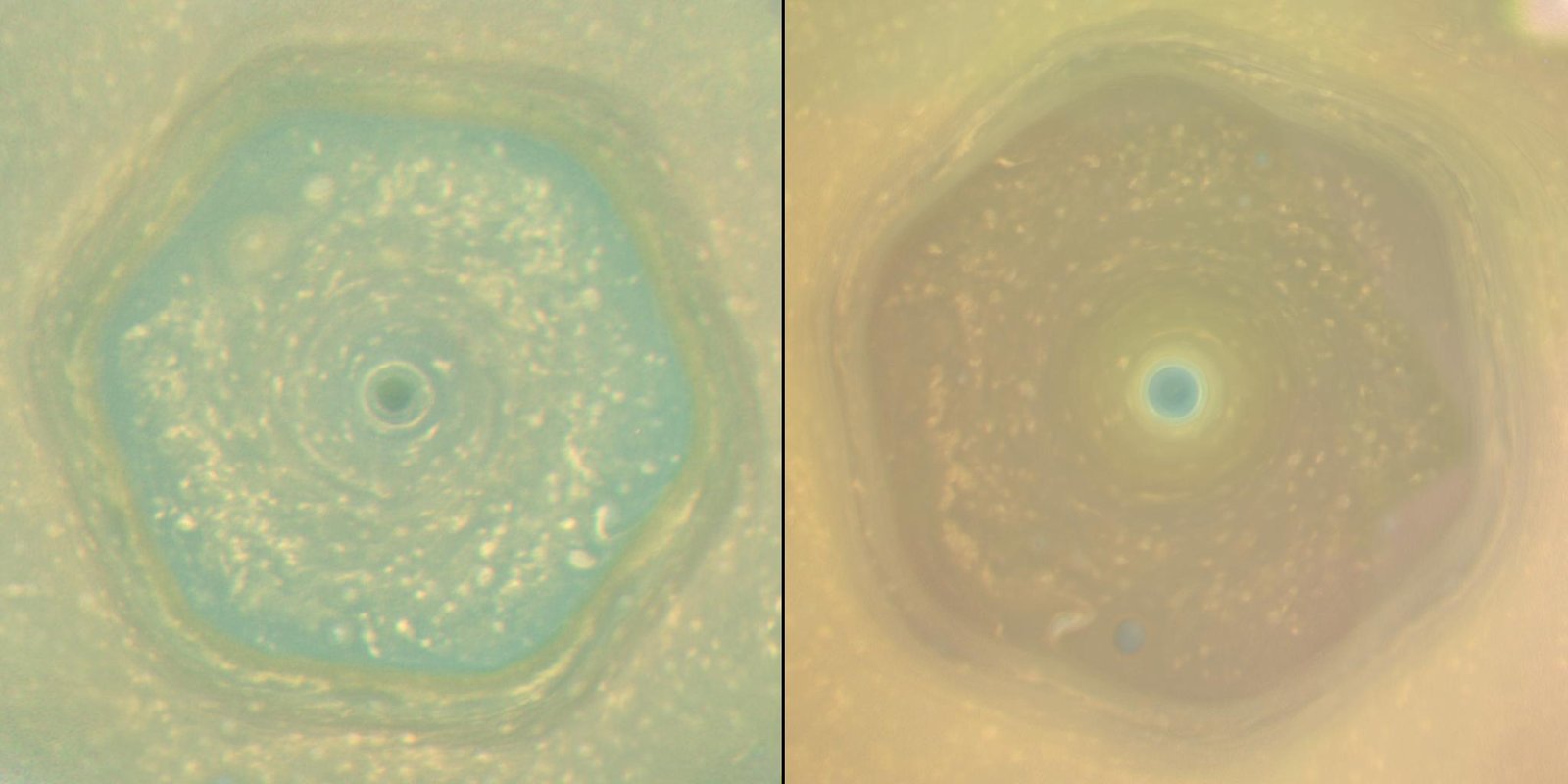
Saturn’s hexagon changing colour as Saturn’s seasons progressed toward northern summer. Credit: NASA/JPL-Caltech/Space Science Institute/Hampton University
What Is the New South-Polar Decagon?
Infographic 3 — what Hubble found at Saturn’s south pole
The decagon is a ten-sided atmospheric wave circling Saturn’s south pole, centred near 63°S latitude and embedded in one of Saturn’s jet streams. Hubble captured it across multiple wavelengths of light, and researchers say it appears to extend through several layers of the atmosphere rather than sitting only at the visible cloud tops — distinct from Saturn’s separate, roughly circular south-polar vortex that sits closer to the pole itself.
Unlike the hexagon, whose vertices stay close to fixed, the decagon’s ten corners visibly shift back and forth, and the whole pattern moves far more slowly than the jet stream carrying it — a sign that scientists are watching a still-forming or still-adjusting feature rather than one that has already settled into a decades-stable state. Researchers are still investigating exactly how long it has existed and whether it will persist the way the hexagon has.
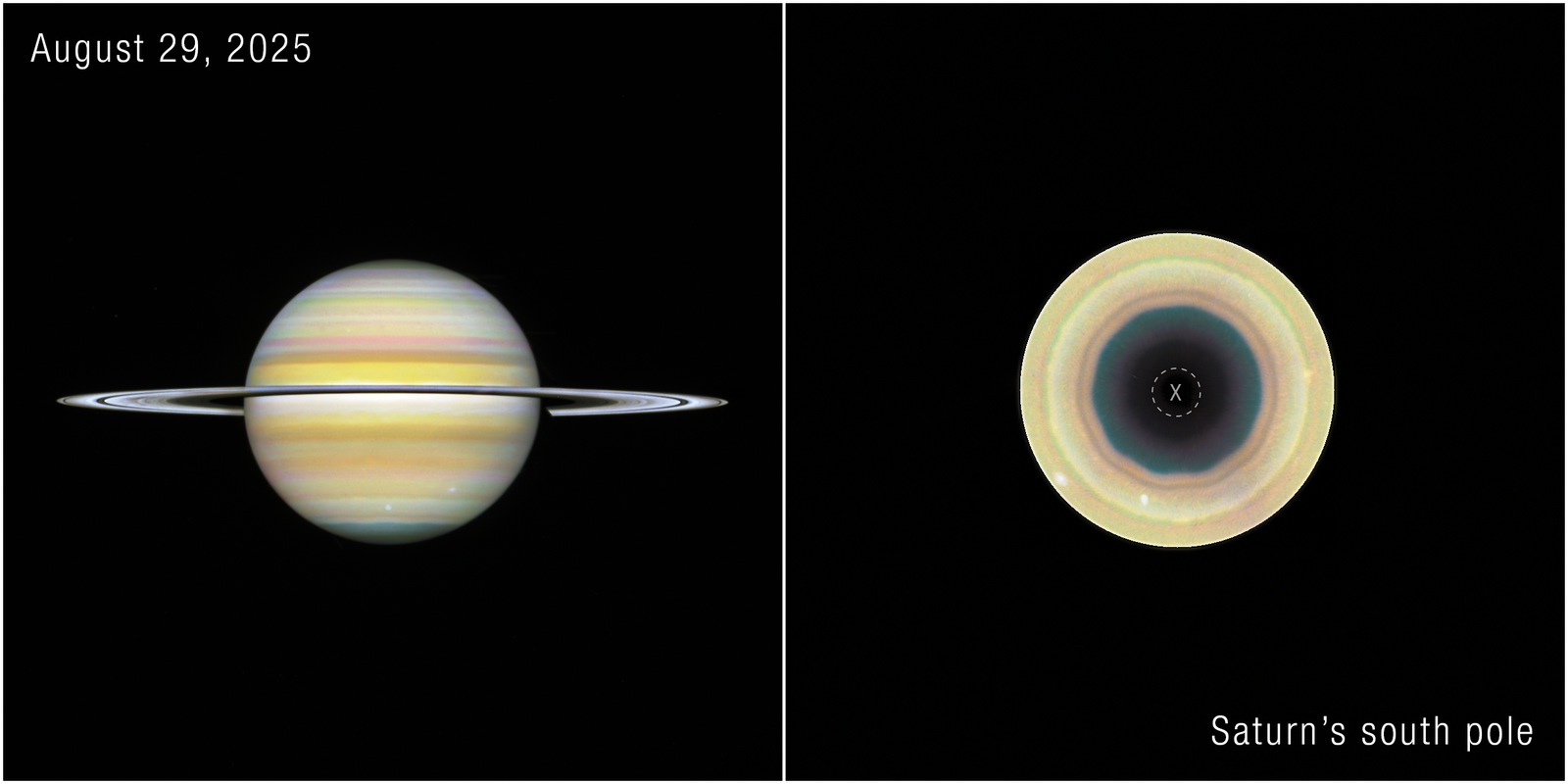
Saturn and its south pole, imaged by Hubble on 29 August 2025. Credit: NASA, ESA, STScI, A. Sanchez-Lavega (UPV), A. Simon (NASA-GSFC), M. Wong (UC Berkeley); image processing: A. Pagan
Why Can a Planet Make a Polygon?
Infographic 5 — known, possible and unknown
Scientists have leading ideas about how a planet’s atmosphere can organise itself into straight-sided shapes, without claiming the mechanism is fully solved.
| Known | Possible explanation | Still unknown |
|---|---|---|
| Both features sit in strong polar jet-stream regions | Jet-stream instability and wave behaviour organise the flow into a standing pattern | Why Saturn produces such stable polygons so clearly, when other planets don’t show the same thing as sharply |
| The hexagon has persisted for over four decades | Rotation and wind shear may lock the wave into a fixed number of sides over time | Why the south-polar feature settled on ten sides rather than six, or some other number |
| The decagon extends through multiple atmospheric layers | Saturn’s decades-long seasons may influence when such features become visible or active | Whether the decagon will last for decades like the hexagon, or fade |
| Laboratory rotating-fluid experiments can produce polygon-like wave patterns | Similar fluid dynamics may apply at planetary scale, adjusted for Saturn’s size and rotation | Whether lab-scale fluid dynamics fully explain a feature this large is not established |
Source: Science Advances (Sanchez-Lavega et al., 2026), NASA/Hubble — verified September 2026
None of this amounts to a solved mystery. Rotating-fluid experiments on Earth can produce polygon-like wave patterns in a spinning tank of liquid, which supports the idea that jet-stream instability is a plausible mechanism — but a tabletop demonstration is not the same as confirming exactly what is happening 1.4 billion kilometres away in an atmosphere of hydrogen and helium.
Saturn’s Seasons and Polar Storms
Infographic 6 — how Saturn’s long seasons change the view
Saturn is a gas giant made mostly of hydrogen and helium, roughly 9.5 times farther from the Sun than Earth. Because its orbit takes about 29.4 Earth years to complete, each of its seasons lasts more than seven years — long enough that a single human research career might only see one full seasonal cycle.
| Date | Saturn season event | Effect on polar visibility |
|---|---|---|
| 11 Aug 2009 | Northern spring equinox | Sunlight reached the north pole in visible light for the first time in the Cassini era, letting scientists finally see the hexagon directly rather than only in infrared |
| 24 May 2017 | Northern summer solstice | North pole at peak sunlight (hexagon haze turned yellowish); south pole entering its own long winter darkness |
| 15 Sep 2017 | Cassini mission ends | No more close-up spacecraft observation of either pole from this point on |
| 6 May 2025 | Equinox (rings edge-on to the Sun) | South pole begins returning to sunlight after years of darkness — widely credited as a key reason the decagon only became clearly observable around this time |
Source: NASA, ESA — verified September 2026
Saturn’s poles also host vortices — roughly circular, storm-like rotating features — separate from the hexagon and decagon waves that circle around them. A polar vortex and a polygonal jet-stream wave are related atmospheric features, both shaped by Saturn’s rotation and winds, but they are not the same thing, and this article uses “vortex,” “storm” or “jet stream” only where the evidence supports each specific term.
Why the 2026 Discovery Matters
What one new polygon changes about how scientists think of Saturn
- Tests theories of planetary weather. A second, differently-shaped polygon at the opposite pole is a natural experiment scientists didn’t have to design themselves.
- Enables a direct north-south comparison. Researchers can now compare two polar jet environments on the same planet, rather than relying on the hexagon alone.
- Sharpens models of atmospheric waves on giant planets. A confirmed second example helps test whether existing jet-stream and rotating-fluid models actually predict what forms, or just explain the hexagon after the fact.
- Invites comparison with Jupiter. Jupiter’s poles host clusters of cyclones arranged in their own geometric patterns, and a second Saturn polygon gives researchers another data point for comparing how giant-planet atmospheres organise themselves.
- Underlines the value of monitoring after a mission ends. The decagon was found using Hubble, years after Cassini stopped flying — a reminder that steady, unglamorous, long-term telescope monitoring can still produce a genuine discovery.
This discovery does not rewrite everything scientists thought they knew about Saturn, and it does not, by itself, prove a universal rule that giant planets always grow polygonal waves at their poles. It is one confirmed new data point on one planet — a meaningful one, because it turns the hexagon from a possible one-off oddity into part of a pattern worth explaining.
What Happens Next?
Infographic 7 — Voyager → Cassini → Hubble: how we learned more, and what’s left to watch
| Question | What astronomers need to observe |
|---|---|
| Will the decagon persist? | Repeated Hubble/OPAL observations across coming Saturn seasons, not just one or two more years |
| Is it growing or fading? | Multi-year imagery and wavelength comparisons to track whether it keeps “strengthening,” as researchers describe it now |
| How deep is the structure? | Measurements across atmospheric layers, potentially including future James Webb Space Telescope infrared observations |
| Why ten sides? | Atmospheric modelling combined with real wind-speed and vertex-drift data from the new study |
| Is there a link to the south-polar vortex? | Comparative observations of both the decagon wave and Saturn’s separate south-polar vortex over time |
Source: NASA/Hubble OPAL programme, Science Advances — verified September 2026
Voyager
Captured the raw images that, once remapped in 1988, revealed the north-polar hexagon for the first time.
Cassini
Thirteen years in orbit turned the hexagon from a curiosity into a well-measured feature — and searched, unsuccessfully, for a southern counterpart.
Hubble (OPAL)
Patient annual monitoring, without a spacecraft at Saturn, is what finally caught the decagon forming near the south pole.
Explore More Timelines
People Also Ask
Frequently Asked Questions
⚠️ Editorial Note — Methodology
This article separates confirmed observations from scientific interpretation throughout, using explicit labels: Observed, Measured, Scientists’ interpretation, Possible explanation and Still unknown. Every date, latitude, speed and instrument name was checked against NASA, ESA, Hubble/STScI and the peer-reviewed Science Advances study as of this update. Where a figure was not published (for example, a direct size comparison between the hexagon and decagon), this article says so rather than estimating one.
Sources & further reading: NASA – Hubble tracks the south-polar decagon · Science Advances – the decagon study · NASA – Saturn’s north-polar hexagon · ESA – Cassini concludes its mission at Saturn · NASA – Saturn facts · STScI – decagon press release · Background: Saturn’s hexagon
Sources & further reading
Every dated entry above was checked against these references. Last reviewed 15 September 2026.
- NASA — Hubble Tracks New Decagon Encircling Saturn's South Pole
- Science Advances — A decagon wave around Saturn's south pole (Sanchez-Lavega et al., 2026)
- NASA — Saturn's North-Polar Hexagon in Motion
- ESA — Cassini Concludes Its Pioneering Mission at Saturn
- STScI — NASA's Hubble Tracks New Decagon Encircling Saturn's South Pole (Press Release)
- NASA — Saturn Facts
- Wikipedia — Saturn's Hexagon (background reference)