Uphaar Cinema Fire: 59 Deaths, a 29-Year Fight for Justice
Explore the 1997 Uphaar Cinema fire, which killed 59 people, and the decades-long legal battle over negligence, compensation and evidence tampering.
Latest Story
On the afternoon of 13 June 1997, a full house at Uphaar Cinema in South Delhi was watching Border when a transformer in the parking area below caught fire for the second time that day. Smoke rose into the balcony, the lights failed, and the doors that could have let people out were bolted or locked. Fifty-nine people died. The Uphaar Cinema fire case that followed has run for more than 29 years: a criminal trial of the owners, Sushil and Gopal Ansal, a landmark compensation ruling, a Rs 60 crore penalty for a trauma centre that families say never materialised, and a separate prosecution for tampering with the court’s own records that is still not over.
💡 Short Answer
The Uphaar fire on 13 June 1997 killed 59 people at a Delhi cinema after a transformer fire filled the balcony with smoke and the exits were locked or blocked. Owners Sushil and Gopal Ansal were convicted of causing death by negligence in 2007; after years of appeals, the Supreme Court let them pay Rs 60 crore in 2015 and sent Gopal back to jail in 2017. A separate tampering conviction from 2021 is still on appeal in the Delhi High Court.
Uphaar Fire Case: Key Questions
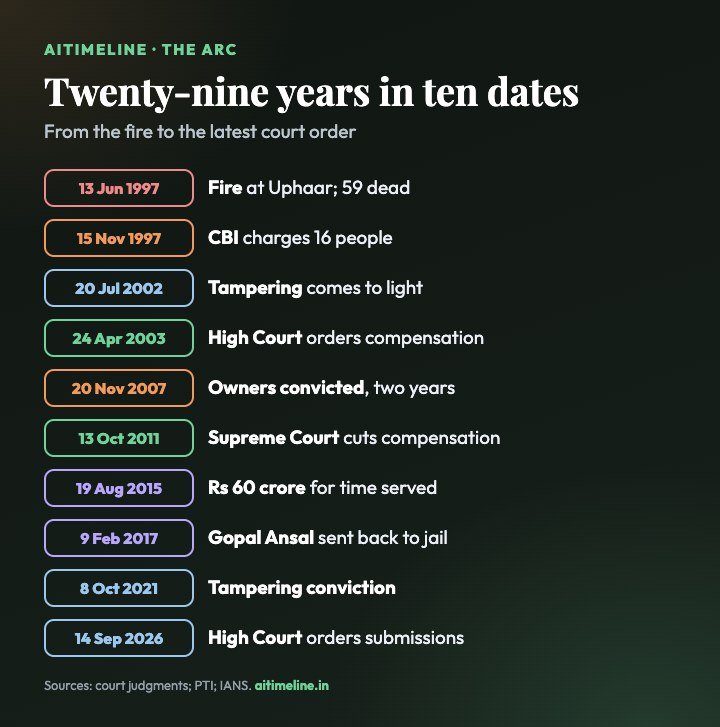
The Case in Ten Points
- Two fires: the same transformer burned at 6:55 am and again at about 4:55 pm on 13 June 1997.
- The toll: 59 dead in the balcony and stairwell, 103 injured.
- Locked exits: the central balcony door was bolted and the staircase door to the foyer locked.
- The charge: 16 people chargesheeted by the CBI in November 1997; 12 convicted in 2007.
- The sentence: two years at trial, one year in the High Court, then a split Supreme Court bench in 2014.
- The penalty: Rs 30 crore each in 2015, meant for trauma care in Delhi.
- The review: Gopal Ansal back in Tihar in March 2017; Sushil spared because of age.
- Compensation: a 2003 High Court award, cut by the Supreme Court in 2011.
- Tampering: seven years in 2021, cut to time served in 2022, still on appeal in 2026.
- The families: AVUT, led by Neelam Krishnamoorthy, has been in court for 29 years.
Timeline: From a Transformer Fire to the Delhi High Court
Newest first. Colour shows which part of the litigation each event belongs to.
Where the case stands: one case closed, one still open Evidence-tampering case
The fire case: Closed. The Ansal brothers’ convictions for causing death by negligence are final, the Rs 60 crore penalty was paid in 2015, and the Supreme Court dismissed the victims’ curative petitions in February 2020.
The tampering case: Open. The Ansals’ appeals against their convictions, and pleas by the Delhi Police and the victims’ association for harsher sentences, are before the Delhi High Court. The trauma-centre dispute is before the Supreme Court.
High Court orders written submissions, no more adjournments Evidence-tampering case
The order: The court told Sushil and Gopal Ansal and the other convicts to file written submissions within a week and to begin their arguments at the next hearing, set for 15 October 2026, with no adjournment.
The other side: The prosecution says the sessions court reduced the sentences on “perverse reasoning”. The victims’ association says tampering with court records strikes at the whole criminal justice system.
A new judge, a new date Evidence-tampering case
The listing: After the recusal, the appeals of Sushil Ansal, Gopal Ansal and others, and the victims’ association’s appeal, were listed before Justice Ajay Digpaul for 29 January 2026.
A judge steps aside Evidence-tampering case
The objection: Neelam Krishnamoorthy, for the victims’ association, said she feared she would not get a fair hearing because the judge had once appeared as a lawyer for Ansal Housing and Construction Ltd.
The decision: The judge called the objection “meritless” but sent the case to another bench “to allay any fear that the complainant may have”. The Ansals’ lawyers objected, as arguments had begun on 29 October.
Supreme Court asks victims to inspect the trauma centres Compensation and trauma centre
The dispute: The Delhi government told the court in August 2025 that the Rs 60 crore paid by the Ansals had been used at three government hospitals. The victims’ association said the trauma centre the 2015 order envisaged was still a “nonstarter”.
The direction: The bench asked the association to inspect the facilities and report whether they were functional and had proper emergency services and ambulances. It said it was not reviewing the 2015 judgment.
The Uphaar building is de-sealed Main case: appeals
The order: The Principal District and Sessions Judge ordered the cinema released to Ansal Theatres and Clubhotels, saying no purpose would be served by keeping it sealed now the trial had reached finality.
The consent: The order noted that the CBI, the Delhi Police and the victims’ association had already consented before the Supreme Court.
Supreme Court opens the way to de-sealing Main case: appeals
The order: The court allowed the company that owned the cinema to apply to the trial court to have the building de-sealed.
Sessions court frees the Ansals on time served Evidence-tampering case
The verdict: On 18 July the court dismissed the appeals and upheld the convictions of the Ansals, former court staffer Dinesh Chand Sharma and Ansal employee P.P. Batra, but acquitted Anoop Singh.
The sentence: On 19 July it cut their prison terms to the time served since 8 November 2021, about eight months, and kept the fines of Rs 2.25 crore on each Ansal and Rs 3 lakh each on the other two.
Seven years for tampering with evidence Evidence-tampering case
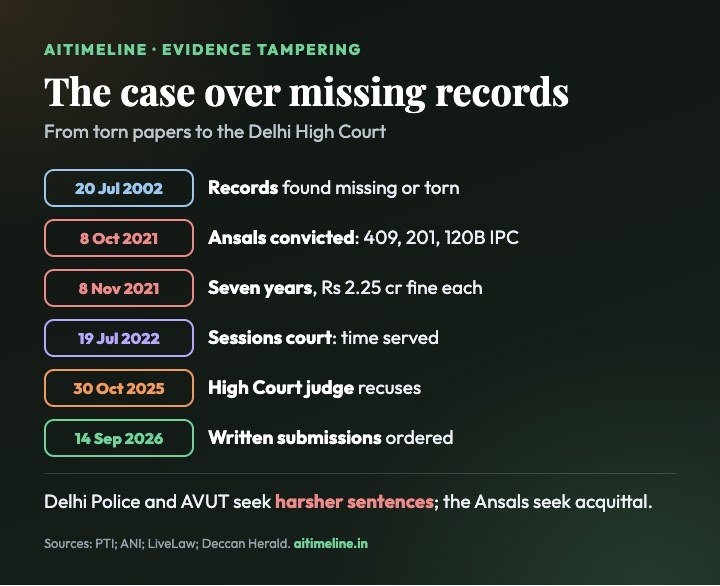
The sentence: The Ansal brothers were sentenced to seven years in prison and fined Rs 2.25 crore each for tampering with evidence in the fire case.
The magistrate: He said the case had been “very hard” to decide and that he had reached his conclusion after thinking “night after night”.
Ansals convicted of tampering with court records Evidence-tampering case
The accused: The Ansals, court staffer Dinesh Chand Sharma, Ansal employee P.P. Batra and Anoop Singh were found guilty of criminal breach of trust, destroying evidence and conspiracy.
The documents: The chargesheet said the tampered records included a police memo of recoveries made just after the fire, Delhi Fire Service records of the transformer repair, minutes of managing director’s meetings and four cheques.
Victims’ last appeal in the fire case is rejected Main case: appeals
The order: Hearing it in chambers, the court dismissed the victims’ association’s curative petition: “no case is made out”. The Ansals would serve no further prison time in the fire case.
The response: Neelam Krishnamoorthy said she was “shattered” by the verdict.
Gopal Ansal surrenders at Tihar Main case: appeals
The surrender: Gopal Ansal surrendered hours after the Supreme Court refused him more time. His counsel, Ram Jethmalani, had said a mercy petition was pending with the President.
The term: He had already spent a little over four months in jail and was to serve the rest of his one-year sentence.
Review: jail for Gopal, not for Sushil Main case: appeals
The decision: By majority, the court ordered Gopal Ansal, 69, to serve the remainder of his one-year sentence. Sushil Ansal, 77, was spared further prison because of his age and ailments.
The penalty: The Rs 30 crore each already paid stood. The court rejected Gopal’s claim to parity with his brother.
Rs 60 crore instead of more prison Compensation and trauma centre
The order: The court sentenced Sushil and Gopal Ansal to two years’ rigorous imprisonment, but reduced it to the time already served if they paid Rs 30 crore each within three months.
The money: It was to go to the Delhi government’s chief secretary to set up a new trauma centre or upgrade existing ones in government hospitals.
Two judges agree on guilt, not on sentence Main case: appeals
The agreement: Both judges upheld the convictions of the Ansal brothers.
The split: Justice Thakur kept the High Court’s one-year term. Justice Misra would have restored two years, replacing the second year with a Rs 100 crore fine split between the brothers. The sentence question went to a three-judge bench.
Supreme Court cuts the compensation Compensation and trauma centre
Liability: The court held the cinema licensee and the Delhi Vidyut Board liable, 85% and 15%. It cleared the Municipal Corporation of Delhi and the licensing authority.
The amounts: Compensation was cut from Rs 18 lakh to Rs 10 lakh for victims over 20, and from Rs 15 lakh to Rs 7.5 lakh for younger victims. Punitive damages on the licensee fell from Rs 2.5 crore to Rs 25 lakh.
Victims and CBI seek a longer sentence Main case: appeals
The appeals: The Supreme Court issued notice on the victims’ association’s petition. The CBI also appealed, seeking a heavier sentence.
High Court halves the sentence Main case: appeals
The verdict: The court upheld the Ansal brothers’ convictions but reduced their sentence from two years to one.
Bail cancelled, Ansals sent to Tihar Main case: appeals
The order: The Supreme Court cancelled the bail the High Court had granted, and the Ansal brothers were taken to Tihar Jail.
High Court grants bail Main case: appeals
The order: The High Court granted bail to the Ansal brothers and two other convicts pending their appeals.
Twelve convicted, two years for the Ansals Main case: investigation and trial
The verdict: The court convicted all 12 accused still on trial, including Sushil and Gopal Ansal, cinema managers, Delhi Vidyut Board staff and officials.
The sentence: The Ansals got two years’ imprisonment, the maximum for causing death by negligence under Section 304A of the Indian Penal Code.
The judge visits the cinema Main case: investigation and trial
The inspection: The trial judge inspected the sealed Uphaar building to see the scene for herself.
High Court orders compensation Compensation and trauma centre
The award: The court awarded Rs 18 lakh for each victim over 20 and Rs 15 lakh for younger victims, Rs 1 lakh to each of the 103 injured, with 9% interest, about Rs 18 crore in all.
Who pays: The cinema owners were to bear 55%, and the Delhi Vidyut Board, the Municipal Corporation of Delhi and the licensing authority 15% each. The owners were also ordered to pay Rs 2.5 crore in punitive damages.
The theatre stays sealed Main case: investigation and trial
The order: The court rejected the Ansals’ plea to take back the theatre, holding that the scene had to be preserved so the evidence could be appreciated.
Evidence tampering comes to light Evidence-tampering case
The discovery: Documents in the trial court record were found missing or torn. A court staffer, Dinesh Chand Sharma, was suspended.
What followed: The discovery led to a separate criminal case against the Ansals, the court staffer and others.
Charges framed Main case: investigation and trial
The charges: The court framed charges under sections including 304 (culpable homicide not amounting to murder), 304A (causing death by negligence) and 337 (causing hurt) of the Indian Penal Code.
Trial begins Main case: investigation and trial
The trial: The sessions court began the trial of the accused named in the CBI chargesheet.
CBI charges 16 people Main case: investigation and trial
The chargesheet: The CBI filed a chargesheet against 16 accused, including the cinema owners Sushil and Gopal Ansal.
CBI takes over Main case: investigation and trial
The transfer: The investigation moved from the Delhi Police to the CBI.
Sushil Ansal arrested in Mumbai Main case: investigation and trial
The arrest: The Crime Branch arrested cinema owner Sushil Ansal and his son Pranav in Mumbai. They were brought to Delhi the next day.
Inquiry ordered Main case: investigation and trial
The inquiry: The Lieutenant Governor ordered an inquiry and appointed Naresh Kumar, Deputy Commissioner (South), to conduct it.
The findings: His report, dated 3 July 1997, listed violations including a transformer installed against the electricity rules, without the oil soak pit that would have contained leaking oil.
59 dead, 103 injured The fire, 1997
The deaths: Fifty-nine people died in the balcony and stairwell, of asphyxiation from the smoke. Another 103 were injured trying to get out.
Among them: Neelam and Shekhar Krishnamoorthy lost both their children, Unnati and Ujjwal, who had gone to see Border.
Trapped in the dark The fire, 1997
The smoke: Smoke was blown towards the balcony staircase, rose by a chimney effect and was drawn into the auditorium through the air-conditioning ducts. The electricity failed and the exit signs could not be seen.
The exits: The central balcony door to the foyer was closed and bolted from outside. The only other exit led to a smoke-filled staircase whose door to the foyer was also locked.
Fire during the matinee of Border The fire, 1997
The fire: Shortly after the interval, the same Delhi Vidyut Board transformer caught fire. Its oil leaked into the parking area and set parked cars alight.
The fuel: Transformer oil, petrol and diesel, car upholstery and foam stored in the parking area produced thick smoke with carbon monoxide and other poisonous gases.
A first fire at dawn The fire, 1997
The fire: The larger of two transformers the electricity board ran in the ground-floor parking area caught fire. It was under control by about 7:25 am.
The repair: Board staff repaired the transformer and recharged it later that morning.
Two Criminal Cases, Not One
The 2017 sentence closed the fire case. The tampering case is separate and still open.
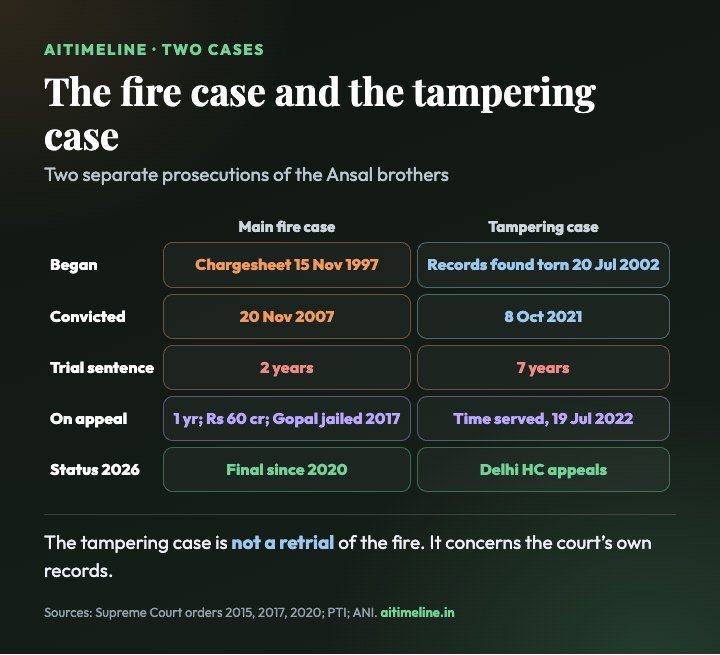
| Main fire case | Evidence-tampering case | |
|---|---|---|
| About | Negligence that caused 59 deaths and 103 injuries | Missing and torn records from the fire trial |
| Offences | Section 304A IPC and related offences | Sections 409, 201 and 120B IPC |
| Trial verdict | 20 Nov 2007: two years | 8 Oct 2021 conviction; 8 Nov 2021: seven years |
| Appeal outcome | One year (HC 2008); Rs 60 crore (SC 2015); Gopal back to jail (SC 2017) | Time served, fines kept (sessions court, 19 Jul 2022) |
| Status, Nov 2026 | Final; curative dismissed 20 Feb 2020 | Appeals and enhancement pleas before Delhi HC |
What Turned a Transformer Fire Into a Disaster
As described in the Supreme Court’s 2011 judgment.
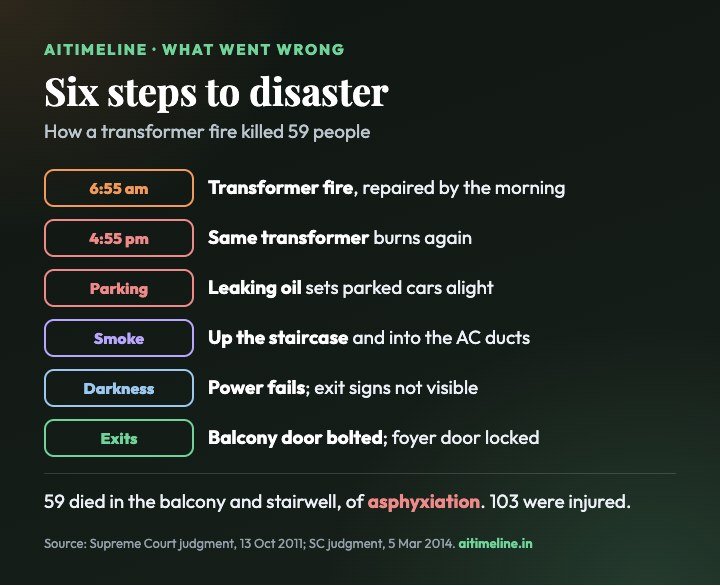
The Supreme Court’s account is precise. Oil from the burning transformer leaked into the passage where cars were parked, two of them right at the transformer room’s entrance. The burning oil, petrol, diesel, upholstery and foam stored in the parking area produced carbon monoxide and other poisonous gases. With the parking area walled in and air blowing in from the entry and exit, the smoke had nowhere to go but up the staircase to the balcony, and into the air-conditioning ducts that fed the auditorium. When the electricity went off, the exit signs went dark. The central gangway door, the easy way out, was bolted from outside because it was used only for entry. People groped towards the one exit at the top left corner, into a staircase full of smoke whose door to the foyer was locked. The Naresh Kumar inquiry found the transformer had been installed against the electricity rules, without the oil soak pit that would have contained the leak.
How the Ansals’ Sentence Changed
Five courts, four different outcomes.
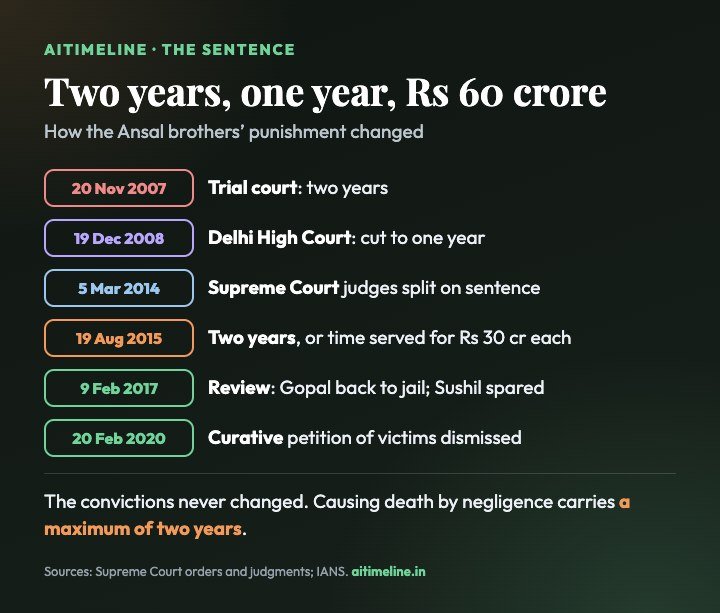
| Date | Court | Sentence for the Ansals |
|---|---|---|
| 20 Nov 2007 | Trial court | Two years’ imprisonment |
| 19 Dec 2008 | Delhi High Court | Reduced to one year |
| 5 Mar 2014 | Supreme Court, two judges | Split: one year, or two years with Rs 100 crore fine |
| 19 Aug 2015 | Supreme Court, three judges | Two years, reduced to time served on paying Rs 30 crore each |
| 9 Feb 2017 | Supreme Court, review | Gopal to complete one year; Sushil spared |
| 20 Feb 2020 | Supreme Court, curative | Victims’ petition dismissed |
The ceiling was set by the offence. The Ansals were charged in 2001 with culpable homicide not amounting to murder, but convicted of causing death by negligence under Section 304A, which carries a maximum of two years. When the Supreme Court explained its 2015 order, it said the punishment was limited by law. That is why the argument shifted to money: whether a large fine for a public cause could stand in for the remaining prison time. The victims’ association never accepted that it could, and in 2017 the court partly agreed, at least for the younger brother.
Compensation: the 2003 and 2011 Rulings
The civil case that became a reference point for public-law compensation.
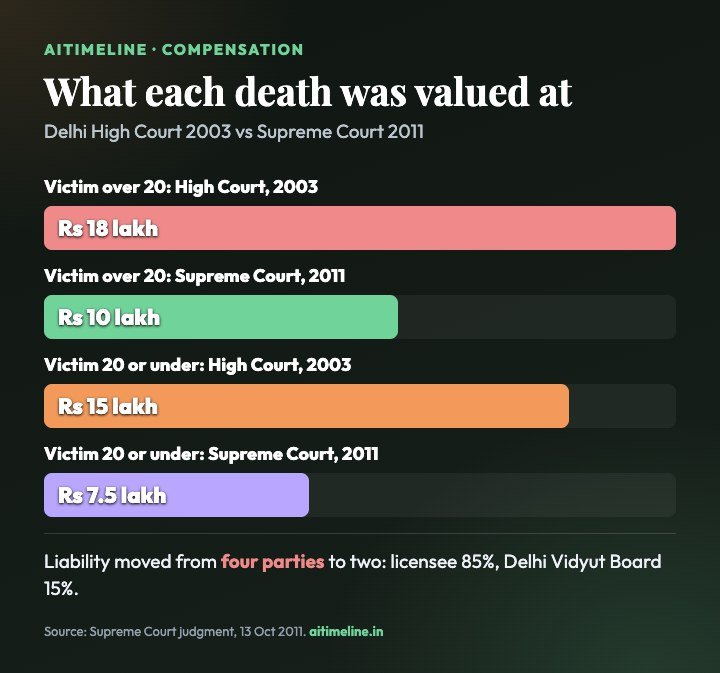
| Delhi High Court, 24 Apr 2003 | Supreme Court, 13 Oct 2011 | |
|---|---|---|
| Death, victim over 20 | Rs 18 lakh | Rs 10 lakh |
| Death, victim 20 or under | Rs 15 lakh | Rs 7.5 lakh |
| Each injured person | Rs 1 lakh | Rs 1 lakh (not disturbed) |
| Punitive damages on licensee | Rs 2.5 crore | Rs 25 lakh |
| Who pays | Licensee 55%; DVB, MCD, licensing authority 15% each | Licensee 85%; DVB 15% |
The High Court treated the case as a public-law remedy: when the state and a licensee fail to protect people’s right to life, the court can order compensation directly rather than send each family through years of civil suits. The Supreme Court accepted that, but found the High Court’s uniform assumption of a Rs 15,000 monthly income for every balcony ticket-holder too high, and held that the MCD and the licensing authority, whatever their lapses, had not directly caused the deaths. It also let any family wanting more than the reduced sum apply to the Delhi High Court within three months.
The Evidence-Tampering Case
From missing papers in 2002 to the Delhi High Court in 2026.
Often claimed
- The Supreme Court ordered the cinema sealed in 2004.
- The sessions court upheld and cut the sentence on the same day.
- The tampering case is a retrial of the fire.
- The Ansals were convicted of culpable homicide.
What the record shows
- The trial court refused to release it in January 2003; we found no 2004 order.
- Conviction upheld 18 July 2022; sentence cut 19 July.
- It concerns missing and torn records from the fire trial.
- Charged with it; convicted of causing death by negligence.
The tampering case turns on what disappeared from the fire trial’s record: according to the chargesheet, a police memo listing recoveries made just after the fire, Delhi Fire Service records of the transformer repair, minutes of managing director’s meetings, and four cheques. A court staffer, Dinesh Chand Sharma, was suspended when the damage was found in 2002, and was convicted with the Ansals and Ansal employee P.P. Batra in 2021. The magistrate gave seven years, saying the offence struck at the justice system. The sessions court kept the convictions but freed the men on time served. The Delhi Police and AVUT want the seven years back; the Ansals want the convictions set aside. Both sets of appeals are before the Delhi High Court.
Uphaar and India’s Fire-Safety Framework
The rules existed before 1997. Enforcing them was the problem.
Cinematograph Act
The legal basis for licensing film exhibition; operators must meet the licence conditions set under it.
Delhi Cinematograph Rules
Cover licensing, seating, gangways, exits and inspections of cinemas in Delhi.
Delhi Fire Prevention and Fire Safety Act
Sets fire-prevention and safety duties for specified buildings and premises in Delhi.
Indian Electricity Rules
The Naresh Kumar inquiry found the Uphaar transformer installed against them, without an oil soak pit.
None of these laws was created by the Uphaar fire, and it would be wrong to suggest otherwise. What the courts examined was why they failed on the day: extra seats added over the years, a transformer that did not meet the electricity rules, exits that were bolted, and licences that kept being renewed regardless. In 2011 the Supreme Court held that some of those lapses by public bodies did not make them liable to pay compensation, a finding the victims’ families still contest.
The Legacy of Uphaar
Exits must open
- No bolted doors in a show.
- Lit signs on battery power.
- Smoke kept out of stairs.
Owners and regulators
- Licensees answer for safety.
- Public bodies can pay too.
- A licence is not compliance.
Fines and follow-through
- Can money replace prison?
- Who checks the trauma centre?
- Records must be protected.
Uphaar is remembered for its victims and for the families who would not let the case go. Neelam and Shekhar Krishnamoorthy, who lost Unnati and Ujjwal, built the Association of Victims of Uphaar Tragedy into a litigant that has appeared in every court, through every round. Its legacy in law is threefold: a compensation ruling still cited when public venues fail, a long argument over whether wealthy defendants can pay instead of serving time, and a conviction for tampering with the very records meant to deliver justice. Its legacy in practice is the question the families still ask: whether the Rs 60 crore built anything that would save the next person caught in a fire.
Explore More Timelines
People Also Ask
Frequently Asked Questions
Dated facts from the court judgments and contemporary reports, 1997 to 2026.
⚠️ Editorial Note
This account draws on the Supreme Court’s judgments of 13 October 2011 (compensation) and 5 March 2014, its order of 19 August 2015, and reporting by PTI, IANS, ANI, LiveLaw, Scroll, Bar and Bench and Deccan Herald on the 1997-2026 proceedings. Checking the brief this page began from against those records: we found no 2004 Supreme Court order sealing the cinema (the trial court refused to release it on 27 January 2003); the sessions court upheld the tampering convictions on 18 July 2022 and cut the sentences on 19 July; the Supreme Court’s 2015 order imposed two years reducible to time served on payment, not a fine alone; and the 2011 ruling cleared the MCD and the licensing authority of liability. We did not repeat the brief’s figures of 23 children and 28 families, which we could not confirm in the court records we used. Status reflects published reports to 7 November 2026, not the court docket.
Related Reading on AiTimeline
Sources & further reading
Every dated entry above was checked against these references. Last reviewed 7 November 2026.
- M.C.D. vs Association of Victims of Uphaar Tragedy (compensation judgment, 13 October 2011)
- Sushil Ansal vs State through CBI (judgment, 5 March 2014)
- Sushil Ansal vs State through CBI (sentence order, 19 August 2015)
- Uphaar tragedy: Two decades of journey to justice
- Uphaar case: Gopal Ansal surrenders in Tihar jail
- Uphaar fire: No further jail term for Ansal brothers as SC dismisses victims' curative pleas
- Uphaar cinema fire: Ansal brothers sentenced to seven years in jail for tampering with evidence
- Court upholds conviction in 1997 Uphaar cinema fire evidence tampering case
- Delhi court orders de-sealing of Uphaar cinema hall premises
- Supreme Court asks Uphaar victims' association to inspect trauma centres
- Uphaar Fire: Delhi High Court judge recuses from hearing evidence tampering case
- Uphaar fire: Delhi HC asks Ansals, others to file submissions in evidence tampering case